
Chapter Three
The afternoon after we got back from Magee Marsh, I moved faster than I’d moved in thirty years. Linda pointed out the window and said, “There’s a magnolia warbler on the evergreen.” I saw a flash of black, white, and yellow, and then I was off like a flash, grabbing our thirty-nine-dollar binoculars from the broom closet and clomping out the basement door. The bird was long gone by the time my feet hit the grass.
It had been almost a year since I braved the iron fingers of shoulder-high weeds and fought my way through our woods to the Grand River. But thinking that the lesson of Magee Marsh had been “where’s there’s one bird, there’s one thousand,” I sloshed through the beginnings of our vernal pond and pushed up the hill through knotted brambles that were still only shin-high, green, and tender. A few small silhouettes in trees along the river faded west as I gained the clearing from the east. I chased after them, trying at first to hold the binoculars to my eyes as I trotted along the riverbank. Then I sprinted, stopped, and looked—sprinted, stumbled, and stopped.
A few minutes later as I trudged up the basement steps, Linda called, “Did you find any morels?”
“I didn’t go out to find morels.”
“Well, I want to look. If they were near water at Magee Marsh, they should be near water here. It’s a similar climate, more or less. And your bird is probably still here.”
I turned around and followed her back outside. She moved much too leisurely through the woods for my liking, using a stick to shove aside a fallen leaf or twig. I wanted to cover a lot of ground, not scrutinize the ground cover. But I considered her to be a warbler magnet and stayed close.
“What’s that bird?” she asked.
I saw nothing. Then I noticed a loud song, quite close. “It’s that song sparrow again. Remember, from your cabin?” She shook her head. “It just changed songs,” I said. “A minute ago it was singing a song that ended in ‘white turkey.’ Now it’s got a new song without the ‘white turkey’ ending.” I kept listening and started hearing other birds. I hadn’t noticed them when I went out earlier, having pushed them into the background along with the noise of passing traffic, but once I started tuning in, they seemed impossible to ignore. Something squeaked like an athletic shoe on a basketball court. Then a woodpecker drummed across the river.
As Linda soldiered on fruitlessly searching for fungal fruiting bodies, I stayed rooted to the spot and counted three more new songs from the sparrow. Each song repeated several times before the bird went back to calling me a white turkey. I also heard the rubber-on-gym-floor squeak again—the same squeak I’d heard in our yard just before a rose-breasted grosbeak whirligigged over to the feeder. I scanned the bushes and found the song sparrow, which responded to the glare of my ruby red lenses by diving for cover. Lifting my chin, I located the grosbeak tucked away in a mulberry tree. I followed my ears to find other birds flitting in the leaves, but even through binoculars they were too far off for me to misidentify.
As we ambled back toward the house, I thought, how great and mighty is my presence that my awareness fills the woods with birds.
“I think I’ll look across the street, if you’ll come with me, “ Linda said.
Too bad my mighty presence didn’t work with mushrooms.
Although I appreciated the repertoire of the song sparrow, I had underestimated the bird’s virtuosity. According to F. Schuyler Mathews, who made multistave musical transcriptions of bird vocalizations in his 1904 book, Field Book of Wild Birds and Their Music, “The Song Sparrow has the ability to render a motive in both the major and minor keys, just exactly as Verdi has done in the ninth and eleventh bars of ‘Di Provenza.’” I didn’t know Verdi from vermicelli, but I nodded when Mathews added, “The Song Sparrow is also one of the very few birds who is able to sing half a dozen songs, each of which is constructively different from the other.”
I didn’t need musical training to single out the song sparrow from our other backyard birds. The dead giveaways were the general form of its song (“Madge-Madge-Madge, put-on-the-tea-kettle-ettle-ettle,” as the National Audubon Society Field Guide to Birds and other sources put it), its pattern of repetition and change, and the bell-like yet buzzy tone of its voice. Having mastered this identification, I decided to expand my expertise beyond one species. I started stalking our yard birds. Whenever I heard a song I didn’t know, which was almost all of the time, I tried to get a look at the singer.
I had no problem finding a robin or rose-breasted grosbeak erupting in full-throated song, but I couldn’t tell the robin and grosbeak songs apart. The nuthatch with its nasal enk-enk was easy. The tufted titmouse drove me crazy. Though it only had two notes in its arsenal, it combined them in seemingly infinite variations, so I took solace in the predictable two-toned whistle of the chickadee. The cardinal with its sliding notes and hearty chirps I knew from my youth. But our Lowell cardinals had regional accents, as did cardinals in other places. It would be years before I ran into one on the other side of the state that sounded like a member of the old Dorroll Street gang.
One mystery singer resisted allowing me to glimpse his person. This tireless Caruso taunted me from various trees throughout the day, zipping unseen from the oak beside the barn to the front hackberry, and then to deep down in the swamp before launching an aria from the barn oak yet again. He sang a jingly, feverish phrase of staccato note pairs that could only be termed melodic by the generous of heart. So intent was he upon celebrating his existence that I figured he’d be oblivious to me. I couldn’t get near him, though. When I approached him in the front yard, he suddenly sang from the next tree down the line. After I’d taken another dozen steps, he popped up across the street.
The following day I managed to get the briefest look at him—a small dark bird that didn’t match up with anything in my field guide. “Was he way in the top of a tree?” Linda asked. “It’s probably an indigo bunting. Unless the sun hits them right, they look almost black instead of blue.” I looked up the indigo bunting in Field Book of Wild Birds and Their Music. Mathews’s transliteration of “sip, swee, swee, chir, chir, wis wis wis sir sir sir” more or less described what I’d been hearing, though the bird didn’t call me “sir.”
“I want to see him,” said Linda. “I love indigo buntings.”
“You’ll hear him, but you won’t see him.”
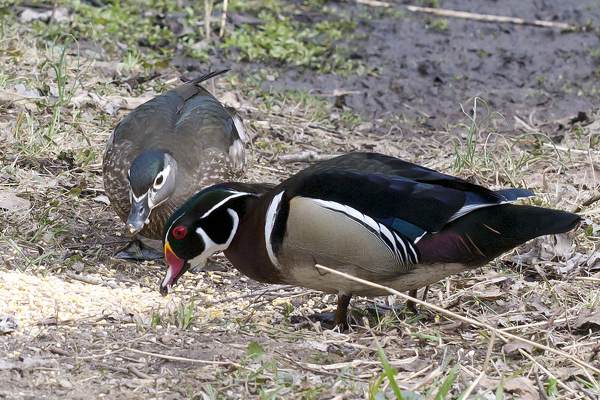
Linda lured the stunning wood ducks closer to the house by setting out heaps of scratch feed on our hill.
When I led her to the oak beside the barn, the bird was perched in plain sight on the top branch, blazing a brilliant lazuli blue.
Unlike the indigo bunting, which looks like the Twitter logo, the wood duck isn’t easy to describe.
The females are the alarm-givers. The first time I ever heard one was shortly after we moved in. I was crashing through the underbrush gawking at the river when a reasonable imitation of a whistling teakettle trying to come to a boil greeted me as the duck fled for its life. Ooh-eek! Ooh-eek! Every spring, these skittish birds peppered our seasonal pond. All it took was my silhouette in the dining room window over a hundred feet away to send the flock flapping toward the river.
Hiding in the shadow of the refrigerator we would watch them through binoculars and gasp in disbelief. The pretty females wore brown and beige earth tones. But the males were stunning, awing us with their hand-painted intensity. Topping a chestnut-colored neck and throat, the iridescent green head with bold white pinstripes ended in a backward sweeping crest—a jaunty cap for a sleek Beau Brummel. The crisply patterned body flaunted metallic green, blue, and purple overtones, with a creamy white patch on the side that gave my overstimulated optic nerves a place to rest. I could imagine storybook emperors trading their gold and jewels for such a bird.
The old-school field guide authors dug deep into their poetic souls when describing the wood duck. “Woodland ponds and forest-bordered streams make a proper setting for the grace and beauty of these richly attired birds,” wrote Frank M. Chapman in Birds of Eastern North American way back in 1895. “I know of no sight in the bird world which so fully satisfies the eye.”
In Michigan Bird Life, from 1912, Walter Barrows says, “This is doubtlessly the most beautiful of American ducks, and the male in full plumage is probably without a superior in any part of the world.”
Pioneering ornithologist Elliott Coues—who helped establish the modern taxonomic classification system in zoology—wrote the two-volume, 1,152-page Key to North American Birds in 1875. Dauntingly awash in scientific terms and Latin phrases, it’s not a book for the dabbler. To call it dry denigrates run-of-the-mill dryness. But Coues can’t resist calling the wood duck “exquisite” and lamenting the fact that “the pernicious spring shooting of the bird on its breeding grounds has made it rare in many places where it was once common.”
Linda turned our own wood ducks into less elusive birds by luring them closer to the house shortly after we started keeping domesticated ducks as pets. Envious of the bounteous food that we gave our plump pet khaki Campbells, a pair of wild mallards flew in to beg. Linda dumped scratch feed on the hill for them. Within a week, the wood ducks joined them, marching up the slope like wind-up penguins for an al fresco meal of grains. No matter how many separate heaps Linda made, the males quarreled over the feed, charging one another with lowered heads and then returning to discover that another male had stolen their spot.
I told my friend Bill Holm about them a few days after my successful identification of the song sparrow, and he said, “I’ll be over Friday for dinner and a duck show.” He didn’t particularly like birds, but he liked them more than he liked people—and he loved watching the Canadian Broadcasting Corporation’s Inuit-language programming on our “big dish” satellite TV. I’d met Bill twenty years earlier at Cadence weekly newspaper in East Grand Rapids, where he may or may not have been my boss. He’d been too detached from everything for me to figure out what he did. Bill had been a witness to my strange transformation since marrying Linda from pet disdainer to fussy caretaker for scores of demanding animals. Early in my duck-keeping days, he had helped me build an extension to our backyard pen, astonishing me with the fact that there was indeed someone in the world more inept with hammer, nails, and a bent handsaw than me.
We didn’t have dinner guests often. I accommodated Bill by putting our birds back in their cages so that they didn’t land on his head while he ate. He still wasn’t satisfied. “You might want to wipe the pigeon poop off my chair before I sit down,” he said.
As Linda set a plate of veggie stir fry in front of him, she said, “I wish I had some morels to go with this, but our woods didn’t have any. We’ll have to take a trip up north.”
“Didn’t you listen to the news?” I asked. “They’re saying there weren’t any morels up north this year and don’t bother looking.”
“They did not. You just don’t want to go.” This was true. I always felt humiliated watching virile men, tiny children, and stooped-over grannies alike struggling with huge sacks of mushrooms, while all we ever managed to bring home was a record number of mosquito bites.
While shoveling stir fry into my mouth, I stared out the window waiting for the wood ducks to show up. It hadn’t rained in over a week. Our once-mighty pond was but a murky shadow of its former self, and we had been getting fewer ducks each day.
“Your only friends in the world have abandoned you,” Bill said.
“I’m seeing a few ripples.”
“Fourteen, you said.”
“Not every night. I said that we get as many as fourteen.”
“None is less than fourteen, so I guess you were right.”
I was scraping leftovers into a dish for our barn birds when a pair of wood ducks finally flew in through the trees and toddled up the hill. As the female pecked at the scratch feed, the male gallantly stood guard. We passed around the binoculars and oohed at them. When it was his turn, Bill announced, “There’s something else in the water. What the heck’s going on with his head? It’s like a lady’s fan.” He lowered his voice two octaves. “Or a blacksmith’s bellows.”
It didn’t take Linda long to find the black, white, and chestnut-colored male hooded merganser in our Audubon field guide. After his own fashion, he was as sensational as the wood duck. What he lacked in brilliant hues he made up for in high style with a huge disc of a crest that he erected and collapsed as his mood dictated. Instead of fleeing at the sight of us like a wood duck, he calmly steered behind a log and disappeared.
Before Bill had a chance to lose himself in an incomprehensible Inuit-language TV talk show from Iqaluit in the Canadian Arctic, I bragged about identifying yard birds by their songs. “I guess it makes sense that I’m good with my ears, since I write a music column.” For ten years, I’d somehow managed to cobble together a CD review column for a reggae and world music magazine called The Beat. To hide my vast ignorance, I avoided covering styles like Celtic or Cuban that my readers might know about and instead stuck to obscure genres like Tuvan throat singing whenever I could. I got paid what I was worth—I did my column for free. To earn a living, I wrote sales copy for a mail order company that sold hi-fi gear, which theoretically added to my sonic expertise.
“You hear that?” I said, lowering the TV volume. “That’s an indigo bunting.”
“Show me,” Bill said, setting down the remote after he had just grabbed it from me.
As we stepped outside into bright but waning sunlight, the slam of the front door silenced the bird. I picked up the song again across the yard and led Bill down the hill behind the barn to a large hackberry tree flanked by jewelweed. “This isn’t an ideal spot,” I said. “They like to perch way up high, and it’ll be tough to see him.”
“He sounds low to me.”
“He might be, but I’m not finding him.”
I passed the binoculars to Bill, but he didn’t need them. “There.” He pointed to a bird singing from a stunted bush. “If that’s an indigo bunting, he’s cleverly disguised as a goldfinch.” Bill couldn’t have sounded more delighted. “Maybe it’s going to rain, and he’s wearing a yellow slicker.”
I shook my head. “There must have been two different birds.”
“Maybe you can devote a column in that reggae magazine to your bird identification talent. You can call it ‘Cool Runnings and Yellow Buntings.’”
“I know an indigo bunting is what I heard.” And I also knew that I hadn’t heard the last about my mistake from Bill.
To boost my auditory skills, Linda bought me the cassette tape A Field Guide to Bird Songs by the Cornell Laboratory of Ornithology and Roger Tory Peterson, the father of the modern field guide. In 1934, Peterson revolutionized birding with his Guide to Birds by inventing a system of identifying birds by the field marks that most readily separated species. So if the blue grosbeak and indigo bunting looked nearly identical in his illustrations, lines pointing to grosbeak’s grossly large beak and the bars on its wings distinguished it from the bunting, which lacked these traits. He also broke new ground by urging his readers to study birds through binoculars instead of shooting them for carcasses to examine, as birders of his day liked to do. (When a pair of unspeakably rare and presumed extinct ivory-billed woodpeckers was discovered in Florida in the 1920s, museum reps rushed to the scene to shoot them for their collections.)
I didn’t listen to cassettes at home, but I had a tape player in my car. And I’d have time to use it, since Linda had scheduled a morel-hunting trip at Newaygo State Park, about an hour north of us. Although I’d lost some of my resistance to tromping through the woods, I preferred to do so within sight of our back door. So I devoted the first ten minutes of our drive to complaining that we’d never find a single mushroom, that campers would have already scoured every inch of the park, and that Bill had phoned to ask if I’d ever heard a calypso called “Yellow Bird.” Then, at Linda’s urging, I popped in the Peterson cassette and leaned back to absorb a flock of brand-new songs.
Instead the vocalizations rolled off me like water off a loon’s back as Tape One opened with “Loons, Grebes, Swans, and Geese,” which didn’t do much for my backyard birding skills. “Marsh Ducks” came next, followed by “Diving Ducks, Coots, and Gallinules.” As we got into “Terns” I cranked down the volume and asked Linda, “Are you getting anything out of this?”
“We’re not going to learn all of these in one trip,” she said. This was a significant understatement.
Flipping the tape over, I grappled with hawk vocalizations, hooted at a selection of owl calls, and hit the eject button. “Let’s concentrate on birds we might hear today.”
“What would those be?”
I had no idea, and the fact that Linda didn’t know either surprised me, since I still considered her to be something of a bird expert. “Well, we won’t be all that far from your cabin, and since you had song sparrows in your yard, lets listen to some other sparrows.”
We sat through the white-throated sparrow, white-crowned sparrow, chipping sparrow, field sparrow, swamp sparrow, American tree sparrow, lark sparrow, clay-colored sparrow, grasshopper sparrow, Bachman’s sparrow, fox sparrow, song sparrow, vesper sparrow, Lincoln’s sparrow, and savannah sparrow before Linda said, “Stop, I’m getting a headache.” I felt overwhelmed as well. Out of all the sparrows that we’d heard, the only ones that I remembered after I’d switched off the tape were the song sparrow and the white-throated sparrow, which I already knew.
“The announcer has a nice voice,” I said. “I’d probably recognize him if I heard him again.”
My worst fears and best hopes came true when we climbed out of the car at Newaygo State Park. The bad news was that the place was overrun with morel hunters, which doomed us to another forlorn search. The good news was that the abundance of mushroomers meant that we could probably give up and go home early.
It was easy to tell the collectors from the weekend campers. When they weren’t straining the canvas of their collapsible chairs, the campers wandered aimlessly around their RVs, hands in pockets and faces relaxed into a state of amiable boredom. Their eyes darted about in search of anyone new to talk to. But the collectors avoided contact with anyone outside their raiding party. They wore the hard, focused expressions of competitive athletes as they examined one small patch of ground after another with thoroughness that would shame a bloodhound.
Linda asked a heavy-set woman with a cloth bag looped around her belt, “Are you finding any morels?”
She stiffened at the impertinence, then realized she was dealing with greenhorns. “Not a thing,” she claimed. “They’re late this year.”
“Sweetheart, I found one,” Linda called a few minutes later. Like a deer switching to high alert at the snap of a twig, mushroom hunters across the park’s 257 acres all froze and twitched their ears. “Never mind,” she said. “It’s a false morel.” As we climbed up and over the ridge, an elderly man glided over and plucked it.
Although the big, brown, brain-shaped false morel Gyromitra esculenta is classified as poisonous, Linda had a friend in Morley who had eaten them for years. They’re considered to be delicacies in parts of Europe. Reactions to eating them range from a satisfied burp to death, with a full spectrum of ill effects in between, depending on one’s sensitivity to the toxin gyromitrin. Symptoms of mild poisoning include lethargy, disorientation, dizziness, anxiety, and headaches—or just another typical day for me.
False morels and morel collectors dogged us in the wooded parts of the park. Knowing that true morels were fickle fungi that could pop up almost anywhere, we retreated to the park entrance to hunt for them in a field at the edge of the trees. As I took a swig from Linda’s water bottle, the conk-la-ree of a red-winged blackbird reminded me that I’d been ignoring bird songs. I couldn’t push them into the background now. All around us macho males of various species clamored for attention as they claimed territory and asserted their identities. Those identities eluded me.
“What do you think these are?” I asked Linda as I scanned the branches.
“Some of them could be the sparrows from the tape.”
I could pick out our old familiar song sparrow easily enough, but he was just one player in a complex orchestra. The rest of the performers were complete unknowns. We got close looks through binoculars at a dark bird that resembled the eastern phoebe back home who helpfully announced his name by calling fee-bee. But this bird said fitz-bew. A mystery vocalist serenaded us with a strenuous bout of wick-wick-wick-ing. Another bird imitated a squeaky pump handle. Others peeped, chirped, or crafted rambling melodies.
Linda could appreciate the sounds and sights without worrying about who was doing what. Not me. I had gone from having only a casual interest in birds to suddenly needing to pin a name on them, and I didn’t have a clue how to do it. Even when I was able to observe the singer, it usually registered in my brain as a complicated assemblage of gray-brown-and-beige parts that looked identical to every other assemblage of gray-brown-and-beige parts in our field guide. Who could keep track of the stripes, spots, speckles, wing-bars, caps, crowns, eye-rings, patches, and streaks that earned a bird its membership in one particular species instead of the species next door? It made me glum, and being glum made me even glummer with so much life bursting out around us. I tried consoling myself knowing that I was out in nature attempting to learn about birds, which was a giant leap forward for a fresh-air-ophobe like me. But it wasn’t consolation enough.
“Let’s go,” I said. “I’ve had enough futility for one day.”
“I want to find at least one morel,” she said.
I had never found one. I didn’t have the eye. But I threw myself into the hunt, because it was a relief to focus on the ground and see nothing but plants and grasses whose names I didn’t expect myself to know. I couldn’t even name the colors—so many shades of green with an occasional splash of white or yellow that nestled softly in my ignorance. Hoping for a mushroom miracle as I searched, I tried thinking like a fungus, which wasn’t all that much of a stretch. I prayed to the spore-bearing gods that I might blunder into the morel mother lode and then call Linda over supposedly to admire some particular weed so that she could make the discovery. But I needed to keep my head down and concentrate.
A sudden commotion made me look up. A pair of red-headed woodpeckers thrashed the air fifteen feet above us, scolding us in unison before rocketing off. Most bird sightings this brief barely registered with me. But time froze as the pair hung overhead, crisscrossing, flicking one another with black-and-white wings and giving us holy heck. I didn’t have a chance to even touch my binoculars much less raise them to my nose, but my impression of the birds was gigantic. No eagles or pterodactyls could have made a stronger impact. I had never seen one of these birds before, but I knew them immediately from having admired them in my field guide. As we traipsed toward the edge of the forest, they swooped over us again, flapping furiously to hold their positions. They harangued us with rattling churr-churr invectives expressing unprintable woodpecker expletives. Losing altitude, they swirled and veered away, only to come back once more. We changed course and moved our search to the opposite end of the field.
“We must have gotten too close to their nest,” Linda said.
“Or too close to their secret morel spot.”
I kept looking back for another glimpse and even considered invading their territory again in hopes of a fourth flyover. But I didn’t have it in me to bother a bird. I didn’t want to get my head hammered, either. Still, I was tempted to go back. Their red heads and snow-white bodies were right out of the book. But their blazing-eyed ferocity couldn’t be found on any page. I hadn’t simply seen two birds. I’d gotten a peek at a totally different world of grace and struggle that had little regard for us. We were pampered apes adrift in leisure time, searching the woods for food for fun, and we didn’t have a particle of sense or seriousness compared to them. We were also lucky to have made it out of there without perforated skulls.
Learning songs seemed like the key to identifying the gray-brown-and-beige birds that had apparently taken over the world. At home I made another stab at improving myself via the Field Guide to Bird Songs cassettes. To avoid inundating my leaky bucket of a brain with far more information than it could contain, I decided to limit myself to learning a manageably small group of birds. Vireos seemed like an excellent place to start. I had read somewhere that the red-eyed vireo was dubbed “the preacher bird” due its gift for tireless repetition. No other bird sang its song up to twenty thousand times in a single day. The odds favored my hearing such a blabby bird, especially since the Aubudon guide referred to it as “abundant.”
Its short, punchy song was easy to remember. I’ve got this, I thought. Then I listened to the Philadelphia vireo. It sounded exactly like the red-eyed. Next I gave the solitary vireo a whirl. I couldn’t tell it from the first two. And the black-capped, black-whispered, and yellow-throated vireos were so similar to the others that I lost my last dwindling trace of vireo virility.
I complained about this to my buddy-since-kindergarten Brian O’Malley, who lived near Washington, DC. Brian wasn’t a birder. But anything that interested me interested him, because it gave us more to talk about on the phone. Rooting around in local bookstores, he found a CD set and sent it to me. But this wasn’t just a catalog of songs. Birding by Ear grouped similar-sounding birds together, and compiler Richard Walton provided helpful hints for telling them apart. So once I’d mastered the robin’s song, which wasn’t too hard, Walton explained that a scarlet tanager sounded like a robin with a sore throat, and he described a rose-breasted grosbeak as a robin that had taken singing lessons. This was brilliant. Even better, it was simple enough for me to understand.
Excited by the tapes, I met Linda at the door with my portable CD player.
“You’ll never guess what I just found in the front yard,” she told me. “Right under the lilac tree.” She opened her hand to reveal a black morel. “Isn’t it beautiful? Even though there’s only one, I’m going to sauté it in butter with some garlic, and we can split it at dinner.”
I followed her into the kitchen. As she plopped the mushroom into a bowl of cold water, I played the track that compared three mimics—the gray catbird, brown thrasher, and northern mockingbird—and explained how their songs were different.
“I always love hearing the catbird,” she said. “Do you want to cook the morel for me? You do a better job than I do with mushrooms.”
“But isn’t it great that now we know which bird is which?”
“I’d have to hear that again to really get it.”
Telling the birds apart wasn’t difficult. All three were thieves who stole songs from other species. But the catbird sang each phrase just once. The thrasher usually sang phrases twice, and the mockingbird went whole hog with three or four repetitions.
The next day I brought the CD player into her study to demonstrate the differences again. Before I had a chance to punch the “play” button, she said, “You learn them first, and I’ll listen to them later.”
I slunk away muttering to myself that since I’d given Linda my half of the morel the night before, the least she could have done was indulge me with the bird songs. Then I brightened when it hit me that for the first time in our relationship, I was actually more interested than she was in some tiny aspect of a subject having to do with nature. Either that or I hadn’t chased her around the house enough with the songs.
The weather turned hot a few weeks later, and Linda wanted to go to the beach. I dreaded this even more than morel hunting. When we searched for mushrooms, I could keep my clothes on. But I didn’t have good options at the lake. Stripping down to bathing trunks transformed me into a white stick of chewing gum—and it seemed pointless exposing my pathetic physique when I had no intention of splashing around in sixty-five-degree water. Staying fully dressed surrounded by half-naked people wasn’t much better. I felt wildly out of place at Ionia State Recreation Area in a long-sleeved shirt, jeans, socks, and shoes. I didn’t want to be taken for a voyeur—especially by the lanky blond woman in the yellow bikini next to us. So I flopped down on my back and closed my eyes. As Linda stashed her watch inside her shoe, I pretended that the towel spread across the lumpy sand was our bed and tried to take a nap.
“Are you sure you don’t want to come in with me?” she asked.
I wrote this off as a rhetorical question and didn’t bother to respond. Seized by a fit of crabbiness, I briefly regretted having told her about this little lake just fifteen miles from home, but the alternative meant driving fifty miles to Lake Michigan to put me in the same antisocial mood. Not for the first time did I wonder why I had a congenital blockage that prevented me from having fun. The energy that should have flowed to the part of my brain that experienced joy jammed up and streamed into an overdeveloped complaint cortex instead. It baffled me that Linda had married such a droop. When I heard her holler, “Whee!” I propped myself up on one elbow to admire her ability to play with a couple of kids. Then I took another stab at a nap.
In the brilliant sun, I could see the blood pumping though my closed eyelids. I threw a towel over my face, but the dark green shirt and blue jeans hadn’t been wise color choices. After roasting for a while, I stuck Linda’s watch into my pocket and set off across the parking lot for my water bottle. As I neared the car I heard bird songs in the wooded field between the lake and the road. Grabbing my brand-new pair of ninety-nine-dollar binoculars, I searched for Linda to reassure myself that she would stay in the water for a while. Her shoes, our towels, and my Dashiell Hammett novel remained undisturbed a short distance from the woman in the yellow bikini, who had just turned over onto her back.
I followed a line of parking curbs to a clearing. Suddenly an unusual sensation lit me up from scalp to toe. I couldn’t place it for a moment, and then I recognized it as delight. My ears unplugged. From behind me I heard waves of laughter from the beach. In front of me the world’s greatest vocalists chipped away at my bad mood. I didn’t even care that I was a fully dressed man loitering conspicuously in a beach parking lot with a pair of binoculars. Okay, I cared a little, so I waded into the brush hoping to get closer to the birds, but the wiry branches put the “thick” in thicket, and I had to stop.
I was treated to a selection of remarkably clear and distinctive songs. The chiva-chiva of the tufted titmouse dueled with the pretty-pretty of the cardinal, while the rhythm of a ping-pong ball speeding up as it bounced indicated a field sparrow. It was as if a bunch of birds with the most easily identifiable songs were having a little fun at my thick-headed expense, getting together just so I could have the pleasure of sorting them out. A scarlet tanager serenaded me with the hoarse version of a robin’s song, and I beamed at the virtuosity of my friend the rose-breasted grosbeak. I heard the laconic musings of warbling vireo, a mewing gray catbird, and the bubble-zee of a brown-headed cowbird.
A door had burst open to reveal a secret world that had been hiding in plain sight. These birds were the mouthpieces for the seasons. They were what we had lost when we learned to speak. They were themselves and nothing more in the same way that we were ourselves and something less. Just by being, they made me happy. I didn’t have to touch them. I didn’t even have to see them, though my ego preferred that I could name them. They made me want to sprint down to the beach, grab the arms of the family playing volleyball, pull the laughing swimmers from the water, tug the yellow-suited sunbather to her feet, and tell them, turn around, you don’t realize what you’re missing. Then again, those people could say the same thing to me.
After Linda toweled off, she followed me across the parking lot. Feeling like Birding by Ear’s Richard Walton, I identified one singer after another—although by now they had been joined by birds I couldn’t recognize.
“The water was the perfect temperature,” she told me as we headed back to the car.
I heard myself reply, “We should come here more often,” stunning both of us into silence.
As we avoided potholes on our way out of the park, she said, “I’m glad you found so many nice birds. You didn’t happen to see any morels, did you?”