Appendix

“Now then, in order to secure to us a Pope in the manner required, it is necessary to fashion for that Pope a generation worthy of the reign of which we dream … That reputation will open the way for our doctrines to pass to the bosoms of the young clergy, and go even to the depths of convents. In a few years the young clergy will have, by the force of events, invaded all the functions. They will govern, administer and judge. They will form the council of the Sovereign. They will be called upon to choose the Pontiff who will reign … You wish to establish the reign of the elect upon the throne of the prostitute of Babylon? Let the clergy march under your banner in the belief always that they march under the banner of the Apostolic Keys.”
—Piccolo Tigre, Permanent Instruction of the Alta Vendita Lodges1
IN THE FIRST CHAPTER, I noted that the documentation surrounding Giordano Bruno’s trial and execution remains obscure. And this is for two reasons. Here, it is best, once again, to turn to Frances A. Yates, who provides the intriguing details:
The documents of the Venetian Inquisition on Bruno’s case have long been known, also some Roman documents, and are available in Vincenzo Spampanato’s publication, Documenti della vita de Giordano Bruno (1933). In 1942, a large addition to the evidence was made by Cardinal Angelo Mercati who published in that year Il Sommario del Processo di Giordano Bruno. This Sommario, a summary of the evidence drawn up for the use of the Roman Inquisitors, was discovered by Mercati among the personal papers of Pope Pius IX. This document repeats much that was known from the Venetian archives but adds a great deal of new information. It is not, however, the actual processo, the official report on the case giving the sentence, that is to say stating on what grounds Bruno was finally condemned. This processo is lost for ever, having been part of a mass of archives which were transported to Paris by the order of Napoleon, where they were eventually sold as pulp to a cardboard factory.2
Why would Napoleon Bonaparte have Venetian archives, which included the original processo of Bruno’s Venetian trial, transported to Paris? And more importantly, why would Pope Pius IX (Giovanni Cardinal Mastai-Ferretti), the pope behind the First Vatican Council’s decree of papal infallibility, and of papal immediate and supreme jurisdiction, be in the possession of papers relating to Bruno’s trial and execution, and found among his personal documents? To my knowledge, no one has attempted an answer to these questions.
And perhaps an answer has not been attempted for good reason, for any attempt to do so will run into some little known, and very murky, facts, which can but compel speculation toward massive conspiracy.
A. BONAPARTE AND THE MASONS
We may easily deal with Bonaparte by pointing out that his foreign minister, Bishop Maurice de Talleyrand, was also the foreign minister for the restored Bourbon monarchy after Napoleon’s final downfall, and was a Mason. It may be possible, therefore, that Bonaparte’s sacking of the Venetian archives may have had something directly to do with acquisition of the transcripts of Bruno’s Inquisition trial.
There is, indeed, some evidence for this, for Napoleon was not only a Mason, but “he owed his first elevation to the Jacobins, and that his earliest patron was Robespierre,” a man with strong lodge connections himself.3 Additionally, the campaign in Italy that led to his looting of the Venetian archives was a campaign that reflected particular brutality to Catholic establishments.4
But it is really after his rule commences as Emperor of the French that Napoleon’s close ties with Grand Orient Freemasonry become explicit. Alexander Dumas, in his Memoires de Garibaldi, outlines the close association:
Napoleon took Masonry under his protection. Joseph Napoleon5 was Grand Master of the Order. Joachim Murat second Master Adjoint. The Empress Josephine being at Strasbourg, in 1805, presided over the fete for the adoption of the Lodge of the True Chevaliers of Paris. At the same time Eugene de Beauharnais was Venerable of the lodge of St. Eugene in Paris … 6
And of course it was due in no small part to the machinations of the former Catholic Bishop de Talleyrand, himself a Mason, that Napoleon obtained power in the first place. It is therefore possible that Napoleon’s plundering of the Venetian archives, and the removal of documents pertaining to Bruno’s trial, might have had some connection to the behind-the-scenes maneuverings of French Masonry.
When we turn to the matter of Pope Pius IX, however, the matter is much more murky, and we must deal with it in detail.
B. GIOVANNI CARDINAL MASTAI-FERRETTI (POPE PIUS IX)
1. Brief Notes
Giovanni-Maria Mastai Ferretti was born on May 13, 1792, died February 7, 1878, and reigned as Pope Pius IX from 1846 to his death, the longest reigning Pope in Catholic Church history. He is famous, of course, for being the Pope who pushed for the definition of papal infallibility, and universal, supreme, and immediate jurisdiction of the pope, at the First Vatican Council (1869–1870), over significant opposition from German and Austrian bishops. He also presided over the dissolution of the Papal States under the advance of Italian nationalist armies, which finally destroyed the last remnants of secular papal power in 1870. Pius IX also had the distinction of being the first pope to allow himself to be photographed.
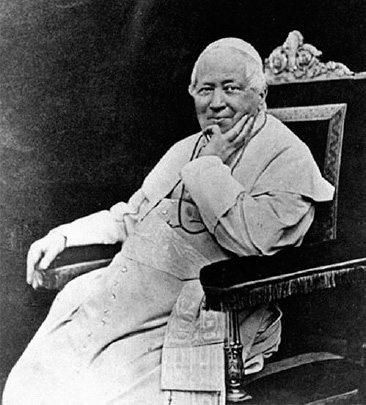
Pope Pius IX (Giovanni-Maria Cardinal Mastai-Ferretti)
It is noteworthy that Pius IX was elected by the liberalizing wing of the Cardinalate, in response to the liberal and revolutionary attitudes sweeping Europe in the mid-1840s, though after a series of assassinations of his ministers, Pius turned increasingly conservative and reactionary, a move culminating in the dogmas of the First Vatican Council. For our purposes, however, we note Pius IX’s early liberal attitudes, for these, in turn, would have been a motivation for him to join the many secret societies of Europe championing such causes. Indeed, in the early years of his papacy Pius IX displayed remarkable leniency to revolutionary political prisoners and to the Italian revolutionary secret society, the Carbonari.
We therefore turn to a consideration of statements of the Carbonari leader Piccolo Tigre, “The Permanent Instruction of the Alta Vendita,” made in 1849, three years after the election of Mastai-Ferretti to the papacy.
2. The Permanent Instruction of the Alta Vendita Lodge
By the 1840s, Weishaupt’s Illuminati had been replaced by the Italian Carbonari lodges as the most obviously revolutionary lodges of Europe, and their manifesto, “The Permanent Instruction of the Alta Vendita,” is a distilled essence of Weishaupt’s Illuminism. For our purposes, we need only cite those passages dealing with their plans for the Catholic Church:
Our final end is that of Voltaire and of the French Revolution, the destruction for ever (sic) of Catholicism and even of the Christian idea which, if left standing on the ruins of Rome, would be the resuscitation of Christianity later on …
… The remedy is found. The Pope, whoever he may be, will never come to the secret societies. It is for the secret societies to come first to the Church, in the resolve to conquer the two.
…
We do not mean to win the Popes to our cause, to make them neophytes of our principles, and propagators of our ideas. That would be a ridiculous dream, no matter in what manner events may turn. Should cardinals or prelates, for example, enter, willingly or by surprise, into a part of our secrets, it would be by no means a motive to desire their elevation to the See of Peter. That elevation would destroy us. Ambition alone would bring them to apostasy from us. The needs of power would force them to immolate us. That which we ought to demand, that which we should seek and expect, as the Hews expected the Messiah, is a Pope according to our wants.7
The document goes on to outline a plan—reminiscent of Weishaupt’s Illuminati—to co-opt the seminaries of the church, and thus to allow
our doctrines to pass to the bosoms of the young clergy, and go even to the depths of convents. In a few years the young clergy will have, by the force of events, invaded all functions. They will govern, administer, and judge. They will form the council of the Sovereign. They will be called upon to choose the Pontiff who will reign; and that Pontiff, like the greater part of his contemporaries, will be necessarily imbued with the Italian and humanitarian principles which we are about to put in circulation.8
It is indeed interesting to observe that Mastai-Ferretti, with his early liberal views and attitudes toward the Carbonari, would seem to fit this bill perfectly. One might go so far as to speculate that there would be no better way to gain power in the Roman church through such a process of subterfuge than to have its primary institution—the papacy—proclaimed infallible, and to endow it with a universal, supreme, and immediate jurisdiction.
While this may sound absurd, there is more …
3. José Maria Cardinal Caro y Rodriguez, Cardinal Archbishop of Santiago
In a little-known work, The Mystery of Freemasonry Unveiled (1928), José Maria Cardinal Caro y Rodriguez, then Archbishop of Santiago de Chile, made some rather breathtaking observations about the pope of papal infallibility:
For the present I shall tell only of the origin of the imputation made against Pius IX, which is the one the Masons tell most often and with greatest assurance. Here is the way John Gilmary Shea tells and refutes that fable in his Life of Pius IX, pp. 291–292, (written in English). “It began in Germany and the Masons believed that by laying the scene in America, it might help to escape investigation. They declared positively that Pius IX had been received into a certain Masonic lodge in Philadelphia, they quoted their discourses and declared that several of his autographs were kept in this lodge. Unfortunately for the story, Philadelphia is in the civilized world. The people there know how to read and write. The claim was investigated and it was found that in that city, there is no Masonic lodge of the name given. It was also found that no lodges in Philadelphia had ever received a Juan Maria Mastai; no trace could be found that he had ever been there, because he never had been; no lodge had any of his autographed letters; the masons themselves testified that the entire matter was merely an invention. The calumny this refuted has been revived from time to time, and in the last version care was taken not to specify the lodge or the city.” (Arthur Press, A Study in American Freemasonry, 270–271). To make it more credible they have placed on the photograph of a Mason with insignias, the head of the Pope, cut from his portrait and substituted in place of the Mason’s.
The reader will recall the previously cited advice of Weishaupt to be sure that persons of merit belong to Masonry, thereby helping to acquire new members. That lie involving Pius IX was calculated above all to deceive the clergy so that they might follow the example of one who had been their chief. I do not know if there could be found in the world a priest so naive that he would allow himself to be deceived by it.9
Note what we have:
1)The story about Pius IX’s Masonic initiation and membership began to be circulated in Germany;
2)Pius IX was allegedly initiated in a lodge in “Philadelphia;”
3)When lodges in Philadelphia were consulted, no indication of any such initiation or membership was forthcoming, nor was Mastai-Ferretti ever known to have traveled to America; thus,
4)Cardinal Caro y Rodriguez concludes that the story was just that, a story, circulated to deceive other Roman Catholic clergy into accepting Masonic initiation (and also, one may speculate, to confuse or cast doubts among the clergy about the orthodoxy of its own hierarchy and institution).
There is, however, more than just this one problem.
4. A Sidelight from the Bavarian Illuminati
It is known that Mastai-Ferretti did travel to South America in 1823 and 1825. More importantly, however, is that at least one secret society with close ties to Freemasonry was known to employ “code names” not only for its members, but also for their locations.This was the Bavarian Illuminati of Ingolstadt professor of canon law, Adam Weishaupt (1748–1830).
For example, Weishaupt himself took the name “Spartacus” as his code name, and his close associate Baron Knigge took the code name “Cato.” More importantly, however, are the names assigned to provinces and towns. Bavaria, for example, was code-named Achaia, the Tyrol region of northern Italy, the Peloponnese. Similarly, Munich was code-named Athens, Ravensburg was code-named Sparta, Vienna became Rome, and so on, for purposes of coded communications between the society’s initiates.10 The implication is clear, for if other fraternal orders maintained this Illuminist practice, the slim possibility arises that Mastai-Ferretti may have been initiated into a lodge in a “Philadelphia” that was simply a code-name for a European city.
5. Fr. Malachi Martin on “The Bargain”
In his novel Vatican, Fr. Malachi Martin outlines the features of what he called “the Bargain,” a secret agreement negotiated by the Vatican after the loss of the Papal States during Italian unification with the high Masonic powers of Europe, in order to gain access to the financial and banking houses of the West and thereby increase its own financial power. As a component of this Bargain, those powers in return received the right of a secret veto of any candidate elected to the papacy. Later, in his last book, the novelWindswept House, Martin wrote of a church hollowed out from within by members of various secret societies with obvious Masonic overtones. This matched in fiction with what some Roman Catholic writers were stating in non-fiction works in the wake of the notorious P2-G scandal, in which Licio Gelli’s Masonic Propaganda Due lodge had successfully infiltrated various Vatican institutions, including, according to some, its financial institutions.
All of this would tend, in a very broad fashion, to corroborate the speculation advanced above, that perhaps the association between the Vatican and the fraternal orders of Europe began with Giovanni Cardinal Mastai-Ferretti himself, who, as Pope Pius IX, led the effort to have the Pope proclaimed infallible, and possessed of an universal, supreme, and immediate jurisdiction over and above the Church. It would, in some measure, explain Mastai-Ferretti’s interest in the case of Giordano Bruno from a different perspective; instead of just ecclesiastical interest, it was the interest of one initiate in another.
Of course, all of this is highly speculative, and we simply present it for consideration here. It remains my own personal opinion that it is unlikely that Mastai-Ferretti was a member of any secret society, but only slightly possible that he was such a member. Nonetheless, if he was, the timing of his pontificate and his early liberal attitudes square quite nicely with the attitude outlined in the Permanent Instruction, and if he was an initiate, it would put a unique perspective on his fascination with Giordano Bruno. It would be as if Bruno’s Giordanistas had come home to capture the papacy itself.
On the other hand, however, Mastai-Ferretti’s subsequent conservatism and ultramontanism would also explain the fascination, as being the interest of someone concerned about the power of the very secret societies that so galvanized the Italian revolution and unification, and stripped him of the last vestiges of power by providing a final end to the Papal States. That too would have been a final manifestation of the Giordanistas sweeping Italy, to the very gates of the Apostolic Palace.
________________________
1Piccolo Tigre, Permanent Instruction of the Alta Vendita, in Monsignor George E. Dillon, D.D., Grand Orient Freemasonry Unmasked as the Secret Power Behind Communism (Metarie, Louisiana: Sons of Liberty Books, no date, original edition published by M.H. Gill and Son, Dublin, 1885), pp. 54–56.
2Frances A. Yates, Giordano Bruno and the Hermetic Tradition (London: Routledge, 1964), p. 349, boldface and italicized emphasis added.
3Dillon, Grand Orient Freemasonry Unmasked as the Secret Power Behind Communism, p. 34.
4Ibid.
5Napoleon’s brother.
6Ibid., p. 38.
7“Permanent Instruction of the Alta Vendita,” cited in Dillon, Grand Orient Freemasonry Unmasked as the Secret Power Behind Communism, pp. 52–53.
8Ibid., pp. 55–56.
9José Maria Cardinal Caro y Rodriguez, The Mystery of Freemasonry Unveiled (Palmdale, CA: The Christian Book Club of America, n.d.), p. 49, emphasis added.
10Henry Coston, Conjurations des Illuminés (Paris: Publications Henry Coston, 1979), pp. 3–4.