
 The Flight from North Britain, 1717-1775
Whole neighborhoods formed parties for removal; so that departure from their native country is no longer exile. He that goes thus accompanied … sits down in a better climate, surrounded by his kindred and his friends: they carry with them their language, their opinions, their popular songs, and hereditary merriment: they change nothing but the place of their abode.
—Dr. Samuel Johnson on the emigration
from North Britain to America, 1773
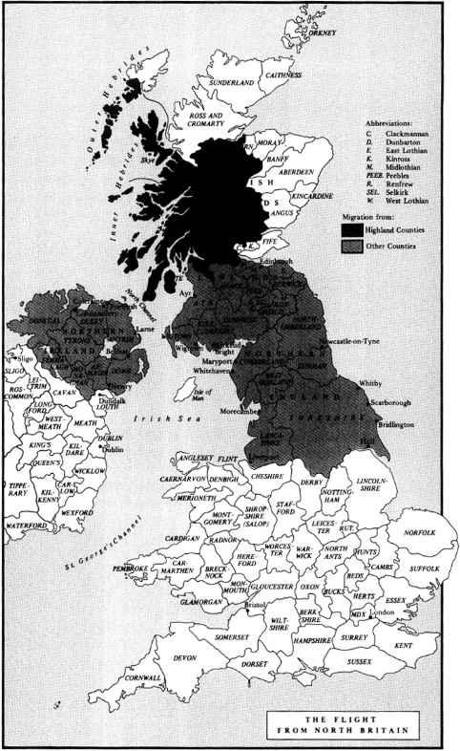
EARLY IN THE SUMMER OF1717, the Quaker merchants of Philadelphia observed that immigrant ships were arriving in more than their usual numbers. By September, as the first hint of autumn was in the air, the Delaware River was crowded with vessels. They came not only from London and Bristol, but from Liverpool and Belfast, and small northern outports with strange-sounding names—Londonderry and Carrickfergus in northern Ireland, Kirkcudbright and Wigtown in Scotland, Whitehaven and Morecambe on the northern border of England.
In October of the same year, a Philadelphia Quaker named Jonathan Dickinson complained that the streets of his city were teeming with “a swarm of people … strangers to our Laws and Customs, and even to our language.”1 These new immigrants dressed in outlandish ways. The men were tall and lean, with hard, weather-beaten faces. They wore felt hats, loose sackcloth shirts close-belted at the waist, baggy trousers, thick yarn stockings and wooden shoes “shod like a horse’s feet with iron.” The young women startled Quaker Philadelphia by the sensuous appearance of their full bodices, tight waists, bare legs and skirts as scandalously short as an English undershift. The older women came ashore in long dresses of a curious cut. Some buried their faces in full-sided bonnets; others folded handkerchiefs over their heads in quaint and foreign patterns.2
The speech of these people was English, but they spoke with a lilting cadence that rang strangely in the ear. Many were desperately poor. But even in their poverty they carried themselves with a fierce and stubborn pride that warned others to treat them with respect.3
The appearance of these immigrants in the streets of Philadelphia marked the start of yet another great folk migration from Britain to America. The magnitude of this movement was very large—more than a quarter-million people altogether. This was truly a mass migration, on a scale altogether different from the movements that had preceded it. Its rhythm was different too—not a single migration but a series of wavelike movements that continued though much of the eighteenth century. It also drew from a different part of Britain. Many of these people came from territories that bordered the Irish Sea—the north of Ireland, the lowlands of Scotland, and the northern counties of England. Together they introduced still another variety of British culture to the New World.
The first slow trickle of emigration from North Britain to America had actually begun much earlier, in the seventeenth century. In Virginia, headrights had been granted for Irish servants before 1630. In New England, a group of 140 Irish Calvinists had arrived from Belfast as early as the year 1636, on board an immigrant ship nicely named Eagle’s Wing.4 A small flow of population continued through the seventeenth century. Then, after the end of Queen Anne’s War in 1713, this movement began to accelerate in a strong wavelike rhythm that continued to the outbreak of the American Revolution. Peak periods occurred in the years 1718, 1729, 1741, 1755, 1767 and 1774. Two-thirds of this
traffic was concentrated in the decade from 1765 to 1775. As much as one-third of it may have occurred in the four years preceding American Independence.