
 The Backcountry “Ascendancy”: Border Origins of an American Elite
Not all of these backcountry settlers were people of humble origins. Some had held high rank in the Old World. Their motive in moving to America was not to rise higher in society, but to keep from falling below the status which they had already achieved. A case in point was the family of Andrew Jackson, the first of many American Presidents to spring from border stock. Jackson’s campaign biographies have stressed the plebian origins of this popular leader. But in fact he did not come from poor or humble people. In his earliest youth, he was taught to think of himself as a gentleman. President Jackson’s Irish grandfather, Hugh Jackson, was a rich man who called himself a “weaver and merchant of Carrickfergus, Ireland, and left his American grandson a legacy later reckoned at three or four hundred pounds sterling. The future President’s immigrant father had been a well-to-do farmer who held a large property near the town of Castlereagh in northern Ireland, and led an entire party of emigrants to America in 1765. Andrew Jackson’s wife, Rachel Donelson, also came from
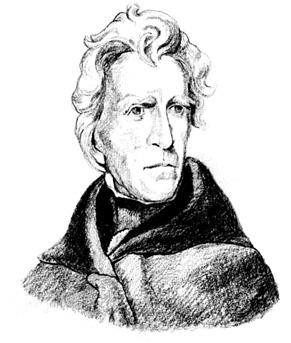
The archetypical backcountry leader was Andrew Jackson, the son of Scots-Irish immigrants who became the seventh President of the United States. Historians and social scientists have suggested many ways of making sense of this man and his movement. To study him in the context of his time and place is to discover that he was the carrier of a special folk culture which was brought from the borders of North Britain to the American backcountry.
an eminent family. Her father, Colonel John Donelson, was one of the most powerful men in the southern backcountry. She was the grandniece of Dr. Samuel Davies, a learned Presbyterian minister who became president of Princeton College.1
Still other immigrants came from even higher ranks, and had belonged to a narrow elite who were known in Ireland and along the borderlands as the “Ascendancy.” These people were few in numbers among the flood of immigrants. But they quickly established a cultural hegemony in the American backcountry, and kept it for many generations. An example of this backcountry “Ascendancy” was the Polk family. Its American progenitor was Captain Robert Polk (d. 1699), who emigrated from County Donegal, Ireland, ca. 1680. He had been highly placed in Anglo-Scots-Irish society. His wife, Magdalen Tasker Porter Polk, was the daughter of the Lord Chancellor of Ireland, who had lived at Bloomfield Castle near Londonderry, and inherited an Irish estate called Moneen. Robert and Magdalen Polk had seven sons. One of them was David Polk who settled in Maryland where his offspring intermarried with the Chesapeake gentry—Tilghmans, Fords, Coxes and Hacketts. Another son, William Polk, made his way to Virginia, and his five children settled mostly in Mecklen-berg County, North Carolina. By the end of the eighteenth century, the Mecklenberg Polks had intermarried with leading back-country clans throughout North Carolina and Tennessee—Alexanders, Ashes, Caldwells, Campbells, Donelsons, Hawkinses, Gilchrists, Knoxes, Shelbys, Spratts and many others. One member of this family was the extraordinary Bishop-General Leonidas Polk, who managed to be both Episcopal bishop of Louisiana and lieutenant general in the Confederate Army. Another descendant was a future president of the United States, James Knox Polk. Two other Presidents, Andrew Jackson and Zachary Taylor, were related by marriage to this clan, as were many political leaders of North Carolina and Tennessee.2
A third example of the backcountry Ascendancy was the Calhoun clan, which moved from Scotland to Ireland in the seventeenth century, and thence to America in 1733. The immigrants included Patrick and Catherine Calhoun, and their four sons
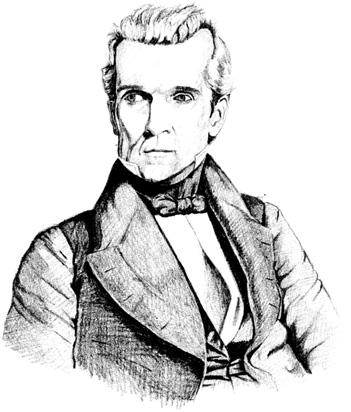
Political leaders in the southern highlands for many generations traced their descent from elite families of North Britain’s border “ascendancy. “An example of this persistence was the eleventh President of the United States, James Knox Polk (1795-1849). He was called “Young Hickory” and was elected as a Democratic leader, but in fact his ancestors had come from the uppermost strata of North British society. President Polk’s public acts and personal values, and his ideals of honor and loyalty, were shaped by the culture of his border forebears.
James, William, Ezekiel and Patrick. These four brothers lived and worked closely together. In 1746 all were named in a single indictment as “divulgers of false information.”3
The Calhouns settled first in Lancaster County, Pennsylvania, then moved south and west to the Carolina upcountry, where they made their home on Long Cane Creek, intermarrying with other North British families along the way—Montgomerys, Nobles, Pickenses—with whom they had been allied even before coming to America. They also intermarried with themselves. The most eminent member of this clan, John C. Calhoun, married his cousin Floride Calhoun, the daughter of John E. Calhoun (or Colhoun). Most of their matrimonial alliances were with other border families—Scottish, Irish and English.
The Calhouns were pioneers in the Carolina backcountry, settling so near the frontier that in 1760 the Cherokees killed twenty-three of them, including the family matriarch Catherine Montgomery Calhoun, who was seventy-six years old.4 By the end of the eighteenth century, there were hundreds of Calhouns in the Carolina upcountry.
From the start the Calhouns were people of substance. The family patriarch Patrick Calhoun was called “squire” even before he settled in South Carolina. As early as the mid-eighteenth century, the four Calhoun brothers owned thousands of acres, and rapidly acquired large numbers of slaves as well. They also held many high offices. Four of them represented South Carolina in the federal Congress before 1815.
Yet another example was the Henry family. Its progenitor was an Anglo-Scottish gentleman named John Henry, who emigrated about the year 1730. He was related to leading families on both sides of the border. Among his cousins was David Henry, publisher ofGentleman’s Magazine, and on his mother’s side he was connected to William Robertson, the historian who became principal of Edinburgh University. Yet another cousin was Eleanor Syme, a famous Edinburgh beauty who married Henry Brougham of Brougham Hall in Westmorland and raised one of England’s great political families.
In Hanover County, the immigrant John Henry met and married one of his own relatives, a beautiful backcountry widow named Sarah Syme. The ubiquitous William Byrd stayed a night
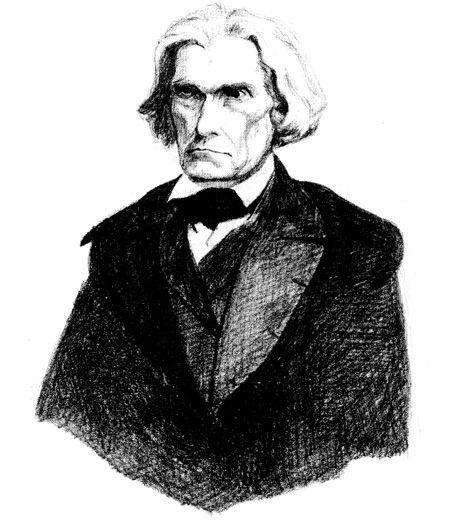
In old portraits and early photographs, the baleful faces of backcountry leaders often bear a striking resemblance to verbal descriptions of the North British borderers who settled the Appalachian highlands. Contemporary observers described these men as tall, lean and sinewy, with hard, angry, weatherbeaten features. The strong emotions that were so actively cultivated in this society left indelible marks upon them. A case in point was John Caldwell Calhoun, whose physiognomy in many ways resembled his enemy Andrew Jackson. Both of these men were descended from the backcountry ascendancy. The compelling portraits of these men testify to their strength of character and force of will, and also to their courage and cruelty. Their vices and virtues had been nourished by the environment of the British borderlands and the American backcountry.
in the home of this lady, and described her in his diary as “a portly handsome dame … of a lively and cheerful conversation. …” Byrd wrote:
we tost off a bottle of honest port, which we relished with a broiled chicken. At nine I retired to my devotions, And then slept so sound that Fancy itself was stupified, else I should have dreamed of my most obliging Landlady. … the courteous Widow invited me to rest there the next day, and go to Church with her, but I excused myself by telling her she would certainly spoil my Devotion. Then she civilly entreated me to make her House my Home whenever I visited my Plantations, which made me bow very low.5
A little later, Mistress Syme married John Henry, and in 1736 became the mother of Patrick Henry. That great revolutionist liked to appear as a tribune of the people, but by birth he was a high-born backcountry gentleman with connections to the English border gentry. Patrick Henry was the cousin of the great English Whig Lord Brougham of Brougham Hall, Westmorland.6
Yet another example of the backcountry ascendancy was John Houston, who arrived in America with his wife and six children in 1730. He signed himself “John Houston, Gent.,” and was of a family of border baronets. He did not come penniless to the New World. According to family legend he arrived with a small keg of gold sovereigns. In passage to America, a rapacious captain and crew discovered the wealth of their passenger, and made the fatal mistake trying to steal it. John Houston promptly organized the passengers, seized the ship, and sailed it himself to America. In the backcountry, he instantly assumed the station of county justice and acquired vast holdings of rich land in the Valley of Virginia. At the age of sixty-five, he was killed by a falling tree. One of his descendants was Sam Houston, the future governor of Tennessee and president of Texas.7
Other elite groups in the backcountry included three of the most prominent raiding, reiving and rustling families on England’s northwestern frontier: the Grahams, Bells and Bank-heads. All were expelled from England and forcibly resettled in Ireland. Many members of these clans came to America, and joined the elite of the southern highlands. The Bankheads became specially eminent in Alabama—producing leaders in
The Backcountry Elite: The Polks of Mecklenberg
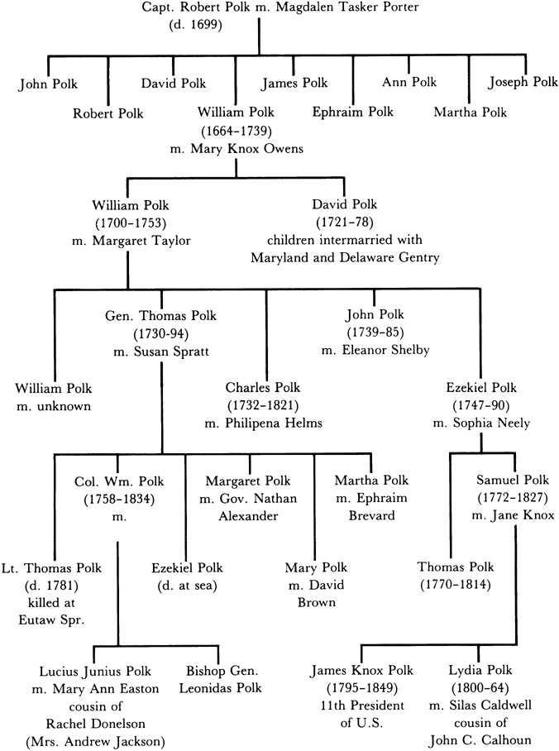
Source: Angellotti, “The Polks of North Carolina and Tennessee,” NEHGR 77 (1923), 133-45; 78 (1924), 33.
The Backcountry Elite: The Calhouns of Long Cane

Source: A. S. Salley, Jr., “The Calhoun Family of S.C.,” SCHGM 7 (1906), 81-98, 153-69; idem, “The Grandfather of John C. Calhoun,” 50; Charles M Wiltse, John C. Calhoun, Nationalist (Indianapolis, 1944), 18.
many fields, including U.S. Senator John Bankhead, his brother William Bankhead, Speaker of the U.S. House of Representatives, and the Speaker’s actress daughter Tallulah Bankhead. Even to our own time, Bankheads occupy many positions of eminence throughout the southern highlands. Also present in even greater number were the Grahams and Bells, two of the earliest border clans to settle in western North Carolina. They held many high offices, and gave their name to counties and towns throughout the southern highlands.
The Calhouns, Polks, Jacksons, Henrys, Houstons, Bells, Grahams and Bankheads were typical of the backcountry elite. The founders of these families in America had all been people of substance in North Britain. They tended to emigrate during the early eighteenth century. Some came a generation earlier or later, but most arrived in the backcountry during the 1730s. They moved quickly to the top of backcountry society, and preserved their eminence for many generations.
These elite families firmly established their hegemony in the backcountry before the American War of Independence. Other ethnic elites also appeared in that region, but the North British borderers reigned supreme. An example of their dominion was the pattern of leadership at the battle of King’s Mountain in 1780, a decisive event in the southern highlands during the American Revolution. The victorious backsettlers fought under ten commanders. One of those officers came from southwest of Scotland, another from northern Ireland, three from the north of England, two from the marches of Wales. One was from Germany, one was from a mixed Huguenot and border family, and one was from parts unknown. The first impression is one of ethnic diversity. But of nine whose regional origins are known, seven came from the borderlands of North Britain. None came from East Anglia or from southwestern England. Further, of eight families whose dates of emigration are known, all arrived in America between 1726 and 1740, the critical period for the formation of the backcountry elite.8
These border families, no matter whether English, Scots, Scots-Irish, Anglo-Irish or even Anglo-Welsh, shared many values and beliefs in common. They intermarried among themselves, and rapidly became an integrated elite throughout the southern highlands. For two centuries the public life of this region has been dominated by names that first appeared in the backcountry during the middle decades of the eighteen century.