
 Backcountry Building Ways: Border Origins of Cabin and Cowpen
As early as the mid-eighteenth century, travelers also found a characteristic style of vernacular architecture in the Appalachian highlands. “These people live in open log cabins with hardly a blanket to cover them.” Charles Woodmason observed in 1767.1 Log cabins had not been much used by English colonists in Massachusetts, Virginia or the Delaware Valley during the seventeenth century and were not invented on the American frontier. The leading authority on this subject, H. B. Shurtleff, concludes after long study that the log cabin was first introduced by Scandinavians, and popularized mainly by Scots-Irish settlers in the eighteenth century. “The log cabin did not commend itself to the English colonists,” Shurtleff wrote. “The Scotch Irish who began coming over in large numbers after 1718 seem to have been the first … to adopt it.”2
The historiography of the log cabin has centered mostly on the history of the log, but at least equally important is the history of the cabin. The trail of that topic leads from the American back-country to the British borderlands. In the seventeenth and eighteenth centuries, cabin architecture was commonplace throughout the Scottish lowlands and northern Ireland, and also in the English counties of Cumberland, Westmorland and Northumberland, but not often in the south of England. Travelers in the border country expressed surprise at the state of housing they found there. One soldier from the south of England, marching north near Duns a few miles beyond the river Tweed, noted that the “husbandmen’s houses … resemble our swine coates, few or none of them have more storeys than one, and that very low and covered usually with clods of earth, the people and their habits are suitable to the dwellings.”3
Small and impermanent houses were common throughout North Britain, in part because the system of land tenure gave no motive for improvement. An historian of Scotland wrote in 1521:
In Scotland, the houses of the country people are small, as it were, cottages, and the reason is this: they have no permanent holdings, but hired only, or in lease for four or five years, at the pleasure of the lord of the soil; therefore do they not dare to build good houses, though stone abound, neither do they plant trees or hedges for their orchards, nor do they dung their land; and this is no small loss and damage to the whole realm.4
On the borders, this factor was compounded by chronic insecurity. There, cottages became cabins of even more primitive construction. The word “cabin” itself was a border noun that meant any sort of rude enclosure, commonly built of the cheapest materials that came to hand: turf and mud in Ireland, stone and dirt in Scotland, logs and clay in America.5
Within these structures, raised beds were uncommon as late as 1582, when George Buchanan wrote of his fellow Scots, “In their houses, also, they lie upon the ground; strewing fern or heath, on the floor, with the roots downward, and the leaves turned up. In this manner they form a bed so pleasant that it may vie in softness with the finest down, while in salubrity it far exceeds it.”6
In the American backcountry, the first emigrants from the borderlands began by building earthen cabins which one of them described as “dirt houses or rather like potato houses, to take their families into.” Roofs were made of poles and sand, with catastrophic consequences in a heavy storm. “The rain quickly penetrated through between the poles and brought down the sand that covered over, which seemed to threaten to cover us alive … I believe we all sincerely wished ourselves again at Belfast.”7 These cabins of dirt and stone soon yielded to log cabins which were better suited to the climate and resources of the New World. But no matter what the materials happened to be, the cabin idea remained much the same.8
The interior design of these cabins was similar on both sides of the Atlantic. Rectangular walls enclosed a single room in which an entire family lived together. The floors were usually of hard-packed dirt. The walls had a few simple openings for windows, and doors were placed on both the front and back walls for quick exits. Some of these structures had a firepit and a hole in the roof; others had a rough open fireplace on the gable end.9
Backcountry cabins had a standard size. Many were between sixteen and seventeen feet long. This dimension had been common in northern England, where it was taken from an old unit of measure variously called a rod, lug, pole, or perch, normally five and a half yards long. It had been used in the mother country for “coppice cutting” of saplings which were carefully regulated by local folk law. Those customs were preserved in log-cabin building for many years in the New World.10
Methods of construction also tended to be much the same on both sides of the water. The spaces between the logs or other materials were “daubed” with clay. In the English border county of Cumberland, this was done in a communal event called a “clay-daubin” where neighbors and friends of a newly married couple came together and built them a cabin with weathertight walls. The work was directed by men called daubers.11 The same technique of wattle and clay daubing (sometimes called wattle and funk) was widely used in the American backcountry. In 1753, for example, James Patton had two “round log houses” on his Shenandoah farm, with “clapboard roofs, two end log chimnies, all funcked and daubed both inside and out.”12
Larger dwellings in the backcountry tended to be several small cabins built close together, rather than buildings of a different type. The traveler Johann Schoepf observed in 1784:
Thus are built gradually a good many small houses and cabins, commonly without the assistance of carpenters, patched together by the people themselves and their negroes; this being an easier method than to put together a large house all at once. One often sees such little houses growing up where there is neither material nor capital for bringing them together in one solid house.13
A common practice was to raise two log structures side by side, with an open breezeway covered by a simple roof. In Appalachia, this was called a dog-trot cabin. The same plan had long been used in Britain, where breezeways were widely known.14 Other
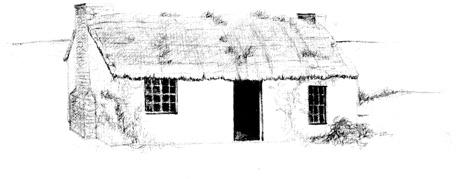
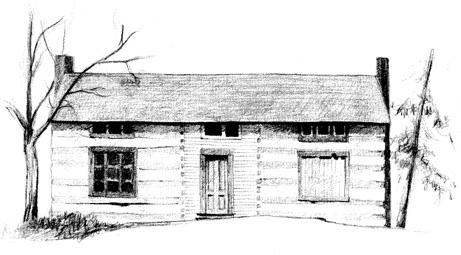
The log house did not spring spontaneously from the American forest. It was a type of vernacular architecture that had been carried out of Europe by Scandinavians, Germans and especially North British borderers. Log-building was common to all of these ethnic groups, but the idea of the cabin was brought from the borderlands. The choice of materials changed in the forests of the New World, where log walls and wooden roofs replaced stone and thatch. But the cabin plans and proportions remained very much the same. Many other forms of log architecture also appeared in America—solid New England garrison forts, fragile Swedish log houses, dovetailed Finnish plank buildings, and big German Blockhausen—but the classic American log cabin came from North Britain.
plans were the saddle-bag, in which two adjacent cabins shared a single chiminey stack; and the “double pen,” in which they had a wall in common. These also had been known in Britain.15
Cabin architecture was striking for its roughness and impermanence. It was a simple style of building, suitable to a migratory people with little wealth, few possessions and small confidence in the future. It was also an inconspicuous structure, highly adapted to a violent world where a handsome building was an invitation to disaster. In that respect, cabin architecture was an expression of the insecurity of life in the northern borders.16
The cabin was also the product of a world of scarcity. It was a style of vernacular architecture created by deep and grinding poverty through much of north Britain during the late seventeenth and early eighteenth century. In that barren country, cabins made of earth and stone were an adaptation to an environment in which other building materials were rare.
Cabin architecture was also a style of building well suited to a people who had a strong sense of family and a weak sense of individual privacy. Travelers from the south of England expressed horror at the lack of respect for privacy. Much the same observations were also made in the American backcountry. “They sleep altogether in common in one room, and shift and dress openly without ceremony,” Woodmason wrote, “ … nakedness is counted as nothing.” Sometimes there was not even a bed. William
Byrd described one backcountry family that “pigged lovingly together” on the floor.17
In the eighteenth century, these cabins began to rise throughout the American backcountry wherever migrants from North Britain settled. The strong resemblance of these houses to the vernacular architecture of the borders was noted by travelers who knew both places. One English traveler noted of a Scots-Irish settlement in the backcountry of Pennsylvania that the people lived in “paltry log houses, and as dirty as in the north of Ireland, or even Scotland.”18
Cabin architecture was not static in its new environment. Folklorists have studied in fascinating detail the hewing of cabin logs, the notching of corners, the development of floor plans and the refinement of fenestration. This was mostly a form of cultural involution, in which things changed by becoming more elaborately the same.19
The architecture of the cabin itself was merely one part of an entire regional vernacular which also included other structures. Barns and stables were crude, impermanent shelters, often made of saplings and boughs—a method widely used in the border country.20Cattle were kept in simple enclosures called cowpens, descended from border “barmkins” which had been built for centuries in North Britain. Historians Bouch and Jones note that “the basis of medieval settlement appears to have been the ‘barmkin,’ a sort of corral or stockade, where behind a timber fence, cattle and dependents could shelter, defended by menfolk.” Cowpens became very common throughout the southern highlands in the eighteenth century. One such area in the Carolina upcountry became the site of the battle of Cowpens during the American War for Independence.21
In North Britain the architecture of cabin and cowpen began to be abandoned during the seventeenth and eighteenth centuries, as violence diminished and prosperity increased. The vernacular architecture that one finds throughout the region today was a later development. “In the seventeenth century,” one local historian writes, “the statesmen had begun to build better houses, in imitation of Jacobean manor halls, and evolved a type of their own—the low, rough-cast building with porch and pent-house, a dead-nailed door and massive threshwood, mullioned windows, and behind the rannel-balk a great open fire-spit where peat burned on the cobble-paved hearth.”22
But the architecture of cabin and cowpens persisted for many generations in the American backcountry. As late as 1939 there were 270,000 occupied log cabins in the United States. Many were in the southern highlands. In the county of Halifax, Virginia, 42 percent of all houses were log cabins as recently as World War II.23
Even today an architecture of impermanence survives in new forms such as prefabricated houses and mobile homes, which are popular throughout the southern highlands. The mobile home is a cabin on wheels—small, cheap, simple and temporary. The materials have changed from turf and logs to plastic and aluminum, but in its conception the mobile home preserves an architectural attitude that was carried to the backcountry nearly three centuries ago.