
 Backcountry Child-naming Ways: Border Onomastics
Another important clue to backcountry culture was the naming of its children. The onomastic customs of these people were unique. Favored forenames in the backcountry included a mixture of biblical names (John was the top choice), Teutonic names (such as Robert or Richard), and the names of border saints (especially Andrew, Patrick, David). This combination did not exist in any other English-speaking culture.
Popular namesakes in the backcountry included Saint Andrew, an apostle who became the patron saint of Scotland. Also much in vogue was David, a name associated not only with its biblical bearer, but also with a seventh-century archbishop who became the patron saint of Wales, and with two early Scottish kings. Yet another favorite namesake was Saint Patrick, the legendary missionary-priest who converted Ireland to Christianity; his name was often used by Protestant as well as Catholic families throughout northern Ireland.
These saints’ names were rare in the other regional cultures of British America. Davids were few and far between in New England and the Delaware Valley; Puritans and Quakers were not amused by King David’s biblical antics. Patricks were uncommon in Anglican Virginia and nearly unknown in Puritan New England. Harvard College did not admit a single undergraduate named Patrick in all the years from 1636 to 1820. But in Cumberland Country, Pennsylvania, Patrick was the fourth most popular name on military muster rolls during the eighteenth century.1
The backsettlers sometimes used Celtic names such as Ewan (var. Ewen, Owen), Barry and Roy. They also had a taste for Scandinavian and Teutonic names unknown to other English-speaking cultures, such as Archibald and Ronald. Particular favorites in the American backcountry were the names of Scottish kings Alexander, Charles and James. Also popular were the names of brave warriors on both sides of the border, notably Wallace, Bruce, Percy and Howard. Nostalgic parents even named their children for border places such as Ross, Clyde, Carlisle, Tyne, Cumberland and Derry.2
These backcountry naming patterns had long existed on the borders of North Britain. But they were different from onomastic patterns in the south of England, and also from naming practices in the Gaelic-speaking parts of the Scottish Highlands and Catholic Ireland. The borderers did not often use forenames such as Douglas, Donald, Kenneth, Alan, Ian, Neil or Stewart which were favored by highlanders. Neither did they make much use of Gaelic Irish names such as Sean, Kathleen, Maureen or Sheila.3 Altogether, a complex border and backcountry combination of biblical names, Celtic names, Teutonic names, saints’ names, folk names, Scottish kings’ names and border warriors’ names was unique to this regional folk culture.
In another respect, however, backcountry naming customs were not unique. The descent of names from one generation to the next was very similar to the folkways of Virginia and the south of England, but different from Puritan and Quaker customs. Eldest sons in the backcountry tended to be named after grandfathers, and second or third sons after fathers, much as in tidewater Chesapeake families. An example was the family of Andrew Jackson (1767-1845). The future President was the second son of a Scots-Irish immigrant also named Andrew Jackson (1730-67), and grandson of Hugh Jackson (d. 1782), a weaver in the Irish town of Castlereagh. The naming rhythm ran as follows through three generations:
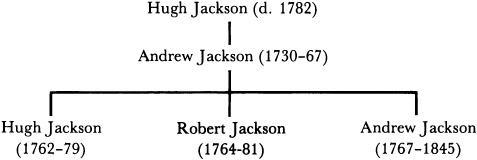
Precisely the same pattern had long prevailed in the northwestern counties of England, as well as in Scotland and northern Ireland. Another example was a Cumberland family (originally from the Isle of Man) which variously called itself McChristen and Christian:
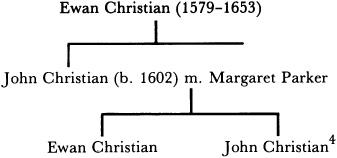
This naming rhythm was much the same in every part of the border region—in the English counties of Cumberland and Westmorland, in the Scottish lowlands and also in northern Ireland. It was introduced to the American backcountry in the eighteenth century and persisted for a long time.4
A good example of this persistence was another presidential family, that of Zachary Taylor. His ancestors were an English border family from Carlisle in the county of Cumberland, who first settled in Virginia, and then moved west to Kentucky. The descent of names in the Taylor family ran as follows:5
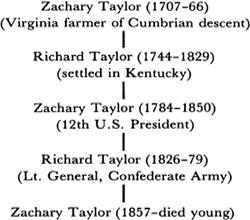
In this respect, backcountry onomastics were much like those of the tidewater south. But in another curious naming custom, the backsettlers went their own way. From an early date they cultivated a spirit of onomastic individualism, sometimes with bizarre results. One famous border family of high status in the backcountry were the Hoggs, who later became one of richest and most cultivated families in Texas. One daughter, a lady of taste and refinement, was named Ima Hogg by her proud parents. Another example of onomastic individualism occurred in Oklahoma City, during the 1940s, where a woman named Hoyette White named her daughters Hoyette, Norvetta, Yerdith, Arthetta, Marlynne and Wilbarine White. A reporter was dispatched by the local newspaper to ask why she made those choices. Mrs. White explained, “When my mother saw I looked so like my father, she made a girl’s name out of the family name Hoyt and called me Hoyette. That started the names. When I named my own girls, I wanted names no one had ever had, and names that nobody would ever want. So I made them up.”6