
 Backcountry Age Ways: The Border Idea of the Elder-Thane
Not many elderly emigrants moved to the back settlements during the first few years. This was a country for young people. In the eighteenth century, less than 1 percent of the population were over sixty-five—a very small minority. But a few older folk were to be found in even the newest settlements. The manner of their treatment tells us many things about this regional culture. Even more than in most societies, the status of elders in the backcountry tended to vary from one older person to the next. Some received deference and deep respect. A case in point was Patrick Calhoun, “Squire Calhoun” as he was called, the founder and family patriarch of the Calhouns of Long Cane, and also his wife Catherine Calhoun. This aged couple sat in the seats of honor on public occasions. Their wisdom was routinely consulted on domestic questions, and their word was law in the community.1
Similar attitudes of respect for age often appeared in the Presbyterian churches of Appalachia. Congregations were normally seated by age, and the oldest were given the best and most comfortable places. “Women with little children were seated nearest the fireplace—the old men were honored with seats near the wall where they could lean back—the young men and young ladies next in front of them, and the boys of restless, unruly age were placed in the center, where batteries of eyes could play on them from all quarters.”2
Old women, as well as old men, were often treated with special respect in this culture. Emma Miles has left us a memorable portrait of a backcountry granny named Geneva Rogers, “Aunt Genevy” to all the neighborhood. Her ancient profile was deeply lined with a lifetime’s suffering. Her manner was gentle, but she was a force to be reckoned with in the community. Emma Miles recalled:
For all her gentleness and courtesy, there is something terrible about old Geneva Rogers. … At an age when the mothers of any but a wolf-race become lace-capped and felt-shod pets of the household … she is able to toil almost as severely as ever. She takes wearisome journeys afoot, and is ready to do battle upon occasion to defend her own. Her strength and endurance are beyond imagination to women of the sheltered life. … I have learned to enjoy the company of these old prophetesses almost more than any other. The range of their experience is wonderful; they are, moreover, repositories of tribal lore—tradition and song, medical and religious learning. They are the nurses, the teachers of practical arts, the priestesses, and their wisdom commands the respect of all. An old woman usually has more authority over the bad boys of a household than all the strength of man. A similar reverence may have been accorded to the mothers of ancient Israel, as it was given by all peoples to those of superior holiness. … It is not the result of affection, still less of fear.3
The authority of these mountain grandmothers was very great, and their wrath was terrible to behold. Emma Miles observed a scene between one of these old women and a backcountry preacher called Elisha Robbins who preached that even his own mother would be eternally damned without baptism in his own small sect. This doctrine brought upon him the full wrath of a mountain granny:
“Lishy,” she shrilled at him, unheeding the crowd, “Lishy Rob-bins, I held you in my arms before you was three hours old, and … you ought to be slapped over for preaching any such foolishness about your mother, and I’m a-gwine to do it!” And forthwith she did. Her toil hardened old fist shot out so unexpectedly that the young preacher went down like a cornstalk. Angry? Of course he was angry, but she was a grandmother of the mountains. There was nothing for it but to pick himself up with as much dignity as remained to him.4
The rule of deference to the old was widespread throughout the backcountry, but it was far from universal. If some old people were respected and obeyed, others were deeply degraded and treated with extreme contempt. One backcountry traveler came upon a toothless “old man” in the woods, who might have been only fifty years of age, but seemed much older. He was a helpless dependent, who was kept alive by his daughter in a small sylvan “hut.” The traveler described him as “an Indian-like animal … in mien and feature, as well as ragged clothing; and having lit [his pipe], made an awkward scratch with his Indian shoe and … fell to sucking like a calf without speaking for near a quarter of an hour.”5
Other travelers recorded similar descriptions of solitary old women who wandered alone through the American forest—the outcasts of their culture. In the Pennsylvania backcountry, Rhoda Barber remembered an aged female named Mary Pitcher. “I have heard my mother describe her as wandering through the woods leading an old horse, her only property her knitting in her hand and her dress mostly sheepskin,” Barber wrote.6
Many sad accounts exist of lonely, weak and impoverished old people in the backcountry. Daniel Drake, for example, recorded his vivid memory of another despised old backsettler:
Old Mr. Rhodes, or “Grand-daddy” as the children called him, was a man of large frame, very meanly dressed, with a rude and extensive white beard. When I most frequently saw him, he must have been, as it now appears to me, nearly ninety years of age. He stayed constantly in the little cabin, and much of the time in bed. He was silent, childish and morose, seemed to have no sympathy with those around him, and they appeared to have but little care or affection for him, who was their terror. His aspect, and the relations of the family with him, made on my feelings and memory an ineffaceable impression. I had never before, nor scarcely since, seen the forlorn and repulsive character of extreme old age so impressively illustrated. I believe that to the sad spectacle which he exhibited to me 53 or 4 years ago, I may trace up much of my dread of falling, at that advanced period of life, out of communion of mind and heart with children, grandchildren, and great grandchildren. When an old man is found in this desolate isolation—those around him praying that he would die, instead of laboring to make him comfortable and cheerful—the fault is generally, I presume, in himself; for it is more reasonable to believe one person to be wrong in feeling and conduct, than a whole family.7
The degradation of these unfortunate older people in the back-country made a dramatic contrast with the deference given to patriarchs such as Patrick Calhoun, and to mountain grannies such as Aunt Genevy Rogers. Similar dualities have existed in many cultures, but in the backcountry this disparity was exceptionally strong. It derived from an ancient custom deeply embedded in the culture of North Britain, where it was called the rule of tanistry.
In North Britain, from time immemorial, the rule of tanistry (or thanistry, as in thane) had long determined the descent of authority within a clan. It held that “succession to an estate or dignity was conferred by election upon the ‘eldest and worthiest’ among the surviving kinsmen.”8 Candidates for this honor were males within the circle of kin called the derbfine—all the relatives within the span of four generations. By the rule of tanistry, one man among that group was chosen to head the family: he who was strongest, toughest and most cunning. This principle became an invitation to violent conflict, and the question was often settled by a trial of strength and cunning. The winner became the elder of his family or clan, and was honored with deference and deep respect. The losers were degraded and despised—if they were lucky. In ancient days they were sometimes murdered, blinded or maimed.
This rule of tanistry had long existed throughout parts of Ireland and Scotland. For many centuries, it had been formally invoked to decide the descent of the Scottish crown.9 Tanistry caused much violence in the history of North Britain. It was also a product of that violence, for it was a way of promoting elders who had the strength and cunning to defend their families, and command respect. But those elders who were unable to do so became a danger to their people. They were degraded and even destroyed. Here was yet another custom by which the culture of North Britain adapted itself to conditions of chronic disorder. By the rule of tanistry, families, clans and even kingdoms gained strong leaders who were able to protect them.
The principle of tanistry operated in North Britain on two levels. It was used in a formal way to settle the descent of high office—in Scotland, even the monarchy. At the same time it also existed as a broad principle of eldership which sorted the old into two categories—the strong who were respected and honored; and the weak who were degraded and despised. In some other cultures, the respect given to age tended to be a form of ascription. In the borders and the backcountry it had more to do with achievements of a special kind that stressed cunning, force, power and the manipulation of others.
These customs were reflected in quantitative indicators of age-heaping. A census in 1776 of exact ages in Maryland’s Frederick County (which then included all of the backcountry region in that colony) showed an interesting pattern of age heaping. An exceptionally large proportion of the population rounded their ages to years ending in zero or five. This bias grew stronger beyond
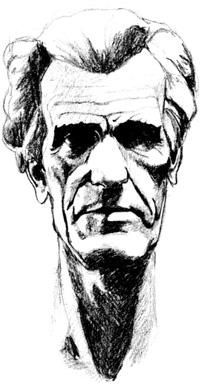
The familiar features of Andrew Jackson are an image of aging in the back settlements. Even in his middle years, the leathery face of this tough old warrior was ravaged by age. Jackson’s gaunt cheeks were deeply scarred by pain, his brow was lined and furrowed by constant care, and his deep-set eyes were marked by an ineffable sadness. Yet, this was the face of power, strong in the habit of command. The marks of age deepened its air of authority.
Old age also had another face in the back settlements. For every border chieftain who grew old in authority and all the mountain grannies who bullied the young bucks of the neighborhood, there were other men and women for whom old age brought a kind of social death. This had long been the cruel rule of tanistry in the British borderlands, where the strong were treated with deference and the weak were despised and abandoned.
thirty, and was very strong after fifty. In these patterns we may ask what proportion rounded their ages up and down—that is, how many made themselves older, and how many younger.
The evidence showed nothing like the extravagant youth bias of Americans in the twentieth century. But neither did it show the strong age bias of New England or the Chesapeake in the seventeenth and eighteenth centuries. Attitudes of backcountry men and women toward age were very mixed. Except when they approached twenty-one, backcountry men and women tended to show a strong youth orientation into their fifties, and also a pronounced age bias in the later years of life.10
These border and backcountry age ways differed from the customs of other regions in British America, and also from attitudes in our own time. But they were not unique. Similar patterns have also appeared in many human cultures which survive precariously on the edge of insecurity. It was this factor that lay behind the principle of tanistry in North Britain, and that also caused Patrick Calhoun to be honored in the Long Cane, and Aunt Genevy to be instantly obeyed, whilst the “silent, childish and morose” old man in his cabin and the wandering old women of the woods were neglected and despised until death at last overtook them.