
 American Development: The Environment
British culture was not the only determinant of regional differences. The American environment also played an important role—not by “breaking down” or “dissolving” European culture (as the frontier thesis suggested) but by more complex material pressures which modified European cultures in some respects and reinforced them in others.
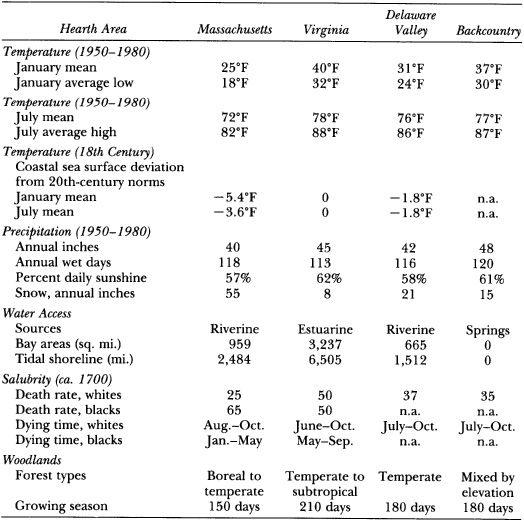
In New England, the Puritans selected a rigorous environment which was well suited to their purposes. The climate (colder and more changeable than today) proved exceptionally healthy to Europeans, but high mortality among African immigrants reinforced a Puritan ambivalence toward the growth of slavery. The configuration of New England’s coastline and the distribution of soil resources in small pockets of alluvial fertility encouraged town settlement. The Indians of Massachusetts Bay had been nearly destroyed by disease before the Puritans arrived; conflicts remained at a comparatively low level for nearly fifty years except during the Pequot War.
The Virginians encountered a very different environment. The Chesapeake Bay, with its 6,500 miles of tidal shoreline, its hundreds of rivers and creeks, and its abundance of good soil, encouraged scattered settlement and plantation agriculture. The climate (about the same as today) produced bountiful staple crops. But the Chesapeake estuary was unhealthy, and European death rates were twice as high as in New England. Africans had lower mortality rates than in the northern colonies, and slavery developed rapidly from the late seventeenth century. The large Indian population of the Powhatan Confederacy strongly resisted English settlement, with much bloody fighting.
The Delaware Valley offered yet a third set of environmental conditions. This area proved more salubrious than the Chesapeake, but less so than Massachusetts. Its climate was mild and its soil endowment was the richest of the eastern colonies, producing crop yields above all other coastal regions for three centuries. An abundance of mineral resources and a fall line only a few miles from the sea supported rapid industrial development. The Delaware Indians were not warlike in the early years of settlement. Altogether this environment was perfectly suited to the purposes of the Quakers, as they well knew when they chose to settle there.
Regional Cultures of Anglo-America: Environmental Conditions
For many years it supported their “holy experiment” in prosperity and peace.
The southern backcountry was a densely forested highland region of enormous proportions. Markets were distant and travel difficult, but the abundance of land and water encouraged the rapid growth of family farming and herding. The climate was comparatively mild and healthy. The Indians were numerous and very hostile to European settlement. The backcountry became a cockpit of international rivalry, and was ravaged by major wars in every generation from 1689 to 1815. The climate, resources and dangers of this American environment were well matched to the culture of the British borderlands.