
 The Jeffersonian Coalition: Virginia, Pennsylvania and the Backcountry against New England, 1801-25
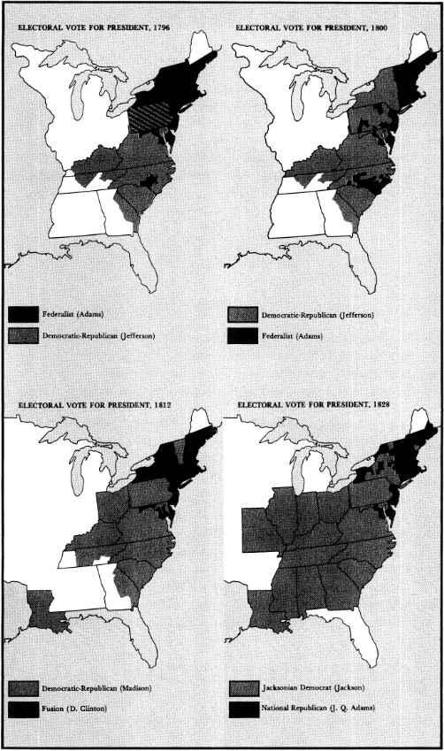
In 1800, Thomas Jefferson was elected President by the combined votes of the middle states, the coastal south and the southern highlands, against the entrenched opposition of New England which still strongly supported Adams.6 This new Jeffersonian coalition of Virginia, Pennsylvania and the backcountry was destined to dominate American politics for a quarter-century (1801-25). Its ideology was a complex and highly unstable combination of three different ideas of liberty, which derived not from “classical republicanism” in Europe but from the inherited folkways of British America. Jeffersonians in the middle and northern states believed in reciprocal liberty; the backcountry thought more in terms of natural liberty; tidewater Virginians drew upon their heritage of hegemonic liberty. The Republican leaders—Jefferson himself, Madison and Gallatin—had their own highly developed principles. Together they created a pluralist libertarian movement.7
But even as Jeffersonians espoused different libertarian ideals, they all opposed New England’s idea of ordered liberty, which most Americans regarded as a contradiction in terms. The major legislation of the Adams presidency was repealed: the Alien Friends Act, the Sedition Act, the Naturalization Act, the Bankruptcy Act of 1800, the Judiciary Act of 1801, and the new tax measures all were overturned. Support for the Federal party dwindled everywhere except New England. The purchase of Louisiana (1803) and the annexation of West Florida (1810) vastly enlarged the backcountry, and promised to shift the balance of regional power toward the south and west.
Now it was New England’s turn to think about disunion. In the period from 1804 to 1814, a separatist movement gathered strength in that region. It was very different from backcountry separatism. In place of mobs and lynchings there were sermons and town meetings which talked of God’s Providence for his chosen people. Yankee children were taught to sing (to the tune of Rule Britannia): “Rule, New England! New England rules and saves!”8 One little girl stitched this sentiment into a sampler:
Amy Kittredge is my name,
Salem is my dwelling place
New England is my Nation.
And Christ is my salvation.9
The Federalist leader Fisher Ames believed that New England was “of all colonies that were ever founded, the largest, the most assimilated, and to use the modern jargon, nationalized, the most respectable and prosperous, the most truly interesting to America and to humanity, more unlike and more superior to other people (the English excepted).”10
New England Republicans shared this nascent sense of Yankee nationalism. James Winthrop, for example, praised the determination of New Englanders to “keep their blood pure.” He added, “ … the eastern states have, by keeping separate from the foreign mixtures, acquired their present greatness in a century and a half, and have preserved their religion and morals.”11
These feelings were most intense from 1807 to 1814, when the American republic was caught up in a bitter conflict between Tory Britain and Napoleonic France. The Jefferson administration desperately sought a way of defending national honor by the Great Embargo, an “experiment in peaceful coercion” which virtually
stopped America’s foreign trade from 1807 to 1809. The effect of this policy was greatly to increase material disparities between American regions. Jefferson’s embargo was an economic disaster which fell hardest on his own region; it shattered the staple agriculture of the coastal south, and encouraged industrial development in New England and the Delaware Valley.12
The War of 1812 divided the nation more deeply than any event since the Revolution, on both regional and party lines. Once again, the coastal south and backcountry strongly supported the war: of 60 Congressmen from those regions, 52 voted for it, and only 8 against. New England and the middle states were internally divided, and experienced an unprecedented growth of organized political parties, and a revolutionary surge in popular participation in democratic politics. These divisions prevented disunionist movements from developing in the northern states, but the democratization of politics increased the cultural differences between the north and south—adding another dimension to regional disparities.13