
 The Republican Coalition versus the Solid South, 1880-96
When the southern states returned to the union, sectional voting patterns instantly reappeared in national politics, stronger than ever. In every presidential election from 1880 to 1908, the south voted as a single bloc, casting virtually all of its electoral ballots for candidates of the Democratic party. The expression “solid South” was popularized in this period.8
In these years, the great majority of electoral votes in the northern states were also united behind the Republican candidate.
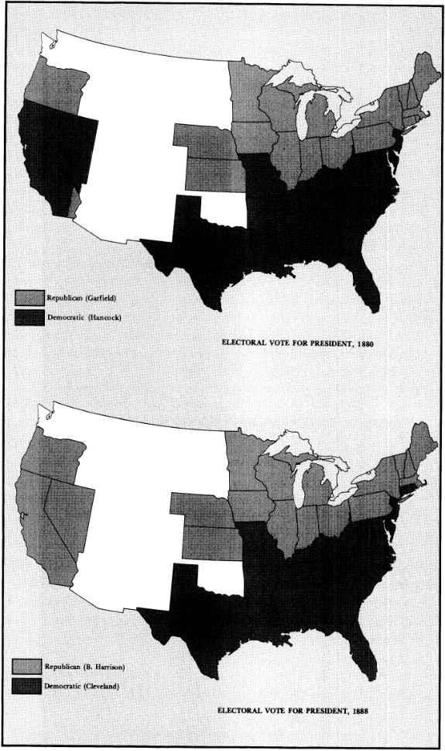
The only exception occurred in 1892 when Populists carried electoral votes in six western states, and Democrat Grover Cleveland ran strongly in the north. Otherwise, regional identities were absolutely the decisive factor in every presidential election from 1880 to 1908.
Regional voting patterns were even stronger and more persistent in Congress. The most detailed study of Congressional voting in this period concludes that “sectional competition … has been and remains the dominant influence on the American political system.” Social scientist Richard Bensel finds evidence in roll-call analyses that “the geographical alignment of sectional competition has undergone very little change in the last one hundred years [1880-1980].”9
Bensel discovered that Congressional voting was primarily regional on most leading questions in this era, including tariffs, military pensions, contested elections, admission of new states, imperialism and foreign policy. Other scholars also discovered strong regional patterns in other issues. On the Bland Free Coinage Bill (1892), and the Gold Standard Act (1899), for example, New England Congressmen voted as a bloc, and the south was almost equally united. The middle states were rather more mixed.10 These major Congressional issues were not merely collisions of material interest. They were also conflicts of cultural value.11
Regional identity was not, of course, the only determinant of political behavior in this period. Ethnicity, class and party loyalty also made a difference. But these other factors were closely interlocked with cultural regionalism. In terms of class, for example, the dominant elite in one section tended to ally itself with the proletariat in the other. Republican Speaker Thomas Reed of New England declared that it was “just as fair for the Republicans to poll ignorant Negroes in the South as for Democrats to poll ignorant immigrants in the North.”12
Partisan allegiance was also very strong in this era. Party battles between Democrats and Republicans were exceptionally hard-fought, and often decided by paper-thin pluralities. The dominant
Republican coalition could not afford to lose any of its regional components—not New England and the northern tier, or the midland states, or even Appalachia. It is interesting to observe that most Republican Presidents in this period had backgrounds which included more than one cultural region. Lincoln, Grant, Hayes, Arthur, McKinley, Theodore Roosevelt, Harding and Hoover all in various ways symbolized the union of New England, the midlands and parts of Appalachia which together constituted the Republican coalition.