
 The New Deal Coalition: Ethnic and Regional Cultures
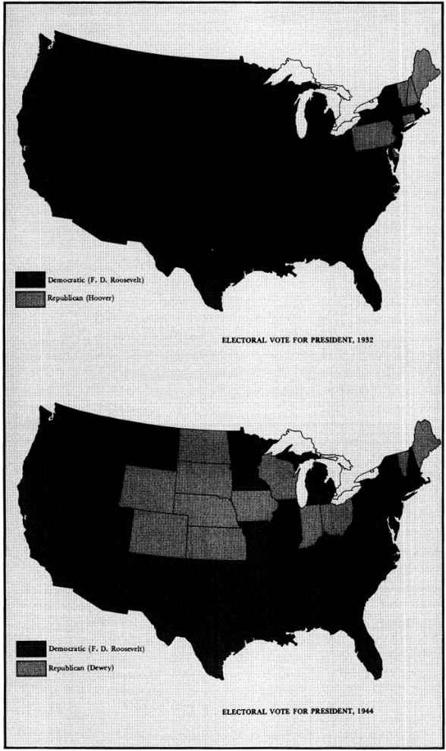
The new immigrants were slow to move into positions of leadership in the United States. A complex system of discrimination by licensing, quotas and covenants kept their numbers small in prestigious professions, the strongest schools and the best neighborhoods. But by 1932 their voting strength made a powerful difference in American politics and produced a major realignment of ethnic and regional groups which put Franklin Roosevelt in the White House.
During the Great Depression, the sufferings of southern farmers and northern workers created the basis for a new coalition which was destined to dominate national politics for nearly twenty years. This New Deal coalition united disparate cultural groups who shared little more than their common revulsion to the cultures, policies and moral purposes of the Republican coalition that had failed so dismally during the Great Depression. The political economy of laissez-faire and the Protestant ethic had been discredited by the Depression. The “noble experiment” of ordered freedom in national prohibition was regarded as a social disaster. This was a period when “puritanism” became a pejorative term in American speech. Descendants of the great migration were ridiculed as absurd and pathetic figures in Sinclair Lewis’s Main Street and Grant Wood’s American Gothic.
The old Republican coalition still remained strong, especially in the northern and midland rural regions which had been settled from New England and Pennsylvania. The states of Maine and Vermont voted Republican in every presidential election but one from 1856 to 1960.20 Republican candidates also ran strongly in the parts of the old northwest (Ohio, Indiana, Michigan, and Wisconsin), in the many northern plains states (Iowa, Nebraska, Kansas and the Dakotas), and in the Pacific northwest state of Oregon. In the depths of the Depression, the old Republican coalition still remained the strongest single culture in American politics. But the growing pluralism of American society now made it impossible for that cultural bloc to dominate national politics as it had done from 1860 to 1932.
The New Deal coalition was a response to this development. It united the many enemies of the old Puritan ethic: Catholic immigrants, Jewish intellectuals, southern gentlemen, black sharecroppers, Appalachian mountain folk, Texas stockmen and California hedonists. All joined in one movement improbably led by a patrician Democrat of New England stock from New York.
The various groups who supported Roosevelt all believed that the national government should play a larger economic role. But they did not share the same moral values and cultural purposes. The policies of New Deal reflected this diversity of cultural origins. It was an American middle way, “slightly left of center” in Franklin Roosevelt’s favorite phrase—a series of pragmatic
experiments designed to preserve the capitalist and democratic fabric of American society by increasing public intervention in the material life of the nation. At the same time, the New Deal also opposed public legislation on questions of private morality. It abolished national prohibition, and rejected the moral activism of the Republican coalition.
Here was the central paradox of the New Deal—material intervention and moral non-intervention. It increased the economic role of government, but diminished its role as the instrument of any single system of ethnic or regional culture. The south received strong material support, but was not required to change its folkways. The ethnic cultures of new immigrants in northern cities were given economic aid in many forms, but legislative challenges to their culture were abandoned. The cultural hegemony of the Republican coalition was finally destroyed.