
 Regional Patterns of Cultural Behavior
The persistence of American regionalism also appeared in every federal census, which continues even today to yield evidence of greater differences between American regions than among European nations. Further, these patterns show remarkably strong linkages with the distant colonial past.
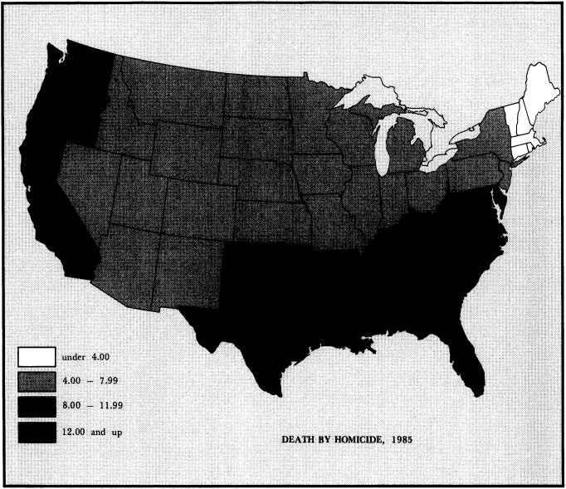
A case in point are statistics of order and violence in the United States. In 1982, the murder rate in the nation as a whole was 9.1 per 100,000. This level of violence was four times higher than most western countries. But within the United States, the homicide rate differed very much from one region to another. The northern tier, from New England across the northern plains to the Pacific northwest, tended as always to have the lowest rates of homicide: 3.8 in Massachusetts, 2.1 in Maine, 3.1 in Wisconsin, 2.3 in Minnesota, 0.9 in North Dakota, 4.4 in the state of Washington. The middle states, on the other hand, had murder rates that were moderately higher, but below the national average: 5.7 in Pennsylvania, 7.2 in the middle west, 5.7 in Kansas, 6.0 in Colorado. Homicide rates were much higher in the upper coastal south. The south Atlantic states averaged 10.9 murders per 100,000 in 1982. The southern highlands and the southwestern states had extremely high murder rates—14.7 in the west south-central states, and 16.1 in Texas, Homicide rates were also high in northern cities with large populations of southern immigrants, both black and white. But southern neighborhoods occupied by migrants from the north tended to have low homicide rates. These patterns are highly complex; many ethnic and material factors clearly have an impact. But in ecological terms, homicide rates throughout the United States correlate more closely with cultural regions of origin than with urbanization, poverty, or any material factor.
One may ask why this is the case. Why have American regions preserved these differences for so long a time? The pattern is particularly striking in New England, because it has persisted in the face of sweeping ethnic changes. Three centuries ago, New England was Congregationalist; today it is mostly Roman Catholic.10 In 1650, its white population was almost entirely English; it has become heavily Irish, Italian and French Canadian. Even so, levels of social violence remain low in New England, just as they have stayed high in the southern highlands. Why?
Some scholars offer a materialist explanation: the comparative wealth of New England against the poverty of the southern highlands. But many a hardscrabble Yankee hill town is poor and orderly, and more than a few southwestern communities are rich and violent.
Others argue that southern violence is mainly a legacy of ethnic or racial diversity. But some of the most violent communities in the southern highlands have no black residents at all, and are in ethnic terms among the most homogeneous in the nation. At the same time, many New England communities are ethnically diverse and yet comparatively peaceful.
A few scholars have explained southern violence in terms of its frontier legacy. But New England was once a frontier too. An occasional explanation of southern violence refers to the Civil War, or to the hot climate or even to human necessity. When one southerner was asked why so many people were killed in his region, he answered that “there were just more folks in the South that needed killing.”11
A less colorful but more promising explanation is cast in institutional terms. At an early date, each regional culture developed its own institutions of order and violence which have persisted powerfully through time. The laws of New England have always given little latitude to violence. This pattern began in Puritan Massachusetts during the seventeenth century; it still existed in the 1980s when Massachusetts enacted the toughest gun-control statutes in the nation.
The laws of New England are actively supported by other institutions. For more than three centuries town schools have taught children not to use violence to solve their social problems. Town meetings strongly condemn internal violence. Town elites teach others by example that violence is not an acceptable form of social behavior in New England. In short, violence “isn’t done” in the prescriptive sence. And when it is done, the regional culture of New England has little tolerance for violent acts, and punishes them severely.
All of these tendencies run in reverse throughout the old southwest and southern highlands. The principle of lex talionis is still part of Texas law, which allows a husband to kill his wife’s lover in flagrante delictu. Texas places comparatively few restraints on the ownership of firearms. Texas schools and schoolbooks glorify violence in a way that those of Massachusetts do not. Texas elites still live by the rule of retaliation, and murder one another often enough to set an example. Texas is entertained by displays of violence; Massachusetts is not amused. In short, violence simply is done in Texas and the southern highlands, and always has been done in this culture—since before the Civil War and slavery and even the frontier—just as it had been done in the borderlands of North Britain before emigration,12
Similar regional disparities. also inherited from the distant past. appeared in other social indicators. A good example is education. By 1980, elementary education was universal in the United States. But large regional differences existed in patterns of secondary schooling and higher education. The proportion of youngsters who graduated from high school varied broadly from one region to another. The highest graduation rates were in the northern tier; the top three states were Minnesota (91%); Connecticut (90%) and North Dakota (90%). Midland states were in an upper middling range (Pennsylvania, 78%. New Jersey 78%, Ohio 80%), and the upper south was in a lower middling position (Maryland, 76%, Virginia, 74%), The lowest states were in the deep south (Georgia, 63%, Louisiana, 63%, and Florida, 62%), and the southwest was also very low (Arizona, 63%, Nevada, 65%, California, 67%), as were northern or midland cities with heavy
immigration from the south (New York, 64%, Michigan, 68%, District of Columbia, 57%). These trends did not correlate with school spending. But they were closely linked to inherited regional attitudes toward education.13
Similar patterns also appeared in higher education. Exceptionally high levels of college attendance were to be found in the northern states originally settled by New England Puritans and Yankees. In Massachusetts, Connecticut, Maine, and Vermont approximately 20 percent of the population had completed four years of college by 1980. The proportion was also comparatively high across the northern tier and in the Great Basin—17 percent in Minnesota, 19 percent in the states of Washington and Oregon, 20 percent in Utah and 23 percent in Colorado. The ratio, was lower in other regions: 16 percent in the midland states, and 15 percent in the coastal south. The lowest levels were in the southern highlands of West Virginia (10.4%), Arkansas (10.8%), Kentucky (11.1%), Alabama (12.2%), Mississippi (12.3%) and Tennessee (12.6%). This regional pattern did not correlate with urbanization or with public spending on higher education. Once again, primary determinants were traditional attitudes toward learning in these various regions.14
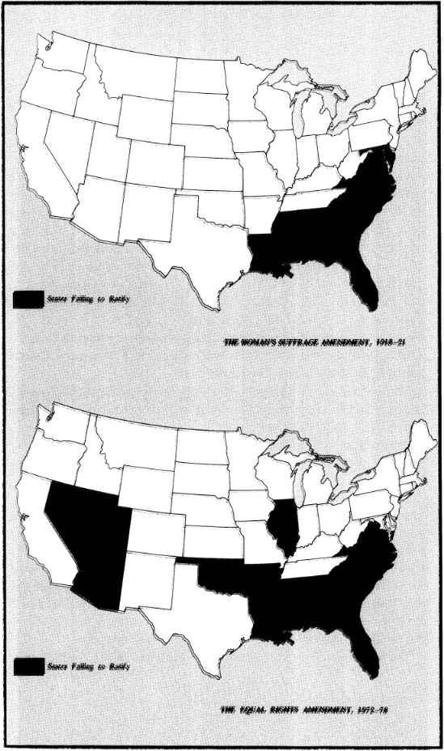
Similar regional differences also persist in attitudes toward gender. In the seventeenth and eighteenth centuries, as we have seen, the status of women was comparatively high in New England and the Delaware Valley, low in Virginia, and lowest in the backcountry. These regional differences persisted through four centuries. The northern states supported women’s suffrage in the nineteenth and twentieth centuries, while the South and especially the southwest consistently opposed the enfranchisement of women. In the late twentieth century, precisely the same pattern appeared in voting on the Equal Rights Amendment. Every state in the northern tier voted in favor of this measure. All states in the southern highlands voted against it. The fact that this pattern has persisted for so long a time is evidence that it cannot be explained merely as a temporary cultural lag. It is produced by deep-seated differences in regional cultures.
Yet another pattern of persistence appears in the public life of the major cultural regions. In every region, the dominant forms of local government are descended from institutions which were introduced in the seventeenth and early eighteenth century. Most New England communities still govern themselves through town meetings. This system has spread through the northern tier to New York, Ohio, Michigan, Wisconsin, Minnesota and the Dakotas. Pennsylvania preserves its county commissions. Virginia and the coastal south are still controlled by county courthouse elites. The tone of government in these regions has remained remarkably stable through many generations.
Further, levels of governmental activity (measured by public spending) have remained relatively the same for three centuries. In the mid-eighteenth century, levels of taxation for state and local governments were roughly twice as high in New England as in Virginia, with the Delaware Valley somewhere in between, and the backcountry below all other regions. Precisely the same patterns still appear today, even when controlled by population and wealth. In 1981, for example, a family of four with an income of $75,000 paid state and local taxes of $10,900 in Boston, $7,000 in Philadelphia, $5,700 in Norfolk, $4,800 in Louisville and $4,600 in Houston. Relative levels of taxing and spending by region have changed remarkably little in many generations.15