
1 Gunnar Myrdal, An American Dilemma (1944, rpt. New York, 1962), 7.
2 The exponents of the germ theory were especially interested in continuities of land tenure such as socage, and political institutions such as the tun and folk-moot. Many early dissertations at Johns Hopkins attempted to establish these linkages, with limited success. No historian in the late 19th century had a sufficient command of archives on both sides of the Atlantic to settle the question. The germ theory lay beyond the empirical reach of American historical scholarship for three generations. For a survey of this literature see J. M. Vincent et al., Herbert B. Adams (Baltimore, 1902), with a bibliography of his students’ works from 1876 to 1902.
3 The Turner thesis is older than Frederick Jackson Turner himself. Similar arguments were made by Cotton Mather and Benjamin Franklin, but Turner gave this idea its classical statement. He preserved the structure of the Teutonic “germ theory,” but argued that the European “germs” were less important than the American environment in which they grew, and specifically that “free land” encouraged the growth of democracy, capitalism and individualism. See generally Ray Billington, Westward Expansion (4th ed., New York, 1974), with a full bibliography; Lee Benson, Turner and Beard (Glencoe, 111., 1960); Ray Billington, Frederick Jackson Turner (New York, 1963); Richard Hofstadter, The Progressive Historians (New York, 1969).
4 Leading examples of the migration model are to be found in the work of Arthur Schlesinger Sr., Marcus Hansen, Oscar Handlin, and most recently Bernard Bailyn, The Peopling of British North America (New York, 1986), and Voyagers to the West: A Passage in the Peopling of America on the Eve of the Revolution (New York, 1986).
5 Albion was the first recorded name for the island of Britain, which was known to the Greeks in the 6th century B.C. as the “island of the Albiones.” This usage persisted for a thousand years. The venerable Bede began his History of the English Church and People thus: “Britannia, oceani insula, cui quondam Albion nomen fuit …” (Historical Works, ed. J. E. King (2 vols., London, 1929), I, 1011). The connotation of Albion changed through time; the Romans made “Albion” into a Latin pun on albus, “white,” for the cliffs of Dover. In German, it is still erroneously translated Weissland, “white land.” In French, “Albion” has become a pejorative for a nation which is thought to preach high ideals but not to practice them; an example was Napoleon’s sneer against “Albion perfide.” In the 19th century, romantic poets made Albion into an ornate alias for England rather than Britain, which was its original meaning.
6 William Graham Sumner, Folkways: A Study of the Sociological Importance of Manners, Customs, Mores and Morals (Boston, 1907), 2.
7 Eric Hobsbawm and Terence Ranger, The Invention of Tradition (Cambridge, 1983). This idea of folkways differs from folklore. The word “folklore” was coined by a British scholar William Thoms in 1846 as “the generic term under which are included traditional institutions, beliefs, arts, customs, stories, songs, sayings and the like current among backward peoples or retained by the less cultured classes of more advanced peoples.”
This idea of folklore was modified by scholars in the 20th century, but some of its biases still survive. Architectural historian Dell Upton observes that “in many treatments of folk culture, change is viewed as decay; folk culture is thought to be constantly threatened. It is a ‘dying’ thing which somehow never manages to expire.” This problem has led scholars such as Upton, James Deetz and Henry Glassie to shift their thinking from “folk” to “vernacular” culture. Cf. Dell Thayer Upton, “Early Vernacular Architecture in Southeastern Virginia” (thesis, Brown, 1980); Richard M. Dorson, Handbook of American Folklore (Bloomington, 1983), xi-xii, xiv, 115, 323-40.
8 Scholars regularly rediscover the persistent power of ethnicity and regional culture in modern societies without being able to explain it except in material terms. See, for example, Michael Hechter, Internal Colonialism: The Celtic Fringe in British National Development, 1536-1966 (London, 1975), which argues that the survival of “ethnic solidarity” in Britain was caused by a division of labor in which some ethnic groups were kept in inferior positions by a process of “internal colonialism.” The argument of the present work is different—that cultural systems have their own imperatives, and are not mere reflexes of material relationships. This is not to argue against the power of material forces, but for a more balanced conception of the problem in which material structures are seen as part of a cultural whole.
9 Sumner, Folkways, 86.
10 The following empirical indicators are employed here:
|
Folkway |
Qualitative Indicators |
Quantitative Indicators |
|
Speech |
pronunciation, vocabulary, grammar |
speech frequencies |
|
Building |
styles, plans, methods, materials |
modal building types |
|
Family |
family ideas, language and law |
completed size, household composition |
|
Marriage |
courtship and marriage customs |
age at marriage, proportion married |
|
Gender |
ideas and language |
|
|
Sex |
ideas and language |
prenuptial pregnancy; bastardy; fertility |
|
Naming |
qualities of namesakes |
forename frequencies, descent ratios, etc. |
|
Child-rearing |
ideas of child nature and nurture |
sending-out frequencies |
|
Age |
ideas of age relations |
age-heaping patterns |
|
Death |
ideas of fatalism |
|
|
Religion |
worship rituals; church architecture |
church membership |
|
Magic |
magic customs |
frequency of witchcraft proceedings |
|
Learning |
institutions and rituals |
total education rate |
|
Literacy |
attitudes toward literacy and orality |
signature-mark frequencies |
|
Food |
foods, cooking and eating methods |
foodstuff frequencies |
|
Dress |
sumptuary laws, dress norms |
|
|
Sport |
common games, ideology of sport |
|
|
Work |
work ethics |
work force composition |
|
Time |
ideas of time; calendars; holidays |
seasonality indicators |
|
Wealth |
ideas of wealth |
grants, Gini ratios, SSTT, zero-holdings |
|
Inheritance |
intestacy rules |
sibling shares |
|
Rank |
criteria, language, rituals of rank |
rank distribution |
|
Association |
ideals of settlement |
settlement patterns, persistence |
|
Order |
ideas of order and ordering institutions |
crime rates; indictments; penalties |
|
Power |
institutions of local government |
voting, officeholding, taxing and spending |
|
Freedom |
libertarian ideas and customs |
1 Ashmole Ms. 36.37 folio 100v, Bodleian Library, Oxford.
2 This, the departure from Cowes on the morning of March 29, 1630, proved to be a false start. But John Winthrop took it in his journal to be the true beginning of his voyage. In fact the ship did not pass through the Needles until 8 April 1630. Winthrop’s Journal, ed. James K. Hosmer (2 vols., New York, 1908), I, 23, 29 March 1630.
The spelling of the ship’s name is disputed by New England historians. Winthrop wrote it as Arbella, others as Arabella; see Edward Channing, History of the United States (6 vols., New York, 1905-25), I, 330n; and Winthrop Papers, Stewart Mitchell, ed. (5 vols., 1929, rpt. New York, 1968), II, 239n.
3 A passenger list compiled by C. K. Bolton appears in Albert K. Rogers, Voyage of the Arbella, 1630 (Boston, 1930); another list is in the Winthrop Papers, II, 276.
4Winthrop’s Journal, I, 23-49.
5 John Winthrop, “General Observations for the Plantation of New England,” May 1629, Winthrop Papers, II, 114.
6 For general discussions of the great migration, see C. M. Andrews, The Colonial Period of American History (4 vols., New Haven, 1934-38), I, chap. 18; and Carl Bridenbaugh, Vexed and Troubled Englishmen (New York, 1967), chaps. 11, 12; Puritan movement to the Caribbean is the subject of A. P. Newton, The Colonising Activities of the English Puritans (New Haven, 1914), and Susanna Fischer, “The Providence Adventure” (thesis, Princeton, 1983); for emigration to Ireland see Philip S. Robinson, The Plantation of Ulster; British Settlement in an Irish Landscape, 1600-1670 (Dublin, 1984).
On the history of the great migration, the Essex County Record Office in Chelmsford, Essex, contains in its reading room many unpublished dissertations, both British and American, touching various aspects of this subject. Of particular value is Norman C. P. Tyack, “Migration from East Anglia to New England before 1660” (thesis, Univ. of London, 1951); David Cressy, Coming Over: Migration and Communication between England and New England in the Seventeenth Century (Cambridge, 1987).
7 This standard estimate, contemporary with the event, was made by Edward Johnson of Woburn, who migrated to the New World in 1630, probably in the ship Arbella with Governor Winthrop. Johnson reckoned that between 1630 and 1640 the number of “Men, Women and Children passing over this wide Ocean, as near as at present can be gathered, is also supposed to be 21,200 or thereabout.” His estimate of the number of emigrant ships is clouded by a typographical error. One passage reported 298 vessels; another, 198. Winthrop’s journal mentioned more than 100 vessels (many by name), and in approximately sixty instances supplied the number of passengers, at a little above 100 per ship. This suggests that the correct number of shiploads is 198. For text and learned commentary see Edward Johnson, Johnson’s Wonder-working Providence 1628-1651, ed. J. F. Jameson (New York, 1910), 58-61.
A radically different estimate has recently been offered by an American economist who argues that the true size of the great migration to New England was only a little above 10,000. He obtains this result as a residual from estimates of fertility, mortality, emigration and total population—some of which may be mistaken; cf. Henry A. Gemery, “Emigration from the British Isles to the New World, 1630-1700; Inferences from Colonial Populations,” Research in Economic History V (1980), 179-233; this difficult question will be discussed in more detail in a forthcoming work.
8 Only one of the 198 vessels in the great migration was lost—the ship Gabriel, on the coast of Maine near Pemaquid in 1635; Johnson, Wonder-working Providence, 61.
1 MAHSC, 4th series, IV, 293.
2 Most American historians agree on the centrality of religion in the Puritan great migration, but some English historians take a more secular view, and one wishes to abolish the word “Puritan” from historical usage altogether; see Tyack, “Migration from East Anglia”; Cressy, Coming Over, 74-106; Patrick Collinson, “Concerning the Name Puritan,” JECH 31 (1980), 483-88.
Empirical evidence for the primacy of religion appears in repeated statements not only by leaders such as Richard Mather, John Winthrop, Thomas Dudley, John Cotton, Thomas Shepard and Thomas Hooker, but also by ordinary emigrants such as indentured servant Roger Clap, tailor John Dane, housewife Lucy Downing and many others. Evidence to the contrary consists of occasional complaints by Puritan leaders that some migrants were not religious enough; and of criminal proceedings against men such as bigamist Christopher Gardiner (banished from the Bay Colony) and fugitive William Schooler (hanged for rape and murder). Altogether, most American historians agree with John White, who observed the great migration at first hand and wrote as early as 1630, “necessity may press some, novelty draw on others, hopes of gain in time to come may prevail with a third sort; but that the most and most sincere and godly part have the advancement of the Gospel for their main scope I am confident” (The Planter’s Plea(London, 1630)).
3Records of the Governor and Company of the Massachusetts Bay in New England, ed. Nathaniel B. Shurtleff (5 vols., Boston, 1853-54), I, 1.
4 John Winthrop, “A Modell of Christian Charity Written on Board the Arrabella on the Atlantick Ocean,” Winthrop Papers, II, 282-95.
5 Frederick J. Simmons, Emmanuel Downing (n.p., 1958), 43.
6 John Dane, “A Declaration of Remarkabell Prouidenses in the Corse of My Lyfe,” NEHGR 8 (1854), 154; for many testimonies to the importance of personal religion as the primary motive for migration see George Selement and Bruce C. Woolley, eds.,Thomas Shepard’s Confessions, CSM Pubs. 58 (1981), 108, 113, 131; Alexander Young, Chronicles of the First Planters of the Colony of Massachusetts Bay (1846, rpt. Williamstown, 1978); and Cotton Mather, Magnalia Christi Americana (1702, rpt. 1852, New York, 1967), which publishes excerpts from journals since lost.
7 Alan Simpson, Puritanism in Old and New England (Chicago, 1955), 21.
8 Edmund S. Morgan, Visible Saints; The History of a Puritan Idea (New York, 1963), chaps. 1-3.
9 Kenneth A. Lockridge, “The History of a Puritan Church, 1637-1736,” NEQ 40 (1967), 397-424.
10 In Rowley the local minister, Ezekiel Rogers, added as a test for membership his own creed, “I professe myselfe to have lived and to dye an unfeigned Hater of all the Base opinnions of the Anabaptists and antinomians, and all other phrentiche dotages of the times that spring from them which God will ere longe cause to be as dung upon the earth.” Quoted in Patricia O’Malley, “Rowley, Massachusetts” (thesis, Boston College, 1975), 23; statistics of church membership in Sudbury and Watertown are from Johnson,Wonder-working Providence, 74, 197.
11 Richard Gildrie found the following pattern in church membership of Salem men, by wealth:
|
Land Holdings (acres) |
Church Members (%) |
N |
|
100 + |
83.3 |
30 |
|
60-99 |
81.3 |
16 |
|
30-59 |
75.1 |
42 |
|
10-29 |
41.7 |
67 |
|
.1-10 |
35.4 |
79 |
|
None |
25.0 |
4 |
|
Total |
53.4 |
238 |
Source: Richard P. Gildrie, “Salem, 1626-1668: History of a Covenanted Community” (thesis, Univ. of Va., 1971), 153.
12 Thomas J. Wertenbaker, The Puritan Oligarchy (New York, 1947).
13 Mather, Magnalia Christi Americana, I, 274.
14 For annotated texts of the creeds and covenants of Salem Church (1629, 1636), Boston Church (1630), Windsor Church (1647), and the two Cambridge Platforms (1646, 1648) see Williston Walker, ed., The Creeds and Platforms of Congregationalism (1893, rpt. Boston, 1960).
15 The Synod of Dort (1618-19) of the Dutch Reformed Church, with German Calvinists and English Puritans sitting in, produced the “Five Points” of Calvinism which included: (1) total depravity, (2) limited atonement, (3) unconditional election, (4) irresistible grace and (5) the final perseverance of the saints (that is, no backsliding). These doctrines emerged in the process of declaring the teachings of Jacobus Arminius to be a Calvinist heresy. The Five Points were generally accepted by Congregationalists in New England; the texts appear with an English translation in Philip Schaff, The Creeds of Christendom (4th ed., New York, 1905), III, 540-97. See also A. W. Harrison, The Beginnings of Arminianism to the Synod of Dort (London, 1926).
16 A major statement was John Cotton, Covenant of God’s Free Grace (London, 1645). The importance of the idea of the covenant to the Puritans was developed by Champlin Burrage, The Church Covenant Idea (Philadelphia, 1904), and enlarged by Perry Miller in “The Marrow of Puritan Divinity,” Errand into the Wilderness (Cambridge, 1956), 48-98; and The New England Mind: the Seventeenth Century (1939, rpt. Cambridge, 1954).
17 Norman Pettit, The Heart Prepared; Grace and Conversion in Puritan Spiritual Life (New Haven, 1966); Philip F. Gura, A Glimpse of Sion’s Glory; Puritan Radicalism in New England, 1620-1640 (Middletown, Conn., 1984), 50.
18 Cotton Mather, Bonifacius, ed. David Levin (1710, rpt. Cambridge, 1966), 64-65. An excellent discussion of the Puritan idea of love appears in Stephen Foster, Their Solitary Way (New Haven, 1971), 41-64.
1 Some of these recommendations appear in Young, Chronicles of the First Planters, 165ff., and in the Winthrop Papers.
2 The first and in many ways the most detailed analysis was Tyack, “Migration from East Anglia.” Tyack has also published “The Humble Puritans of East Anglia and the New England Movement: Evidence from the Court Records of the 1630’s,” NEHGR 138 (1984), 79-106. Other studies include T. H. Breen and Stephen Foster, “Moving to the New World: The Character of Early Massachusetts Immigration,” WMQ3 30 (1973), 189-222; and Virginia DeJohn Anderson, “Migrants and Motives: Religion and the Settlement of New England, 1630-1640,” NEQ58 (1985), 339-83.
3 Breen and Foster, “Moving to the New World,” 189-222. Anderson, “Migrants and Motives,” 339-83. Of major ethnic stocks, in American history, only the Germans approached this proportion of migration in family groups.
4“The Zealous Puritan,” 1639, in C. H. Firth, The American Garland; Being a Collection of Ballads Relating to America, 1563-1759 (Oxford, 1915), 25-26.
5 Anderson shows that this distribution of ages was remarkably similar to the population of England in 1636:
|
New England s Immigrants (Anderson) |
England’s Population (1636) (Wrigley and Schofield) |
||
|
0-14 |
11.6% |
0-14 |
12.4% |
|
5-14 |
19.6% |
5-14 |
19.7% |
|
15-24 |
26.15% |
15-24 |
17.7% |
|
25-59 |
41.65% |
25-59 |
42.03% |
|
60 + |
00.97% |
60 + |
8.12% |
The only exception was the proportion of immigrants over sixty. The Massachusetts Puritans, because of the intensity of their respect for age, gave much attention to the presence of elderly emigrants among them. Thomas Welde in 1632 reported “many aged passengers” in his ship, “twelve persons being in all able to make well nigh one thousand years.” But every quantitative test shows that the proportion of emigrants over sixty was in fact very small—less than 1%, compared with 8–10% in England at that time. Cf. Everett Emerson, ed., Letters from New England: The Massachusetts Bay Colony, 1629–1638 (Amherst, 1676); Anderson, “Migrants and Motives,” 195, 339-83; E. A. Wrigley and R. S. Schofield, The Population History of England, 1541-1871 (Cambridge, 1981), table A3.1.
6 Computed from shipping lists in John C. Hotten, The Original Lists of Persons of Quality; Emigrants and Religious Exiles … Who Went from Great Britain to the American Plantations, (rpt. Baltimore, 1962); slightly different estimates appear in Herbert Moller, “Sex Composition and Correlated Culture Patterns of Colonial America,” WMQ3 2 (1945), 113-53; Breen and Foster, “Moving to the New World”; Tyack, “Migration from East Anglia”; and Anderson, “Migrants and Motives.”
7 They included the Hon. Charles Fiennes; Sir Richard Saltonstall and his son; Isaac Johnson, Esq.; John Winthrop, Esq.; and Messrs. Benjamin Brand, Robert Feake, Josiah Plaistow, William Pynchon, George Alcock, Simon Bradstreet, Richard Browne, William Coddington, Robert Cole, John Dillingham, Thomas Dudley, Samuel Freeman, Ralph Glover, Edward Jones, John Masters, Thomas Mayhew, William Pelham, Israel Stoughton and Thomas Stoughton, Nathaniel Turner, Arthur Tyndale and William Vassall. Altogether these gentlemen were 27 out of 247 heads of families in the Winthrop fleet. Others also arrived in the great migration. See Charles E. Banks, The Winthrop Fleet of 1630 (Boston, 1930), 52-54.
8 Tyack, Anderson, and Breen and Foster all generally agree on this question, with minor differences of emphasis.
9 Anderson, “Migrants and Motives,” 366.
10 Emerson, Letters from New England, 92; Anthony C. Salerno, “The Character of Emigration from Wiltshire to the American Colonies” (thesis, Univ. of Va., 1977), table IV.
11 Cressy, Coming Over, 52-63, is a valuable discussion of this neglected subject but Cressy counts as servants everyone in a household of a different name—an upper-bound estimate.
12 Thomas Dudley to the Countess of Lincoln, 12 March 1630/31, NHHSC 4 (1834), 224-49; John Winthrop to John Winthrop, Jr., 23 July 1630, Winthrop Papers, II, 306.
13 The Puritans themselves reckoned the cost at £54 for a family of six; a modern computation yields the same result; see Cressy, Coming Over, 108.
14 Kenneth Lockridge, Literacy in Colonial New England (New York, 1974); David Cressy, Literacy and the Social Order: Reading and Writing in Tudor and Stuart England (Cambridge, 1980). These two works are not precisely comparable. Lockridge’s estimates should be treated as an upper-bound estimate of illiteracy in Massachusetts; Cressy’s as a lower-bound of illiteracy in England. The difference was probably even greater; see below, “Massachusetts Learning Ways.”
15 Five tabulations of occupations among emigrants to New England yield the following result:
|
Occupations |
Anderson (n = 139) |
Tyack (n = 147) |
Salerno (n= 124) |
Breen-Foster (n = 42) |
Cressy (n = 242) |
|
Professional |
3.6% |
27.2% |
2.4% |
4.8% |
2.1% |
|
Agriculture |
33.8% |
16.3% |
28.2% |
26.2% |
22.3% |
|
Cloth trades |
25.2% |
23.1% |
24.2% |
23.8% |
20.7% |
|
Other crafts and trades |
35.3% |
29.9% |
45.2% |
40.5% |
28.9% |
|
Maritime |
2.2% |
3.4% |
0.0% |
4.8% |
1.2% |
|
Laborers |
n.a. |
n.a. |
n.a. |
n.a. |
4.1% |
|
Servants |
n.a. |
n.a. |
n.a. |
n.a. |
20.7% |
|
Total |
100.1% |
99.9% |
100.0% |
100.1% |
100.0% |
16 Anderson, “Migrants and Motives,” 358. Of 590 immigrants, more than 200 came from the city of London and the six large towns of Canterbury, Dover, Maidstone, Great Yarmouth, Norwich and Salisbury. This pattern is partly the result of bias in the ship lists available to Anderson, as she herself points out. But other inquiries yield much the same result.
1 Charles E. Banks, Topographical Dictionary of 288? English Emigrants to New England, 1620-1650 (Philadelphia, 1937).
2 G. Andrews Moriarity, “Social and Geographic Origins of the Founders of Massachusetts,” in A. B. Hart, ed., Commonwealth History of Massachusetts (5 vols., rpt. New York, 1966), I, 49-65.
3 Eight studies have obtained similar results. The largest and most detailed is still Charles E. Banks, The Planters of the Commonwealth; A Study of the Emigrants and Emigration in Colonial Times … (Boston, 1930), and Topographical Dictionary. His tabulations show that 51.3% of 2,885 emigrants came from the nine eastern counties. Banks was a careful historian, but the Topographical Dictionary was a posthumous work, and other scholars have found many inaccuracies. Its statistical results also understate the East Anglian connection with Massachusetts Bay, for they include emigrants to Plymouth (a different group), to New Haven (which drew heavily from London), and to New Hampshire and Maine (which attracted disproportionate numbers from the West Country).
Moriarity independently reached the same results in his “Social and Geographical Origins of the Founders of Massachusetts,” 49-65. Anderson found a similar concentration in her study of seven ship lists in the period 1635-38. Of 592 passengers whose origins she could identify, 188 (32%) came from Norfolk and Suffolk; 182 (31%) were from Kent; and another third were scattered widely through the other counties of England. This pattern was partly produced by her sample, but is broadly consistent with other results (“Migrants and Motives,” 339-83). Anders Orbeck, in a study for his thesis on New England speech, concluded that “67.73 percent of New England immigrants came from the coast counties from (and including) London to the Wash.” That area comprises Essex, Suffolk, Norfolk and Lincoln; see Orbeck, Pronunciation in Early New England (Ann Arbor, 1927).
Similar conclusions were reached by Tyack, and also by Breen and Foster. David Grayson Allen does not directly address this question in In English Ways: The Movement of Societies and the Transferal of English Local Law and Custom to Massachusetts Bay in the Seventeenth Century (Chapel Hill, 1981), but in his unpublished dissertation he included a survey of geographical origins to all New England towns before 1650. The results, once again, appear to be broadly similar. Cf. “In English Ways” (thesis, Univ. of Wisconsin, 1974), appendix I, 415-26.
Breen and Foster have raised the important question of bias in ship lists, but precisely the same patterns also appear in independent evidence of elite origins and New England place names, reported below.
4 Lucy Winthrop Downing to John Winthrop, 4 March 1636/37; Simmons, Emmanuel Downing, 44.
5 Mather, Magnalia Christi Americana, I, 409; Allen, In English Ways, 166.
6 A detailed study has been made of one shipload of West Country Puritans who sailed in the Mary and John. They were recruited by the Rev. John White from Dorset, Devon and Somerset, and founded the town of Dorchester in Massachusetts. But many left the Bay Colony within a few years, and settled in Connecticut. The descendants of this one shipload included many leading Connecticut families: Wolcott, Griswold, Ellsworth, Gibbs, Dewey, Burr and Gallup. John Winthrop called these settlers “the west country people.” Dudley referred to them as “the western men.” See Winthrop, Journal, I, 50; Dudley to Countess of Lincoln, 12 March 1631, Young, Chronicles of the First Planters, 314; and for a genealogy, Maude P. Kuhns, The “Mary and John” (Rutland, Vt., 1943).
7 Origins of New England’s immigrants, the Banks sample (corrected for errors of computation), were as follows:
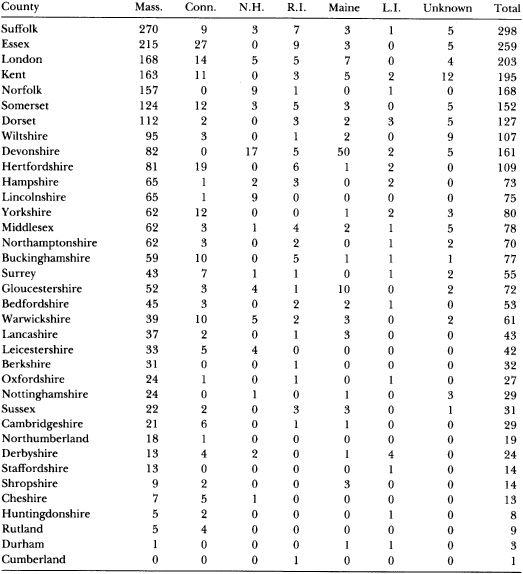
Compiled by Jonathan Schwartz from data in Banks, Topographical Dictionary, whose totals differ in several details.
8 Regional origins of emigrants in the Winthrop fleet (1630) were as follows: Suffolk, 159; Essex, 92; London, 78; Lincolnshire, 17; Norfolk, 8; Northamptonshire, 22; Yorkshire, 8; Leicestershire, 7; Kent, 7; Nottinghamshire, 5; Lancashire, 6; Surrey, 5; Wiltshire, 1; Oxfordshire, 3; Warwickshire, 2; Middlesex, 3; Buckinghamshire, 2; Hertfordshire, 2; Hampshire, 5; Rutland, 2; Berkshire, 1; Cambridgeshire, 1; Cheshire, 1; Netherlands 5. Compiled by Hadley Lewis from Banks, The Winthrop Fleet.
9 Another way of approaching this problem is to study the English origins of householders in individual towns. Studies of seven towns yield the following results: Boston (n = 141): Suffolk and Essex, 59%; London 10%; scattering, 31 %; Sudbury (n = 52): Suffolk, Essex and Hertford, 36%; Wiltshire, Dorset and Hampshire, 36%; London, 9%, scattering, 19%; Ipswich (n= 121): Suffolk, 20%; Essex, 20%; Herts., Norf., Lines., and Kent, 23%; Middlesex, 9%; scattering, 28%; Hingham (n = 114): Norfolk, 59%; other Eastern counties, 16%; scattering 25%; Watertown (n = 82): Suffolk, 51%; Essex 17%; London and Middlesex, 12%; scattering, 20%; Rowley (n = 32): Yorkshire, 91%; East Anglia, 9%; Newbury (n= 74): Wiltshire and Hampshire, 61%; East Anglia, 10%; scattering, 29%. By and large, towns in what are now Essex, Suffolk, Norfolk and Middlesex counties of Massachusetts drew most heavily from East Anglia. The area around Scituate harbor on the South Shore was settled from Kent. Exceptions included the towns of Dorchester (Dorset and Lancashire), Lancaster (Lancashire and Yorkshire) and Weymouth (Dorset and Somerset). Other colonies in New England, beyond the borders of Massachusetts, drew from different sources: Plymouth (n = 40): London, 55%; Yorkshire, 13%; Essex and Norfolk, 10%; scattering, 22%; New Haven (n = 110): London, 52%; East Anglia, 22%; Kent, 9%; Yorkshire, 9%; scattering, 8%. Sources include Darrett B. Rutman, Winthrop’s Boston: Portrait of a Puritan Town, 1630-1649(Chapel Hill, 1965), 138; Edward S. Perzel, “The First Generation of Settlers in Colonial Ipswich, Massachusetts 1633-1660” (thesis, Rutgers, 1967), appendix II; and Allen, In English Ways, appendix; William Bradford, Of Plymouth Plantation, 1620-1647, ed. S. E. Morison (New York, 1952), appendix; and Floyd Shumway, “Early New Haven and Its Leadership” (thesis, Columbia, 1971), 22; impressionistic but generally accurate generalizations about many other towns appear in Moriarity, “Social and Geographic Origins of the Founders of Massachusetts,” 49-65; also helpful is Anne R. Yentsch, “Expressions of Cultural Diversity and Social Reality in Seventeenth Century New England,” (thesis, Brown, 1980).
1 Charlestown (pronounced Charlton) was not named directly for Charles I, but after the Charles River, which Captain John Smith had named long before the Puritans arrived.
2 The following towns in the Massachusetts Bay Colony were named after English communities through 1660:
|
Haverhill (Suffolk) |
Newbury (Berkshire) |
Rowley (Yorkshire) |
|
Ipswich (Suffolk) |
Salisbury (Wiltshire) |
Weymouth (Dorset) |
|
Lynn (Norfolk) |
Medford (Kent) |
Sudbury (Suffolk) |
|
Cambridge (Cambridge) |
Boston (Lincoln) |
Dorchester (Dorset) |
|
Dedham (Essex) |
Braintree (Essex) |
Hingham (Norfolk) |
|
Woburn (Bedfordshire) |
Andover (Hampshire) |
Chelmsford (Essex) |
|
Groton (Suffolk) |
Lancaster (Lancashire) |
Hadley (Suffolk) |
|
Newton (Norfolk) |
Reading (Berkshire) |
Wrentham (Suffolk) |
|
Boxford (Suffolk) |
Marlborough (Wiltshire) |
Framingham (Suffolk) |
|
Springfield (Essex) |
Hull (Yorkshire) |
Malden (Essex) |
|
Topsfield (Essex) |
Billerica (Essex) |
Gloucester (Gloucs.) |
|
Manchester (Lancashire) |
Northampton (Northamptonshire) |
Of these 35 names, 22 came from the counties of Essex, Suffolk, Norfolk, Kent, Lincolnshire, Cambridgeshire, and Bedfordshire). The rest were scattered broadly throughout England. Two town names (Roxbury and Medfield) were of unknown origin. See William H. Whetmore, “On the Origins of the Names of Towns in Massachusetts,” MAHSP 12 (1871-73), 391-413. On the naming of Boston by Puritans from Lincoln (not by Capt. John Smith) see evidence cited in G. A. Taylor, “Lincolnshire and Massachusetts,” LNQ 21 (1930), 4-6.
3 This finding is important because it confirms the evidence of ship lists. Breen and Foster wondered whether the predominance of East Anglian emigrants in those documents might have been merely a source-bias. The answer is clearly negative. The same pattern appears in place names, and also in the origins of Massachusetts elites. We have three independent sources for English regional origins in the great migration. All yield similar results.
1 Of 129 university-trained ministers and magistrates known to have settled in New England, last known addresses were as follows: Suffolk, 18; Essex, 15; Lincolnshire, 13; Cambridge, 12; London, 11; Kent, 7; Yorkshire, 7; Hertfordshire, 5; Wiltshire, 5; Devon, 4; Norfolk, 3; Somerset, 3; Lancashire, 3; Buckinghamshire, 2; Cheshire, 2; Hampshire, 2; Lancashire, 2; Northamptonshire, 2; Surrey, 2; Leicestershire, 2; Bedfordshire, Cornwall, Dorsetshire, Gloustershire, Huntingdonshire, Middlesex, Northumberland, Oxfordshire, Rutland, Shropshire, Staffordshire, Wales, Warwickshire and Worcester, 1 each; unknown, 1. Compiled mainly from biographical data in S. E. Morison, The Founding of Harvard College (Cambridge, 1935), 359-410; see also Harry S. Stout, “University Men in New England, 1620-1660: A Demographic Profile,” JIH 4 (1974), 357-400; idem, “The Morphology of Remigration: New England University Men and Their Return to England, 1640-60,” JAS 10 (1976), 151-172.
2 Computed from the same sources.
3 At least 35 are known to have studied at Emmanuel, 13 at Trinity and 7 at Magdalen College, Cambridge. These are lower-bound estimates.
4 Rebecca Seward Ralph, “Emmanuel College, Cambridge, and the Puritan Movements of Old and New England” (thesis, Univ. of Southern California, 1979); Morison, Founding of Harvard College, 92-107.
5 Reginald C. Dudding, “Alford and America,” in History of the Parish and Manors of Alford … (Horncastle, 1930), 145-81; the family linkages appear in The Parish Register of Alford …; LRSV (1917), 6.
6 Alice Morse Earle, Customs and Fashions in Old New England (New York, 1893, rpt. Rutland, Vt., 1973), 71.
7 Sarah Story’s name was variously spelled Storey or Storre.
8 Edmund Morgan, The Puritan Family: Religion & Domestic Relations in the Seventeenth Century (1944, rev. ed., New York, 1956), 150.
9 Charles M. Andrews, Pilgrims and Puritans (New Haven, 1926), 166.
10 Harriet Beecher Stowe, Oldtown Folks (1869), in Kathryn Kish Sklar, ed., Harriet Beecher Stowe (New York, 1982), 891.
1 This apocryphal remark is attributed both to Charles I and to Charles II. East Anglians quote it as a comment on the excellence of their roads; others remember it as a complaint against the poverty of their soil; cf. N. Kent, General View of the Agriculture of Norfolk (London, 1796), 16.
2 For the use of “turnips and pease [to] manure the land,” see Sir Thomas Sclater Manor Book, CAMBRO.
3 B. A. Holderness, “East Anglia …,” in Joan Thirsk, ed., The Agrarian History of England and Wales, 1640-1750, vol. 5.1, Regional Farming Systems (Cambridge, 1984), 197-238; M. R. Postgate, “Field Systems of East Anglia,” in Alan R. H. Baker and Robin A. Butlin, eds., Studies of the Field Systems in the British Isles (Cambridge, 1973), 281-324; N. Riches, The Agricultural Revolution in Norfolk (Chapel Hill, 1937); Eric Kerridge, The Agricultural Revolution (London, 1967); R. A. C. Parker, Coke of Norfolk(Oxford, 1975); Arthur Young, A Farmer’s Tour in the East of England (4 vols., London, 1771).
4 John Patten, “Towns in the National Urban System—East Anglia,” English Towns, 1500-1700 (Folkestone, Kent, 1978), 244-96; Felix Hull, “Agriculture and Rural Society in Essex, 1560-1640” (thesis, Univ. of London, 1950), 3; two very rich sources for this region are Thomas William Bramston, ed., The Autobiography of Sir John Bramston, KB. (London, 1845); and John Bruce, ed., Diary of John Manningham (Westminster, 1868).
5 B. E. Supple, Commercial Crisis and Change in England, 1600-1642: A Study in the Instability of a Mercantile Economy (Cambridge, 1959), 102-12.
6 J. O. Halliwell ed., The Autobiography and Correspondence of Sir Simonds D’Ewes, Bart., during the Reigns of James I and Charles I (2 vols., London 1845), ca. 1603.
7 Arne Bang-Andersen, Basil Greenhill and Egil Harald Grade, The North Sea: A Highway of Economic and Cultural Exchange; Character—History (Stavanger, Norway, 1985), 9-26, 151-66.
8 For graphic details of the Dutch presence in East Anglia, see Thomas William Bramston, Autobiography (London, 1845), 108; for East Anglian Puritans in the Netherlands, see Raymond P. Stearns, Congregationalism in the Dutch Netherlands: The Rise and Fall of the English Congregational Classis, 1621-1635 (Chicago, 1940).
9 Arthur Gray, “Massacre at the Bra Ditch,” Cambridge Antiq. Comm. 31 (1931), 77-87; W. M. Palmer, “Notes on Linton” (1937), ms. B20, Cambridge Univ. Library, 39.
10 Francis Hervey, ed., Suffolk in the Seventeenth Century; The Breviary of Suffolk by Robert Reyce, 1618 (London, 1902), 13; for the raids of 1626-27 and the panic they caused, see Ruth Hughey, ed., The Correspondence of Lady Katherine Paston, 1603-1627(Norwich, 1941), 91; and Mary Anne Everett Green, Diary of John Rous, Incumbent of Santon Downham, Suffolk, from 1625 to 1642, CS 66 (1856), 9 (15 March 1627).
11 K. P. Witney, The Jutish Forest (London, 1976).
12 The Peasants’ Rebellion occurred mainly in Kent, Essex, Suffolk, Norfolk, Cambridge, Huntingdon, Hertford, Middlesex and Surrey. See Edgar Powell, The East Anglian Rising in 1381 (Cambridge, 1896); for the ethnic character of this movement see Witney,The Jutish Forest, 186 (Walsingham: “totem illud Kentensium et Juttorum”). For Clarence’s Rising and Buckingham’s Revolt see E. F. Jacob, The Fifteenth Century, 1399-1485 (Oxford, 1961), 580, 625-26.
13 Clive Holmes, The Eastern Association in the English Civil War (Cambridge, 1974).
14 Lollardy was a movement that arose in the 14th century, and generally espoused doctrines of predestination, limited atonement, and consubstantiation. The social and theological attitudes of the Lollards were similar in some ways to those of the Puritans three centuries later. Lollardy was by no means confined to the eastern counties. But after its suppression it proved most persistent in East Anglia, Kent and the Thames Valley. For the distribution of leading centers of Lollardy before and after Oldcastle’s Rising in 1414 see Malcolm Falkus and John Gillingham, Historical Atlas of Britain (New York, 1981), 80; see also Claire Cross, Church and People, 1450-1660 (Glasgow, 1978); Kenneth W. Skipps, “Lay Patronage of East Anglian Puritan Clerics in Pre Revolutionary England” (thesis, Yale, 1971); J. D. Fines, “Studies in the Lollard Heresy; Being an Examination from the Dioceses of Norwich, Lincoln, Coventy, Lichfield, and Ely” (thesis, Sheffield, 1964).
15 The distribution of Marian martyrs was as follows: Kent, 59; Essex, 52; London, 47; Sussex, 27; Suffolk, 25; Middlesex, 13; Hertfordshire, 13; Norfolk, 10; Cambridgeshire, 3; the rest of England and Wales, 35. See John D. Gay, The Geography of Religion in England (London, 1971); P. Hughes, The Reformation in England (London, 1953), II, 260-64.
16 During the 1580s, the distribution of Puritan ministers has been estimated as follows:
|
Ministers |
Locations |
|
|
Essex |
88 |
78 |
|
Suffolk |
77 |
58 |
|
Norfolk |
51 |
47 |
|
Rutland and Northamptonshire |
49 |
42 |
|
Lincoln |
33 |
33 |
|
Kent |
30 |
27 |
|
Sussex |
27 |
24 |
|
Cambridgeshire |
13 |
14 |
|
Hertfordshire |
20 |
12 |
|
Bedfordshire and Huntingdonshire |
11 |
9 |
|
Other counties |
103 |
97 |
|
Total |
502 |
441 |
Source: Allen, In English Ways, 10, tabulating data from Patrick Collinson, “The Puritan Classical Movement in the Reign of Elizabeth I” (thesis, Univ. of London, 1957), II, 1252-81. A few counties are missing, but would not alter the result in a material way. An independent study which obtained the same result was Ronald G. Usher, The Reconstruction of the English Church (2 vols., New York, 1910), I, 248.
17 William Hunt, The Puritan Movement: The Coming of the Revolution in an English County, (Cambridge, 1983), x.
18 Quoted in John Strype, Analysis of the Reformation (Oxford, 1824), II, pt. 2, p. 282.
19 On the connection between Arminianism and Lincolnshire, see Emory Battis, Saints and Sectaries: Anne Hutchinson and the Antinomian Controversy in the Massachusetts Bay Colony (Chapel Hill, 1962), 249-85; for the linkage between London, Middlesex and Arminianism, see Shumway, “Early New Haven,” and Isabel Calder, New Haven Colony (New Haven, 1934); on the Puritan “middle way,” the classical work is still Cotton Mather, Magnalia Christi Americana. The argument of this work was developed in scholarly detail by Congregational historians in the 19th century, in particular Henry Martin Dexter and Williston Walker. Their work in turn was generalized by Perry Miller. These historians showed little interest in the social or regional origins of the Puritan middle way. But if one compares the small number of religious writers whom Perry Miller drew together as The New England Mind, most came from Suffolk, Essex and Norfolk, and were educated at Cambridge.
20 Cressy, Literacy and the Social Order; Havelock Ellis, A Study of British Genius, new ed. (Boston, 1926), 25-36.
21 R. W. Ketton-Cremer, Norfolk in the Civil War (1969, Norwich, 1985), 20.
1 Francis Higginson, “Journal,” in Young, Chronicles of the First Planters, 228-33.
2 Mather, Magnalia Christi Americana, I, 42.
3 Hubert H. Lamb, The Changing Climate: Selected Papers (London, 1966), 16.
4 William Wood, New England’s Prospect, ed. Alden Vaughan (1634, rpt. Amherst, Mass., 1977), 29.
5 These generalizations summarize demographic patterns of high complexity, which will be discussed in forthcoming monograph on death in New England.
6 An exception was the Narragansett or “South Country” of Rhode Island and southeastern Connecticut, where the climate was similar to southern New Jersey or northern Maryland. This subject will be discussed in volume II; for attempts to introduce slavery to Massachusetts see Lorenzo Johnston Greene, The Negro in Colonial New England (New York, 1924).
7 These places are identified in Bernard and Lotte Bailyn, Massachusetts Shipping, 1697-1714 (Cambridge, 1959).
8 W. R. Baron, “Eighteenth Century New England Climate Variation and Its Suggested Impact on Society,” MEHSQ 21 (1981-82), 201-14; David C. Smith, “Climate Fluctuations and Agriculture in Southern and Central New England,” ibid., 179-200.
9 In the environmental history of New England, one might stand the Wittfogel thesis on its head. The absence of hydraulic problems allowed an open society to develop; cf. Karl Wittfogel, Oriental Despotism: A Comparative Study of Total Power (New Haven, 1957).
10 S. W. Tromp, Medical Biometeorology: Weather, Climate and the Living Organism (Amsterdam, 1963).
11 Arnold Toynbee, A Study of History (12 vols., 1934-61, rpt. New York, 1962), II, 65.
1 Thomas Dudley to Countess of Lincoln, 12 March 1631, in Young, Chronicles of the First Planters, 312; Johnson, Wonder-working Providence, 66.
2 American historians have much to learn from Geoffrey Blainey, The Tyranny of Distance; How Distance Shaped Australia’s History (Melbourne, 1966, 1974).
3 Lucy Winthrop Downing to John Winthrop, n.d., Winthrop Papers, MAHS; Simmons, Emmanuel Downing, 43.
4 Nathaniel B. Shurtleff, Records of the Governor and Company of the Massachusetts Bay in New England (5 vols. in 6, Boston, 1853-54), I, 252-53; 13 Mar. 1639.
5Ibid., I, 104, 152, 1 Apr. 1633; 7July 1635.
6 John Winthrop, Charles Fiennes, Richard Saltonstall, Isaac Johnson, George Philips, Thomas Dudley, William Coddington and others, The Humble Request of His Majesties Loyal Subjects, the Governour and the Company Late Gone for New England; to the Rest of Their Brethren in and of the Church of England (London, 1630). Contemporary comment on this work appears in John Rous, Diary, 54, 7 June 1630.
7Mass. Bay Records, II, 228 (1648).
8 Cotton Mather, The Way to Prosperity (Boston, 1690), 33; Samuel Eliot Morison, The Intellectual Life of Colonial New England (1936, rpt. Ithaca, 1956), 75.
9 Albert H. Marckwardt, American English (2d ed., rev., New York, 1980), chap. IV, “Colonial Lag and Leveling,” 69-90.
1 The Norfolk whine was one of a family of closely related eastern dialects. A leading authority defines this “southeastern speech region” as having extended from “Norfolk to Kent inclusive” in the period from 1500 to 1700; see E. J. Dobson, English Pronunciation, 1500-1700 (2 vols., Oxford, 1968), I, xxv.
H. T. Armfield argues that “the speech of the New Englanders is largely indebted to the county of Essex, and especially to the valley of the Colne” in “The Essex Dialect and Its Influence in the New World,” EAST 4 (1893), 245-53; see also S. F. Hoar, “The Obligations of New England to the County of Kent,” AAS Proceedings, n.s. 3 (1885), 344-71; see also Augustus M. Kelley, Suffolk Words and Phrases (1823, rpt. New York, 1970); Edward Gepp, An Essex Dialect Dictionary (London, 1923); Helge Kokeritz, “The Juto-Kentish Dialect Boundary,” AS 16 (1941), 270-77.
On the Norfolk whine, see R. Forby, The Vocabulary of East Anglia (2 vols., 1830); G. J. Chester, “Norfolk Words Not in Forby’s Vocabulary,” NA 5 (1859), 188-93; W. G. Waters, “Norfolk Words Not Found in Forby’s Vocabulary,” NA 8 (1879), 167-74; H. Orton and P. M. Tilling, Survey of English Dialects: III, The East Midland Counties and East Anglia (Leeds, 1969-71).
Also related was the dialect of east Lincolnshire. In the northern and western parts of that county, people spoke a broad midland accent, similar to that of Nottinghamshire, Derbyshire and south Yorkshire. But the fen dwellers of Lincoln and Norfolk had similar speech ways in the 17th century. This east Lincoln accent included words such as argify, ax, arsy-varsy, begum, bile (for boil), blab (for talk), bust, caant (for cannot), codger, consarn, dowter (for daughter), edicated, forrard, hessle (to chasten), jabber, kid (for child), mawkin, quality (for gentry), rumpus, shaant, talk (conversation), teeny (small), uppish (proud), varmint (for vermin). See Jabez Good, A Glossary or Collection of Words, Phrases, Place Names, Superstitions, etc., Current in East Lincolnshire(n.p., n.d., copy in LINCRO); see also R.E.G. Cole, Glossary of the Words in Use in South-West Lincolnshire (Wapentake of Graffoe) (London, 1886); and J. Ellet Brogden, Provincial Words and Expressions Current in Lincolnshire (London, 1866); Edward Peacock, A Glossary of Words Used in the Wapentakes of Manley and Corringham, Lines. (London, 1889).
2 Most scholars agree. Anders Orbeck writes, “We are to look for the roots of Eastern Massachusetts speech in the eastern dialects of England” (Early New England Pronunciation as Reflected in Some Seventeenth Century Town Records of Eastern Massachusetts[thesis, Columbia, 1925, rev. ed., Ann Arbor, 1927]). M. Schele de Vere observes of the first generation in Massachusetts that “they brought not only their words which the Yankee still uses, but also a sound of voice and a mode of utterance which have been faithfully preserved, and are now spoken of as the ‘New England drawl,’ and the high metallic ring of the New England voice … is nothing but the well-known ‘Norfolk Whine.’” Americanisms; The English of the New World (New York, 1872); see also Herbert J. Tjossem, “New England Pronunciation before 1700” (thesis, Yale, 1955).
One of the best general discussions is still George Philip Krapp, The English Language in America (2 vols., New York, 1925), II, 124; see also G. H. Grandgent, “From Franklin to Lowell: A Century of New England Pronunciation,” PMLA 14 (1899), 207-39; Henry Alexander, “The Language of the Salem Witch Trials,” AS, 3 (1927-28), 390-400; C. H. Grandgent, Fashion and the Broad A in Old and New England (Cambridge, 1920).
3 Through many centuries it preserved archaic constructions such as housen for houses, and blowth for blossoms which were rarely recorded in other parts of British America, and had been commonly used in East Anglia. S. A. Green, Natural History and Topography of Groton, Massachusetts (Groton, 1912), 74; James Russell Lowell, The Biglow Papers, series II (Boston, 1867), introduction.
4 Speech ways in Massachusetts and East Anglia were dynamic in their nature. Patterns of pronunciation recorded in the 20th century are only an echo of earlier practices. The best guides to the Yankee twang in its classical form are not the speech maps of scholars in the 20th century, but more casual descriptions, rhyming patterns and orthography in the 17th, 18th and 19th centuries. See John Pickering, A Vocabulary or Collection of Words and Phrases … Peculiar to the United States (Boson, 1816), 42; John Lambert, Travels through Canada and the United States (3 vols., London, 1814), II, 505; see also Noah Webster, A Grammatical Institute of the English Language (Hartford, 1783), I, 6; Groton Records, 130; New Haven Records, 97; Mass Bay Records, I, 238, 241; J. F. Cooper, Pioneers, ed. J. F. Beard (Albany, 1980), chap. xv.
In East Anglia similar pronunciations in “the eastern dialect” were recorded by Alexander Gil in his Logonomia Anglica in 1916; for a general discussion see Dobson, English Pronunciation, 1500-1700 1, 147-52.
5 A New England word list compiled in the 19th century by J. B. Moore may be taken as representative of many such lists. He compared the speech of the “typical Yankee” or “country Jonathan” with standard English, as follows:
“Aimest for earnest; Actilly, actually; Ax, ask; Arter, after; Airly, early; Ain’t, is not; Bellowses, bellows; Better, bellow; Bin, been; Bile, boil; Bimeby, by and by; Blurt out, to speak bluntly; Bust, burst; Caird, carried; Chunk, a piece; Cuss, curse, [also] a mean fellow; Close, clothes, Darsn’t, dare not; Darned, a polite way of saying damned; Desput, desperate; Du, do; Dunno, don’t know; Dror, draw; Eend, end; Tamal, eternal; Etamily, eternity; Ef if; Emptins, yeast; Es, as; Fur, far; Forrard, forehead, or forward;Ferfle, fearful; Ferrel, ferrule; Feller, fellow; Fust, first; Foller, follow; Furrer, furrow; Git, get; Gret, great; Gal, girl; Grouty, sulky; Gut, got; Gump, a foolish or full fellow; Gum, to impose upon; Hed, had; Housen, houses; Het, heated; Hull, whole; Hum, home; Hev, have; Ideno, I don’t know; Inimy, enemy; Idees, ideas; Insine, ensign; Inter, into; Jedge, judge; Jest, just; Jine, join; Jint, joint; Keer, care; Ketch, catch; Kinder, similar; Kittle, kettle; Let daylight into him, to shoot or destroy him; Lick, to beat or whip; Lights, lungs;Mash, marsh; Mean, stingy; Offen, often; Ole, old; Peek, peep; Pint, a point; Popler, popular; Popple, poplar; Put out, troubled, or vexed; Riled, angry; Riz, rose or risen; Sass, sauce; Sassy, impertinent; Sartin, certain; Set by or sot by, admired; Sich, such; Slarter, slaughter; No great shakes, not much account; Meetin’ heouse, meeting house; Nower’s, nowhere; Pooty, pretty; Pizen, poison; Scaly, mean; Scrouging, hard labor; Soi, sat; Picter, picture; Snaked out, pulled out; Streaked, mean;Scoot, to run away; Sogerin, shirking; ‘Somers, somewhere, Suthin, something; Take on, to mourn; Taters, potatoes; Tetch, touch; Sost, so as to; Darter, daughter; Wal, well; Wuz, was; Puddn, Pudding; Winder, window; Hins, hens; Ter rites, presently; Harrer, harrow; Harrer up yer feelins, to excite your feelings; Put out, offended; Straddle over, step over; Grouty, cross or angry; Terbarker or Barker, tobacco; Pester, annoy; Sharder, shadow; Pesky, offensive; Larnin, learning; Turkle, turtle; Tootin, blowing on an instrument; Sho, an exclamation of surprise; Duds, clothes; Nuther, neither; Natur, nature; Yaller, yellow; I swow, or I swan, another way of saying I swear; Edicated, educated; This ere, this here; That are, that there; Seed, saw; Hist, hoist; T’other, the other. Words ending with the syllable ing were pronounced as though the final consonant, g, was silent.”
Moore commented that “for many years after the settlement of New England, the majority of the people who were not well educated were in the habit of pronouncing many of the common words in use in a very peculiar manner. … The typical Yankee or country Jonathan always talked in this dialect.” History of the Town of Candia (Manchester, N.H., 1893), 324; other early New England word lists and records of pronunciation appear in Timothy Dwight, Travels in New England and New York, ed. Barbara Miller Solomon (3 vols., Cambridge, Mass., 1969); John Drayton, Letters Written during a Tour through the Northern and Eastern States of America (Charleston, S.C., 1794), 58; and Andrew Beers, Beers’ Almanack for the Year 1808 (New Haven, 1807), 23.
The pattern of orthography in town and colony records also contains many clues which have been studied systematically by Anders Orbeck, with results summarized in Early New England Pronunciation.
6 Bernard Bloch, “The Treatment of Middle English Final and Preconsonantal R in the Present-Day Speech of New England” (thesis, Brown, 1935); and “The Post Vocalic R in New England Speech,” Actes du IVe Congrès Internationale de Linguistes(Copenhagen, 1938), 195-97; Gordon E. Bigelow, “More Evidence of Early Loss of [r] in Eastern American Speech,” AS 30 (1955) 154-56; Vivian S. Lawrence, “Dialect Mixture in Three New England Pronunciation Patterns: Vowels and Consonants” (thesis, Columbia, 1960); Robert L. Parslow, “The Pronunciation of English in Boston, Massachusetts: Vowels and Consonants” (thesis, Univ. of Michigan, 1967); Peter and Jane Benes, American Speech: 1600 to the Present, DSNEF, 1983(Boston, 1985).
7 Dwight, Travels, I, 368-69.
8 Edmund B. O’Callaghan, ed., Documentary History of the State of New York (4 vols., Albany, 1849-51), I, 678; see also Martha Jane Gibson, “Early Connecticut Pronunciation: Guilford, 1639-1800; Branford, 1644-1800” (thesis, Yale, 1933); Claude Mitchell Simpson, “The English Speech of Early Rhode Island, 1636-1700” (thesis, Harvard, 1936); and Tjossem, “New England Pronunciation before 1700.”
There were also individual variations. New England’s Puritan poet Edward Taylor constructed his rhyme schemes with a distinct Leicester accent. Taylor was a comparative latecomer to New England, having been born in Sketchley, Leicestershire, probably in the year 1642; he emigrated in 1668. See Bernie Eugene Russell, “Dialectical and Phonetic Features of Edward Taylor’s Rhymes: A Brief Study Based upon a Computer Concordance of his Poems (6 vols., thesis, Univ. of Wisconsin, 1973); also Karl Keller, A Concordance to the Poems of Edward Taylor (Washington, 1973), and Donald E. Stanford, ed., The Poems of Edward Taylor (New Haven, 1960.
9 Nathaniel Ward, The Simple Cobler of Aggawam (London, 1647).
10 Dwight, Travels, I, 368.
1 The best introduction to English vernacular architecture is Eric Mercer, English Vernacular Houses (London, 1975); see also R. W. Brunskill, Timber Building in Britain (London, 1985); and John and Jane Penoyre, Houses in the Landscape: A Regional Study of Vernacular Building Styles in England and Wales (London, 1978); more specialized works include C. A. Hewett, “Timber-Building in Essex,” AMST, n.s. 9 (1961), 32-56; O. Rackham, “Grandie House: On the Quantities of Timber in Certain East Anglian Buildings in Relation to Local Supplies,” VA 13 (1982), 39-47; H. C. Hughes, “Some Notes on the Character and Dating of Domestic Architecture in the Cambridge District,” CASP 37 (1935-36), 1-23; F. W. Steer, Farm and Cottage Inventories of Mid-Essex, 1635-1749 (Colchester, 1950); F. A. Gurling, “Suffolk Chimneys of the Sixteenth Century,” SIAP 22 (1934-36), 104-7.
Specially helpful are careful modern studies of demolished buildings in the east of England; D. G. Macleod, “Cottages on the East Side of Rochford Market Square,” EJ 1 (1966), 25-37; and Ian G. Robertson, “The Archaeology of the Ml Motorway in Essex, 1970-1975,” EJ 10 (1975), 68.
On New England architecture see Abbott L. Cummings, The Framed Houses of Massachusetts Bay, 1623-1675 (Cambridge, 1979); R. G. St. George, “Set Thine House in Order …,” in New England Begins: The Seventeenth Century (3 vols., Boston, 1982), II, 159-351; and Anthony Garvan, “The New England Plain Style,” CSSH 3 (1960), 106-22.
2 R. J. Brown, The English Country Cottage (London, 1979), 105.
3 This form of sheathing is called weatherboarding or woodcladding in England today. But in the 17th century it was called clapboarding—a term which survives in the United States. On wooden clapboards as “indigenous to the South-east,” see R. J. Brown,English Farmhouses (London, 1982), 172. They were particularly common in Kent, Essex and eastern Hertfordshire near the Essex border.
4 These patterns are highly complex. To summarize briefly, framing techniques in East Anglia and New England were similar in the following respects:
1. Crownposts and clasped purlins were common in the east; roof construction in other English regions (especially the north) ran more to king-posts (if box-built).
2. Internal chimney-stacks were preferred to chimneys on gable ends.
3. Tenons were secured by one or two pins at most, even on chimney girts.
4. Roof-frames consisted of close-built principal and common rafters; rather than principal rafters, ridge pieces, and common purlins.
5. Roof scantling (and other timbers) tended to be more slender than in the west and north of England.
6. Bays were functionally spaced on the lower floor but regularly spaced on the upper floor.
7. Windbraces in the roof sometimes rose above the purlins rather than falling below them.
The leading authorities are C. A. Hewett, The Development of English Carpentry, 1200-1700: An Essex Study (London, 1969); and “Some East Anglian Prototypes for Early Timber Houses in America,” PMA 3 (1969), 100-121; “Seventeenth Century Carpentry in Essex,” PMA 5 (1971), 77-087; and Cummings, Framed Houses of Massachusetts Bay, 95-117.
5 A “twelve pitch” roof in the lexicon of New England house carpenters is a roof that rises 12 inches in height for every 12 inches in depth.
6 When this house was demolished in 1961, it was studied in close detail; see AC 77 (1961), 92-93; C. W. Chalkin, Seventeenth-Century Kent (London, 1965), 237.
7 Basil Oliver, Old Houses and Village Buildings in East Anglia, Norfolk, Suffolk and Essex (London, 1912); Arthur Oswald, Country Houses of Kent (London, 1933); Abbott Cummings observes of the “hall and parlor” plan of the Mayflower Cottage of Colne Engaine, Essex, that “this well established plan type set a pattern which has persisted through three and a half centuries and survives today in modified form in the modern American builder’s vocabulary of styles as Garrison, Colonial and Cape Cod house.” (Framed Houses of Massachusetts Bay, 6.)
See also Allen G. Noble, Wood, Brick and Stone, The North American Settlement Landscape; vol I, Houses (Amherst, 1984), 23-25; Alfred E. Poor, Colonial Architecture of Cape Cod, Nantucket and Martha’s Vineyard (New York, 1932); Ernest A. Connally, “The Cape Cod House,” SAHJ, 19 (1960), 47-56; Henry Glassie, Pattern in the Material Folk Culture of the Eastern United States (Philadelphia, 1968), 128-30, discusses the spread of the Cape Cod house through upstate New York and the Old Northwest (the states of Ohio, Indiana, Illinois, Michigan and Wisconsin).
8 For an example from central Kent, see Chalkin, Kent, 237.
9 This structure was destroyed in the 18th century; it is known through a drawing of doubtful authenticity, reproduced in Cummings, Framed Houses of Massachusetts Bay, 144.
10 Penoyre and Penoyre, Houses in the Landscape, 78.
11Ibid.
12 Elizabeth G. Farrell, “Essex Rural Settlement” (thesis, Wales, 1969).
1 On this subject we have two classics of American historiography: Edmund Morgan, The Puritan Family, and John Demos, A Little Commonwealth: Family Life in Plymouth Colony (New York, 1970). Morgan’s work is strong on ideas of the family; Demos gives more attention to actual conditions as revealed in probate and court records. I am much indebted to both historians.
2 Jonathan Mitchell, “Sermons from Psalms,” n.d., MAHS; quoted in Morgan, Puritan Family, 15.
3 Boston Sermons, 14 Jan. 1672, MAHS, as quoted in Morgan, Puritan Family, 143.
4 John Cotton, The Covenant of God’s Free Grace (London, 1645), 19-20.
5 William Stoughton, New Englands True Interest, Not to Lie (Cambridge, 1670), 33.
6 Stowe, Oldtown Folks, 1102.
7 Cotton, God’s Free Grace, 19.
8 John Cotton, Christ the Fountaine of Life (London, 1651), 33; quoted in Morgan, Puritan Family, 6-7; the Puritan idea of the family covenant is discussed in ibid., 6-9, 181; see also Champlin Burrage, The Church Covenant Idea (Philadelphia, 1904); Leonard J. Trinterud, “The Origins of Puritanism,” Church History 20 (1951), 55; Miller, Errand into the Wilderness and The New England Mind, 366-97.
9 The magnitudes of difference were very great, and have been replicated in many studies. See below, “Massachusetts Naming Ways.”
10 Robert L. Goodman, “Newbury, Massachusetts, 1635-1685: The Social Foundations of Harmony and Conflict” (thesis, Michigan State Univ., 1974), 65; the magnitudes of difference between Puritan and non-Puritan colonies cannot be accounted for by mortality rates.
11 Total numbers of children known to have been born to completed families and all families in New England were as follows:
|
Town |
Marriage Cohort |
Comp. |
All |
Town |
Marriage Cohort |
Comp. |
All |
|
Plymouth |
1st gen. |
8.3 |
n.a. |
1710-40 |
7.4 |
n.a. |
|
|
2nd gen. |
8.7 |
n.a. |
1740-50 |
7.4 |
n.a. |
||
|
3rd gen. |
9.3 |
n.a. |
1750-60 |
7.8 |
n.a. |
||
|
Andover Mass. |
1st gen. |
8.3 |
8.3 |
1760-70 |
8.3 |
n.a. |
|
|
2nd gen. |
8.7 |
8.1 |
Concord Mass. |
1750-70 |
7.1 |
5.4 |
|
|
3rd gen. |
7.6 |
7.2 |
Sturbridge Mass. |
1730-59 |
8.8 |
n.a. |
|
|
Waltham Mass. |
1671-80 |
9.0 |
n.a. |
Brookline Mass. |
1710-1810 |
7.2 |
6.5 |
|
1691-1700 |
8.3 |
n.a. |
Windsor Conn. |
1640-59 |
7.7 |
n.a. |
|
|
1701-10 |
8.4 |
n.a. |
1660-79 |
8.0 |
n.a. |
||
|
1711-20 |
8.5 |
n.a. |
1680-99 |
7.2 |
n.a. |
||
|
1721-30 |
9.0 |
n.a. |
1700-19 |
6.2 |
n.a. |
||
|
1731-40 |
9.7 |
n.a. |
1720-39 |
7.6 |
n.a. |
||
|
Hingham Mass. |
pre-1660 |
7.5 |
6.4 |
1740-59 |
6.6 |
n.a. |
|
|
1661-80 |
7.9 |
7.7 |
1760-79 |
7.1 |
n.a. |
||
|
1681-1700 |
6.0 |
5.5 |
Hampton N.H. |
1638-74 |
8.6 |
7.5 |
|
|
1701-20 |
5.6 |
4.8 |
1675-99 |
7.3 |
6.7 |
||
|
1721-40 |
6.8 |
5.7 |
1700-24 |
7.7 |
6.4 |
||
|
1741-60 |
7.2 |
6.3 |
1725-49 |
7.2 |
6.9 |
||
|
Milford Mass. |
1660-1710 |
8.4 |
n.a. |
Nantucket |
1680-1739 |
7.2 |
n.a. |
Compiled from Demos, A Little Commonwealth, 192; Philip J. Greven, Jr., Four Generations: Population, Land, and Family in Colonial Andover, Massachusetts (Ithaca, 1970); D. S. Smith, “Population, Family, and Society in Hingham, Massachusetts, 1635-1880” (unpubl. thesis, Berkeley, 1975); unpublished family reconstitution projects conducted under the direction of the author at Brandeis on Milford, Mass., by Sally Barrett; on Hampton, N.H., by Lawrence Kilbourne; on Nantucket by Carol Shuchman and Edward Byers; on Waltham by Susan Simmons; on Concord by Marc Harris, Susan Kurland, James Kimenker, Richard Weintraub and Joanne Early Levin; and on Brookline by Beth Linzner, Kenneth A. Dreyfuss, Alisa Belinkoff Katz and Bethamy Dubitzky Weintraub, and on Windsor, Conn., by Linda Auwers. Results have been partly published by Marc Harris, “The People of Concord: A Demographic History, 1750-1850,” in D. H. Fischer, ed., Concord, The Social History of a New England Town, 1750-1850(Waltham, 1983); Beth Linzner, “Population and Society: A Demographic History of Brookline,” in D. H. Fischer, ed., Brookline the Social History of a Suburban Town (Waltham, 1986), 7-48; Lawrence J. Kilbourne, “The Fertility Transition in New England: The Case of Hampton, New Hampshire, 1655-1840,” in Robert M. Taylor, Jr., and Ralph J. Crandall, eds., Generations and Change: Genealogical Perspectives on Social History (Mercer, Ga., 1986).
12 Samuel E. Morison, ed., Records of the Suffolk County Court, CSM Collections 29-30 (1933), 646, 23 Nov. 1675.
13 Morgan, Puritan Family, 148-149; still useful is Herbert Baxter Adams, Saxon Tithingmen in America (Baltimore, 1883).
14Mass. Bay Records, 21 April 1629, I, 397.
15 Morgan, Puritan Family, 146.
16Essex County Court Records, V, 104.
17 F. G. Emmison, Elizabethan Life: Home, Work and Land; From Essex Wills and Sessions and Manorial Records (Chelmsford, 1976), I, 148-49; also idem, Elizabethan Life: Disorder; Mainly from Essex Sessions and Assize Records (Chelmsford, 1970), 31, 33, 46, 210, 222-24.
18 Laurel Thatcher Ulrich, “‘It Went Away She Knew Not How’: Food Theft and Domestic Conflict in Seventeenth Century Essex County,” Foodways in the Northeast, DSNEF for 1982, 97.
19 Cummings, Framed Houses of Massachusetts Bay, 5, 28. William Bentley in Salem recalled that “no … heads of families lodged on the second stories” during the 17th century. See The Diary of William Bentley (4 vols., rpt. Gloucester, 1962), IV, 127. In Virginia, as we shall see, everyone normally slept on the same floor; in the backcountry, the entire family often slept in the same room.
20“If a man have a stubborn or rebellious son, of sufficient years and understanding (viz) sixteen years of age, which will not obey the voice of his father or the voice of his mother, and that when they have chastened him will not harken unto them … such a son shall be put to death.” This law followed the text of Deuteronomy 21:18-21 (King James version). Massachusetts Laws of 1648, 6; Connecticut Laws of 1673, 78; The Compact with the Charter and Laws of the Colony of New Plymouth, 100. Instances of actual punishment appear in the Plymouth Colony Records, III, 201; VI, 20; Mass. Bay Records, I, 155; Essex Records, I, 19; Assistants Records, III, 138-39, 144-45.
21 For a summary of laws and court cases, see Morgan, Puritan Family, 78.
1 Twenty town studies of mean age at marriage yield a normal New England pattern and three regional variations. The norm appeared in the seed towns of Congregational Massachusetts, New Hampshire and Connecticut by the second generation. Variation I in new interior towns combined a near-normal age for men and an early age for women, converging on the regional standard by the 2d or 3d generation. Variation II among Plymouth Separatists, Rhode Island Baptists and Nantucket families was marriage at a slightly earlier age for both sexes. Variation III among Boston elites and Massachusetts ministers was marriage at an advanced age for males and a near-normal age for females. Mean age at marriage was as follows:
|
Town |
Marriage Cohort |
Men |
Women |
Town |
Marriage Cohort |
Men |
Women |
|
Dedham |
1640-90 |
25.5 |
22.5 |
Ipswich |
1652-1700 |
27.2 |
21.1 |
|
(Lockridge) |
(Norton) |
1701-25 |
26.5 |
23.6 |
|||
|
Andover |
1st gen. |
26.8 |
19.0 |
1726-50 |
24.0 |
23.3 |
|
|
(Greven) |
2nd gen. |
26.7 |
22.3 |
||||
|
3rd gen. |
27.1 |
24.5 |
Topsfield |
1701-25 |
28.3 |
23.3 |
|
|
4th gen. |
25.3 |
23.2 |
(Norton) |
1726-50 |
27.8 |
25.3 |
|
|
1751-75 |
16.1 |
24.3 |
|||||
|
Rowley |
1st gen. |
26.6 |
22.0 |
||||
|
(O’Malley) |
2nd gen. |
26.5 |
24.1 |
Boxford |
1701-25 |
26.9 |
22.8 |
|
3rd gen. |
24.5 |
23.5 |
(Norton) |
1726-50 |
26.6 |
23.7 |
|
|
1751-75 |
25.5 |
22.8 |
|||||
|
Hingham |
1641-1700 |
26.8 |
22.6 |
||||
|
(Smith) |
1701-20 |
27.8 |
24.3 |
Wenham |
1701-25 |
24.8 |
22.2 |
|
1721-40 |
26.3 |
23.3 |
(Norton) |
1726-50 |
24.0 |
23.6 |
|
|
1741-60 |
25.7 |
22.5 |
1751-75 |
24.7 |
23.7 |
||
|
Concord |
1750-70 |
25.1 |
21.1 |
Sturbridge |
1730-59 |
24.8 |
19.5 |
|
(Harris) |
1770-90 |
26.2 |
23.9 |
(Osterud and |
1760-79 |
25.4 |
21.6 |
|
Fuller) |
|||||||
|
Brookline |
1710-30 |
26.6 |
23.0 |
Deerfield |
1741-79 |
n.a. |
21.1 |
|
(Linzner) |
1731-50 |
26.4 |
23.0 |
(Temkin-Greene |
|||
|
and Swedlund) |
|||||||
|
Hampton, N.H. |
1655-99 |
25.7 |
21.5 |
Greenfield |
1741-79 |
n.a. |
18.5 |
|
(Kilbourne) |
1700-1719 |
26.7 |
23.3 |
(Idem) |
|||
|
Windsor, Conn. |
1640-59 |
26.7 |
n.a. |
Shelburne |
1741-79 |
n.a. |
23.7 |
|
(Auwers) |
ca. 1660-75 |
25.1 |
19.8 |
(Idem) |
|||
|
ca. 1670-85 |
25.4 |
20.6 |
|||||
|
ca. 1680-95 |
26.4 |
21.8 |
Nantucket |
1710-19 |
23.3 |
21.6 |
|
|
ca. 1690-1705 |
26.3 |
23.0 |
(Byers) |
1720-29 |
24.0 |
20.0 |
|
|
1730-39 |
24.6 |
19.3 |
|||||
|
Plymouth |
1st gen. |
27.0 |
20.6 |
1740-49 |
22.6 |
20.0 |
|
|
(Demos) |
2nd gen. |
26.0 |
20.2 |
1750-59 |
22.7 |
20.6 |
|
|
3rd gen. |
25.4 |
21.3 |
1760-69 |
23.0 |
21.7 |
||
|
4th gen. |
24.6 |
22.3 |
1770-79 |
23.6 |
20.7 |
||
|
Boston elites |
1710-20 |
27.7 |
22.2 |
Bristol, R.I. |
before 1750 |
23.9 |
20.5 |
|
(Simmons) |
(Demos) |
after 1750 |
24.3 |
21.1 |
Sources include Kenneth Lockridge, “The Population of Dedham, Massachusetts, 1636-1676,” ECHR 19 (1966), 331; Greven, Four Generations, 34; Smith, “Population, Family and Society in Hingham,” 55; Harris, “Concord,” 89; Linzner, “Brookline,” 24; Nancy Osterud and John Fulton, “Family Limitation and Age at Marriage: Fertility Decline in Sturbridge, Massachusetts, 1730-1850,” PS 30 (1976), 481-94; Susan Norton, “Population Growth in Colonial America: A Study of Ipswich, Mass.,” PS 25 (1971), 445; Patricia O’Malley, “‘Beloved Wife’ and ‘Inveigled Affections’: Marriage Patterns in Early Rowley, Massachusetts,” in Robert M. Taylor and Ralph J. Crandall, eds., Generations and Change (Macon, Ga., 1986), 181-202; Demos, A Little Commonwealth, 193;idem, “Families in Colonial Bristol, Rhode Island,” WMQ3 25 (1968), 55; unpublished data by Lawrence Kilbourne on Hampton, Susan Simmons on Boston elites, Edward Byers and Carol Shuchman on Nantucket.
2 The proportion of women who remained single among Andover’s third generation was 7.4%; among Hingham women before 1700 it was 5.3%. Bachelorhood was less common—below 2.6% in Hingham; Greven, Four Generations, 121; Smith, “Population, Family and Society in Hingham,” 12.
3 J. Hajnal, “European Marriage Patterns in Perspective,” in D. V. Glass and D. E. C. Eversley, eds., Population in History (London, 1965), 101-46; subsequent research has confirmed the Hajnal thesis for Britain; see E. A. Wrigley and R. S. Schofield, The Population History of England, 1541-1871 (Cambridge, 1981), 160.
4 O’Malley, “Beloved Wife,” 181-201.
5 Alice Morse Earle, Customs and Fashions in Old New England (1893, Rutland, Vt., 1973), 38; OED, s.v., “thornback.”
6 George Elliott Howard, A History of Matrimonial Institutions (2 vols., Chicago, 1964), I, 364-402. The Anglican position on matrimony was a compromise—complex, inconsistent and unstable; a typical product of the halfway reformation which created the Church of England. Church law declared that marriage was not a true sacrament. But the customs of the church required that it should be solemnized in a sacramental ceremony.
7 Bradford, Of Plymouth Plantation, 86; Howard, Matrimonial Institutions, II, 129.
8 Alan Macfarlane, The Family Life of Ralph Josselin (Cambridge, 1970), 31.
9 An example was Col. William Dudley’s unsuccessful courtship of Samuel Sewall’s daughter Judith: “September 26, 1719, Col. Wm. Dudley calls, and after other discourse, asked me [permission] to wait on my daughter Judith home, when ‘twas fit for her to come. I answered, It was reported he had applied to her and he said nothing to me … his waiting on her might give some Umbrage: I would speak with her first … October 13, 1719, Governor Dudley visits me in his Chariot; speaks to me in behalf of Colonel William Dudley, that I would give him leave he might visit my daughter Judith. I said ‘twas a weighty matter. I would consider of it &c.” On 12 May 1720, Judith married the Reverend William Cooper (The Diary of Samuel Sewall, ed. Milton Halsey Thomas (2 vols. New York, 1973), II, 929, 931, 948).
Precisely the same rituals were kept by Puritan families in East Anglia. “Jonathan Wood-thorp of our town, a Tanner, asked my consent to come to my daughter Jane and had it, on this ground especially that he was a sober, hopeful man his estate about 500 pounds” (The Diary of Ralph Josselin, 1616-1683, ed. Alan Macfarlane (London, 1976), 551; 21 Jan. 1669-70; see also Howard, Matrimonial Institutions, II, 202).
10 Sewall, Diary, II, 937, 1 Jan. 1719/20.
11 Sewall, Diary, 960 (12 Aug. 1720).
12 Many historians have followed Edmund Morgan in an uncharacteristic error on this point. Morgan concluded that Puritans believed that love should follow marriage, but not necessarily precede it. This is not correct.
13 Josselin, Diary, 632 (4 June 1681).
14 Henry R. Stiles, Bundling: Its Origins, Progress and Decline (1869, rpt. Mt. Vernon, N.Y., n.d.); Laurel Thatcher Ulrich, Good Wives: Image and Reality in the Lives of Women in Northern New England, 1650-1750 (New York, 1982), 122-23.
15 Earle, Customs and Fashions in Old New England, 64.
16Ibid., 68.
17Mass. Bay Records, I, 275.
18 Only after 1686 were ministers allowed to conduct marriages in Massachusetts by order of the Crown; before that date they were forbidden to do so.
19 Howard, Matrimonial Institutions, II, 333.
20 Nancy F. Cott, “Divorce and the Changing Status of Women in Eighteenth-Century Massachusetts,” WMQ3, 33 (1976), 586-614.
1 Anne Bradstreet, The Tenth Muse, Lately Sprung Up in America (London, 1650, rpt. Gainesville, 1965), 4.
2 Simmons, Emmanuel Downing, 43.
3 On the English side, consult Claire Cross, “He-Goats before She-Flocks: A Note on the Part Played by Women in the Founding of Some Civil War Churches.” Studies in Church History 8 (1972), 195-202; Keith Thomas, “Women and the Civil War Sects,”PP13 (1958), 42-62; E. M. Williams, “Women Preachers in the Civil War,” JMH 1 (1929), 561-69; R. L. Greaves, “The Ordination Controversy and the Spirit of Reform and Puritan England,” JEH 21 (1970), 225-41; Patricia Higgins, “Women in the Civil War” (thesis, Manchester Univ., 1965); Roger Thompson, Women in Stuart England and America; A Comparative Study (London, 1974).
Some American historians have been misled by the exceptional events of the Antinomian Controversy; cf. Lyle Koehler, A Search for Power: The Weaker Sex in Seventeenth Century New England (Urbana, 111., 1980); and the same author’s “The Case of the American Jezebels: Anne Hutchinson and Female Agitation during the Years of Antinomian Turmoil, 1636-1640,” WMQ3 31 (1974), 55-78.
More balanced interpretations appear in Laurel Ulrich, “Vertuous Women Found: New England Ministerial Literature, 1668-1735,” AQ 28 (1976), 20-40; Margaret Masson, “The Typology of the Female as a Model for the Regenerate …,” Signs 2 (1976), 304-15; and Lonna Malmsheimer, “Daughters of Zion: New England Roots of American Feminism,” NEQ 50 (1977), 484-504.
4 Samuel Willard, A Complete Body of Divinity (Boston, 1726), 609-612; quoted in Ulrich, “Vertuous Women Found,” 28-30.
5 Milton, Paradise Lost, book IV, line 297.
6 The courts in all New England colonies frequently recognized the right of married women to hold property independently of their husbands. In 1660, for example, a court in Connecticut recorded an agreement that “Jeremiah Adams did resign all power of disposing the estate (left by Thomas Greenhill to Goodwife Adams) unto his wife’s hands to be wholly at her dispose.” See J. Hammond Trumbull, ed., The Public Records of the Colony of Connecticut (Hartford, 1850), I, 360, 14 March 1660. Of Plymouth Colony, a leading authority writes, “ … one finds the Court sustaining certain kinds of contracts involving women on a fairly regular basis.” Both prenuptial and postnuptial contracts were enforced for women living with their husbands. See Demos, A Little Commonwealth, 85-86; cf. Marylynn Salmon, Women and the Law of Property in Early America (Chapel Hill, 1986).
7 C. Dallett Hemphill, “Women in Court: Sex Role Differentiation in Salem, Massachusetts, 1636-1683,” WMQ3 39 (1982), 164-75; Thomas Fuller, The Holy State and Prophane State (1642), quoted in Ulrich, Good Wives, 36.
8 Morgan, Puritan Family, 46–47.
9Ibid., 45.
10 One must be very careful in the use of court records as a source for family history. In Massachusetts, judicial materials have survived in more abundance than other types of evidence, and they also tend to be exceptionally graphic. But to build an interpretation of Puritan families upon that base would be comparable to writing a history of the American family today from record of intervention by the police in family quarrels. Many scholars (including the author) have also used the testimony of court depositions, which are rich sources of information on problems far removed from their nominal subject or theme. But these inferences must also be drawn with caution, for court depositions do not derive from a cross-section of New England’s population. Opposite biases exist in prescriptive sources. Accuracy requires a balance between these forms of evidence.
11 Miriam Hibel, “Adultery in Maryland and Massachusetts” (unpublished paper, Brandeis, 1978.)
12 Demos, A Little Commonwealth, 88.
13 Anne Bradstreet, “To My Dear and Loving Husband,” in Seventeenth Century American Poetry, ed. Harrison T. Meserole (1968, rpt. New York, 1972), 32.
1 Edmund Morgan, “The Puritans and Sex,” NEQ 15 (1942), 591-607; counter-arguments appear in M. Zuckerman, “Pilgrims in the Wilderness: Community, Modernity and the Maypole at Merry Mount,” NEQ 50 (1977), 265; Philip J. Greven, The Protestant Temperament (New York, 1977).
2 Morgan, “Puritans and Sex,” 591; Samuel Willard, A Compleat Body of Divinity (Boston, 1726), 125, 608-13; John Cotton, A Meet Help (Boston, 1699), 14-15.
3 John Winthrop to Margaret Winthrop, 9 May 1621, Winthrop Papers, I, 261-62.
4 David H. Flaherty, Privacy in Colonial New England (Charlottesville, 1972), 80.
5 For one such case in the town of Newbury, Massachusetts, see Ulrich, Good Wives, 89.
6 Amy Buchbinder, “Unlawful Familiarity in Ipswich,” (paper, Brandeis, 26 Nov. 1986); the case appears in Records and Files of the Quarterly Courts of Essex County, V, 143-46 (1672). There was, however, strong reluctance to impose capital punishment for adultery. In Connecticut, Governor John Winthrop, Jr., refused to approve a death sentence imposed on Hannah Hackleton after she had freely confessed to adultery. The magistrates refused to approve his decision for a year, while Hannah languished in a Connecticut jail. Finally her sentence was commuted to a whipping, and the law was changed so that adultery ceased to be a capital crime in Connecticut. In Massachusetts, nobody was sentenced to death for this offense after 1644, but many were punished by banishment, imprisonment, whippings and fines. See John Murrin, “Trial by Jury in Seventeenth-Century New England,” in David D. Hall, John Murrin and Thad Tate, eds., Saints and Revolutionaries (New York, 1984), 190-93.
7 Sheri Keller, “Adultery and Fornication in Massachusetts and Maryland” (paper, Brandeis, 1987); the gender ratio of punishments for fornication changed through time. In the first generation most proceedings were against men. By the end of the 17th century the proportion was nearly even.
8 Rates of prenuptial pregnancy in 9 Massachusetts towns were as follows:
|
Proportion of First Births Within |
|||||
|
Town |
Marriage Cohort |
7 mos. |
8 mos. |
8.5 mos. |
9 mos. |
|
Hingham |
pre-1660 |
0.0 |
0.0 |
0.0 |
0.0 |
|
1661-80 |
5.0 |
11.2 |
11.2 |
||
|
Watertown |
pre-1660 |
11.1 |
|||
|
1661-80 |
8.6 |
||||
|
Nantucket |
pre-1699 |
11.1 |
|||
|
1700-1709 |
0.0 |
||||
|
Dedham |
1661-69 |
4.8 |
4.8 |
4.8 |
|
|
1671-80 |
2.8 |
8.5 |
11.1 |
||
|
Andover |
1655-74 |
0.0 |
|||
|
1675-99 |
12.5 |
||||
|
Topsfield |
1660-79 |
7.7 |
7.7 |
7.7 |
|
|
1680-99 |
2.3 |
4.5 |
6.8 |
||
|
Salem |
1651-70 |
5.3 |
|||
|
1671-1700 |
8.2 |
||||
|
Boston |
1651-55 |
3.6 |
6.0 |
14.3 |
|
|
Ipswich |
1651-87 |
3.8 |
6.0 |
8.2 |
|
Daniel Scott Smith and M. S. Hindus, “Premarital Pregnancy in America, 1640-1971,” JIH 5 (1975), 537-70; Daniel Scott Smith, “The Long Cycle in American Illegitimacy and Prenuptial Pregnancy,” in Peter Laslett et al., Bastardy and Its Comparative History (Cambridge, Mass., 1980), 362-78; Robert V. Wells, “Illegitimacy and Bridal Pregnancy in Colonial America,” ibid., 349-61. Rates of prenuptial pregnancy in most parts of England and the Chesapeake colonies were generally much higher in the same period. For another study which also concludes that the ratio of bridal pregnancy in the county of Middlesex, Massachusetts, was “minuscule in comparison with England or the Southern colonies” see Roger Thompson, Sex in Middlesex: Popular Mores in a Massachusetts County, 1649-1699 (Amherst, 1986), 70.
9 As late as 1764, the rate of illegitimacy in Middlesex County, Massachusetts, was 7.7 per 1000 live births. This as we shall see was lower even than among Quaker families, and very far below bastardy rates in the Chesapeake colonies, which were ten to twenty times higher. See Robert V. Wells, “Illegitimacy and Bridal Pregnancy in Early America,” and Daniel Scott Smith, “The Long Cycle,” in Laslett, Bastardy and Its Comparative History, 349-61, 362-78.
10 Laslett reports the following illegitimacy ratios (that is, bastards as a percent of baptisms) by English region in the period of American colonization:
|
Region |
1581-1640 |
1661-1720 |
|
Eastern Counties |
1.2 |
1.0 |
|
Southern Counties |
2.1 |
1.4 |
|
Midland Counties |
1.6 |
1.3 |
|
West and Northwest |
3.6 |
1.4 |
|
Northern Counties |
2.9 |
1.3 |
Source: Peter Laslett, “Long-term Trends in Bastardy in Britain,” in Family Life and Illicit Love in Earlier Generations (Cambridge, 1977), 137-42.
11 Ulrich, Good Wives, 99.
12 John M. Murrin, “Trial by Jury in Seventeenth-Century New England,” in John M. Murrin et al., Saints and Revolutionaries (New York, 1983), 177.
13 Roger Thompson, Sex in Middlesex: Popular Mores in a Massachusetts County, 1649-1699 (Amherst, 1986), 74.
14 Norman Himes, Medical History of Contraception (Baltimore, 1936).
15 These tests for contraception within marriage include age-specific intramarital fertility, total marital fertility, the wife’s age at last birth, intergenesic intervals, completed family size, and fertility by age at marriage. Family reconstitution studies have been completed by the author and his students and research assistants for the New England towns of Concord, Brook-line, Nantucket, Hampton, Windsor, Milford, Waltham and Boston. Other studies have been done elsewhere for Salem, Ipswich, Sturbridge, Dedham, Andover, Rowley, Deerfield and Hingham. All yield firmly negative results for contraception within marriage before 1790, except Nantucket with its large Quaker population, and one cohort in Hingham. The data will appear in volume four, Deep Change: America’s Age of Cultural Revolution.
16 J. Potter, “Growth of Population in America, 1700-1860,” in Glass and Eversley, eds., Population in History, 647.
17 Sewall, Diary, I, 458; 6 Jan. 1701/02.
1 Many studies of naming in New England have been completed, by different methods but with broadly similar results; see George Stewart, “Men’s Names in Plymouth and Massachusetts in the Seventeenth Century,” University of California Publications in English (Berkeley and Los Angeles, 1948); Daniel Scott Smith, “Childnaming Practices, Kinship Ties, and Change in Family Attitudes in Hingham, Massachusetts, 1641 to 1880,” JSH 19 (1985), 541-66; D. H. Fischer, “Forenames and the Family in New England: An Exercise in Historical Onomastics,” Chronos I (1981), 76-111, also published in Generations and Change, eds. Robert M. Taylor, Jr., and Ralph S. Crandall (Macon, 1986), 215-42; David W. Dumas, “The Naming of Children in New England, 1780-1850,”NEHGR 132 (1978), 196-210; Donald Lines Jacobus, “Early New England Nomenclature,” NEHGR 77 (1923), 10-20; John J. Waters, “Naming and Kinship in New England: Guilford Patterns and Usage, 1693-1759,” NEHGR 138 (1984), 196-210.
2 Many published studies yield similar results; see Stewart, “Men’s Names in Plymouth and Massachusetts,” 118; Smith, “Child-naming Practices,” 541-66; Fischer, “Forenames and the Family,” 76-111.
3 Donald Lines Jacobus, “Early New England Nomenclature,” NEHGR 77 (1923), 11-12; N. I. Bowditch, Suffolk Surnames (London, 1861), 5-27, 473-79.
4 George R. Stewart, American Given Names (New York, 1979), 15; Fischer, “Forenames and the Family,” 82.
5 The quantitative evidence appears in Fischer, “Forenames and the Family.”
6Ibid.
7 Thomas Adams, Meditations upon the Creed (1629; rpt. London, 1872), III, 213.
8 Stewart, American Given Names, 26.
9 In Hingham, more than two-thirds of first-born male and female children received the same forenames as their parents. The pattern was much the same in Concord. See Smith, “Child-naming Practices,” 548; Fischer, “Forenames and the Family,” 85-89.
10 Fischer, “Forenames and the Family,” 91.
11 An Anglican student of Puritan onomastics dates the “Hebrew invasion of font names” from the year 1560, when the Geneva Bible was published in a compact English quarto edition. See Charles W. Bardsley, Curiosities of Puritan Nomenclature (London, 1897), 38-108.
12“Examinationof ffly fornication Bull of Hailsham Single Woman taken ye 21 of september 1646 who sayeth shee is with childe by Nathaniel Hugget of Hailsham, husbandman—that the said Hugget lay with her a littell before the harvest last in Goodman Woodman’s shop of Hailsham, & that he never lay with her but once & that no other person ever lay with her but ye sd Hugget.” Sussex Quarter Sessions Records, QR/E/73-91, ESUSRO, Lewes.
13 The popularity of hortatory names in Sussex was promoted by a minister named Thomas Hely; see Jeremy Goring, Church and Dissent in Warbleton, c. 1500-1900 (Warbleton and District History group, 1980), ESUSRO; for their vogue among Sussex Puritans see Brian Phillips, “Analyzing Christian Names,” SFH 6 (1985), 212-16; also Hylda Rawlings, “Note,” Danehill Parish Historical Society Magazine 2 (1982), 25; L. F. Salzmann, The History of the Parish of Hailsham (Lewes, 1901), 49-50; Charles Thomas-Stanford, Sussex in the Great Civil War, 24; for their unpopularity in East Anglia and Massachusetts see Smith, “Child-naming Practices,” 544; and Fischer, “Forenames and the Family,” 81.
1 John Wilson, A Seasonable Watchword (Cambridge, 1677), 8.
2 Bradstreet, The Tenth Muse, 43-45.
3 For good general discussions, see Morgan, Puritan Family, chaps. 3, 4; Demos, A Little Commonwealth, chaps. 6, 9; Greven, The Protestant Temperament, chaps. 2, 3.
4 John Robinson, New Essays; Or, Observations Divine and Moral (1628), in Works, ed. Robert Ashton (Boston, 1851), I, 246; on Robinson’s preaching in Norwich, see Timothy George, John Robinson and the English Separatist Tradition (Macon, Ga., 1982), 69-80.
5 On this subject I have been taught by my students Gail Goldberg, “Puritan Fathers,” and Naomi Levitsky, “Ralph Josselin and Samuel Sewall: Two Puritan Fathers” (unpublished papers, Brandeis, 26 Nov. 1986).
6 Thomas Cobbett, A Fruitfull and Usefull Discourse Touching the Honour Due from Children to Parents and the Duty of Parents toward Their Children (London, 1656).
7 In 1633, Samuel Fuller sent his daughter Mercy into another household at the same time that he took three other children into his own home. “Abstract of the First Wills in the Probate Office, Plymouth,” NEHGR 4 (1850), 33.
8 Morgan, Puritan Family, 77.
9 Sewall, Diary, 12-13 Oct. 1693, 10 Feb. 1696.
10 Another example appears in the diary of Ebenezer Parkman of Westborough, Mass., 30 miles west of Boston. “Captain [Rowland?] Storey [of Boston] conversed with me about his Sons living with me. His words were these about the Conditions of our Discourse. ‘Take the Lad, Sir, till about May, when I expect to return from Sea, but if it please God to prevent me, if you like the boy keep him till he is 15 or 16 years old, when I would have him put to apprentice. All I desire is that you keep him warm, and feed him Suitably. Instruct him [in] Christianity. My main expectation and hope is that you’ll give him Education proper to such an one. Let him serve you as he is able, impose not on him those heavy burthens that will either Cripple him or Spoil his Growth. But in all regards I am willing he should Serve you to his Utmost. Upon my Consenting to this he said he has no Hatt. Let him have one of yours, and if it should so happen that he doth not remain with you I’ll pay for it.’ Upon all I got him a Hatt at my Brothers and took him with Me at the Entrance of the Evening. It was very Cold and for the Sake of the Boy I was forc’d to call in twice by the way to Cambridge.” Young John Storey duly entered the Parkman household. Parkman, Diary, I, 8, 13 (20 Jan., 6 June 1726).
11 A comparison of “sending out” in two Puritan households in East Anglia and Massachusetts yields the following result:
|
The Children of Samuel Sewall, Boston, Mass. |
|||
|
Name |
Date Sent Out |
Age (yr.month) |
Place and Purpose |
|
Samuel Jr. |
11.10.1694 |
16.4 |
Boston, bound apprentice |
|
Hannah |
11.10.1693 |
13.8 |
Rowley, learning housewifery |
|
Elizabeth |
24.08.1696 |
14.8 |
Salem, learning needlework |
|
Joseph |
16.08.1703 |
15.0 |
Cambridge, attends college |
|
Mary |
02.11.1696 |
5.0 |
Boston, learning to read and knit |
|
Judith |
27.04.1704 |
2.7 |
Dedham, “to be healed of her rupture” |
|
The Children of Ralph Josselin, Earls Colne, Essex |
|||
|
Name |
Date Left |
Age (yr.month) |
Place and Purpose |
|
Thomas |
25.05.1659 |
15.5 |
London, bound apprentice |
|
Jane |
21.04.1656 |
10.6 |
Colchester, education |
|
John |
09.01.1667 |
15.4 |
London, bound apprentice |
|
Anne |
24.06.1668 |
14.0 |
London, bound as servant |
|
Mary |
02.02.1668 |
10.0 |
White Colne, education |
|
Elizabeth |
23.04.1674 |
13.9 |
Bury St. Edmunds, education |
|
Rebecka |
17.05.1677 |
13.5 |
London, bound as servant |
Sources: Sewall, Diary; Alan Macfarlane, The Family Life of Ralph Josselin, A Seventeenth-Century Clergyman: An Essay in Historical Anthropology (Cambridge, 1970), 93.
1 This section combines new materials with those presented in Growing Old in America (exp. ed., New York, 1978), 26-77. For subsequent scholarship which has replicated results as to age heaping, life expectancy, the language of age relations, church seating, office holding, retirement, and property holding, see Heather Green Campbell, “A Study of Old Age in Early America, 1607-1820” (thesis, Univ. of Houston, 1986).
2 Cotton Mather, A Good Old Age (Boston, 1726), 4; Increase Mather, Two Discourses Shewing, I, That the Lord’s Ears Are Open to the Prayers of the Righteous, and II, The Dignity and Duty of Aged Servants of the Lord (Boston, 1716), 52.
3 Mather, Two Discourses, 52.
4 Fischer, Growing Old in America, 275-77.
5 Job Orton, Discourses to the Aged (Salem, Mass., 1801).
6 The early New England pattern in age-heaping showed a bias toward youth in early adulthood, and bias toward old age in the later years of life. The transition occurred in the fifties. This differed from age heaping in the 19th and 20th centuries (youth bias throughout), and as we shall see, from other colonial cultures. Three New England samples show the following trends:
|
Essex County, Mass. |
Middlesex County, Mass. |
New Haven, Conn. |
|
|
Depositions |
Depositions |
Census |
|
|
1636-72 |
1661-75 |
1787 |
|
|
Age |
(n = 4106) |
(n = 251) |
(n = 5085) |
|
29 |
.793 |
.617 |
.798 |
|
30 |
2.716 |
1.944 |
1.575 |
|
31 |
.498 |
.597 |
.949 |
|
39 |
.503 |
.166 |
1.014 |
|
40 |
3.939 |
2.449 |
1.557 |
|
41 |
.363 |
.392 |
.879 |
|
49 |
.669 |
.222 |
.585 |
|
50 |
4.161 |
4.286 |
1.934 |
|
51 |
.254 |
.541 |
.923 |
|
59 |
.327 |
.416 |
.522 |
|
60 |
4.139 |
6.875 |
2.456 |
|
61 |
.365 |
.385 |
.902 |
|
69 |
.345 |
n.a. |
n.a. |
|
70 |
3.354 |
n.a. |
n.a. |
|
71 |
.384 |
n.a. |
n.a. |
For any given age cohort these data can be converted into a single age-heaping ratio which measures the relative strength and direction of bias in age-reporting. Where no net bias exists, the ratio is 1.0; that is, the same proportion of people are distorting their ages up and down, toward age and youth. Where a youth bias exists, the age-heaping ratio falls below 1.0; a bias toward old causes the ratio to rise above 1.0.
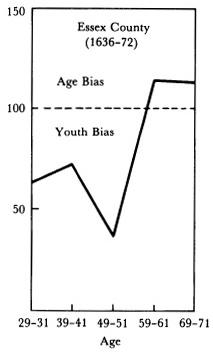
|
Age |
Essex Co. (1636-72) |
Middlesex Co. (1661-75) |
New Haven(1787) |
New England (Mean) |
U.S. (1950) |
|
29-31 |
.63 |
.97 |
1.18 |
.93 |
.94 |
|
39-41 |
.72 |
2.36 |
.87 |
1.31 |
.93 |
|
49-51 |
.38 |
2.43 |
1.58 |
1.46 |
.93 |
|
59-61 |
1.12 |
.93 |
1.72 |
1.26 |
.92 |
|
69-71 |
1.11 |
n.a. |
n.a. |
n.a. |
.91 |
Sources: Carol Shuchman, “Examining Life Expectancies in Seventeenth Century Massachusetts” (Unpub. paper, Brandeis, 1976); unpub. data furnished by John Demos; Fischer, Growing Old in America, 85; Ansley J. Coale and Melvin Zelnick, New Estimates of Fertility and Population in the United States (Princeton, 1963), 127-28.
When this test was invented by the author as an empirical indicator of age-bias, American historians and social scientists responded with expressions of incomprehension and disbelief; but European historians replicated the test and obtained similar results; see David Herlihy and Christiane Klapisch-Zuber, Tuscans and Their Families (New Haven, 1985), 169-81; for sources, methods and equations see Fischer, Growing Old in America, 85ff; data for the United States in 1950 are from Ansley J. Coale and Melvin Zelnik,New Estimates of Fertility and Population in the United States (Princeton, 1963), 90-138.
7 Seating committees usually employed three criteria—age, wealth and something else variously called rank or usefulness or office. A study by Robert Gross of Concord’s 1774 list found that people were seated first by age, then within age groups by wealth, and finally within wealth groups by status. Procedures varied in detail from one community to another. Some purse-proud trading towns such as New Haven gave wealth priority over age. But in most places, age came first. See Fischer, Growing Old in America, 39.
8 Sarah Knight, “Journal,” in Newton D. Mereness, ed., Travels in the American Colonies (New York, 1961), 14.
9 Demos, A Little Commonwealth, 174; Fischer, Growing Old in America, 46.
10 John L. Sibley, Biographical Sketches of Graduates of Harvard College (Cambridge, 1873), I, 114.
11 Nathaniel Hawthorne, Twice Told Tales (Boston, 1851).
12 John Adams to Jefferson, in The Adams-Jefferson Letters, ed. Lester J. Cappon (2 vols., Chapel Hill, 1959), II, 582.
13OED, s.v. “sad,” A2,3,4.
14 The 92nd Psalm taught that “the righteous shall flourish like the palm tree: he shall grow like a cedar in Lebanon. Those that be planted in the house of the Lord shall flourish in the courts of our God. They shall still bring forth fruit in old age: they shall be fat and flourishing; to shew that the Lord is upright.” Richard Saltonstall to the Governor and Council of Massachusetts and to the Overseers of Harvard College, 5 March 1671/2, Saltonstall Papers, I, 159.
15Mass. Bay Records, I, 328.
16 Greven, Four Generations, 88-92.
17 Personal communication from John Murrin; Carol F. Karlsen, The Devil in the Shape of a Woman (New York, 1987).
18 John Robinson, New Essays, Or Observations Divine and Moral (London, 1628), 246.
19 John Eliot, Biographical Dictionary (Salem, 1809), 44.
20 Elizabeth and Nathaniel Saltonstall to Elizabeth (Saltonstall) Denison, 6 Dec. 1688, Saltonstall Papers, I, 186.
1 Francis Bacon, Essays (1625), “Of Death,” quoted in David Stannard, The Puritan Way of Death (New York, 1977). Two histories of Puritan death ways argue opposite theses. Stannard stresses the death-fears which were highly developed in this culture; Geddes, Welcome Joy: Death in Puritan New England (Ann Arbor, 1981), brings out death-hopes, which were equally intense. Both of these interpretations accurately describe one side of a complex culture, in which hopes and fears were closely intertwined.
2 The seventeen shiploads of immigrants in the Winthrop fleet suffered much in 1630. Thomas Dudley wrote home that “many were interrupted with sickness and many died weekly, yea almost daily.” Altogether, he counted about 200 deaths from April to December 1630, with a crude mortality rate of perhaps 125 per thousand, assuming a population of “1600 English.” In Plymouth, the crude death rate was 500 per thousand in the first year; in Virginia, it was near 700 per thousand. See Thomas Dudley to Countess of Lincoln, 12 March 1630, NHHSC, 4 (1834), 224-49.
3 Colin McEvedy and Richard Jones, Atlas of World Population History (New York, 1978), 69-71 passim.
4 These estimates are higher than those of other scholars; they are discussed at greater length in “The Dying Time,” forthcoming.
5 Evidence (from mortality registers privately kept in most Massachusetts towns) will appear in “The Dying Time.”
6 Clegg, Diary, I, 35, 22 May 1728.
7 Morgan, Visible Saints, 69-70; Simpson, Puritanism in Old and New England, 3.
8 Stowe, Oldtown Folks, chap. 29, 1238.
9 Sewall, Diary, 10 Jan. 1689/90, 13 Jan., 22 Feb., 3 May, 12 Nov. 1696.
10 Stannard, Puritan Way of Death, 77.
11 Clegg, Diary, I, 28 Aug. 1723.
12 Stannard, Puritan Way of Death, 105.
13 One of these marker-rocks still survives in the original Sudbury burying ground, now part of the town of Wayland, Mass.
14 Geddes, Welcome Joy, chaps. 5, 6; Stannard, Puritan Way of Death, chap. 5.
15 Simpson, Puritanism in Old and New England, 3-5.
16Ibid.
1 Stowe, Oldtown Folks, 909.
2 Details of 203 17th-century Congregational meetinghouses in British America before 1701 appear in Marian Card Donnelly, The New England Meeting Houses of the Seventeenth Century (Middletown, 1968), 121-30.
3 Alice Morse Earle, The Sabbath in Puritan New England (New York, 1891), 5.
4 Ola Elizabeth Winslow, Meetinghouse Hill (New York, 1952), 55.
5 Earle, The Sabbath in Puritan New England, 16.
6 Stowe, Oldtown Folks, 940.
7Records of the Quarterly Court of Essex County, 1654.
8 Mather, Magnalia Christi Americana, I, 256; Miller, New England Mind, 331.
9 Miller, New England Mind, 358.
10 George Selem and Bruce C. Woolley, eds., Thomas Shepard’s Confession (Boston 1981), 13.
11The Diary of Cotton Mather, ed. Worthington Chauncey Ford (2 vols., 1911, rpt. New York, 1957), I, 98 (13 May 1685).
12 Morgan, Visible Saints, 27, 58-59, 82, 99; Gura, A Glimpse of Sion’s Glory, 37, 61-62, 73, 97, 111, 162, 242, 286-87, 299.
13 Zoltan Haraszti, The Enigma of the Bay Psalm Book (Chicago, 1956), 61-71; Percy A. Scholes, The Puritans and Music in England and America (London, 1934); Waldo S. Pratt, The Music of the Pilgrims (Boston, 1921); Robert Stevenson, Protestant Church Music in America (New York, 1966), 13-31.
14 Stowe, Oldtown Folks, 942; the music of the old New England hymns was very beautiful in a somber way. Most were sung in the minor key. The tune that Puritans called High Dutch was the old Lutheran chorale Vater unser im Himmelreich which is a motif in many Bach chorales (BMV 636, 682, 683, 737, 760-62). Westminster was a melody by Orlando Gibbons. York was the Scottish hymn commonly called The Stilt.
15Ibid., 927.
16Ibid., 940.
1 John Josselyn, An Account of Two Voyages to New-England, ed. Paul J. Lindholdt (1674, rpt. Hanover, 1988), 20; Edward Eggleston, The Transit of Civilization from England to America in the Seventeenth Century (1900, rpt. Boston, 1959), 15; Staines is a suburb of London, now very near to Heathrow Airport.
2 Writing generally upon the subject of magic in 16th- and 17th-century England, historian Keith Thomas observes that “sometimes they were parasitic upon Christian teaching; sometimes they were in sharp rivalry to it.” Religion and the Decline of Magic (New York, 1971), ix.
3 On Puritanism and science see Robert Merton, Science, Technology and Society in Seventeenth Century England (New York, 1970); the Merton thesis has stimulated a large controversial literature which is reviewed in idem, Sociology of Science in Europe(Carbondale, 1977).
4 Edward Eggleston, Transit of Civilization from England to America in the Seventeenth Century, ed. Arthur M. Schlesinger (1900, Boston, 1959), 1-47; an excellent survey of this subject appears in David D. Hall, “The Mentality of the Supernatural in Seventeenth Century New England,” CSMP 63 (1964), 239-74.
5 Increase Mather, Essay for the Recording of Illustrious Providences (Boston, 1684), reprinted in Narratives of the Witchcraft Cases, 1648-1706 (New York, 1914), 9, 12-13. Idem, Heaven’s Alarm to the World (Boston, 1682); idem, Kometographia (Boston, 1684); Johnson, Wonder-working Providence; Cotton Mather, Wonders of the Invisible World (1692, rpt. London, 1862).
6 John Eliot, “Records of the First Church of Roxbury …,” NEHGR 33 (1879), 373-74.
7 In the past twenty years, historians have discovered many more cases of witchcraft than had been previously known. In 1968, Frederick Drake’s count of witchcraft cases in the American colonies from 1647 to 1692 yielded the following result: Connecticut, 42; Massachusetts Bay, 20; New Haven, 6; Maryland, 3; Virginia, 3; New Hampshire, 2; Plymouth, 1; Puritan settlements on Long Island, 1; these 58 accusations ended in 20 executions. Of that total, the Puritan colonies accounted for 90% of accusations and 85% of executions. The executions outside of New England occurred on ships at sea, bound to or sailing from America. Every execution for witchcraft in the colonies themselves from 1647 to 1662 was carried out by the Puritans. From 1663 to 1692, Drake found another 37 accusations and 2 executions, which were also heavily centered in New England. In the great Salem outbreak, there were an additional 141 indictments or formal complaints which further swelled New England’s total. See Frederick C. Drake, “Witchcraft in the American Colonies, 1647-1692.” AQ 20 (1968), 694-726.
Subsequent research by other scholars has uncovered many more cases in the Puritan colonies. John Demos, in a project confined to New England, found 93 complaints filed or indictments for witchcraft from 1620 to 1700, not counting the Salem cases. With the addition of Salem, Demos’s count rose to 234 New England indictments or complaints filed, of which 36 ended in execution. An inquiry by Lyle Koehler identified 315 accusations in New England, and yet another other study by Carol Karlsen has identified 344 accusations of witchcraft and 35 executions in New England from 1620 to 1725.
Proceedings for witchcraft were “uncommon in other parts of British America” (John Demos, Entertaining Satan (New York, 1982), 12, 401-9). But they were not unknown. For witchcraft in other colonies see Lawrence J. Spagnola, “The Witchcraft Cases of Maryland and Virginia, 1626-1712,” (undergraduate thesis, Harvard, 1977); Richard Beale Davis, “The Devil in Virginia in the Seventeenth Century,” VMHB 65 (1957), 131-49; F. N. Parke, “Witchcraft in Maryland,” MDHM 31 (1936), 271-98; “Witchcraft in New York,” NYHSC (1869), 273-76; Tom P. Cross, “Witchcraft in North Carolina,” SP 16 (1919), 217-87; Lyle Koehler, A Search for Power: The “Weaker Sex” in Seventeenth Century New England (Urbana, 1980), 474-91; Carol F. Karlsen, The Devil in the Shape of a Woman (New York, 1987), 47.
8 Demos, Entertaining Satan, 12; for other studies which reach a similar result see C. L. Ewen, Witchcraft and Demonianism (London, 1933), which tabulated 83 cases, of which the leading areas were: Essex, 7; Suffolk, 6; London, 6; Somerset, 6; Kent, 5, and Yorkshire, 5. The rest were scattered through many counties. The same pattern was found by Wallace Notestein, A History of Witchcraft in England from 1558 to 1718 (Washington, 1911), appendix C, which tabulated 299 cases of which nearly half came from nine eastern counties. The leading counties were Middlesex, 51; Yorkshire, 32; Norfolk, 21; Northumberland, 19; Kent, 18; Wiltshire, 15; Lancashire, 14; Essex, 14; Somerset, 13; Suffolk, 11. Macfarlane makes a contrary argument, but is contradicted by his own evidence. Keith Thomas, in conversation with the author, urges caution on the ground that judicial records are more abundant for the eastern counties—a problem which also exists in America. But the studies of Ewen and Notestein seem not to be seriously affected by this problem.
9 Mather, Wonders of the Invisible World, 79; George Gifford, A Dialogue Concerning Witches and Whitchcraftes (London, 1593).
1“Certain Proposals Made by Lord Say, Lord Brooke and Other Persons of Quality …” (1636), reprinted in Thomas Hutchinson, The History of the Colony and Province of Massachusetts Bay (3 vols, with addenda, Cambridge, 1936), I, 415.
2 Kenneth Lockridge, Literacy in Colonial New England: An Inquiry into the Social Context of Literacy in the Early Modern West (New York, 1974), 13-23. Lockridge, among the first to control for age and wealth, raised the history of literacy to a new level of sophistication. But his raw data are at odds with three other studies by George H. Martin, William Kilpatrick and Clifford Shipton. Kilpatrick found in a study of Suffolk County deeds (1653-56) that 89% of men and 42% of women could sign their names. Clifford Shipton, in another inquiry based on 2,729 names on petitions, addresses and other legal documents, obtained the following result:
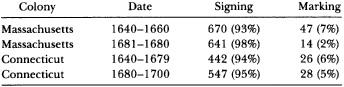
Shipton found remarkably little variance throughout Massachusetts and Connecticut. Signature-mark ratios ranged from a high of 99% in older eastern towns to a low of 90% in new settlements. Significantly lower were signature-mark rates in Plymouth Colony (81% signing). The difference between these estimates and those of Lockridge cannot be accounted for by age, biases of wealth, or name repetition. Lockridge’s sample also yields lower raw numbers than another New England sample in W. H. Kilpatrick, The Dutch Schools of New Netherland (New York, 1912), 229; see also Samuel E. Morison, The Puritan Pronaos (Ithaca, 1936), 83-84.
3 Lockridge and Morison agree; cf. Morison, Puritan Pronaos, 85; and Lockridge, Literacy in Colonial New England, 14.
4 Lockridge, Literacy in Colonial New England, chap. 1.
5 Cressy, Literacy and the Social Order, 74-75; see also Lawrence Stone, “Literacy and Education in England,” Past and Present 42 (1969), 100.
6 K. E. Wrightson, “The Puritan Reformation of Manners,” (thesis, Cambridge Univ., 1973), 121.
7 Cressy, Literacy and the Social Order, 118-41.
8 David Cressy found that during the period 1580-1640 the proportion of East Anglian men who were unable to sign their own names was 44% for yeomen. In New England, from 1650 to 1670, a roughly comparable figure for all males was 40%. A much larger proportion of women were unable to sign their names—90-95% in East Anglia, 70% in New England. Cf. David Cressy, “Education and Literacy in London and East Anglia, 1580-1700” (thesis, Cambridge Univ., 1972); Lockridge, Literacy in Colonial New England, chaps. 1-3.
9 Keith Wrightson, English Society, 1580-1680, (London, 1982), 186.
10 The texts of all these statutes appear in Marcus W. Jernegan, Laboring and Dependent Classes in Colonial America, 1607-1783 (Chicago, 1931), 87-99.
11The Book of the General Lawes and Libertyes … (Cambridge, Mass., 1660), 47.
12 The idea of “public” education appears in Thomas Shepard, Eye-Salve (Cambridge, 1673).
13 Margery Somers Foster, “Out of Small Beginnings …” An Economic History of Harvard College in the Puritan Period (Cambridge, 1962), 88; Morison, The Founding of Harvard College; and Harvard College in the Seventeenth Century (2 vols., Cambridge, 1936).
14 Morison quoted Cotton Mather’s complaint against “the too general want of Education in the Rising Generation; which, if not prevented, will gradually dispose us, to a sort of Criolian degeneracy”; Cotton Mather, The Way to Prosperity (Boston, 1690), 33-34; quoted in Morison, Puritan Pronaos, 75.
15 Henry Cabot Lodge, “The Distribution of Ability in the United States,” in Historical and Political Essays (Cambridge, 1892), 138-68; Lodge quantified Appleton’s Cyclopaedia of American Biography. Half a century later, similar inquiries were made by southern scholars, who quantified the Dictionary of American Biography with the same result. Cf. Rupert Vance, “The Geography of Distinction: The Nation and Its Regions, 1790-1927,” SF 18 (1939), 168-79; Dumas Malone, “The Geography of American Achievement,” AM 154 (1934), 666-79.
16 Havelock Ellis, A Study of British Genius (rev. ed., Boston, 1926). Ellis quantified the Dictionary of National Biography.
1 Sarah McMahon, “A Comfortable Subsistence,” WMQ3 42 (1985), 26-65, which draws from her thesis, “A Comfortable Subsistence: A History of Diet in New England, 1630-1850” (Brandeis, 1982); see also Jay Allan Andrews, “A Solid Sufficiency; An Ethnohistory of Yeoman Foodways in Stuart England” (thesis, Univ. of Pennsylvania, 1971).
2 Johnson, Wonder-working Providence, 85.
3 John Winthrop, “Experiencia,” 1616, Winthrop Papers, I, 197.
4 Francis Higginson, New-Englands Plantation (London, 1630); Young, Chronicles of the First Planters, 246.
5 Sarah McMahon’s findings are drawn from a painstaking analysis of food stocks in 1,215 inventories of estates throughout Middlesex County, Massachusetts, from 1653 to 1835. Some of her many findings appear in “A Comfortable Subsistence,” 26-65.
6 John Mack Faragher, Sugar Creek (New Haven, 1986), 46.
7 McMahon, “A Comfortable Subsistence,” 45.
8 John Winthrop to his wife, 29 Nov. 1630, Winthrop Papers, II, 320.
9 Stowe, Oldtown Folks, 1218.
10 David Ellerton Allen, British Tastes: An Inquiry into the Likes and Dislikes of the Regional Consumer (London, 1968).
11 Stowe, Oldtown Folks, 1216.
12 Johnson, Wonder-working Providence, 77.
13 Stowe, Oldtown Folks, 1211-12.
1 There are two historical myths about Puritan costume. One is the image of the black-coated, steeple-hatted, round-headed killjoy. The second myth, a reaction to the first, was set in motion by Samuel Eliot Morison, who wrote that “on great occasions your Puritan might be gaudy. Governor Bradford left a red waistcoat with silver buttons, a colored hat, a violet cloak and a Turkey-red grogram suit” (S. E. Morison, Builders of the Bay Colony (Boston, 1930), 140). Other scholars have discovered bright colors in inventories of estates, and some have incautiously concluded that Puritan austerity was largely a fiction. Both myth and countermyth are very much mistaken, as Morison himself knew very well, but others have forgotten. Morison noted that Puritan costume was distinguished by “comparative plainness.” It is necessary to find a mediating position.
2Mass. Bay Records, I, 23-24.
3Mass. Bay Records, I, 126 (3 Sep. 1634); for sumptuary laws in England see Francis E. Baldwin, Sumptuary Legislation and Personal Regulation in England (Baltimore, 1926).
4Mass Bay Records, I, 183, 28 Oct. 1636.
5Ibid., I, 274, 9 Sep. 1639.
6Ibid., II, 60, 14 Oct. 1651.
7 Sewall, Diary, 10 June 1701, 1, 449.
8 Morison, Builders of the Bay Colony, 139.
9 As late as 1893, Alice Earle wrote that “this colonial remedy is still employed on New England farms” (Customs and Fashions, 303).
10 Simmons, Emmanuel Downing, 50.
11 Larger exceptions appeared in Boston, where purse-proud merchants who were increasingly Arminian and even Anglican tended to adopt more gaudy fashions. Many recent revisionist arguments on Puritan costume have drawn their examples from this urban Arminian elite, who were not typical of the region.
12 This account follows the version in Alice Morse Earle, Two Centuries of Costume in America, 1620-1820 (2 vols., 1903, Rutland, Vt., 1971).
13 Knight, “Journal,” Peckham, Narratives, 35.
1 Increase Mather, A Testimony against Several Profane and Superstitious Customs (Boston, 1688), 37.
2 Winthrop, “Experiencia,” Writings, I, 201-2.
3 Nancy Struna, “Puritans and Sport,” JSPH 2 (1977), 1-21; this important essay demonstrates the error of the oft-repeated idea that “persons inclined to Puritanism were fundamentally hostile to sportive play.” See also idem, “Sport and Social Values: Massachusetts,” Quest 27 (1977), 40; Winton Solberg, Redeem the Time: The Puritan Sabbath in Early America (Cambridge, Mass., 1977), 49.
4 Struna, “Puritans and Sport,” 6; Benjamin Wadsworth, Good Soldiers a Great Blessing (Boston, 1700).
5CSMP 3 (1935), 330-33.
6 Shipton, Harvard Graduates, IV, 522.
7 Thomas Shepard, Theses Sabbaticae (London, 1649), IV, 49; Samuel E. Morison, Harvard College in the Seventeenth Century (2 vols., Cambridge, Mass., 1936), I, 117.
8 Scott Wiener, “Three Generations of Sports and Games in the Massachusetts Bay Colony” (paper, Brandeis, 26 Nov. 1986).
9Records and Files of Essex Quarterly Court, I, 91.
10Mass. Bay Records, I, 85 (22 March 1631).
11Records and Files of the Essex Quarterly Court, V, 39; VII, 364; Boston Gazette, 19-26 April 1725; Wiener, “Three Generations of Sports and Games.”
12 Alice Bertha Gomme, The Traditional Games of England, Scotland and Ireland (2 vols., New York, 1964), I, 136-37.
13 A. B. Hart, Commonwealth History of Massachusetts (5 vols., New York, 1927), I, 280.
14 Bentley, Diary, I, 254.
15 William D. Parish, A Dictionary of the Sussex Dialect (Lewes, 1875); Gomme, The Traditional Games of England, Scotland and Ireland, I, 34, 217-20. Many other folk games have been identified as ancestors of baseball—stoolball, rounders and cat. Stoolball was a game more like cricket but in which the ball was driven from stool to stool. Cat was generally very different—a game in which a small piece of wood was driven with sticks toward a defended hole. Rounders was, I think, a 19th-century invention; I find no reference before 1856. Gomme’s American reference to stoolball is inaccurate; the game was played not in Massachusetts Bay but in Plymouth on the second Christmas, much to William Bradford’s displeasure.
16 Isaiah Thomas, A Little Pretty Pocket Book (Worcester, 1787).
17 Jennie Holliman, American Sport, 1785-1835 (Durham, N.C., 1931), 65-66.
18 Harold Seymour, Baseball, The Early Years (New York, 1980), 7.
19 Thurlow Weed, Autobiography, ed. Harriet A. Weed (Boston, 1883).
20 Abner Doubleday was not the inventor of baseball, as the official histories would have us believe. But neither was his association mythical, as some revisionists have suggested. For a review of the evidence see Seymour, Baseball, The Early Years, 12.
21“Ball playing was less well known in the southern colonies.” Seymour, Baseball, The Early Years, 7; Holliman, American Sport, 7.
1 Winthrop, Journal, II, 122 (1643); Johnson, Wonder-working Providence, 183; Samuel Maverick, “A Brief Description of New England and the Severall Townes Therein, Together with the Present Government Thereof,” MAHSP, 2d series, I (1884-85), 235; David Grayson Allen, In English Ways (Chapel Hill, 1981).
2 Christine Heyrman, Commerce and Culture: The Maritime Communities of Colonial Massachusetts, 1690-1750 (New York, 1984); Stephen Innes, Labor in a New Land: Economy and Society in Seventeenth Century Springfield (Princeton, 1983).
3 The quantitative research of James Kimenker, Richard Weintraub and Marc Harris have established that 80 to 90% of Concord’s male polls engaged primarily in agriculture before 1790; this proportion may be taken as typical of most farming towns; in the region as a whole the proportion was a little lower; see D. H. Fischer, ed., Concord: The Social History of a New England Town, 1750-1850 (Waltham, 1983), 65-261.
4 The soils of New England are exceptionally complex and varied—more so than other American regions. Some are rich and fertile—especially alluvial soil in the flood plains of the Charles, Merrimack and Connecticut river valleys. Farmers in the Connecticut Valley still raise tobacco with high success on productive fields which have been cultivated continuously for three centuries. There is excellent soil in Concord, Dedham and the original Sudbury (now the town of Wayland).
5 Winthrop to Sir Nathaniel Rich, 22 May 1634, Winthrop Papers, III, 167; on farming in Massachusetts see Darrett B. Rutman, “Governor Winthrop’s Garden Crop: The Significance of Agriculture in the Early Commerce of Massachusetts Bay,” WMQ3 20 (1963), 396-415; idem, The Husbandmen of Plymouth: Farms and Villages in the Old Colony (Boston, 1967); Robert R. Walcott, “Husbandry in Colonial New England,” NEQ 9 (1936), 218-52.
6 Rutman, “Governor Winthrop’s Garden Crop,” 405.
7 Johnson, Wonder-working Providence, 246–47.
8 John J. McCusker and Russell R. Menard, The Economy of British America, 1607-1789 (Chapel Hill, 1985), 92; Bernard Bailyn, New England Merchants in the Seventeenth Century (Cambridge, Mass., 1955).
9 Bailyn, New England Merchants in the Seventeenth Century, 45.
10The Apologia of Robert Keayne: The Self Portrait of a Puritan Merchant (New York, 1964), 58.
11 Winthrop, Journal, I, 317.
12 Bernard Bailyn, “The Apologia of Robert Keayne,” WMQ3 7 (1950), 568-87; A leading source is Robert Keayne’s will which has been republished as The Apologia of Robert Keayne: The Self Portrait of a Puritan Merchant. Other important sources are Winthrop’s Journal, I, 315-18; II, 4, 64-66, 116-20. The judgment of the church appears in The Records of the First Church in Boston, 1630-1868, ed. Richard D. Pierce. CSM Publications, 39 (1961), 25, 19. Secondary accounts include Rutman, Winthrop’s Boston, 155, 243-44; Emil Oberholzer, Jr., Delinquent Saints: Disciplinary Action in the Early Congregational Churches of Massachusetts (New York, 1956), 188-89; Bernard Bailyn, The New England Merchants in the Seventeenth Century (Cambridge, 1955), 41.
13 Winthrop, Journal, I, 318.
14 For the Puritan work ethic see Stephen Foster, Their Solitary Way: The Puritan Social Ethic in the First Century of Settlement in New England (New Haven, 1971), 99-126.
1 Sewall, Diary, ed. Thomas, I, 660 (1711).
2Mass. Bay Records, I, 109, 112 (1 Oct. 1633, 4 March 1633/34).
3Ibid., II, 920-21 (1719).
4 Clegg, Diary, I, 68 (20 Oct. 1729).
5Ibid., 1727.
6 Stowe, Oldtown Folks, 1424.
7 Cotton Mather, Parentator (Boston, 1724), 38.
8Papers of Benjamin Franklin, III, 304.
9Ibid., I, 8, 9, 170, 195, 225; II, 296, 333, 334, 337; III, 7; IV, 187.
10 Ralph Thoresby Diary, 1 Nov. 1680, ms. 21, Yorkshire Archaeological Society, Leeds.
11 Franklin, “An Economical Project,” Writings, IX, 183-89.
12 Bailyn, “The Apologia of Robert Keayne,” 577. For a general discussion of these questions see Patricia Cline Cohen, A Calculating People: The Spread of Numeracy in Early America (Chicago, 1982).
13OED, s.v. “punctual.”
14 Sewall, Diary, II, 660 (1712).
15 David H. Flaherty, Privacy in Colonial New England (Charlottesville, 1972), 62, 196.
16 Winton U. Solberg, Redeem the Time: The Puritan Sabbath in Early America (Cambridge, 1977), 111.
17Ibid., 162; Oberholzer, Delinquent Saints, 57-77; Ola Elizabeth Winslow, Meetinghouse Hill, 1630-1783 (New York, 1952), 180; Alice Morse Earle, The Sabbath in Puritan New England (New York, 1891), 246. Here again, there are two countervailing myths about New England: the myth of the spurious Connecticut “Blue Laws” which allegedly forbade men to shave and women to kiss their children on the sabbath. These statutes were invented by Samuel Peters, an Anglian clergyman and High Tory who fled New England in the Revolution and wrote a General History of Connecticut (London, 1781). Travelers’ accounts added other apocrypha. But partisans of the Puritans have created a countermyth in correcting these errors. The sabbath laws of New England were very rigorous, and prosecutions by church and state were sometimes extreme.
18 Charles Francis Adams, “Some Phases of Sexual Morality and Church Discipline in Puritan New England,” MAHSP, 2nd series 6 (1891), 495.
19 Major Puritan works on the Sabbath include Thomas Shepard, Theses Sabbaticae: Or, The Doctrine of the Sabbath (London, 1649); William Pynchon, A Treatise on the Sabbath … Whereto Is Annexed a Treatise of Holy Time (London, 1655).
20 The definitive study of marriage seasonality in New England is by David Cressy. He reports the following results for six New England towns, including Dedham, which is illustrated in the graph (1638-99).
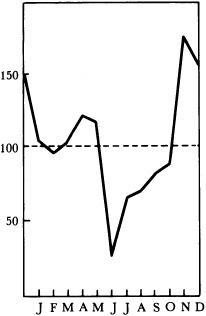
|
Marriage Index (m = 100) |
||
|
Month |
Six Towns |
Dedham |
|
January |
122 |
103 |
|
February |
82 |
97 |
|
March |
87 |
103 |
|
April |
94 |
121 |
|
May |
99 |
117 |
|
June |
72 |
25 |
|
76 |
64 |
|
|
August |
73 |
69 |
|
September |
86 |
81 |
|
October |
94 |
88 |
|
November |
158 |
177 |
|
December |
158 |
156 |
|
Total |
1200 |
1200 |
|
(N) |
(2217) |
(256) |
(The marriage index is based on the monthly mean; that is, the annual total of marriages is made proportionate to 1200, so that the monthly mean is 100.) Cressy’s findings are reproduced here so that they can be compared with other regions, below. Cressy’s six-town sample dilutes the distinctive Bay Colony pattern by including Plymouth and Boston. The classic Massachusetts pattern is more clearly visible in the town of Dedham. See David Cressy, “The Seasonality of Marriage in Old and New England,” JIH 16 (1985), 1–21; for similarities between New England and East Anglia, see Ann Kussmaul, “Time, Space, Hoofs and Grain: The Seasonality of Marriage in England,” JIH 15 (1985), 755-79.
21 Winthrop, Journal, I, 63 (17 April 1631).
22 Morison, Harvard College in the Seventeenth Century, II, 465-71.
23 Winthrop, Journal, I, 299-300; II, 42.
24Ibid., I, 59
25 W. DeLoss Love, Jr., The Fast and Thanksgiving Days of New England (Boston, 1895); Earle, Customs and Fashions in Old New England, 214-33.
26 Stowe, Oldtown Folks, 1218.
27 This finding was first reported by Kenneth Lockridge in an unpublished paper presented to a conference on social history at Stony Brook, N.Y., in 1969. Lockridge discovered that New England’s spring peak in conceptions was less than half as high as in France, Sweden and Canada during the same era. Marriage rhythms were mixed. Rural towns showed a high peak in November, as in East Anglia; but in Boston there was little variation from month to month.
1 In Billerica, the number of individual grants were as follows:
|
10 acres |
6 |
50 acres |
11 |
100 acres |
7 |
220 acres |
1 |
|
15 acres |
6 |
60 acres |
16 |
140 acres |
2 |
250 acres |
1 |
|
20 acres |
11 |
70 acres |
6 |
150 acres |
5 |
300 acres |
3 |
|
30 acres |
3 |
80 acres |
18 |
180 acres |
1 |
400 acres |
1 |
|
40 acres |
5 |
90 acres |
6 |
200 acres |
4 |
450 acres |
1 |
Source: William Haller, Jr., The Puritan Frontier; Town-Planting in New England Colonial Development 1630-1660 (New York, 1951), 68. See Stephen Innes, Labor in a New Land: Economy and Society in Seventeenth-Century Springfield (Princeton, 1983), 14.
2 This was the intent. A controversy quickly arose as to whether the first division of land in Providence was only for “use” or for ownership as well. This dispute led to another division which was less egalitarian. See Bartlett, ed., Records of Rhode Island Colony, I, 23.
3 David Grayson Allen found the following patterns in inventoried wealth:
|
Percent of Total Wealth Held By: |
Hingham, Norfolk 1642-88 |
Hingham, Mass. 1654-92 |
|
Top 10% |
31.9% |
31.0% |
|
Top 25% |
66.2% |
57.8% |
|
Top 50% |
89.3% |
81.5% |
|
Bottom 50% |
10.7% |
18.5% |
This refers to personal estate only, as land was not included in English inventories; see Allen, In English Ways, 79.
4 The materialism of New Haven appeared also in the way that it seated its meetinghouse—mainly according to wealth rather than age. Many towns in the Massachusetts Bay Colony reversed this priority.
5 Many studies of wealth distribution in 17th-century Massachusetts yield similar results. Gini ratios (the standard measure of concentration which ranges from .00 (perfect equality) to .99 (perfect inequality where the top percentile owns everything)), fell mostly in a narrow middling range of .4 in small farming communities to .6 in seaport towns. One of the most equal patterns appeared in Andover’s division lists (.38); least equal were tax assessment lists in Boston and its suburb of Muddy River (now Brookline), which were .64.
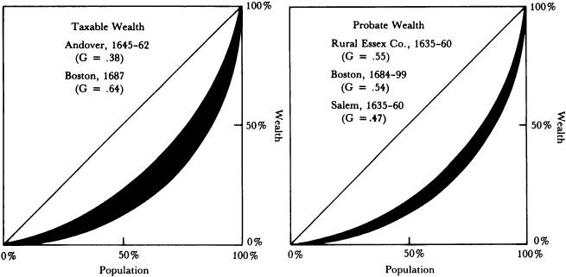
Sources: G. B. Warden, “Inequality and Instability in Boston: A Reappraisal,” JIH 6 (1976), 505-620; Greven, Four Generations, 46; Donald W. Koch, “Income Distribution and Political Structure in Seventeenth Century Salem,” EIHC 105 (1969), 50-69; Gary Nash, “Urban Wealth and Poverty,” JIH 61 (1976), 549.
6 William Gately, “Wealth Distribution in Berkhamsted, Weyhill, Sudbury, and Marlboro” (unpublished paper, Brandeis, 1971).
7 The distribution of wealth in New England has been measured by many different methods. The only statistical indicator common to most inquiries is the size share of the top tenth (SSTT). This appears as follows, in taxable wealth and estate inventories.
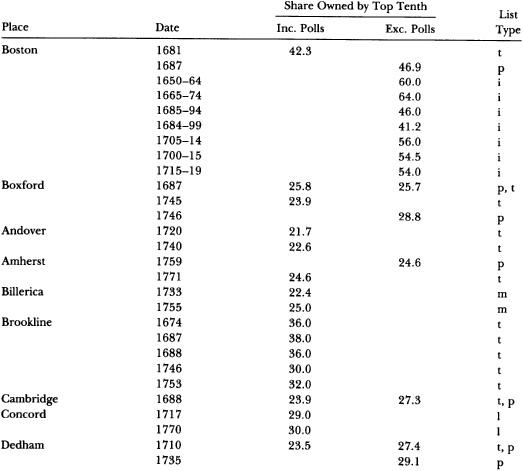
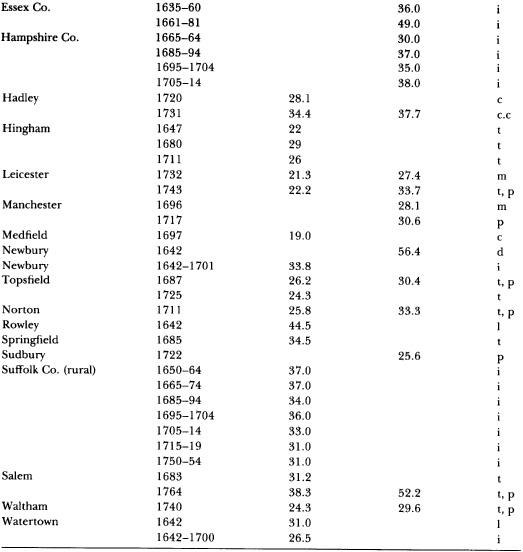
Note: t = total taxable wealth including polls; p = total taxable wealth excluding polls; m = rates to pay a minister or build a meetinghouse; c = commons division lists; r = real estate valuations or taxes; 1 = acreage of land owned in the town; i = inventories of estates in probate. Sources include Edward M. Cook, Jr., The Fathers of the Towns: Leadership and Community Structure in Eighteenth-Century New England (Baltimore, 1976); unpublished data assembled by the Brandeis Concord, Brookline and Waltham projects; Smith, “Hingham”; Allen, In English Ways.
8Winthrop Papers, I, 306.
9 Deuteronomy 21:16; this was also their interpretation of Genesis 48:22 where Israel said unto Joseph, the first born of the true wife, “I have given thee one portion of above thy brethren.”
10 William Gouge, Of Domesticall Duties (London, 1622), 575-79; as quoted in Joan Thirsk, “The European Debate on Customs of Inheritance, 1500-1700,” in Jack Goody, Joan Thirsk and E. P. Thompson, eds., Family and Inheritance (Cambridge, 1976), 189.
11 Large numbers of these customals survive in county record offices. No scholar, to my knowledge, has studied them systematically.
12 F. G. Emmison, Elizabethan Life: Home, Work and Land; From Essex Wills and Sessions and Manorial Records (Chelmsford, 1976), 107.
13Ibid.
14Ibid., 275.
15 A few individual examples from Watertown might illustrate the rule and variations: Deacon Henry Bright, a widower who died in 1686, gave to his oldest son John the homestead and 200 acres of land; his other sons and daughters received 40 or 50 acres each and equal portions of money. Abraham Browne assigned everything to the care of his widow, with the land later to be divided equally among his sons, legacies of livestock for his daughters; but the will could not be proved and the court applied the double-partible rule. John Coolidge in 1691 left everything in the care of his widow, subsequently to be divided equally among five sons, with the homestead to a younger son, and a double portion of money to the eldest. John Whitney of Watertown who died in 1673 left the homestead and “the old mare if she lives” to his youngest son, the furniture to the eldest, a double share of land to the second-born and single shares to his other children. John Warren (d. 1667) left his homestead to his second son Daniel and divided his lands among five children. Roger Wellington (d. 1698) divided his lands equally among three sons and gave his furniture to the youngest. These instances are drawn from Jonathan C. Sor-ken, “Watertown Inheritance Patterns in the Seventeenth Century” (paper, Brandeis, 26 Nov. 1986). See also Thomas R. Cole, “Family, Settlement and Migration in Southeastern Massachusetts, 1650-1805: The Case for Regional Analysis,” NEHGR 132 (1978), 171-85.
16 Lord Adam Gordon, “Journal of an Officer … in 1764 and 1765,” in Newton D. Mere-ness, ed., Travels in the American Colonies (1916, rpt., New York, 1961), 404-5.
1 John Winthrop, “A Modell of Christian Charity, Written on Boarde the Arrabella on the Attlantick Ocean,” Winthrop Papers, II, 282; for the structure of a Puritan lay-sermon, see Perry Miller and Thomas H. Johnson, The Puritans (2 vols., New York, 1963), II, 294.
2 T. H. Swales, “The Redistribution of the Monastic Lands in Norfolk at the Dissolution,” NA 34 (1966-69), 14-44; Francis Blomefield, An Essay towards a Topographical History of Norfolk (11 vols., 1805).
3 William Hunt, The Puritan Moment: The Coming of Revolution in an English County (Cambridge, 1983), 15.
4 Chalkin, Seventeenth Century Kent, 50; Everitt, The Community of Kent in the Great Rebellion, 35.
5 Of the county of Essex, Felix Hull writes, “The following points stand out. The first is the great proportion represented by the agrarian proletariat holding less than five acres; the second is the comparative uniformity in the statistics.” Hull reckoned that in the county of Essex generally, holders of five acres or less amounted to 40% of manorial tenants. Similar patterns appeared throughout the eastern counties. In Norfolk and Suffolk, R. H. Tawney calculated that 54% of the copyholders had less than ten acres. See Felix Hull, “Agriculture and Rural Society in Essex, 1560-1640” (thesis, Univ. of London, 1950), I, 75, 477; R. H. Tawney, The Agrarian Problem in the Sixteenth Century (London, 1912), 63.
6 Braintree Town Records, 1 Dec. 1623; F. G. Emmison, ed., Early Essex Town Meetings: Braintree, 1619-1636; Finchingfield, 1626-1634 (London, 1970), 23.
7“Old Father Clewes shall receive 3s 4d quarterly for his relief, being aged. … the overseers shall provide for old father Paule in the tyme of his sickness.” Braintree Records, 2 Aug. 1630. The materialist argument, that old age was treated with respect only when supported by wealth, is certainly mistaken.
8 Emmison, Early Essex Town Meetings, xi.
9Ibid.
10“Robert Eliott being grown aged and poor, shall be put into the Almshouse wherein Baldwin is, and he turned out.” Braintree Records, 12 July 1619, ESSRO.
11 Chalkin, Seventeenth Century Kent, 46.
12“Certain Proposals Made by Lord Say, Lord Brooke, and Other Persons of Quality, as Conditions of Their Removing to New-England, with the Answers Thereto,” in Thomas Hutchinson, The History of the Province and Colony of Massachusetts Bay, (ed Lawrence S. Mayo) (3 vols., Cambridge, Mass., 1936), I, 410-17.
13“Letters of John Andrew,” MAHSP, ser. I, 8 (1864-65), 344; Jackson T. Main, The Social Structure of Revolutionary America (Princeton, 1965), 230.
14 Quoted in Richard Gildrie, “Salem, 1626-1668: History of a Covenanted Community” (thesis, Univ. of Va., 1971), 203.
15 C. F. Adams, ed., Works of John Adams, IV, 393; Main, The Social Structure of Revolutionary America, 233.
16 Fischer, Growing Old in America, chap. 1.
17 Knight, “Journal,” in Mereness, ed., Travels in the American Colonies, 30.
1 Morgan, Puritan Family, 10.
2Ibid., I, 190.
3Mass. Bay Records, I, 157; 3 Sept. 1635.
4 Much, perhaps too much, has been made of differences between towns in 17th-century Massachusetts—between covenanted and uncovenanted towns, seed towns and satellite towns, communal towns and nucleated towns. All of these distinctions existed within a very narrow range, by contrast with other types of local communities in the Western world. Strong similarities sprang from common purposes and common experiences, and also from the laws of the Bay Colony, which strictly regulated many institutions—political, religious, educational, familial and economic.
5 The quantitative data appear in Gildrie, “Salem, 1626-1668,” 60. It should be noted that patterns of settlement and field systems were two different but related issues, on which regional customs were very mixed. Open fields in particular were introduced as a matter of expediency in the first generation and rapidly abandoned in most towns. In Salem, East Anglians supported open fields and West Countrymen remained apart from them. In Watertown and Sudbury, the opposite was the case—another indication that the “means of production” were secondary to cultural affiliations.
6 The following persistence rates have been found in studies of eight New England towns:
|
Crude |
Refined |
Refined |
||
|
Persistence |
Persistence |
Persistence |
||
|
Town |
Period |
Rate |
Rate I |
Rate II |
|
Rowley, Mass. |
1643-53 |
59% |
71% |
|
|
Dedham, Mass. |
1648-60 |
51% |
63% |
|
|
1660-70 |
78% |
88% |
||
|
1670-80 |
76% |
93% |
||
|
1680-90 |
73% |
91% |
||
|
1690-1700 |
83% |
96% |
||
|
Brookline, Mass. |
1674-87 |
42% |
49% |
|
|
1688-93 |
66% |
69% |
||
|
1746-53 |
63% |
69% |
||
|
1753-70 |
43% |
62% |
||
|
1771-83 |
42% |
58% |
||
|
1784-91 |
71% |
|||
|
Hingham, Mass. |
1670-80 |
73% |
88% |
93% |
|
1754-65 |
69% |
76% |
||
|
1790-1800 |
62% |
82% |
||
|
Windsor, Conn. |
1676-86 |
57% |
71% |
|
|
1686-1702 |
57% |
79% |
||
|
Wenham, Mass. |
1731-41 |
68% |
76% |
83% |
|
1741-51 |
58% |
67% |
73% |
|
|
1751-61 |
53% |
70% |
74% |
|
|
1761-70 |
59% |
70% |
76% |
|
|
Beverly, Mass. |
1741-51 |
50% |
66% |
|
|
1751-61 |
58% |
67% |
||
|
1761-71 |
60% |
67% |
||
|
Concord, Mass. |
1746-57 |
69% |
84% |
|
|
1757-70 |
71% |
86% |
A crude persistence rate measures the proportion of one population list which reappears upon another list, without regard to mortality. Refined persistence (Type I) removes from the first list all who are known to have died, and assumes that others not persisting have moved. Refined persistence (Type II) assumes that “unknowns” for whom no evidence of death or migration survives tended to share the same persistence rates as others. Computed from data in Lockridge, “Dedham”; Smith, “Hingham”; Harris, “Concord”; Dreyfuss, “Brookline”; Auwers, “Windsor”; and Douglas Lamar Jones, Village and Seaport: Migration and Society in Eighteenth-Century Massachusetts (Hanover, 1981).
7 High rates of migration in early life explain why so many New Englanders died outside their native towns at the same time that persistence rates on tax lists were very high; cf. John W. Adams and Alice Bee Kasakoff, “Migration and the Family in Colonial New England: The View from Genealogies, ” JFH 9 (1984), 24-43; and “Migration at Marriage in Colonial New England …,” in Bennett Dyke and Warren Morrill, eds., Genealogical Demography (New York, 1980).
8Mass. Bay Records, I, 190.
9 An unanswered question is the similarity of migration in New England and East Anglia. There have been many English studies of internal migration in the east of England, but differences in methods and materials do not permit controlled quantitative comparisons. See John Patten, English Towns, 1500-1700 (Folkestone, Kent, 1978); and “Patterns of Migration and Movement of Labour to Three Pre-industrial East-Anglian Towns,” JHG 2 (1976), 111-29; Peter Clark and Paul Slack, Crisis and Order in English Towns, 1500-1700 (London, 1972); Peter Clark, ed., The Transformation of English Provincial Towns, 1600-1800 (Oxford, 1982).
10 Johnson, Wonder Working Providence, 185.
11 Andrews, Pilgrims and Puritans, 133.
12 Gordon, “Journal of an Officer,” 448.
13Mass. Bay Records, I, 110.
14 For examples from Lincolnshire see Joan Thirsk, “Field Systems of the East Midlands,” in A. R. H. Baker and R. A. Butlin, eds., Studies in the Field Systems of the British Isles (Cambridge, 1979), 279.
15 Carl Bridenbaugh, Vexed and Troubled Englishmen (New York, 1968), 70.
16Mass. Bay Records, I, 112.
17 Earle, The Sabbath in Puritan New England, 264.
18 Mather, Magnolia Christi America, I, 160-61; references to “honor” and “honorable” qualities appear throughout this work; see, e.g., I, 157, 158, 253, 262, passim. See also the discussion of Puritan ideas of honor in Bertram Wyatt-Brown, Southern Honor; Ethics and Behavior in the Old South (New York, 1982), 26.
1 John Norton, Sion the Outcast Healed of Her Wounds (Cambridge, Mass., 1664).
2 John Winthrop, “A Modell of Christian Charity,” Winthrop Papers, II, 282-83.
3 Solomon Stoddard, The Way for a People to Live Long in the Land That God Hath Given Them (Boston, 1705), 61.
4 Jonathan Edwards, A Humble Attempt to Promote Explicit Agreement and Visible Union in God’s People … (Boston, 1747), reprinted in David Austin, The Millennium (Elizabethtown, N.J., 1794), 171; see also David Balch, A Public Spirit (Boston, 1749). Kerry A. Trask, “In the Pursuit of Shadows; A Study of Collective Hope and Despair in Provincial Massachusetts …” (thesis, Univ. of Minn., 1972), 21.
5 Joan R. Kent, The English Village Constable, 1580-1642 (Oxford, 1986), 15.
6 In the period from 1657 to 1680, the annual homicide rate in Massachusetts was below 3 per 100,000. In Maryland, it was above 7 per 100,000. Computed from data in William Buttenweiser, “An Examination of Murders, 1630-1692; Frequency, Seasonal Variations, Participants in Maryland and Massachusetts” (unpub. paper, Brandeis, 1978).
7 The first national crime statistics which allow controlled regional comparisons were for robbery of the U.S. mail. This offense was rare in New England and regional disparities were very great:
|
State |
Number of Offenses, 1790-1827 |
|
Maine |
0 |
|
Massachusetts |
5 |
|
Rhode Island |
1 |
|
Vermont |
0 |
|
New York |
1 |
|
New Jersey |
3 |
|
Pennsylvania |
10 |
|
Maryland |
11 |
|
Virginia |
14 |
|
South Carolina |
2 |
|
Georgia |
4 |
|
Tennessee |
10 |
|
Kentucky |
6 |
|
Ohio |
8 |
|
Indiana |
0 |
Returns were not given for missing states; Returns of … Offences against the Laws of the United-States (Washington, 1828).
8 Mark Saloman found the following patterns of criminal prosecution in the county courts of Essex, Suffolk, and Plymouth from 1636 to 1699:
|
Crimes |
Essex Co. |
Suffolk Co. |
Plymouth |
Plymouth |
|
|
Against: |
Total |
1636-41 |
1671-80 |
1651-68 |
1668-99 |
|
Order |
503(51.3%) |
40 (60.6%) |
251 (44.0%) |
162(66.7%) |
50(51.5%) |
|
Sexual Morality |
225 (23.0%) |
6 (9.0%) |
144 (25.2%) |
42(17.3%) |
33 (34.0%) |
|
Property |
175(17.9%) |
16(24.2%) |
131 (22.9%) |
22 (9.0%) |
6 (6.2%) |
|
The Person |
74 (7.6%) |
4 (6.0%) |
45 (7.9%) |
17(7.0%) |
8 (8.3%) |
Mark Andrew Saloman, “Community and Hierarchy: A Comparative Study of Law, Crime and Punishment in Colonial Massachusetts and Maryland, 1636-1699,” (thesis, Brandeis, 1989), 43.
9 Saloman, “Community and Hierarchy,” 37-42. Michael Hindus found that differences between Massachusetts and South Carolina in the relative frequency of crimes persisted into the 18th century.
|
Percent of Total Criminal Prosecutions |
||
|
Middlesex Co., Mass. |
Charleston, S.C. |
|
|
1760-74 |
1769-76 |
|
|
Crimes against persons (murder, assault, rape) |
9.5% |
53.6% |
|
Crimes against property (larceny, arson) |
13.2% |
37.8% |
|
Crimes against sexual mores (fornication, bastardy) |
57.6% |
1.6% |
|
Crimes against order (contempt of authority, riot, vagrancy, church offenses, etc.) |
18.4% |
1.6% |
|
Slave-related crimes |
0.0% |
3.1% |
|
Counterfeiting, fraud |
1.2% |
2.4% |
|
Total |
99.9% |
100.1% |
Similar contrasts continued in the 19th century; see Michael S. Hindus, Prison and Plantation: Crime, Justice and Authority in Massachusetts and South Carolina, 1767-1878 (Chapel Hill, 1980), 64-65. Another important study is David H. Flaherty, “Crime and Social Control in Provincial Massachusetts,” HJ 24 (1981), 339-60.
10 Dwight, Travels, I, 141.
11 Edwin Stone, History of Beverly (Boston, 1843), 307.
12 Stowe, Oldtown Folks, 1208.
13 For evidence of a major difference between Massachusetts and Maryland in prosecutions for burglary, see Saloman, “Community and Hierarchy,” 107-31.
14 James Axtell, ed., “The Vengeful Women of Marblehead,” WMQ3 31 (1974), 652.
15 John Adams to Abigail Adams, 7 July 1774, Adams Family Correspondence, ed. Butterfield, I, 131; John R. Howe, Jr., The Changing Political Thought of John Adams (Princeton, 1966), 13. This was not Adams’s view alone, nor merely a rationale for revolution. The same conception of “constitutional mobs” was also held by the Massachusetts tory Thomas Hutchinson, who observed that “mobs, a sort of them at least, are constitutional,” even as he fell victim to their violence in Boston. Pauline Maier, “Popular Uprisings and Civil Authority in Eighteenth-Century America,” WMQ3 27 (1970), 24; see also idem, From Resistance to Revolution; Colonial Radicals and the Development of American Opposition to Britain, 1765-1776 (New York, 1972), 3-26.
16 A strong regional pattern appears in the frequency of armed rebellions in the thirteen colonies from 1607 to 1763: New Hampshire, 2; Massachusetts, 1; Rhode Island, 2; Connecticut, 0; New York, 4; New Jersey, 3; Pennsylvania, 3; Delaware, 0; Maryland, 9; Virginia, 9; North Carolina, 7; South Carolina, 3; these data will appear in vol. IV, Deep Change, forthcoming.
17 George Francis Dow, Every Day Life in the Massachusetts Bay Colony (Boston, 1935), 210.
18 Powers estimated in the county courts of Essex and Suffolk, and the Massachusetts Court of Assistants and the Plymouth Court from 1620 to 1692, the death penalty was invoked for the following offenses: witchcraft, 23; murder, 11; piracy, 6; rape, 4; Quakers, 4; bestiality, 2; adultery, 2; arson, 2; treason, 2. Flaherty found that in Massachusetts from 1693 to 1769, 56 people were hanged: murder, 26; infanticide, 15; burglary 8, rape, 3; arson, 3; sodomy, 1. See Flaherty, “Crime and Social Control in Provincial Massachusetts,” 339-60; “The Punishment of Crime at the Massachusetts Assizes: An Overview, 1692-1750” (unpub. paper, 1978-79); Edwin Powers, Crime and Punishment in Early Massachusetts, 1620-1692 (Boston, 1966), 294, 404-8; Kathryn Preyer, “Penal Measures in the American Colonies: An Overview,” AJLH 26 (1982), 327-53.
19 Alice Morse Earle, Curious Punishments of Bygone Days (1896, Rutland, Vt., 1972), 140; Jones, Quakers in the American Colonies, 75.
20 Earle, Curious Punishments, 140.
21 Jones, Quakers in the American Colonies, 71.
22 Boston Evening Post, 7 Oct. 1754.
23 Richard H. Phelps, Newgate of Connecticut; Its Origin and Early History, Being a Full Description of the Famous and Wonderful Simsbury Mines and Caverns, and Prison Built over Them (Hartford, Conn., 1876); Earle, Curious Punishments, 92 passim.
24 Powers, Crime and Punishment, 295.
1 Mitford Mathews, A Dictionary of Americanisms (Chicago, 1951), s.v., “town meeting,” “selectman.”
2 Fraralingham Town Book; also East Bergholt Town Book, 15 Feb. 1650; both in SUFROIP.
3 Occupation and rank is given in the town meeting book of East Bergholt, 1650-78, SUFROIP.
4 Braintree Town Book, ESSRO.
5 A selection of these records has been published in Emmison, Early Essex Town Meetings.
6 The Ancient Customs of the Towne and Parishe of Dedham, County of Essex …,” ESSRO.
7Ibid.
8 Emmison, Early Essex Town Meetings, 23.
9 This pattern in Massachusetts town meetings before 1780 may be seen in the following statistics of voters as a percentage of adult males:
Boston: 1696, 10%; 1698, 25%; 1699, 23%; 1703, 31%; 1703, 16%; 1704, 14%; 1709, 13%; 1711, 10%; 1715, 15%; 1716, 21%; 1717, 16%; 1718, 13%; 1719, 25%; 1721, 13%; 1722, 11%; 1723, 14%; 1724, 10%; 1725, 16%; 1726, 9%; 1727, 9%; 1728, 11%; 1729, 8%; 1730, 22%; 1755, 15%; 1756, 24%; 1757, 24%; 1758, 17%; 1759, 21%; 1760, 45%; 1761, 15%; 1762, 28%; 1763, 49%; 1764, 20%; 1765, 29%; 1766, 34%; 1767, 28%; 1768, 20%; 1769, 23%; 1770, 23%; 1771, 19%; 1772, 33%; 1773, 19%; 1774, 24%. Concord: 1765, 51%; 1765, 62%; 1778, 25%; 1778, 36%. Lynn: 1750, 32%; 1751, 32%; 1752, 37%; 1753, 21%; 1754, 24%; 1756, 28%. Salem: 1735, 24%; 1738, 25%; 1739, 15%; 1740, 21%; 1741, 39%; 1742, 24%. Watertown: 1757, 97%. Weston: 1772, 80%. Dorchester: 1726, 30%; 1750, 37%; 1751, 32%. Stockbridge: 1763, 94% (awm). Cambridge: 1739, 45%. Woburn: 1742, 38%.
Sources: Robert J. Dinkin, Voting in Provincial America (Westport, Conn. 1977), 174; Marshall C. Spatz, “Political Power in Colonial Boston, 1679-1721,” (thesis, Brandeis, 1966); Susan Kurland, “Democratization in Concord: A Political History, 1750-1850,” in D. H. Fischer, ed., Concord: The Social History of a New England Town, 1750-1850 (Waltham, Mass., 1984), 261-342.
10 For computations of relative levels of taxation and expenditure see R. R. Palmer, The Age of Democratic Revolution (Princeton, 1959), 155; James Henretta et al., America’s History (Chicago, 1987), 254.
1 Samuel Adams to Samuel Cooper, 25 Dec. 1778; Adams to Benjamin Austin, 9 March 1779; Adams to John Scollay, 30 Dec. 1780; Adams to Richard Henry Lee, 15 Jan. 1781, Cushing, ed., Works of Samuel Adams, IV, 104, 132, 235-36, 239-40.
2Mass. Bay Records, I, 83, 159.
3“Concord, Sudbury & Dedham … being inland towns & not thinly peopled, it is ordered that no man now inhabiting & settling in any of the said town (whether married or single) shall remove to any other town without the allowance of a magistrate or other selectman of that town.” Mass. Bay Records, II, 122.
4“Every unmarried man in the township shall kill six black-birds or three crows while he remains single; as a penalty for not doing it, shall not be married until he obey this order.” Eastham Town Records, 1695; Earle, Customs and Fashions in Old New England, 37.
5Mass. Bay Records, I, 110.
6Ibid., I, 174.
7 John Gage, The History and Antiquities of Hengrave, in Suffolk (London, 1822).
8Mass. Bay Records, 3 April 1632, I, 94.
9[Nathaniel Ward], “The Massachusetts Body of Liberties (1641), reprinted in The Colonial Laws of Massachusetts (Boston, 1889).
10Mass. Bay Records, I, 174.
11 Ward, “Massachusetts Body of Liberties.”
12“Candidus,” [Samuel Adams], Boston Gazette, 27 Jan. 1772; Cushing, ed., Writings of Samuel Adams, II, 324.
13 In 1637 the General Court passed a law “to restrain Indians from profaning the Lord’s day”; Mass. Bay Records, I, 209.
14Ibid., I, 134.
15Mass. Bay Records, I, 173.
1 Sir William Berkeley is known today mainly for the event that ended his long career—Bacon’s Rebellion in 1676. By that date he was seventy years old, worn down by ill health, and exhausted by long service. He punished the rebels with a savagery that shocked even the King. “That old fool,” Charles II is alleged to have said, “has killed more people in that naked country than I have done for the murder of my father.” To this day, liberal historians remember Berkeley as a failed reactionary who was an alien presence in the American past.
A rare revisionary essay argues that Berkeley was a failed progressive whose plans for economic development met defeat. This was true of specific projects such as the silk industry, but in other ways as we shall see the southern colonies developed much as Berkeley intended—in their labor system, class structure, and many of their folkways—and progress had no place in his pantheon; cf. Joan de Lourdes Leonard, “Operation Checkmate: The Birth and Death of a Virginia Blueprint for Progress, 1660-1676,”WMQ324 (1967), 44-74.
Berkeley has been the victim of three strong trends in southern historiography. The first was the work of scholars who heaped ridicule on the so-called “cavalier myth” and argued that “the most significant feature of the Chesapeake aristocracy was its middle class origin” (Carl Bridenbaugh, Myths and Realities (Baton Rouge, La., 1952), 12). A second trend appeared in the work of the “Chesapeake group” who were interested in market forces, demographic processes and models of social change which left little latitude for the agency of individuals. A third trend has been a continuing reinterpretation of Bacon’s Rebellion in ways unfavorable to Berkeley; e.g., Stephen S. Webb, 1676: The End of American Independence (New York, 1984). There is no full-length published biography of this neglected man; but see Jane Carson, “Sir William Berkeley” (thesis, Univ. of Va., 1951), and J. R. Pagan, “Notes on Sir William Berkeley,” ms., GLOCRO.
2 H.P.R. Finberg, “Three Centuries in Family History: Berkeley of Berkeley,” Gloucester Studies (Leicester, 1957), 145-59. The Berkeleys, still securely in possession of their castle, are one of the few landed families in England who can trace their pedigree back before the Norman conquest. They claim descent from Eadnoth the Staller, a Saxon nobleman who joined William the Conqueror and was killed in 1068.
3 The founder of the Bruton Berkeleys was Sir Maurice Berkeley (ca. 1505-81), a standard bearer of Henry VIII and supporter of Thomas Cromwell. His reward was the land of Bruton Priory, together with Northwood Park near Glastonbury, and other tracts in Berkshire, Buckingham and Surrey. He was also a gentleman of the Privy Chamber before 1539, a member of Parliament for Surrey, and sheriff of Somerset in 1567. The Bruton lands descended to Sir Henry Berkeley (d. 1601) and then to Sir Maurice Berkeley (d. 1617), a member of Parliament from various West Country seats (Truro, Minehead) and father of Virginia’s future governor. See S. W. Bates-Harbin, Members of Parliament from the County of Somerset (Taunton, Eng., 1939); Visitation of Somerset (1623), s.v. “Berkeley”; for much unpublished material see ms. 20/i, 137, SOMERO.
Little remains today of the house where Sir William Berkeley lived as a child. It stood near the ruins of the abbey, high on a hill above the stone-built medieval town. St. Mary’s Church in Bruton contains many memorials of the Berkeleys. The walls are decorated with their insignia; in the back of the church one may still find the old oil lamps which were used at midnight burials of Berkeleys in the crypt of the church. See A Walk Round St. Mary’s, Bruton (n.p., ca. 1980); D. A. McCallum, “A Demographic Study of the Parishes of Bruton and Pitcombe,” SANHSP 121 (1977), 77-87.
4 According to the records of his various colleges, Sir William Berkeley matriculated at The Queen’s College, 14 Feb. 1622-23, took his B.A. in St. Edmund Hall, 10 July 1624, became a Fellow of Merton in 1625, received his M.A. in 1630, and lost his Merton Fellowship to the Puritans in 1649. In 1632, Berkeley was made a gentleman of the Privy Chamber Extraordinary, and was knighted at Berwick on 27 July 1639. He was appointed governor of Virginia in 1641, arrived in 1642, and briefly returned to England in 1644-45. Berkeley’s family patronized many writers, including Robert Burton, who dedicated the Anatomy of Melancholy to George Berkeley (1613-58). Sir William’s play, The Lost Lady: A Tragy Comedy (London, 1639), entered the English repertory, and was often reprinted in the 18th and 19th centuries in Dodsley’s Old Plays. Portraits of Sir William Berkeley hang at Berkeley Castle in Gloucester and Stratford Hall in Virginia.
5 Berkeley to Lord Arlington, 5 June 1667, VMHB, 21 (1913), 43.
6 Governor Francis Wyatt followed Harvey and also became very unpopular. For various views of these events see Bernard Bailyn, “Politics and Social Structure in Virginia,” in James Morton Smith, ed., Seventeenth Century America: Essays in Colonial History(Chapel Hill, 1959), 95-96; J. Mills Thornton, “The Thrusting Out of Governor Harvey,” VMHB 76 (1968), 11-26; Edmund S. Morgan, American Slavery, American Freedom: The Ordeal of Colonial Virginia (New York, 1975), 144-45.
7 The truth of this reputation was conceded even by so fierce a booster as Berkeley himself. “This to our maligners we would easily grant,” he wrote, “if they would consent to the omen of it, for was not Rome thus begun?” William Berkeley, A Discourse and View of Virginia (London, 1663, rpt. 1914), 3.
8Ibid.
9 Thomas Ludwell to [Lord Arlington?], 17 Sep. 1666, VMHB 21 (1913), 37.
10 Francis Moryson and Henry Randolph, eds., The Laws of Virginia Now in Force; Collected out of Assembly Records … (London, 1661).
1 Philip A. Bruce in Dictionary of American Biography, s.v. Berkeley; idem, Social Life of Virginia in the Seventeenth Century: An Inquiry into the Origin of the Higher Planting Class … (Richmond, 1907).
2 Francis Bamford, ed., A Royalist’s Notebook: The Commonplace Book of Sir John Oglander, Kt [1585-1655] (London, 1931), 109; on economic losses of Royalist families, who mostly suffered and survived, see H. J. Habbakuk, “Landowners and the Civil War,” ECHR2 18 (1965), 130-51; Ann Hughes, Politics, Society and the Civil War in Warwickshire (Cambridge, 1987), 267; and many writings by Joan Thirsk, beginning with “The Sales of Delinquent Estates during the Interregnum and the Land Settlement at the Restoration” (thesis, Univ. of London, 1950).
3 Henry Cary, ed., Memorials of the Great Civil War (London, 1842), II, 118; quoted in David Underdown, Royalist Conspiracy in England, 1649-1660 (New Haven, 1960), 13-14.
4“Ingram’s Proceedings” [n.d., ca. 1676]; Peter Force, ed. Tracts and Other Papers Relating Principally to the Origin, Settlement and Progress of the Colonies in North America … (4 vols., 1836-46, New York, 1947), 1.11, 34.
5 Dates of migration for the founders of 72 families in Virginia’s high elite as follows: 1607-19, 3; 1620-29, 4; 1630-39, 7; 1640-49, 8; 1650-59, 29; 1660-69, 11; 1670-79, 4; 1680-89, 4; 1690 and after, 2. These data refer to holders of major offices, 1680-1776. Sources include standard genealogical materials indexed in Swem, Virginia Historical Index, and English materials in English county record offices; also Bruce, Social Life of Virginia, 39-99; Bailyn, “Politics and Social Structure in Virginia,” 90-115; Douglas Southall Freeman, George Washington (7 vols., New York, 1948-57), I, 15, appendix 1-4; Louis Morton, Robert Carter of Nomini Hall (Williamsburg, 1945), 3; Nell M. Nugent, Cavaliers and Pioneers (Richmond, 1934); William G. and Mary N. Stanard, The Colonial Virginia Register (Albany, 1902).
6 Berkeley, A Discourse and View of Virginia, 3.
7 Joan Thirsk, “Younger Sons in the Seventeenth Century,” H 54 (1969), 358-77.
8 The sixteen with aristocratic connections included Aston, Berkeley, Booth, Culpeper, Digges, Fairfax, Gage, Mason, Mathews, Pawlett, Percy, Spencer, Spotswood, Throckmorton/Throgmorton, West and Zouch.
Gentry families included Armistead, Ashton, Bacon, Ball, Ballard, Batte, Bathurst, Beckwith, Bedell, Bennett, Bernard, Bland, Booth, Brent, Broadhurst, Brodnax, Burwell, Butt, Cabell, Calthorpe, Carter, Catlett, Chamberlayne, Cheisman, Chicheley, Chilton, Churchill, Claiborne, Clarke, Clayton, Cocke, Cole, Corbin, Croshaw, Custis, Ferrer/Farrar, Fauntleroy, Filmer, Finch, Fleetwood, Fortescue, Fowke/Fowkes, Goldsborough, Goodrich, Grosvenor, Grymes, Hackett, Hammond, Harrison, Honeywell, Horsmanden, Hyde, Isham, Jennings, Kemp, Kings-mill, Landon, Lee, Lear, Leigh, Lightfoot, Littleton, Lovelace, Ludlow, Lunsford, Marshall, Mason, Mayo, Milner, Monroe, Moryson, Norwood, Page, Parke, Peachey/Peachy, Perceval, Peyton, Randolph, Reade, Robinson, Scarborough, Scott, Skipwith, Smith, Spelman, Steward, Tayloe, Thoroughgood, Tucker, Turberville, Warner, Washington, Webb, Welsford, Wentworth, Willoughby, Wingfield, Woodhouse, Wormeley, Wyatt and Yeo.
Armigerous urban families included Bland, Byrd, Cary, Craven, Fitzhugh and Ludwell; all had held the highest offices in their towns, possessed their own arms, and maintained close ties to county gentry.
Lesser ranks included Blair and Donne (professional), Bassett, Beverley and Taylor (yeomen), Boiling, Brooke, Buckner, Chew, Corbin, Hamor, Jones, Munford, Nelson, Perry (merchants, traders and mariners); Allerton, Clopton and Madison (artisans) and Fry (“pleb”). Not of English origin were Taliaferro (Florentine) and Minor (Dutch). Of unknown origins were Duke, Eppes, Hartwell, Jefferson, Lewis, Marable, Porteus, Quary, and Whiting.
Sources include genealogical materials in English county record offices, and works cited in note 6, above. Families of royal governors are included only if other kin settled permanently in Virginia. It should be noted that many men of humble origins became prosperous planters in Virginia but were never admitted to this higher elite. Also many other high-born immigrants came to Virginia, but did not perpetuate themselves in the New World. This list understates aristocratic connections.
9 M. E. Finch, The Wealth of Five Northamptonshire Families, 1540-1640, NHANTRS 19 (1954-55, Oxford, 1958), 38; Lawrence and Jeanne C. Fawtier Stone, An Open Elite? England 1540-1880 (Oxford, 1984), 80-81.
10 Tinling, ed., Correspondence of Three Byrds, I, 122. If the old myths stressed the rural roots of these men, modern historians have made much of their mercantile and maritime careers. Some have argued that the founders of Virginia’s first families were really businessmen whose descendants only later acquired the culture and values of a rural gentry. The truth is more complex than either of these interpretations. One must study family backgrounds of these men (mostly younger sons of rural gentry) and their youthful careers (often mercantile and maritime), as well as expressions of value. Statements such as those of William Byrd I, quoted above, should not be explained away. One should also remember the central fact that these men abandoned mercantile and maritime careers for the life of a planter. To understand their values, one must study both their heads and their feet. For three excellent essays with somewhat different emphases, see Martin H. Quitt, “Immigrant Origins of the Virginia Gentry: A Study of Cultural Transmission and Innovation,” WMQ3 45 (1988), 629-55; Carole Shammas, “English-Born and Creole Elites in Turn-of-the-Century Virginia,” in Tate and Ammerman, eds., The Chesapeake in the Seventeenth Century, 274-97; Warren M. Billings, “The Growth of Political Institutions in Virginia, 1634 to 1676,” WMQ3 31 (1974), 225-42.
11 A few prominent Virginia families were descended from Puritan ancestors; the Harrisons even had a regicide in their family tree. Another unlikely “FFV” was the wayward Pilgrim Isaac Allerton, a London tailor’s son who emigrated in the Mayflower to Plymouth Colony and resettled in Virginia, ca. 1655, where he married into Berkeley’s ruling elite. So tightly connected were Virginia’s first families that many are qualified for the Society of Mayflower Descendants through kinship with Isaac Allerton.
12 Counties of origin for 127 families in Virginia’s high elite were as follows: Kent, 13; Gloucester, 9, Northampton, 8; Somerset, 8; London, 7; Yorkshire, 6; Surrey, 6; Devon, 5; Berkshire, 4; Hampshire, 4; Shropshire, 4; Bedfordshire, Dorsetshire, Middlesex, Norfolk, Suffolk, Sussex, Warwickshire and Wiltshire, 3 each; Buckinghamshire, Essex, Leicestershire, Lincolnshire, Staffordshire, and Worcestershire, 2 each; Cambridgeshire, Cheshire, Cornwall, Cumberland, Derbyshire, Hertfordshire, Huntingdonshire, Lancashire, Rutland, Westmorland, Channel Islands, West Indies, New England, Italy, the Netherlands, Scotland and Wales, 1 each.
13 Quitt finds that “altogether, 19 of 59 immigrant leaders whose English locations can be traced are known to have lived in London.” Billings reports from another sample that 25 of 75 lived in London. See Quitt, “Origins of Virginia Gentry,” 635; Billings, “Political Institutions in Virginia,” 237n.
14 Hugh Jones, The Present State of Virginia (1724, rpt. Chapel Hill, 1956), 81, 102; see also Robert Beverley, The History and Present State of Virginia (1795, rpt. Chapel Hill, 1947), 287-88.
15 The record of this business is in Filmer mss, KAO.
16 For the armigerous status of the Byrd family see Lorraine E. Holland, “Rise and Fall of the Ante-bellum Virginia Aristocracy: A Generational Analysis” (thesis, Univ. of Calif. at Irvine, 1980), 33; Alden Hatch, The Byrds of Virginia (New York, 1969), 3-5.
17 William Cabell Bruce, John Randolph of Roanoke, 1773-1833 (2 vols., New York, 1922), I, 22.
18 Another candidate for this title was Lucy Higginson, who had three husbands including Lewis Burwell and Philip Ludwell. So numerous were her descendants that Leonard Labaree writes, “ … one sixth of all Virginia councilors after 1680 could refer to the good lady as ‘Grandmother Lucy.’” Leonard W. Labaree, Conservatism in Early American History (New York, 1948), 7-8.
19 Charles H. Townshend, “The Bacons of Virginia and Their English Ancestry,” NEHGR 37 (1883), 191.
20 The Randolph family in Virginia is commonly traced to William Randolph of Turkey Island, the younger son of Sir Richard Randolph of Morton Hall, Warwickshire, who came to Virginia in 1673. But the true beginning of the family in Virginia was Henry Randolph, the third son of William Randolph of Northamptonshire who emigrated ca. 1650. William Randolph of Turkey Island married Mary Isham, grandaughter of Sir Henry Isham of Braunston, Northamptonshire. Her sister Anne Isham married Francis Eppes in Virginia. The Ishams and Randolphs intermarried in both England and Virginia. See VCH Northamptonshire Genealogies, plus ms. genealogies in NHANTRO.
21 Henry Isham Longden, The History of the Washington Family (Northampton, 1927), 30; H. Clifford Smith, Sulgrave Manor and the Washingtons (London, 1933).
22 Jones, The Present State of Virginia, 103, 235-41.
23 Labaree found that, of 91 councilors from 1680 to 1775, more than 60% had 23 surnames. David Jordan concludes from this and other evidence that Bacon’s Rebellion had less impact on the composition of Virginia’s elite than did the 1689 revolt on that of Maryland. See “Political Stability and the Emergence of a Native Elite in Maryland,” in Thad W. Tate and David L. Ammerman, eds., The Chesapeake in the Seventeenth Century (London, 1975), 245; James L. Anderson, “The Governors’ Councils of Colonial America: A Study of Pennsylvania and Virginia, 1660-1776” (thesis, Univ. of Va., 1967); Labaree, Conservatism in Early American History, 7; Grace L. Chickering, “Founders of an Oligarchy: The Virginia Council, 1692-1722,” in Bruce C. Daniels, ed., Power and Status: Officeholding in Colonial America (Middletown, Conn., 1986), 255-77.
24 Fairfax Harrison, Virginia Land Grants, A Study of Conveyancing in Relation to Colonial Politics (Richmond, 1925).
25 Cul. Robert Quary to Board of Trade, 16 June 1703, quoted in Chickering, “Founders of an Oligarchy,” 262.
26 Jones, Present State of Virginia, 70.
27 Philip Fithian to Enoch Green, 1 Dec. 1773; in Philip Vickers Fithian, Journal and Letters 1773-1774: A Plantation Tutor of the Old Dominion (Williamsburg, 1943), 34-35.
28“Narrative of George Fisher___” WMQ1 17 (1908-9) 123.
29 Lord Adam Gordon, “Journal of an Officer … in 1764 and 1765,” in Newton D. Mere-ness, ed., Travels in the American Colonies (New York, 1916), 404-5.
30 The historiography of the Virginia cavalier is itself a fascinating subject. In the 19th century, gentlemen-scholars such as Philip Bruce documented the Royalist origins of the Virginia elite, and argued that it came from an integrated group of English gentry and merchants, of whom the latter “traced their pedigrees back, and that not too remotely, to landed proprietors in the different shires” (Social Life of Virginia, 83).
Bruce was correct. But another scholar from a very different part of Virginia’s society, T. J. Wertenbaker, condemned this interpretation as nostalgic nonsense and made a career of debunking the “cavalier myth.” Wertenbaker argued that “few men of good social standing” came to the Chesapeake, and that the “leading settlers in Virginia” were petty tradesmen of “humble extraction” (Patrician and Plebian in Virginia (1910, rpt. New York, 1959), 10, 11, 28-30, passim).
Wertenbaker was unable to consult English materials until after he wrote this book, and in the few cases where he made specific attributions of social rank to individual Virginians, he was mistaken in his facts (e.g., Thoroughgood, Cary, Ludwell, even Byrd). By reason of his origins, he also had an axe to grind against the first families of Virginia. But the image of the cavalier was unwelcome in the New South, and his argument was quickly accepted. W. A. Reavis appeared to buttress it with a quantitative test which reported that 8296 of Maryland’s elite were “not real English gentry at all.” But under the heading of “not real” he included younger sons, shrinking fortunes and any sort of commercial connection (“The Maryland Gentry and Social Mobility, 1637-1676,”WMQ314 (1957), 418-28). Similar conclusions appear in Aubrey Land, “Economic Base & Social Structure: The Northern Chesapeake in the Eighteenth Century,” JECH 25 (1965), 639-54, and “The Planters of Colonial Maryland,” MDHM 67 (1972), 109-28; but Land had virtually no evidence on English origins, and Maryland was not Virginia. The Wertenbaker thesis has been accepted by social historians of the “Chesapeake group,” by cultural historians who write about the “cavalier myth” and by leading historians of the New South.
A few scholars have confirmed parts of the Bruce thesis: as to origins, John E. Manahan, “The Cavalier Remounted: A Study of the Origins of Virginia’s Population, 1607-1700” (thesis, Univ. of Va., 1946); as to timing, Bailyn, “Politics and Social Structure in Virginia,” 90-118; as to beliefs, Bertram Wyatt-Brown in his excellent and useful Southern Honor: Ethics and Behavior in the Old South (Oxford, 1982).
1 Gentry families who survived from the early years of settlement included Archer, Eppes, Forrest, Powell, and Wingfield.
2 This is the conclusion of Wesley Frank Craven, White, Red and Black: The Seventeenth Century Virginian (Charlottesville, 1971); Russell Menard agrees that although this conclusion is “quite accurate … one might want to add some qualifications. A more precise timing would probably push its beginning back to the late 1640’s and its end up to 1680, and note that it was interrupted several times, severely in the mid-1660’s, less so in the mid-50s and early 70s. Two years outside the period, 1635 and 1699, may have witnessed the arrival of more new settlers than any single year between 1650 and 1675. Still, the annual average was almost certainly higher in the third quarter than in any other period of comparable length in the century.” These qualifications apply with more force to Maryland than to Virginia; Russell Menard, “Immigration to the Chesapeake Colonies in the Seventeenth Century; A Review Essay,” MDHM 68 (1973), 323-29.
3 The pattern appears in the following population estimates:
|
Colony |
1629 |
1640 |
1660 |
1670 |
|
Newfoundland |
100 |
|||
|
New England |
1,000 |
25,000 |
50,000 |
|
|
New Netherland |
270 |
2,000 |
5,000 |
|
|
Maryland |
— |
600 |
4,000 |
11,000 |
|
Virginia |
2,500 |
8,000 |
30,000 |
|
|
Bermuda |
2,000 |
3,000 |
4,000 |
|
|
Barbados |
1,400 |
20,000 |
42,000 |
|
|
Jamaica |
— |
— |
3,500 |
|
|
Leeward Islands |
3,150 |
12,000 |
10,000 |
|
|
Providence Island |
— |
1,000 |
— |
From 1629 to 1640, English emigrants went mostly to New England and Barbados. The great migration to the Chesapeake occurred from 1640 to 1600, when population grew threefold in Virginia and elevenfold in Maryland, while merely doubling in New England. These estimates are from many sources, mainly those summarized in Carl Bridenbaugh, Vexed and Troubled Englishmen, 1590-1642 (New York, 1968), 410, 432, 473; Richard S. Dunn, Sugar and Slaves: The Rise of the Planter Class in the English West Indies, 1624-1713 (Chapel Hill, 1972), 311-13; Russell Menard, “Population, Economy and Society in Seventeenth Century Maryland,” MDHM 79 (1984), 71-92, and standard works on individual colonies.
For Virginia, a variant estimate appears in Morgan, American Slavery, American Freedom, 404, which reckons the population of that colony at 25,600 in 1662, 31,900 in 1674, and 40,600 in 1682, These numbers are too low; Morgan assumed that ratios between tithables and the general population were linear, but in fact the pattern was parabolic with its apogee in 1662. Informed contemporaries believed that Virginia’s population had reached 40,000 as early as 1660 (Berkeley, Discourse and View of Virginia, 6-7), but this estimate seems too high. A more probable estimate for 1660 was 30,000 (12,000 tithables). The estimates in HSUS are far off the mark.
Total immigration has been estimated at 82,000 for Virginia (1607-99), 42,000 for Maryland (1634-99), and 120,000 to 130,000 for the Chesapeake during the 17th century; Berkeley reckoned in 1670 that “yearly, we suppose there comes in, of servants, about 1,500, of which most are English, few Scotch and fewer Irish.” This estimate, plus freemen and slaves, is roughly consistent with other evidence. See Craven, White, Red and Black, 16; Menard, “Immigration,” 323; J.P.P. Horn, “Social and Economic Aspects of Local Society in England and the Chesapeake: A Comparative Study of the Vale of Berkeley, Gloucestershire, with the Lower Western Shore of Maryland, 1660-1700” (thesis, Univ. of Sussex, 1982), 6; William W. Hening, Hening’s Statutes at Large: Being a Collection of All the Laws of Virginia … (13 vols., New York, 1819-1923), 11,515.
4 Craven found that “the vast majority of the settlers in seventeenth-century Virginia, perhaps 75 per cent or more of them,” were indentured servants; White, Red and Black, 5.
5 These lists also tell us much about the timing of migration. The number of Bristol emigrants rose steadily through the 1650s, reached a peak in 1659, fell a little in 1660 when Charles II returned to the throne, rose again to high levels in the 1670s, and then dropped sharply and remained at a low ebb through the next 20 years. See Abbot Emerson Smith, Colonists in Bondage: White Servitude and Convict Labor in America, 1607-1776 (Chapel Hill, 1947), 71, 308-9; David Galenson, White Servitude in Colonial America: An Economic Analysis (Cambridge, 1981), 34-39.
Another rough indicator of the rhythm of migration (though not of its rate) in this period is the annual number of headrights in Virginia. This evidence also shows high values in the years from 1635 to 1640, a trough from 1640 to 1649, a great surge from 1650 to 1664, and a decline thereafter. Headrights tended to lag behind migration, and cannot be used to estimate annual immigration. But they are valuable as an indicator of general trends; for a discussion see Craven, White, Red and Black, 1-37, which also reports the raw data. See also Edmund Morgan, “Headrights and Head Counts,” VMHB 80 (1972), 361-71; and Menard, “Immigration.”
6 Horn, “Social and Economic Aspects of Local Society in England and the Chesapeake,” 61. On this question a controversy has developed. Marcus Jernegan described Virginia’s servants as “dissolute persons of every type,” and Abbot Smith took them to be “rabble of all descriptions.” But Mildred Campbell argued the contrary proposition that most came from the “middling classes.” Mediating positions are taken by David Galenson, who estimated that low to middling occupations predominated, and by Horn, who concluded that they were a “broader cross section.”
Horn’s thesis includes an interesting comparison between Bristol emigrants and Gloucester militia. He finds that emigrants with listed occupations were more agrarian and less skilled than the militiamen of Gloucester as a whole. Further, no occupations were recorded for 30 to 60% of emigrants; Galenson has argued persuasively that many of these people of unknown origin were in fact unskilled farm laborers.
Servants who sailed from London were more skilled and more urban in their occupations than their Bristol counterparts, but less so than emigrants to New England in the period 1629-40.
7 Several studies have yielded the following occupational results for Chesapeake immigrants by port of departure:
|
Occupation |
Bristol |
London |
|
Farmers |
47% |
24% |
|
Laborers |
21% |
28% |
|
Artisans |
30% |
33% |
|
Gent. & Prof. |
2% |
12% |
|
Other |
0% |
3% |
James Horn, “Servant Emigration to the Chesapeake in the Seventeenth Century,” in Tate and Ammerman, eds., The Chesapeake in the Seventeenth Century, 51-95; similar findings appear in Anthony Salerno, “The Character of Emigration from Wiltshire to the American Colonies, 1630-1660” (unpub. diss., Univ. of Virginia, 1977), 55; Galenson, White Servitude in Colonial America 34–64.
8 The sex ratio among Bristol servants (1654-86) was 308; among London servants it was 642. See Moller, “Sex Ratios and Correlated Culture Patterns.”
9“The Trappan’d Malden,” in C. H. Firth ed., An American Garland: Being a Collection of Ballads Relating to America, 1563-1759 (Oxford, 1915), 51-53.
10“A Net for a Night-Raven; Or, A Trap for a Scold,” in ibid., 54-56.
11 Horn, “Servant Emigration,” 61.
12 Peter Wilson Coldham, “The ‘Spiriting’ of London Children to Virginia, 1648-1685,” VMHB 83 (1975), 280-88.
13“The Lads of Virginia,” in Firth, ed., An American Garland, 72-73.
1 John Donne, A Sermon … to the Honourable Company of the Virginian Plantation (London, 1622). The same arguments appeared in William Symonds, a fellow of Magdalen College, Oxford, in Virginia: A Sermon Preached at White Chappel, in the Presence of … the Adventurers and Planters of Virginia (London, 1609). Symonds was a ghost-writer of Captain John Smith’s general history of Virginia.
2 William Crashaw, A Sermon Preached in London before the Honourable the Lord Lawarre [sic], Lord Governour and Captain Generall of Vergenea (London, 1610), folio L, F.
3 William Strachey, “A True Repertory …,” in Samuel Purchas, ed., Hakluytus Posthumus of Purchas His Pilgrimes (Edinburgh, 1906), xix, 56-57.
4 This is from a petition dated 5 March 1603/04, and signed by a larger number of Sussex gentry, including Thomas La Warre himself and many families who appeared in Virginia, such as the Wests, Culpepers, Newtons, Goreings, Parkers and Palmers. See T.W.W. Smart, “Extracts from the Mss. of Samuel Jeake,” SAC 9 (1857), 45-60.
5 Alexander Whitaker to William Gough, 18 June 1614, George M. Brydon, Virginia’s Mother Church (2 vols., New York, 1947), I, 24; see also Whitaker, Good News from Virginia (1613), ed. Wesley Frank Craven (New York, 1937).
6 Hening, Statutes at Large, I, 184.
7 Brydon, Virginia’s Mother Church, I, 123.
8 Philip A. Bruce, Institutional History of Virginia in the Seventeenth Century (2 vols., 1910, Gloucester, Mass., 1964), I, 222-51.
9 Beverley, The History and Present State of Virginia, 65.
10 The following parochial reports in 1725 show that the Anglican establishment was stronger in Virginia than many historians have believed:
|
Number |
Number |
Average |
||
|
of |
of |
Number |
||
|
Name of Parish |
Churches |
Families |
Usual Size of Congregation |
Communicants |
|
St. Pauls, Hanover |
4 |
1,200 |
no information |
400 |
|
James City, Mulberry I. |
2 |
78 |
130 and 200 “in cong.” |
75-90 |
|
Bristol |
2 |
430 |
“pretty full attendance, often more than there are pews” |
50 |
|
St. Peters |
1 |
204 |
”170-180 attend usually” |
40-50 |
|
Westover |
3 |
233 |
“two-thirds attend” |
75 |
|
Hungar’s |
2 |
365 |
“scarce one third attend” |
80 |
|
Newport-Chuckatuck |
4 |
400 |
1000 in church and 3 chapels |
40 |
|
Stratton-Major |
2 |
200 |
”300 attend on average” |
220 |
|
Wilmington |
3 |
180 |
“No dissenters; church well frequented” |
100 |
|
Blissland |
2 |
136 |
“Greater part attend” |
60-70 |
|
York-hampton |
2 |
200 |
“About % are commonly present” |
80 |
|
Christ Church, Lancaster |
2 |
300 |
“Almost all persons attend” |
60-80 |
|
South Farnham |
2 |
200 |
no information |
100 |
|
Petsworth |
1 |
146 |
”300 attend on average” |
100 |
|
Lawne’s Creek |
2 |
165 |
no information |
32-52 |
|
Washington |
2 |
200 |
“churches crowded … 2 qts wine” used |
|
|
Elizabeth City |
1 |
350 |
“most attend; few dissenters” |
100 |
|
Upper Parish, Isle of Wight |
1 |
165 |
“small proportion attend” |
10-20 |
|
Christ Church, Middlesex |
3 |
260 |
”200 [families] attend |
230 |
|
Bruton |
1 |
110 |
“full cong. on some days” |
50 |
|
Accomack |
3 |
400-500 |
“churches cannot contain all who come” |
200 |
|
St. Stephens, King & Queen |
2 |
300 |
“a good congregation” |
60 |
|
Henrico |
3 |
400 |
no information |
20 |
|
Southwalk [sic] |
3 |
394 |
“congregations very large” |
40-80 |
|
Abingdon |
1 |
300 |
“attendance generally good” |
60-70 |
|
St. Mary’s |
1 |
150 |
“attendance 150 [families] |
100 |
|
Overwharton |
3 |
650 |
“full attendance at church” |
80-100 |
|
St. Anne’s, Essex |
2 |
130 |
“between 100 and 180” |
50-80 |
Source: Parochial returns in 1725, reproduced in Brydon, Virginia’s Mother Church, I, 371-72.
1 Of families known to have settled in the Isle of Wight County during the 17th century, 50% came from the five counties of Devon, Dorset, Gloucester, Somerset and Wiltshire. Another 40% were from London and its environs. The rest of England contributed 10%. The data appear in John Bennett Boddie, Seventeenth Century Isle of Wight County, Virginia (Baltimore, 1959), 204.
2 Eric Gethryn Jones, George Thorpe and the Berkeley Company, a Gloucester Enterprise in Virginia (Gloucester, 1982).
3“A Declaration of the State of Virginia,” in Peter Force, ed., Tracts and Other Papers Relating Principally to the Colonies in North America (4 vols., 1843-46, rpt. New York, 1947), III, 5.
4 Horn, “Servant Emigration to the Chesapeake,” 70-71.
5 The regional origins of 721 servants who sailed from Bristol for the Chesapeake were as follows: West Country, 29%, Severn Valley, 38%; South Wales, 20%; other parts of England, 13%; Horn, “Servant Emigration to the Chesapeake,” 51-95.
6 David Souden discovered the following patterns of recruitment for apprentices and servants who sailed from Bristol in the period 1654-79;
|
Distance from Bristol |
Servants |
Apprentices |
|
0-10 miles |
19.0% |
54.5% |
|
10-20 miles |
16.3 |
16.3 |
|
20-40 miles |
26.2 |
14.6 |
|
40-60 miles |
16.3 |
7.4 |
|
60-80 miles |
6.1 |
2.5 |
|
80-100 miles |
6.5 |
2.0 |
|
100-150 miles |
7.9 |
2.4 |
|
150-200 miles |
1.4 |
0.2 |
|
200+ miles |
0.3 |
0.0 |
|
Total |
100.0 |
99.9 |
Source: David Souden, “Rogues, Whores and Vagabonds? Indentured Servant Emigrants to North America, and the Case of Mid-Seventeenth-Century Bristol,” SH 3 (1978), 31; for other ports see David F. Lamb, “The Seaborn Trade of Southampton in the First Half of the Seventeenth Century” (thesis, Univ. of Southampton, 1971).
7 David Souden found the following counties of origin among 2,492 servants who sailed from Bristol during the years 1654-79, compared with apprentices in that town:
|
Indentured Servants |
Apprentices |
|||
|
Area |
n |
% |
n |
% |
|
Bristol |
272 |
10.9 |
330 |
33.6 |
|
Somerset |
395 |
15.9 |
158 |
16.1 |
|
Gloucester |
287 |
11.5 |
201 |
20.5 |
|
Wiltshire |
225 |
9.0 |
57 |
5.8 |
|
Monmouth |
241 |
9.7 |
56 |
5.7 |
|
South Wales |
225 |
9.0 |
52 |
5.3 |
|
Hereford, Salop, Worcs |
283 |
11.4 |
54 |
5.5 |
|
Dorset, Hants., Sussex |
74 |
3.0 |
18 |
1.8 |
|
Cornwall, Devon |
87 |
3.5 |
9 |
0.9 |
|
London and Home Counties |
135 |
5.4 |
15 |
1.5 |
|
East Anglia |
18 |
0.7 |
0 |
0.0 |
|
Beds, Leics, Nhants, Notts, Oxon |
32 |
1.3 |
2 |
0.2 |
|
Derby, Stafford, Warwick |
26 |
1.0 |
4 |
0.4 |
|
Ches, Cumb, Lane, Line, Nhum, York |
45 |
1.8 |
5 |
0.5 |
|
North Wales |
106 |
4.3 |
12 |
1.2 |
|
Ireland |
36 |
1.4 |
7 |
0.7 |
|
Other |
5 |
0.2 |
1 |
0.1 |
|
Total |
2,492 |
100.0 |
981 |
99.8 |
This emigration went mainly (86.1%) to Barbados and Virginia with no major differences in region of origin by colonial destination; Souden, “Rogues, Whores and Vagabonds,” 31.
8 Horn, in “Servant Emigration to the Chesapeake,” suggests that most Virginia migrants came either from wood-pasture districts or from towns and cities—a hypothesis similar to that made by Anderson for the New England migration. I believe that this idea is mistaken, but firm evidence is lacking on both sides of the question.
9 The 25 Virginia counties in being by 1703 were as follows: Royalist names: King and Queen, King William, Elizabeth City, Henrico, Prince George, Charles City, James City, Princess Anne; southern and western names: Surry, Isle of Wight, Gloucester, Northampton, Warwick, Stafford, Middlesex, New Kent; eastern names: Norfolk, Essex; northern names: York, Lancaster, Northumberland, Westmorland; Indian names: Accomac, Nansemond. Naming patterns in Maryland were similar, but not precisely the same. The name of the first county reflected the Roman Catholic religion of the founders. Many counties were given the surnames of families related to the lord proprietor of this colony, and a few bore royal names. Only a small minority were named after English counties. All these place names, without exception, were from the south and west of England: Religious names: St Mary’s; proprietary names: Baltimore, Calvert, Cecil, Harford, Anne Arundel, Caroline; Indian names: Wicomico, Allegany; Royalist names: Prince George’s, Charles, Frederick; English counties and towns (all south and west): Dorcester, Kent, Worcester, Somerset, Talbot; Revolutionary leaders: Washington, Montgomery, Howard, Carroll. The two counties of southern Delaware were named Sussex and Kent, both in the south of England.
10 These parish names, and the English counties from which they came, were as follows: South Farnham (Surrey); Abingdon (Oxford); Petsworth (Sussex); Ware (Hertfordshire); Kingston (Worcester-Herefordshire); Bristol (Somerset); Bruton (Somerset); Newport (Isle of Wight); Sittenbourn [sic] (Kent); Whitechapel (London); Southwark (London); Warwick (Warwickshire); Washington (Sussex); Hampton (Middlesex); see Brydon, Virginia’s Mother Church, I, 363-64.
1 On Hardy’s fictional map of Wessex, Casterbridge was Dorchester, Exonbury was Exeter, Wintoncester was Winchester, and Christminster was Oxford, and Castle Royal was Windsor. For the geography of Hardy’s Wessex see David Daiches and John Flower,Literary Landscapes of the British Isles: A Narrative Atlas (1979, New York, 1980), 158-71; Carl J. Weber, Hardy of Wessex (rev. ed., New York, 1965); Merryn Williams, Thomas Hardy and Rural England (New York, 1972); Ruth Firor, Folkways in Thomas Hardy (Philadelphia, 1951); Robert Gittings, Young Thomas Hardy (Boston, 1975); idem, Thomas Hardy’s Later Years (Boston, 1978).
2 The Turbervilles intermarried with the Lees and Custis families; their genealogy and heraldry appears in Edmund J. Lee, Lee of Virginia, 1642-1692: Biographical and Genealogical Sketches of the Descendants of Col. Richard Lee (1895, Baltimore, 1983), 93-95.
3 David Hill, An Atlas of Anglo-Saxon England, maps 174-177.
4 J. H. Bettey, Wessex from AD 1000 (London, 1986) 6, summarizing much scholarship, notably D. Bonney, “Early Boundaries and Estates in Southern England,” in P. Sawyer, ed., Medieval Settlement, Continuity and Change (London, 1976), 72-81.
5 D.J.V. Fisher, The Anglo-Saxon Age, c 400-1042 (London, 1973), 44, 122, 333.
6 Eddius Stephanus, The Life of Bishop Wilfrid, ed. B. Colgrave, Cambridge, 1927); Fisher, Anglo-Saxon Age, 44.
7 H. C. Darby and E.M.J. Campbell, The Domesday Geography of South-East England (Cambridge, 1962); H. C. Darby and R. Welldon Finn, The Domesday Geography of South-West England (Cambridge, 1967); H. C. Darby, A New Historical Geography of England before 1600 (Cambridge, 1973).
8 Even today habits of deference are stronger among older country people in Gloucestershire than in the north of England or East Anglia, in the experience of this historian. Elderly laborers in Gloucestershire still knuckle and tug their forelocks when met in remote country lanes. Manners in East Anglia and the north are distinctly different.
9 The towns of Bath, Taunton, Poole and Bridgewater, and large parts of south Hampshire, supported Parliament during the Civil War. But the Cathedral towns were Royalist, as were many of the rural gentry.
10 During the 19th century this region continued to vote for conservative candidates. It did so even in the 1880 election, which was a liberal landslide. In the late 20th century, the south of England is still a Tory stronghold, and the place of greatest popularity for the conservative policies of Prime Minister Margaret Thatcher.
11 Frances Rose-Troup, The Western Rebellion of 1549 (London, 1913).
12 John Penruddock, ms. notes dated 1655, Penruddock Mss 332/265/1-50, WILTRO; The Trial of the Honourable Col. John Penruddock, of Compton in Wiltshire and His Speech, which he Delivered the Day before He Was Beheaded in the Castle of Exon … (n.p., 1655); a copy of this pamphlet is in the Penruddock Mss. in the Wiltshire Record Office at Trowbridge.
13 Christopher G. Dursten, “Berkshire & Its County Gentry, 1625-1629” (thesis, Univ. of Sussex, 1977), 8; David E. Underdown, Somerset in the Civil Wars and Interregnum (Newton, Abbott, 1973), 18; William Camden, Britannia (1586, Eng. tr., London, 1610); A History of the Worthies of England, 81 (1662, ed. J. Freeman, London 1952).
14 Charles R. Young, The Royal Forests of Medieval England (Philadelphia, 1979), 62, 152; Philip A. J. Pettit, “The Royal Forest of Northamptonshire: A Study of the Economy, 1558-1714,” NHANTRS 23 (1968), 167.
15 The 31 deer parks in Domesday were distributed as follows: Sussex, Hampshire, Hertford and Kent, 3 each; Bucks, Hereford, Cambridge and Middlesex, 2 each; Surrey, Devon, Gloucester, Shropshire, Worcester, Bedford, Essex, Suffolk and Norfolk, 1 each; 1 of unknown location; the rest none. In later periods the pattern changed somewhat, as small deer parks increased in the counties round London, and diminished in the industrial midlands. In the 19th and 20th centuries shooting parks were founded in larger numbers in Essex and East Anglia by London exurbanites; this reversed the earlier distribution. See Evelyn Philip Shirley, Some Account of English Deer Parks, with Notes on the Management of Deer (London, 1867).
16 Bettey, Wessex from AD 1000, 3.
17 John Patten, English Towns, 1500-1700 (Folkestone, Kent, 1978), 95-145, 114, 119, 120.
18 Dursten, “Berkshire & Its County Gentry,” 41 [permission needed to quote].
19 For undertenants see Court Book of Coleshill Manor, in Wiltshire and Berkshire, ms. V219cD/Epbm6, BERKRO.
20 C. E. Brent, “Employment, Land Tenure and Population in East Sussex, 1540-1640” (thesis, Univ. of Sussex, 1973), 51.
21 J. Taylor, “Plague in the Towns of Hampshire: The Epidemic of 1665-6,” SH 6 (1984), 104-22; David Palliser, “Dearth and Disease in Staffordshire, 1540-1670,” in Christopher Chalk and Michael Havinden, eds., Rural Change and Urban Growth, 1500-1800: Essays in English Regional History in Honour of W. G. Hoskins (London, 1974), 54-75; Gary Lynch, “The Risings of the Clubmen, 1644-45,” in An Atlas of Rural Protest in Britain (London, 1983), 123; idem, “The Risings of the Clubmen in the English Civil War” (thesis, Manchester Univ., 1973).
22OED, s.v., “ordinary.”
1 Michael G. Kammen, ed., “Maryland in 1699: A Letter from the Reverend Hugh Jones,” JSH 29 (1963), 368.
2 Beverley, History and Present State of Virginia, 120; Arthur Middleton, Tobacco Coast; A Maritime History of Chesapeake Bay in the Colonia Era (Newport News, Va., 1953), 31, 34.
3 Jones, Present State of Virginia, 73.
4 William Hugh Grove, “Virginia in 1732,” VMHB 85 (1977), 26-28.
5 Beverley, History and Present State of Virginia, 118.
6 John Smith, “Description of Virginia,” in Lyon G. Tyler, ed., Narratives of Early Virginia, (1907, New York, 1966), 83.
7 Johann David Schoepf, Travels in the Confederation [1783-84] (1788, rpt. New York, 1968), II, 88.
8Ibid., II, 88, 96.
9Ibid., II, 124.
10 Beverley, History and Present State of Virginia, 131.
11 John Smith, Works, ed. Edward Arber and A. G. Bradley (2 vols., Edinburgh, 1910) I, 344.
12 Schoepf, Travels, II, 72-73.
13 An elegant essay on this subject is Carville Earle, “Environment, Disease and Mortality in Early Virginia,” in Tate and Ammerman, eds., The Chesapeake in the Seventeenth Century, 96-125. Earle believes that the problem was most severe in the freshwater-saltwater transition zones, particularly on the left banks of rivers, because of the complex hydraulics of the estuary. A point of exceptionally high danger was unluckily the site of Jamestown, where health problems were compounded by salt-poisoning.
14 Beverley, History and Present State of Virginia, 302.
15 Darrett and Anita Rutman, “Of Agues and Fevers: Malaria in the Early Chesapeake,” WMQ3 33 (1976), 31-60.
16 [Durand de Dauphiné], A Huguenot Exile in Virginia, or the Voyages of a Frenchman Exiled for His Religion with a Description of Virginia & Maryland, ed. Gilbert Chinard (New York, 1934), 130, 174. The book was first published as Voyages d’un François exilé pour la Religion avec une description de la Virgine & Marilan [sic] dans l’Amérique (The Hague, 1687).
17 Schoepf, Travels, II, 49, 94; John F. D. Smyth, Tour in the United States, (2 vols., London, 1784) I, 41; Earle, “Environment, Disease and Mortality,” 103.
1Calendar of Virginia State Papers, I, 63.
2 Peter Laslett, “Sir Robert Filmer: The Man versus the Whig Myth,” WMQ3 5 (1948), 545.
3 Bamford, ed., A Royalist’s Notebook, 132.
4 William Byrd II to Mrs. Anne Taylor Otway, 30 June 1736, Tinling, ed., Three William Byrds, I, 482.
5 Calvert added, “In short Sancho Pancha [sic] in his government, as described in Don Quixote, is the nearest description I can give you of myself and subjects. The country in itself is certainly kindly disposed by the author of Nature, to bless with kindly fruits the labour of man and beast, soil rich and various, and perhaps the greatest disposition of waters favorable to navigation, that any country has, but we as yet have only followed the planting of tobacco, which of late yields so little produce in England that without helps from the legislature in England, will not answer the Planters’ pains. We must leave it off and turn to other manufactures.” Benedict Leonard Calvert to Earl of Litchfield, 17 March 1728, Litchfield Mss, OXRO.
6 Sir Henry Chicheley to his niece, 16 Feb. 1673/74, Lady Newton, Lyme Letters, 1660-1760 (London, 1925), 64.
7 Byrd to 5 July 1726, Tinling, ed., Three William Byrds, I, 355.
8“The Lads of Virginia,” Firth, ed., The American Garland, 72-73.
9 William Byrd II to John Bartram, 30 Nov. 1738, Tinling, ed., Three William Byrds, II, 530.
10 William Byrd to John Pratt, 24 June 1736, Tinling, ed., Three William Byrds, II, 480; Wurtemberg, “Travels,” in Rye, ed., England as Seen by Foreigners, 7.
11 On Bacon’s Rebellion one finds four interpretations, very different in their sympathies. Thomas Jefferson Wertenbaker, Torchbearer of the Revolution (Princeton, 1940), sympathizes with Bacon; Wilcomb Washburn, The Governor and the Rebel (Chapel Hill, 1957), is more accurate, and sympathetic to Berkeley; Richard L. Morton, Colonial Virginia (2 vols., Chapel Hill, 1960), and Wesley Frank Craven, The Colonies in Transition, 1660-1713 (New York, 1968), are balanced accounts by southern gentlemen who sympathize with both sides; Morgan, American Slavery, American Freedom, 251-70, is a view from New England, sympathetic to neither side. Yet to be written is a rounded cultural history which might capture the ideals, hopes, and fears that gave rise to this event.
12 This chronological fact must be stressed, because an opposite idea has become conventional—that Virginia’s high elite and its classical culture were not firmly in place until the early or even mid-18th century. A problem of evidence exists here. Surviving sources for the study of Virginia’s cultural history are more abundant for the 18th than the 17th century. But enough materials survive from the period 1650-90 to settle the question. They include the Fitzhugh letters and correspondence of the first William Byrd, and English materials including Filmer, Chicheley, Culpeper and Washington mss., together with the travel account of Durand of Dauphiné published in 1687. Further, the sources collected in Hening’s Statutes (from manuscripts now lost) also establish that the institutional development of this culture happened mainly in the period 1643-90. The question of timing is important in its causal implications, for it shows that Virginia’s classical culture emerged before the development of slavery on a large scale.
1 The speaker was Major William Stoddard (1759-93), a rich Maryland planter who lived on the Potomac River; the incident appears in Kathyrn Zabelle Derounian, ed., The Journal and Occasional Writings of Sarah Wister (Rutherford, N.J., 1987), 47, 77 (26 Oct. 1777).
2 Fithian, Journal and Letters, 235-36; Claude M. Newlin, “Philip Vickers Fithian’s Observations on the Language of Virginia,” As 4 (1928), 111.
3 Hans Kurath, A Word Geography of the United States (Ann Arbor, 1949).
4 George Philip Krapp, The English Language in America (2 vols., New York, 1925), 238.
5 Bennett Wood Green, Word-Book of Virginia Folk-Speech (Richmond, 1889), is still the most comprehensive survey from historical materials; particularly useful as evidence of 17th-century Virginia speech are phonetic spellings in manuscripts, court records and especially the journals of non-English speaking visitors. See Gilbert Chinard, ed., Un Français en Virginie (Baltimore, 1932).
6 Another example is mushmillion for muskmelon, which was used by Uncle Remus, and also by a Dorsetshire traveler in 1591; OED, s.v. “musk melon”; Cleanth Brooks, The Language of the American South (Athens, 1985), 8.
The Uncle Remus stories are very interesting for students of southern speech, especially with regard to the relative role of African and English contributions. Joel Chandler Harris gave a Gullah accent to Daddy Jack, but Uncle Remus himself spoke more in the manner of the old Sussex speech, as Brooks demonstrates in detail.
7“You all” appears in Virginia servant ballads recorded during the 17th century; see “The Trappan’d Malden,” line 60, in Firth, ed., An American Garland, 53
8 Green, Word-Book of Virginia Folk-Speech, 13-16; see also “Virginia Names Spelt One Way and Called Another,” WMQ1 3 (1894), 371; for the pronunciation of family names in the west of England, see R. Pearse Cheyne, The Dialect of Hartland, Devonshire(London, 1891, copy in the West Country Collection, Exeter Library, Exeter). Cheyne notes, for example, that Pennington was pronounced Tennent in his corner of Devon; Galsworthy was Gals’ry; Southward was Shaddick; Cookwood became Cookooda.
9 Most but not all scholars agree. Bennett W. Green concluded from long study that “there seems to be a distinctly southern, southwestern and east midland character in the speech of the Virginians, little or none of the East-Anglian or Norfolk.” Cleanth Brooks, who has studied this subject for fifty years, agrees that “the language of the South almost certainly came from the south of England.” The dean of linguistic geographers, Hans Kurath, also concluded that “American regionalisms … are derived from British regional dialects,” and that the speech of the American south came from southeastern and southwestern England. Also of the same opinion were Raven McDavid and Philip Bruce.
A small minority of radical and Marxist language-historians, of whom the most vocal is Joey L. Dillard, strenuously disagree, and insist that the southern accent came from Africanisms, Indian borrowings, and material conditions in America. There is an element of truth in this argument, but it is not an alternative to the prevailing view.
See Green, Word-Book of Virginia Folk-Speech, 9; Brooks, The Language of the American South, 13; Hans J. Kurath, Studies in Area Linguistics (Bloomington, 1972), 66; Bruce, Social Life of Virginia, 68-69; Raven I. McDavid, Jr., “Historical, Regional and Social Variation,” JEL 1 (1967), 24-40; cf. J. L. Dillard, Toward a Social History of American English (Berlin, 1985), 52.
10 Brooks, The Language of the American South, 8-12.
11 Thomas Hardy, The Mayor of Casterbridge (1886), chap. 20.
12 Records of dis and dat in Sussex in the 19th century appear in W. D. Parish, A Dictionary of the Sussex Dialect and Collection of Provincialisms in Use in the County of Sussex (Lewes, Sussex, 1875, rpt. 1957). Other sources are brought together by Cleanth Brooks in The Language of the American South, 55-56.
13 Parish, A Dictionary of the Sussex Dialect.
14Sussex Pilgrimages (1927), 99.
15 William H. Cope, A Glossary of Hampshire Words and Phrases (London, 1883), vi; see also William D. Cooper, A Glossary of Provincialisms in Use in Sussex (1852), and John George Aker-man, A Glossary of Words in Use in Wiltshire (1842). On common elements in the dialects of Somersetshire, Wiltshire and parts of Devonshire see Frederic T. Elworthy, The West Somerset Word-Book (London, 1886), and An Outline of the Grammar and Dialect of West Somerset (London, 1877). These early glossaries show stronger resemblances to the southern accent than do the surveys of English rural speech by scholars in the 20th century. An excellent collection of materials on this question is in the West Country Room of the Exeter Library, adjacent to the Devonshire Record Office.
16 Cope, A Glossary of Hampshire Words and Phrases.
17“Selected Poems in Somerset Dialect,” SFS I (1922), 54-90.
18 Green, Word-Book of Virginia Folk-Speech, 7-8.
19“Selected Poems in Somerset Dialect,” SFS I (1922), 21-90.
20 John Smyth, The Berkeley Manuscripts (3 vols., Gloucester, 1883-85), III, 22-23.
21Ibid., III, 23.
22 Schoepf, Travels, II, 62.
23 In the Byrd correspondence, for example, one finds London expressions such as “dining with Duke Humphrey,” a reference to a statue in London which was a gathering place for beggars (Tinling, ed., Three William Byrds, 273). For general discussions of London speech ways in the Chesapeake colonies, see Hugh Jones, The Present State of Virginia (1724), 80; and William Eddis, Letters from America, ed. Aubrey Land (Cambridge, 1969), 33.
24 Schoepf, Travels, II, 62; Cleanth Brooks, The Relation of the Alabama-Georgia Dialect to the Provincial Dialects of Great Britain (Baton Rouge, 1935), cf. J. L. Dillard, Black English (New York, 1972). This question has given rise to an absurd academic controversy so typical of our times, in which scholars of radical politics stress African origins of the southern accent and conservatives take the other side. Both interpretations contain important elements of truth, and are in fact complementary. The dialect of the tidewater south was an English regional dialect, with an overlay of old London speech and the later addition of Africanisms.
1 Hening, ed., Statutes at Large, III (1647), 340.
2“The Virginia house was a transplanted English house,” wrote Henry C. Forman in The Architecture of the South: The Medieval Style, 1585-1650 (Cambridge, 1948). Most scholars agree; see Thomas Waterman and John A. Barrows, Domestic Colonial Architecture of Tidewater Virginia (1932, rpt. New York, 1969); Fiske Kimball, Domestic Architecture of the American Colonies and the Early Republic (1922, rpt. New York, 1966); Cary Carson, “Settlement Patterns and Vernacular Architecture in Seventeenth Century Tidewater Virginia” (thesis, Univ. of Delaware, 1969); Dell Thayer Upton, “Early Vernacular Architecture in Southeastern Virginia,” (thesis, Brown, 1980); Henry Glassie, Pattern in the Material Folk Culture of the Eastern United Slates(Philadelphia, 1969); idem, Folk Housing in Middle Virginia (Knoxville, 1975).
In the architectural historiography of Virginia, the first generation of Forman, Waterman, Barrows and Kimball stressed great houses and public buildings as ideal types. The second generation of Carson, Glassie and Upton rejected this emphasis as a “cavalier myth.” Upton writes (p. 1), “ … the large houses and public buildings of early Virginia are exceptional and unrepresentative in almost every respect. Until the twentieth century, the characteristic rural eastern Virginia building was a single-pile frame house, one or two rooms long, with end chimneys.” Both groups of scholars have enlarged our knowledge of this subject, but neither have encompassed it. Great houses and smaller ones were both part of the vernacular.
3 Gregory Stiverson and Patrick H. Butler III, “Virginia in 1732: The Travel Journal of William Hugh Grove,” VMHB 85 (1977), 18-44.
4 Beverley, History and Present State of Virginia, 290.
5 Darrett B. and Anita H. Rutman, A Place in Time: Middlesex County Virginia, 1650-1750 (2 vols., New York, 1984), 154.
6 Louis B. Caywood, “Green Spring Plantation,” VMHB 65 (1957), 67-83; Jesse Dimmick, “Green Spring,” WMQ2 9 (1929), 129-30; Henry C. Forman, The Architecture of the Old South: The Medieval Style, 1585-1650 (Cambridge, Mass., 1948).
7 Joan Thirsk, ed., Agricultural History of England and Wales vol. 5.2, p. 604-8; see also Wolesley, Some of the Smaller Manor Houses of Sussex (London, 1925).
8 Theodore Reinhart and Judith Habicht, “Shirley Plantation in the Eighteenth Century,” VMHB 92 (1984), 29-49; see also Henry Glassie, Folk Housing in Middle Virginia (Knoxville, 1975); William Kelso, “Impermanent Architecture in the Southern American Colonies,” Winterthur Portfolio 16 (1981), 135-96.
9 G. C. Tyack, “Country House Building in Warwickshire, 1500-1914” (unpub. thesis, Oxford, 1970), 41.
10 H. A. Wyndham, A Family History (2 vols., Oxford, 1939-50), II, 72.
11 Forman, The Architecture of the Old South, 122-27.
12 J. Alfred Gotch, The Old Halls and Manor Houses of Northamptonshire (London, 1936), 27.
13 For experiments in stone, see Henry C. Forman, Jamestown and St. Mary’s: Buried Cities of Romance (Baltimore, 1938), 83.
14Ibid.
15 Anthea Brian, “A Regional Survey of Brick Bonding in England and Wales,” VA 3 (1972), 11-15; idem, “The Distribution of Brick Bonds in England up to 1800,” VA 11 (1980), 3-11; R. J. Brown, The English Country Cottage (London, 1979), 194-205; Norman Davey, A History of Building Materials (London, 1961); Nathaniel Lloyd, A History of English Brickwork (London, 1925); J. Wight, Brick Building in England (London, 1972); Herbert A. Claiborne, Comments on Virginia Brickwork before 1800(Portland, Me., 1957).
16 For the hall-and-parlor house see Allen G. Noble, Wood, Brick and Stone; The North American Settlement Landscape (2 vols., Amherst, 1984), 48-49; Paul E. Buchanan. “The Eighteenth Century Frame Houses of Tidewater Virginia, in Charles E. Petersson, ed., Building in Early America (Radnor, Pa., 1976), 54-73; Dell Upton, “Toward a Performance Theory of Vernacular Architecture: Early Tidewater Virginia as a Case Study,” Folklore Forum 12 (1979), 170.
17 Durand, A Huguenot Exile in Virginia, 119.
18 Raymond B. Wood-Jones, Traditional Domestic Architecture in the Banbury Region (Manchester, 1963).
19 Specially helpful is the work of Cary Carson: “The ‘Virginia House’ in Maryland,” MDHM 69 (1974), 185-96; “Segregation in Vernacular Buildings,” Vernacular Architecture 7 (1976), 24-29; also Lorena Walsh in MDHM 67 (1972).
20 Eric Mercer, English Vernacular Houses (London, 1975), 130.
21 Upton, “Early Vernacular Architecture in Southeastern Virginia,” 96.
22Fitzhugh Utters, 202.
23 George Washington, Diary, 20 Sept. 1704.
1 Outstanding in a very large literature on the family in the 17th-century Chesapeake are the works of Lorena Walsh, especially “‘Till Death Us Do Part’: Marriage and Family in Seventeenth-Century Maryland,” in Tate and Ammerman, eds., The Chesapeake in the Seventeenth Century, 126-52. Also of high quality are many publications by Lois Green Carr, including “The Development of the Maryland Orphans Court,” in Aubrey Land et al., Law, Society and Politics in Early Maryland, (Baltimore, 1977), 41-62; other major works include Rutman and Rutman, A Place in Time, 94-127; Gloria Main, Tobacco Colony, Life in Early Maryland, 1650-1720 (Princeton, 1982), 9-47, 167-239; Allan Kulikoff, Tobacco and Slaves (Chapel Hill, 1986), 165-204; and on the 18th century there are Daniel Blake Smith, Inside the Great House: Planter Family Life in Eighteenth-Century Chesapeake Society (Ithaca, 1980), and Jan Lewis, The Pursuit of Happiness: Family and Value in Jefferson’s Virginia (Cambridge, 1984).
2 Laslett, “Sir Robert Filmer,” 544.
3 Bamford, ed., A Royalist’s Notebook, xxi.
4 Michael Zuckerman, “William Byrd’s Family,” Perspectives in American History XII (1979), 255-311.
5 Many examples of this usage appear in the correspondence of the Byrds and Fitzhughs; see for example William Fitzhugh to Nicholas Hayward, 30 Jan. 1686/87; and William Fitzhugh to Mrs. Mary Fitzhugh, 30 Jan. 1686/87; Richard Beale Davis, ed., William Fitzhugh and His Chesapeake World 1676-1701: The Fitzhugh Letters and Other Documents (Chapel Hill, 1963), 197-201.
6 Jonathan Boucher, ed., Reminiscences of an American Loyalist (Boston, 1925), 61.
7Ibid.
8 Jones, The Present State of Virginia, 97; for the custom in England see records of a court case (ca. 1706) in Warwickshire, where a family refused to part with a manor “because it is so ancient an estate and has been the burying-place of the Family for above 400 years.” Ms. B1309G, WARO.
9 Bruce, John Randolph, I, 12.
10 Fithian, Journal and Letters, 100.
11 Morton, Robert Carter of Nomini Hall, 210.
12 Family size (mean numbers of children) in the Chesapeake colonies was as follows for all families, and for completed families (which remained intact through the wife’s child-bearing years):
|
Place |
Population |
Cohort |
All Fams. |
Compl. Fams. |
|
Somerset Co. (Md.) |
immigrant whites |
1665-95m |
3.9 |
6.1 |
|
native whites |
1665-95m |
6.1 |
9.4 |
|
|
Prince George’s Co. (Md.) |
all whites |
1700-24m |
n.a. |
7.5 |
|
1725-49m |
n.a. |
7.6 |
||
|
Middlesex Co., Virginia |
all whites |
1650-54b |
n.a. |
7.0 |
|
1655-59b |
n.a. |
8.1 |
||
|
1660-64b |
n.a. |
9.6 |
||
|
1665-69b |
n.a. |
6.2 |
||
|
1670-74b |
n.a. |
6.2 |
||
|
1675-79b |
n.a. |
5.9 |
||
|
1680-84b |
n.a. |
7.3 |
||
|
1685-89b |
n.a. |
7.3 |
||
|
1690-94b |
n.a. |
7.4 |
||
|
1695-99b |
n.a. |
7.2 |
||
|
1700-04b |
n.a. |
7.3 |
||
|
1705-09b |
n.a. |
6.2 |
||
|
1710-14b |
n.a. |
4.7 |
||
|
Virginia |
elite whites |
pre-1700m |
n.a. |
8.5 |
|
1701-20m |
n.a. |
6.7 |
Note: Cohorts are defined by date of marriage (m), or by date of the wife’s birth (b); sources include Rutman and Rutman, A Place in Time, 73; Allan Kulikoff, “Tobacco and Slaves: Population, Economy and Society in Eighteenth-Century Prince George’s County, Maryland” (thesis, Brandeis, 1976), chap. 12; Russell R. Menard and Lorena S. Walsh, “The Demography of Somerset County, Maryland: A Progress Report,” Newberry Papers in Family and Community History 81-2 (1981), 33; Susan Simmons, unpublished research on Virginia elites.
13 Darrett B. and Anita H. Rutman, “‘Now-Wives and Sons-in-Law’: Parental Death in a Seventeenth-Century Virginia County,” in Tate and Ammerman, eds., The Chesapeake in the Seventeenth Century, 153-82; Rutman and Rutman, A Place in Time, 79-82; Kulikoff, Tobacco and Slaves, 170.
14 Walsh, “Till Death Us Do Part,” 144.
15 The mean number of servants and slaves per household declined a little in the late 17th century, and increased in the early 18th, fluctuating in the range of 4 to 7. The median number of slaves and servants per male household head was smaller, but most householders owned at least one. By the American War of Independence, the proportion of tidewater Virginia householders who owned servants or slaves had risen above two-thirds; in the Peninsula it was as high as 78%; Rutman and Rutman, A Place in Time, Explicatus (vol. 2), 123; Kulikoff, Tobacco and Slaves, 137.
16 Wilbraham Diary, 2 Jan. 680, Ms. DDX 210/2, CHESRO.
17 Field slaves were forbidden to enter the house; entering the house after dark was a capital offense. Col. Robert Carter announced that “if anyone be caught in the House, after the family are at rest, on any pretence what ever, that person he will cause to be hanged.” But house slaves slept in the same chamber with the Carters. Fithian, Journal and Letters, 242 (5 Sept. 1774).
18Ibid., 78.
19 WiIbraham Diary, 3 Feb. 1709, ms.DDX 230/2, CHESRO.
20 WiIliam Byrd I to Warham Horsmanden, 8 March 1685/86, in Tinling, ed., Three William Byrds, I, 56.
21 Byrd to Lord Orrery, 5 July 1726, ibid., I, 354-55.
22 Byrd to Anne Taylor Otway, 30 June 1736, ibid., I, 482.
23 Laslett, “Sir Robert Filmer,” 545.
24 Further, this law specified that “it shall be understood where they make a joynt cropp, that he which hath the command shall be adjudged the master of the family.” Hening, Statutes at Large, I, 286 (1644).
1 William Byrd, The London Diary (1717-1721) and Other Writings, (New York, 1958), 469, 1 Nov. 1720.
2 William Fitzhugh to Kenelm Chiseldine, 8 June 1681, Davis, ed., Letters of Fitzhugh, 97.
3 Archibald Burnett of Maryland (1688) married an eleven-year-old heiress without permission of her guardian, and landed in jail. Archives of Maryland VIII, 32-34; for a clandestine child marriage in Northampton County, Va., where the bride was under the age of twelve, see Bruce, Social Life in Virginia, 224, 233.
4‘North Carolina Folklore I, 224.
5 John Haynes, Household Expences 17 April 1635, Ms. 36, DEVRO.
6 Durand, A Huguenot Exile in Virginia, 138-39.
7 Bamford, ed., A Royalist’s Notebook, 235.
8Ibid., 70-71, 201.
9The Whole Duty of Man (London, 1684); quoted in Smith, Inside the Big House, 140; Smith describes an episode when William Byrd’s daughter Evelyn wished to marry a British baronet of whom he disapproved. The angry father ordered his daughter “never more to greet, speak or write to that gentleman”; and if she refused to obey she was warned “not to look for one brass farthing. … Figure then to yourself my dear child how wretched you will be with a provoked father and a disappointed husband.”
10 Marriage agreements of Nicholas Wheeler (yeoman) and Isabel Wright, 1649, Ms., HAMPRO; for parallels in 17th-century Virginia, see Bruce, Social Life of Virginia, 230-31.
11 Marriage agreement of Nicholas Hasted, Thomas Jaynes, Richard Shaloff, Edward Rooks and Elizabeth Hasted, 1676, HAMPRO.
12 Francis Carew to Sir Nicholas Carew, n.d., Ms. S/EL1/C1/81 BERKRO.
13“My eldest sister Alice [Wilbraham] changed her condition but not her name, being married in Wrenbury [sic] Church to Cousin Ralph Wilbraham,” Wilbraham Diary, 26 May 1709, Ms. DDX 230/2, CHESRO.
14 Mean age at first marriage in the Chesapeake colonies was as follows:
|
Place |
Population |
Cohort |
Males |
Females |
|
Charles Co., Md. |
native whites |
1640-79b |
24.1(n = 40) |
17.8(15) |
|
Somerset Co., Md. |
native whites |
1648-69b |
23.1(30) |
16.5(44) |
|
native whites |
1670-1711b |
22.8(25) |
17.0(32) |
|
|
native whites |
1710-40b |
24.1(25) |
19.0(13) |
|
|
Prince George’s Co., |
native whites |
1680-99b |
23.1(48) |
18.2 (29) |
|
Md. and Lower |
||||
|
Western Shore |
||||
|
1710-19b |
23.7(72) |
18.5 (72) |
||
|
1720-49b |
25.9(100) |
21.4(64) |
||
|
Southern Maryland |
slaves (age at |
1725-34 |
17.8 |
|
|
1st conception) |
||||
|
1735-47 |
17.3 |
|||
|
1748-57 |
18.1 |
|||
|
1758-67 |
18.5 |
|||
|
Middlesex County, Va. |
former servants |
thru 1669b |
29.5(70) |
22.8 (21) |
|
1670-79b |
28.9(21) |
23.9 (6) |
||
|
1680-89b |
27.2(22) |
22.9 (8) |
||
|
all others |
thru 1669b |
28.4(105) |
18.7 (86) |
|
|
1670-79b |
26.7(53) |
18.8 (59) |
||
|
1680-89b |
25.2(92) |
20.3 (97) |
||
|
1690-99b |
24.7(90) |
19.6 (94) |
||
|
1700-09b |
25.0(108) |
20.6(118) |
||
|
1710-19b |
24.4(109) |
20.5(119) |
||
|
1720-29b |
25.0(48) |
20.9 (53) |
||
|
Virginia |
elites |
1725-34b |
27.0 |
18.3 |
|
1735-44m |
28.2 |
19.8 |
||
|
1745-54m |
30.1 |
19.5 |
Sources include Russell R. Menard, “Immigrants and Their Increase …,” in Aubrey Land, Lois Carr and Edward Papenfuse, eds., Law, Society and Politics in Early Maryland (Baltimore, 1977), 100; “The Demography of Somerset County, Maryland: A Preliminary Report”; Lorena S. Walsh, “Charles County, Maryland, 1658-1705: A Study of Chespeake Social and Political Structure” (thesis, Michigan State Univ.), ch. 2; Michael J. Kelly, “Family Reconstitution of Stepney Parish, Somerset County, Maryland” (thesis, Univ. of Md., 1971), 18-25; Kulikoff, “Tobacco and Slaves,” chap. 3; Rutman and Rutman, A Place in Time, Explicatus, 65; Susan Simmons, unpublished research on Virginia elites; R. B. Outhwaite, “Age at Marriage in England from the Late Seventeenth to the Nineteenth Century,” RHST 23 (1973), 55-70; Stone, The Family, Sex and Marriage in England, 46-54; Michael W. Flinn, The European Demographic System, 1500-1820 (Baltimore, 1981), 19-29.
15 This difference was partly a consequence of distorted sex ratios in Virginia, but not entirely so; even after sex ratios reached near normal levels, the pattern persisted.
16 Walsh, “Till Death Us Do Part,” 131n.
1Minutes of the Council and General Court of Virginia, 165.
2 Many touching examples appear in the correspondence of the condemned leader of Penruddock’s rising, John Penruddock, with his “virtuous lady,” whom he routinely addressed as “my dearest heart,” added many other basciamani which were conventional in this period. The correspondence is in the Wiltshire Record Office, Trowbridge.
3 Julia Cherry Spruill, Women’s Life and Work in the Southern Colonies (1938, rpt, New York, 1969), 184.
4 Louis B. Wright and Marion Tinling, eds., The Secret Diary of William Byrd of Westover, 1709-1712 (Richmond), 17-20.
5Ibid., 494 (2 Mar. 1712); Susan Irwin, in unpublished research on slave autobiographies, found that the mistress was more commonly feared and hated than the master. A cyclical relationship was obviously at work here. The husband-patriarch treated his wife with something less than equality of esteem. She in her frustration lashed out against those beneath her. Those acts of cruelty in turn brought down upon her the wrath of her husband, and her frustration increased once more.
6 Wright and Tinling, eds., Secret Diary of William Byrd, 483 (10 Feb. 1712).
7Ibid., 463 (1 Jan. 1712).
8Ibid., 253 (4 Nov. 1710).
9Ibid., 401 (6 Sept. 1711).
10Ibid., 197 (28 June 1710).
11Ibid., 187 (June 5, 1710).
12VMHB IV (1897), 64-66.
13 Spruill, Women’s Life and Work, 168.
14 John Richards of Warmwell, Diary II, 16 Sept. 1699, DORSRO.
15Ibid., 12 Sept. 1699.
16“Q[ues]ta notte dormis in Cellar Chamber per esser in repose dal Ecla [Alice spelt backwards].” John Richards Diary, 21 July 1700, DORSRO.
17 Williamsburg Virginia Gazette, 20 May 1737.
18 Wright and Tinling, eds., Secret Diary of William Byrd, 11 (2 March 1709); VMHB 7 (1900), 278; 31 (1929), 84.
19VMHB 37 (1930), 246-47.
20In Re Goble, Ms. D/EW1/L3, BERKRO; see also Joan R. Kent, “Folk Justice and Royal Justice in Early 17th Century England: A Charivari in the Midlands,” MH 8 (1983), 70-85; there is now a vast literature on rough music in England, Europe and America.
21 Bettey, Wessex from AD 1000, 176; M. Ingram, “Ridings, Rough Music nd the Reform of Popular Culture in Early Modern England,” PP 105 (1984), 79-113.
22 Lewis, The Pursuit of Happiness, 37.
23 Mainwaring Diary, n.d., 1675 Ms. DDY/394/l/26r, CHESRO.
24 Bamford, ed., A Royalist’s Notebook xxv.
25 Fithian, Journal and Letters, 111.
26 Williamsburg Virginia Gazette, 22 Oct. 1736.
1 Rates of prenuptial pregnancy in the Chesapeake colonies were as follows:
|
Percent of First Births Within |
|||||
|
Place |
Cohort |
7 mos. |
8 mos. |
8.5 mos. |
9 mos. |
|
Somerset County, Md. |
1665-95 |
23.7% |
32.9% |
34.2% |
36.8% |
|
Immigrants |
|||||
|
Somerset County, Md. |
1665-95 |
9.5% |
19.0% |
19.0% |
20.6% |
|
Natives |
|||||
|
Middlesex County, Va. |
1720-36 |
9.4% |
15.2% |
16.8% |
|
|
Christ Church Parish |
|||||
|
Gloucester County, Va. |
1749-60 |
2.8% |
13.9% |
13.9% |
|
|
Kingston Parish |
1761-70 |
12.1% |
22.7% |
24.2% |
|
|
Richmond County, Va. |
1710-19 |
18.7% |
|||
|
1720-29 |
9.8% |
||||
|
1730-39 |
33.3% |
||||
|
1740-49 |
33.3% |
||||
|
1750-59 |
38.5% |
||||
Sources: Menard and Walsh, “Demography of Somerset County,” 23; Lois Green Carr and Lorena Walsh, “The Planter’s Wife: the Experience of White Women in Seventeenth Century Maryland,” WMQ3 34 (1977), 547-48; Daniel Scott Smith and Michael S. Hindus, “Prenuptial Pregnancy in America, 1640-1971: An Overview and Interpretation,” JIH 5 (1975), 537-70; Robert V. Wells, “Illegitimacy and Bridal Pregnancy in Colonial America,” in Peter Laslett et al., eds., Bastardy and Its Comparative History(Cambridge, 1980), 349-61; Lee Gladwin, “Tobacco and Sex: Factors Affecting Non-Marital Sexual Behavior in Colonial Virginia,” JSOCH 12 (1978), 57-78.
2 This offense was dealt with more frequently in Virginia than in Maryland, but less so than in Massachusetts. The most frequent prosecutions were in Lower Norfolk County, a center of Puritanism in Virginia until Sir William Berkeley enforced his policy of religious uniformity. See Bruce, Institutional History of Virginia, I, 48-49; for cases of fornication in Maryland, I have drawn from Sheri Keller, “Adultery and Fornication in Massachusetts and Maryland, the 1600s” (paper, Brandeis, 1987).
3 Illegitimate births in two counties of southern Maryland were very common:
|
Annual Rates of Illegitimate Births |
||||
|
Per 1000 |
Per 1000 |
Per 1000 Single |
||
|
Place |
Date |
Total Births |
Population |
Women 15–44 |
|
Prince George’s Co., Md. |
1696-99 |
26 |
1.7 |
17.2 |
|
Somerset Co., Md. |
1666-70 |
63 |
2.5 |
32.1 |
|
1671-75 |
68 |
2.8 |
34.7 |
|
|
1676 |
75 |
3.3 |
38.3 |
|
|
1683 |
68 |
3.1 |
34.7 |
|
|
1688-94 |
118 |
5.9 |
60.2 |
|
Sources: Menard and Walsh, “Demography of Somerset County,” 35; Wells, “Illegitimacy and Bridal Pregnancy in Early America,” and Daniel Scott Smith, “The Long Cycle in American Illegitimacy and Prenuptial Pregnancy,” in Laslett et al., eds., Bastardy and Its Comparative History, 349-61, 362-78.
4 Miriam Hibel, “Adultery in New England and the Chesapeake,” (essay, Brandeis n.d.,); Bruce, Institutional History of Virginia, I, 48.
5 The idea that a woman’s adultery polluted the family more than a man’s was not absent from New England. One finds it expressed in Puritan sermons on this subject, and also in the law of adultery, which was defined as extramarital coitus involving a married woman. But Hibel found that men and women were punished more nearly equally in New England than in the Chesapeake.
6 Wright and Tinling, eds., Secret Diary of William Byrd, 169, 313, 425.
7 Louis B. Wright and Marion Tinling, eds., William Byrd of Virginia, The London Diary, 1717-1721, and Other Writings (New York, 1958, passim.
8 Personal communication by a lady of an old Prince George’s County family; for an actual case see VMHB 14 (1896-97), 185-97.
9 Edward M. Riley, ed., The Journal of John Harrower, (New York, 1963), 144.
10 Fithian, Journal and Letters, 115, 246.
11 C. Vann Woodward, ed., Mary Chesnut’s Civil War (New Haven, 1981), 28, 168-69.
12 See, for example, the Bennett Pedigree Book, Ms. 413/389, WILTRO.
13 T. Ellison Gibson, A Cavalier’s Notebook … (n.p., n.d.,), 179.
14 Spruill, Women’s Life and Work in the Southern Colonies, 46.
15 Landon Carter, Diary, II, 713, 1103 Smith, 70.
16 Fithian, Journal and Letters, 254 (20 Sept. 1774).
17 Grove, in VMHB 85 (1732), 31.
18 Susie M. Ames, ed., County Court Records of Accomack-Northampton, Virginia, 1640-1645 (Charlottesville, 1973), 290-91.
1 One of the historian’s Royalist ancestors emigrated to Virginia in 1659. He was John Gibbon, an eccentric English gentleman whose passion was heraldry. He observed that the Indians painted their shields in armorial designs, and wrote a curious book which argued that “heraldry was ingrafted naturally into the sense of the human race.” It is interesting that the Puritans regarded the Indians as a lost tribe of Israel, the Quakers saw them as Children of Light, the borderers regarded them as rival warriors, and royalist gentlemen such as John Gibbon saw them as natural aristocrats with an inborn taste for heraldry.
The Gibbon heraldry, by the way, had a bizarre history. An ancestor named Edmund Gibbon quarreled incessantly with three female relatives, and was given permission to change family’s coat of arms from three scallop shells to “three ogresses or female cannibals.” After his death, the scallop shells returned. Edward Gibbon, Autobiography, e d. M. M. Reese (London, 1970), 7, 17.
2 George R. Stewart, American Given Names, 106.
3 Daniel Scott Smith, “ChildNaming Practices, Kinship Ties, and Change in Family Attitudes in Hingham, Massachusetts, 1641-1880,” JSOCH 18 (1985), 543.
4 One study of Middlesex County, Virginia, found both native-born colonists and immigrants favored the same forenames in the 17th century:
|
Virginia Immigrants |
Virginia Natives |
|||
|
Rank |
1650-1699 |
1650-1699 |
||
|
1 |
John |
Mary |
John |
Elizabeth |
|
2 |
Thomas |
Elizabeth |
William |
Mary |
|
3 |
William |
Ann |
Thomas |
Ann |
|
4 |
Richard |
Sarah |
Richard |
Sarah |
|
5 |
Robert |
Margaret |
George |
Catherine |
|
6 |
James |
Jane |
Robert |
Margaret |
|
7 |
George |
Catherine |
James |
Frances |
|
8 |
Edward |
Frances |
Henry |
Alice |
|
9 |
Henry |
Alice |
Charles |
Jane |
|
10 |
Samuel |
Dorothy |
Edward |
Rebecca |
Source: Rutman and Rutman, A Place in Time, Explicatus, 86-88.
5 This test understates the difference. The researches of the Rutmans on Middlesex County, Virginia, and Daniel Scott Smith on Hingham, Massachusetts, show a strong contrast when controls are introduced for names shared by the parents and grandparents and by grandparents on both sides. For the descent of names to the eldest male child they obtained the following result:
|
Percent with Same Forenames as |
||||||
|
Place |
Period |
Father |
Grandfather |
Both |
Neither |
N |
|
Hingham, Mass. |
pre-1721 |
47% |
17% |
20% |
17% |
155 |
|
Middlesex Co, Va. |
1651-1750 |
11% |
44% |
16% |
29% |
197 |
For the first-born daughters, the pattern was much the same:
|
Percent with Same Forenames as |
||||||
|
Mother |
Grandmother |
Both |
Neither |
N |
||
|
Hingham, Mass. |
pre-1721 |
56% |
18% |
15% |
11% |
156 |
|
Middlesex Co., Va. |
1651-1750 |
15% |
46% |
4% |
34% |
177 |
Source: Smith, “Child-Naming Practices,” 550; Rutman and Rutman, A Place in Time, Explicatus, 90.
6 William Berry, County Genealogies; Pedigrees of the Families in the County of Kent (London, 1830), 186-87.
7 For the Peyton genealogy in England see Robert E. C. Waters, Genealogical Memoirs of the Extinct Family of Chester of Chicheley (London, 1878).
8 Rutman and Rutman, A Place in Time, 85.
9The Trial of the Honorable John Penruddock (n.p., 1655), 8.
10 See, for example, the Diary and Fortune Book of Henry Sturmy, ms. D2375, GLOCRO.
11 Bamford, ed., A Royalist’s Notebook, 105.
1 Morgan, Virginians at Home, 5.
2 Kulikoff, Tobacco and Slaves, 61, estimates the proportion dying before age 20 as 39% in the 17th century and 33% in the 18th.
3 Daniel Blake Smith writes, “ … anyone who reads through the family letters and diaries from the eighteenth-century Chesapeake will discover an abundance of evidence of parental tenderness and affection toward young children. These sources clearly suggest that children were not treated as sinful beings whose willfulness and sense of autonomy had to be controlled, if not quashed, by age two or three—as children were apparently seen in much of Puritan New England. Rather, parents in Virginia and Maryland during the eighteenth century seemed to delight in the distinctively innocent and playful childhood years of their offspring” (Inside the Great House, 40).
4 Thomas Jones to Elizabeth Jones, 10 Nov. 1736; Rachel Cocke to Elizabeth Jones, 17 Sept. 1728; Jones papers LC; quoted in Smith, Inside the Big House, 51.
5 Schoepf, Travels, II, 95.
6 Fithian, Journal and Letters, 65.
7 Morgan, Virginians at Home, 7. Another difference between Massachusetts and Virginia was in the degree of daily intimacy between parents and small children. In both cultures, adolescents were often placed in other families. To this common English practice, called “sending out” in New England and “putting out” in the Chesapeake, Virginians added the segregation of small children as well. Nomini Hall had separate dining rooms for adults and children, so that youngsters would not intrude upon the conversation of their elders. The master’s children on that plantation also slept in outbuildings, away from their parents and under doubtful authority of nurses and tutors. This custom had long been practiced in the great country houses of England. It still survives today within upper-class families.
8Fithian, Journal and Letters, 44-45 (18 Dec. 1773).
9 Bruce observes, “ … the taste for dancing did not content itself with such skill as could be acquired by the ordinary participation in this form of amusment. There is some evidence of the presence in the colony of dancing masters who gave lessons in the art professionally. One of these was Charles Cheate, who was accompanied by his servant Clason Wheeler, a fiddler … it is quite probable that they were also able to secure large fees by serving as musicians at the entertainments so frequently given in the planters’ residences” (Social Life of Virginia, 184-85).
10 John Cannon Memoirs, Ms., 161-64, SOMERO.
11 Cannon followed the fifth edition of Garretson’s The School of Manners (London, 1726).
12 A facsimile appears in Charles Moore, ed., George Washington’s Rules of Civility and Decent Behaviour in Company and Conversation (Boston, 1926), 2-21. Washington’s rules were largely taken from Francis Hawkins, Youths’ Behaviour, or Decency in Conversation Amongst Men (London, 2ded., 1646).
13 Here I follow a neglected classic of Virginia’s historiography, Samuel Eliot Morison, “The Young Man Washington,” By Land and By Sea (New York, 1953), 161-80.
14 Langhorne Washington, “Virginia Gleanings in England,” VMHB XX (1912), 373.
15Ibid., 373-75.
16 Louis B. Wright, The First Gentlemen of Virginia; Intellectual Qualities of the Early Colonial Ruling Class (San Marino, Calif., 1940), 80.
17Ibid.
1 Sir Robert Filmer, Patriarcha and Other Political Works, ed. Peter Laslett (Oxford, 1949), 63.
2Ibid., 79.
3 Richard Newdigate II to Richard Newdigate I, 19 Sept., 30 Sept. 1674; Newdigate Papers, CR 136/B349, WARRO; the modern judgment is Vivienne M. Larminie, “The Life Style and Attitude of the Seventeenth Century Gentleman, with Special Reference to the Newdigates …” (thesis, Univ. of Birmingham, 1980), 238.
4 Bamford, ed., A Royalist’s Notebook, xiv.
5 Many examples of “gaffering” and “gammering” appear in the Dorset diary of John Richards, Ms. D320/F65, DORSO; the saga of Arthur Cryde is in an entry dated 15 Sept. 1692.
6 Bamford, ed., A Royalist’s Notebook, xiv.
7 Quoted by A. G. Roeber, “Authority, Law and Custom: The Rituals of Court Day in Tidewater Virginia, 1720 to 1750,” WMQ3 37 (1980), 33.
8 See, for example, an “Act Concerning Styllyards,” 1654, in Hening, Statutes at Large, I, 391.
9 Smith, Inside the Big House, 101.
10 Age-heaping ratios are not available for Virginia. But in 1776, a census of exact ages was taken in Prince George’s County, Maryland, on the north bank of the Potomac River, and culturally similar to Virginia. The pattern of age heaping was as follows, in comparison with data for early New England and the modern United States (1950):
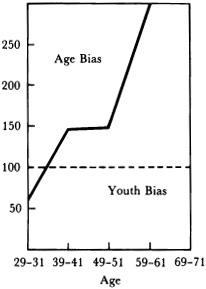
|
Age |
Prince George s Co., Md. (1776) |
New Haven, Conn. (1787) |
United States (1950) |
|
29-31 |
.60 |
n.a. |
.94 |
|
39-41 |
1.46 |
.87 |
.93 |
|
49-51 |
1.47 |
1.58 |
.93 |
|
59-61 |
2.99 |
1.72 |
.92 |
|
69-71 |
n.a. |
n.a. |
.91 |
These ratios measure the relative strength and direction of bias in age reporting. Where no net bias exists, the ratio is 1.0. Where a youth bias exists, the age-heaping ratio falls below 1.0; a bias toward older ages causes the ratio to rise above 1.0. For further discussion, see D. H. Fischer, Growing Old in America (rev. ed., New York, 1978), 82-86; sources of New England data appear in part I, above; Maryland data are from John Modell, unpublished compilation from Gaius Marcus Brumbaugh, Maryland Records(2 vols., Baltimore, 1915, 1967), 1-89; data for the United States in 1950 are from Ansley J. Coale and Melvin Zelnik, New Estimates of Fertility and Population in the United States (Princeton, 1963), 90-138.
11 Smith, Inside the Big House, 124.
12 Jack P. Greene, ed., Diary of Colonel Landon Carter of Sabine Hall (2 vols., Charlottesville, 1965), 250, 310, 315, 713, 763, 1004, 1102; this relationship is discussed at greater length in Fischer, Growing Old in America, 73-76.
13 Fithian to John Peck, 12 Aug. 1774, Journal and Letters, 212.
14 Wright and Tinling, eds., Secret Diary of William Byrd, (24 Jan. 1710).
15 Fischer, Growing Old in America.
16 Maude H. Woodfin, ed., Another Secret Diary of William Byrd of Westover, 1739-1741 (Richmond, 1742), 50.
1 Byrd, London Diary and Other Writings, 465 (22 Oct. 1720).
2 Wright and Tinling, eds., Secret Diary of William Byrd, 481-85; 2-11 Dec. 1720.
3WMQ1 16 (1907), 16.
4 Bruce, Social Life of Virginia, 219.
5Ibid.
6 Jones, The Present State of Virginia, 96-97.
7Executive Journals, Council of the Colony of Virginia, I, 85-87.
8 Woodfin, ed., Another Secret Diary of William Byrd, 6-8.
9 Wright and Tinling, eds., Secret Diary of William Byrd, 188-92.
10 Edward Holt to John Newdigate, 21 Jan. 1621, Newdigate Papers, CR 136/B224, WARRO.
11 Lewis, The Pursuit of Happiness, 72.
12 William Fitzhugh to Mrs. Mary Fitzhugh, 30 June 1698, Davis, ed., Fitzhugh Letters, 261.
13 Wright, Letters of Robert Carter, 18; Smith, Inside the Big House, 267.
1 Hening, Statutes at Large, I, 559.
2 Bruce, Institutional History of Virginia, I, 19.
3Ibid., I, 20.
4Ibid., I, 3-27, 293-315 passim.
5 Bruce, Institutional History of Virginia, I, 21. This will was proved between 1665 and 1677.
6 Beverley, The History and Present State of Virginia, 65.
7 William Fitzhugh to Capt. Roger Jones, 18 May 1685, Davis, ed., Fitzhugh Letters, 168; for the origins of Virginia’s clergy, which have been much misunderstood by historians, see Bruce, Institutional History of Virginia, I, 194-207.
8 Cf. Perry Miller, “Religion and Society in the Early Literature: The Religious Impulse in the Founding of Virginia,” WMQ3 6 (1949), 24-41.
9“A Release for the Parish of Mulberry Island in Virginia,” 1672, Filmer ms., KAO.
10 Bruce, Institutional History of Virginia, I, 25.
11 George K. Smith, “Private Libraries in Colonial Virginia,” AL 10 (1938), 24-52.
12 An English example is John Newdigate’s Commonplace Book, 1609, Ms. B 632C WARRO.
13 Surviving examples of cruciform or T-shaped Virginia churches built before 1775 include Blandford Church, Petersburg; St. Paul’s Church, Norfolk; St. John’s Church, Hampton; St. John’s Church, Richmond; Abingdon Church, Gloucester; Mattapony Church, King and Queen County; Vauter’s Church, Essex County; St. John’s Church, King William County; and Yeocomico Church, Westmoreland County; St. Paul’s Church, King George County, and Aquia Church in Stafford County.
14 Fithian, Journal and Letters, 38 (13 Dec. 1773); 220 (12 Aug. 1774).
15Ibid., 256 (25 Sept. 1774).
16 Robert Stevenson, Protestant Church Music in America, (New York, 1966), 54; Norman A. Benson, “The Itinerant Music Masters of Eighteenth Century America” (thesis, Univ. of Minnesota, 1963); Wright and Tinling, eds., Secret Diary of William Byrd, 272, 276, 292.
17 Morton, Robert Carter of Nomini Hall, 20-21.
18 Fithian, Journal and Letters, 38 (13 Dec. 1773); 220 (12 Aug. 1774).
19Ibid., 10 July 1774.
1 In 1659, an “old woman” named Katharine Grady was accused of witchcraft and summarily hanged from a yardarm on board an immigrant ship bound for Virginia. The authorities in the colony, far from approving the action, hauled the captain into court to answer for the affair. Bruce, Institutional History of Virginia, I, 280-81.
2 Judicial punishment for witchcraft was not unknown in Virginia. In 1655, a case appeared in the prosecution of William Harding of Northumberland County, by a clergyman recently arrived from Scotland. Harding was found guilty of sorcery by a jury and sentenced to banishment. Bruce concludes that “whilst accusations of witchcraft brought into court for investigation were numerous enough, there seems to have been little disposition on the part of justices or juries to affirm them by a favorable judgment or verdict.” Many defamation suits, however, were brought successfully by people denounced for witchcraft. For a review of the evidence, see Bruce, Institutional History of Virginia, I, 276-89.
3 Robert Filmer, An Advertisement to the Jurymen of England, Touching Witches; Together with a Difference betywen an English and a Hebrew Witch (Royston, 1653); see also H[enry] F[ilmer], A Prodigious and Tragicall History of the Arraignment, Tryall … of Six Witches at Maidstone (1652). Similar attitudes appear in gentlemen-justices who sat on the Somerset bench. See T.G. Barnes, ed., “Somerset Assize Orders, 1629-1640,” SOMERSRS 65 (1959), 28.
4 David Woodman, White Magic and English Renaissance Drama (Rutherford, N.J., 1973).
5 An example of an English gentleman’s “fortune book” is the Henry Sturmy Fortune Book (1646), Ms. D 2375, GLOCRO; see also William Gregory, “Speculum Navitates,” Gainsborough Collection ms. 1655, LAO. Many other examples of this genre are to be found in English archives and country houses.
6 Samuel Watts Commonplace Book, 1610, Watts mss., SOMERO.
7 John Holden, Autobiography, 1694, Ms. D 1371, GLOCRO.
8“Journal of a French Traveler in the Colonies: 1765,” AHR 26 (1920-21), 746.
9 Timothy Breen, “Horses and Gentlemen: The Cultural Significance of Gambling Among the Gentry of Virginia,” Puritans and Adventurers (New York, 1980), 148-63.
10 John Richards Diary II, 24 Jan. 1697; 11 Feb., 24 March 1699, DORSRO; on white magic in England, see Keith Thomas, Religion and the Decline of Magic (New York, 1971); Katherine M. Briggs, The Anatomy of Puck (London, 1959); Charles Grant Loomis, White Magic (Cambridge, 1948).
11 Henry C. Forman, The Architecture of the Old South: The Medieval Style, 1585-1850 (Cambridge, 1948), 76.
1 Ames, ed., County Court Records of Accomack-Northampton, 307, 311, 320, 350, 382, 287, 407 (1643).
2 The most comprehensive quantitative study is still that of Philip Bruce, who obtained the following results from wills and depositions:
|
Proportion Signing by Mark |
||||
|
Total Population |
Women Only |
|||
|
County |
Period |
Deeds |
Depositions |
All Documents |
|
Lower Norfolk |
1646-98 |
48.4 |
51.8 |
80.3 |
|
Isle of Wight |
1643-1700 |
45.3 |
53.7 |
89.4 |
|
Surry |
1652-84 |
48.8 |
63.2 |
83.0 |
|
Henrico |
1677-97 |
50.7 |
63.3 |
67.1 |
|
Elizabeth City |
1693-99 |
32.3 |
66.7 |
64.4 |
|
York |
1657-1700 |
44.9 |
63.5 |
75.1 |
|
Middlesex |
1673-1700 |
34.6 |
n.a. |
66.6 |
|
Essex |
1692-99 |
46.7 |
53.8 |
84.1 |
|
Lancaster |
1652-97 |
32.3 |
37.9 |
56.3 |
|
Rappahannock |
1654-99 |
49.3 |
n.a. |
77.8 |
|
Northumberland |
1652-77 |
47.6 |
52.4 |
83.0 |
|
Westmoreland |
1653-77 |
36.6 |
68.4 |
67.3 |
|
Northampton |
1647-98 |
38.2 |
53.3 |
68.5 |
|
Accomac |
1641-97 |
49.3 |
61.7 |
73.7 |
|
All Counties |
1641-1700 |
45.3 |
57.6 |
75.3 |
The sample was 13,135 for deeds; 2,376 for depositions; and 3,066 women; computed from data in Bruce, Institutional History of Virginia, I, 458.
3 Galenson, White Servitude in Colonial America, ch. 5. Literacy of servants tended to be higher in East Anglia, and during the 18th century increased markedly.
4 Advertisements for runaway slaves in Virginia during the mid-18th century reported that less than one in a hundred were able to read and write. That proportion rose a little from 1750 to 1790, but remained at very low levels—much below rates of literacy among slaves in northern colonies. Literacy rates among 678 runaway slaves (according to published descriptions by their masters) was as follows:
|
Period |
Able to Read |
Able to Write |
Able to Read and Write |
Total |
N |
% |
|
1750-59 |
0 |
0 |
1 |
1 |
135 |
0.7 |
|
1770-79 |
0 |
0 |
4 |
4 |
253 |
1.6 |
|
1790-99 |
5 |
4 |
5 |
14 |
189 |
7.4 |
Compiled by Donna Bouvier, Susan M. Irwin, Marc Orlofsky and the author from fugitive slave advertisments in the holdings of the Virginia Gazette.
5 The Rutmans’ study of literacy in Middlesex County, Virginia, yields estimates of literacy by gender and father’s status through time:
|
Literacy by Gender, Status and Period of Maturity |
|||||||
|
Status of |
1650-1699 |
1700-1719 |
1720-1744 |
||||
|
Father |
m |
f |
m |
f |
ra |
f |
|
|
High |
100.0 |
100.0 |
100.0 |
100.0 |
100.0 |
100.0 |
|
|
High Middle |
87.5 |
80.0 |
100.0 |
100.0 |
100.0 |
83.3 |
|
|
Middle |
80.0 |
17.8 |
81.4 |
17.9 |
78.7 |
17.8 |
|
|
Lower Middle |
44.4 |
20.0 |
66.7 |
20.0 |
95.7 |
20.0 |
|
|
Low |
50.0 |
5.3 |
47.5 |
0.0 |
45.8 |
14 3 |
|
Source: Rutman and Rutman, A Place in Time, Explicatus, 169
6 David Cressy, Literacy and the Social Order; Reading and Writing in Tudor and Stuart England (Cambridge, 1980), 73-74.
7 Kenneth Lockridge, Literacy in Colonial New England (New York, 1974), 73-87.
8 William Fitzhugh to Nicholas Hayward, 30 Jan. 1687, Davis, ed., Fitzhugh Letters, 203.
9 Hening, Statutes at Large, II 517.
10lbid., II, 518.
11 Cressy, Literacy and the Social Order, 45.
12Ibid., 187.
13 John R. Barden, “Reflections of a Singular Mind: The Library of Robert Carter of Nominy Hall,” VMHB 96 (1988), 83-94.
14 As early as 1658 John Lee of Virginia presented to The Queen’s College a silver cup which bears the piquant inscription, “Coll. Regi. Oxon. D.D. Johanes Lee Natus in Capohowasick Wickacomoco in Virginia Americae, Filius Primogenitus Richardi Lee Chiliarchae Orundi de Morton [orig. Coton?] Regis in Agro Salopiensi 1658.” This branch of the Lee family came from Coton in Shropshire; the error was probably made in re-engraving.
15 A survey of education among the gentry of Warwickshire by Ann Hughes finds that roughly 18% had some university training, mostly at Oxford. Another 13% had attended the Inns of Court; two-thirds had no higher education. Ann Hughes, Politics, Society and Civil War in Warwickshire, 1620-1660 (Cambridge, 1987), 44.
16 Particularly valuable for the history of education in this region are the “Memoirs of the Birth, Education, Life and Death of Mr. John Cannon” (1684-1742), a sometime excise officer and school keeper in the West Country. The manuscript is in the Somerset Record Office, Taunton.
1 In William Byrd’s diary, 43 references to meat appeared within a period of three months, from 1 Dec. 1709 to 1 March 1710. Beef was mentioned twenty-four times, pork five times, mutton three times, fish, goose, turkey and chicken twice each, and venison, pigeon and duck once each; in other periods Byrd abstained from meat. Main, Tobacco Colony, 209.
2OED, s.v. “mess,” I.I, a “prepared dish. …” In England, this usage was identified as “now only archaic” as early as the 19th century, but it continued in the American south until the 20th century and is still current in black culture throughout the United States, as a “mess of greens.”
3 Main, Tobacco Colony, 220-21; for English diet in the records of Berkshire farmers, see G. E. Fussell, ed., “Robert Loder’s Farm Accounts, 1610-1620,” CS 3d series 53 (1936), passim; Cicely A. H. Howell, “The Social Condition of the Peasantry in South East Leicestershire, AD 1300-1700” (thesis, Univ. of Leicester, 1974), 193.
4 Byrd, London Diary and Other Writings, 462, 248, passim.
5 Many English cookery books survive in ms. from the 17th century, both in country houses and county record offices. One of them, from a Berkshire household circa 1650, included recipes for artichoke pie, almond pudding, roast pullet stuffed with oysters, buttered lobster, boiled carp in blood, potted lamprey, marinated cherries, hartshorn jelly, blow pudding (“the lights and heart of a hog”) carrot pudding, gooseberry fool, blanc mange, marrow pudding and many fricassees. See “Book of Cookery …,” ms. D/ED F37, BERKRO.
6 Jane Carson, Colonial Virginia Cookery; Procedures, Equipment, and Ingredients in Colonial Cooking (Williamsburg, 1985), 98-99.
7“Book of Cookery Hints,” D/ED/F37 BERKRO; Wright and Tinling, Secret Diary of William Byrd, 487, 514 (18 Feb., 14 April 1712).
8 Dorothy Hartley, Food in England (London, 1954) 174.
9 David Ellerton Allen, British Tastes: An Inquiry into the Likes and Dislikes of the Regional Consumer (London, 1968), 75, 34.
10 Horn, “Social and Economic Aspects of Local Society in England and the Chesapeake,” 183, 185, 205, reports the following frequencies of roasting equipment (spits), by total wealth of inventoried estates, in the late 17th century:
|
Total Wealth |
Gloucestershire |
Maryland |
Virginia |
|
less than £10 |
29.7% |
6.7% |
0.0% |
|
£10-£49 |
63.2 |
24.6 |
34.8 |
|
£50-£99 |
73.8 |
44.9 |
68.3 |
|
£100-£249 |
77.5 |
73.1 |
78.9 |
|
£250 and up |
81.1 |
77.6 |
91.7 |
11 Carson, Colonial Virginia Cookery, 11.
12 Frederick P. Stieff, Eat, Drink and Be Merry in Maryland (New York, 1932), xiv.
13Fithian, Journal and Letters, 15 June 1774.
14 F. Hopkinson Smith, Col. Carter of Carterwille; Stieff, Eat, Drink and Be Merry in Maryland, 181.
15 Chinard, ed., A Huguenot Exile in Virginia, 158.
16 Main, Tobacco Colony, 211.
17 Keith Wrightson, English Society, 1580-1680 (London, 1982), 32-33, citing Everitt, “Farm Labourers,” in Thirsk, ed., Agrarian History of England and Wales, IV, 438-553.
1 Peter Collinson to John Bartram, 17 Feb. 1737, WMQ2, 6 (1926), 304.
2 The conventional sources for costume are inventories of estates; even better evidence is to be found in household account books. A particularly rich trove of information for this subject is the John Haynes Book of Household Expences, 1631-43, Ms. 36 DEVRO.
3 Alice Morse Earle, Two Centuries of Costume in America (New York, 1903).
4 Fithian, Journal and Letters, 38-39.
5 For gold and silver hatbands see Massingbird Diary, 1648, Ms. MM10/1 LINCRO; ribands and laces frequently appear in John Haynes Household Account Book, 3 Sept. 1638, Ms. 36 DEVRO.
6 Carter, Diary, II, 938.
7“Gentlemen appear in all places naked (i.e. without their swords) … from a polite declaration that in places of public resort all distinctions ought to be lost in a general complaisance.” Arthur Rowntree, History of Scarborough, 256.
8 John Haynes Household Account Book, 13 June 1639, ms. 36, DEVRO.
9 Jones, Present State of Virginia, 24.
10 William Fitzhugh to Capt. Henry Fitzhugh, 30 Jan. 1686/87, Davis, ed., Fitzhugh Utters, 192.
11 Gregory A. Stiverson and Patrick H. Butler III, “Virginia in 1732: The Travel Journal of William Hugh Grove,” VMHB 85 (1977), 44.
12Ibid.
1 Wright, First Gentlemen of Virginia, 87; Mary Newton Stanard, Colonial Virginia: Its People and Customs (Philadelphia, 1917), 257.
2WMQ1 3 (1894), 136.
3 Breen, “Horses and Gentlemen,” 159.
4 Bruce, Social Life in Virginia, 201.
5 Jane Carson, Colonial Virginians at Play (Charlottesville, 1965), 113.
6 Thomas Anburey, Travels through the Interior Parts of America (London, 1789), 227.
7 Carson, Colonial Virginians at Play, 120-22.
8Diary of Thomas Isham, 5 Sept. 1672; James Rice, History of the British Turf (n.p., 1879), 151.
9 Fairfax Harrison, “Racing in Colonial Virginia,” VMHB 1 (1895), 293.
10 Thomas Jefferson to Peter Carr, 19 Aug. 1785, Jefferson Papers, ed., Boyd, VIII, 407.
11 Daniel Eaton to 3rd Earl of Cardigan, 12 Aug. 1725, “Letters of Daniel Eaton,” NHANTRS 24 (1971), 38.
12 John Richards Diary, 26 Oct. 1698, DORSRO.
13 For descriptions of ganderpulling in Virginia, Kentucky, Tennessee, North Carolina and Georgia, see Henry Fearon, Sketches of America (London, 1818), 243; A. B. Longstreet, Georgia Scenes (New York, 1957), 97-105; J. P. Young, “Happenings in a White Haven Community, Shelby County, Tennessee, Fifty or More Years Ago,” THM 7 (1923), 97; Guion G. Johnson, Antebellum North Carolina: A Social History (Chapel Hill, 1937), 111-12.
14 Thomas Aldrich to Thomas Isham, 4 March 1668, ms. 596, Isham Papers, NHANTSRO.
15 Cheyne, The Dialect of Hartland, Devonshire, 17.
16 Marlow, ed., Diary of Thomas Isham, 1658-1681, 30.
1 Bamford, ed., A Royalist’s Notebook, 230.
2 A very large literature on this subject is surveyed in John J. McCusker and Russell R. Men-ard, The Economy of British America, 1607-1789 (Chapel Hill, 1985), 117-43.
3 Here again the historiographical literature has gone through broad swings. Three generations ago, Virginia gentlemen were perceived as hostile to commerce and removed from it. The next generation reversed this interpretation, and argued that the first gentlemen of Virginia were descended from merchants, and actively and even centrally engaged in commercial activity. The truth lies in between.
4 Kingsbury, Records of the Virginia Company, III, 706.
5 William Byrd II to Charles Boyle, Earl of Orrery, 2 Feb. 1727, Tinling, ed., Correspondence of the Three William Byrds, I, 350.
6 Beverley, The History and Present State of Virginia, 296.
7Ibid., 295.
8 Thoraas Smith, De Republica Anglorum, ed. Mary Dewar (Cambridge, 1982), 63.
9 The earliest American directories in the 18th century used the words “independent” and “gentleman” as synonyms.
10 Berkeley, Discourse and View of Virginia, 6-7.
11 Morgan, American Slavery, American Freedom, 147.
12“An Act for the repealing the Act for Markets and regulating trade.” Hening, Statutes of Virginia, I (March 1655-56), 397.
13 Byrd to Lord Orrery, 5 July 1726, Tinling, ed., Correspondence of the Three William Byrds, I, 355.
14 Collinson to Bartram, 17 Feb. 1737, WMQ2 VI (1926), 304.
15 Morton, Robert Carter of Nomini Hall, 262.
16 An excellent discussion of planter debt appears in Timothy Breen, Tobacco Culture: The Mentality of the Great Tidewater Planters on the Eve of Revolution (Princeton, 1985), 128.
17 Vivienne M. Larmine, “The Lifestyle and Attitudes of the Seventeenth Century Gentleman with Special Reference to the Newdigates” (thesis, Univ. of Birmingham, 1980).
1 Byrd, “A Progress to the Mines,” in London Diary and Other Writings, 627.
2 Wm. Byrd to Earl of Orrery, 5 July 1726, Tinling, ed., Correspondence of the Three William Byrds, I, 354-55.
3 William Tatham, An Historical and Practical Essay on the Culture and Commerce of Tobacco (London, 1800), 16-17, 119.
4 John Gage, The History and Antiquities of Hengrave in Suffolk (London, 1822), 6.
5 For the actual settling of annual accounts in England, see John Meriwether Diary, 25 Dec. 1711, ms. 2220, WILTRO; for the Chesapeake, see Carville Earle, The Evolution of a Tidewater Settlement System: All Hallow’s Parish, Maryland, 1650-1783(Chicago, 1975), 158.
6 Fithian, Journal and Letters, 52.
7 The index of marriages in All Hallow’s Parish, Anne Arundel County, Maryland, was as follows (1700-1776):
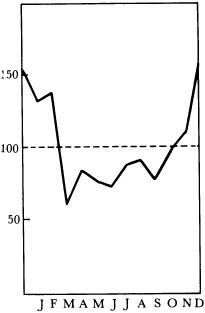
|
Month of |
Percent of |
Marriage Index |
|
Marriage |
All Marriages |
m=100 |
|
Jan. |
11.0 |
132 |
|
Feb. |
12.4 |
149 |
|
March |
5.1 |
61 |
|
April |
7.1 |
85 |
|
May |
6.4 |
77 |
|
June |
6.1 |
73 |
|
July |
7.3 |
88 |
|
Aug. |
7.7 |
92 |
|
Sept. |
6.6 |
79 |
|
Oct. |
8.1 |
97 |
|
Nov. |
9.2 |
110 |
|
Dec. |
13.0 |
156 |
Computed from data in Earle, The Evolution of a Tidewater Settlement System, 159; similar patterns are reported for other parts of Maryland and Virginia in Darrett B. Rutman, Charles Wetherell and Anita Rutman, “Rhythms of Life: Black and White Seasonality in the Early Chesapeake,” JIH 11 (1980), 29-53; and Kulikoff, Tobacco and Slaves, 256; see also David Cressy, “The Seasonality of Marriage in Old and New England,” JIH 16 (1985), 23; for similarities between Virginia and the south of England (which was very different from the north) see Ann Kussmaul. “Time and Space, Hoofs and Grain: The Seasonality of Marriage in England,” JIH 15 (1985), 755-79.
8 On the conception cycle, Carville Earle’s research on All Hallow’s Parish yields the following pattern for the period from 1700 to 1776:
|
Month of |
Month of |
Percent of Annual |
Monthly Index |
|
Conception |
Baptism |
Births |
(Monthly Mean = 100) |
|
Dec-Jan. |
Oct. |
9.6% |
115 |
|
Jan.-Feb. |
Nov. |
4.9% |
59 |
|
Feb.-March |
Dec. |
4.3% |
52 |
|
March-April |
Jan. |
3.3% |
40 |
|
April—May |
Feb. |
8.6% |
103 |
|
May—June |
March |
10.0% |
120 |
|
June-July |
April |
11.0% |
132 |
|
July-Aug. |
May |
8.6% |
103 |
|
Aug.-Sept. |
June |
10.2% |
122 |
|
Sept.-Oct. |
July |
8.1% |
97 |
|
Oct.-Nov. |
Aug. |
11.8% |
142 |
|
Nov.—Dec. |
Sept. |
9.6% |
115 |
Computed from data in Earle, in The Evolution of a Tidewater Settlement System, 159; similar but not identical cycles are reported in Rutman, Wetherell and Rutman, “Rhythms of Life,” 30-31; and Kulikoff, Tobacco and Slaves, 256. These data refer to the white population only; as will be discussed in volume 3, the rhythm of seasonality among blacks was different.
9 William Byrd to John Custis, 29 July 1723, Tinling, ed., Correspondence of Three William Byrds, I, 346.
10 Bullen Reynes Diary, 8 Sept. 1632, 5 April 1632, 27 Nov. 1632; Ms. 865/392, WILTRO; see also Richard Newdigate Diary, 12 May 1682, Ms. B 1306a-C, WARRO.
11 Kenneth Stampp, The Peculiar Institution (New York, 1956), chap. 2.
1 William Fitzhugh to William Fitzhugh, 22 April 1686; David, ed., Fitzhugh Letters, 174.
2 In Surry County, Virginia, historian Kevin Kelly finds that male tithables were distributed as follows by material status in 1703/04:
|
Status |
Number (%) |
|
Free landowners |
96(11.1%) |
|
Great landowners (950 acres+) |
8 |
|
Upper middling landowners (650-949 acres) |
6 |
|
Lower middling landowners (350–649 acres) |
15 |
|
Small landowners (1-349 acres) |
67 |
|
Free non-landowners |
344 (39.8%) |
|
Non-free non-landowners |
425 (49.2%) |
|
Dependent sons of landowners |
74 |
|
White male servants |
131 |
|
Black slaves |
220 |
|
Total tithables |
865 (100.1%) |
|
Total population |
2,230 |
Surry was a low, swamp-filled county directly across the James River from Jamestown. Inventoried estates in 1690 showed a Gini ratio of .55, which was exceptionally egalitarian by Virginia standards at that date. Tithables in this county included males from 16 to 60, and widows who held property, plus male servants and slaves. See Kelly, “Economic and Social Development of Seventeenth Century Surry County, Virginia” (thesis, Univ. of Washington, 1972), 19, 111, 135.
3 Many studies of wealth distribution in the Chesapeake colonies report the following results.
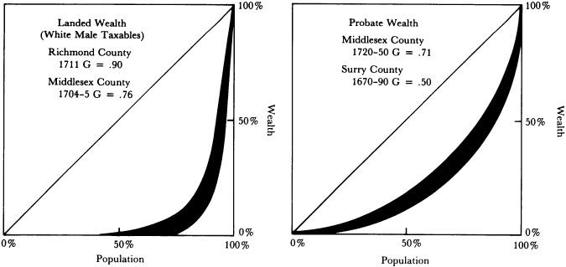
Sources include Kelly, “Surry County”; Rutman and Rutman, A Place in Time, Explicatus, 117-32; Main, Tobacco Colony, 55; Robert E. and B. Katherine Brown, Virginia, 1705-1786: Democracy or Aristocracy? (East Lansing, 1964), 13, 75; Lee Gladwin, “Tobacco and Sex,” JSH 12 (1978), 57. The Browns omitted tenants, whose numbers may be computed from data in Evarts B. Green and Virginia D. Harrington, America Population before the Federal Census of 1790 (1932, rpt. New York, 1966), 150-51. This has been done here.
The Rutmans found the following patterns for Middlesex County, Virginia:
|
Wealth Type |
Period |
Gini |
SSTT |
SSBT |
n |
|
Personal wealth |
1650-59 |
.62 |
50.0 |
4.2 |
23 |
|
1700-19 |
.78 |
71.6 |
2.0 |
120 |
|
|
1720-50 |
.71 |
58.7 |
2.7 |
192 |
|
|
Servants and slaves |
1668 |
.74 |
58.4 |
0.0 |
83 |
|
1687 |
.85 |
73.5 |
0.0 |
231 |
|
|
1724 |
.77 |
60.5 |
0.0 |
254 |
|
|
Land |
1668 |
.61 |
47.5 |
4.0 |
83 |
|
1687 |
.74 |
60.5 |
0.1 |
215 |
|
|
1724 |
.74 |
58.5 |
0.0 |
242 |
Gini = Gini Ratio; SSTT = size share top tenth; SSBT = size share bottom tenth.
Gloria Main’s research on Maryland inventories yielded much the same findings: a Gini ratio of .59 for gross personal wealth in 1656-83; rising to .65 in 1694-1705 and to .73 in 1715-19.
Probate records understate inequality in Virginia (more so than in Massachusetts or Pennsylvania), and yield results very different from land lists and tax assessments when the latter are adjusted for the large number of landless adult males. In Middlesex County (1704-5), the Gini ratio of land distribution among adult white males was .76; the proportion owning no land was above 43%. When black males are included, the Gini ratio rises to .81 and zero holding to 58%. In Richmond County (1711), wealth was even more concentrated: the Gini ratio was .90 among white males and .94 when blacks are included. In a population of approximately 2,500 people, 13 planters possessed 61% of taxable acreage and only 72 others owned any land at all; most white male adults were landless. In Lancaster County (1750-55) nearly half of the adult male population were slaves; another quarter were landless white tenants, and 21 great planters owned between 500 and 2,000 acres apiece.
4 The richest families in New England were only middling prosperous by comparison with the great tidewater planters. Most towns in Massachusetts knew nothing like the dominion of great landed families that existed throughout the Chesapeake. The closest parallel in New England was the town of Springfield, where the Pynchon family was exceptionally rich and powerful. But even at the peak of their power, the Pynchons owned only about 20% of taxable wealth in that town. By most quantitative measures, the distribution of wealth even in Springfield was closer to the New England average than to Virginia’s. Stephen Innes, Labor in a New Land: Economy and Society in Seventeenth Century Springfield (Princeton, 1983), 44-47.
5 Horn, “Social and Economic Aspects of Local Society in England and the Chesapeake,” 126-28; see also idem, “The Distribution of Wealth in the Vale of Berkeley, Gloucestershire, 1660-1700,” SH 3 (1981), 81-110.
6 On the nexus of land, family and politics see John Randolph to Sir Justinian Isham, 7 March 1660, Isham Mss. 499, NHANTSRO.
7 Bruce computed the size of land grants as follows:
|
Year |
Mean |
Maximum |
|
1607-50 |
442 |
5,350 |
|
1650-1700 |
674 |
20,000 |
Source: Philip A. Bruce, Economic History of Virginia in the Seventeenth Century (2 vols., 1895, New York, 1935), I, 532.
8 Edward Ingle, Local Institutions in Virginia (Baltimore, 1885), 32.
9 Rutrnan and Rutman, A Place in Time, 216-17.
10 Wyatt-Brown, Southern Honor, 102.
11 Allan Kulikoff has brought together the results of many research projects on tenancy in the Chesapeake colonies:
|
Percent of |
Number of |
||
|
Households |
Households |
||
|
Place |
Year |
Owning Land |
Altogether |
|
Prince George’s Co., Md. |
1705 |
65% |
459 |
|
1733 |
58% |
1,204 |
|
|
1755 |
56% |
1,337 |
|
|
1776 |
45% |
1,669 |
|
|
Charles and Calvert Cos., Md. |
1783 |
47% |
2,805 |
|
Northern Neck, Va. |
1787 |
42% |
n.a. |
|
Fairfax Co., Va. |
1782 |
36% |
831 |
|
Richmond Co., Va. |
1782 |
70% |
511 |
|
1790 |
56% |
655 |
|
|
James City Co., Va. |
1768 |
70% |
268 |
|
Tidewater Virginia |
1787 |
64% |
n.a. |
Source: Kulikoff, Tobacco and Slaves, 135, citing research by Lois Green Carr, Gregory Stiverson, Jackson Turner Main and Norman Risjord, in addition to his own inquiries.
12 Andrews, Colonial Folkways, 35.
13 Willard F. Bliss, “The Rise of Tenancy in Virginia,” VMHB 58 (1958), 427-41.
14 Rutman and Rutman, A Place in Time, 130; Morgan, American Slavery, American Freedom, 338-43.
15 Rutman and Rutman, A Place in Time, 201; cf. Virginia Bernhard, “Poverty and the Social Order in Seventeenth Century Virginia,” VMHB 85 (1977), 141-55.
16 C. Ray Keim, “Primogeniture and Entail in Colonial Virginia,” WMQ3 25 (1968), 545-86.
17 Jones, Present State of Virginia, 93.
18 John Washington to his sister 22 June 1699, Ms. PI 700a, NHANTSRO.
19 Smith, Inside the Great Howe, 245.
20 Half of this estate went to the eldest son at his majority, with the stipulation that he would provide marriage portions for his sisters. The smallest portions in the Newdigate family went to the younger sons. This was a common pattern in the south and west of England. Younger sons did not do as well as their sisters. Newdigate testament and inventory, 10 July 1610, Newdigate Mss. CR 136, C19, WARRO.
21 Kulikoff, Tobacco and Slaves, 267; Harry Wright Newman, Mareen Duvall of Middle Plantation … (Washington, 1952).
22 For another study which finds broad similarities in the inheritance customs of Gloucestershire and the Chesapeake, see Horn, “Social and Economic Aspects of Local Society in England and the Chesapeake,” chap. V.
1 Richard Newdigate, ms. dated 15 July 1699, Newdigate Papers, B 1308 a-c, WARRO.
2 Thomas Westcote, Gent., A View of Devonshire in 1630 (Exeter, 1845).
3 William Camden, Britannia (1586, 6th ed. 1606, Eng. tr. London, 1610); William Dugdale, Life, Diary and Correspondence (London, 1827).
4 Westcote, A View of Devonshire.
5 William Harrison, A Description of England, ed. George Edelen (New York, 1968), 149; on honor see Wyatt-Brown, Southern Honor, chap. 2.
6 Quitt adds the word “apparently” because he was unable to discover the origins of 13 burgesses out of 345. Arguments to the contrary have been made about the Chesapeake, but they tend to draw their evidence from Maryland, which was more open than Virginia in the late 17th and early 18th century. The social system of Virginia had been more fluid in the early years of the colony, but after the arrival of Sir William Berkeley, it became very much more rigid. Quitt’s evidence shows that the major change occurred in the 1640s and 1650s, not in 1676 or 1690. See Martin H. Quitt, “Virginia House of Burgesses, 1660-1706: The Social, Educational and Economic Bases of Political Power (thesis, Washington Univ. 1970), 274.
7 Byrd, Secret Diary, 410, 411, 413: Rhys Isaac, The Transformation of Virginia, 1740-1790 (Chapel Hill, 1982), 108.
8The Life of the Rev. Devereux Jarratt, Rector of Bath Parish, Dinwiddie County, Virginia, Written by Himself (Baltimore, 1806), 39.
9 Isaac, The Transformation of Virginia, 161.
10 Byrd, 27 Aug. 1720, London Diary and Other Writings, 444; similar dreams appear in the diary of the English astrologer Simon Forman; see A. L. Rowse, Sex and Society in Shakespeare’s Age: Simon Forman the Astrologer (New York, 1974), 20-21.
11“Notes of St. George Tucker on Manuscript Copy of William Wirt’s Life of Patrick Henry (September 25, 1815),” WMQ1 22 (1914), 252; Breen, Tobacco Culture, 34.
12 Charles Woodmason, The Carolina Backcountry (Chapel Hill, 1953), 198.
13 Sir William Berkeley to Maj. Gen. Smyth, 22 June 1666, WMQ2 16 (1936), 591.
14 The number of Africans in Virginia was reckoned at 500 in 1649 by an anonymous pamphleteer, 2,000 in 1671 by Sir William Berkeley, and 3,000 in 1681 by Thomas Culpeper. Philip Bruce estimated that there were 6,000 blacks in Virginia by 1700. Wesley Frank Craven put the number in that year at “somewhat larger but not greatly in excess of six thousand.” Edmund Morgan guessed that the total number of blacks was between 1,000 and 3,000 in 1674 and between 6,000 and 10,000 in 1700—with the lower estimates being more likely. The Historical Statistics of the United States are grossly inaccurate on this issue. See Bruce, Economic History of Virginia, II, 108; Craven, White, Red and Black, 98-103; Morgan, American Slavery, American Freedom, 423.
15 The black population changed as follows in the four colonies:
|
New England |
New York |
Chesapeake |
Maryland |
Virginia |
|
|
1640 |
195 |
232 |
160 |
10 |
150 |
|
1680 |
470 |
1,200 |
5,438 |
1,438 |
4,000 |
Source: Russell R. Menard, “Population, Economy and Society in Seventeenth Century Maryland,” MDHM 79 (1984), 71-92.
16 Wyatt-Brown, Southern Honor, 16.
17 William Byrd II to Charles Boyle, Earl of Orrery, 2 Feb. 1727, Tinling, ed., Correspondence of the Three William Byrds, III, 358.
18 William Byrd II to John Perceval, Earl of Egmont, 12 July 1736, ibid., I, 487.
19 The history of slavery and African folkways in America is discussed at length in volume 2 of this book. Here only two points are to be made. First, the culture of Virginia came before slavery. Second, slavery developed not merely from an economic but a broadly cultural imperative.
1 Peter Fontaine to John and Moses Fontaine, 15 April 1754, in Ann Maury, Memoirs of a Huguenot Family (New York, 1853), 340-42; quoted in Jan Lewis, The Pursuit of Happiness, (Cambridge, 1983), 12.
2 Thomas Glover, “The Account of Virginia,” The Philosophical Transactions and Collections to the End of the Year 1700 …, ed. John Lowthrop (London, 1716), III, 569.
3 Stiverson and Butler, “Virginia in 1732,” 18-44.
4Ibid., 26; see also Isaac, Transformation of Virginia, 35.
5 Beverley, The History and Present State of Virginia, 308.
6 Crude rates of persistence for tithables were as follows in Northampton Co., Va.: 1664-74, 45%; 1665-75, 43%; 1666-76, 46%; 1667-77, 42%. In Surry Co., Va., they were: 1668-78, 46%; 1678-88; 47%; 1688-98, 45%. Comparisons with rates of persistence in New England are problematical. The unit of study is the county in Virginia and the town in New England. The county tended to be larger than the town. As the analytic unit increases in size, the persistence rate rises too, ceterus paribus. In consequence, the difference between Massachusetts and Virginia in rates of crude persistence was actually greater than appears here. But mortality was higher in the Chesapeake than in New England; refined persistence rates (which cannot yet be computed for Virginia) would be closer in the two regions than crude persistence rates tended to be. Sources include Kevin Kelly, “Economic and Social Development of Seventeenth Century Surry County, Virginia” (thesis, Univ. of Washington, 1972); Edmund S. Morgan, American Slavery, American Freedom (New York, 1975), 427.
7 Allan Kulikoff reports the following refined migration rates for Prince George’s County, Maryland, 1733-43: householders owning land and slaves, 15%; householders owning land or slaves, 29%; long-term residents, owning neither, 39%; recent immigrants, owning neither, 58%; sons of tenants, 65%; laborers without kin ties in county, 75%; Kulikoff, Tobacco and Slaves, 93.
8 Peter Laslett discovered two population lists for the parish of Cogenhoe, Northamptonshire, an area that contributed heavily to the peopling of Virginia. The crude persistence rate in Cogenhoe from 1618 to 1628 was 48%, almost exactly the same as in Northampton County, Virginia. See Peter Laslett and John Harrison, “Clayworth and Cogenhoe,” in H. E. Bell and R. L. Ollard, eds., Historical Essays Presented to David Ogg (1963); a revised and expanded edition appears in Peter Laslett, Family Life and Illicit Love in Earlier Generations; Essays in Historical Sociology (Cambridge, 1977), 50-101.
9 For evidence that the size of the neighborhood was similar in the Chesapeake and the west of England, see Horn, “Social and Economic Aspects of Local Society in England and the Chesapeake,” 286.
10 Bamford, ed., A Royalist’s Notebook, 4.
11 John Richards Diary, DORSRO, is particularly full in descriptions of credit relations among cousins and neighbors, and also of the constant entertaining. See especially entries for 1692 and 1697.
12 Manwaring Diary, 10 April 1649, ms. DDY 384/1, CHESRO.
13 Cannon Memoirs, 1707, SOMERO.
14 F. J. Snell, “A Devonshire Yeoman’s Diary,” A 26 (1892), 254-59.
15Ibid., 257.
16Ibid., 256.
17Ibid., 257; see also Christopher M. Gerrard, “Taunton Fair in the Seventeenth Century: An Archaeological Approach to the Historical Data,” SANHSP 128 (1985), 65-74.
18 Francis Taylor Diary, SHCUNC.
19“Bacon’s Speech at Green Spring,” WMQ1 3 (1894), 121; Wyatt-Brown, Southern Honor, 82.
20 Wright, First Gentlemen of Virginia, 10.
21 Clara Ann Bowler, “Carted Whores and White-Shrouded Apologies: Slander in the County Courts of Seventeenth Century Virginia,” VMHB 85 (1977), 411-26; William Andrews, Old-Time Punishments (1890, rpt. Williamstown, 1977), 164-75.
22Charles County Court Proceedings, 1662, MDA LIII, 319.
1“An Exhortation to Obedience,” Book of Homilies (1562). This was still read in Anglican churches in Virginia as late as the mid-17th century. For a helpful discussion see Terence R. Murphy, “The Early Tudor Concept of Order,” in Emilio C. Viano and Jeffrey H. Reiman, eds., The Police in Society (Lexington, Mass., n.d.), 75-87; Keith Wrightson, “Two Concepts of Order …,” in John Brewer and John Styles, eds., An Ungovernable People; The English and Their Law in the Seventeenth and Eighteenth Centuries(London, 1980), 21-46.
2 George Alsop, “A Character of the Province of Maryland” (1666), rpt. in Clayton C. Hall, ed., Narratives of Early Maryland, 340-87.
3 Michael Dalton, The Office and Authoritie of the Sherifs (London, 1623, rpt. 1682, 1700).
4 Cyrus H. Karraker, The Seventeenth-Century Sheriff: A Comparative Study of the Sheriff in England and the Chesapeake Colonies, 1607-1689 (Chapel Hill, 1930), 77-78.
5 Arthur P. Scott, Criminal Law in Colonial Virginia (Chicago, 1930), 316.
6 The neck verse ran, “Have mercy upon me, O God, according to thy loving kindness; according unto the multitude of thy mercies blot out my transgressions.”
7 Benefit of clergy rarely occurred in New England. Only two cases have been found in that region—in York County, Maine (1736), and in the trial of British soldiers after the Boston massacre (1770). Hundreds of cases have been found in Virginia; see Arthur Lyon Cross, “Benefit of Clergy in American Criminal Law,” MAHSP 61 (1928), 154-81; George W. Dalzell, Benefit of Clergy & Related Matters (Winston-Salem, 1955); Hugh F. Rankin, “Criminal Trial Proceedings in the General Court of Colonial Virginia,”VMHB (1964), 50-71.
8 Rankin, “Criminal Trial Proceedings,” 50-74.
9Virginia Gazette, 24 Nov. 1738.
10 Rankin, “Criminal Trial Proceedings,” 71.
11 Byrd, London Diary and Other Writings, 435; Wright and Tinling, eds., Secret Diary of William Byrd, 2,46, 112, 113, 117, 119.
12lbid., 419.
13Ibid., 424,431.
14 Mary Isham to Sir Thomas Isham, 9 Dec. 1677, Isham Mss. 1007, NHANTSRO.
15 Morgan, Virginians at Home, 19.
16 John Richards Diary, 13 Oct. 1701, DORSRO.
17 Byrd, London Diary and Other Writings, 433.
18 William Byrd II to William Beckford, 6 Dec. 1735, Tinling, ed., Correspondence of the Three William Byrds, II, 464.
19 Scott, Criminal Law in Colonial Virginia, 150.
20 W. S. Holdsworth, A History of English Law (13 vols., London, 1922-52), V, 348.
21 In five Maryland county courts (1658-79), annual rates of criminal prosecution averaged 248 per 100,000; in four New England courts, 561 per 100,000. Saloman, “Community and Hierarchy,” 42.
22 Mark Saloman obtains the following results for criminal prosecutions in Maryland courts:
|
Maryland |
Charles Co. |
Talbot Co. |
Kent Co. |
Somerset Co. |
Pr. George’s Co. |
|
|
Crimes against |
total |
1658-74 |
1662-74 |
1668-71 |
1665-71 |
1696-99 |
|
Order |
52 (31%) |
6 (13.6%) |
3 (10.3%) |
15 (50.0%) |
1 (16.7%) |
27 (46.5%) |
|
Sexual Morality |
60 (35.9%) |
19 (43.2%) |
18 (62.1%) |
7 (23.3%) |
3 (50.0%) |
13 (22.4%) |
|
Property |
29 (17.4%) |
9 (20.5%) |
5 (17.2%) |
3 (10.0%) |
1 (16.7%) |
11 (19.0%) |
|
The Person |
26(15.6%) |
10 (22.7%) |
3 (10.3%) |
5 (16.7%) |
1 (16.7%) |
7(12.1%) |
Source: Saloman, “Community and Hierarchy,” 43-51.
23Ibid., 43-44.
1 Chinard, ed., A Huguenot Exile in Virginia, 111, 148, passim.
2 R. R. Palmer, The Age of the Democratic Revolutions (2 vols., Princeton, 1959), I, 155.
3 Hening, Statutes at Large, I, 240; Wm. H. Seiler, “The Anglican Parish Vestry in Colonial Virginia,” JSH 22 (1956), 310-37.
4 Fitzhugh to Roger Jones, 18 May 1685, Davis, ed., Fitzhugh Letters, 168.
5 A. G. Roeber, “Authority, Law and Custom: Rituals of Court Day in Tidewater Virginia,” WMQ3 (1980), 29-52; for the architecture of the Middlesex County court house see Rutman and Rutman, A Place in Time, 129.
6 William Fitzhugh to Robert Fitzhugh, 30 Jan. 1687, Davis, ed., Fitzhugh Letters, 201.
7 Strong similarities between the English county courts and those of the west of England may be observed by comparing American materials with sources such as T. G. Barnes, Somerset Assize Orders, 1629-1640, and J. S. Cockburn, ed., Somerset Assize Orders, 1640-1659, SOMERSRS 71 (1971); for a helpful comparative study of one local officer, see Cyrus H. Karraker, The Seventeenth Century Sheriff; A Comparative Study of the Sheriff in England and the Chesapeake Colonies, 1607-1689 (Chapel Hill, 1930).
8 Beverley, The History and Present State of Virginia, 65.
9 From the ruins of the house, antiquarians reckoned that the main part was 48 feet broad by 43 feet deep, with two wings each measuring 26 feet by 16. The massive walls were 2 1/2 feet thick.
10 Berkeley, Discourse and View of Virginia, 8.
11 William Byrd II to William Beckford, 6 Dec. 1735, Tinling, ed., Correspondence of the Three William Byrds, II, 464.
12 In the elections of Burgesses during the year 1755, turnout in tidewater Virginia was as follows:
|
Percent of White Adult Males Voting: |
|||||
|
County |
1742 |
1752 |
1755 |
1758 |
1771 |
|
Accomac Co. |
49% |
43% |
48% |
50% |
|
|
Amelia Co. |
50% |
||||
|
Brunswick Co. |
46% |
||||
|
Elizabeth City Co. |
45% |
||||
|
Essex Co. |
53% |
44% |
53% |
53% |
33% |
|
Fairfax Co. |
42% |
36% |
|||
|
Henrico Co. |
58% |
||||
|
King George Co. |
34% |
45% |
|||
|
Lancaster Co. |
58% |
50% |
39% |
60% |
46% |
|
Northumberland Co. |
45% |
39% |
|||
|
Prince Edward Co. |
27% |
45% |
|||
|
Prince George Co. |
55% |
||||
|
Richmond Co. |
45% |
37% |
40% |
37% |
|
|
Spotsylvania Co. |
46% |
35% |
42% |
49% |
|
|
Surry Co. |
44% |
||||
|
Westmoreland Co. |
53% |
57% |
48% |
||
Sources include Robert J. Dinkin, Voting in Provincial America (Westport Conn., 1977), 148-49; Lucille Griffith, The Virginia House of Burgesses, 1750-1774 (revised ed., University, Ala., 1970), 168. These may be understood as upperbound estimates, which require correction for under-enumeration of tithables, a problem as yet unsolved.
13 William Fitzhugh to Thomas Clayton, 7 April 1679, Davis, ed., Fitzhugh Letters, 72.
14 William Fitzhugh to Ralph Wormeley, 10 June 1684, ibid., 157-59.
1 Samuel Johnson, Taxation No Tyranny: An Answer to the Resolutions and Address of the American Congress (London, 1775).
2 Fitzhugh to Thomas Clayton, 7 April 1679, Davis, ed., Fitzhugh Letters, 72.
3 Burnaby, Travels (1812), 715; quoted in Breen, Tobacco Culture, 244.
4 James Thomson, Alfred (1740), act 2, scene 5.
5 Bruce, John Randolph, II, 203.
6 Edmund Burke, Speech on Conciliation with the Colonies, 22 March 1775, in Speeches and Letters on American Affairs (London, 1908), 94.
7 Hening, Statutes at Large, I, 236-37; Steven D. Crow, “Your Majesty’s Good Subjects,” VMHB 87 (1979), 158-73.
8 Hening, Statutes at Large, I, 235.
9The Diary of London Carter, I, 19; Peyton Randolph, A Letter to a Gentleman in London, from Virginia (Williamsburg, 1759); both quoted in Breen, Tobacco Culture, 86, a work to which I am much indebted in this section.
10 Chinard, ed., A Huguenot in Exile in Virginia, 110.
11 Bruce, John Randolph, II, 205.
12 Even the most cynical scholars have felt the force of their character. An example was Rupert Hughes, who intended to write a “debunking” biography of George Washington, and before he was finished, had become an enthusiastic admirer.
13 Beverley, The History and Present State of Virginia, 287.
14 Bruce, Social Life of Virginia, 31.
15 Bruce, Institutional History of Virginia, I, ch. V.
16 H. R. McIlwaine, ed., Journals of the House of Burgesses, 1659/60-1693, (Richmond, 1914), 110.
17 Quoted in Bernard Holland, The Life of Spencer Compton, Eighth Duke of Devonshire (2 vols., New York, 1911), I, 4.
18Ibid., I, 5.
1 For this encounter, there are several accounts, varying in detail; some place the King in his barge, others in his royal yacht. See “Emigration from Yorkshire to West Jersey, 1677,” AHR II (1897), 472-74; Samuel Smith, History of the Colony of Nova Caesaria, or New Jersey (Burlington, 1765), 93; Amelia Mott Gummere, “Friends in Burlington,” PMHB 7 (1883), 249-67, 353-76; New Jersey Archives, II, 239; the details of the royal yacht are taken from her builder’s model in Frank C. Bowen, From Carrack to Clipper; A Book of Sailing-Ship Models (London and New York, 1948), plate 20.
2 Not all Quaker emigrants came to the Delaware. Others went to the West Indies, and a few to the Chesapeake colonies and New England. Many also found their way to Carolina, encouraged by the great Quaker colonizer John Archdale, a country gentleman from Buckinghamshire. Quakers became an important part of North Carolina’s population until the 19th century, when most left the state in a flight from slavery. See Stephen Weeks, Southern Quakers and Slavery (Baltimore, 1896), and Kenneth Carroll’s articles on Maryland Quakers in MDHM 47 (1952), 297-313; 53 (1958), 326-70.
3 Arrivals included the ships Griffen [sic] with 150 settlers who founded Salem in 1675; Kent, with 230 passengers who established Burlington in 1677; Willing Mind, with 60 or 70 and Martha with 114 to Burlington in 1677; Mary and Shield to Burlington in 1678. In 1677, the deputy lieutenant of the West Riding of Yorkshire reported that “some 200 men, women and children from Sheffield and nearby parts of Derbyshire and Nottinghamshire had sailed from Hull to ‘an island in America called West Jersey.’” Most authorities agree that 1,400 Quakers migrated to West Jersey by 1681. A few other Quakers may have settled in what is now Pennsylvania and Delaware before 1680. See John E. Pomfret, The Province of West New Jersey, 1609-1702 (Princeton, 1956), 75, 102-3, 106-7; Amelia M. Gummere, “The Early Quakers in New Jersey,” in Rufus Jones, ed., The Quakers in the American Colonies (rpt. ed., New York, 1966), 357.
4 These estimates were made by William Penn himself, who recorded the arrival of “about ninety sail of ships,” each carrying about 80 passengers each, or 7,200 immigrants in all from 1682 to 1685. He also noted that “not one vessel designed to the Province, through God’s mercy, hitherto miscarried,” but many emigrant ships to Pennsylvania suffered severely from shipboard epidemics. See William Penn, “A Further Account of the Province of Pennsylvania,” in Albert Cook Myers, ed., Narratives of Early Pennsylvania, West New Jersey and Delaware, 1630-1707 (1912, rpt. New York, 1967).
5 The growth of population was as follows:
|
Year |
West Jersey |
Pennsylvania |
N. Delaware |
Total |
|
1670 |
100 |
000 |
500 |
600 |
|
1680 |
1,700 |
700 |
700 |
3,100 |
|
1690 |
2,500 |
11,500 |
1,000 |
15,000 |
|
1700 |
4,000 |
18,000 |
2,000 |
24,000 |
|
1710 |
7,000 |
25,000 |
3,000 |
35,000 |
|
1720 |
10,000 |
31,000 |
4,000 |
45,000 |
|
1730 |
16,000 |
52,000 |
6,000 |
74,000 |
|
1740 |
24,000 |
86,000 |
9,000 |
119,000 |
|
1750 |
36,000 |
120,000 |
14,000 |
170,000 |
Census returns in West Jersey enumerated 14,380 people in 1726; 20,900 in 1737-38; and 31,931 in 1745. Pennsylvania conducted no census before 1776, because of Quaker hostility to “numbering the people.” Immigration to the Delaware Valley (both transatlantic and intercolonial) may be estimated by decade as follows: 1,500 (1670-80), 11,000 (1680-90), 3,000 (1690-1700), 2,500 (1700-1710), 5,000 (1710-20), for a total of 23,000 from 1670 to 1720. Only a small minority of these emigrants carried certificates from Quaker meetings, but many were sympathetic to the Society of Friends.
The conclusion adopted here mediates between Joseph Illick’s standard estimate that “some 8,000 people, almost entirely English, Welsh and Irish Quakers, migrated to Pennsylvania by 1685” out of a British population of 60,000 to 80,000 Quakers in 1680; and Richard Vann’s revisionist argument that the number of Pennsylvania immigrants who were “Quakers in good standing … could not have been much greater than 1,000 in the 1680’s and another 1,000 in the 1690’s,” from a British population of approximately 50,000 to 60,000 Quakers ca. 1681–85. See Joseph E. Illick, Colonial Pennsylvania (New York, 1976), 7, 21; Richard T. Vann, “Quakerism: Made in America?,” in Richard S. Dunn and Mary Maples Dunn, eds., The World of William Penn (Philadephia, 1986), 164-65; HSUS (1976), series Zl-19; Evarts B. Greene and Virginia D. Harrington, American Population before the Federal Census of 1790 (New York, 1932); Robert V. Wells., The Population of the British Colonies in America before 1776 (Princeton, 1975); Henry A. Gemery, “Emigration from the British Isles to the New World, 1630-1700: Inferences from Colonial Populations,” Research in Economic History V (1980), 179-233.
6 An estimate of numbers of Quakers belonging to Derby Meeting (extrapolated from numbers of marriages) was as follows: 1660-69, 216; 1670-79, 446; 1680-89, 533; 1690-99, 573; 1700-1709, 400; 1710-19, 493; 1720-29, 340; 1730-39, 240; 1740-49, 153. Helen Forde, “Derbyshire Quakers, 1650-1761” (thesis, Univ. of Leicester, 1977), 31.
7 J. Gwynn Williams, “The Quakers of Merioneth during the Seventeenth Century, “Journal of the Merioneth Historical and Record Society 8 (1978), 335-36.
8 Several quantitative studies of religion in early America yield the following estimates of churches or meetings:
|
Denomination |
1650 |
1750 |
1775 |
1820 |
1850 |
|
Congregationalist |
62 |
465 |
668 |
1,096 |
1,706 |
|
Episcopalian |
31 |
289 |
495 |
600 |
1,459 |
|
Quaker |
1 |
250 |
310 |
350 |
726 |
|
Presbyterian |
6 |
233 |
588 |
1,411 |
4,824 |
|
Lutheran |
4 |
138 |
150 |
800 |
16,403 |
|
Baptist |
2 |
132 |
494 |
2,885 |
9,375 |
|
German Reformed |
0 |
90 |
159 |
389 |
2,754 |
|
Catholic |
6 |
30 |
56 |
124 |
1,221 |
|
Methodist |
0 |
0 |
65 |
2,700 |
13,280 |
|
Disciples |
0 |
0 |
0 |
618 |
1,898 |
Sources include: (1650): Edwin S. Gaustad, Historical Atlas of Religion in America (rev. ed. New York, 1976), 21-26; (1750 and 1820): unpublished research by Edward Richkind and Janice Bassil for the author; Howard K. Macauley, Jr., “A Social and Intellectual History of Elementary Education in Pennsylvania to 1850” (thesis, Univ. of Pa., 1972), II, 895-927; (1775): research directed by Marcus W. Jernegan for Charles O. Paullin, Atlas of the Historical Geography of the United States (New York, 1932), 50; (1850): U.S. Census of 1850.
9 Historian Richard Vann finds that only one-third of English and Welsh emigrants to Pennsylvania carried certificates from Quaker meetings in Britain, and that less than 40% of Pennsylvania’s First Purchasers could be found in Quaker registers of vital events, or books of sufferings. He concludes that there were only about 2,000 “British Quaker emigrants in good standing” to Pennsylvania in the period 1681-99, but that many others were “attenders” or “sympathizers.” This estimate, as Vann himself is careful to point out, must be used with caution. It derives from records which were underregistered and regionally skewed. Most Quaker meetings kept no formal membership lists and the lines between “members,” “attenders” and “sympathizers” were very thin; see Vann, “Quakerism: Made in America?,” 157-72.
10 Edmund Peckover Journal, 1742-44, ms. HAV.
11Ibid.
12 Joshua Evans, Journal, 29.vii.1795 to 17.xii.1796, ms., SWAR.
1 These judgments (which run contrary to some secondary authorities) rest upon a reading of Books of Sufferings for Derbyshire and Nottinghamshire, principally in the Nottinghamshire Record Office. Many Quakers continued to suffer severely for refusal to pay “steeple taxes.”
2 Gummere, “Friends in Burlington”; historians of this movement do not agree on the importance of persecution as a stimulus for migration. Rufus Jones and William Braithwaite believed it to be a major factor. Frederick Tolles showed, on the other hand, that some Quakers condemned emigration to escape persecution as “shunning the cross.” Joseph Illick and Richard Vann took a mediating position, arguing that persecution created a sense of a collective purpose which led to emigration; cf. Tolles, Meeting House and Counting House: The Quaker Merchants of Colonial Philadelphia, 1682-1783 (Chapel Hill, 1948), 34-37; Illick, Colonial Pennsylvania, 11; Vann, “Quakerism: Made in America?” 163.
3 Jane Hoskins, “The Life of That Faithful Servant of Christ Jane Hoskins …,” Friends Library, I, 461.
4 J. William Frost, The Quaker Family in Colonial America (New York, 1973), 24.
5 Caleb Raper, Commonplace Book, 1711, HAV.
6 Thomas Chalkley, “Concerning Personal Election and Reprobation,” Works (Philadephia, 1749), 544; quoted in David R. Kobrin, The Saving Remnant: Intellectual Sources of Change and Decline in Colonial Quakerism, 1690-1810 (Philadelphia, 1968), 80.
7 David Cooper, Memoir, ca. 1777, Haverford; Benjamin Ferris Journal, n.d., Swarthmore.
8 The leading study of Quaker discipline is Jack D. Marietta, The Reformation of American Quakerism, 1748-1783 (Philadelphia, 1984), 6-7.
9 Still the standard history of Quakers is the “Rowntree series,” including William C. Braithwaite, The Beginnings of Quakerism (London, 1912); idem, The Second Period of Quakerism (London, 1919); Rufus Jones, The Later Periods of Quakerism (London, 1921); idem, ed., The Quakers in the American Colonies. Specially helpful on the first period of Quakerism are Hugh Barbour, The Quakers in Puritan England (New Haven, 1964); W. A. Cole, “The Quakers and the English Revolution,” in Trevor Aston, ed.,Crisis in Europe (New York, 1967), 358-76; Barry Reay, The Quakers and the English Revolution (London, 1985). For the second period see Richard T. Vann, The Social Development of English Quakerism (Cambridge, Mass., 1969); Jones, ed., Quakers in the American Colonies; and Tolles, Meeting House and Counting House. On the third period, a short but excellent overview appears in Tolles, Meeting House and Counting House, 230-43. Also valuable are Marietta, The Reformation of American Quakerism;Sydney V. James, A People Among Peoples; Quaker Benevolence in Eighteenth-Century America (Cambridge, Mass., 1963); and Kobrin, The Saving Remnant. (Philadelphia, 1968).
1 Penn, “A Further Account of the Province of Pennsylvania, 260.
2 John Clement, Sketches of the First Emigrant Settlers in Newton Township, Old Gloucester County, New Jersey (Camden, 1877), 51; Nicholas Canny, “The Irish Background to Penn’s Experiment,” in Dunn and Dunn, eds., The World of William Penn, 139-56.
3 T. M. Rees, A History of Quakers in Wales and the Emigration to North America (Carmarthen, 1925), 178; J. Ambler Williams, “The Influence of the Welsh in the Making of Pennsylvania,” PH 10 (1943), 120; Charles H. Browning, Welsh Settlement of Pennsylvania (Philadelphia, 1912), 27; A. H. Dodd, The Character of Early Welsh Emigration to the United States (Cardiff, 1953).
4 William Hull, William Penn and the Dutch Quaker Migration to Pennsylvania (Swarthmore, 1935).
5 Stephanie Grauman Wolf, Urban Village: Population, Community and Social Structure in Germantown, Pennsylvania, 1683-1800 (Princeton, 1976), 12, 129.
6 Marianne Wokeck, “Promoters and Passengers: The German Immigrant Trade, 1683-1775,” in Dunn and Dunn, eds., The World of William Penn, 259-78.
7 The ethnic composition of Pennsylvania’s population changed as follows in the 18th century:
|
Year |
English-Welsh |
Scots-Irish |
German |
Other |
Total |
|
1726 |
60% |
12% |
23% |
5% |
100% |
|
1755 |
28% |
28% |
42% |
2% |
100% |
|
1790a |
35% |
23% |
33% |
9% |
100% |
|
1790b |
29% |
30% |
38% |
3% |
100% |
Source: 1726 and 1755 from Alan Tully, William Penn’s Legacy; Politics and Social Structure in Provincial Pennsylvania, 1726-1755 (Baltimore, 1977), 53; 1790a from ACLS, “Report of the Committee on Linguistic and National Stocks,” AHAR for 1931 I (1932), 107-441; 1790b from Thomas L. Purvis, “The European Ancestry of the United States Population, 1790,” WMQ3 41 (1984), 98-101.
8 Wolfe, Urban Village, 140; Harry Tinkcom, Margaret Tinkcom and Grant Simon, Historic Germantown (Philadelphia, 1955).
9 James O. Knauss, Social Conditions among the Pennsylvania Germans in the Eighteenth Century (Lancaster, 1922).
10 Jones, ed., Quakers in the American Colonies, 422.
11 The religious composition of the Pennsylvania legislature was as follows in these years:
|
Denomination |
1729-30 |
1739-40 |
1745-46 |
1749-50 |
1754-55 |
|
Quaker |
18 |
24 |
25 |
24 |
27 |
|
Anglican |
3 |
5 |
2 |
1 |
1 |
|
Presbyterian |
3 |
1 |
2 |
3 |
2 |
|
Baptist |
2 |
||||
|
Dutch Reformed |
1 |
1 |
1 |
||
|
Moravian |
1 |
||||
|
Deist |
1 |
||||
|
Non-Quaker |
2 |
3 |
|||
|
Unknown |
3 |
1 |
1 |
||
|
Total |
30 |
30 |
30 |
32 |
36 |
|
% Quaker (Tully) |
60% |
80% |
83% |
75% |
75% |
|
% Quaker (Ryerson) |
63% |
90% |
87% |
75% |
75% |
This table comes from Tully, William Perm’s Legacy, 170-73; a second estimate comes from Richard Ryerson, “The Quaker Elite in the Pennsylvania Assembly,” in Bruce C. Daniels, ed., Power and Status; Officeholding in Colonial America (Middletown, Conn., 1986), 106-35.
12 Tully, William Penn’s Legacy, 53.
1 Much of this movement was a chain migration. In Derbyshire for example two brothers called Adam and John Rodes emigrated to Pennsylvania in 1684. They were followed by their father John Rodes, and by their brothers Joseph and Jacob. This pattern of chain migration sometimes continued over many decades. The first Bunting emigrated from Derbyshire to Chesterfield, New Jersey, before 1680; other Buntings of the same family were still coming over in the 1720s. Family units were thus stronger than the statistics cited above would suggest. But large numbers of servants came to Pennsylvania—larger than in Massachusetts, though smaller than in Virginia. The comparative generalizations would therefore survive a correction for chain migration. See Forde, “Derbyshire Quakers,” 40.
2 A learned controversy continues on the social origins of English Quakers. Alan Cole, in “The Social Origins of the Early Friends,” FHSJ 48 (1956-58), 103-14, argues that Quakers tended to be “petty bourgeois” traders and artisans. Richard T. Vann, in The Social Development of English Quakerism, finds that Quakers in Norfolk and Buckingham were of the “upper bourgeoisie,” with an overrepresentation of yeomen and traders, and an underrepresentation of laborers and artisans. David Heber Pratt concludes that occupational patterns shifted from yeomen and artisans in the 17th century to middle-class traders in the 18th. Helen Forde reports that the Quakers of Derbyshire were of “middling status,” being mostly husbandmen, yeomen and artisans, with very few gentlemen or laborers (“Derbyshire Quakers,” 81-99). Barry Reay believes that “Quakerism was essentially an affair of the middling sort. It was more plebeian than Vann’s pioneering work suggested. It was also, above all, rural.” See Reay, Quakers and the English Revolution, 25; see also Alan Anderson, “The Social Origins of Early Quakers, QH 68 (1979), 133-40; J. J. Hurwich, “The Social Origins of the Early Quakers,” PP 48 (1970), 156-61; Barry Reay, “The Social Origins of Early Quakerism,” JIH 11 (1970), 55-72; David Heber Pratt, “English Quakers and the First Industrial Revolution: A Study of the Quaker Community in Four Industrial Counties: Lancaster, York, Warwick and Gloucester, 1750-1830” (thesis, Univ. of Neb., 1975).
3 Tolles, Meeting House and Counting House, 39.
4 Ranks and occupations in these two lists were as follows:
|
Occupation |
Philadelphia |
Bucks |
|
Yeoman |
0 |
9 |
|
Freeman |
17 |
0 |
|
Husbandman |
9 |
12 |
|
Merchant |
2 |
0 |
|
Seller of Small Wares |
0 |
1 |
|
Chapman |
0 |
1 |
|
Schoolmaster |
1 |
0 |
|
Grocer |
1 |
1 |
|
Glover |
2 |
1 |
|
Shoemaker |
2 |
2 |
|
Feltmaker |
1 |
0 |
|
Blacksmith |
2 |
2 |
|
Carpenter |
2 |
1 |
|
Mason |
1 |
1 |
|
Joyner |
1 |
1 |
|
Taylor |
2 |
0 |
|
Tanner |
1 |
0 |
|
Glassmaker |
1 |
0 |
|
Brickmaker |
1 |
0 |
|
Brazier |
1 |
0 |
|
Vilemonger (?) |
0 |
1 |
|
Weaver |
0 |
1 |
|
Fruiterer |
0 |
1 |
|
Callenderer |
0 |
1 |
|
Wheelwright |
0 |
1 |
|
Servant |
185 |
78 |
These data are computed from “A Partial List of the Families Who Resided in Bucks County, Pennsylvania, Prior to 1687, with the Date of Their Arrival,” PMHB 9 (1886), 223-33; and “A Partial List of the Families Who Arrived at Philadelphia between 1682 and 1687,” PMHB 8 (1885), 328-40.
5 Quaker marriage records in Philadelphia showed a remarkable variety of urban occupations: merchants, 16; cordwainers, 8; tailors, 7; carpenters, 5; bricklayers, bakers and weavers, 4 each; coopers, joiners and shipwrights, 3 each; mariners, chandlers, turners, brickmakers, sawyers, wheelwrights, husbandmen and yeomen, 2 each; clothier, saddler, glassmaker, tanner, glover, winedresser, worsted-comber, combmaker, blacksmith, bodicemaker, vintner, locksmith, tobacco pipemaker, clerk, physician and gentlemen, 1 each. Quaker marriage records in London showed much the same patterns; Tolles found that three fifths were artisans and manual workers; the rest were mostly tradesmen and shopkeepers. See Tolles, Meeting House and Counting House, 41.
6 Williams, “The Quakers of Merioneth,” 122-56, 312-39. Controversy exists on the social origins of Welsh Quaker emigrants. Charles H. Browning argued that they were “the highest social caste of the landed gentry in Wales.” J. Ambler Williams, on the other hand, thought that they tended to be “the most impecunious brethren.” Subsequent inquirers tended to take a middling position. Cf. Browning, Welsh Settlement of Pennsylvania, 27; Williams, “The Influence of the Welsh in the Making of Pennsylvania,” 120; F. B. Tolles, Quakers and the Atlantic Culture (New York, 1960), 113; Dodd, Character of Early Welsh Emigration to the United States.
7 Tolles, Meeting House and Counting House, 40; in another study, Richard Vann found that Quaker emigrants from Bristol were mostly textile workers (35.7%) and artisans, servants and laborers (42.9%); only one emigrant was identified as a gentleman and only two were merchants or tradesmen. Vann, “Quakerism: Made in America?,” 161.
8 W. Pearson Thistlethwaite, ed., Yorkshire Quarterly Meeting (privately published, Harrogate, 1979), 160; These requests were not always granted. When Robert Thompson asked for help in 1683, the Yorkshire Quarterly Meeting decided that it was “not free to yield him any assistance upon that accompt to further his transportation … but rather desires him to rest contented in his own country”; but recognizing his poverty, it gave him one pound. Ibid., 160.
9 Chester Quarterly Meeting Records, 1699, EFC 1/1, CHESRO.
10 Hoskins, “The Life of That Faithful Servant,” I, 461.
11 Mary Penington Abstract, md., n.d., HAV.
12” … Brief Relation of the Illegall Committment of William Penn by Him Called Sr John Robinson, Lt. of the Tower …” (Feb. 1671), Papers of William Penn, I, 199.
1 In 1684 the government of Pennsylvania required immigrants to register on arrival. The law was not strictly enforced; in Philadelphia only 410 people registered and many did not give their place of origin. For those who did so, the results were as follows: England, 115; including Lancashire, 52; Yorkshire, 20; Cheshire, 18; London, 7; Sussex, 6; Worcestershire, 5; Derbyshire, 3; Shropshire, 3; and Gloucester, 1; also Wales, 34; including Montgomeryshire, 14; Radnorshire, 13; Merioneth, 5; Carmarthen, 2; and Ireland, 39; Germany, 71; Holland, 2; origin unknown, 142; total, 410; see “A Partial List of the Families Who Arrived at Philadelphia between 1682 and 1687,” 328-40.
2 In the Bucks County list, which in a few cases duplicated the list of Philadelphia arrivals, patterns of origin were as follows: English immigrants, 234; including Cheshire, 89; York, 32; Lancashire, 18; Staffordshire, 13; Dorset, 12; London, 11; Wiltshire, 10; Middlesex, 10; Sussex, 7; Somerset, 6; Berkshire, 5; Devonshire, 4; Oxfordshire, 3; Buckinghamshire, 3; Gloucestershire, 3; Worcestershire, 1; Wales, 7; including Denby, 6; Montgomeryshire, 1; also Ireland, 6; unknown, 13; total, 260; compiled from “A Partial List of the Families Who Resided in Bucks County, Pennsylvania,” 223-33.
3 The geographic origins of 111 Quaker ministers engaged by the Philadelphia Yearly Meeting from 1684 to 1773 were as follows: Cumberland, 5; Westmorland, 7; Durham, 2; Yorkshire, 21; Lancashireshire, 5; Nottinghamshire, 2; Hertfordshire, 2; London, 8; Essex, 5; Norfolk, 3; Lincolnshire, 2; Cornwall, 1; Somerset, 1; Wiltshire, 1; Oxfordshire, 1; England, unspecified, 24; Ireland, 18; Barbados, 1; America, 2; total, 111; tabulated from lists in Jones, ed., Quakers in the American Colonies, 540-43.
4 The birthplaces of Quaker autobiographers in this source were as follows: Westmorland, 10; Yorkshire, 8; Cumberland, 8; London, 7; Wales, 4; Gloucestershire, 3; Somerset, 3; Cornwall, Sussex, Nottingham, Lincoln, Norfolk, Essex, Worcestershire, 2 each; Leicestershire, Buckinghamshire, Hertfordshire, Durham, Bedford, Cheshire, Kent, Oxfordshire, Hampshire, Staffordshire, Devon and Berkshire, 1 each. Another 10 were born in America, 6 in Ireland, 1 in the West Indies, 1 in the Netherlands, and 5 were of unknown origin. Compiled from William and Thomas Evans, eds., Friends’ Library (14 vols., Philadelphia, 1837-50).
5 Albert Cook Myers, Quaker Arrivals in Philadelphia, 1682-1750 (Philadelphia, 1902); “The district least affected by Quakerism was the tier of counties forming the south midlands.” Tolles, Meeting House and Counting House, 30. The numbers were as follows: London, 96; Yorkshire, 27; Gloucester, 18; Wales, 15; Lancashire, 14; Cumberland, 13; Bristol, 13; Cheshire, 11; Worcestershire, 8; Essex, 7; Middlesex, 7; Somerset, 7; Staffordshire, 6; Berkshire, 6; Durham, 6; Oxfordshire, 6; Leicestershire, 5; Wiltshire, 5; Kent, 5; Nottingham, 4; Sussex, 4; Derby, 4; Devon, 4; Suffolk, 3; Herefore, 2; Shropshire, 2; Dorset, 2; Westmorland, 2; Northampton, 2; Hampshire, Surrey, Warwickshire, Bedfordshire, Huntingdon, Hertfordshire, Norfolk, 1 each; unidentified, 8. Also, 81 came from Ireland and 3 from America. Compiled for the author by Jonathan Schwartz.
6 The distribution of 589 First Purchasers was as follows: London Area, 185 (35%), including London 107, Middlesex 20, Berkshire 13, Buckinghamshire 17, Surrey 11, Kent 10, Hertfordshire 7; Bristol Area, 110 (21%), including Bristol 36, Wiltshire 53, Somerset 21; North Country, 113 (22%), including Cheshire 55, Yorkshire 13, Derbyshire 7, Worcestershire 6, Nottinghamshire 6, Westmorland 5, Lancashire 5, Staffordshire 5, Shropshire (fin Salop) 5, Northumberland 4, Durham 2, Cumberland 0; East, 3 (1%), including Essex 2, Suffolk 1, Lincolnshire 0, Norfolk 0, Huntingdonshire 0, Cambridgeshire 0; S. and W., 31 (6%), including Huntingdon 7, Sussex 25, Dorset 0, Devon 0, Cornwall 0; 5. Midlands, 24 (4%), including Oxfordshire 18, Gloucestershire 2, Herefordshire 2, Warwickshire 0, Northamptonshire 2, Leicestershire 0, Rutland 0; Other, 61 (11%), including Ireland 28, Wales 23, Scotland 2, Germany 3, France 2, Holland 1, Barbados 1, New York 1; Unknown, 58. Source: Papers of William Penn, II, 630-64.
7 John E. Pomfret, “West New Jersey …,” 8 WMQ3 (1951), 493-519.
8 Amelia Gummere, “London Bridge, Burlington, N.J.,” PMHB 8 (1884), 1-16.
9 Tolles, Quakers and the Atlantic Culture, 118.
10 Reuben Pownall Ely, An Historical Narrative of the Ely, Revell and Stacye Families (New York, 1910).
11 Clement, Sketches of the First Emigrant Settlers in Newton Township, 51.
12 T. M. Rees, A History of Quakers in Wales and the Emigration to North America, 178; J. Ambler Williams, “The Influence of the Welsh in the Making of Pennsylvania,” 120; Browning, Welsh Settlement of Pennsylvania, 27; Dodd, Character of Early Welsh Emigration to the United States.
13 In 1775 the counties (and county seats) of Pennsylvania were named Philadelphia (Philadelphia), Bucks (Newtown), Chester (Chester), Northamptom (Easton), Berks (Reading), Lancaster (Lancaster), York (York), Cumberland (Carlisle), Northumberland (Sunbury), Bedford (Bedford), and Westmorland (Hannah Town). Of eleven counties, six bore northern names; the rest were scattered through the center of England. None bore East Anglian names and only one (Berks) was from the south and west. A secondary center lay in three contiguous counties north of London (Buckinghamshire, Bedfordshire and Northamptonshire).
14 For an early account of these towns, “where the Welchmen do abide,” see Richard Frame, “A Short Description of Pennsylvania,” in Myers, ed., Narratives of Pennsylvania, 304. Some of the Welsh names on Philadelphia’s “main line” were later picked by a railroad president. But Radnor, Haverford, Merion, Gwynedd, Bala and many others were named before 1695. Bryn Mawr was the home of Rowland Ellis; Berwyn was taken from the high country between Merioneth and Montgomery in Wales; see Browning,Welsh Settlement of Pennsylvania; J. J. Levick, “John Ap Thomas and His Friends,” PMHB 4 (1880), 301-28.
15 James Lomax, “Early Organization of Quakers in Nottingham,” Thoroton Society Transactions 48 (1944), 40-51; Henry Charlton Beck, More Forgotten Towns of Southern New Jersey (1937, rpt., New Brunswick, 1963), 199-206.
1 Joan Parkes, Travel in England in the Seventeenth Century (London, 1925).
2 Ralph Thoresby Diary, 24 Jan. 1680, ms. 31, YAS.
3 Barbour, The Quakers in Puritan England, 74.
4 William Kapelle, The Norman Conquest of the North: The Region and Its Transformation (Chapel Hill, 1979).
5 Barbour, The Quakers in Puritan England, 74.
6 Quoted in Forde, “Derbyshire Quakers,” vi.
7 Pratt, “English Quakers and the First Industrial Revolution,” 53-65; especially helpful is chap. 3, “The Geography of Nonconformity,” which concludes that “the Quakers had always been a northern religion.” By the end of the 17th century, there were Quakers in every English county and city. In the 18th century, many Quakers moved south to London and Birmingham. But the largest number remained north and west of the River Trent.
8 Parishes specially prominent in the emigration were Stockport, Wilmslow, Macclesfield, Gawsworth, Middlewich, Northwich, Nantwich, Great and Little Budworth, Cheadle and Prest-bury. All but the Budworths lay along the eastern edge of Cheshire. Comparatively little emigration came from north Cheshire, which has been identified mistakenly as a major Quaker center in the 17th century. For a good description of the eastern part of the county see R. N. Dore, Cheshire (London, 1974), chap. VI, “The Pennine Border.” On wind and wireglass and close mist, see William Bagshawe Diary, 1 Jan. 1697, DERBRO.
9 Monyash Monthly Meeting Minutes, 21.xii.1672, ms. Q86/NRS, NOTTRO.
10 Forde, “Derbyshire Quakers,” 1-6.
11 Humphrey Moore, The Case of Lydia Davy (York, 1983), 25-26.
12 Barbour, The Quakers in Puritan England, 74.
1 Francis Daniel Pastorius, “Circumstantial Geographical Description of Pennsylvania,” 1700, in Myers, ed., Narratives of Pennsylvania, 378; “Letter of Thomas Paschall,” ibid., 251.
2 Gabriel Thomas, “An Historical and Geographical Account of Pensilvania and West-New-Jersey,” in Myers, ed., Narratives of Pennsylvania, 318.
3 C. A. Weslager, The Delaware Indians (New Brunswick, 1972); idem, “The Delaware Indians as Women,” Journal of the Washington Academy of Sciences 34 (1944), 381-88; Anthony F. C. Wallace, King of the Delawares: Teedyuskung, 1700-1763(Philadelphia, 1949); Albert C. Myers, ed., William Penn, His Own Account of the Lenni Lenape or Delaware Indians (Moylan, 1937); Daniel G. Brinton, The Lenape and Their Legends (Philadelphia, 1885); Frank H. Stewart, The Indians of South Jersey(Woodbury, 1932).
4 Thomas, “An Historical and Geographical Account of Pensilvania and West-New-Jersey,” 340.
5 In 1768, a clergyman wrote of a colleague in southern Delaware, “from a ruddy robust young man, he looks like one just risen from the Dead; and prays, for God’s sake, that he may be moved up to his native hills in Pennsylvania. Sussex on Delaware is as it were the Fens of Essex.” John Duffy, Epidemics in Colonial America (Baton Rouge, 1953), 211.
6 Fox, Journal, 619, 632 (9. iii. 672; 9. vii. 1672).
7 William Sewel, The History of the Rue, Increase and Progress of the Christian People Called Quakers (1717, 2 vols., London, 1811), I, 450; Josiah Coale, The Books and Divers Epistles of the Faithful Servant of the Lord Josiah Cole (London, 1671).
8 These transactions were complex; West Jersey was actually sold by Berkeley to John Fenwick of Buckinghamshire, who was acting as an agent for Edward Byllinge. It is not clear whether Fenwick and Byllinge were mainly engaged in a commercial or a spiritual speculation. In any case, the colony passed quickly into the control of a group including William Penn, Gawen Laurie and Nicholas Lucas.
9 The bill of sale for East Jersey was dated 2 Feb. 1681/82. Jones, ed., Quakers in the American Colonies, 368; Braithwaite, Second Period of Quakerism, 403.
10 Tolles, Quakers and the Atlantic Culture, 116.
11 James Weston Livingood, The Philadelphia-Baltimore Trade Rivalry (Harrisburg, 1947), 3.
12 Tolles, Quakers and the Atlantic Culture, 117.
1 The historiography of William Penn is a fascinating story in its own right. In 1870 his papers were vandalized and sold for scrap paper, probably by an illegitimate and disinherited great-grandson. Fortunately, a dealer rescued much of the material. In the 20th century, 2,600 manuscripts have been microfilmed, and a generous selection issued in a letterpress edition of The Papers of William Penn. An interpretative bibliography of William Penn by Edwin Bronner and David Fraser has identified 135 works published in Penn’s lifetime or shortly thereafter. A distillation of Penn’s works in one volume by Frederick Tolles and E. Gordon Alderfer, The Witness of William Penn (New York, 1957), makes the best beginning for a modern reader.
Of more than 40 full-scale biographies of Penn, the most valuable are early works by Sewel (1722), Clarkson (1813) and Janney (1852), and later studies by Fisher (1900), Dobrée (1932), Pound (1932), Vulliamy (1934), Hull (1937) and Peare (1956, rpt. 1966). Specialized monographs of high quality include Mabel Brailsford, The Making of William Penn (London, 1930), Mary Maples Dunn, William Penn: Politics and Conscience (Princeton, 1967); Joseph Mick, William Penn the Politician (Ithaca, 1965); Edward C. O. Beatty, William Penn as a Social Philosophe) (New York, 1939); Melvin Endy, Jr., William Penn and Early Quakerism (Princeton, 1973); and Dunn and Dunn, eds., The World of William Penn.
2 The great-grandmother of William Penn’s first wife Gulielma Springett was Lord Thomas Culpeper’s great aunt. Culpeper’s daughter Frances Berkeley, the wife of Sir William Berkeley, corresponded with Penn and called him cousin. See Penn to Lord Thomas Culpeper, 5.xii. 1682/83; Lady Frances Culpeper Berkeley to Penn, 13 Oct. 1685, Papers of William Penn, II, 350; III, 64-65.
3 William Penn, No Cross, No Crown (London, 1682), 148.
4 Penn was imprisoned for writing The Sandy Foundation Shaken (London, 1668), which seemed to deny the divinity of Christ and the doctrine of atonement. In prison he wrote Innocency with an Open Face (London, 1669), and his most successful work, No Cross, No Crown (London, 1669).
5[Thomas Rudyard?], The People Ancient and Just Liberties Asserted in the Tryal of William Penn, and William Mead … (London, 1670), reprinted at least nine times in 1670, and many times thereafter.
6The Great Case of Liberty of Conscience (1670, rev. London, 1671).
7 Fulmer Mood, “William Penn and English Politics in 1680-81,” FHSJ 32 (1935), 1-19.
8 Perm to Stephen Crisp, 28 Feb. 1685, Papers of William Penn, III, 28.
9 Penn to Robert Turner et al., 12.ii. [Apr.] 1681, Papers of William Penn, II, 89.
10 Penn, “Some Account of the Province of Pennsylvania,” 197-254.
11 Here I follow Mary Maples Dunn, Politics and Conscience (Princeton, 1967), with one difference. Penn’s idea, I think, was not Christian unity but Christian harmony—a crucial distinction on which Penn’s idea of reciprocal liberty was based.
12 Ralph Waldo Emerson, “Self Reliance,” in Essays: First Series, in The Selected Writings of Ralph Waldo Emerson (New York, 1940), 154.
1 William Penn, Some Fruits of Solitude (London, 1693); quoted in Tolles, Meeting House and Counting House, 110.
2 Deborah Norris to Isaac Norris, 3 Nov. 1733, quoted in Tully, William Penn’s Legacy, 81.
3 This was a closed corporation called “the mayor and commonalty of Philadelphia,” which controlled the city from the 1701 to 1776; see Judith Diamondstone, “The Philadelphia Corporation, 1701-1776” (thesis, Univ. of Pa., 1969), 258-68; and “Philadelphia’s Municipal Corporation, 1701-1776,” PMHB 90 (1966), 183-201; see also Daniel R. Gilbert, “Patterns of Organization and Membership in Philadelphia Club Life” (thesis, Univ. of Pa., 1952).
4 Randolph Shipley Klein, “The Shippen Family: A Generational Study in Colonial and Revolutionary Pennsylvania” (thesis, Rutgers, 1972).
5 Rhoda Barber Journal, HSP.
6“Extracts from Letters of Alexander Mackraby to Sir Philip Francis,” PMHB 11 (1887), 277.
7 Carl Bridenbaugh, Rebels and Gentlemen; Philadelphia in the Age of Franklin (1942, rpt. New York, 1962), 199.
8 Edward Shippen of Lancaster to his son the future Chief Justice Edward Shippen, 20 March 1754, PMHB 30 (1906), 85-90.
9 A graphic account of his sufferings appears in the Anthony Sharp Papers, Dublin Friends Meeting, microfilm in SWAR.
10 Thomas Wendel, “The Keith-Lloyd Alliance,” PMHB 92 (1968), 293.
11 This Quaker elite of the Delaware Valley should not be confused with Gary Nash’s “early merchants of Philadelphia,” a different but overlapping group. Nash identifies 102 “first-generation” Philadelphia merchants, and 143 of the second generation. He finds that 111 or 112 of the second generation were not “related by birth” to the first and concludes that the “founding elite” failed to perpetuate itself. But in Nash’s analysis, “not related by birth” means not sons of first-generation merchants; a test which takes no account of other degrees of kinship. Moreover, some members of elite families moved in and out of mercantile occupations; occupational mobility was not proof of the “disintegration of an elite.” Further, many merchants (even rich merchants) in every generation were never members of Philadelphia’s elite—e.g., Jewish merchants who arrived from New York and abroad after 1711. Their appearance was not evidence of a disintegrating elite. Many of Nash’s merchants were modest traders with middling or even small estates; in the second generation, 21 left estates below £500, and 5 below £100. Altogether, Nash’s “early merchants” and the Delaware elite were like overlapping circles in a Venn diagram. Cf. Gary B. Nash, “The Early Merchants of Philadelphia: The Formation and Disintegration of a Founding Elite,” in Dunn and Dunn, eds., The World of William Penn, 337-62.
12 Many scholars distinguish between Quaker and non-Quaker elites in mid-18th-century Philadelphia. Non-Quakers had their own institutional life—the College of Philadelphia, the Mount Regale Fishing Company, the Hand-in-Hand Fire Company, and the Dancing Assembly. The leaders of the non-Quaker elite are identified by Brobeck as the Penn, Shippen, Allen, Coxe, Dickinson and other families which had originally been Quaker. Some were of different origins—Richard Peters, for example, who had fled England to escape arrest for bigamy. But these “non-Quakers” were often ex-Quakers with many kin connections to the Quaker elite; see Stephen J. Brobeck, “Changes in the Composition and Structure of Philadelphia Elite Groups” (thesis, Univ. of Pa., 1974), 123-81.
13 Tully, William Perm’s Legacy, 141.
1 John Jones to Hugh Jones, n.d., ca. 1725, Myers, ed., Narratives of Pennsylvania, 454-55. This letter was first published in its original Welsh in Y Great V (1806), 210-14; it was reprinted with omissions in PMHB 14 (1890), 227-31.
The parents of John Jones came from Bala in North Wales to Pennsylvania in 1682. It is interesting to note that in the immigrant lists they are mistakenly identified as Londoners, for they boarded their ship in the metropolis and gave London as their place of origin. Here is more evidence of a London and Bristol bias in these documents.
2 Edwin B. Bronner, William Penn’s “Holy Experiment”: The Founding of Pennsylvania, 1681-1701 (New York, 1962), 134-53; Gary B. Nash, Quakers and Politics: Pennsylvania, 1681-1726 (Princeton, 1968), 127-80.
1 Craig Carver, American Regional Dialects: A Word Geography (Ann Arbor, 1987), 248; Hans Kurath, A Word Geography of the Eastern United States (Ann Arbor, 1949), v; Ashcom agrees: “ … this Midland area which is linguistically distinct from the Northern and Southern areas and is in part set off by sharp boundaries, corresponds to the Pennsylvania settlement area.” B. B. Ashcom, “Notes on the Language of the Bedford, Pennsylvania, Subarea,” AS 28 (1953), 241; see also Ann Louise Sen, “The Linguistic Geography of Eighteenth-Century New Jersey Speech Phonology” (thesis, Princeton, 1973); Raven I. McDavid, Jr., Linguistic Atlas of the Middle and South Atlantic States (Chicago, 1980).
2 Orton, A Word Geography of England (London, 1974), M28, 29, 59, 67.
3 Many other examples appear in Orton, Linguistic Atlas of England, including:
|
Standard |
East Anglian |
Southern |
Northern |
|
English |
Rural English |
Rural English |
Rural English |
|
She isn’t |
She ain’t |
She ban’t |
She isn’t |
|
He doesn’t |
He don’t |
He don’t |
He doesn’t |
|
We are |
We are |
We be |
We are |
|
I haven’t |
I haint |
I haint |
I haven’t |
|
his |
his |
his’n |
his |
|
yours |
yours |
your’n |
thine |
|
himself |
himself |
hissell |
hisself |
4 Hans Kurath, Studies in Area Linguistics (Bloomington, Ind., 1972), 66; EDD, s.v., “nicker”; OED, s.v., “neigh”; H. Orton and W. J. Halliday, Survey of English Dialects: The Six Northern Counties (Leeds, 1962-63).
5 John F. Watson, Annals of Philadelphia (2 vols., Philadelphia, 1830, new ed., 1856), I, 129.
6 All of these words may be found in J. C. Atkinson, A Glossary of the Cleveland Dialect (London, 1868); Abel Bywater, Sheffield Dialect (Sheffield, 1839); W. H. Thompson, Speech of Holderness and East Yorkshire (Hull, 1890); John H. Wilkinson, Leeds Dialect and Glossary (2 vols., Leeds, 1924); Samuel Dyer, Dialect of the West Riding, Yorkshire (Brighouse, 1891); and also the following anonymous compilations: The Dialect of Craven (London, 1828); The Dialect of Leeds and Its Neighborhood (London, 1862); and A Glossary of Yorkshire Words and Phrases Collected in Whitby and the Neighborhood (London, 1855).
7 Barbour, The Quakers in Puritan England, 165.
8 Richard Bauman, Let Your Words Be Few: Symbolism of Speaking and Silence among Seventeenth Century Quakers (Cambridge, 1983); T. Edmund Harvey, Quaker Language (Philadelphia, 1928).
9 A test of regional bias toward Indian languages appeared in the naming of rivers throughout the colonies. Virtually all major rivers in the Quaker colonies kept their Indian names even when unpronounciable to English tongues (Susquehanna, Schuylkill, Juniata, Tioga, Kiskiminetas, Youghiogheny, Allegheny, Conemaugh, Monongahela, Kishecoquillas, Lackawanna); the only major exception was the Delaware which was named before the Quakers arrived.
In southern New England, on the other hand, most rivers were given English names (Charles, Sudbury, Concord, Taunton, Farmington, Ware, Miller’s, Swift, Deerfield, Westfield, Thames, Blackstone). The only major exceptions were the Merrimack, Pawtucket, Connecticut, Naugatuck and Housatonic. Many small ponds and creeks in southern New England which bear Indian names today received them in the nineteenth century. Thus, the sheet of water east of Worcester was named Long Pond by the Puritans; it was renamed Lake Quinsigamund in the nineteenth century.
In Virginia, the pattern was mixed (Potomac, Rappahannock, York, James, Blackwater, Shenandoah, Dan, Roanoke, Appomattox). Here were three distinct regional patterns of river naming.
10 Albert H. Marckwardt, American English (1958, rev. ed. J. L. Dillard, Oxford, 1980), 59.
1 Allen G. Noble, Wood, Brick and Stone; The North American Settlement Landscape (2 vols., Amherst, 1984), I, 40.
2 Peter Kalm, Travels in North America (1770, New York, 1964), 98 (11 Oct. 1748).
3“Directions to Such Persons as Incline to America,” PMHB 4 (1880), 335; “Present State of the Colony of West Jersey,” Myers, ed., Narratives of Pennsylvania, 192.
4 R. W. Brunskill, Vernacular Architecture of the Lake Counties (London, 1974), 53, 70, 110.
5 For pent roofs, see Brunskill, Vernacular Architecture of the Lake Counties, 83; John and Jane Penoyre, Houses in the Landscape: A Regional Study of Vernacular Architecture (London, 1968), 139; K. R. Adey, “Seventeenth Century Stafford,” MH II (1974), 161. Also widespread from northern Staffordshire to Westmorland was the hooded roof; see, e.g., Some Westmorland Wills, 1686-1738 (Kendal, 1928), 5.
6 Penoyre and Penoyre, Houses in the Landscape, 139.
7 Many examples of these three-celled Quaker houses from Lancashire, the West Riding of Yorkshire, Cheshire and Derbyshire appear in Eric Mercer, English Vernacular Houses (London, 1975), 185, 220, 224, 227, 142, 146-47; for the Quaker plan in the Delaware, see Noble, Wood, Brick and Stone, I, 45; Henry Glassie, Pattern in the Material Folk Culture of the Eastern United States (Philadelphia, 1969), 56; Patricia Irvin Cooper, “A Quaker-Plan House in Georgia,” Pioneer America 10 (1978), 14-34; “Postscript to a Quaker-Plan House in Georgia,” Pioneer America 11 (1979), 143-50; Thomas T. Waterman, The Dwellings of Colonial America (Chapel Hill, 1950).
8 Brunskill, Vernacular Architecture of the Lake Counties, 53; Eleanor Raymond, Early Domestic Architecture of Pennsylvania (Exton, Pa., 1977).
9 Barry Levy, “The Birth of the ‘Modern Family’ in Early America: Quaker and Anglican Families in the Delaware Valley, Pennsylvania, 1681-1750,” in Michael Zuckerman, ed., Friends and Neighbors: Group Life in America’s First Plural Society(Philadelphia, 1982), 26-64; since this book was written, Levy has also published Quakers and the American Family; British Settlement in the Delaware Valley (New York, 1988), a most helpful and stimulating work.
10 Joshua Evans Journal, n.d., SWAR.
11 Gummere, “Friends in Burlington,” 354.
12 An example is the inventory of George Hopkinson, dated 12 April 1700, ms. PRNW, NOTTRO.
13 Gummere, “Friends in Burlington,” 354, 357; Max Weber, The Protestant Ethic and the Spirit of Capitalism (1904-5, rpt. New York, 1958).
14 Amelia Gummere, The Quaker: A Study in Costume (Philadelphia, 1901), 23.
15 Dell Upton, “Traditional Timber Framing,” in Brooke Hindle, ed., Material Culture of the Wooden Age (Tarrytown, 1981), 35-96; Noble, Wood, Brick and Stone, I, 40-43.
16 Robert C. Bucher, “The Swiss Bank House in Pennsylvania,” PF 18 (1968-69), 2-11.
1 Levy, “The Birth of the ‘Modern Family,’” 56.
2 Frost, The Quaker Family, 64.
3 Judy Mann DiStefano, “The Concept of the Family in Colonial America: The Pembertons of Philadelphia” (thesis, Ohio State Univ., 1970), 136-68.
4 Mean household size in West Jersey (1772) was 6.4; in Massachusetts (1764) it was 7.2. The mean number of children was 3.1 in West Jersey, and 3.4 in Massachusetts; but the number of servants and slaves was larger in the Delaware Valley than in New England. Robert V. Wells, The Population of the British Colonies in America before 1776 (Princeton, 1975).
Six family reconstitution studies also show that completed family size (except among Philadelphia elites) tended to be a little smaller in the Delaware Valley than in New England, but much larger than in the Chesapeake during the 17th and early 18th century. Calvinist groups in the middle colonies had fertility levels similar to New England Puritans:
5 Crèvecoeur, Letters from an American Farmer, letter XI.
6 Joseph Oxley, “Joseph’s Offering to His Children,” ms. HSP; Abigail Pemberton to Israel Pemberton, 5 day, 4 mo 1700, ms. HAV.
|
Group |
Cohort |
All |
Complete |
Incomplete |
n |
|
Philadelphia Elites |
m. 1700-75 |
7.5 |
9.2 |
6.0 |
42 |
|
m. 1776-1825 |
7.9 |
9.1 |
5.8 |
46 |
|
|
N.J. and Pa. Quakers |
b. before 1730 |
6.7 |
7.5 |
5.4 |
|
|
b. 1731-55 |
5.7 |
6.2 |
4.4 |
||
|
b. 1756-85 |
5.0 |
5.1 |
4.8 |
||
|
all cohorts |
5.7 |
6.0 |
4.9 |
276 |
|
|
Germantown Quakers |
first settlers |
5.8 |
14 |
||
|
Pa. Schwenkfelders |
m. 1735-64 |
5.3 |
28 |
||
|
m. 1765-89 |
6.1 |
39 |
|||
|
N.J. and N.Y. Dutch |
m. 1685-89 |
8.9 |
34 |
||
|
m. 1760-89 |
7.0 |
46 |
|||
|
New Paltz Huguenots |
m. 1750-74 |
7.3 |
28 |
||
|
m.1775-79 |
8.9 |
34 |
Sources: Louise Kantrow, “The Demographic History of a Colonial Aristocracy: A Philadelphia Case Study” (thesis, Univ.of Pa., 1976), 103-8; Robert V. Wells, “Family Size and Fertility Control in Eighteenth Century America: A Study of Quaker Families,” PS 25 (1971), 73-82; Stephanie Wolf, Urban Village (Princeton, 1976), 269; unpublished family reconstitution studies of Schwenkfelder, Dutch and Huguenot families prepared for the author by Lawrence J. Kilbourne.
7 Quoted in Frost, The Quaker Family, 187.
8 Gummere, “Friends in Burlington,” 354.
9Ibid. Note that the advice to “guard against the admission of servants” was applied not merely to non-believers, but to servants in general.
1 “ …bitterness of spirit to them, and so indeed ought all such mungrel marriages to be to all godly parents.” Ann Cooper Whitall Diary, 1st day, vii month, 1760, Haverford.
2 Break Meeting Records, 10.v.1706, NOTTRO. This hostility to marriage with strangers had regional as well as religious roots. “Better to marry over the mixen than over the moor,” was an old Cheshire proverb. Here again, the religious attitudes of the Quakers added a religious imperative to customs and traditions which had long existed in the North Midlands. Cheshire Proverbs (Chester 1917), q.v. “Mixen”; see also OED and EDD, “Mixen.”
3 Jack D. Marietta, “Ecclesiastical Discipline in the Society of Friends, 1682-1776” (thesis, Stanford, 1968), 31-32.
4 Caleb Raper Commonplace Book, 1711, HAV.
5“We were met to confirm the agreement between thy brother and his sweetheart. … She is really an agreeable girl and don’t doubt they’ll live happily together.” James Pemberton to John Smith, 15.xi.1741/2, John Smith Correspondence, HSP.
6 Cheshire Quarterly Meeting Records, 2.ii.1685, ms. EFC 1/1, CHESRO, see also Arnold Lloyd, Quaker Social History, 1669-1738 (London, 1950), 58; Forde, “Derbyshire Quakers,” 138.
7 For two couples who were refused permission to marry for “not producing a Certificate from his relations of their consent,” see Chesterfield Monthly Meeting Records, ms. Q62b, NOTT.
8 Forde, “Derbyshire Quakers,” 14, Low Laughton Monthly Meeting, ms. EFC 3/2, 1735, CHES; William Penn and Gulielma Springett, Marriage Certificate, [4 Apr. 1672], Papers of William Penn I, 238-39.
9 Mean age at first marriage for Quakers in England and America, and also for other ethnic groups in New Jersey and Pennsylvania, was as follows in seven studies:
|
Sample |
Marriage Cohort |
Males |
Females |
|
Derbyshire Quakers |
wed before 1710 |
31.0 |
27.0 |
|
(Forde) |
wed after 1710 |
31.9 |
29.8 |
|
Nottinghamshire Quakers |
wed before 1710 |
31.9 |
29.8 |
|
(Forde) |
27.7 |
26.9 |
|
|
Pa. and N.J. Quakers |
wives born by 1730 |
26.5 |
21.9 |
|
(Wells) |
wives born 1730-55 |
25.8 |
22.8 |
|
wives born 1756-85 |
26.8 |
23.4 |
|
|
Philadelphia Elites |
1700-1775 |
26.2 |
23.3 |
|
(Kantrow) |
1776-1825 |
26.1 |
24.0 |
|
1826-75 |
28.2 |
26.6 |
|
|
Germantown Families |
1750-59 |
29.8 |
25.0 |
|
(Wolf) |
|||
|
Pa. Schwenkfelders |
1735-64 |
n.a. |
27.1 |
|
(Kilbourne) |
|||
|
N.J. and N.Y. Dutch |
1685-1759 |
n.a. |
21.2 |
|
(Kilbourne) |
These estimates, it should be stressed, refer to the mean age at marriage; median age was lower. All studies are of age at first marriage except Wolf who included remarriages. Sources include Forde, “Derbyshire Quakers,” 33; Wells, “Quaker Marriage Patterns in a Colonial Perspective,” WMQ3 29 (1972), 415-42; Kantrow, “The Demographic History of a Colonial Aristocracy,” 71; Wolf, Urban Village, 257; Lawrence Kilbourne, unpublished research reports on Schwenkfelder and Dutch families prepared for the author.
10 Wells, “Quaker Marriage Patterns.”
11 Frost, Quaker Family, 172.
12“It was now ripened in my mind, to go and see my dear Friend, Hannah Brown, having the free consent of my parents,” he wrote in his diary. After she agreed he approached her parents. “I let them know the occasion of my being there, and that I thought Parents had a right timously [sic, in a timely fashion] to know any intention of that sort.” Benjamin Ferris Diary, l.vi.1765, SWAR.
13 There were Quaker controversies about what Thomas Chalkley called “great entertainments at marriages” (“Journal,” 1714, Friends’ Library, VI, 30). But great dinners were favored even by so pious a Quaker as Benjamin Ferris. This reclusive Friend had a curious motive for marriage. “I … marryed my wife thinking that I should have more opportunity for retirement.” In the end, he was much disappointed. But on his wedding day, even Ferris had a dinner with “the company of about twenty-two Friends,” including relatives “that came from Wilmington to dine with us.” Ferris Diary, 24.X.1765, SWAR.
14 Frost, Quaker Family, chap 9; for descriptions of Quaker marriages see Peter Kalm, Peter Kalm’s Travels in North America: The America of 1750 (2 vols., New York, 1937), II, 677; Gottlieb Mittelberger, Journey to Pennsylvania (Cambridge, 1960), 69; Moreau de St. Méry, Moreau de St Méry’s American Journey, 1793-1798 (Garden City, N.Y., 1947), 286-87.
1 Perm actually wrote, “ … sexes made no difference; since in souls there is none.” Some Fruits of Solitude, 33; for the proverb itself see Margaret Hope Bacon, Mothers of Feminism: The Story of Quaker Women in America (San Francisco and New York, 1986), 2; in a large literature on this subject, specially helpful works are Mary Maples Dunn, “Women of Light,” in Carol Berkin and Mary Beth Norton, eds., Women of America: A History (Boston, 1979), 114-36; Jean R. Soderlund, “Women’s Authority in Pennsylvania and New Jersey Quaker Meetings, 1680- 1760,” WMQ3 44 (1987), 722-49; Joan M. Jensen, Loosening the Bonds: Mid-Atlantic Farm Women, 1750-1850 (New Haven, Conn., 1986).
2 In his ministry, George Fox labored repeatedly to reach the most miserable and abandoned female outcasts of English society. In 1649 he found a raving madwoman at Nottingham Jail. “The poor woman would make such a noise in roaring,” he wrote, “ … that it would set all the Friends in a heat … and there were many friends who were overcome by her with the stink that came out of her, roaring and tumbling on the ground.” Fox comforted her and in his care she became calm and well. At Mansfield-Woodhouse, Fox found a “distracted woman under a doctor’s hand, with her hair loose all about her ears.” As the doctor was about to bleed her, “she being bound, and many people being about her holding her by violence.” Fox intervened and set her free, and “bid her be quiet and still, and she was so. The Lord settled her mind, and she mended and afterwards received the Truth, and continued in it to her death.” Fox, Journal 8, 43 (1647, 1649).
3 Sarah Blackborow [Blackbury], The Just and Equal Balance Discovered (London, 1660), 13; quoted in Bauman, Let Your Words Be Few, 36.
4 Braithwaite, The Second Period of Quakerism, 270.
5 I Timothy 2.11-12.
6 Sewel, History of the Rise, Increase and Progress of the Christian People Called Quakers, I, 433; Braithwaite, The Beginnings of Quakerism, 421-24.
7 Joseph Besse, Sufferings of the Quakers (London, 1753), II, 228-31; Bauman, Let Your Words Be Few, 67.
8 James Boswell, The Life of Samuel Johnson (1791, rpt. New York, Modern Library, n.d.), 279 (31 Jan. 1763).
9 Braithwaite, Second Period of Quakerism, 286.
10 One must be careful of anachronism here; 17th-century Quakers were not 20th-century feminists. They did not intend that women should possess material independence or social autonomy, and had no conception of their gender as an interest group.
11 George Fox, A Collection of Many Select and Christian Epistles, Letters and Testimonies … (2 vols., London, 1698), 313; Braithwaite, Second Period of Quakerism, 274.
12 William Penn, Just Measures (London, 1692).
13 Margaret Hope Bacon, “A Widening Path: Women in the Philadelphia Yearly Meeting Move Toward Equality,” in John M. Moore, ed., Friends in the Delaware Valley: The Philadelphia Yearly Meeting, 1681-1981 (Haverford, 1981), 173-99.
14“Epistle to Friends in Holland,” 15.vii.1682, in “A Collection of Letters Dreams, Visions and Other Remarkable Occurrences of Some of the People Called Quakers,” ms. Weeks v/1936, 8/6, FLL.
15 Morley Monthly Meeting Records, 2.xi.1677, ms. EFC 2/1/1 CHESRO.
16 Many examples are quoted by DiStefano, “Concept of the Family in Colonial America,” 22-23.
17 Soderlund, “Women’s Authority in Quaker Meetings,” 726.
18 Rhoda Barber, Journal, HSP.
19 Anne Cooper Whitall Diary, 6.vii.1760, HAV; the diarist was born in 1716, married in 1739, and became the mother of nine children. She lived in Red Bank, New Jersey, and died in 1797; see John M. Whitall, Story of Her Life, by Hannah Whitall Smith(Philadelphia, 1879).
20 Anne Cooper Whitall Diary, 31.i.762, HAV.
21Ibid.
22 Samuel Bownas, “Life,” Friends’ Library, III, 57
23“Where Quakerism was strongest, the villages were mainly Norse in origin and name, and Norse had been spoken there in the Middle Ages.” Barbour, The Quakers in Puritan England, 74.
24Njal’s Saga, tr. Magnus Magnusson and Hermann Palsson (New York, 1960), 56, 66; Laxdaela Saga, tr. Magnusson and Palsson (New York, 1969), 51, 117-19.
1 Tolles and Alderfer, eds., The Witness of William Penn, 174; others accused the Quakers of being sexual “libertines,” but this opinion arose from a confusion of the Friends with other radical sects; for one such episode in New England see Christine Leigh Heyrman, Commerce and Culture, The Maritime Communities of Colonial Massachusetts, 1690-1750 (New York, 1984), 99-103.
2 Daniel Langstaff was disowned for many offenses, among them, making his wife “great with child by fornication.” Joseph Siddall was punished in the same way for “taking his wife before a priest, and his evill practice of knowing her before marriage.” A “troubled friend” named Emanuel Lapage was chastised for “not taking due care” in his “evil actions to commit fornication with his servant.” See Jean and Russell Mortimer, eds., Leeds Friends’ Minute Book, 1692-1712 (Leeds, Publications of the Yorkshire Archaeological Society, vol. 139, 1980), 38, 63, 107-10.
3 George Fox, Works (Philadelphia, 1831), 7, 338-39; Frost, Quaker Family, 181.
4 Marsden Monthly Meeting, Book of Sufferings, 1679, ms. FRM 1/739, LANCRO.
5 Frost, Quaker Family, 181.
6Ibid.
7Ibid., 185-86.
8 Joseph Nicholson to Margaret Fell 2.iii.1660, Swarthmore Mss., FLL; Frost, Quaker Family, 179.
9 Joshua Evans Journal, 1794-96, 28.ix.1795, SWAR; this passage is omitted from the transcript of this journal and must be consulted in the original manuscript.
10 J. William Frost, ed., The Records and Recollections of James Jenkins … (New York, 1984), 205.
11 William Penn, “Right Marriage,” 1671, Papers of William Penn, I, 232-37.
12 Thomas, “An Historical and Geographical Account of Pennsylvania and of West-New-Jersey,” 333.
13 Frost, Quaker Family, 180.
14Ibid., 48.
15 E. Digby Baltzell, Puritan Boston and Quaker Philadelphia (Boston, 1979), 102.
1 William Penn, The Rise and Progress of the People Called Quakers (London, 1694), chap, xi; for other evidence see Frost, Quaker Family, 70.
2 Anne Wharton, “The Wharton Family,” PMHB I (1877), 324-26.
3 Jane W. T. Brey, A Quaker Saga: The Watsons of Strawberyhowe, the Wildmans and Other Allied Families from England’s North Counties and Lower Bucks in Pennsylvania (Philadelphia, 1967).
4 Joseph Sharpless, Family Record: Containing the Settlement and Genealogy to the Present Time of the Sharples Family in North America (Philadelphia, 1816).
5 Among English Quakers, the most popular names were as follows:
|
Derbyshire Quakers, 1680-1750 |
Cheshire Quakers, 1680-1750 |
||
|
John |
Mary |
John |
Mary |
|
Joseph |
Sarah |
Thomas |
Elizabeth |
|
William |
Anne |
Samuel |
Sarah |
|
Samuel |
Elizabeth |
Jacob |
Martha |
|
Thomas |
Hannah |
Joseph |
Hannah |
|
George |
Hester/Esther |
Richard |
Anne |
|
Francis |
Phoebe |
Daniel |
Catherine |
|
Henry |
Martha |
Benjamin |
Ellen |
|
Benjamin |
Margaret |
James |
Hester |
|
Elihu |
Ruth |
David |
Phoebe |
|
Isaac |
|||
Compiled from vital records of Chesterfield Monthly Meeting, DERBRO; and Cheshire and Staffordshire Meeting Records, CHESRO.
6 Three Quaker genealogies, centered on the Watson, Smedley and Sharples/Sharpless familes yielded the following results for children born between 1675 and 1750:
|
Male Names |
Female Names |
|
1. John |
1. Mary |
|
2. Thomas |
2. Sarah |
|
3. William |
3. Ann |
|
4. Joseph |
4. Jane |
|
5. George |
5. Hannah |
|
6. James |
6. Elizabeth |
|
7. Samuel |
7. Lydia |
|
8. Jacob |
8. Esther |
|
9. Robert |
9. Martha |
|
10. Daniel |
10. Rebecca |
The next ten names for males were Benjamin, Nathan, Joshua, Richard, Caleb, Henry, Amos, Ezra, Edward and Adam; and for females, Rachel, Margaret, Grace, Phebe, Susanna, Abigail, Alice, Edith, Patience, Mercy and Deborah (the last three tied). The sources are Sharp-less, Family Record; Gilbert Cope, Genealogy of the Smedley Family (Lancaster, 1901).
7 Brey, A Quaker Saga. “Notes on the Lippincott Family,” ms. FI.L.
1 Fox, Works, VIII, 23.
2 Walter Joseph Homan, Children and Quakerism (Berkeley, 1939), 32.
3 John Hepburn, The American Defense of the Christian Golden Rule … (Philadelphia, 1714?).
4 Frost, Quaker Family, 67.
5 Anne Cooper Whitall Diary, 3.vii.1760, HAV.
6 Isaac Norris to Sampson Lloyd, 27.x. 1746, Isaac Norris Letterbook, HSP.
7 Lloyd, Quaker Social History, 166.
8 Rufus Jones, Finding the Trail of Life (New York, 1926), 21-22.
9 Frost, Quaker Family, 76; Homan, Children and Quakerism, 48, 55.
10 Hannah Pemberton to Thomas Parke, 29 Aug. 1780; quoted in DiStefano, “Concept of the Family in Colonial America,” 95.
11 Penn, Works I, 901; Frost, Quaker Family, 77.
12 Joseph Oxley, “Joseph’s Offering to His Children” (1770), 357, HSP.
13 William Dillwyn to Susannah Dillwyn, 21 Dec. 1774, Dillwyn Papers, HSP.
14 David Cooper, “Some Memoirs … Intended for the Use of His Children,” 1725-95, HAV.
15 Frost, Quaker Family, 81.
16 DiStefano, “Concept of the Family in Colonial America,” 81.
17 John Kelsall Journal, ms. 3/194, FLL, ca. 1690.
18 William Dillwyn to Susannah Dillwyn, 21 Dec. 1774, Dillwyn Papers, HSP.
19 Frost, Quaker Family, 133-49.
20 John Smith to Dr. William Logan, 2 June 1750, J. Smith Papers, HSP.
21 Anne Cooper Whitall Diary, 10 day of 6 month, 1760, Haverford.
22 Penn, Works, I, 901; Frost, Quaker Family, 144.
23“Ellen Chapman being a place for her cannot be found where she may be bound as an apprentice among friends.” The monthly meeting agreed to “lay it before the quarterly meeting”; Marsden Monthly Meeting Records, 7.iv.l686.
24 Henry Muhlenberg, Journal (Philadelphia, 1958), I, 197.
25 Thomas Chalkley, Journal (New York, 1808), 93.
26 William Penn, Fruits of a Father’s Love, 50-51; quoted in DiStefano, “Concept of the Family in Colonial America,” 97.
27 Frost, Quaker Family, 43, 80. Conservative Quakers complained bitterly of this practice. One wrote, “I reckon among all the delusions of the Notionists it is not the least that of pretending and publishing that great numbers of children of Six years old and upwards are brought under deep convictions, Nay are converted by their Ministry. I have seen a boy younger imitate a preacher very nicely, use unexceptional words, and deliver himself, as if he was affected with what he said. But I count it no miracle. Who does not know that children of that age, by example and tuition, are capable of imitating almost anything. … Even a parrot may be taught to speak some few words, but he cannot [give] any rational account of the cause of those words.” John Smith to James Pemberton, 20.v.1741, Pemberton Papers, HSP.
28 John A. Hosteller, Amish Society (rev. ed., Baltimore, 1968), 108-9, 153-57. The Amish were not representative of Swiss and German immigrants in general, but the author can testify from the experience of his own family that similar ideas about child nature and nurture also existed among German Lutherans. Different practices prevailed in German Reformed households, which were closer to English Puritans.
1 Jones, Quakers in the American Colonies, 87.
2 Frost, Quaker Family, 64, 40.
3 Bauman, Let Your Words Be Few, 139.
4 Marsden Monthly Meeting, Womens Meeting Book, 1678-1738, ms. FRM 1/24, LANCRO.
5 Oxley, “Joseph’s Offering to His Children”; David Cooper, “Some Memoirs.”
6 Benjamin Bangs, Memoirs … (London, 1798), 19; quoted in Bauman, Let Your Words Be Few, 139.
7 Israel Norris to Sampson Lloyd, 12.vi.1736, Israel Norris Letterbook, HSP.
8 Harvey, “Quaker Language,” 19.
9 Bauman, Let Your Words Be Few, 145.
10Ibid., 139-44.
11 Frost, Quaker Family, 53.
12 Thistlethwaite, ed., Yorkshire Quarterly Meeting, 238.
13Ibid., 39.
14Leeds Friends Meeting Book, xxxviii.
15 Anne Cooper Whitall, Diary, 10.vi.1760, HAV.
16 George Churchman, Diary, 26.ii.1761, HAV.
17 Frost, Quaker Family, 46-47.
18 Phillips B. Moulton, ed., The Journal and Major Essays of John Woolman (New York, 1971), 32.
19 Susannah Morris, Travels, 1746, HSP.
1 This was the general trend throughout British America and is discussed in D. H. Fischer and Mary Dobson, “The Dying Time,” chaps. 2, 3.
2 Specimens of this literature include John Tomkins, ed., Piety Promoted; in a Collection of the Dying Sayings of Many of the People Called Quakers (1701, 2d ed., London, 1703); also A Seasonable Account of the Christian and Dying-Words, of Some Young Men Fit for the Considerations of All; But Especially the Youth of This Generation (Philadelphia, 1700); and Hannah Hill, A Legacy for Children; Being Some of the Last Expressions and Dying Sayings of Hannah Hill (Philadelphia, 1717).
3 David Cooper, Diary, 16.iv.l759, HAV.
4 Mary Penington, “Abstract,” HAV.
5 William Dillwyn to Susannah Dillwyn, 5.i.1770, Dillwyn Papers, HSP.
6 Oxley, “Joseph’s Offering to His Children.” HSP
7 Moulton, ed., Woolman Journal, 185-86.
8 Bacon, “A Widening Path,” 178.
9 Thistlethwaite, ed., Yorkshire Quarterly Meeting, 63.
10 Chester Mens Quarterly Meeting Minutes, 4.X.1683, ms. EFC1/1/120, CHESRO.
11 Frost, Quaker Family, 43.
12 Thistlethwaite, ed., Yorkshire Quarterly Meeting, 63.
13Ibid., 63-64.
14Ibid., 63.
15 Frost, Quaker Family, 44.
16 Chalkley, “Journal,” Friends’ Library, VI, 30.
17 David Cooper, Memoir, 1782, HAV.
1 David Cooper, Memoir, HAV.
2 A. R. Barclay, Letters &c of Early Friends (London, 1841), 365; quoted in Bauman, Let Your Words Be Few, 121.
3 Quoted in Frost, Quaker Family, 36-37.
4Ibid.
5 Photographs of 73 surviving Quaker meetinghouses, all built before 1789, appear in Harold Wickliffe Rose, The Colonial Homes of Worship in America (New York, 1963).
6 A 19th-century treatise on the design of meetinghouses gave much attention to “atmospheric light.” See William Alexander, Observations on the Construction and Fitting Up of Meeting Houses … (York, 1820).
7 For the locked deed box, see Chesterfield Meeting Records, ms. Q61a, l.xi.1690.
8 Hubert Lidbetter, The Friends Meeting House (2d ed., York, 1979), examines architecture on both sides of the Atlantic. See also David M. Butler, Quaker Meeting Houses of the Lake Counties (London, 1978); and on America, Horace Mather Lippincott,Quaker Meeting Houses, and a Little Humor (Jenkintown, 1952).
1 Watson, Annals of Philadelphia, I, 266.
2 Lawrence Lewis, Jr., “The Courts of Pennsylvania in the Seventeenth Century,” PMHB 5 (1881), 141-90.
3 Amelia Mott Gummere, Witchcraft and Quakerism (Philadelphia, 1908).
4Ibid.
5 George Winthrop Geib, “A History of Philadelphia, 1776-1789” (thesis, Univ. of Wis., 1969), 23; citing Philadelphia Pennsylvania Packet, 16 July 1787; Pennsylvania Herald, 21 July 1787.
6 Gummere, “Friends in Burlington,” 259.
7 These books were John Heydon, Theomagia: or, The Temple of Wisdom (1644), and Agrippa [a false attribution], The Fourth Book of Occult Magic (1655). Reginald Scot, Discoverie of Witchcraft (1584), argued that witches did not exist. A discussion of this episode appears in Jon Butler, “Magic, Astrology and the Early American Religious Heritage, 1600-1760,” AHR 84 (1979), 333-34.
8 I am told that in England’s Oxford Friends meeting, after the assassination of John F. Kennedy, the only prayer offered was for the assassin.
9 Tolles, Meeting House and Counting House, 213.
10 Keith Thomas, Religion and the Decline of Magic, (New York, 1971), 261.
11 Reay, The Quakers and the English Revolution, 37.
12 Thomas, Religion and the Decline of Magic, 127.
13 Reay, The Quakers and the English Revolution; G. F. Nuttall, “Unity with the Creation: George Fox and the Hermetic Philosophy,” Friends Quarterly I (1947).
14 Isaac T. Hopper, A True Life, ed. Lydia Maria Child (Cleveland, 1853), 92; Howard H. Brinton, Quaker Journals: Varieties of Religious Experience among Friends (Wallingford, Pa., 1972), 92.
1 Penn, Some Fruits of Solitude, preface.
2 William Penn, “The Advice of William Penn to His Children,” Works, I, 898-99.
3 Chalkley, “Journal,” 210; Tolles, Meeting House and Counting House, 146.
4“Abstract of the Travels of Elizabeth Hudson from 22.i.1743,” HAV.
5 Alan Tully obtained the following results from Pennsylvania wills (1729-1774):
|
Percent Signing by Mark |
|||||
|
Place |
Period |
Male |
Female |
Mean |
Number |
|
Chester Co. |
1729-44 |
32% |
54% |
43% |
312 |
|
1745-54 |
27% |
81% |
54% |
328 |
|
|
1755-64 |
31% |
73% |
52% |
333 |
|
|
1765-74 |
27% |
56% |
42% |
413 |
|
|
Lancaster Co. |
1729-44 |
37% |
100% |
68% |
63 |
|
1745-54 |
40% |
86% |
63% |
182 |
|
|
1755-64 |
35% |
85% |
60% |
273 |
|
|
1765-74 |
36% |
62% |
49% |
412 |
|
Source: Alan Tully, “Literacy Levels and Educational Development in Rural Pennsylvania, 1729-1775,” PH, 39 (1972), 304.
6 Lawrence Cremin reported the following results for Philadelphia:
|
Percent Signing by Mark |
|||
|
Period |
Male |
Female |
N |
|
1699-1706 |
20% |
40% |
50 |
|
1773-1775 |
18% |
29% |
136 |
Source: Cremin, American Education: The Colonial Experience (New York, 1974).
7 Frederick B. Tolles, James Logan and the Culture of Provincial America (Boston, 1957), 194.
8 Macauley, “A Social and Intellectual History of Elementary Education in Pennsylvania,” I, 671.
9 One may observe here the operation of an historical law. Egalitarian movements which take the form of “leveling down” commonly create substantive inequalities, despite their own intention, because the few will always find their own way up, against the general trend. This was equally true of dachas in Soviet Russia and learning in Quaker Pennsylvania. Movements which seek equality by “leveling up” tend to be more successful.
10 Tolles, Meeting House and Counting House, 3–11.
11 Penn, Some Fruits of Solitude, in Tolles and Alderfer, eds., The Witness of William Penn, 169.
12 This school still exists as Penn Charter Academy.
13 Thomas Budd, Good Order Established in Pennsylvania and West New Jersey in America (Philadelphia, 1685); a discussion of Budd’s work appears in Thomas Woody, Early Quaker Education in Pennsylvania (New York, 1920), 36-37.
14 Woolman, Works, 305-6.
15 Woody, Early Quaker Education in Pennsylvania; and his Quaker Education in the Colony and State of New Jersey: A Source Book (Philadelphia, 1923). See also Macauley, “A Social and Intellectual History of Elementary Education in Pennsylvania,” II, 388-415, 908-12.
16 A quantitative survey of Pennsylvania schools appears in Macauley, ibid., II, 895-928.
17 Tolles and Alderfer, eds., The Witness of William Penn, 167-99.
18 William Penn, A Letter from William Penn to Wife and Children (London, 1761).
19 Anne Whitall Cooper Diary, l.ii.1761, HAV.
1 William W. Weaver, A Quaker Woman’s Cookbook: The Domestic Cookery of Elizabeth Ellicott Lea (Philadelphia, 1982), xvi.
2 Thomas J. Wertenbaker, The Founding of American Civilization: The Middle Colonies (New York, 1938), 193.
3 Braithwaite, Second Period of Quakerism, 556.
4 Lloyd, Quaker Social History, 73.
5 James Nayler, A Collection of Sundry Books, Epistles and Papers … (London, 1716), 46; quoted in Barbour, The Quakers in Puritan England, 170.
6 Penn, No Cross, No Crown, in Tolles and Alderfer, eds., The Witness of William Penn, 54.
7 Penn, Some Fruits of Solitude; ibid., 172.
8Ibid., 54.
9 Testimony of William Kay, 28.V.1685, Morley Monthly Meeting Records, ms. EFC 2/1/1, NOTTRO.
10 Anne Whitall Cooper Diary, 26.iii.1762, HAV.
11Ibid., 110.
12 Marietta, Reformation of American Quakerism, 110.
13 John Kips to Henry Stacy, 28 Aug. 1677, in Harry B. Weiss, Life in Early New Jersey (Princeton, 1964).
14 Mahlon Stacy to Henry Stacy, 1680, ibid., 21.
15 Watson, Annals of Philadelphia, I, 26.
16Ibid., I, 260.
17 Isaac Decow, Journal, 8.xi.1763, SWAR.
18 Edward Shippen of Lancaster to C. J. Edward Shippen, 20 March 1754, PMHB 30 (1906), 85-90.
19 Allen, British Tastes, 23.
20 Watson, Annals of Philadelphia, I, 179.
21 J. Thomas Scharf, History of Delaware 1609-1888 (Philadelphia, 1888) I, 158; Weaver, A Quaker Woman’s Cookbook, xxix.
22 Kalm, Travels in North America, I, 66; Weaver, A Quaker Woman’s Cookbook, xlv; Evelyn A Benson, ed., Penn Family Recipes (York, Pa., 1966).
23 Weaver, A Quaker Woman’s Cookbook, lix; recipes for cream cheese appear in Mary Smith, The Compute House-Keeper (New Castle, Eng., 1786); and Elizabeth E. Lea, Domestic Cookery, Useful Receipts and Hints to Young Housekeepers (Baltimore, 1853). The latter work, in its recipe for “Pennsylvania Cream Cheese,” calls for the use of rennet and curds.
Quaker housewives also preserved dairy products in other ways. They simmered milk over a slow heat until it was as thick as cream, and then they bottled it; a recipe for condensed milk appeared in Margaret Hill Morris Recipe Book, 26.iii.1762, HAV.
24 Weaver, A Quaker Woman’s Cookbook, xliii.
25“Take a spoonful of salt petre to each piece of beef—mixed with salt and as much molasses as will make it like brown sugar—rub it well and let it lay three days; then make a cold pickle to bear an egg, pour it on the meat and let it lay ten days, drain it from the pickle and smoke it”; this recipe for dried beef appears in Margaret Hill Morris Recipe Book, ca. 1750, HAV.
26Ibid., xxix.
27 Susan J. Ellis, “Traditional Food in the Commercial Market: The History of Pennsylvania Scrapple,” PF 22 (1973), 10-21.
1 Anne Whitall Cooper Diary, 18.iii.1762, Haverford.
2 Braithwaite, The Beginnings of Quakerism, 72.
3 Penn, No Cross, No Crown, 54–55.
4Ibid., 56.
5Ibid., 55.
6 Penn, Some Fruits of Solitude, 174.
7 Isaac Norris to Joseph [?] Norris, April [?] 1719; quoted in Tolles, Meeting House and Counting House, 58.
8 Epistle of Women Friends at Burlington Yearly meeting, 21.vii.1726, Alice Morse Earle, Two Centuries of Costume in America, 1620-1820 (1903, rpt. Rutland, 1971), II, 595.
9 Quoted in Joan Kendall, “The Development of a Distinctive Form of Quaker Dress,” C 19 (1985), 59.
10Ibid., 59.
11 Crèvecoeur, Letters from an American Farmer, 178.
12 For “the well-known hodden gray of the Cumberland yeoman,” see Walter McIntire, Lakeland and the Borders of Long Ago (Carlisle, Eng., 1948), 240-42; Barbour, The Quakers in Puritan England, 74.
13“Letter of Thomas Paschall,” 1683, in Myers, ed., Narratives of Pennsylvania, 250.
14 Thomas, Religion and the Decline of Magic, 475; quoting Some Account of the Circumstances of Mary Penington (1821), 24.
15 J. W. Frost, “Religious Liberty in Pennsylvania,” PMHB 105 (1981), 419-51.
16 On cross pockets, see David Cooper, Memoir, 1777, HAV.
17PMHB 92(1968), 318.
18 Lloyd, Quaker Social History, 73.
19 Braithwaite, Second Period of Quakerism, 514.
20 Thistlethwaite, ed., Yorkshire Quarterly Meeting, 237.
21 Moulton, ed., Woolman Journal, 220.
22 Gummere, The Quakers: A Study in Costume, 33.
23 Cheshire Quarterly Meeting, 14.i.699, ms. EFC 1/1. CHESRO.
24 Gummere, The Quakers: A Study in Costume, 195.
25 Rayner Kelsey, ed., “An Early Description of Pennsylvania,” PMHB 45 (1921), 252-53; Tolles, Meeting House and Counting House, 127.
26 Richard S. Dunn, “Penny Wise and Pound Foolish: Penn as a Businessman,” in Dunn and Dunn, eds., The World of William Penn, 37-54.
27 Oxley, “Joseph’s Offering to His Children.”
28 Brissot de Warville, New Travels, 301; Frost, Quaker Family, 195.
29 Kendall, “The Development of a Distinctive Form of Quaker Dress,” 72.
30 Francisco de Miranda, The New Democracy in America: Travels … (Norman, Okla., 1963), 5 Sept. 1784, 140.
1Pennsylvania Colonial Records, I (1838), xxxiii.
2Ibid.
3 Thistlethwaite, ed., Yorkshire Quarterly Meeting, 238.
4 Morley Meeting, 5.viii.1681, ms. EFC 2/1/1, CHESRO.
5 Ann Cooper Whitall Diary, 2.v.1760, HAV.
6 Frost, The Quaker Family, 207.
7 Thistlethwaite, ed., Yorkshire Quarterly Meeting, 238.
8 Keith Thomas, Man and the Natural World (New York, 1983), 158.
9 Elizabeth Drinker Diary, 16.x. 1793, HSP.
10 Watson, Annals of Philadelphia, I, 279.
11 Frost, Quaker Family, 83.
12 Ulysses P. Hedrick, A History of Horticulture in America (New York, 1950), 84.
13 Watson, Annals of Philadelphia, I, 280.
14Ibid.
15 Thomas, Man and the Natural World, 237; see below, “Land Ways.”
16 Perm, No Cross, No Crown, 56.
1 Tolles, Meeting House and Counting House, 57.
2 Moulton, ed., Woolman Journal.
3 John Kelsall Journal, n.d., ras. s/194, FLL.
4 Brinton, Quaker Journals, 69.
5 Chalkley, Journal.
6 Brinton, Quaker Journals, 69–75. This work includes a chapter on “restriction of business,” which is a helpful corrective to the Weber thesis.
7 Thistlethwaite, ed., Yorkshire Quarterly Meeting, 358-59.
8 Monyash Monthly Meeting, 1672-1735, ms. Q86; Break Monthly Meeting Records, 1701-64, ms. Qxx, NOTTRO.
9 Penn, Some Fruits of Solitude, 175.
10“A Collection of Divers Letters,” 15. vii.1682, ms. Weeks Colls/1936/8/6, FLL.
11 N.S.B. Gras, “The Oldest American Business Corporation in Existence,” Business Historical Society Bulletin 10 (1936), 21-24.
12 Tolles, Meeting House and Counting House, 91.
13Ibid., 95.
14 Pratt, “English Quakers in the First Industrial Revolution.”
15“Present State of the Colony of West Jersey,” in Myers, ed., Narratives of Early Pennsylvania, 191-95.
16 Weiss, Life in Early New Jersey, 21.
1 Winton Solberg, Redeem the Time: The Puritan Sabbath in Early America (Cambridge, 1977), 231.
2 Before the adoption of the Gregorian Calendar by Parliament in 1752, the first day of the year was Lady Day, March 25, and the Quakers’ “First Month” was March.
3 Moulton, ed., Woolman Journal, 94.
4 George Fox argued that the number-system was the manner in which “they were given forth and called by God from the beginning,” in the book of Genesis. See Bauman, Let Your Words Be Few, 44.
5 Many examples appear in the Chester County Court Records.
6 Solberg, Redeem the Time, 231.
7Leeds Friends Minute Book, 23 Dec. 1702, 80.
8 Penn, Some Fruits of Solitude (1693), Tolles and Alderfer, eds., The Witness of William Penn, 166.
9 Penn, No Cross, No Crown, 57.
10 Hodson, Cheshire, 1660-1780, 81.
11 M. L. Baumber, A Pennine Community on the Eve of the Industrial Revolution: Keighly and Haxmuorth between 1660 and 1740 (Keighly, n.d.), 89.
12 Edward Shippen of Lancaster to C. J. Edward Shippen, 20 March 1754, PMHB 30 (1906), 85-90.
13 Moulton, ed., Woolman Journal, 101.
14 Brinton, Quaker Journals, 73.
15Ibid., 180-202.
16 Moulton, ed., Woolman Journal, 183.
17Ibid., 101.
18 Ann Kussmaul, “Time and Space, Hoofs and Grain: The Seasonality of Marriage in England,” JIH 15 (1985), 775-79.
19 R. V. Wells discovered this bimodal pattern in the season of marriage among Quakers of Rahway, Plainfield and Chesterfield, New Jersey:
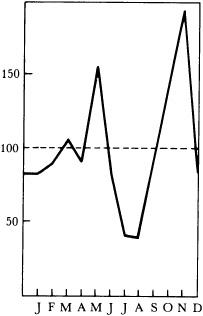
|
Month |
Index of Marriages |
Index of Conceptions |
|
January |
81.7 |
96.9 |
|
February |
89.1 |
89.0 |
|
March |
106.0 |
88.4 |
|
April |
89.0 |
117.5 |
|
May |
155.0 |
114.9 |
|
June |
82.3 |
102.3 |
|
July |
41.2 |
105.7 |
|
August |
40.6 |
93.9 |
|
September |
90.8 |
77.2 |
|
October |
147.0 |
99.2 |
|
November |
194.9 |
111.7 |
|
December |
82.3 |
103.3 |
|
Total |
1199.9 |
1200.0 |
|
(n = 447) |
(n = 1,542) |
Source: R. V. Wells, “A Demographic Analysis of Some Middle Colony Quaker Families of the Eighteenth Century” (thesis, Princeton, 1969), 66, 99.
1 Two exceptionally good studies of land policy in Pennsylvania appear in Edwin Bronner, William Penn’s “Holy Experiment,” 39-60, and in James T. Lemon, The Best Poor Man’s Country: A Geographical Study of Early Southeastern Pennsylvania(Baltimore, 1972).
2“The First Purchasers of Pennsylvania, 1681-1685,” Papers of William Penn, II, 630-64.
3 Lemon, Best Poor Man’s Country, 65; John R. Stilgoe, Common Landscape of America, 1580 to 1845 (New Haven, 1982), 79.
4 Penn, “A Further Account of Pennsylvania,” in Myers, ed., Narratives of Pennsylvania, 263.
5 James T. Lemon and Gary B. Nash, “The Distribution of Wealth in Eighteenth Century America,” JSH 2 (1968), 1-24; for similar patterns of wealth distribution in Germantown, Pa., see Wolf, Urban Village, 108-9, 120-24.
6 Patterns of wealth distribution in tax assessments and inventories of estates were as follows, for urban Philadelphia and rural Chester County from 1684 to 1750.
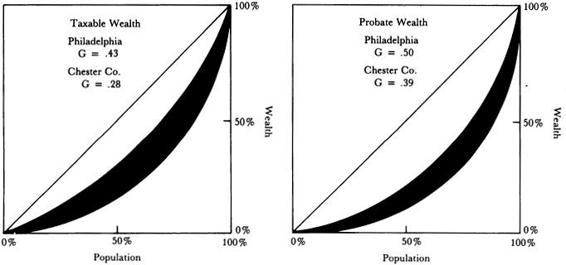
|
Chester Co. |
Philadelphia |
Chester Co. |
Philadelphia |
|
|
Tax Lists |
Tax Lists |
Inventories |
Inventories |
|
|
Year |
(top 10%) |
(top 10%) |
(*top 20%) |
(top 10%) |
|
1684-99 |
36.4% |
|||
|
1693 |
23.8% |
46.0% |
||
|
1700-15 |
41.3% |
|||
|
1715 |
25.9% |
|||
|
1714-31 |
*46.4% |
|||
|
1716-25 |
46.8% |
|||
|
1730 |
28.6% |
|||
|
1726-35 |
53.6% |
|||
|
1734-45 |
*53.0% |
51.3% |
||
|
1748 |
28.7% |
|||
|
1756 |
46.6% |
Sources include Lemon and Nash, “The Distribution of Wealth in Eighteenth Century America”; G. B. Nash, “Urban Wealth and Poverty in Pre-Revolutionary America,” JIH 6 (1976), 545-84; G. B. Nash, “Poverty and Poor Relief in Pre-Revolutionary Philadelphia, WMQ3 33 (1976), 3-30; Duane Ball, “Population and Wealth in Pennsylvania,” JIH 6 (1976), 545.
7 George Staughton et al., Charter to William Perm, and Laws of the Province of Pennsylvania, Passed between the Years 1682 and 1700 … (Harrisburg, 1879).
8 Moore, Case of Lydia Davy.
9 Will of James Sanderlands, 6 April 1692, ms. 546/253/viii, CHESRO.
10 Will of John Hart, Nottingham, 23 Oct. 1712, ms. PRNW, NOTTRO.
11 John Somervell, Some Westmorland Wills, 1686-1798 (Kendal, 1928), 80; this volume is a collection of wills drawn by Quakers of Kendal and the surrounding countryside.
12 Will of Thomas Wilson, ibid., 69.
13 Will of Thomas Braithwaite, ibid., 74.
14 Cunliffe Shaw, “The Townfields of Lancashire,” HSLCT 114 (1962).
15 This differed from Anglican families who “tended to invest in the family line rather than individual children.” See Levy, “The Birth of the ‘Modern Family’ in Early America,” 44, 37.
16 Cheshire Quarterly Mens Meeting Records, 10.vii.1689, ms. EFC 1/1/CHESRO.
17 G. H. Jenkins, “Thomas Wynne,” ms. 61, FLL.
18 Moulton, ed., Woolman Journal, 50-51.
19 Various estimates appear in Main, Social Structure of Revolutionary America, 180; Lemon, Best Poor Man’s Country, 94; Lucy Simler, “Tenancy in Colonial Pennsylvania: The Case of Chester County,” WMQ3 (1986), 542-69.
20 Rhoda Barber, Journal, HSP.
21 Simler, “Tenancy in Colonial Pennsylvania,” 555.
22 Woolman, “A Plea for the Poor,” in Moulton, ed., Woolman Journal, 238-39.
23 Joshua Evans Diary, 4.x.1796-29.vi.1798, 81, SWAR.
24 Tolles, Meeting House and Counting House, 109-143.
25 Chester Quarterly Meeting Records, 3.iv.l684, ms. EFC 1/1 CHESRO; Break Meeting, 1701, ms. Q59, NOTTRO.
26 James, A People Among Peoples, 40.
27 Chesterfield Women’s Meeting Records, 1698, ms. Q62b, NOTTRO.
28 Woolraan, “A Plea for the Poor,” 225.
1 James Parnell, “The Trumpet of the Lord,” [1655] in A Collection of the Several Writings of James Parnell (London, 1675), 28-29; Barbour, The Quakers in Puritan England, 171.
2 Penn, No Cross, No Crown, 50.
3Ibid., 51.
4Ibid.
5lbid.
6 Penn, Some Fruits of Solitude, 180.
7 Bauman, Let Your Words Be Few, 45.
8 Marsden Monthly Meeting Records, 1655, ms. FRM 1/39, LANCRO.
9 Richard Davies, An Account of … Richard Davies (Philadelphia, 1832), quoted in Bauman, Let Your Words Be Few, 51.
10 Frost, Quaker Family, 192; Staughton George et al., Charter to William Penn and Laws of the Province of Pennsylvania (Harrisburg, 1896), 111.
11 Bauman, Let Your Words Be Few, 47.
12Ibid.
13 Joan Wildeblood and Peter Brinson, The Polite World: A Guide to English Manners and Deportment from the Thirteenth to the Nineteenth Century (Oxford, 1965).
14 Nash, Quakers and Politics, 327.
1 Philip Ford, A Vindication of William Penn (London, 1683); Jean R. Soderlund, ed., William Penn and the Founding of Pennsylvania (Philadelphia, 1983), 188.
2“In Yorkshire and Cumberland, the mainly pastoral economy and lower population levels required [sic] a much thinner scattering of market towns.” Peter Clark and Paul Slack, English Towns in Transition, 1500-1700 (Oxford, 1976), 18.
3 Penn, “A Further Account of Pennsylvania,” in Myers, ed., Narratives of Pennsylvania, 263.
4 Lemon, Best Poor Man’s Country, 220.
5 One study reports the following crude rates of persistence for adult males:
|
Place |
Period |
Annual |
Decennial |
|
Chester County, Pa. |
1774-85 |
94% |
38% |
|
Lancaster County, Pa. |
1771-82 |
95% |
n.a. |
Source: Lemon, Best Poor Man’s Country, 74-75, 249.
6 Laslett and Harrison report the following rates of persistence:
|
Place |
Period |
Annual |
Decennial |
|
Clayworth, Notts. |
1676-88 |
95% |
39% |
These crude persistence rates were within one percentage point of those in Chester and Lancaster counties, Pa. See Peter Laslett, Family Life and Illicit Love in Earlier Generations; Essays in Historical Sociology (Cambridge, 1977), 79; This finding was first reported by Laslett and John Harrison, “Clayworth and Cogenhoe,” in H. E. Bell and R. L. Ollard, eds., Historical Essays Presented to David Ogg (1963), 157-84; the evidence is taken from an extraordinary rector’s book kept by William Sampson and published under the title of Sparrows of the Spirit, Harry Gill and Everard L. Guilford, eds. (London, 1961).
7 Morley Womens Meeting, 4.vii.1706, ms. EFC 2/3/1, CHESRO.
8 Cheshire Monthly Meeting, l.vii.1686, ms EFC/1/1, CHESRO.
9 John Kelsall Journal, n.d., [circa 1700], p. 35; ms. S/194, FLL.
10 Anne Cooper Whitall Diary, 28.viii.1760, HAV.
11 For reference to a meetinghouse “raising,” see John Bernard Diary, x.1775, HSP.
12 Rhoda Barber, Journal, HSP.
13 James, A People Among Peoples, 332-33.
14 Bertram Wyatt-Brown, Southern Honor (Oxford, 1982), 17, 75-78, 150-51.
15 Thomas Mifflin, “Abridgement of Metaphysicks,” 1759, HSP.
16 Isaac Norris to Moses Gainsborough, 8 Oct. 1735, Norris Letterbook, HSP.
17 Oxley, “Joseph’s Offering to His Children,” HSP.
18 For an excellent discussion of the contrast between Pennsylvania Quakers and Virginia gentlemen on this point, see Wyatt-Brown, Southern Honor, 77.
Wyatt-Brown notes that “honor was not merely a noun but a verb in these cultures.” Here again, Quakers were different from Virginia gentlemen. A young English Quaker named Thomas Ellwood wrote after his conversion in 1659 that “the honour due to parents did not consist in uncovering the head and bowing the body to them, but in ready obedience to their lawful commands, and in performing all needful services unto them.” His Anglican father Thomas Ellwood had a very different idea of honor, and was so outraged by his son’s argument that “the old man fell upon his son with both fists, ‘plucked off the headgear,’ and ‘threw it away.’” Ibid.
1 George Fox, Journal (Cambridge, 1952), 357.
2 William Penn, The People’s Ancient and Just Liberties Asserted (London, 1670).
3Colonial Records of Pennsylvania, I, 96.
4 The term of office was extended to three years in 1701, but reduced to one year again in 1706. The limit on length of service did not apply to coroners. See Wayne L. Bockelman, “Local Government in Colonial Pennsylvania,” in Bruce C. Daniels, ed., Town and Country: Essays on the Structure of Local Government in the American Colonies (Middletown, Conn., 1978), 219-20.
5Ibid., 232.
6 For Peacemakers see Record of the Courts of Chester County, 34, 39;14.x.l683.
7 After 1755, Quakers began to be punished in Pennsylvania for refusing to pay war taxes. But this irony belongs to the history of a subsequent period.
8Record of the Court of Chester County, 56 (3.iv.1685); Winthrop, Journal, 14 June 1631.
9Record of the Court of Chester County, 5, 9, 10, 12, 15.
10 Alan Tully found the following patterns in cases heard by the court of quarter sessions in Chester County, 1726-55:
|
number |
percent |
|
|
Crimes against persons |
(192) |
(27.7%) |
|
Assault and battery |
192 |
27.7% |
|
Crimes against property |
(158) |
(22.8%) |
|
Larceny |
144 |
20.8% |
|
Forgery and counterfeiting |
8 |
1.1% |
|
Forcible entry |
6 |
0.9% |
|
Crimes against morality |
(167) |
(24.1%) |
|
Sexual offenses |
159 |
22.9% |
|
Keeping a disorderly house |
8 |
1.2% |
|
Crimes against order and authority |
(56) |
(8.1%) |
|
Riot and disturbing the peace |
31 |
4.5% |
|
License violations |
16 |
2.3% |
|
Contempt of authority |
9 |
1.3% |
|
Crimes unidentified |
93 |
13.4% |
|
Crimes miscellaneous |
28 |
4.0% |
|
Total |
694 |
100.1% |
Source: Tully, William Penn’s Legacy, 190-91; a study of Philadelphia County in a later period found a higher incidence of property crimes; see A. H. Hobbs, “Criminality in Philadelphia, 1790-1810, Compared with 1937,” ASR 8 (1943), 198-200.
11 For the testimony of George Fox and John Bellers against capital punishment, see Herbert W. K. Fitzroy, “The Punishment of Crime in Provincial Pennsylvania,” PMHB 60 (1936), 244.
12 Fitzroy, “The Punishment of Crime in Provincial Pennsylvania,” 242-69; Harry and Grace Weiss, An Introduction to Crime and Punishment in Colonial New Jersey (Trenton, 1960); Albert Post, “Early Efforts to Abolish Capital Punishment in Pennsylvania,”PMHB 68 (1944) xxx; Harry Elmer Barnes, The Evolution of Penology in Pennsylvania: A Study in American Social History (Indianapolis, 1927); Harry Elmer Barnes, A History of the Penal, Reformatory and Correctional Institutions of the State of New Jersey (Trenton, 1918); Kathryn Preyer, “Penal Measures in the American Colonies: An Overview,” AJLH 26 (1982), 326-53.
13 Watson, Annals of Philadelphia, I, 309.
14 Samuel Breck, Recollections (Philadelphia, 1877) 36-37.
15 Lewis, “The Courts of Pennsylvania in the Seventeenth Century,” 176.
16 Paul Lermack, “Peace Bonds and Criminal Justice in Colonial Philadelphia,” PMHB 100 (1976), 173-77.
17 I. Norris to Richard Partridge, 31.v.1744, Norris Letterbook, HSP.
18 Robert C. Smith, ed., “A Portuguese in Philadelphia,” PMHB 78 (1954), 86-87.
1 There was a brief period of royal control from 1692 to 1694.
2 Isaac Norris, Friendly Advice to the Inhabitants of Pennsylvania (n.p., n.d., (Philadelphia, 1710?); a copy is in the Pemberton Papers, HSP.
3 Tolles, Meeting House and Counting House, 10.
4 For an example by the Philadelphia Yearly Meeting in 1711, see Richard Bauman, For the Reputation of Truth, 2.
5 William Penn to Thomas Lloyd et al., 15 Aug. 1685, Penn Papers, HSP.
6 Nash, Quakers and Politics, 241.
7 Tolles, Quakers and Atlantic Culture, 124.
8 Clair W. Keller, “The Pennsylvania Commission System, 1712 to 1740,” PMHB 93 (1969), 372-82; this essay summarizes a dissertation by the same author, “Pennsylvania Government, 1701-1740” (thesis, Univ. of Wash., 1967).
9 Tully, William Penn’s Legacy, develops this point.
10 Bockelman, “Local Government in Colonial Pennsylvania,” 216-37.
11 In various elections of legislators and local officers throughout the Delaware Valley, the following levels of turnout were recorded (as a percentage of adult white males):
|
Place |
Year |
Turnout |
Place |
Year |
Turnout |
|
Bucks Co., Pa. |
1738 |
26% |
Philadelphia Co., Pa. |
1727 |
28% |
|
1739 |
19% |
1728 |
33% |
||
|
1740 |
22% |
1730 |
19% |
||
|
1765 |
46% |
1732 |
26% |
||
|
1742 |
38% |
1734 |
22% |
||
|
Chester Co., Pa. |
1737 |
29% |
1735 |
28% |
|
|
1738 |
37% |
1736 |
18% |
||
|
1739 |
32% |
1737 |
21% |
||
|
1742 |
32% |
1738 |
29% |
||
|
1765 |
22% |
1739 |
12% |
||
|
1740 |
38% |
||||
|
Lancaster Co., Pa. |
1737 |
31% |
1741 |
23% |
|
|
1738 |
40% |
1742 |
34% |
||
|
1740 |
34% |
1743 |
19% |
||
|
1741 |
37% |
||||
|
1742 |
45% |
Philadelphia City, Pa. |
1737 |
15% |
|
|
1749 |
32% |
1742 |
32% |
||
|
1757 |
14% |
1751 |
37% |
||
|
1765 |
48% |
1757 |
23% |
||
|
1758 |
7% |
||||
|
Middlesex Co., N.J. |
1754 |
49% |
1764 |
42% |
|
|
Kent Co., Del. |
1751 |
48% |
1765 |
62% |
|
|
1766 |
46% |
||||
|
1774 |
36% |
||||
|
1775 |
27% |
Sources: Robert J. Dinkin, Voting in Provincial America (Westmont, Conn., 1977), 158-59; Tully, William Penn’s Legacy, 93; Chilton Williamson, American Suffrage from Property to Democracy (Princeton, 1960), 34; Richard P. McCormick, History of Voting in New Jersey (New Brunswick, 1963), 63; David P. Peltier, “Border State Democracy: A History of Voting in Delaware, 1682-1897” (thesis, Univ. of Del., 1967), 36.
12 Tolles, Meeting House and County House, 178.
13 Jones, Quakers in the American Colonies, 487.
14“An Early Petition of the Freemen of the Province of Pennsylvania to the Assembly, 1692,” PMHB 38 (1914), 495.
15 Jones, Quakers in the American Colonies, 487.
1Leviticus 25:10; italics original in the King James version.
2 Tolles, Meeting House and Counting House, 12.
3 William Penn, The Great Case of Liberty of Conscience (London, 1670).
4 Braithwaite, Second Period of Quakerism, 114. This is a conservative estimate. Others are much higher. Besse’s Sufferings list 366 Quaker martyrs by name; Braithwaite raises that total to “at least 450.” Various editions of Besse also list by name 12,406 Quakers who were made victims for their Christian beliefs. The true number was undoubtedly much higher. Jeremy $$$te reckoned it at 60,000 imprisonments and 5,000 deaths in prison.
5 Book of Sufferings of Friends in Derby, 1672, ms. Q/62a/l, NOTTRO.
6Ibid., 1670.
7 Bronner, William Penn’s “Holy Experiment,” 264.
8 Tolles, Meeting House and Counting House, 13.
9 Penn, The People’s Ancient and Just Liberties Asserted; “Injustice Detected …,” Papers of William Penn, I, 194-204; Dunn, William Penn, Politics and Conscience, 13-19.
10 Bronner, William Penn’s “Holy Experiment,” 267-68.
11 Jean R. Soderlund, Quakers and Slavery (Princeton, 1985), 34.
12“The Germantown Protest,” PMHB IV (1880), 28-30.
13 Soderlund, Quakers and Slavery, 34.
14Ibid., 137.
15 Arthur Zilversmit, The First Emancipation: The Abolition of Slavery in the North (Chicago, 1967), 74-75.
16Ibid., 3.
17 Soderlund, Quakers and Slavery, 179.
18 For southern Quakers and slavery see Hiram H. Hilty, Toward Freedom for All: North Carolina Quakers and Slavery (Richmond, Ind., 1984).
19 William Penn, Frame of Government (1682).\
20 Bronner, William Penn’s “Holy Experiment,” 266.
21 William Comfort, The Quakers, A Brief History of Their Influence on Pennsylvania (rev. by F. B. Tolles, Harrisburg, 1955), 6.
1 Jonathan Dickinson to John Aiken, 22 Oct. 1717; Dickinson to brother, 22 Aug. 1718; Dickinson to cousin, 17 Oct. 1719, Jonathan Dickinson Letterbook, 1715-21, HSP.
2 For details of dress and appearance, see GM 36 (1766), 582; also Robert Ferguson, Northmen in Cumberland and Westmorland (London, 1856), 144-45.
3GM 36 (1766), 582.
4 The name was inspired by Exodus xix:4-5, where the Lord said to Moses, “Ye have seen what I did unto the Egyptians, and how I bare you on eagles’ wings, and brought you to myself. Now therefore, if ye will obey my voice indeed, and keep ray covenant, then ye shall be a peculiar treasure unto me above all people: for all the earth is mine.”
5 James Boswell, Journal of a Tour to the Hebrides with Samuel Johnson, LL.D. (1785, New York, 1936), 242 (2 Oct. 1773).
6Ibid. Dr. Johnson noted in his journal, “I inquired the subjects of the songs, and was told of one, that it was a love song, and of another, that it was a farewell composed by one of the Islanders that was going, in this epidemical fury of emigration, to seek his fortune in America.” Samuel Johnson, A Journey to the Western Islands of Scotland (1775), ed. Mary Lascelles (New Haven, 1971), 59, 67, 95.
7 The “Scotch-Irish” emigration to Anglo-America before 1775 has been variously estimated as follows:
|
Period |
Number |
Area or Population |
Date and Source |
|
1733-73 |
400,000 |
Ireland “mainly Ulster” |
Dublin Journal, 1773 |
|
1750-99 |
200,000 |
Ireland |
Newenham, 1805 |
|
1718-75 |
250,000 |
Scotch-Irish |
Dunaway, 1944 |
|
1718-75 |
200,000 |
Scotch-Irish |
Leyburn, 1962 |
|
1718-75 |
114,000 |
Ulster Scots |
Dickson, 1966 |
More recently, the American historian Bernard Bailyn has reckoned that 155,000 to 205,000 people left Ulster for the New World from 1718 to 1775. In the period 1760-75, he also estimates the number of emigrants at 55,000 from the north of Ireland, 40,000 from Scotland and 30,000 from England. See Bailyn, Voyagers to the West (New York, 1986), 26; Faulkner’s Dublin Journal, 10-13 April 1773; Thomas Newenham, A Statistical and Historical Inquiry into the Progress and Magnitude of the Population of Ireland(London, 1805), 59-60; James G. Leyburn, The Scotch-Irish: A Social History (Chapel Hill, 1962), 180; R. J. Dickson, Ulster Emigration to Colonial America, 1718-1775 (London, 1966), 23, 34, 59, 64; Forrest McDonald and Ellen Shapiro McDonald, “Commentary,” WMQ3 41 (1984), 95.
8 Estimates of emigration from Scotland itself remain very doubtful. One contemporary observer reckoned that 20,000 left in the decade from 1763 to 1773; Another guessed that 30,000 Scots may have sailed in the years 1773-75. A modern estimate has been made by I.C.C. Graham, who found actual records of 15,989 departures Scotland in the years 1768-75, and an additional 4,256 arrivals culled from American records. He concludes that the emigration totaled 20,245 from 1768 to 1775. A leading Scottish historical demographer, Michael Flinn, agrees that “it seems very unlikely … that emigration from Scotland in the 18th and early 19th century ever sustained an average of much more than about 2,000 per year for more than a few years at a time.” An American scholar, T. L. Purvis, reckons that emigration from Scotland was approximately 62,500 in the period 1707-75. If the annual flow was between 1,200 and 1,500 a year, then the magnitude of Scottish migration to America in the period from 1717 to 1775 was probably in the range of 70,000 to 80,000. Cf. Ian C. C. Graham, Colonists from Scotland: Emigration to North America, 1707-1783 (Ithaca, 1956,); Michael Flinn, ed., Scottish Population History (Cambridge, 1977), 443; Thomas L. Purvis, “The European Ancestry of the United States Population, 1790,” WMQ3 41 (1984), 85-101.
9 Recent and authoritative estimates of Scottish and Irish migration by Dickson, Graham and Flinn are too low to square with estimates of the population identified as Scotch Irish, Scottish and Irish in studies of the U.S. Census of 1790 by the McDonalds (above 25%), Purvis (21.6%) or even Barker (14.3%). These estimates by American historians can be reconciled with the findings of Irish and Scottish demographers only if many immigrants called “Scotch-Irish” in the United States were Anglo-Irish, Anglo-Scots, or English borderers.
It is important to bear in mind that the entire population of Scotland was only about one million in 1650, increasing to 1.5 million by 1800. Ireland’s population was 2.5 million in 1650, rising to 5.25 million in 1800; England’s was about 5.75 million in 1700, rising to 9.25 million in 1800.
Migration from the north of England and Wales to the backcountry has not been estimated with precision in this period. Scattered evidence suggests that it may have been roughly equal to the flow from the north of Ireland and much larger than from Scotland. One statistical straw in the wind is a study of servants from Britain and Ireland mentioned in the Charleston Gazette from 1733 to 1773, which found the following numbers from Britain and Ireland: Irish and Scotch-Irish, 38.6%; English and Welsh, 40.0%; “Scotch,” 21.4%. See Warren B. Smith, White Servitude in Colonial South Carolina (Columbia, S.C., 1961), 44-48.
10 These estimates are a weighted average of Bailyn’s data for six counties: Cumberland, Westmorland, Northumberland, Durham, Lancashire and Yorkshire. His data for the Scottish borders includes the seven counties of Berwick, Roxburgh, Peebles, Selkirk, Dumfries, Kirkcudbright and Wigtown. For other parts of Scotland, Bailyn reports a more mixed pattern; overall, 48% came in family groups. From the south of England, the proportion traveling in families was very low—approximately 7% in the period from 1773 to 1776, ranging from 2 to 14% by region. See Bailyn, Voyagers to the West, 140.
11 Of these 405 immigrants, 379 (93.5%) were from northern Ireland; 20 (4.9%) were from Great Britain or Ireland; and 6(1.5%) were from Germany. The rest were not identified. Of the 379 from northern Ireland, 93% had taken ship to Philadelphia, and traveled overland to the backcountry. The rest arrived in Virginia ports. The majority reported that they had traveled at their own expense. Robert David Mitchell, “The Upper Shenandoah Valley of Virginia during the Eighteenth Century: A Study of Historical Geography” (thesis, Univ. of Va., 1969), 68.
12 Bailyn, Voyagers from the West, 129-34.
13 The distribution of ages among Scottish emigrants in the period from 1773 to 1776 appears as follows in an analysis of migration records of Bernard Bailyn:
|
Age Cohort |
Emigrants from Scotland 1773-1776 |
Population of Scotland 1755 |
|
1-14 |
24.7% |
33.1% |
|
15-24 |
35.8% |
18.0% |
|
25-59 |
38.7% |
41.1% |
|
60 + |
0.8% |
7.8% |
Source: Bailyn, Voyagers to the West, 128. Data are not available for emigrants from northern Ireland and northern England.
14 R. J. Dickson tabulated six surveys of motives for emigration from northern Ireland and northern England in the year 1719. The following causes were mentioned in positive or negative terms.
|
English |
Presbyterian |
Anglican |
Dublin |
|||
|
Cause |
Judges |
Ministers |
Bishops |
Essayist |
Landowner |
Emigrants |
|
Famine |
yes |
yes |
yes |
yes |
yes |
|
|
High rents |
yes |
yes |
yes |
yes |
yes |
yes |
|
Church taxes |
yes |
yes |
no |
yes |
yes |
yes |
|
News from America |
yes |
yes |
yes |
yes |
||
|
Short leases |
yes |
yes |
yes |
yes |
||
|
Little coin |
yes |
yes |
yes |
|||
|
Luxuries of the rich |
yes |
yes |
||||
|
Fall of linen trade |
yes |
yes |
||||
|
Too little tillage |
yes |
yes |
||||
|
Absentees and pensions |
yes |
yes |
||||
|
To escape creditors |
yes |
|||||
|
Oppression by JPs |
yes |
|||||
|
Overpopulation |
yes |
|||||
|
Sacramental tests |
yes |
no |
Source: Dickson, Ulster Emigration, 46; rearranged by frequency; for similar findings see Bailyn, Voyagers to the West, 189-93.
15 A total of 518 emigrants in this group mentioned the following motives for migration (some giving more than one): to seek a better livelihood, or find employment, 298; excessive rents, 156; scarcity and dearness of provisions, 67; the engrossing of small farms, 4; other (to visit relatives, see the country, etc.). 19. Dickson, Ulster Emigration, 81.
16 C.M.L. Bouch and G. P. Jones, A Short Social and Economic History of the Lake Countries, 1500-1850 (1961, rpt. New York, 1968), 897.
17 Transatlantic insurance rates declined during the 18th century, but human cargo was more roughly handled. See James F. Shepherd and Gary Walton, Shipping, Maritime Trade and Economic Development of Colonial North America (Cambridge, 1972).
18 James MacMichael, “Diary …,” ed. William P. MacMichael, PMHB 16 (1892), 145-46.
19 A. C. Davies, “‘As Good a Country as Any Man Needs to Dwell In’: Letters from a Scotch Irish Immigrant in Pennsylvania, 1766, 1767, and 1784,” PH 50 (1983), 313-22.
1 Dickson, Ulster Emigration, 97.
2 Boulter to Newcastle, 23 Nov. 1728, Wayland F. Dunaway, The Scotch-Irish of Colonial Pennsylvania (Chapel Hill, 1944), 20; John Stewart, “Letter,” 3 May 1736, PMHB 21 (1897), 485-86; S. F. Warren to Dr. Warren, 22 Jan. 1766, in H. Roy Merrens, ed.,The Colonial South Carolina Scene: Contemporary Views, 1697-1774 (Columbia, S.C., 1977), 233-34.
3 A quantitative analysis of British emigrant registers (1773-76) by American historian Bernard Bailyn yields the following occupational data for those who came from the borders:
|
Occupation |
Emigrants from Northern England |
Emigrants from Scottish Borders |
|
Gentry |
1.0% |
0.6% |
|
Merchandising |
4.8% |
3.3% |
|
High skilled crafts and trades |
4.6% |
7.8% |
|
Ordinarily skilled crafts and trades |
37.5% |
27.2% |
|
Farming |
40.0% |
26.7% |
|
Laborers |
12.1% |
34.4% |
|
Total |
100.0% |
100.0% |
Note: Northern England includes the six counties of Cumberland, Westmorland, Northumberland, Durham, Lancashire and Yorkshire; the Scottish Borders include the seven counties of Wigtown, Kirkcudbright, Dumfries, Roxburgh, Selkirk, Peebles, and Berwick. The source is Bailyn, Voyagers to the West, 162-63.
4Ibid., 170-71.
5 Cheesman A. Herrick, White Servitude in Pennsylvania (Philadelphia, 1926), 164-66; Abbot E. Smith, Colonists in Bondage: White Servitude and Convict Labor in America, 1607-1776 (Chapel Hill, 1947), 171, 289.
6 George R. Gilmer, Sketches of Some of the First Settlers of Upper Georgia … (rev. ed., Baltimore, 1965), 62.
7 T. C. Smout, A History of the Scottish People, 1560-1830 (London, 1969), 213-22; J. D. Mackie, A History of Scotland, eds. Bruce Lenman and Geoffrey Parker (2d ed., Harmondsworth, 1978), 298-305; W. L. Mathieson, The Awakening of Scotland, 1747-1797(Glasgow, 1910); idem, Church and Reform in Scotland (Glasgow, 1916), P.W.J. Riley, The English Ministers and Scotland (London, 1964).
8 Charles K. Bolton, Scotch Irish Pioneers in Ulster and America (Baltimore, 1967), 68.
9 R. M. Barnes, The Uniforms and History of the Scottish Regiments (London, 1960), 37, 42-45, passim.
10 Charles Woodmason, “An Account of the Churches in South Carolina, Georgia, North Carolina and the Floridas,” in The Carolina Backcountry on the Eve of the Revolution: The Journal and Other Writings of Charles Woodmason, Anglican Itinerant (Chapel Hill, 1953), 78.
11 Carl Bridenbaugh, Myths and Realities, Societies of the Colonial South (Baton Rouge, 1952), 183.
12 Woodmason, Carolina Backcountry, 20, 30-31, 39, 45.
13Ibid., 45, 53.
14 T. Scott Miyakawa, Protestants and Pioneers (Chicago, 1964), 128.
15 Dunaway, Scotch Irish in Colonial Pennsylvania, 10.
16 Gilmer, First Settlers of Upper Georgia, 173.
17 Ned C. Landsman, Scotland and Its First American Colony, 1683-1765 (Princeton, 1985), 8.
18 John C. Campbell, The Southern Highlander and His Homeland (New York, 1921), 51.
19 R. G. Collingwood, “The Hill Fort on Carrock Fell,” CWAAS ns 10 (1910), 342-53.
20 Much of the archaeology of this region, including excavations at Carrock Fell, was done by W. G. Collingwood and his philosopher-son R. G. Collingwood. Two surveys of high quality are Nick Higham, The Northern Counties to AD 1000 (London, 1986), and Roy Millward and Adrian Robinson, The Lake District (rev. ed., London, 1974).
21 The “Celtic” interpretation appears in Forrest McDonald and Grady McWhiney, “The Antebellum Southern Herdsman: A Reinterpretation,” JSH 41 (1975), 147-66, and many other essays; a contrary interpretation appears in Landsman, Scotland and Its First American Colony, 282-83, passim.
22 William A. Schaper, Sectionalism in South Carolina, (1901, rpt. New York, 1968), 66.
23 Duane Meyer, The Highland Scots of North Carolina, 1732-1776 (Chapel Hill, 1961), Graham, Colonists from Scotland, 188; Bailyn, Voyagers to the West, 110-11.
24 Woodmason, Carolina Backcountry, 6.
1 Cecil Sharp to John Campbell, n.d., in Campbell, The Southern Highlander and His Homeland (New York, 1921), 70; see also Olive Campbell and Cecil J. Sharp, English Folk Songs from the Southern Appalachians (New York, 1917).
2 By tradition this region is called the border in England and the borders in Scotland.
3 Here is another application for the Palmer-Godechot thesis, about the relative permeability of land and sea in the eighteenth century. Maritime communications had much improved since the middle ages, but travel over land was not much better than in the world of the Romans. The argument of Palmer and Godechot about the borders of the “Atlantic world” also applies to the edges of the Irish Sea. See Jacques Godechot and R. R. Palmer, “Le problème de l’Atlantique du XVIIIe au XXe siècle,” Relazioni del X Congresso Internazionale di Scienze Storiche (Roma 4-11 Settembre 1955) (Florence, 1955), V, 175-239.
4 The Penrith beacon was built in 1719, within a year of the beginnings of the American migration. It was used in 1745, and repaired as late as 1780. Nikolaus Pevsner, The Buildings of England: Cumberland and Westmorland (Harmondsworth, 1967), 178.
5 Bouch and Jones, Economic and Social History of the Lake Counties, 2, 11, 16.
6 George Williams Diary, Ms. DX 124, CUMROC.
7 George M. Fraser, The Steel Bonnets, (New York 1972), 65.
8 The word reiving is from the ME reven, to take by force; for the Debateable Land, see T.H.B. Graham, “The Debateable Land,” CWAAS n.s. 12 (1912), 33-58.
9 It would, of course, be chronologically more correct to say that American rustling was reminiscent of the traditional northern English model. See R.A.E. Wells, “Sheep Rustling in Yorkshire,” NH 20 (1984), 127-84; J. G. Rule, “The Manifold Causes of Rural Crime: Sheep Stealing in England, circa 1740-1780,” in J. G. Rule, ed., Outside the Law (Exeter, 1983).
10 Robert Newton, “The Decay of the Borders: Tudor Northumberland in Transition,” in Christopher Chalkin and Michael Haveden, eds., Rural Change and Urban Growth, 1500-1800 (London, 1977), 2-31.
11 Joan Thirsk, ed., Agrarian History of England and Wales, (Cambridge, 1967), IV, 49.
12Calendar of State Papers, Venetian, 1615-1617, 150.
13 Douglas L. W. Tough, The Last Years of a Frontier; A History of the Borders During the Reign of Elizabeth (Oxford, 1928), 38; Bouch and Jones, Economic and Social History of the Lake Countries, 123.
14 Pevsner, Cumberland and Westmorland, 29.
15 Tough, Last Years of a Frontier, xvi; R. T. Spence, “The Pacification of the Cumberland Border, 1593-1628,” NH 13 (1977), 62.
16 Sir William Hutton to the Earl of Cumberland, Dec. 1611, quoted in Spence, “The Pacification of the Cumberland Border,” 123.
17 The term blackmail, from the French mail for rent, is defined by the OED as “a tribute formerly exacted from farmers and small owners in the border counties of England and Scotland … in return for protection or immunity from plunder.”
18 Fraser, The Steel Bonnets, 66.
19 A case in point was the “robber clan” of Graham, forcibly “transported beyond the seas.” See J. Nicolson and R. Burn, The History and Antiquities of Westmorland and Cumberland (2 vols., 1977), I, cxviii-cxxi; and Spence, “The Pacification of the Cumberland Border,” 59-160.
20 Edward Hughes, North Country Life in the Eighteenth Century: The North East, 1700-1750 (London, 1952), 1, 3, 5, 11, xx; see also J. D. Marshall, “The Rise and Transformation of the Cumbrian Market Town, 1660-1900,” NH 19 (1983), 128-209; and idem, “Kendal in the Late Seventeenth and Eighteenth Centuries,” CWAAS 75 (1975), 188-257.
21 J. V. Beckett, “Absentee Land Ownership in the Later 17th and Early 18th Centuries: The Case of Cumbria,” NH 19 (1983), 87-107.
27 Hugh Boulton to Duke of Newcastle, 23 Nov. 1728, in Letters Written by His Excellency Hugh Boulton, D.D. (2 vols., Dublin, 1770), I, 225-26.
28 Dickson, Ulster Emigration, 76.
22 S. H. Scott, A Westmorland Village: The Story of the Old Homesteads and “Statesman” Families of Troutbeck by Windermere (Westminster, 1904), 21. A statesman whose papers survive in the Cumbria Record Office at Kendal was Benjamin Browne of Westmorland (1664-1748).
23 Paul Brassley, “Northumberland and Durham,” in Thirsk, ed., Agrarian History of England and Wales, Vol. 5, Part 1, 49.
24 Robert V. Remini, Andrew Jackson and the Course of American Empire, 1767-1821 (New York, 1977), 15; T.G.F. Darby, “The Agrarian Economy of Westmorland” (thesis, Univ. of Leicester, 1965).
25 J. Leopold, “The Levellers’ Revolt of Galloway in 1724,” SLHSJ 14 (1980), 4-29.
26 Hughes, North Country Life in the Eighteenth Century: The North East, 1700-1750, 16.
1 Jonathan Dickinson to John Asher, 22 Oct. 1717, Dickinson Letterbook, 1715-1721, HSP.
2 Charles A. Hanna, The Scotch-Irish; or the Scot in North Britain, North Ireland and North America (2 vols., New York, 1902), II, 63.
3 Jonathan Dickinson to John Asher, 22 Oct. 1717, Dickinson Letterbook, 1715-1721, HSP.
4 James Logan to John, Thomas and Richard Penn, 17 April 1731, Penn Papers, Official Correspondence, Historical Society of Pennsylvania; Frederick B. Tolles, Quakers and the Atlantic Culture (New York, 1960), 126.
5 Two studies yield the following estimates of Scottish and Irish surnames in the census of 1790.
|
State |
McDonald |
Purvis |
|
Me. |
20.8 |
17.4 |
|
N.H. |
20.8 |
15.7 |
|
Vt. |
18.6 |
14.5 |
|
Mass. |
15.0 |
10.5 |
|
R.I. |
16.9 |
13.1 |
|
Conn. |
11.3 |
8.3 |
|
N.Y. |
21.0 |
17.1 |
|
N.J. |
n.a. |
14.3 |
|
Pa. |
36.9 |
29.8 |
|
Del. |
n.a. |
21.8 |
|
Md. |
31.6 |
26.5 |
|
Va. |
32.2 |
24.4 |
|
N.C. |
40.9 |
32.3 |
|
s.c. |
44.6 |
36.5 |
|
Ga. |
n.a. |
26.9 |
|
Ky. |
n.a. |
33.8 |
|
Tenn. |
n.a. |
35.3 |
In addition, during the mid-18th century at least one-fourth (or more) of all English settlers in the backcountry came from six northern counties. If we average the estimates of Purvis and McDonald and add 25% of the English population, then the combined total of Scottish, Protestant Irish and northern English settlers was more than 51% of whites in North Carolina, and more than 53% in South Carolina, ca. 1790. These data refer to entire colonies including coastal districts; in the backcountry, the proportion was above 60%. See Forrest McDonald and Ellen Shapiro McDonald, “The Ethnic Origins of the American People, 1790,” WMQ3 38 (1980), 179-99; Purvis, “The European Ancestry of the United States Population, 1790,” 85-101; John B. Sanderlin, “Ethnic Origins of Early Kentucky Land Grantees,” KSHSR 85 (1987), 103-10.
6 The evidence supports the McDonalds’ conclusions that comparatively few Germans migrated more than 300 miles from Philadelphia. See McDonald and McDonald, “Commentary,” 134. Other scholars have replicated these results. John Campbell (The Southern Highlander, 63) concluded from surnames in pension lists, muster rolls and census tracts that in North Carolina and Tennessee, the English and Scots-Irish were each about one-third of the population; in Kentucky, the English were 40% and the Scots-Irish 30%; in Georgia, English and Scots-Irish were each about 40% of all names. He reckoned that Germans accounted for one-fifth of names in North Carolina, one-seventh in Tennessee and one-twelfth in Kentucky. Even this estimate overcounts the number of Germans. H. Roy Merrens (Colonial North Carolina in the Eighteenth Century (Chapel Hill, 1964), 53-81) reckons that Germans were between 2.8 and 4.7% of the population of North Carolina as a whole, but 22.5% of two counties near the Moravian Tract.
7 Bridenbaugh, who thought of them as Scotch-Irish, wrote, “Of all the national groups the Scotch Irish were the most numerous, and it is not surprising that in the long run they came to dominate” the backcountry. McDonald and McWhiney thought of them as Celts and concluded that they were dominant in North Carolina, South Carolina, and other settlements to the south and west. See Bridenbaugh, Myths and Realities, 132; McDonald and McDonald, “Ethnic Origins,” 199; idem, “Commentary,” 133; Schaper,Sectionalism in South Carolina, 43; Mitchell, “Upper Shenandoan Valley,” 218.
8 Hanna, Scotch-Irish, II, chap. 5, “The Settlements Enumerated.”
9 William S. Powell, The North Carolina Gazetteer (Chapel Hill, 1968).
10Ibid.
11 George R. Stewart, Names on the Land (new ed., San Francisco, 1982), 113, 151.
12Ibid., 150.
13 Sorne called it “the frontiers” in the conventional 18th-century sense of a boundary between governments—a very different meaning from the Turnerian usage. An exception was Benjamin Franklin, who developed his own frontier thesis before 1760.
1 Remini, Andrew Jackson, 2; Marquis James, The Life of Andrew Jackson (unabr. one-vol. ed., Indianapolis, 1938), 31.
2 Mrs. Frank M. Angellotti, “The Polks of North Carolina and Tennessee,” NEHGR 77 (1923), 133-45, 250-70; 78 (1924), 33.
3SCHGM 7 (1906), 81.
4 A. S. Salley, “The Grandfather of John C. Calhoun,” SCHGM 39 (1938), 50.
5 Moses Coit Tyler, Patrick Henry (Boston, 1887), 2.
6 Both families were aware of this connection; Patrick Henry’s grandnephew was received by Lord Brougham on a visit to Britain in the 19th century; Tyler, Patrick Henry, 4.
7 Marquis James, Sam Houston (New York, 1929), 3-6.
8 The nine commanders, plus another relieved shortly before the action, were William Campbell (b. Augusta County, Va., 1745), whose ancestors were connected with the Scottish aristocracy and emigrated ca. 1726; Benjamin Cleveland (b. Prince William Co., Va., 1738), whose his parents emigrated in the 1730s from the North Riding of Yorkshire where they were an old armorial family; Frederick Hambright (b. in Germany, 1727), emigrated to America ca. 1738 and married Sarah Hardin of Border stock; William Graham, of a leading Cumbrian family; Edward Lacey (b. Shippensburg, Pa., 1742), of English descent, region unknown; Joseph McDowell (b. Winchester, Va., 1756), his father was a Scots-Irish weaver who emigrated ca. 1740; John Sevier (b. Rockingham County, Va., 1745), his father emigrated from England ca. 1740, the son of a French Huguenot who married into a family from the north of England; Isaac Shelby (b. North Mountain, now Washington County, western Md., 1750) whose father emigrated from Wales, ca. 1735; James Williams (b. Hanover County, Va., 1737), his father emigrated from Wales ca. 1730; Joseph Winston (b. Louisa County, Va., 1746), his family emigrated from Yorkshire at an unknown date, and his father was a kinsman of Patrick Henry’s mother.
1 Bridenbaugh, Myths and Realities, quoting Dunaway, Scotch Irish, 182.
2 Wylene P. Dial, “The Dialect of the Appalachian People,” WVAH 30 (1969), 463-71.
3 Historians first perceived the Regulation as a political event; other scholars have interpreted it as a social movement. It was both of these things, but also a cultural movement; see Richard M. Brown, The South Carolina Regulators (Cambridge, 1963); Rachel N. Klein, “Ordering the Backcountry: The South Carolina Regulation,” WMQ3 38 (1981), 661-80; Ronald Hoffman et al., eds., An Uncivil War: the Southern Backcountry during the American Revolution (Charlottesville, 1985).
4 Woodmason, Carolina Backcountry, 14, 31, 52; Bridenbaugh, Myths and Realities, 177.
5 Emma Miles, The Spirit of the Mountains (1905, rpt. Knoxville, 1975), 137.
1 Hans Kurath, A Word Geography of the Eastern United States (Ann Arbor, 1949); Craig M. Carver, American Regional Dialects; A Word Geography (Ann Arbor, 1987); Robert F. Dakin, “South Midland Speech in the Old Northwest,” JEL 5 (1971), 31-48; C. Williams, “Appalachian Speech,” NCHR 55 (1978), 174-79.
2 Virginia Gazette, 22 Oct. 1772; Bridenbaugh, Myths and Realities, 169.
3 An early description of backcountry speech ways—so early as to capture the language of the immigrants who had arrived in the 18th century—was made by the American traveler Anne Royall, after a visit to the region which she fancifully called “Grison republic,” and is now the state of West Virginia:
“To return to my Grison republic,” she wrote, “their dialect sets orthography at defiance, and is with difficulty understood; for instance, the words by, my, rye, they pronounce as you would ay. Some words they have imported, some they have made out and out, some they have swapped for others, and nearly the whole of the English language is so mangled and mutilated by them, that is hardly known to be such. When they would say pretence, they say lettinon, which is a word of very extensive use amongst them. It signifies a jest, and is used to express disapprobation and disguise; ‘you are just lettinon to rub them spoons—Polly is not mad, she is only lettinon.’ Blaze they pronounce bleez, one they call waun, sugar shugger;‘and is this all it ye got?’ handkerchiefhancorchy, (emphasis on the second syllable); and ‘the two ens of it corned loose’; for get out of the way, they say, get out of the road: Road is universally used for way; ‘put them cheers, (chairs) out of the road.’ But their favorite word of all, is hate, by which they mean the word thing; for instance, nothing,‘not a hate—not wann hate will ye’s do.’ What did you buy at the stores ladies? ‘Not a hate—well you hav’nt a hate here to eat.’ They have the hickups, and corp, (corpse), and are a (cute) people. Like Shakespeare they make a word when at a loss: scawm’d is one of them, which means spotted.” Anne Royall, Sketch of the History, Life and Manners in the United States (New Haven, 1826), I, 53; for other early descriptions of this dialect see “Skitt,” [H. E. Taliaferro], Fisher’s Rover (North Carolina) Scenes and Characters (New York, 1859); and Ralph Steele Boggs, “North Carolina Folktales …,” JAF 47 (1934), 268-88.
4 Dial, “The Dialect of the Appalachian People,” 463-71.
5 James Parton, Life of Andrew Jackson (3 vols., New York, 1859), I, 47.
6Honey as a term of endearment was also occasionally heard in New England and the Chesapeake. But it was specially associated with North British and Irish speech, and in the 18th century came to be regarded as an “hibernianism.”
7 Dial, “The Dialect of the Appalachian People,” 470.
8 Richard R. Beeman, The Evolution of the Southern Backcountry: A Case Study of Lunenburg Country, Virginia, 1746-1832 (Philadelphia, 1984), 18.
9 J. H. Combs, “Old, Early and Elizabethan English in the Southern Mountains,” DN 4 (1913-17), 283-97; Thomas Pyles, The Origins and Development of the English Language (New York, 1964).
10 W. Dickson, Glossary of Words and Phrases Pertaining to the Dialect of Cumberland (London, n.d.); see also an anonymous compilation, Westmorland and Cumberland Dialects, Dialogues, Poems, Songs & Ballads by Various Writers in the Westmorland and Cumberland Dialect Now Collected with a Copious Glossary (London, 1839); and see W. Dickinson and E. W. Prevost, A Glossary of the Words and Phrases Pertaining to the Dialect of Cumberland (London, 1879); and Ann Wheeler, Westmorland Dialect …(London, 1840), 130. Also valuable are writings in dialect by the 18th century “Cumberland Bard,” Robert Anderson. Early descriptive sources are more helpful for an historian’s purposes than 20th-century speech studies, which, though more refined in their analytic tools, are less useful as a guide to past patterns.
Patterns of grammar were also very much the same. Hughes notes, for example, that the borderers “used the indefinite article freely, e.g., ‘he had a one.’” See Hughes, North Country Life in the Eighteenth Century: The North East, 37. An example of the Northumbrian double negative appears in Fraser, Steel Bonnets, 72.
11Westmorland and Cumberland Dialect, vi.
12 Ferguson, Northmen in Cumberland and Westmorland, 152-53; see also Dickinson and Provost, A Glossary of the Words and Phrases Pertaining to the Dialect of Cumberland, xxv.
1 Woodmason, Carolina Backcountry, 16.
2 See H. B. Shurtleff, The Log Cabin Myth (Cambridge, Mass., 1939). Log houses of various types appeared at an earlier date throughout the colonies, often for special purposes such as forts and jails and garrison houses, where walls of unusual thickness were desired. Instances appear in the Archives of Maryland, II (1884), 224; North Carolina Colonial Records, I (1886), 300.
Germans also introduced log buildings, but these structures differed from the classical log cabin in many ways. See C. A. Weslager, The Log Cabin in America (New Brunswick, N.J., 1969); Henry Glassie, “The Appalachian Log Cabin,” MLW 39 (1963), 5-14;idem, “The Types of Southern Mountain Cabin,” in The Study of American Folklore, ed. Jan H. Brunwand (New York, 1968), 338-70; Fred Kniffen, “Folk Housing; Key to Diffusion,” AAAG 55 (1965), 549-77; Fred Kniffen and Henry Glassie, “Building in Wood in the Eastern United States,” GR 56 (1966), 40-66.
3 John Aston, “Diary,” in “Six North Country Diaries,” Publications of the Surtees Society 118 (1910), 31; for modern discussions, see R. W. Brunskill, “The Clay Houses of Cumberland,” AMST 10 (1962), 57-80; Christopher Stell, “Pennine Houses,” FL 3 (1965), 5-24; James Walton, “Upland Houses: The Influence of Mountain Terrain on British Folk Building,” AA 30 (1956), 142-48; Caoimhín ó Danachair, “The Combined Byre-and-Dwelling in Ireland,” FL 2 (1964), 58-75; Alan Gailey, “The Peasant Houses of the South-west Highlands of Scotland: Distribution, Parallels, and Evolution,” G 3 (1962), 227-42; M. W. Barley, The English Farmhouse and Cottage (London, 1961); Henry Glassie, Pattern in the Material Folk Culture of the Eastern United States(Philadelphia, 1968); idem, Folk Housing in Middle Virginia (Knoxville, 1975); Carl Linsberg, “The Building Process in Antebellum North Carolina,” NCHR 60 (1983), 431-56.
4 John Major, Historia Majoris Britanniae tam Angliae q. Scotiae … (Paris, 1521); tr. in P. Hume Brown, ed., Scotland before 1700 from Contemporary Documents (Edinburgh, 1893), 44.
5 The OED defines a cabin as “a permanent human habitation of rude construction. Applied especially to mud or turf-built hovels of slaves or impoverished peasantry, as distinct from the comfortable cottages of working men.” Most examples of usage in the 17th and 18th centuries are from Scotland, Ireland and the English border counties. The EDD identifies the area of most common English usage as Northumberland, Durham and Yorkshire.
6 George Buchanan, “Description of Scotland,” in Brown, ed., Scotland before 1700 from Contemporary Documents, 235.
7 Robert Witherspoon, “Recollections,” in Merrens, ed., Colonial South Carolina Scene, 126.
8 E. Estyn Evans, “Cultural Relics of the Ulster-Scots in the Old West of North America,” Ulster Folklife 11 (1966), 33-38.
9 Interesting ethnic variations existed in interior design. Germans preferred to divide their cabins into three small rooms with a sleeping loft above. The borderers preferred one large open space, rectangular dimensions and opposed front and rear doors. See Evans, “Cultural Relics of the Ulster Scots”; Glassie, “The Appalachian Log Cabin,” 5-14; idem, Pattern in the Material Folk Culture of the Eastern United States, 78.
10OED, s.v. “rod”, “perch” and “pole.” The length varied according to local tradition. In Ireland a perch was 21 feet long. On the use of this measure in the American backcountry, Noble writes, “ … the dimensions of the log pen house averaged about sixteen or seventeen feet by twenty-one through twenty-four feet. … a sixteen to seventeen foot length had long been a standard dimension in both English houses and barns”; Allen G. Noble, Wood, Brick and Stone (2 vols., Amherst, Mass., 1984), I, 114.
11Westmorland and Cumberland Dialect, 339.
12 Mitchell, “Upper Shenandoah Valley,” 294.
13 Johann David Schoepf, Travels in the Confederation [1783-84] (1911, New York, 1968), II, 33.
14 The dog-trot cabin was similar to the design that has been called the statesman house in Britain; see Bouch and Jones, Economic and Social History of the Lake Country, 108-9.
15 Martin Wright, “The Antecedents of the Double Pen House Type,” AAAG 48 (1958).
16 Leyburn has collected impressive evidence of continuities in the vernacular architecture of the Scottish lowlands, quoting Froissart in the 15th century that “after an English raid, the country-folk made light of it, declaring they had driven their cattle into the hills, and that with six or eight stakes they would soon have new houses.”
Of the 16th century, MacKenzie wrote that throughout Galloway, cottages and cabins were “constructed of rude piles of [drift]wood, with branches interwoven between them, and covered on both sides with a tenacious mixture of clay and straw.”
A report in 1670 noted that “the houses of the commonalty are very mean, mud-wall and thatch, the best; but the poorer sort live in such miserable huts as never eye beheld. … In some parts, where turf is plentiful, they build up little cabins thereof, with arched roofs of turf, without a stick of timber in it; when the house is dry enough to burn, it serves them for fuel, and they remove to another.”
Of the 18th century it was written that the houses were “little removed from hovels with clay floors, open hearths … only the better class of farmers had two rooms, the house getting scant light by two tiny windows.”
Leyburn, The Scotch-Irish: A Social History, 18; P. Hume Brown, Early Travelers in Scotland (Edinburgh, 1891), 12-16; William Mackenzie, History of Galloway from the Earliest Period to the Present Time (2 vols., Kirkcudbright, 1841), I, 232; Harleian Miscellany, VI, 139; H. G. Graham, The Social Life of Scotland in the Eighteenth Century (London, 1899), 182-83.
17 Woodmason, Carolina Backcountry, 31; William Byrd, The London Diary (1717-1721) and Other Writings (New York, 1958), 588-89; Edmund Morgan, Virginians at Home (New York, 1952), 73; similar observations were made two centuries later of Appalachian families in industrial cities such as Baltimore and Detroit.
18 Leyburn, The Scotch-Irish; A Social History, 151.
19 Michael J. O’Brien and Dennis E. Lewarch, “The Built Environment,” in M. J. O’Brien, ed., Grassland, Forest and Historical Settlement (Lincoln, Neb., 1984), 231-65; Terry Jordan, Texas Log Building: A Folk Architecture (Austin, 1978); Wilbur Zelinsky, “The Log House in Georgia,” GR 43 (1953), 173-93; Eugene M. Wilson, Alabama Folk Houses (Montgomery, Ala., 1975); Donald A. Hutslar, The Log Architecture of Ohio (Columbus, 1977); Charles McRaven, Building the Hewn Log House (New York, 1978); Fred Kniffen, “Louisiana House Types,” AAAG 26(1936), 179-93.
20 Amos Long, “Fencing in Rural Pennsylvania,” PF 12 (1961), 30-35; Arthur Dobbs in Colonial Records of North Carolina, V, 262.
21 Bouch and Jones, Economic and Social History of the Lake Countries, 33; Eugene Cotton Mather and John Fraser Hart, “Fences and Farms,” GR 44 (1954), 201-23.
22 Ernest Hudson, Barton Records (Penrith, 1951), 56; W. G. Collingwood, The Lake Counties (London, 1902), 144; Scott, A Westmorland Village, 64-65, Bouch and Jones, Economic and Social History of the Lake Countries, 108.
23 Shurtleff, Log Cabin Myth, 185.
1 Bridenbaugh, Myths and Realities, 135.
2 Fraser, Steel Bonnets, 55-65 passim.
3 Robert Witherspoon, “Recollections,” in H. Roy Merrens, ed., The South Carolina Scene: Contemporary Views, 1697-1774 (Columbia, S.C., 1977), 124. For another description of clan migration, see Parton, Life of Andrew Jackson, I, 46.
4 Charles G. Sellers, James K. Polk, Jacksonian, 1795-1843 (Princeton, 1957), 8-9.
5 Gilmer, First Settlers of Upper Georgia, 168.
6 Landsman, Scotland and Its First American Colony, 46.
7Ibid., 160.
8 Bouch and Jones, Economic and Social History of the Lake Countries, 30.
9 G. E. Braithwaite, “The Braithwaites,” 10, LANCSRO.
10Ibid., 153.
11 Woodmason, Carolina Backcountry, 39.
12 Arthur Dobbs to Board of Trade, 24 Aug. 1755, Colonial Records of North Carolina, V, 355; somewhat smaller households are reported in Alan D. Watson, “Household Size and Composition in Pre-Revolutionary North Carolina,” MQ 31 (1978), 551-69.
13 Yasukichi Yasuba, Birth Rates of the White Population in the United States, 1800-1860 (Baltimore, 1962), 61-62, 131-32; Colin Forster and G.S.L. Tucker, Economic Opportunity and White American Fertility Ratios, 1800-1860 (New Haven, 1972), 40-41; for the persistence of large and complex households in this region during the nineteenth century, see William M. Selby, Michael J. O’Brien and Lynn M. Snyder, “The Frontier Household,” in Michael J. O’Brien, ed., Grassland, Forest and Historical Settlement(Lincoln, Neb., 1984), 266-316. There is evidence of large families in Ulster, with as many as five males each on the average; see Raymond Gillespie, Colonial Ulster: The Settlement of East Ulster, 1600-1641 (Cork, 1985), 55.
14 Miles, The Spirit of the Mountains, 13-14.
15 Edward C. Banfield, The Moral Basis of a Backward Society (New York, 1958), 110.
16 W. D. Weatherford and Earl D. C. Brewer, Life and Religion in Southern Appalachia (New York, 1962), 9.
17 Otis K. Rice, The Hatfields and McCoys (Lexington, 1978).
18 Charles G. Mutzenberg, Kentucky’s Famous Feuds and Tragedies (New York, 1917); S. S. McClintock, “The Kentucky Mountains and Their Feuds,” AJS 7 (1901), 1-28, 171-87; O. O. Howard, “The Feuds in the Cumberland Mountains,” I 56 (1904), 783-88; Jenny Wormald, “Blood Feud, Kindred and Government in Early Modern Scotland,” Past and Present 87 (1980), 54-97.
1 Patrick C. Power, Sex and Marriage in Ancient Ireland (Dublin and Cork, 1976), 42-47.
2 Leyburn, The Scotch-Irish: A Social History, 32; R. Chambers, Domestic Annals of Scotland (Edinburgh, 1858-61), I, 5.
3 Woodmason, Carolina Backcountry, 207.
4 There are many versions of this tangled affair; an authoritative account appears in Remini, Andrew Jackson, I, 40-58.
5Ibid., I, 66.
6 Samuel Kercheval, “The Wedding,” in A History of the Valley of Virginia (1833, 3d ed., rev. and extended, Woodstock, Va., 1902), 58, 266-69.
7Ibid., 269
8 For a virtually identical description of Scots-Irish wedding customs in Londonderry, New Hampshire, see Alice Morse Earle, Customs and Fashions in Old New England (1893, Rutland, Vt., 1973), 74; see also North Carolina Folklore, II, 238.
9 Kercheval, Valley of Virginia, 266-69; John Lewis Peyton, History of Augusta County, Virginia (Staunton, Va., 1882), 44-46; Julia Cherry Spruill, Women’s Life and Work in the Southern Colonies, (1938, New York 1972), 110-11.
10 Robert Anderson, “The Codbeck Weddin’,” in Westmorland and Cumberland Dialect, 262-63.
11 One Cumberland man recorded in much detail the dowry for his daughter; “Sep. 20 [1677], paid unto my son in law [Edward] Wilson in part of his wife’s portion £10 … March 18 [1678] paid my son [in law] Wilson more of his wife’s portion 9/0/0 … May 17 [1678] more of his portion £20. … June 28 [1678] more of his portion £20. …” Danlie Fleming Accounts, WD/R/box 199, CUMROK.
12“Toucher” was the border word for a dowry; see Westmorland and Cumberland Dialect, 330.
13Ibid.
14 Jane M. Ewbank, Antiquary on Horseback: The First Publication of the Collections of the Reverend Thomas Machell, Chaplain to Charles II, towards a History of the Barony of Kendal (Kendal, 1963).
15 David Ramsey, History of South Carolina from Its First Settlement in 1670 to the Year 1808 (2 vols., Charleston, 1809), II, 600.
16 Mark Kaplanoff obtained the following estimates of mean age at marriage from an ingenious analysis of the South Carolina census of 1800, for marriages contracted in the population living at that time.
|
District |
Males |
Females |
|
Greenville |
22.3 |
19.4 |
|
Newberry |
21.4 |
19.1 |
|
Sumter |
20.9 |
19.8 |
Source: Unpublished research, communicated by the kindness of Mark Kaplanoff.
17 In England before 1750, mean age at first marriage of women was 26.9 in twenty-six southern parishes, and 23.5 in sixteen northern parishes. Age at marriage was generally higher in all British regions than in the American colonies, but relative differences were much the same. See Michael W. Flinn, The European Demographic System, 1500-1820 (Baltimore, 1981), 124-25.
1 Kercheval, Valley of Virginia, 268.
2 Alan D. Watson, “Women in Colonial North Carolina …,” NCHR 58 (1981), 1-22.
3 John Oldmixon also wrote that, throughout the backlands, “the ordinary women take care of cows, hogs, and other small cattle, make butter and cheese, spin cotton and flax, help to sow and reap corn, wind silk from the worms, gather fruit and look after the house”; The History of the British Empire in America in Alexander S. Salley, Jr., Narratives of Early Carolina (1911, New York, 1967), 372.
4Gentleman’s Magazine 36 (1766), 582.
5 Mackenzie, History of Galloway, I, 236.
6 Leyburn, The Scotch-Irish: A Social History, 148.
7 Arthur W. Calhoun, The American Family, the Colonial Period (rpt. New York, 1960), 207.
8 A. S. Salley, “The Grandfather of John C. Calhoun,” SCHGM 39 (1938), 50.
9 Gilmer, First Settlers of Upper Georgia, 117.
10Ibid., 95.
11Ibid., 78.
12 Miles, The Spirit of the Mountains, 70.
1 Woodmason, Carolina Backcountry, 30, 61.
2Ibid., 32.
3 Kercheval, Valley of Virginia, 257.
4 Woodmason, Carolina Backcountry, 7, 100.
5 Peter Laslett supplies the following regional data for illegitimacy ratios in England by period from 1581 to 1820:
|
Region |
1581-1640 |
1661-1720 |
1721-80 |
1781-1820 |
|
West and northwest |
3.6 |
1.4 |
4.6 |
6.2 |
|
North |
2.9 |
1.3 |
3.5 |
4.2 |
|
South |
2.1 |
1.4 |
4.0 |
4.5 |
|
Midlands |
1.6 |
1.3 |
2.9 |
3.1 |
|
East |
1.2 |
1.0 |
3.3 |
4.0 |
The “west and northwest” included much of the border country. As late as 1842-45, Cumberland had the highest recorded rates of illegitimacy of any county in England. See Peter Laslett, “Long Term Trends in Bastardy in England,” in Family Life and Illicit Love in Earlier Generations (Cambridge, 1977), 142-46.
6 Kercheval, Valley of Virginia, 269.
7Ibid., 294.
8 Dyer Journal, 9 Nov. 1770, HSP.
9 Alice B. Gomme, The Traditional Games of England, Scotland and Ireland (1894-98, new ed., London, 1984), 75
1 The ten most popular names on backcountry militia lists were as follows, ca. 1776: John, William, James, Patrick, Robert, Thomas, Charles, Samuel, Edward, and Joseph. See George R. Stewart, American Given Names (New York, 1979), 25, 208-9.
2Ibid.
3 Border onomastics should not be confused with the romantic inventions of Victorian border poets and novelists. Enid was popularized by Tennyson, Lorna by Blackmore and Cedric by Sir Walter Scott.
4 William Hutchinson, History of the County of Cumberland (Ilkley, Yorkshire, 1974), 146.
5Burke’s Presidential Families of the United States of America (London, 1981), 235-46.
6 Oklahoma City Oklahoman, 19 May 1947; as quoted in Thomas Pyles, “Bible Belt Onomastics; or, Some Curiosities of Antipedobaptist Nomenclature,” in Selected Essays on English Usage (Gainesville, 1979), 152.
1 Miles, The Spirit of the Mountains, 100-101.
2 Remini, Andrew Jackson, I, 9.
3Ibid., 9.
4 Quoted in Hughes, North Country Life in the Eighteenth Century: The North East, 36-37.
5 Marquis de Chastelleux, Travels in North America in the Years 1780, 1781 and 1782 (2 vols., Chapel Hill, 1963), II, 442; these generalizations referred explicitly to “Americans” and to “Virginians,” but they were framed in the backcountry; for similar modern descriptions see Miles, The Spirit of the Mountains, 3; Margaret J. Hagood, Mothers of the South: Portraitures of the White Tenant Farm Women (New York, 1977); Bertram Wyatt-Brown, Southern Honor (New York, 1982), 159.
6 Johnson, Antebellum North Carolina, 254; Miles, The Spirit of the Mountains, 3.
7 Daniel Drake, Pioneer Life in Kentucky, 1785-1800 (New York, 1948), 37.
8 Beeman, The Evolution of the Southern Backcountry, 109.
9 William B. Little Diary, ms., NYPL.
10 Raleigh Register, 16 Sept. 1805.
1 Salley, “The Grandfather of John C. Calhoun,” 50.
2 William Stuart Fleming, Historical Sketch of Maury County (Columbia, Tenn., 1876), 26.
3 Miles, The Spirit of the Mountains, 37, 54.
4Ibid., 136.
5 Vernon L. Parrington, Main Currents of American Thought: The Colonial Mind, 1620-1800 (New York, 1927), 138.
6 Rhoda Barber Journal, Ms. HSP.
7 Drake, Pioneer Life in Kentucky, 219.
8OED, s.v., “tanistry.”
9 Mackie, A History of Scotland, 33, 42, 65.
10 The following pattern occurred in a census of Lower Potomack Hundred, Frederick County, Md., 1776: A ratio of 1.0 is age-neutral; the proportion who rounded their ages down and those who rounded up were precisely the same. Lower ratios are biased toward youth; higher ones are biased toward age:
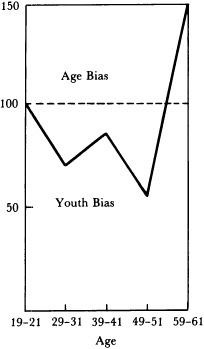
|
Reported Ages |
Backcountry Age Bias (1776) |
Modern U.S. Age Bias (1950) |
|
19-21 |
1.00 |
1.04 |
|
29-31 |
.67 |
.94 |
|
39-41 |
.83 |
.93 |
|
49-51 |
.53 |
.93 |
|
59-61 |
1.50 |
.92 |
Computed from data in Gaius M. Brumbaugh, ed., Maryland Records (2 vols., Baltimore, 1915, rpt. 1967), 181-92. Onomastic evidence indicates that a large proportion of this hundred were from North Britain; 20th-century data is from Ansley J. Coale and Melvin Zelnik, New Estimates of Fertility and Population in the United States (Princeton, 1963), 127-29.
1 In the year 1806, Samuel Blodget estimated that annual crude death rates per thousand by region as follows: Southern highlands, 20-22; Boston, 20-21; Philadelphia, 20-23; Tidewater south, 26-29. Samuel Blodget, Economica: A Statistical Manual for the United States of America (Washington, 1806), 76.
2“Epitaph on Wee Johnny,” The Poetical Works of Robert Burns (Oxford, 1904, 1960), 316.
3“Epitaph to J. Rankine,” ibid., 310.
4“Elegy on Captain Matthew Henderson,” ibid., 102. A translation from the Scots is:
O Death! thou tyrant cruel and bloody!
The very devil with his hanging tree.
5“Man Was Made to Mourn,” ibid., 111.
6 Drake, Pioneer Life in Kentucky, 35.
7Ibid., 35.
8 Miles, The Spirit of the Mountains, 140.
9Ibid., 143.
10“It is customary yet in some parts of the north of England to place a plate filled with salt on the stomach of a corpse after death.” Charles Hardwick, Traditions, Superstitions and Folklore (London, 1872), 181; see also Lowry C. Wimberly, Death and Burial Lore in the English and Scottish Popular Ballads (Lincoln, Neb., Univ. of Nebraska Studies in Language, Literature and Criticism, no. 8, 1927).
11 William Rollinson, Life and Tradition in the Lake District (London, 1974), 56.
12 Parton, Andrew Jackson, I, 42-43.
13 Scott, A Westmorland Village, 78.
14 Will of John Wilson of Rosthwaite, 23 March 1763, ms. DX 241/108, CUMROC.
15 Daniel Fleming, Book of Accounts, 15 April 1675, ms. 386, WD/R/box 199, CUMROK.
16 Hudson, Barton Records.
17“If the murderer touches the corpse of a murdered man, it will purge; therefore, have the suspect touch the corpse.” North Carolina Folklore, VI, 490.
18North Carolina Folklore, I, 258.
19 Dyer Journal, 24 Aug. 1767, 7 June 1769, Ms. HSP.
20 Johnson, Antebellum North Carolina, 145-48.
1 Woodmason, Carolina Backcountry, 29.
2 Governor William Bull to Board of Trade, 30 Nov. 1770; reprinted in Merrens, ed., Colonial South Carolina Scene, 254-70.
3“The Presbyterians are the most numerous,” Informations Concerning the Province of North Carolina, Addressed to Emigrants from the Highlands and Western Isles of Scotland (Glasgow, 1773); reprinted in Wm. K. Boyd, ed., Some Eighteenth Century Tracts Concerning North Carolina (Raleigh, 1927), 450.
4 Thomas P. Ford, “Status, Residence and Fundamentalist Religious Beliefs in the Southern Appalachians,” SF 39 (1960), 41-49.
5“I wager 5 shillings a side Mr. Graham is not the Rector of Arthuret for two years longer,” George Williamson Diary, 18 Jan. 1745, ms. CUMROC.
6 Witherspoon, “Recollections,” 127.
7 Benjamin Ferris Journal, ca. 1777, ms. HSP.
8“A Letter from a Blacksmith to the Ministers and Elders of the Church of Scotand,” 1759, quoted in Robert T. Fitzhugh, Robert Burns (Boston, 1970), 72.
9 Witherspoon, “Recollections,” 127.
10 Woodmason, Carolina Backcountry, 95; Guion Griffis Johnson, “The Camp Meeting in Ante-bellum North Carolina,” NCHR X (1933), 1-20; Robert B. Semple, A History of the Rise and Progress of Baptists in Virginia (1810, rpt. 1894), 23-24.
11 Wesley M. Gewehr, The Great Awakening in Virginia, 1740-1790 (Durham, 1930), 170.
12 Francis Asbury, Journal I, 444, 447, 461, 493, 612.
13 John B. Boles, The Great Revival, 1787-1805; Origins of the Southern Evangelical Mind (Lexington, 1972); Dickson D. Bruce, They All Sang Hallelujah: Plain-Folk Camp-Meeting Religion (Knoxville, 1974);
14 Benjamin Ferris Journal, 1726, Ms., SWAR.
15 Witherspoon, “Recollections,” 128.
1 For these and many other accounts, see Vance Randolph, “Nakedness in Ozark Folk Belief,” JAF 66 (1953), 333-34.
2 Drake, Pioneer Life in Kentucky, 216.
3 Proverbs in this chapter, unless otherwise cited, are drawn from Newman Ivey White, ed., The Frank C. Brown Collection of North Carolina Folklore (7 vols., Durham, 1952-64), I, 329-502.
4 Conjuring originally referred to rites in which spirits were summoned by secret oaths and rituals. Sorcery in the 17th century meant mainly black magic, and in particular the science of poisoning. Superstition in its original Latin meant an exaggerated fear of the Gods. All of these words later took on the broad and general meaning which is used here—a practical belief in the power of charms, omens, spells, potions and incantations to change the course of events.
5 Kercheval, Valley of Virginia, 288, 281.
6 Miles, The Spirit of the Mountains, 118.
1 Blackwell P. Robinson, A History of Moore County, N.C., 1747-1847 (Southern Pines, N.C., 1956), 140.
2 Woodmason, Carolina Backcountry, 49, 52; Arthur K. Moore, The Frontier Mind (1957, New York, 1963), 192-193, passim.
3 William W. Boddie, History of Williamsburg (Columbia, S.C., 1923), 543.
4 Robert L. Meriwether, The Expansion of South Carolina, 1729-1765 (Kingsport, Tennessee, 1940, rpt. Phila., 1974), 177; Duane Meyer, The Highland Scots of North Carolina, 1732-1776 (Chapel Hill, 1961), 119.
5 The most detailed study, which radically revises previous estimates, concludes that the “levels and the profile of illiteracy in Lowland Scotland [were] extremely close to those for northern England … literacy over Lowland Scotland as a whole was not particularly high compared to northern England.” R. A. Houston, Scottish Literacy and the Scottish Identity (Cambridge, 1985), 41, 34; idem, “Illiteracy in the Diocese of Durham, 1663-89 and 1750-62: The Evidence of Marriage Bonds,” NH 18 (1982), 229-51.
6 Houston finds the following rates of occupational illiteracy for craftsmen and traders in the borderlands during the period of emigration:
|
Decade |
Northern England |
Lowland Scotland |
|
1710s |
n.a. |
22% |
|
1720s |
44% |
14% |
|
1730s |
23% |
15% |
|
1740s |
22% |
17% |
|
1750s |
31% |
21% |
Source: Houston, Scottish Literacy and Scottish Identity, 40.
7 Houston’s research yields the following levels of illiteracy by occupation for the period 1700-1770:
|
Occupation |
England |
Scotland |
|
Professional |
0% |
1% |
|
Gentry |
0% |
3% |
|
Craft and Trade |
26% |
18% |
|
Yeoman and Tenant |
26% |
32% |
|
Laborer |
64% |
68% |
Source: Houston, Scottish Literacy and Scottish Identity, 41, 34.
8 Scott, A Westmorland Village, 70.
9 Ralph L. Rusk, The Literature of the Middle Western Frontier (2 vols., New York, 1925, 1962), I, 51-76.
10 The ratio of religious titles to all books was 1:4 in Edgecombe County (1733-53), and 1:6 in Bertie County (1720-74); it later fell to 1:8 in Edgecombe (1765-83), and 1:10 in Bertie (1775-83); these data are from Helen R. Watson, “The Books They Left: Some ‘Liberies’ in Edgecombe County, 1733-1783,” NCHR 46 (1971), 245-57.
11 Others testified that Jackson read only Tristram Shandy and a pamphlet on the South Sea Bubble. For two different views cf. Parton, Life of Andrew Jackson, and Remini, Andrew Jackson, I, 7; see also Arda Walker, “The Educational Training and Views of Andrew Jackson,” ETHSP, 16 (1944), 22.
12 Hughes, North Country Life in the Eighteenth Century: The North East, 37.
13 Kercheval, Valley of Virginia, 285-86.
14 Taliaferro, Fisher’s River (North Carolina) Scenes; an analysis appears in Ralph Steele Boggs, “North Carolina Folktales Current in the 1820’s,” JAF 47 (1934), 268-88.
15 Taliaferro, Fisher’s River (North Carolina) Scenes, 233.
16 James T. Pearce, “Folk Tales of the Southern Poor-White,” JAF 63 (1950), 398-411.
17 Gilmer, First Settlers of Upper Georgia, 78.
18Ibid., 13.
19 An example is given in ibid., 146; see also North Carolina Folklore, I.
20 Gilmer, First Settlers of Upper Georgia, 62.
1 Here again, as in other regional cultures, mean years of schooling are derived from total enrollment data by the following equation: Ys = Yp (E/P) where Ys is mean years of schooling, Yp is the range in ages of enrolled children. E is the number enrolled, and Pis the population of school age. The result may be thought of as a total education rate, comparable in its epistemic status to a total fertility rate. Data are drawn from A. R. Newsome, “Twelve North Carolina Counties in 1810,” NCHR 6 (1929), 17-99; this subject will be discussed in more detail in volume II.
2SAUS (1984), 145.
3 A radical revision of this historical problem appears in Houston, Scottish Literacy and Scottish Identity, 110-61; see also Rosemary O’Day, Education and Society, 1500-1800 (London, 1982); D. J. Witherington, “Education and Society in the Eighteenth Century,” in N. T. Phillipson and R. Mitcheson, eds., Scotland in the Age of Improvement (Edinburgh, 1970); idem, “Schools in the Presbytery of Haddington in the Seventeenth Century,” ELAST 9 (1963), 90-111; T. C. Smout, A History of the Scottish People, 424; W. Boyd, Education in Ayrshire through Seven Centuries (London, 1961). For education in the north of England see Hughes, North Country Life in the Eighteenth Century: Cumberland and Westmorland, 293-333; and idem, North Country Life in the Eighteenth Century: The North East, 341-79.
4 Woodmason, Carolina Backcountry, 26.
5 Gov. Wm. Bull to Board of Trade, 30 Nov. 1770, Merrens, ed., Colonial South Carolina Scene, 265.
6“Given yesterday at Ambleside unto William Baxter to drink—having then hired him to be schoolmaster, for a year from the 3rd day of May next at 40s. and his diet, and to suffer others to come unto him—the sum Is.” Daniel Fleming, Book of Accounts, 19 Feb. 1663, ms. WD/R/Box 199, CUMROK.
7 Alan Watson finds in North Carolina wills the same concern for education that Bruce discovered in Virginia; see Alan D. Watson, “Society and Economy in Colonial Edgecombe County,” NCHR 50 (1973), 231-55.
8 Douglas Sloan, The Scottish Enlightenment and the American College Ideal (Columbia, 1971), 45.
9Ibid., 36-72; Sloan’s list of Presbyterian academies founded before 1800 appears on pp. 281-84.
10 The account books of Daniel Fleming in Cumbria recorded most years a sum of one shilling, or l/6d., “given to the children at their barring out.” The dates varied from 24 Nov. to 10 Dec. He also gave his children larger sums, from ca. 30 Jan. to 24 March, for “cock pennies to the master.” See Daniel Fleming Account Books, 9 Dec. 1664, 6 Feb. 1665, 26 Feb., 26 March, 10 Dec. 1666; 24 Nov. 1668, 25 Nov. 1670, 30 Jan. 1675; Ms. WD/R/box 199, CUMROK.
11 Keith Thomas has mapped the incidence of barring out, and concludes that “the ninety or so schools for which I have so far collected definite evidence of the ritual are all situated north of the line from the Severn to the Wash, which marks so many fateful divisions in English history. Instances occur in almost every English county above that boundary, with a particularly heavy concentration in what is now called Cumbria, but never outside the North and the midlands”; Rule and Misrule in the Schools of Early Modern England (Reading, 1976), 30; and conversation with the author.
Whitehead observed that barring out occurred in most Cumberland villages; “the master, who always expected the barring out at the proper time, used to adjourn to the village ale-house, & treat the biggest boys to mulled ale, for in the winter season plenty of big fellows 18–20 years in age attend school”; see Talks about Brampton (Selkirk, 1907), 171-72.
Rollinson describes barring out in Westmorland as a “good natured, … school riot.” Most lasted “a day and a night and the next [day] till one in the afternoon.” But the custom of Brampton was a three-day barring out; see Life and Tradition in the Lake District, 60.
In the north of Ireland, barring out was also very common. “Within memory,” writes an historian of Carrickfergus, “it was common with boys to assemble early at their school-house on the morning before Christmas, and to bar out the master, who was not admitted till he promised a certain number of days’ vacation. Early on Christmas day, the boys set out to the country in parties of eight or twelve, armed with staves and bludgeons, killing and carrying off such fowl as came in their way. They were taken to their respective school-rooms, and dressed the following day. To this feast many persons were invited, who furnished liquors, or other necessaries; the entertainment usually continued for several days.” Parton, Andrew Jackson, I, 44.
12 Barring out occurred in the grammar school at Williamsburg in 1702 and again in 1705; Commissary James Blair wrote that Lt. Gov. Francis Nicholson was “the author and contriver of this business.” Nicholson was a Yorkshireman, who came from the north of England where this custom was very common. The documents are brought together in Edgar W. Knight, ed., A Documentary History of Education in the South Before 1860 (5 vols., Chapel Hill, 1949), I, 474-88.
13 The classical description appears in Edward Eggleston, Hoosier School-master (1872, rpt. New York, 1957), 73-74; also idem, Transit of Civilization, 270; for other accounts see H. M. Brackinridge, Recollections of Persons and Places in the West(Philadelphia, 1834), and J. P. Wick-ersham, History of Education in Pennsylvania (Lancaster, 1886), 207.
14 Gilmer, First Settlers of Upper Georgia, 133.
15 Quoted in Thomas, Rule and Misrule, 21.
16North Carolina Folklore, VI, 69-70.
1 Kercheval, Valley of Virginia, 196, 253; Woodmason, Carolina Backcountry, 34, 173.
2 Woodmason, Carolina Backcountry, 34, 173, 176, 196; Thomas Anburey, Travels (2 vols., London, 1789), 340, 376; William Eddis, Letters from America (1792, Cambridge, 1969), 57; “Observations on Several Voyages and Travels to America,” WMQ3 15 (1958), 146.
3 John Gough, The Manners and Customs of Westmorland (Kendal, 1827), 20; also Ulster Journal of Archueology II (1854), 204; Woodmason, Carolina Backcountry, 176, 34, passim.
4 Redcliffe N. Salaman, The History and Social Influence of the Potato (Cambridge, 1985); for a first-hand account of the introduction of the potato to the backcountry by North British immigrants, see James Ellerton, Journal, 19 March 1740, in Merrens, ed.,Colonial South Carolina Scene, 132; potatoes were not unknown in other food-cultures of British America, but they were not staples.
5 Ferguson, Northmen in Cumberland and Westmorland, 149; Rollinson, Life and Traditions in the Lake District, 38-40, 49.
6 Sam Bowers Hilliard, Hog Meat and Hoecake: Food Supply in the Old South, 1840-1860 (Carbondale, 111., 1972).
7 Kercheval, Valley of Virginia, 253.
8 Chastelleux, Travels, II, 409, 19 April 1782.
9 Hudson, Barton Records, 56; John C. Campbell, The Southern Highlander and His Homeland (New York, 1921), 203.
10 Campbell, The Southern Highlander, 203.
11 Kercheval, Valley of Virginia, 255.
12 Allen, British Tastes, 75 passim; see also Gough, Manners and Customs of Westmorland, 20; Bouch and Jones, Economic and Social History of the Lake Counties, 243.
13 Woodmason, Carolina Backcountry, 173.
14 Leyburn, The Scotch Irish: A Social History, 25; Graham, The Social Life of Scotland in the Eighteenth Century, 179-80.
15Ibid., 196.
16 Kercheval, Valley of Virginia, 255.
17Ibid., 253.
18 The account book of a Cumbrian “statesman” Benjamin Browne recorded many feasts and special meals. See the Browne Account Book, 1719, Browne mss., WD/TE box 8, CUMROK. For the persistence of these food ways in Appalachia during the twentieth century, see Campbell, The Southern Highlander and His Homeland, 198-203.
1 Woodmason, Carolina Backcountry, 61.
2Ibid., 21.
3 Kercheval, Valley of Virginia, 257.
4Ibid., 256.
5 Woodmason, Carolina Backcountry, 176.
6 For a discussion of the differences between this costume and that of the Indians, see Kercheval, Valley of Virginia, 256.
7 Rollinson, Life and Traditions in the Lake District; Scott, A Westmorland Village, 91-93.
8 For leather stockings see George Williams Diary, 22 May 1742, ms. DX/124, CUMROC.
9 Journal of Sir William Brereton, SSP 124 (1914) 30.
10 Roger North, Lives of the Right Hon. Francis North … (3 vols., London, 1826); quoted in Hughes, North Country Life in the Eighteenth Century: The North East, 14.
1 Gomme, Traditional Games of England, Scotland and Ireland, 183; William Dodd, ed., Edenhall and People Who Have Lived There (n.p., 1974), 19, CUMBROC; Ferguson, Northmen in Cumberland and Westmorland, 150; Scott, A Westmorland Village, 18.
2 Rollinson, Life and Tradition in Lake District, 161-62.
3 Parton, Andrew Jackson, I, 66.
4 Jacob Robinson and Sidney Gilpin, Wrestling and Wrestlers (n.p., 1893).
5 Hugh W. Mackell, Some Records of the Annual Grasmere Sports (Carlisle, 1911), 15.
6 Thomas Ashe, Travels in America, Performed in 1906 (New York, 1811).
7 Hening, Statutes, VI, 250; VIII, 520.
8 Greenfield Gazette, 12 July 1800.
9 Anburey, Travels, II, 217-18.
10Ibid., II, 201-2.
11 Mackell, Some Records of the Annual Grasmere Sports; Robinson and Gilpin, Wrestling and Wrestlers.
12 Collingwood, Lake District, 150; Rollinson, Life and Tradition in the Lake District, 162.
13 Johnson, Antebellum North Carolina, 111.
14“Caledonian games” had not been confined to the highlands. The leading historian writes, “ … similar games were held in other parts of Scotland as well, and Lowlanders and Borderers often disputed the alleged superiority of the Highlanders.” Gerald Redmond, The Caledonian Games in Nineteenth-Century America (Rutherford, N.J., 1971), 30.
15Ibid., 37; Rowland Berthoff, British Immigrants in Industrial America (Cambridge, 1953), 151.
16 PA 2 series XV, 175-78.
17 Many instances of shinny were recorded by folklorists throughout Derby, Lancashire, Cumberland, Cheshire, Derby, the lowlands of Scotland and northern Ireland. See Gomme, Traditional Games of England, Scotland and Ireland, II, 190; Parton, Andrew Jackson, I, 45; Don K. Price tells the author that he remembers playing shinny as a child at Middlesboro, Kentucky, where he was born in 1910.
18 Kercheval, Valley of Virginia, 285.
19Ibid., 284.
20lbid., 283.
1 Thomas Pennant, A Tour of Scotland (London, 1790); qtd. in Grady McWhiney and Perry D. Jamieson, Attack and Die: Civil War Military Tactics and the Southern Heritage (University, Ala., 1981), 183.
2 Woodmason, Carolina Backcountry, 49; J. Dickinson to John Harriot, 10 Nov. 1719, Jonathan Dickinson Letterbook, 1715-21, HSP.
3 A. R. H. Baker and R. A. Butlin, eds., Studies of Field Systems in the British Isles (Cambridge, 1973), has chapters on English borders, Scotland and Ireland; also relevant are chapters in Thirsk, ed., Agrarian History of England and. Wales, vols. 4 and 5; these works summarize an immense literature and include extensive bibliographies.
4 Witherspoon, “Recollections,” 125.
5 For cowpens in Northumberland see Thirsk, ed., Agrarian History of England and Wales, IV, 17,27.
6 OED, “cowpens.”
7 Schaper, Sectionalism in South Carolina, 59; Forrest McDonald and Grady McWhiney, “The Antebellum Southern Herdsman: A Reinterpretation,” JSH 41 (1975), 147-66; idem, “The South from Self-Sufficiency to Peonage: An Interpretation,” AHR 85 (1980), 1095-118; idem, “The Celtic South,” History Today 30 (1980), 11-15; Grady McWhiney, “Antebellum Piney Woods Culture: Continunity Over Place and Time,” in Noel Polk, ed., Mississippi’s Piney Woods: A Human Perspective (Jackson, Miss., 1986), 40-59.
8 Grady McWhiney and Forrest McDonald, “Celtic Origins of Southern Herding Practices,” JSH 51 (1985), 165-82, traces the continuities from Britain and Ireland to the American back-country; Terry G. Jordan, Trails to Texas: Southern Roots of Western Cattle Ranching (Lincoln, Neb., 1981). Here again the McWhiney-McDonald thesis grows stronger if it is recast from racial to regional terms.
9 Witherspoon, “Recollections,” 126.
10 Remonstrance presented to the Commons House of Assembly by the Upper Inhabitants, 1767, reprinted in Woodmason, Carolina Backcountry, 213.
11 Boston Chronicle, 5-12 Dec. 1768; Gov. Wm. Bull to Board of Trade, 30 Nov. 1770; reprinted in Merrens, The Colonial South Carolina Scene, 265.
1 The season of marriage in Augusta County, Va., from 1749 to 1773 was as follows:
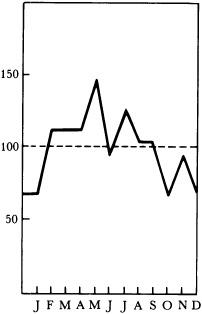
|
Marriage Index |
Percent of all |
|
|
Month |
(m = 100) |
Marriages |
|
January |
68.09 |
5.7 |
|
February |
110.64 |
9.2 |
|
March |
110.64 |
9.2 |
|
April |
110.64 |
9.2 |
|
May |
144.68 |
12.1 |
|
June |
93.62 |
7.8 |
|
July |
127.67 |
10.6 |
|
August |
102.13 |
8.5 |
|
September |
102.13 |
8.5 |
|
October |
68.09 |
5.7 |
|
November |
93.62 |
7.8 |
|
December |
68.09 |
8.5 |
|
Total |
1200.04 |
Source: Computed from data in William A. Crozier, Early Virginia Marriages (Baltimore, 1968), 85-88.
2 In eight English border parishes scattered through the counties of Cumberland and Westmorland, all showed a peak season of marriage in the months of April, May, June and July. See E. A. Wrigley and R. S. Schofield, The Population History of England, 1541-1871 (Cambridge, 1981), 302; and Ann Kussmaul, “Time and Space, Hoofs and Grain: The Seasonality of Marriage in England,” JIH 15 (1985), 755-79.
This North British pattern differed from that of East Anglia, which showed a strong autumn peak, and the Midlands, which tended to be mixed or bimodal. Marriages in Roman Catholic countries of western Europe, including France, Italy and Belgium, generally showed a January-February peak similar to that in Anglican Virginia. The Cambridge Group offer a materialist explanation for these variations, in terms of systems of production and agricultural regimes (arable, wood pasture), but their own evidence does not support them.
3 January 6, the twelfth day after Christmas, is the feast of the Epiphany in the Christian calendar. In the eastern church it is celebrated in honor of the baptism of the infant Jesus. In the western churches it is usually taken to mark the adoration of the Magi; that is, the first manifestation of Christ to the Gentiles. In England, even to this day, the sovereign marks the occasion by special offerings of gold, myrrh and frankincense, in ceremonies of great beauty and antiquity.
The evening before Epiphany is Twelfth Night, a happy event celebrated differently in various parts of the English-speaking world. The people of Herefordshire, for example, light twelve bonfires at once, in honor of the Apostles.
Other Christians, however, have celebrated January 6 as the actual birthday of Jesus. This still is the case in the Armenian Church, and was so in some parts of the Appalachian highlands as recently as the 1930s.
4 Newman, I. White, Frank C. Brown, et al., The Frank C. Brown Collection of North Carolina Folklore (7 vols., Durham, N.C., 1952-64), I, 2416.
5lbid., I, 224.
6 Collingwood, Lake District, 152; T. E. Lones, ed., British Calendar Customs (England) (London, 1938); M. Macleod Banks, British Calendar Customs (Scotland) (London, 1937).
7 Johnson, Antebellum North Carolina, 180.
8 Parton, Andrew Jackson, I, 45-46; James Elerton, Journal, 1740, published in Elizabeth Poyas, Olden Time of Carolina (Charleston, 1855), and excerpts in Merrens, ed., The Colonial South Carolina Scene, 130-37.
1“A Memorandum of M. Austin’s Journey from the Lead Mines in the County of Wythe in the State of Virginia to the Lead Mines in the Province of Louisiana West of the Mississippi, 1796-1797,” AHR 5 (1899-1900), 525-26.
2 In South Carolina, from 1760 to 1765, there were about 2,500 applications for land, a total of 525,000 acres. The average grant was a little larger than 200 acres. But many of these grants went to petitioners who were already landowners. See Robert L. Meriwether, The Expansion of South Carolina (1940, rpt. Philadelphia, 1974), 257-59.
3 John Vincent Beckett, “Landownership in Cumbria, c. 1680-c. 1750” (thesis, Univ. of Lancaster, 1975); Charles F. Searle, “The Odd Corner of England: A Study of Rural Social Forms in Transition: Cumbria, 1700-c. 1924” (thesis, Univ. of Essex, 1983).
4 In Westmorland most customary manors had fixed rents. See Searle, “The Odd Corner of England,” 43.
5Ibid., 45.
6 Landsman, Scotland and Its First American Colony, 21.
7 Paul Brassley, “Northumberland and Durham,” in Thirsk, ed., Agrarian History of England and Wales, I, 49.
8“Disbursed for conveying vagrants through the county … three man and three horses and a cart two days and their meat and wages, and myself four days.” Benjamin Brown Accounts, 2 Dec. 1731, Brown mss. WD/TE/wI CUMROK.
9 The distribution of taxable wealth in East Tennessee was as follows:
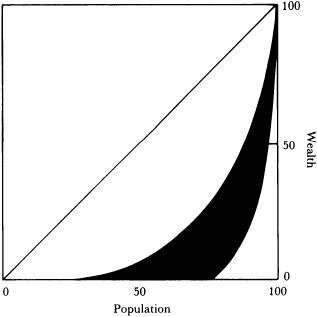
|
Total Wealth |
Wealth in Land |
Wealth in Slaves |
||||||||
|
Place |
Year |
SSTT |
Gini |
Zero |
SSTT |
Gini |
Zero |
SSTT |
Gini |
Zero |
|
Washington Co. |
1778 |
46 |
57 |
10 |
na |
na |
na |
na |
na |
na |
|
Washington Co. |
1787 |
47 |
64 |
28 |
42 |
60 |
29 |
100 |
94 |
89 |
|
Sullivan Co. |
1796 |
50 |
67 |
30 |
39 |
60 |
33 |
87 |
92 |
83 |
|
Carter Co. |
1796 |
73 |
83 |
39 |
72 |
83 |
41 |
100 |
95 |
91 |
|
Grainger Co. |
1799 |
85 |
86 |
53 |
79 |
88 |
57 |
89 |
92 |
87 |
|
Jefferson Co. |
1800 |
61 |
75 |
38 |
59 |
74 |
41 |
92 |
92 |
88 |
|
Hawkins Co. |
1809-12 |
63 |
79 |
47 |
68 |
82 |
50 |
82 |
89 |
82 |
|
Cooke Co. |
1836-37 |
62 |
77 |
38 |
59 |
75 |
39 |
100 |
95 |
90 |
na = not available
SSTT = Size share of the upper decile of wealth holders
Gini = Gini ratio of wealth inequality
Zero = percent of taxables owning no taxable property, and paying only a poll tax. These data are calculated from tax lists published in Polyanna Creekmore, ed., “Early East Tennessee Taxpayers,” ETHSP 27 (1955), 100-119; 23 (1963), 121-51. Landed wealth refers to acres; slaves, to black polls; total wealth to property weighted by the Tennessee assessment act of 1805: 100 acres = 1.0; town lots = 0.5; taxable slaves = 1.00. The author wishes to thank Mark Orlofsky for his help with data processing.
10 The distribution of taxable wealth in Kentucky was as follows:
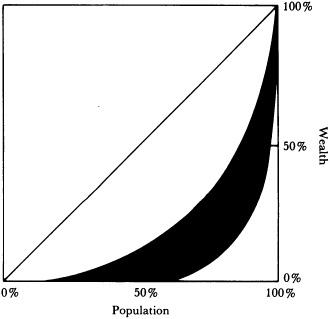
|
Total Wealth |
Wealth in Land |
Wealth in Slaves |
||||||||
|
Place |
Date |
SSTT |
Gini |
Zero |
SSTT |
Gini |
Zero |
SSTT |
Gini |
Zero |
|
Madison Co. |
1792 |
68 |
83 |
59 |
69 |
84 |
68 |
82 |
89 |
81 |
|
Washington Co. |
1792 |
64 |
79 |
44 |
58 |
79 |
52 |
81 |
89 |
79 |
|
Nelson Co. |
1792 |
na |
na |
na |
72 |
83 |
48 |
na |
na |
na |
|
Lincoln Co. |
1792 |
na |
na |
na |
na |
na |
na |
73 |
87 |
77 |
|
Logan Co. |
1795 |
86 |
92 |
78 |
99 |
97 |
88 |
91 |
92 |
86 |
|
Campbell Co. |
1795 |
86 |
92 |
73 |
92 |
94 |
78 |
100 |
95 |
90 |
|
Mercer Co. |
1795 |
na |
na |
na |
na |
na |
na |
76 |
87 |
74 |
|
Montgomery Co. |
1799? |
na |
na |
na |
96 |
96 |
81 |
na |
na |
na |
|
Cumberland Co. |
1799 |
42 |
67 |
47 |
40 |
61 |
45 |
100 |
95 |
90 |
|
Christian Co. |
1800 |
50 |
66 |
34 |
37 |
55 |
37 |
80 |
88 |
80 |
|
Hart Co. |
1819 |
na |
na |
na |
60 |
77 |
51 |
na |
na |
na |
na = not available
SSTT = Size share of the upper decile of wealth holders
Gini = Gini ratio of wealth inequality
Zero = percent of taxables owning no taxable property
Source: Calculated from Kentucky tax lists with the assistance of Marc Orlofsky.
11 This conclusion rests upon the same data used by Harriet and Frank Owlsley, as carefully reworked in Donald L. Winters, “‘Plain Folk” of the Old South Reexamined: Economic Democracy in Tennessee,” JSH 53 (1987), 565-86. As Winters himself points out, his own computations understate wealth concentration, and an attempt is made to refine them here. His data are limited to farm operators listed in the agricultural schedules of the Census of 1850. This source omitted many landless freemen who appeared in the population schedules of the census but not in the agricultural schedules. From the research of Blanche Clark, we know that, when they are included, landlessness in the eight Tennessee counties rises to 35% of the free population. Further, it also omits slaves as potential wealthowners, who made up 25% of the Tennessee population in 1850. These two large landless groups were a majority of the population. Without them Winters obtained a Gini ratio of .58 for improved acres. If they are included, the Gini ratio rises to .8, and even this estimate understates concentration, for the Census of 1850 missed many poor farmers, migrant farm laborers and squatters.
12 Charels C. Geisler et al., Who Owns Appalachia? (Lexington, Ky., 1983), 14; another study that obtained similar results is Lee Soltow, “Kentucky Wealth at the End of the Eighteenth Century,” JEH 43 (1963), 617-33.
13Ibid., 14-40.
1 Woodmason, Carolina Backcountry, 43, 47, 53.
2 Beeman, Evolution of the Southern Backcountry, 132.
3North Carolina Folklore, I, 371, 374, 399, 402, 410, 443, 465, 482.
4 Fraser, Steel Bonnets, 42, 236; passim.
5 Thomas P. Abernethy, From Frontier to Plantation in Tennessee (Memphis, 1955), 160.
6 Campbell, The Southern Highlander, 86.
7 Everett Dick, The Dixie Frontier: A Social History of the Southern Frontier from the First Transmontane Beginnings to the Civil War (New York, 1948), 24, 310.
8EDD, “Hoozer;” cf. Mitford Mathews, A Dictionary of Americanisms on Historical Principles (1951, Chicago, 1956), “Hoosier.”
9“Red-neck,” Matthews, Dictionary of Americanisms, 1373; Anne Royall, Mrs. Royall’s Southern Tour (3 vols., Washington, 1830-31), I, 148; for an earlier example in the north of England, see OED, “redneck,” under “red,” 18.a.
10“Cracker,” Matthews, Dictionary of Americanisms; for earlier English examples, see “Cracker,” OED. Other suggestions that cracker is short for “corn-cracker” or for “whip-cracker” are contradicted by the earliest examples.
1 Landsman, Scotland and Its First American Colony, 31, 44; Gillespie, Colonial Ulster, 60.
2 Those statistics do not include movement within the county, nor were they much affected by mortality; Beeman, Evolution of the Southern Backcountry, 29-30, 67-70, 81-82.
3 Miles, The Spirit of the Mountains, 177; Remini, Andrew Jackson, I, 37.
4 Schoepf, Travels, II, 103.
5 John Hill Wheeler, Historical Sketches of North Carolina (rpt. Baltimore, 1964), 438.
6 Andrew Jackson to Rachel Jackson, May 9, 1796, Papers of Andrew Jackson, I, 91.
7 Kercheval, Valley of Virginia, 250.
8 Karl B. Raitz, Appalachia, A Regional Geography: Land, People and Development (Boulder, Colo., and London, 1984), 115.
9 Miles, The Spirit of the Mountains, 19-20.
10 T. W. Carrick, History of Wigton (Cumberland) (Carlisle, 1949), 25.
11North Carolina Folklore, I, 482.
12 Kercheval, Valley of Virginia, 292.
13 Wyatt-Brown, Southern Honor, 147.
14 Parton, Andrew Jackson, I, 42.
15 Wyatt-Brown, Southern Honor, 34, 50, 388, 390.
1 Andrew Jackson to Martin Van Buren, 4 Dec. 1838, Jackson Correspondence, V, 573; W. H. Sparks, The Memories of Fifty Years (Philadelphia, 1882) 147-48; Remini, Andrew Jackson, I, 11-12,429.
2North Carolina Folklore, I, 472.
3 Selwyn G. Champion, Racial Proverbs (London, 1938), 59.
4 The tradition still exists. A vigilante killing occurred in the small town of Maryville, Missouri, as recently as the 1980s, when Kenneth McElroy, a typical backcountry bully who “for most of his years … terrorized many of the town’s 440 citizens,” shot a grocer in town. When he continued to threaten his neighbors, he was surrounded by a crowd of sixty townspeople and shot to death “by person or persons unknown.” NY Times, 26 Sept. 1986.
5 Woodmason, Carolina Backcountry, 28.
6 The leading survey has found evidence of 326 American vigilante movements, of which 211 occurred in the southern highlands and the southern rim. Most of the remainder were on the fringes of that region, in the lower middle west and the mountain states. Not a single case was recorded in New England, New York, or the Yankee part of the old northwest. There were none in the Delaware Valley, and only two cases in tidewater Virginia and the Carolina low country. Other cases can be found in all of these regions, but they were very rare compared with the southern highlands and the southwestern rim. See Richard M. Brown, “The American Vigilante Tradition,” in The History of Violence in America, 154-226.
7 This is Brown’s judgment in ibid., 158-59.
8 Mathews, Dictionary of Americanisms, 1010; A. Matthews in CSM, 27, 256-71.
9 Charles L. Wallas, Stories on Stone (n.p., n.d.), 62.
10ALAR 12 (1959), 92; Clarence E. Carter, Territorial Papers of the United States (27 vols., Washington, D.C., 1934-69), VI, 243-46, 268-69.
11 For many examples, see D.L.W. Tough, The Last Years of a Frontier: A History of the Borders during the Reign of Elizabeth (Oxford, 1928), 14, 16, 12, 117, 131, 141, 156, 173-74, 180,225; also, Fraser, Steel Bonnets, passim.
12 For general accounts see Charles G. Mutzenberg, Kentucky’s Famous Feuds and Tragedies (New York, 1917); Noah and John Reynolds, History of the Feuds of the Mountain Parts of Eastern Kentucky (Whitesburg, Ky., n.d.); S. S. McClintock, “The Kentucky Mountains and Their Feuds,” AJS 7 (1901), 1-28, 171-87.
13 Otis K. Rice, The Hatfields and the McCoys (Lexington, Ky., 1978).
14 Edward M. Steel obtained the following pattern of indictments for crimes and misdemeanors in Ohio County, Va., 1801-10: Crimes against persons (125): Murder, 3; Assault and battery, 91; Peace action (abortive assaults), 31. Crimes against property (24): Larceny, 16; Robbery, 1; Counterfeiting, 2; Forgery, 2; Breaking and entering, 2; Trespass, 1. Crimes against morality (29): Profanity, 24; Bastardy, 4; Sabbath breaking, 1. Crimes against order and authority (62): Riot, 8; Affray (unpremeditated riot), 2; Unlawful assembly, 2; Disturbing public assembly, 1; Misfeasance (failure to lay out roads), 36; Unlawful distilling and retailing, 8; Obstructing highway, 2; Contempt, 3. Total: 240. Source: Edward M. Steel, “Criminality in Jeffersonian America—A Sample,”Crime and Delinquency, 18 (1972), 154.
15 Campbell, The Southern Highlander, 119.
16 Garland F. Hopkins, Cumberland County, Virginia (Winchester, 1942), 31.
17 Edward L. Ayers, Vengeance and Justice: Crime and Punishment in the Nineteenth-Century American South (New York, 1984), 111.
18North Carolina Folklore, I, 500.
19 Parton, Andrew Jackson, I, 112-13.
20 Woodmason, Carolina Backcountry, 133.
21 Paul M. Fink, “Russell Bean, Tennessee’s First Native Son,” ETHSP 37 (1965), 35, 39.
22 Charleston South Carolina Gazette and Country Journal, 28 July, 4 Aug. 1767; quoted in Rachel Klein, “The Rise of the Planters in the South Carolina Backcountry, 1767-1808” (thesis, Yale, 1979), 66.
23 Jack Kenny Williams, Vogues in Villainy: Crime and Retribution in Ante-bellum South Carolina (Columbia, 1959), 4; Allen Trelease, White Terror: The Ku Klux Klan Conspiracy and Southern Reconstruction (New York, 1971), 72, 349.
24 Paul M. Angle, Bloody Williamson: A Chapter in American Lawlessness (New York, 1973); Henry P. Lundsgaarde, Murder in Space City: A Cultural Analysis of Houston Homicide Patterns (New York, 1977).
25 Hughes, North Country Life: The North East, 12-25.
26Ibid., 19; see also expenditures for pistols and holsters in Daniel Fleming Account Books, 16 March 1661, passim; ms. WD/R/199, CUMROK.
27 Fleming Account Book, 25 April 1665, ms. WD/R/199, CUMROK.
28 Hughes, North Country Life, 16.
29 Tough, The Last Years of a Frontier, 147-86.
1 Bridenbaugh, Myths and Realities, 132.
2 William Byrd, History of the Dividing Line, ed. William Boyd (Raleigh, 1929), 207.
3 Joseph Oxley, “Joseph’s Offering to His Children,” ms. memoir, 377-78 (1770), HSP.
4 Beeraan, Evolution of the Southern Backcountry, 92.
5 Oliver Hart, “Diary …,” Journal of the South Carolina Baptist Society I (1975), 94; quoted in Klein, “Rise of Planters,” 94.
6 Joseph Johnson, Traditions and Reminiscences of the American Revolution in the South (Charleston, 1851), 158-60; as quoted in Richard Maxwell Brown, The South Carolina Regulators (Cambridge, 1963), 26, whose account I follow on Richardson.
7 Schoepf, Travels, II, 124.
8 South Carolina Gazette, 19 Oct. 1767, quoted in Klein, “Rise of Planters,” 66.
9 Parton, Andrew Jackson, I, 163.
10 Remini, Andrew Jackson, I, 8; on politics in the British borderlands see Robert Hopkinson, “Elections at Appleby, 1700/01-1714/15” (B.A. dissertation, Univ. of-Newcastle-upon-Tyne, 1968); idem, “Elections in Cumberland and Westmorland, 1695-1713” (thesis, Univ. of New-castle-upon-Tyne, 1973).
11Ibid., I, 15.
12 Chilton Williamson, American Suffrage from Property to Democracy (Princeton, 1960), 18.
13 Turnout in the backcountry Virginia counties was as follows, as a percentage of adult white male tithables:
|
Year |
County |
Turnout |
|
1755 |
Frederick Co., Va. |
18.9% |
|
1786-89 |
Albemarle Co., Va. |
23.2% |
|
Culpeper Co., Va. |
16.7% |
|
|
Orange Co., Va. |
20.7% |
Source: Charles S. Sydnor, Gentlemen Freeholders (Chapel Hill, 1952), 142, corrected for population growth; and Lucille Griffith, The Virginia House of Burgesses, 1750-1774 (University, Ala., 1968), 168.
1 Norris W. Preyer, Hezekiah Alexander and the Revolution in the Backcountry (Charlotte, 1987), 66.
2 Schoepf, Travels, 238-39.
3 Richard Trappes-Lomax, “The Diary and Letterbook of the Rev. Thomas Brockbank, 1671-1719,” CHSP n.s. 89 (1930), 44.
4 Tyler, Patrick Henry, 418.
5Ibid.
6 For two versions of this event, see American Historical Review 26 (1921) 745-46; and Leon G. Tyler, Letters and Times of the Tylers (3 vols., New York, 1884-96), I, 56; four versions of the Virginia resolves are printed in Edmund S. Morgan, ed., Prologue to Revolution: Sources and Documents of the Stamp Act Crisis (Chapel Hill, 1959), 46-50.
7 Tyler, Patrick Henry, 111.
8 William Meade, Old Churches, Ministers and Families of Virginia (2 vols., 1857, rpt. Baltimore, 1966), I, 220.
9 Jonathan Elliot, Debates in the Several State Conventions on the Adoption of the Federal Constitution (5 vols., 1836-45), III, 53-54.
10 Patrick Henry to Thomas Madison, 21 Oct. 1787, NYPL; quoted in Robert Douthat Meade, Patrick Henry, Practical Revolutionary (Philadelphia, 1969), 334.
11 Tyler, Patrick Henry, 12.
12 William Wirt, Sketches of the Life and Character of Patrick Henry (Hartford, n.d.), 18.
13 J. Lewis Peyton, History of Augusta County, Virginia (2d ed., Bridgewater, Va., 1953), 345.
14 Hughes, North Country Life: The North East, 39.
15 Ayers, Vengeance and Justice, 22.
16 George Harrison, “Every Man at Nature’s Table Has a Right to Elbow Room,” FHSJ 21 (1924), 27-30.
1 Atlantic settlements planted in the present United States between 1606 and 1625 include:
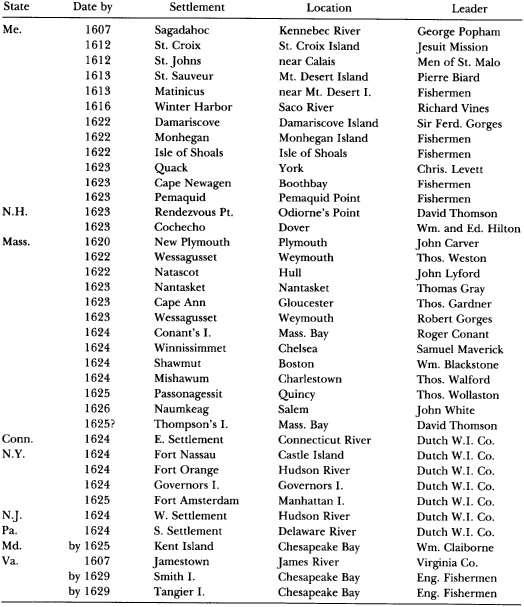
2 There is much manuscript material on early Maine in the Devon Record Office and the Exeter City Library. Some of it has been published in Robert E. Moody, ed., The Letters of Thomas Gorges, Deputy Governor of the Province of Maine, 1640-1643(Portland, Me., 1978); see also Daniel Vickers, “Work and Life on the Fishing Periphery of Essex County, Massachusetts, 1630-1675,” CSMP 63 (1984), 83-118; Edwin A. Churchill, “The Founding of Maine, 1600-1640: A Revisionist Interpretation,”MEHSQ 18 (1978), 21-54; Charles E. Clark, “The Founding of Maine, 1600-1640, A Comment,” MEHSQ 18 (1978), 55-62.
3“Maverick,” NEHGR 69 (1915), 146-59.
4 Clifford K. Shipton, Roger Conant (Cambridge, 1945).
5 Signs of change appear in the founding of English journals called Northern History (1966), Midland History (1971), and Southern History (1979). But few articles in these journals are truly regional in nature; most run to national or local history. Even the manifestos that called these journals into being were reluctant to make strong claims for regional history. One called it “provincial history,” and argued that it should be “outward looking” rather than “inward looking” (see Asa Briggs, “Themes in Northern History,”NH I (1966)). Only in the 1980s did the number of genuinely regional essays increase.
Other harbingers of change are centers for regional history at the universities of East Anglia, Exeter and Leeds. But again much of their work is not regional but local or national in its conception. The oldest and strongest of these centers is the Centre of East Anglian Studies at the University of East Anglia. But comparatively little of its research is devoted to the region as a unit. The largest project under way at the Centre of East Anglian studies is a building survey of Norwich—a very useful project, but not an exercise in regional history. See Janice Henney, ed., East Anglian Studies: Theses Completed (Norwich, 1982).
Still, the important beginnings have been made. A new series of monographs on English regional history began to appear in 1986—another sign of growing interest in this field.
6 John Langton, an English geographer who is swimming against the tide, writes that “relatively little regional geography has been written about England”; see “The Industrial Revolution and the Regional Geography of England,” IGBT, n.s. 9 (1984), 145-67. Strong arguments against regional models have come from British geographers and historians, at the same time that colleagues in other nations have been moving the other way. See G.H.T. Kimble, “The Inadequacy of the Regional Concept,” in L. D. Stamp and S. W. Wooldridge, eds., London Essays in Geography (London, 1951). This antiregional bias is especially strong among middle-class Londoners (as it also tends to be in New Yorkers and Parisians) who divide their country into the “metropolis” and the “provinces.”
7 Cyril Fox, The Personality of Britain (Cardiff, 1932); Joan Thirsk, “The Farming Regions of England and Wales,” in Thirsk, ed., The Agrarian History of England and Wales: IV, 1500-1640 (Cambridge, 1967), 1-112; John D. Gay, The Geography of Religion in England (London, 1971); R. T. Mason, Framed Buildings of England (Horsham, 1974); Eric Mercer, English Vernacular Houses (London, 1975).
8 David Underdown, “The Chalk and the Cheese,” PP 85 (1979), 129-54; Thirsk, “The Farming Regions of England and Wales,” 1-112. Thirsk asks, “Was it generally true that pastoral regions were also the most fertile seedbeds for Puritanism and dissent?” In the 17th century, antiquarians such as John Aubrey used soil types to explain differences in dialect in Wiltshire. “In North Wiltshire and the Vale of Gloucestershire (a dirty clayey country),” he wrote, “the Indigenae or Aborigines speak drawling. They are phlegmatique, skins pale and livid, slow and dull, heavy of spirit.” The Natural History of Wiltshire (1862, rpt. New York, 1969), 11.
9 Lawrence Stone, The Causes of the English Revolution, 1529-1642 (New York, 1972), 106; Many historians have argued that the “county community” was the most important unit of identity in Civil War. The seminal work was done by A. M. Everitt, “The County Community,” in E. W. Ives, ed., The English Revolution, 1600-1660, (London, 1968), 49; idem, The Local Community in the English Civil War, Historical Association Pamphlet G70 (1969); idem, Change in the Provinces: The Seventeenth Century(Leicester University Department of Local History, Occasional Papers, 2d ser., I, 1969).
Other “county community” studies include W. B. Willcox, Gloucestershire, 1590-1640 (New Haven, 1940); Thomas Garden Barnes, Somerset 1625-1640: A County’s Government during the Personal Rule (Cambridge, Mass., 1961); C. W. Chalkin,Seventeenth Century Kent: A Social and Economic History (London, 1965); Alan Everitt, The Community of Kent and the Great Rebellion, 1640-1660 (Leicester, 1966); J. S. Morrill, Cheshire 1630-1660: County Government and Society during the English Revolution (Oxford, 1974); Anthony Fletcher, Sussex 1600-1660: A County Community in Peace and War (London, 1975); J. T. Cliffe, The Yorkshire Gentry from the Reformation to the Civil War (1969); B. G. Blackwood, The Lancashire Gentry and the Great Rebellion, 1640-1660(1978); Clive Holmes, Seventeenth Century Lincolnshire (Lincoln, 1980).
A second generation of studies, as yet unpublished but made available to the author in manuscript, tends to stress the permeability of county communities and the importance of connections that carried across county lines—thus opening a quasi-regional consciousness.
10 In a pioneering regional history of England, series editors Barry Cunliffe and David Hey write, “English regional identities are imprecise, and no firm boundaries can be drawn … any attempt to define a region must be somewhat arbitrary, particularly in the midlands … yet regional differences are nonetheless real. … People still feel that they belong to a particular region within England as a whole.” Their taxonomy uses the following county-clusters:
Northern Counties (Cumb., Dur., Nhumb., Tyne and Wear, N. Cleve.); Lancashire/Cheshire (Lancs., Ches., Mersey, Gr. Mancs.); Yorkshire (N., S., W. Yorks.; S. Cleve., N. Humberside); West. Midlands (Salop, Staffs., W. Mid., Here, and Worcs., Warw., Glocs.); East Midlands (Derby, Notts., S. Humber, Lines., Leics.); South Midlands (Northants., Oxon., Beds., Bucks., Herts., NW London); Eastern Counties (Norf., Suff., Essex., Cambs., NE London); South West (Devon., Cornwall); Wessex (Avon, Wilts., Berks., Hants., Dorset, Somerset); South East (Surrey, Kent, E. and W. Sussex, S. London); see Nick Higham, The Northern Counties to AD 1000 (London, 1986), xv.
11“The earliest use so far discovered of the expression ‘the provinces’ to describe England outside London places it significantly in the context of the Industrial Revolution”; Donald Read, The English Provinces, 1760-1790: A Study in Influence (London, 1964), 2. The idea of “provinces” and “provincial” as a collective alternative to the metropolis was imported from France, and was rarely used as collective alternative to the metropolis before the mid-eighteenth century.
12 John Morrill, The Revolt of the Provinces: Conservatives and Radicals in the English Civil War, 1630-1650 (London, 1976, 1980). Both Morrill and Everitt use the idea of “provinces” and “provincialism” to mean local attachments of many kinds.
13 General works include John Patten, English Towns, 1500-1700 (Folkestone, Kent, 1978); Peter Clark and Paul Slack, Crisis and Order in English Towns, 1500-1700 (London, 1972); idem, English Towns in Transition, 1500-1700 (Oxford, 1976). Individual studies include Wallace T. MacCaffrey, Exeter, 1540-1640 (2d ed., Cambridge, 1976); Roger Howell, Newcastle-on-Tyne and the Puritan Revolution (Oxford, 1967); and many other works.
14 An example is the changing role of communications in defining regional identities. In the early 17th century, water was a medium more permeable than land. Areas which are now held apart by the arms of the sea were joined together in close embrace. East Lincolnshire, East Anglia and East Kent, for example, were united by the North Sea. In the same way, English Cumbria, Scottish Galloway and the Irish provinces of Antrim and Down were all linked by the Irish Sea. In these terms, British regions in the 17th century were not the same as those we know today. The idea of “permeability” comes from R. R. Palmer and Jacques Godechot, “Le problème de l’Atlantique du XVIIe au XXe siècle,” Relazioni del X Congresso Internationale di Scienze Storiche (Rome, 1955), 5, 175-239; for a similar argument as regards the Irish Sea, see Innes Macleod, Discovering Galloway (Edinburgh, 1986), 5.
15 These maps appear below.
16 Clive Holmes, The English Association in the English Civil War (Cambridge, 1974).
17 Henry James, English Hours (1905, rpt. New York, 1960), 724; James Bishop, ed., The Illustrated Counties of England (London, n.d.), 124; evidence of the common historical experience of this region appears in part 2, below.
18 John Crock, “Memoirs”; Charles Marshall, “Journal …”; and Edmund Chester, “Narrative,” in William and Thomas Evans, eds., Friends’ Library (14 vols., Philadelphia, 1837-50), XIII, 207; IV, 123; III, 71.
19OEA s.v. “Border,” 3.a; “Borderer,” 1.
20 Sir Thomas Smith, De Republica Anglorum (1583), ed. Mary Dewar (Cambridge, 1982); William Harrison, The Description of England (1587), ed. Georges Edelen (Ithaca, 1968); Sir Thomas Wilson, “The State of England, 1600,” ed. F. J. Fisher, CS 3d ser. 52 (1936), 18-25. Some parts of Harrison’s account (which appeared earlier in another form) were copied by Smith; parts of Smith and Harrison were borrowed by Wilson. Each author added many passages of his own invention.
21 Smith, De Republica Anglorum, 64, 76.
22Ibid., 20.
23Ibid., 70.
24 Wilson, “The State of England.”
25 Smith, De Republica Anglorum, 72.
26 Wilson, “The State of England.”
27 Smith, De Republica Anglorum, 76.
28 Harrison, Description of England, 117.
29 Smith, De Republica Anglorum, 64, 76; Harrison wrote that they “have neither voice nor authority in the commonwealth, but are to be ruled and not to rule other.” Description of England, 118.
30 This question is separate from that of the accuracy of King’s estimates. It is thought by some historians that King undercounted the upper ranks and underestimated incomes of those at the bottom. See G. S. Holmes, “Gregory King and the Social Structure of Pre-Industrial England,” RHST (1977).
31 Daniel Defoe, Review, 14 April 1705.
32Ibid., 25 June 1709, quoted in Dorothy George, London Life in the Eighteenth Century (New York, 1965), 370n.
33 Raymond Williams, Keywords: A Vocabulary of Culture and Society (New York, 1976), 51.
34 J. H. Plumb, The Growth of Political Stability in England, 1675-1725 (London, 1967), 13.
1 The Lords of Trade might be thought of as a transitional institution, which began to assert effective control over the American colonies; see Winfred T. Root, “Lords of Trade and Plantations, 1675-1696,” American Historical Review 23 (1917), 20. A strong case has recently been made for the mid-1670s as the pivot point, rather than the 1680s or 1690s. See Stephen S. Webb, 1676: The End of American Independence (New York, 1984).
2 The revolution began in Boston on 19 April 1689, after news that William had landed in England, but before the outcome was known. See David S. Lovejoy, The Glorious Revolution in America (New York, 1972).
3 A subsequent volume in this series will examine this question.
4 The “king’s girls” were collected from orphanages, alms-houses and various other places, and sent by the shipload to Quebec. More than 1,000 arrived in the eight years from 1665 to 1673.
5 Francis Parkman turned up the manuscript sources and reported them in The Old Regime in Canada (Cambridge, 1974), 418.
6 The leading works are still those of José Toribio Medina, Historia del tribunal del Santo oficio … (6 vols., Santiago, 1887-1905), and Henry C. Lea, The Inquisition in the Spanish Dependencies … (New York, 1908); see also Cecil Roth, The Spanish Inquisition (1937, London, 1964), 208-26; Richard E. Greenleaf, Zumárraga and the Mexican Inquisition, 1536-1543 (Washington, 1961).
7 Patricia U. Bonomi, A Factious People (New York, 1971), 22.
8 Recent historical writing has been more interested in commercial and material processes; see Thomas J. Condon, New York Beginnings: The Commercial Origins of New Netherland (New York, 1968); and Van Cleaf Bachman, Peltries or Plantations(Baltimore, 1969). The work of historical ethnography is only beginning; see Peter O. Wacker, “The Dutch Culture Area in the Northeast, 1609-1800,” NJH 104 (1986), 1-21; idem, Land and People; A Cultural Geography of Preindustrial New Jersey (New Brunswick, 1975); Sophia Hinshallwood, “The Dutch Culture Area of the Mid-Hudson Valley” (thesis, Rutgers, 1981); David S. Cohen, “How Dutch Were the Dutch of New Netherland?,” NYH 38 (1981), 43-60.
9 Differences between Dutch and English Calvinists prefigured those between Yankees and Yorkers. Besides the familiar texts such as Bradford’s Plymouth Plantation, much manuscript material exists in English archives such as the Ralph Thoresby diary in the York Archeological Society. In 1678, Thoresby was in Rotterdam. “I could not but with sorrow observe one sinful custom of the place,” he wrote, “it being customary for all sorts to profane the Lord’s day by singing, playing, walking, sewing, etc., which was a great trouble to me, because they profess the name of Christ, and are of the Reformed churches.” Ralph Thoresby Diary, 14 July 1678, ms. 21, YASL.
10 The preferred estimate of 98,000 is from Thomas L. Purvis, “The European Ancestry of the United States Population, 1790,” WMQ3 (1984), 98. Other estimates by Wacker, Hansen and Swierenga are a little higher—in the range of 100,000 to 110,000. The doubling time of the old Dutch population in the Hudson Valley was approximately 35 years, compared with 25 to 28 years for New England and the Delaware colonies.
11 M. Eugene Sirmans, Colonial South Carolina: A Political History, 1663-1763 (Chapel Hill, 1966); Peter H. Wood, Black Majority: Negroes in Colonial South Carolina from 1670 through the Stono Rebellion (New York, 1974); Charles Joyner, Down by the Riverside: A South Carolina Slave Community (Urbana, 1984).
12 The low country in 1790 was normally defined as the districts of Beaufort, Charleston and Georgetown. See John H. Wolfe, Jeffersonian Democracy in South Carolina (Chapel Hill, 1940), 5; Robert Mills, Statistics of South Carolina (Charleston, 1826).
13 Duane Meyer, The Highland Scots of North Carolina, 1732-1776 (Chapel Hill, 1961).
14Ibid., 119; Charles W. Dunn, Highland Settler: A Portrait of the Scottish Gael in Nova Scotia (Toronto, 1953), 138.
15 Personal conversation with Charles Joyner.
16 Many other colonial cultures in British America maintained separate identities and close relations with various parts of England. The longest and strongest of these associations was that between Newfoundland and the Dorset seaport of Poole, which may have begun as early as 1528 and survived into the twentieth century. F. W. Mathews, Poole and Newfoundland (Poole, 1936), copy in DORSRO.
17 In New England, some historians of the Puritans understood this process as a great declension. But this captures only one part of a complex transformation, which included strong continuities and positive developments; the best accounts include Richard L. Bushman, From Puritan to Yankee: Character and the Social Order in Connecticut, 1690-1765 (Cambridge, 1967); Robert G. Pope, The Half-Way Covenant (Princeton, 1969). A large literature has also been written on Pennsylvania, including Frederick Tolles,Meeting House and Counting House (Chapel Hill, 1948); and Gary Nash, Quakers and Politics: Pennsylvania, 1681-1726 (Princeton, 1968); Alan Tully, William Perm’s Legacy: Political and Social Structure in Provincial Pennsylvania, 1726-1755(Baltimore, 1977); on Virginia, Rhys Isaac, The Transformation of Virginia, 1740-1790 (Chapel, Hill, 1982), deals with a different subject. The transformation from Royalists to Whigs in the Chesapeake, and from backsettler to frontiersman in the southern highlands, still await their historians.
1 George Gardiner, A Description of the New World (London, 1651), 92.
2 Fithian, Journal and Letters, 62 (2 Jan. 1774).
3 William Byrd II to the Earl of Egmont, 12 July 1736, Tinling, ed., Three Byrds, I, 487.
4 Caleb Raper Commonplace Book, 1711, HAV.
5 Joshua Evans Journal, 24.vi.1795, SWAR.
6 Charles M. Andrews, Colonial Folkways (New York, 1919), 235; Joshua Evans Journal, 24.ii.1797, SWAR.
7 Rhoda Barber Journal, HSP.
8 Fithian, Journal and Letters, 220.
9 Conversation with the author.
10 Another part of this speech way, now long forgotten, was the slurred s which came to be called the cavalryman’s lisp. Perhaps borrowed from Castilian Spanish, this curious mannerism was adopted by England’s equestrian class, and persisted in fashionable cavalry regiments even into the twentieth century.
11 Raymond Williams, “The Growth of ‘Standard English,’” in The Long Revolution (rev. ed., New York, 1966), 214-29.
12 Henry Van Schaack, The Life of Peter Van Schaack (New York, 1842). 162-63.
13 John W. Fortescue, A History of the British Army (13 vols, in 20, London, 1902), III, 3.
14 Thomas Seeker, A Sermon Preached before the Society (1741); reprinted in Frank J. Klingberg, Anglican Humanitarianism in Colonial New York (1940), 213-233.
15 Arthur Lyon Cross, Anglican Episcopate and the American Colonies (1902, rpt. Hamden, Conn., 1964); Carl Bridenbaugh, Mitre and Sceptre (New York, 1962).
16 Edmund S. Morgan, Prologue to Revolution: Sources and Documents on the Stamp Act Crisis (Chapel Hill, 1953), 57.
17 D. Pickering, The Statutes at Large … (46 vols., Cambridge, 1762-1807), XXVI, 179-87, 201-4. (5 George III, chap. 12).
18 The leaders of this agitation were the Alexander and Polk clans. See Norris W. Preyer, Hezekiah Alexander and the Revolution in the Backcountry (Charlotte, 1987), 58, 72, 88.
19Select Letters on the Trade and Government of America, and the Principles of Law and Polity, Applied to the American Colonies (London, 1774); Edmund S. Morgan and Helen M. Morgan, The Stamp Act Crisis (New York, 1953), 14-18.
20 In the new nation, “eastern” usually meant New England. Not affiliated with any of these blocs were a few independent Congressmen mostly from Rhode Island, Maryland and the Carolina low country—the boundary cultures of British America. See H. James Henderson, “The Structure of Politics in the Continental Congress,” in Stephen G. Kurtz and James H. Hutson, eds., Essays on the American Revolution (Chapel Hill, 1973), 157-196; and idem, Party Politics in the Continental Congress (New York, 1974); cf. Joseph L. Davis, Sectionalism in American Politics, 1774-1787 (Madison, 1977).
21 Paul Wentworth, “Minutes Respecting Political Parties in America and Sketches of the Leading Persons in Each Province,” in Benjamin F. Stevens, ed., Facsimiles of Manuscripts in European Archives Relating to America, 1773-1783 (25 vols., 1889-95), XVII, 487.
22 James Madison, Notes of Debates in the Federal Convention of 1787, ed. Adrienne Koch (Athens O., 1966), 195.
23 Madison’s first draft of this clause embodied attitudes that prevailed in Virginia and Pennsylvania: “The civil rights of none shall be abridged on account of religious belief or worship, nor shall any national religion be established, nor shall the full and equal rights of conscience be in any manner, or on any pretext, infringed.” It was strenuously opposed by New England congressmen (Sherman and Huntington of Conn., Gerry of Mass., Livermore of N.H.), who protested that it would be “extremely hurtful to the cause of religion” in “congregations to the Eastward.” The opposition was regional rather than ideological; it included both Federalists and Antifederalists, or as Elbridge Gerry preferred to call them, “rats and anti-rats.” The final wording was a regional compromise.Annals of Congress 1st Cong., 1st Session, cols. 434-35, 729-32 (8 June, 15 Aug. 1789).
24 William Strickland to J. Robinson, 5 Dec. 1794, Strickland Papers, NYHS.
25 John Bristed, Aermica and Her Resources (London, 1818) 377, 386.
26 Michel Chevalier, Society, Manners and Politics in the United States (1961, New York, 1969), 139.
27 Alexis de Tocqueville, Democracy in America (2 vols., New York, 1951), II, 36.
28 George Flower, History of the English Settlement in Edwards County, Illinois. … (Chicago, 1882), II, 24.
29 Marckwardt, in company with many linguists, heaped ridicule upon this idea. But ridicule is not a form of refutation, and as Marckwardt himself observed, these persistent “impressions of archaism remain to be accounted for.” Albert H. Marckwardt,American English (2d ed., rev. by J. L. Dillard, New York, 1980), 70-71.
30 John Mack Faragher, Sugar Creek: Life on the Illinois Prairie (New Haven, 1986), 45-46.
31 Andrew Jackson was entirely of North British stock; his parents emigrated from Carrickfergus, northern Ireland, in 1765.
James Knox Polk was descended from William and Margaret Pollock [shortened to Polk], emigrants from Londonderry in 1698; the future President’s mother was Jane Knox and his maternal grandmother was Mary Wilson; both were of North British origin.
James Buchanan’s father emigrated from County Donegal to the backcountry in 1783.
Andrew Johnson’s parents were Jacob and Mary (McDonough) Johnson; his paternal grandfather was Andrew Johnson, who migrated from Ulster to the backcountry ca. 1759.
Zachary Taylor’s progenitor James Taylor emigrated from Carlisle, Cumberland County.
Rutherford Hayes’s namesake came from Scotland, ca. 1680.
Chester Arthur was the son of Ulster emigrant Alan Arthur who had been born in Dreen, County Antrim (the house is now an historic site), and after attending college in Belfast came to Quebec, ca. 1818 (Sam Henry, “The Ulster Background of Chester Alan Arthur …,” Ulster-Irish Society Year Book (1939), 38-46).
Grover Cleveland’s mother Ann Neal was the daughter of an Anglo-Irish immigrant to the backcountry.
Benjamin Harrison’s mother was Elizabeth Irwin, of a rich and powerful Anglo-Scottish border family in backcountry Westmoreland County, Pa.; his paternal grandmother was Anna Symmes, of New England ancestry; his paternal father was John Scott Harrison, of Virginia.
William McKinley’s father, and also his mother Nancy Campbell Allison, came mostly from border immigrants who settled in Pennsylvania, ca. 1740; but an important family influence was great-grandmother Mary Rose, an English Quaker whose forbears came to Pennsylvania with William Penn (Robert P. Porter and James Boyle, Life of William McKinley (Cleveland, 1897)).
Theodore Roosevelt’s mother Martha Stewart Bulloch was of border Scots ancestors who came to South Carolina in the 18th century; his paternal grandparents were Cornelius Van Schaik Roosevelt (entirely Dutch) and Margaret Barnhill of Pennsylvania.
Woodrow Wilson’s father, Joseph Ruggles Wilson, was the son of an immigrant from northern Ireland. His mother, Jessie Woodrow, had been born in Carlisle, on the Cumbrian border of England. The future President identified strongly with what he called “the stern covenanter tradition that is behind me” (Arthur Link, Wilson: The Road to the White House (Princeton, 1947).
Harry S. Truman’s parents were of English and Scots backcountry stock; genealogists later found a thin link to the Tylers of tidewater Virginia, which was unknown to the President.
Lyndon Johnson was the great-great-grandson of John Johnson, an English borderer who was in Georgia by 1795. The Johnsons intermarried with eminent backcountry families including the Polks and Buntons. His mother, Rebekah Baines, was of lowland Scots descent on her father’s side and German on her mother’s side.
Gerald Ford was originally named Leslie Lynch King. His natural father was of mixed English and Scots-Irish stock. The future President was an adopted child, raised by Gerald R. Ford, Sr., a businessman in Grand Rapids, Michigan.
Jimmy Carter was mostly of border and backcountry stock; his Carter forbears had lived in the interior of Georgia for eight generations; the future President’s mother also came from border Scots who had lived in the backcountry since the 18th century.
Ronald Reagan’s Irish Catholic forbear Michael O’Regan entered the United States without papers in the 1840s. The future President’s mother was of mixed Anglo-Scottish Protestant border and backcountry descent; her culture was dominant in his upbringing.
32 The first Adams was a Puritan maltster who came to New England in 1638; both John and John Quincy Adams were entirely descended from families who arrived in the great migration.
Millard Fillmore was entirely of old New England stock. He was the son of Nathaniel and Phebe (Millard) Fillmore, whose ancestors had arrived in the great migration.
Franklin Pierce was descended from Thomas Pierce, who emigrated to Charlestown, Massachusetts, in 1634-35; his mother, Anna Kendrick, was also of an old New England family which came in the great migration.
Rutherford Hayes was of mixed ancestry; he was descended from George Hayes, who emigrated from Scotland to New England, ca. 1680, and on his mother’s side from John Birchard, who settled in New England ca. 1635. Despite these Scottish and Huguenot names, his biographer notes that the “majority of his forefathers were English on both sides,” mostly descended from the great migration (H. J. Eckenrode, Rutherford B. Hayes (Port Washington, N.Y., 1963), 4). Hayes identified strongly with his New England forbears (letter to Harriet Moody, 24 Feb. 1838, Diary and Letters, I, 19).
James Garfield’s American roots began with Edward Garfield, who came to Massachusetts Bay in 1630. The future President’s mother was Eliza Ballou, also of an old Massachusetts family.
Chester Arthur was half-Yankee; his Ulster emigrant father married Malvina Stone, of old New England stock.
Grover Cleveland was also of mixed origins; the first Cleveland came from East Anglia to Massachusetts in 1635; his father was a Congregational (later Presbyterian) minister who wed Ann Neal, who was the daughter of an Anglo-Irish immigrant and an Anglo-German Quaker mother from Germantown, Pennsylvania.
William Howard Taft was entirely of New England stock. An ancestor named Robert Taft appeared in the records of Braintree, Massachusetts, by 1678; the date of his emigration is unknown. The president’s paternal grandmother, Sylvia Howard, was descended from forbears originally called Hayward who settled in Braintree by 1642. His mother, Louisa Maria Torrey, was descended from Capt. William Torrey, who emigrated to Massachusetts in 1640.
John Calvin Coolidge traced his descent from John Coolidge, who had migrated from Cambridgeshire to Massachusetts ca. 1635. The future President’s mother, Victoria Moor, was of an eminent Connecticut Valley family. Her father Hiram Dunlap Moor was of mixed English and Scottish descent; her mother, Abigail Franklin, came from forbears who had migrated to Massachusetts during the 1630s.
33 Franklin Roosevelt’s Dutch grandfather Isaac Roosevelt married Mary Aspinwall, of a New England family who arrived in Boston ca. 1630. His mother Sara Delano came entirely from old New England stock; his maternal grandmother was a Lyman, whose forbears had come to Massachusetts in 1631.
34 He was descended from Samuel Lincoln, a weaver who migrated from East Anglia to Massachusetts in 1637; several Lincolns moved to Berks County, Pennsylvania, marrying with Quakers. “The family were originally Quakers,” the President wrote, “though in later times they have fallen from the peculiar habits of that people.” The ancestry of Lincoln’s mother Nancy Hanks is unknown; she may have come from one of many Quaker Hanks families who went from Cheshire and Derbyshire to Pennsylvania during the 1680s. Lincoln was raised by a stepmother of part New England stock, Sarah Bush Johnston, who became a strong influence upon the future President. See Abraham Lincoln, “Autobiography Written for John L. Scripps, 1860,” Abraham Lincoln to Solomon Lincoln, 6 March 1848; and Abraham Lincoln to Jesse W. Fell, 20 Dec. 1859, in The Collected Works of Abraham Lincoln, ed. Roy P. Basler (New Brunswick, 1953), IV, 60-61; I, 456; II, 511; cf. William E. Barton, Lineage of Lincoln (Indianapolis, 1929), 316-18.
35 Grant was mostly of border stock, but identified primarily with his Puritan forbears, Matthew and Priscilla Grant, who came to Massachusetts ca. 1630. Matthew Grant’s Puritan diary survives in the Connecticut State Library. Grant’s mother was Hannah Simpson, from a Pennsylvania family whose origin was unknown to the future President. He wrote in his memoirs, “I have little information about her ancestors … her family took no interest in genealogy. … on the other side my father took a great interest in the subject” (I, 22). His mother was in fact the granddaughter of John Simpson, who emigrated from northern Ireland to Pennsylvania in 1763. Grant’s New England father married Rachel Kelly of Westmoreland County, Pennsylvania.
36 He was descended from Richard Harding, who came with his brothers to Massachusetts before 1640, and whose children and grandchildren intermarried with Puritan families and moved west to New York and Pennsylvania. His mother, Phoebe Dickerson, was of a Quaker family who settled in West Jersey before 1680.
37 The first Washingtons were two Royalist brothers of an old Northampton gentry family who came to Virginia, ca. 1656. The President’s mother, Mary Ball Washington, was descended from Col. William Ball, the second son of an armigerous Berkshire family who emigrated in 1650.
Thomas Jefferson’s paternal origins are unknown; his mother, Jane Randolph, was the daughter of Isham Randolph of a Royalist gentry family in Warwickshire which appeared in Virginia ca. 1650.
James Madison’s roots reached to an emigrant from Gloucestershire who patented 600 acres in 1653 and whose children intermarried with the Catlett, Conway and Taylor families.
James Monroe was descended from Capt. Andrew Monroe, a cavalry commander who emigrated after the battle of Preston in 1648.
William Henry Harrison was the son of Virginia’s governor Benjamin Harrison (1726-91), and grandson of Robert (King) Carter. His mother was Elizabeth Bassett, a relative of Washington.
John Tyler was the descendant of Henry Tyler, a Royalist who emigrated to Virginia ca. 1650. His maternal grandmother was Anne Contesse, a French Huguenot; all other American ancestors were armigerous English gentry who emigrated in the mid-17th century.
38 Hoover’s ancestor Andreas Huber came from the Rhineland to Lancaster Co., Pennsylvania, in 1738. His wife and son became Quakers. The family lived in North Carolina, then moved to Ohio and Iowa because of slavery and the violence of backcountry culture. There they intermarried with Quakers of English origin.
Eisenhower was descended from Hans Nicol Eisenhauer, a German Mennonite who came in 1741 to Lancaster County, Pennsylvania. The president’s mother, Ida Stover, was in her son’s words a “passionate pacifist” who traced her origins from Germans who emigrated from the Rhineland to Pennsylvania in 1730. The president’s parents were Mennonite River Brethren.
39 His father, a “Black Irishman” named Francis Nixon, was descended from James Nixon, who emigrated from Ireland to the Delaware in 1731 and settled in the Pennsylvania backcountry. His mother, Hannah Milhous, was a Quaker descended from Friends who settled in Pennsylvania by 1729. Nixon was born in a Quaker household, grew up in the Quaker community of Whittier, California, and attended Quaker Whittier College.
Another wayward lamb, by the way, wore a fleece that was not black but Confederate grey. Jefferson Davis traced his descent from a family of Welsh Quakers who originally settled in Pennsylvania and then moved south and intermarried with the elite of another culture.
40 Martin Van Buren was entirely of Dutch descent, without “a single intermarriage with one of different extraction from the time of arrival of the first emigrant to that of the marriage of my eldest son, embracing a period of over two centuries and including six generations” (Autobiography (ed. J. C. Fitzpatrick, Washington, 1920), 8).
John F. Kennedy was completely Irish Catholic; his great grandfather, Patrick Kennedy, came from County Wexford, ca. 1848-50.
1 This historian has discussed Hamilton’s special angle of vision, which was very different from most other Federalists, in The Revolution of American Conservatism (New York, 1965).
2 Leland D. Baldwin, Whiskey Rebels: The Story of a Frontier Uprising (Pittsburgh, 1939), was a close study of Pennsylvania sources, and one of the first to take this movement seriously; Thomas P. Slaughter, The Whiskey Rebellion (New York, 1986), discovered in other materials its regional breadth and depth.
3 Slaughter, Whiskey Rebellion, 132.
4 On the critical question of appropriations to implement Jay’s treaty, regional votes were as follows:
|
Aye |
Nay |
|
|
New England |
23 |
4 |
|
Delaware and Susquehanna |
12 |
1 |
|
Coastal South |
0 |
15 |
|
Backcountry |
3 |
26 |
Votes in the Hudson Valley were divided. The roll call appears in Annals of Congress, 4th Cong. 1st Session, 30 Apr. 1796.
5 Manning Dauer, The Adams Federalists (Baltimore, 1953), 339; James Broussard, The Southern Federalists (Baton Rouge, 1978) 14.
6 For an analysis of the voting patterns in 1800, see Fischer, The Revolution of American Conservatism, appendix.
7 Cf. Lance Banning, The Jeffersonian Persuasion (Ithaca, 1978); Drew McCoy, The Elusive Republic (Chapel Hill, 1980), and Joyce Appleby, Capitalism and a New Social Order (New York, 1984).
8 James M. Banner, To the Hartford Convention (New York, 1970), 87.
9 Samuel Eliot Morison, Maritime History of Massachusetts (Boston, 1921, rpt. 1979), 211.
10 Fisher Ames, “To New England Men,” Works of Fisher Ames, ed. Seth Ames (2 vols., Boston, 1854), II, 134.
11[James Winthrop], “Agrippa IX,” in Cecilia Kenyon, ed., The Antifederalists (Indianapolis, 1966), 135.
12 Louis M. Sears, Jefferson and the Embargo (Durham, 1927).
13 On the declaration of war in 1812, a map of voting by Congressional district appears in Charles O. Pauliin, Atlas of the Historical Geography of the United States (Washington, 1932), 113a; and residence of Congressmen in Bardford Perkins, Prologue to War: England and the United States, 1805-1812 (Berkeley and Los Angeles, 1961), 409.
14 Adam’s support included Delaware, Maryland, parts of North Carolina.
15 The Jacksonians have been interpreted as a class movement, (Schlesinger), a frontier phenomenon (Turner), yeomen farmers (Beard), small capitalists and “incipient entrepreneurs” (Hofstadter-Hammond), nostalgic neo-Jeffersonians (Meyers), “Old Republicans,” (McCormick fils), moral crusaders for honesty in government (Remini), professional politicians on the make (White), and as an ethno-religious group (Benson, Formisano). Every one of these interpretations adds something to our understanding of this complex phenonomenon. But there is room for another idea of the Jacksonians as a coalition of regional cultures.
16 Andrew Jackson, Farewell Address of Andrew Jackson to the People of the United States … (Washington, 1837).
17 Burton W. Folsom, Jr., “The Politics of Elites: Prominence and Party in Davidson County, Tennessee, 1835-1861,” JSH 39 (1973), 359-79; Ronald Formisano, The Birth of Mass Political Parties (Princeton, 1971), 192, passim.
18 Robert W. Johannsen, To the Halls of the Montezumas (New York, 1985), 270-301; John Q. Anderson, “Emerson on Texas and the Mexican War,” Western Humanities Review 13 (1959), 191-99; John H. Schroeder, Mr. Polk’s War: American Opposition and Dissent (Madison, 1973).
19 Roy Nichols, Franklin Pierce (2d ed., Philadelphia, 1969), 189-215.
20 There were occasional exceptions. In 1791, for example, a traveling Quaker stopped the whipping of a slave boy in South Carolina; he noted in his journal that the master was “full of horrid execrations and threatenings upon all the northern people; but I did not spare him, which occasioned a bystander to express an oath that I should be ‘popped over.’” William Savery, “Journal,” Friends’ Library, I, 331.
21 James M. McPherson, Ordeal by Fire (New York, 1982), 23-25; idem, Battle Cry of Freedom (New York, 1988), 40.
22 A path-breaking essay, David Donald, “Toward a Reconsideration of Abolitionists,” in Lincoln Reconsidered (New York, 1956), 19-37, has been confirmed in its description of regional origins of abolitionist leaders, but refuted in its argument for “downwardly mobile” social origins. See John L. Hammond, The Politics of Benevolence: Revival Religion and American Voting Behavior (Norwood, N.J., 1979), 92-93.
23 John L. Hammond finds the following zero-order r values between New England origins and voting for the Liberty Party and Black Suffrage:
|
Ohio Liberty |
New York |
New York |
|
|
Year |
Party |
Liberty Party |
Black Suffrage |
|
1840 |
.539 |
.349 |
|
|
1842 |
n.a. |
.419 |
|
|
1844 |
.521 |
.521 |
|
|
1846 |
.374 |
.697 |
The author himself points out that this association is stronger than other social variables. See John L. Hammond, The Politics of Benevolence, 90-91.
24 Clement Eaton, The Freedom-of-Thought Struggle in the Old South (rev. and enl. ed., New York, 1964), 347
25 The motives which led Stephen Douglas to introduce his disastrous Kansas-Nebraska Bill have been much debated by historians. Without reviving that learned controversy here, it might be noted that Douglas meant his bill to be the basis of a new regional compromise, within which omnibus coalitions would continue to function.
Stephen Douglas himself aspired to be an omnibus candidate for his party. He was a native New Englander and a long resident of the west, who was closely tied by politics and marriage to leaders in both the coastal south and the southern highlands. His wife was related to Jefferson Davis. At the same time he was a leader of the movement called Young America, whose spread-eagled rhetoric appealed to voters in every region. Douglas’s motives were expressed in a regional calculus and compounded of both altruism and interest.
26 Here again, Hammond reports strong and robust zero-order r correlations for the association between Republican voting and New England origins:
|
Year |
Ohio |
New York |
|
1856 |
.534 |
.560 |
|
1860 |
.569 |
.732 |
He finds negative correlations of nearly equal strength between Know-Nothing voting and New England origins. See The Politics of Benevolence, 132-33.
1 John Hope Franklin, The Militant South (Cambridge, 1956), 189.
2 A controversy has developed on the question of cultural differences in the military conduct of the war. Some historians have insisted that strong cultural differences existed. Others have strongly denied them. This historian believes that the Celtic thesis of Grady McWhiney and Perry D. Jamieson requires conceptual revision, and that the counterargument of Richard E. Beringer et al. has not settled the question. There are persistent quantitative and qualitative differences in the combat records of Union and Confederate armies which cannot be explained in material or strategic terms. Cf. Grady McWhiney and Perry D. Jamieson, Attack and Die: Civil War Military Tactics and the Southern Heritage (University, Ala., 1982); Richard E. Beringer et al., Why the South Lost the Civil War (Athens, Ga., 1986).
3 The Puritan idea of ordered liberty may be traced through Lincoln’s earliest public speeches. I am thinking particularly of his “Address before the Young Men’s Lyceum of Springfield, Illinois,” first printed in the Sangamo Journal, 3 Feb. 1838, and reprinted in Basler, ed., The Collected Works of Abraham Lincoln, I, 108-15.
4 Edmund Jennings Lee, Lee of Virginia, 1642-1892: Biographical and Genealogical Sketches of the Descendants of Colonel Richard Lee (1895, rpt. Baltimore, 1974, 1983); Thomas L. Connely, The Marble Man: Robert E. Lee and His Image in American Society (New York, 1977).
5 Bertram Wyatt-Brown, Southern Honor, (New York, 1983), 35.
6 Cf. Eric Foner, Nothing but Freedom: Emancipation and its Legacy (Baton Rouge, 1983).
7 C. Vann Woodward, Origins of the New South (Baton Rouge, 1951), 111.
8 Mathews, Dictionary of Americanisms, s.v. “South.”
9 Richard Franklin Bensel, Sectionalism and American Political Development, 1880-1980 (Madison, 1984) xix.
10 Pauliin, Atlas of the Historical Geography of the United States, plate 119.
11 Bensel, Sectionalism and American Political Development, xix.
12Ibid., 76.
13 Samuel Eliot Morison, Frederick Merk and Frank Friedel, Dissent in Three American Wars (Cambridge, 1970), 78-79; Robert Beisner, Twelve Against Empire: The Anti-Imperialists, 1898-1900 (New York, 1968); E. Berkeley Tompkins, Anti-Imperialism in the United States: The Great Debate, 1890-1920 (1970).
14 I’aullin, Atlas of Historical Geography of the United States, 128a.
15 Bensel, Sectionalism and American Political Development, 375.
16 Wilbur R. Jacobs, ed., America’s Great Frontiers and Sections (Lincoln, Neb., 1969) 63; quoted in Bensel, Sectionalism and American Political Development, 8.
17 John Higham, Strangers in the Land (New Brunswick, N.J., 1955), 311.
18 The changing ethnic composition of the American Population has been estimated as follows in the 20th century:
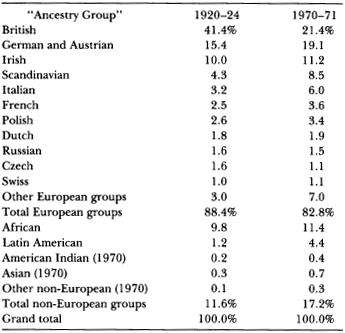
Source: U.S. Bureau of the Census, Current Population Reports, series P-20; and SAUS (1976), table 40; estimates of non-European ethnic stocks as indicated are drawn from the Census of 1970.
19 On pari-mutuel betting in 1939, John L. Hammond found zero-order r values of negative .523 for communities founded by Yankees before 1855; for immigrant populations the correlation was a positive .700 on the other side. He reported similar patterns in voting on state lotteries in 1966; The Politics of Benevolence, 169.
20 The sole exception was the presidential election of 1912, when Maine went Democratic, largely as a result of the Republican divisions.
1 Martin Blumenson, Pattern, The Man Behind the Legend, 1885-1945 (New York, 1985), 20-21, 113, passim; George S. Patton, Jr., War As I Knew It (Boston, 1947); Martin Blumenson, The Patton Papers (2 vols., 1972-74); Kenneth W. Simmons,Kriegie(New York, 1960).
2 Stephen Ambrose, Eisenhower (2 vols., New York, 1983-84), I, 30.
3 Leonard Mosley, Marshal, A Hero for Our Times (New York, 1928), 107.
4 This generalization refers to New England as a bloc. Democratic presidential candidates carried Connecticut in 1876, 1884, 1888 and 1892; Rhode Island in 1928 and 1948; Ohio in 1948; and Pennsylvania in 1856.
5 Walter Dean Burnham, “American Voting Behavior and the 1964 Election,” Midwest Journal of Political Science 12 (1968), 1-40.
6 V. O. Key, Politics, Parlies and Pressure Groups (New York, 1964).
7 Nixon was re-elected by the following pluralities:
|
Northern: 52-55% |
Southern: 68-70% |
|
New England 52% |
South Atlantic 68% |
|
Northern Plains 56% |
East South Central 70% |
|
Pacific Northwest 55% |
West South Central 68% |
|
Midland: 59-60% |
Great Basin: 68% |
|
Mid-Atlantic 59% |
California: 55% |
|
E.N. Central 59% |
|
|
W.N. Central 60% |
8 Peter Could and Rodney White, Mental Maps (New York, 1974), 175.
9 Arnold Krammer, Nazi Prisoners of War in America (New York, 1979), 133.
10 Edwin S. Gaustad, Historical Atlas of Religion in America (rev. ed., New York, 1976).
11 Sheldon Hackney, “Southern Violence,” AHR 74 (1969), 906-25.
12 Texas humor continues to be full of vicarious violence against humanity in general, and Vankees in particlar. Diromg the oil crisis of 1978-81, for example, a Texas humper sticker read. “Drive at 90; Freeze a Vankee.”
13New York Times, 1 March 1988.
14SAUS (1984), 145; exceptionally high was the District of Columbia (27.5%), and contiguous states of Maryland and Virginia.
15SAUS (1984), 302.
16 Barrington Moore, Social Origins of Dictatorship and Democracy: Lord and Peasant in the Making of the Modern World, (Boston, 1966), 485-86.
17 Allan Kulikoff, Tobacco and Slaves: The Development of Southern Cultures in the Chesapeake, 1680-1800 (Chapel Hill, 1986), 280-313, 408-20.