
 Massachusetts Age Ways: The Puritan Idea of the Elder-Saint
From childhood to the grave, the Puritans of Massachusetts had strong views on every stage of life. This was specially the case in regard to old age, and age-relations in general. On these subjects, the customs of New England were shaped by Puritan beliefs.
In the twentieth century, Americans share an exceptionally strong bias toward youth. We fear the process of aging, and despise old age. Further, our system of social rank is so centered on wealth that other criteria of status such as age operate only when they can be translated into materialist terms. So dominant is our materialistic ranking system today that other customs are not merely unfamiliar; they are inconceivable.1
The people of seventeenth-century New England lived in another world. They carefully cultivated an attitude of respect for the old, and ranked people in proportion to their age. “These two qualities go together, the ancient and the honorable,” wrote Cotton Mather. “If any man is favored with long life,” wrote Increase Mather, “it is God who has lengthened his days.”2
The moral posture which young people were taught to assume before their elders was unlike that of any other social relationship.
It was summarized in a word now lost from common usage: veneration, which came from the Latin deponent verb veneror, venerari, “to regard with religious awe and reverence.” Veneration took on a special meaning among the Puritans, who more than others made a cult of age. The Calvinist doctrine of limited atonement—that Jesus died only for the elect—created a difficult problem. How could election be known?
Old age, in short, was a sign. The Puritans had need of signs. They argued that elderly people had “a peculiar acquaintance with the Lord Jesus.” Further, their cosmology taught that everything in the world happened according to God’s purpose. They believed that the small numbers of godly men and women who lived to old age were the saving remnant of the race.3
Every Puritan moralist who wrote upon this subject agreed that old age was a sign of grace. This belief was powerfully joined to a demographic reality. In Massachusetts, there were not very many older people. The proportion of men and women over sixty-five in that population was not more than 2 percent, compared with more than 12 percent in 1988. This was mainly because rates of fertility were high, and the number of children was relatively large. But mortality also made a difference in another way: the chances of living a biblical span of seventy years were approximately 20 percent at birth, compared with 80 percent today. The odds of reaching the age of seventy were highly unfavorable—in fact, four to one against. This demographic fact deepened a theological perception.4
Respect for age was not merely an ideal. It became a living reality in New England. Evidence appears in the assumptions that writers tacitly made about the ways in which people normally behaved in this culture. A case in point was the following passage by New England clergyman Job Orton:
One is sometimes ready to wish that the aged who have the most wisdom and experience, had most strength; but while we have old heads to contrive and advise, and young hands to work, it comes to much the same. Besides, had the aged the strength of youth, they would be more ready to despise the young than they now are.5
Orton assumed in this extraordinary passage that “old heads” did effectively control “young hands.” Further, he also assumed that the major problem was not that young people would despise their elders, but that elders would despise the young. This evidence is most interesting for the truth that it betrays about Puritan assumptions which were so different from our own.
Evidence of these attitudes also appeared in census tracts and depositions. When people report their ages today they are apt to bend the truth, and make themselves a little younger than they actually are. The result is a tendency called “age-heaping,” by people who prefer to be 39 rather than 40; similar distortions are caused by others who claim to be 49, 59, 69 and even 79. In early New England the pattern of age-bias was very different. On balance, people of advanced age tended to make themselves older rather than younger than they actually were—the opposite of the modern bias.6
This attitude of respect for age was also woven into the fabric of New England’s institutions. It appeared in the custom of “seating the meeting.” Throughout rural Massachusetts, older men and women were given the places of highest “dignity” and the entire population was distributed according to its age. Women of advanced age shared this honor equally with men.7 Elderly women in general were respectfully addressed as “Gran’mam,” and older men were greeted as “Grandsire” throughout this region.8
The same attitudes also appeared in patterns of officeholding. The higher the office, the older the incumbent was likely to be. In Plymouth Colony, for example, five out of six governors served into old age: four died in office at advanced ages; the last was seventy-three when Plymouth was annexed by Massachusetts. The same was true of assistants who “rarely left their posts of
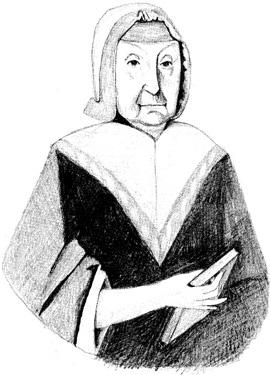
The iconography of old age in New England appears in this portrait of Mistress Anne Pollard of Boston (1621-1725), “Aetatis Suae 100 & 3 Months.” This much-venerated lady was born at Saffron Walden (Essex) and emigrated at the age of nine. Long afterward she claimed to be the first female in the Great Migration to land on Boston’s shore. Later she married Boston innkeeper William Pollard (ca. 1643), bore him 12 children, and survived to a great age, much revered in New England. When she died in 1725 at the age of 104 she was buried with the body of a great-grandchild cradled in her arms. The two corpses were carried to the grave by six of Boston’s elders including diarist Samuel Sewall, who noted that the ages of the bearers “join’d together, made 445.”
This icon of Anne Pollard was painted in April 1721. She wears a sad brown dress, white cap and bonnet, a graceful bib and lace cuffs, and holds a small book in her right hand. The artist has elongated her features and made heavy use of light and shadow to bring out the arched brow, long nose and firm chin. There is nothing frail or weak about this old woman. Her image combines the strength, resolve, seriousness, dignity, virtue and gravitas that Puritans expected from elders. This sketch follows a painting in the Massachusetts Historical Society.
their own accord, nor were they often voted out of office by their constituents. Usually their tenure was ended by death, which in some instances was very long delayed.”9
Yet another sign was the tendency of New England to turn to older people in time of crisis. A classical example was William Goffe (c. 1607-79), a Puritan soldier and “Regicide” who sentenced Charles I to death. After the Restoration, Goffe fled to New England, and found refuge first in New Haven and later in Hadley, Massachusetts, where he lived in hiding, unknown to most people of that frontier town. In 1675, an Indian war began, and the townspeople repaired to their meetinghouse—all but Goffe himself who remained in hiding. As he watched from a window, he saw an Indian war party stealing upon the town. Goffe left his place of concealment and ran to the meetinghouse, where his sudden appearance caused panic among the people:
“I will lead,” the old man said. “Follow me!” The people instantly obeyed him. They had an old cannon, but knew not how to use it. Goffe trained it upon the Indians and his first shot crashed against a chimney above their heads, and sent them fleeing through a shower of brick and mortar. He rallied the townsmen, and ordered them in pursuit. When they returned he had vanished as miraculously as he had arrived. Later, it was written that “His venerable form, silvery locks, mysterious appearance and sudden disappearance, with the disposition of the pious in those days to recognize in any strange event a special providence, led the inhabitants to regard their deliverer as an angel, who after fulfilling the purpose of his missions, had rescended to heaven. They very likely never knew who he was.”10
This episode became a folk legend in New England. It was the basis for Nathaniel Hawthorne’s story, “The Grey Champion,” in which another old man with venerable appearance and silvery locks appeared as if by miracle to lead New England against Sir Edmund Andros in the Glorious Revolution. There were many “grey champions” in New England’s history and more in its collective imagination—Captain Samuel Whittemore who fought at Lexington at the age of 78; Deacon Josiah Haynes led his townsmen to Concord at the age of 80 and Congressman John Quincy Adams who stood as firm as New England granite against the
“slave power” at the age of 81. The idea of the “grey champion” became a cliché in New England culture.11
John Adams used another New England cliché when he wrote that “none were fit for Legislators and magistrates but ‘sad men,’ … aged men who had been tossed and buffeted by the vicissitudes of Life, forced upon profound reflection by grief and disappointments, and taught to command their passions.”12 In this context, “sad” preserved its old English meaning of “grave, serious, wise, discreet, settled, steadfast and firm”—qualities which the people of New England associated with old age.13
When Harvard sought a president in 1672, Richard Saltonstall insisted that old age was a requirement for that office, and youth or even middle age a disqualification. He argued:
First, Paul the aged, or Paul at the age of 60, or 70 years, is not only as good, but in some respects much better, than Paul not so old by ten or twenty years. Aged persons eminently righteous, by virtue of the promise [in] Psalm the 92:14, shall certainly yield more, better, sweeter and fairer fruit, than they did, or could have done, when they were not so old. …
Secondly, the scripture giveth great and weighty caution concerning youth or younger men.14
These principles were also incorporated in the institution of Christian eldership, which became a formal part of the New England Way. “Reverend Elders” were the official guardians of religion and morality in the Bay Colony. Difficult questions were specifically referred to them by the General Court. In 1641, for example, the legislature resolved that “it is desired that the elders would make a catechism for the instruction of youth in the grounds of religion.”15
Respect for age rested upon a solid material base. The system of land-holding in New England was purposely used to maintain a proper attitude of subordination in the young. Puritan elders tended to retain land for an unusually prolonged period. Sons who married at twenty-five or twenty-six sometimes did not receive land of their own until well into their thirties, and continued in a state of dependency upon their aged parents.16
This system of age relations also had its underside. Exceptions to the principle of veneration were made for older people who violated the moral precepts of this culture. Many of those who did so were not despised but feared; in Essex County, perhaps as many as one out of four women over the age of forty-five was accused of witchcraft in 1692.17
Most elderly people were treated with respect in New England, no matter whether rich or poor, male or female, weak or strong. But sometimes they were not much loved. Veneration was a cold emotion, closer to awe than to affection. The control which elders maintained over the young created strong resentments. “Love rather descends than ascends,” wrote John Robinson.18 A case in point was Timothy Cutler (1684-1765), the rector of Yale College. He was said to be “haughty and overbearing in his manner; and to a stranger, in the pulpit, appeared as a man fraught with pride. He never could win the rising generation, because he found it so difficult to be condescending, nor had he intimates of his own age and flock. But people of every denomination looked upon him with a kind of veneration, and his extensive learning excited esteem and respect where there was nothing to move or hold the affections of the heart.”19
Within the family, there was also an ambivalence of another sort. One pair of Puritan parents instructed their daughter how to regard her “good Grandmother”:
Deny your self very far to please her. Consider [that] her relation, age, [and] goodness all call for honor and respect from you. Her weakness of body and infirmities of old age call for patience and pity from you. Consider if you should live to be old you may stand in need of the same from others. It is certainly your duty next to pleasing God and your husband.20
The idea of “honor and respect, patience and pity” for age was not in itself unique to New England. As we shall discover, it also was very strong in other cultures of British America before 1750. But among the people of the Bay Colony, the Puritan idea of veneration and the Calvinist image of the “elder-saint” gave it a special form and meaning.