
 Massachusetts Religious Ways: The Puritan Meeting and Lecture Style
When the builders of the Bay Colony spoke of the “New England Way,” what they usually meant was their religion. We have already studied this subject in several of its aspects—its origins in East Anglia, its role in the great migration and its tenets of belief. Here we shall examine the ritual of worship as a religious folkway in Congregational New England.
Many different forms of Christian ritual flourished in British America—the liturgical style of Anglican churches; the evangelical style of Presbyterian field meetings; the communal style of Baptist fellowships; the spiritual style of the Society of Friends. The people of New England adopted still another form of worship which might be called the meeting and lecture style. It was fully developed in Massachusetts by the mid-seventeenth century, and persisted throughout the Puritan colonies for many generations.
This New England Way was distinguished by its exceptional austerity. “Everything was stripped bare,” wrote Harriet Beecher Stowe, “all poetic forms, all the draperies and accessories of religious ritual, have been rigidly and unsparingly retrenched.” It claimed to be a religion without ritual, but in fact it replaced one set of rituals with another.1
Like every other form of worship, the New England Way created its own unique physical setting in the architecture of its Congregational meetinghouse. More than 200 of these buildings were constructed in the Puritan colonies before 1700. They were very different from the white neo-classical picture-postcard churches of a later period. Seventeenth-century meetinghouses tended to be compact squarish buildings, with a steep four-sided roof rising to support a central “turret.” They were constructed on the model of secular buildings in East Anglia such as courthouses and markets.2
The meetinghouses of New England were often set high on a commanding hilltop. Roxbury’s aged minister John Eliot was heard to say as he climbed meetinghouse hill on the arm of a townsman, “This is very like the way to heaven; ‘tis uphill. The
Lord by his grace fetch us up.”3 Most meetinghouses faced due south; like so many domestic buildings in New England, they were “sun-line structures,” carefully planned so as to be “square with the sun at noon.”4
From the outside, these buildings made a grim appearance. The walls were rough unpainted clapboards. On them were nailed the bounty-heads of wolves with dark crimson bloodstains below. The doors were covered with tattered scraps of faded paper which told of intended marriages, provincial proclamations, sales of property, and sometimes rude insults in which one disgruntled townsman denounced another.
The interiors were very plain. The Puritan meetinghouse was fundamentally a lecture room, intended for the hearing of the word. Its design was the same as Calvinist meetinghouses throughout western Europe. There was never an altar in Congregational New England; only a simple table which usually stood on the north wall rather than the east as in an Anglican church. Beside the table, a steep stairway or ladder rose to a high tub pulpit which dominated the room. Alice Morse Earle remembered that “the pulpit of one old unpainted church retained … as its sole decoration, an enormous, carefully painted, staring eye, a terrible and suggestive illustration to youthful wrong-doers.”5
Above the pulpit a sounding board leaned ominously outward over the minister’s head. In front of him was a lectern and a large wooden hourglass. Beneath the pulpit was the elders’ seat, facing outward. The congregation sat before the pulpit, on rows of backless benches, later to be replaced by pews. Men were seated on one side of an aisle and women on the other, all carefully arranged in order of age, wealth and reputation. Most meetings had no ornaments except that terrible staring eye—no paint, no curtains, no plaster, no pictures, no lights—nothing to distract the congregation from the spoken word.
There was no heat in these buildings, partly because the earliest meetinghouses also served as powder magazines, and fires threatened to blow the entire congregation to smithereens. They were bitter cold in winter. Many tales were told of frozen communion bread, frostbitten fingers, baptisms performed with chunks of ice and entire congregations with chattering teeth that sounded like
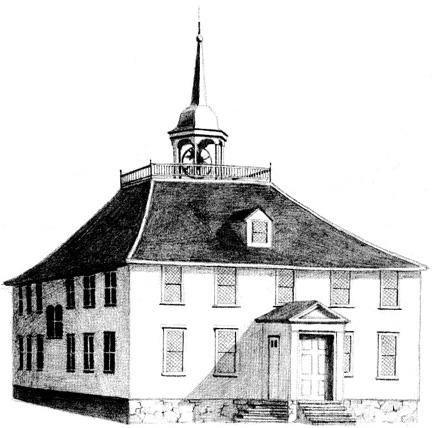
Meetinghouses in seventeenth-century New England were very different from the later white-painted Greek Revival temples that live in the national memory. The only survivor is Hingham’s Old Ship Meeting House, its windows and proportions much altered by passing generations. Early meetinghouses were rude square buildings, with unpainted wooden sides, a hipped roof and sometimes a central spire. They closely followed the conventions of secular buildings such as markets and town halls in East Anglia. Their austerity made a striking contrast with liturgical complexities of Anglican church architecture.
a field of crickets. It was a point of honor for the minister never to shorten a service merely because his audience was frozen. But sometimes the entire congregation would begin to stamp its feet to restore circulation until the biblical rebuke came crashing down upon them: “STAND STILL and consider the wonderous work of God.” Later generations built “nooning houses” or “sab-baday houses” near the church where the congregation could thaw out after the morning sermon and prepare for the long afternoon sermon to come. But unheated meetings remained a regional folkway for two hundred years.
The ritual of worship in these buildings had nothing to do with the lights and incense of Anglican devotionalism, or with the spontaneous movements of the spirit among Radical Protestant sects. Puritan worship centered on the Bible, the lecture and the relentless hearing of the word.
On Lord’s days and lecture days at nine o’clock in the morning the town was summoned by the sound of a bell, or the rasping cry of a conch shell, or often in the seventeenth century the rattle of a drum. The congregation arrived in orderly family groups, husbands and wives walking side by side, followed by children, servants and dogs. By a law of 1640, the men were required to carry arms to meeting, and sentries were posted at the doors. These precautions were repeated whenever danger threatened. As late as 1775, townsmen within twenty miles of the sea were urged to carry arms to church lest godless British raiding parties surprise them while at worship. After the service, the men left the meeting first—a regional folkway that continued long after its military origins had been forgotten.
After the townsfolk entered the meetinghouse and took their seats, the minister and his family made a grand entrance. In the mid-seventeenth century he usually dressed in a black flowing cape and black skullcap. The entire congregation rose respectfully to its feet until he had climbed into the pulpit. “Our fathers were no man worshippers,” wrote Harriet Stowe, “but they regarded the minister as an ambassador from the great Sovereign of the universe.” Many Calvinist tracts in the seventeenth century described their clergy in precisely these terms, as ambassadors from Christ.6
An important part of every service was a ritual of purification. Members of the congregation who had committed various sins were compelled to rise and “take shame upon themselves.” Often they wore signs that proclaimed their misdeeds, as in Essex County where Elizabeth Julett was ordered to appear on lecture day with “a paper to be pinned upon her forehead with this inscription in capital letters: A SLANDERER OF MR. ZEROBABEL ENDECOTT.”7 Sometimes they dressed in rags and smeared streaks of dirt upon their faces to deepen their humiliation. Occasionally, they were compelled literally to crawl before the congregation.
The major part of the service was the sermon. Church-going New Englanders normally heard two sermons every Sunday—one in the morning and another in the afternoon, each two hours long (or longer). Sometimes a third short sermon was added in the nooning house. It was not uncommon for a congregation to sit through five or six hours of instruction every Sunday. These sermons were very austere. In stained-glass words, as well as stained-glass windows, Puritans saw only an impediment to light. The style of preaching was a relentless cultivation of the plain style. John Cotton set the model. At Cambridge in England he startled his listeners by preaching in a “plain and profitable way, by raising of doctrines, with propounding the reasons and uses of the same.” His auditors were so shocked that they “sat down in great discontent, pulling their hats over their eyes, to express their dislike of the sermon.”8 But this was the style that caught on in New England—the “text-and-context” sermon. It began with a powerful and usually puzzling scrap of Scripture which was relentlessly analyzed and ramified in a prolonged discussion called “the finding out.” The plain style was carefully cultivated throughout. Of Increase Mather it was said that he “concealed every other art, that he might pursue and practice the art of being intelligible.”9
A modern reader might imagine that these sermons were very dull and dreary. Popular historians in the twentieth century have painted an image of bored and sleepy congregations nodding in their seats. Nothing could be more mistaken. Puritan listeners sat on the edge of their benches through these long sermons. It was said of Thomas Shepard’s church that he “scarce ever preached a sermon, but some or other of his congregation … cried out in agony, ‘What shall I do to be saved?’” Many Puritan sermons were an answer to this great question.10
Another important part of the service was the prayer, which was nothing like the liturgical rites of the Roman and Anglican churches. In Congregational New England, there was no kneeling or genuflection. In the first generation there was not even a bowing of heads or the closing of eyes. A Puritan prayed on his feet, standing upright and looking God in the eye. These prayers were original compositions, usually delivered by the minister at very great length. Cotton Mather recorded that at his ordination service he “prayed about an hour and a quarter, and preached … about an hour and three quarters.” Samuel Sewall recorded prayers of several hours’ duration. These addresses tended to be closely argued statements of great density, in which Puritans reasoned as relentlessly with their maker as they did with one another.11
In the first generation, the ritual of Puritan worship sometimes had another part which was called “the prophesying.” This was a moment when members of the congregation other than the minister rose to “expound and apply” passages from the Bible, sometimes with much emotion. Prophesying had long occurred in the more radical Protestant sects, and was permitted for a time in some New England churches. It seems to have been practiced with comparative restraint in Massachusetts, but prophesying was regarded with grave suspicion by ministers and magistrates. After the disorders of the Antinomian crisis, it was suppressed.12
At the end of a New England service a psalm was sung, if singing is the word to describe the strange cacophony that rose from a Puritan congregation. Here again, the emphasis was on words rather than music. The psalm would be begun with a line by a member of the congregation. Then each individual “took the run of the tune” without common tempo, pitch or scale. One observer wrote in 1720, “ … everyone sang as best pleased himself.” Another described the effect as a “horrid medley of confused and disorderly noises.” Strangers were astounded by the noise, which carried miles across the quiet countryside. But New Englanders were deeply moved by this “rote singing” as it was
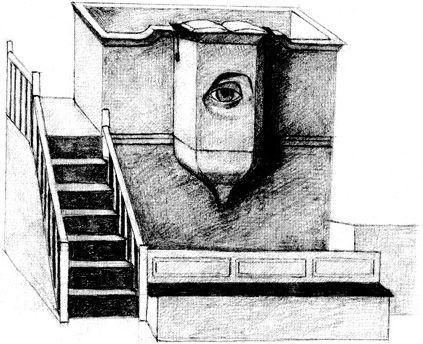
The center of attention in a Calvinist meetinghouse was the pulpit from which the minister preached. New England historian Alice Morse Earle remembered that “the pulpit of one unpainted church retained until the middle of this [nineteenth] century, as its sole decoration, an enormous, carefully painted, staring eye, a terrible and suggestive illustration to youthful wrong-doers of the great all-seeing eye of God.” Beneath the pulpit was the elder bench, on which the lay leaders of the church sat facing the congregation, sternly monitoring every move during the long sermons and prayers. Here was a symbol of the Christian watch-care that came to be so highly developed in this culture.
called, and strenuously resisted efforts to improve it. The result was a major controversy in the eighteenth century between what was called “rote singing” and “note singing.”13
Much later, Harriet Beecher Stowe remembered that “the rude and primitive singing in our old meeting house always excited me powerfully. It brought over me, like a presence, the sense of the infinite and the eternal, the yearning and the fear and the desire of the poor finite being, as if walking on air, with the final words of the psalm floating like an illuminated cloud around me.”14
Every part of the religious ritual of Congregational New England was thus centered on the word of God—the design of the meetinghouse; the enforcement of Mosaic law; the structure of the sermon; the pattern of Puritan prayer; the form of psalmody. This communal harkening to the word of God was the primary purpose of Puritan worship.
Worship also had another meaning in this culture. Harriet Stowe explained that it was the only moment in the week when the entire town gathered together. “Nobody thought of staying away,—and for that matter, nobody wanted to stay away. … our weekly life was simple, monotonous and laborious; and the chance of seeing the whole neighborhood together in their best clothes … appealed to the idlest and most unspiritual. … the meeting on Sunday united in those days, as nearly as possible, the whole population of a town.” She recalled her unhappiness when forced by illness to stay home. “How ghostly and supernatural the stillness of the whole house and village outside the meeting-house used to appear to me, how loudly the clock ticked and the flies buzzed down the window-pane, and how I listened in the breathless stillness to the distant psalm-singing, the solemn tones of the long prayer, and then to the monotone of the sermon, and then again to the closing echoes of the last hymn.”15
This ritual of worship became a powerful instrument of cultural continuity in New England for two hundred years. Stowe remembered that “rude and primitive as our meeting-houses were, this weekly union of all classes in them was a most powerful and efficient mode of civilization. The man and woman cannot utterly sink who on every seventh day is obliged to appear in decent apparel, and to join with all the standing and respectability of the community in a united act of worship.”16
There was also a deeper sort of union in these rituals, which were an act of cultural communion that joined the past to the present, the living to the dead. Every Sunday, for many generations, the people of Congregational New England returned to the first purposes of their regional culture and reenacted its founding impulse. The persistence of that culture owed much to the power of these religious rituals.