
 The Massachusetts Comity: Patterns of Migration, Settlement and Association
In the year 1656, the magistrates of Massachusetts heard a charge of fornication against a troubled young woman of humble rank, who was appropriately named Tryal Pore. She pleaded guilty to her indictment and told the court, “By this my sin I have not only done what I can to pull down judgment from the Lord on myself, but also upon the place where I live.”1
Tryal Pore came from the underclass of the Bay Colony. Her prophetic name hinted at other troubles which her parents had known even before she was born. But for all of her misfortunes, she shared the Puritan purposes of the colony, and showed a strong sense of responsibility for “the place where I live.” That sense of belonging became the basis of a comity in Massachusetts which was similar in many respects to that of eastern England.
A modern study has found three types of settlement in East Anglia during the seventeenth century—villages, hamlets and dispersed farmsteads. The leading student of this subject observes that “no single settlement type assumed dominance,” but villages and hamlets were common, and isolated homesteads were comparatively rare. Houses were not scattered across the countryside, but grouped in small clusters close to the edges of major roads.
Similar settlement-patterns also appeared in Massachusetts at an early date, and persisted for three centuries—the familiar New England system of nucleated central villages, with small satellite hamlets and isolated farmsteads of “outliers” scattered along the country roads. From the start there were always a few stubborn loners, of whom the General Court complained that they “keep their families at their farms, being remote from any town.” But their numbers were comparatively small in Massachusetts. Towns and hamlets became normal units of settlement, as in the east of England.2
The builders of the Bay Colony actively encouraged close-built towns. A law in 1635 ordered that “no dwelling house shall be built above half a mile from the meeting house in any new plantation … without leave from the Court, except mill houses & farm houses of such as have their dwelling houses in some town.”3
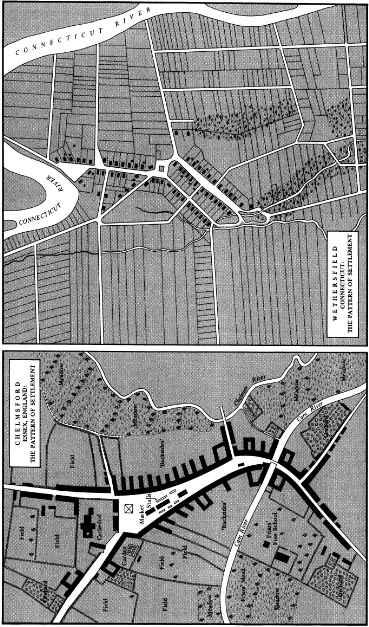
Similar laws were also passed in many other colonies, but could not be enforced. In Massachusetts, the policy was made to work because the founders came from the most densely settled region of England, and two-thirds had lived in villages or towns before emigrating. They brought with them an East Anglian habit of settlement which they reproduced in the New World.
In this process of reproduction, changes were inevitably introduced. The New England town became a more formal institution, fixed in its conception, recognized in law, and continuously replicated across the New England countryside. Once again, the major tendency was not the reproduction of an English form but its creative adaptation to the conditions of a new environment.
Within a few years of settlement, the New England town had taken on the character which it retained for three centuries, complete with meetinghouses and schools, stocks and pillories, animal pounds and training fields, town commons and enclosed fields, nucleated centers and rural neighborhoods. Despite many individual differences, the first forty towns in Massachusetts possessed these attributes by 1650, as do most of the 1,600 New England towns that exist today.4
In the origin of these settlement patterns, East Anglian folkways played a major role. One may observe their importance in the history of the town of Salem, which was settled by two groups—a party of “old planters” who came from the West Country before 1628, and a contingent of East Anglians who arrived in the great migration during the 1630s. They brought with them two very different ideas of community. Historian Richard Gildrie writes:
The West Country and East Anglian conceptions of the ideal community tended to differ in material ways. Salem’s West Countrymen had originated in an area of dispersed and separate farms. … East Anglians tended to envision the ideal community as a compact village. … Until 1636 the great difficulty of clearing the wilderness kept the West Countrymen on the peninsula, but as soon as they could, they spread out over the township, building farms and hamlets in the pattern most familiar to them. East Anglians, however, tended to stay in the original village …,5
These communities gained a strong hold upon their individual members. One indicator of their social gravity was the rate of internal migration, which was very low in New England before 1780. In the town of Dedham, for example, only 9 percent of taxable inhabitants moved away during the entire decade of the 1690s. Even fewer (7%) moved out of town in the 1670s. In Hingham and Concord the pattern was much the same.6
Those studies refer not to the entire population, but mainly to mature male adults. Young people were more mobile, partly because of the custom of sending out children.7 Women also moved more often than men because patterns of settlement after marriage tended to be patrilocal.8 There were many other variations, but in New England as a whole rates of refined persistence were very high—in some older country towns, the highest that have been measured in any adult population throughout the Western world. This pattern continued from the mid-seventeenth century to the late eighteenth.9
These patterns of migration and settlement helped to create a special system of association in New England. The vital factors were the comparative immobility of the mature population and the density of town life in this region. A special language of belonging was carried to Massachusetts from the east of England. It appeared in words such as “townsman” and “town-born” which were common in East Anglia during the seventeenth century, and also became part of the social vocabulary of New England. On the night of the Boston massacre, for example, a cry went through the streets of the city, “Town-born, turn out!”
So strong was this sense of belonging that when danger threatened in Massachusetts, people turned instinctively toward their fellow townsmen. A small earthquake in Massachusetts, for example, caused “divers men … being at work in the fields, to cast down their working-tools and run with ghastly terrified looks to the next company they could meet withal.”10
The same feeling also led to strong resentments against outsiders. Rivalries between towns were so intense that they sometimes led to violence in the seventeenth century. One such clash occurred between the Connecticut towns of Stamford and Greenwich over disputed boundary lines. Another quarrel between New London and nearby towns over a meadow ended in a nasty fight when the farmers of these communities attacked each other with sharpened scythes. A conflict over land between the towns of Windsor and Enfield led to a pitched battle in which 100 men were said to be “fiercely engaged in resolute combat.” New England towns were units of passionate identity. Many took on a character and even a personality of their own, and have maintained it through many generations.11
The tone and spirit of association within New England towns was very different from other communities. A British traveler observed of New Englanders that “the people are uncommonly stiff and formal.” Similar statements were made by many other visitors.12
The New England town, for all its solidarity against external threats, was not a unitary structure. The most important unit of daily association in Massachusetts was not the town itself but the neighborhood—a small cluster of houses, inhabited by families who were increasingly related to one another. From an early date in the seventeenth century, these rural neighborhoods appeared on the settlement maps of most New England towns. Urban neighborhoods also appeared at the nucleated centers of these communities. Even the isolated homesteads of “outlyers” tended to be bunched loosely together on a stretch of road, with long unbuilt distances round about.
The existence of neighborhoods was recognized by law in Massachusetts as early as 1633. One statute in that year declared that “no man shall give his swine any corn but such, as being viewed by two or three neighbors, shall be thought unfit for any man’s meat.”13 This was a continuation of practices in the east of England, where mundane questions were routinely settled by what was called the “laws of neighbouring men,” or the “custom of neighbours.”14
“Neighboring” was a verb in Massachusetts which described social acts of high complexity. The spirit of a New England neighborhood
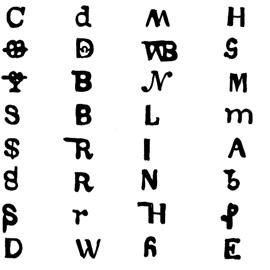
“Towne marks” in Puritan Massachusetts were important symbols of belonging and were used for the branding of animals. In the southern colonies every planter had his own individual brand, but in Puritan Massachusetts animals were also marked by town. The General Court of Massachusetts formally agreed on these “towne marks” for horses, “to be set upon one of the near quarters.” These marks were (col. 1, left): Charlestown, Cambridge, Concord, Salem, Salisbury, Sudbury, Strawberry Bank (Portsmouth), Dorchester; (col. 2): Dedham, Dover, Boston, Braintree, Roxbury, Rowley, Reading, Watertown; (col. 3): Weymouth, Woburn, Northampton, Lynn, Ipswich, Newbury, Hingham, Hampton; (col. 4): Haverhill, Gloucester, Medford, Manchester, Andover, Hull, Springfield, Exeter. (Mass. Records, II [1647], 225)
was summarized in a proverb by a descendant of the great migration, Benjamin Franklin. “Love your neighbor,” said Poor Richard, “but don’t pull down your fence.” This Yankee proverb was not invented in New England. In England a century earlier, George Herbert had written, “Love your neighbor, yet pull not down your hedges.” Even as the granite “fences” of Massachusetts replaced the green hedgerows of England, customs of social “hedging” remained much the same. Here was yet another continuity from the Old World to the New.15
One might recognize a ring of modernity in this system, but in other ways, the comity of early New England was far removed from systems of association in our own time. This was specially the case in regard to social reputation, which was urgently important to the Puritans, as to most others of their age. The social cement of their world was a sense of belonging, and an intense fear of “shame,” which was the emotion felt when reputation was lost. Punishments were meant to promote a sense of shame. Fornicating couples were sometimes compelled to stand in white sheets before the congregation and confess their sins. Drunkards were forced to wear a great shame-letter D, “made of red cloth and set upon white, and to continue for a year.”16 Serious offenses were punished by excommunication, in which every member of the church was ordered “to forbear to eat and drink with him,” and life became an agony of isolation and shame.17
The opposite of shame was honor. Puritans had a very strong sense of honor—but one that was very different from what historian Bertram Wyatt-Brown has called the “primal honor” of the cavaliers who came to Virginia. When John Winthrop wrote of honor, which he often did, he meant mainly a condition of Christian sanctification. In 1643, Winthrop instructed his son, “ … esteem it the greatest honor to lie under the simplicity of Christ crucified.” When Cotton Mather celebrated the “honor” of New England’s founders, he meant a reputation for being “a studious, humble, patient, reserved and mortified person, and one in whom the love of God was fervent and the love of man sincere.”18 These obsessions with honor and shame were not unique to New England, but the Puritans gave them a special meaning.