
 Virginia Building Ways: English Origins of Chesapeake Houses
Similar patterns also appeared in the vernacular architecture of Virginia. During the governorship of Sir William Berkeley, a distinctive building style developed there. By the mid-seventeenth century, homes and barns had become so standard throughout the colony that when the Burgesses ordered a structure to be built in 1647, they merely insisted that its construction should be “according to the form of Virginia houses.” No further specifications were thought necessary.1
Virginia’s building ways, like its speech ways, were not created de novo in the New World. They grew out of the vernacular architecture of southern England in a process that was guided by cultural purposes, environmental conditions and the inherited memory of an English past.2
The vernacular architecture of Virginia was a complex hierarchy of styles, plans, materials and techniques. Its highest expression was the “great house”—a handsome, brick-built structure, surrounded by outbuildings, gardens and fields. It tended to be one and a half or two storys high and perfectly symmetrical, with a great central passage, or “summer hall,” running through the house from front to back. The hall was flanked by large, lofty living spaces on the first floor, and small, low-ceilinged chambers below stairs. William Hugh Grove wrote in 1732, “The manner of building is much alike. They have a back staircase with a passage through the house in the middle which is the summer hall and draws the air; and two rooms on each hand.”3
Interior plans were designed for congregate living. Even the largest houses had comparatively few rooms. “They always contrive to have large rooms,” wrote Robert Beverley, “that they may be cool in the summer.”4 In the grandest houses, small private rooms called closets were constructed for the master and mistress of the house. But few Virginians had private spaces of their own in the mid-seventeenth century.5
The first great house in Virginia was Green Spring, a brick mansion built by Sir William Berkeley in 1646. The cost of its construction was supported by a special tax which the assembly levied with “an eye to the honor of the place.” No longer in existence, Green Spring stood on an estate of 1,000 acres near Jamestown. In its own time it was the largest house in Virginia, with an imposing facade one hundred feet in breadth. Its central block, 48 feet wide by 43 feet deep, was flanked by two symmetrical wings, each extending 26 feet. The interior consisted of six large rooms and a long central hall. Later an elevated loggia and curious double dormers were added—fashions which did not catch on. But the general plan of this building set the fashion to which plantation architecture conformed for two centuries.6
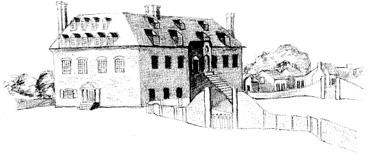
Green Spring, the home of Sir William Berkeley, was Virginia’s first great house. It set the example for plantation architecture in generations to come. Built in 1646 with the aid of a special appropriation by the colonial assembly, it was originally a large symmetrical brick structure, with a central entrance and great hall flanked by “public” spacious rooms on the main floor. In 1796, British architect Benjamin Latrobe visited Green Spring and sketched the house shortly before it was pulled down. “It is a brick building of great solidity, but no attempt at grandeur,” Latrobe wrote. “The lower story was covered with an arcade which is fallen down. The porch has some clumsy ornamental brickwork about it of the style of James the 1st.” This drawing shows the building without its arcade (a later addition) as perhaps it might have looked in the time of Berkeley himself. The source is Edward C. Carter, ed., The Virginia Journals of Benjamin Henry Latrobe (2 vols., New Haven, 1977), I, 181-82, 247, plate 21.
Much has been written of this architecture as an adaptation to the Chesapeake environment. Long halls open at both ends caught refreshing summer breezes. High ceilings retained cool morning temperatures throughout a summer day. Massive brick fireplaces and chimney stacks repelled the winter chill. Steeppitched slate roofs proved useful in heavy summer storms, and were more durable than in New England.
This was indeed an American architecture, but it was also English in its roots. In most respects Virginia’s plantation houses were exactly like middle-sized manors in south and west of England during the seventeenth and early eighteenth centuries. One study of manorial architecture in this part of England found that the following general characteristics were typical of the genre: broad fronts of 70 to 100 feet; symmetrical plans; a first floor with a modest number of large rooms, generous proportions and high ceilings; a large central hall open at both ends; and a low “ground floor” with bed chambers. The great house was set far back from the road, with a cluster of small outbuildings for kitchens, stables, servants, and elaborate gardens in front. This description of manor houses in the south and west of England fits the great houses of Virginia exactly.7
The plans of these great country houses were highly symmetrical on both sides of the water, sometimes in surprising ways. The plan of the great plantation house at Shirley in Virginia, for example, looked at first sight to be a simple arrangement of boxes. It was in fact a complex mathematical structure, conceived with great care. Every dimension in the main block and wings was a multiple of the cabalistic Christian numbers of three and twelve. The design of Shirley became an act of architectural liturgy in this Anglican culture.8
The great hall running through the center of the house was not a Virginia invention. G. C. Tyack found that this feature was “universally popular” in larger country houses throughout the south and west of England during the seventeenth century.9
Large country houses were also set in much the same way in England and Virginia, surrounded by “gardens, stewponds, bowling-greens, terraces, and other natural concomitants of baronial residences.” Recalcitrant American shrubs and trees were ruthlessly cut and pruned into imitations of English flora. On very large and rich plantations even the land itself was laboriously rearranged by sweating servants until it provided English vistas to please nostalgic masters.10
Plantation buildings in Virginia were also similar to English country houses in their architectural details. Virginia planters, like West Country gentry, ornamented their houses with emblems of royalism. In the twentieth century, archeologists have found plaster fragments of royal arms and other monarchical motifs which were used as ceiling decorations.11
In both England and Virginia, these structures were mainly designed not by professional architects but by local gentlemen. Their remarkable similarities were evidence that tastes were very much the same among the gentry on both sides of the Atlantic.12
There were also important differences between the country houses of England and America. Many changes were required by the American environment. Stone, for example, had been a common building material in a belt of territory that extended from Dorsetshire north across the Wiltshire Downs to the Cotswolds. During the seventeenth century, Virginians tried to build with a local yellow sandstone which seemed similar to Cotswold limestone. But in practice it proved too soft for general use, and nothing better was available. Thereafter, stone was generally abandoned in Virginia except for embellishments.13
The taste for stone survived, however, and found expression in curious ways. An example was Mount Vernon, the pretentious home of George Washington. Its exterior consisted of wooden weatherboards which were carved to resemble masonry and sprinkled with sand to give the look and feel of stone. The effect was somewhat spoiled by the dampness of Virginia’s climate, which caused wooden seams to show through their gritty camouflage. But when Mount Vernon was seen in a haze of nostalgia after a bottle or two of madeira, the woodwork turned to stone in the eyes of homesick Englishmen.
With stone unavailable and craftsmen in short supply, Virginians were forced to adapt English building customs to the material realities of the New World. But they did so in ways that showed a strong continuity of cultural purposes. For the best tidewater buildings, the preferred building material was brick, which had rapidly gained popularity in England during the late sixteenth and early seventeenth centuries. Brick was used for foundation walls, cellar floors, building columns, curtain walls, and chimney stacks. Specially cut or moulded bricks were employed as window mullions, door frames, rounded cornices and corbelled parapets.
Brick building developed slowly in Virginia during the seventeenth century. Most houses even on large plantations continued to be made of wood for many years. But handsome brick of good quality was the ideal. It was made from local clay which fired to warm and beautiful colors that ranged from dark red to pale orange. The size of bricks in England was regulated by royal proclamation—precisely 9 by 4¼ by 2 inches in Elizabeth’s reign, and 9 by 4 by 2¼ inches under Charles I. Virginians generally conformed to these standards; the size of bricks in seventeenth-century Virginia houses tended to be the same as in England.14
Techniques of bricklaying in Virginia were also very English for many generations. During the period 1625-50, Flemish bond (alternating stretchers and headers in every course) had been especially popular in the south of England. It also came to be widely used in Virginia, together with English bond (alternate courses of headers and stretchers) and various Garden bonds (which increased the proportion of stretchers in various combinations). Other patterns peculiar to the north or east of England (Yorkshire bond, Monk’s bond) rarely appeared in the Chesapeake colonies.15
These great houses were of course few in number. Most houses in the Chesapeake were very modest. From an early date in the
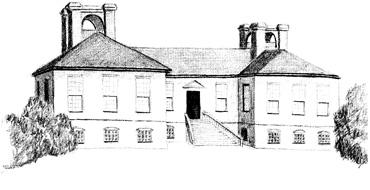
Stratford, the ancestral home of the Lees, was one of many gentlemen’s houses built in the half-century after the death of Sir William Berkeley. Constructed about the year 1725 for Thomas Lee, Stratford was the birthplace of Richard Henry Lee, Francis Lightfoot Lee and Robert E. Lee. It stands today in Westmoreland County, surrounded by outbuildings, and shaded by huge beech trees. The plan is H-shaped, with a large central hall flanked by “public” rooms few in number but large in scale. On the ground floor are smaller low-ceilinged bedrooms and workrooms which stay comfortably cool in the summer. The brick exterior is dominated by two massive chimney clusters. The architecture creates a feeling of austerity, solidity, integrity, seriousness and permanence—a suitable symbol of the family who lived there for two centuries. Grand houses of this sort were few in number before 1690, but many were constructed after that date. Their appearance changed in many superficial ways with the whirl of architectural fashion, but their structure and function remained the same for many generations.
seventeenth century smaller houses were also highly stylized in their design, and continued to be built in the same way for many years. They ran heavily to a single type called the hall and parlor house by architectural historians. These were humble structures of one or one and a half storys, divided into two large rooms. Exterior chimneys stood on one or both gable ends, and a corner staircase led to a sleeping loft which was sometimes lighted by gable windows.16
The French visitor Durand noted of the Virginians in 1687, “whatever their rank, and I know not why, they build only two rooms with some closets on the ground floor, and two rooms in the attic above. But they build several like this according to their means. They build also a separate kitchen, a separate house for the Christian slaves, one for the negro slaves, and several to dry the tobacco.”17 This design was carried from the southern and western counties of England, which contributed so heavily to the colonization of Virginia. The cultural continuities were as strong for smaller buildings as for larger ones.18
The typical size of a small farm house in Virginia was sixteen by twenty feet—a little smaller than in England. Furnishings were very sparse. Many Chesapeake houses lacked even beds in the mid-seventeenth century; families slept on piles of straw and leaves.19Building materials were modest as well. In Virginia as in England, smaller houses were rarely built of brick. Eric Mercer writes of English vernacular architecture that “small brick houses were nowhere erected before the second half of the 17th century.” They remained uncommon for many years thereafter. Small Virginia houses were also constructed mostly of wood, but in a style very different from the prevailing East Anglian fashions of Massachusetts. They tended to be simple frame structures, one story high or a story and a half, with a steep pitched roof. Walls were sometimes strengthened by a technique in which clay filling was rammed between the studs, and protected from the damp by oak clapboards.20
Methods of house carpentry were much simplified—more so than in Massachusetts. Virginians typically gave minimal attention to the foundations of their houses, which stood two or three feet above the ground on irregular posts or blocks. Walls were framed with as much simplicity as possible. Roofs were made of light collars and common rafters, which were mortised at the top and nailed at the bottom into ingenious false plates that allowed a great deal of play in the structures of these insecure buildings.21 These patterns reflected economic realities in Virginia, where lumber was cheap and labor was costly. In 1687, William Fitzhugh warned a correspondent that “labor is so intolerably dear, and workmen so idle,” that framing costs were at least a third higher than in London, “and near three times as long preparing.” Material conditions made a major difference in colonial building.22
In the hierarchy of Virginia’s vernacular architecture, there was also a third level of housing which consisted of rough one-room shacks or shanties, made of whatever materials came to hand. By the end of the seventeenth century, many of these structures were made of “puncheons,” or timbers which had been crudely split. The quarters of servants and slaves were often puncheon houses. But they were not log cabins. Their plan and style followed the conventions of English architecture.23
None of these architectural forms was static. During the late seventeenth and eighteenth centuries, building styles changed on both sides of the Atlantic. New tastes ran to neo-classical proportions, pediments, pillars, quoins, bands, and hipped roofs. But through all of these changing fashions, strong continuities persisted in Virginia architecture. In an environment where firewood remained comparatively abundant, massive fireplaces and broad chimney stacks remained in fashion. Brick continued to be the building material of choice, rather than stone or stucco which became more fashionable in rural England. The result was a strong and vibrant combination of austere neoclassical forms with
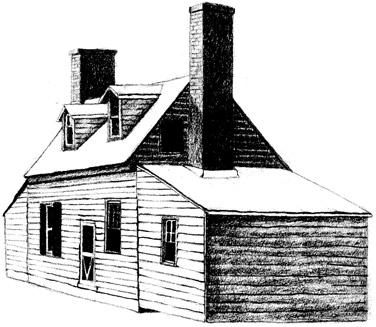
The Hall and Parlor House was typical of middling farmhouses in Virginia. It was commonly a small, simple building, more often built of wood than brick, with chimneys and fireplaces on the gable ends. Historian Dell Upton has found that half of all houses in Virginia inventories had only two rooms on the ground floor: often a hall and parlor, sometimes a hall and kitchen, or a kitchen and parlor, plus several small chambers above. This was the modal house type in Virginia for many generations. The average number of rooms remained constant at approximately five per house from 1646 to 1720.
vivid red walls, grey slates, and painted wooden trim. In all of these ways, the plantation architecture of Virginia was derived from the English rural forms but it became a unique provincial style, with its own distinct identity.