
 Virginia Gender Ways: True-born Englishmen and Spirited “She-Britons”
On the subject of marital relations between husbands and wives, Virginia’s governor Sir William Berkeley set his colony a high example of marital felicity and domestic peace. His will testified to his love for his wife and to the happiness of their married life together. Governor Berkeley left all his property to his “dear and most virtuous wife,” declaring that “if God had blessed me with a far greater estate, I would have given it all to my most dearly beloved wife.”1
The tone of this document captured the ideal of conjugal relations in both England and the Chesapeake—a devoted husband, a virtuous wife, and a loving life together. Many successful marriages came close to realizing these goals. Much domestic correspondence survives to tell us how deeply English-speaking men and women on both sides of the Atlantic valued a happy and loving marriage.
An outward expression of affection was also much encouraged in this culture. In the seventeenth century, husbands and wives addressed each other as “dearest heart,” “sweet spouse,” “my most sweet heart.” The language of love changed during the eighteenth century, but the custom remained the same.2
Domestic realities, unhappily, were often different. In every culture there are happy marriages and unhappy ones. But historians of the family have remarked upon the extent of marital discord among the gentry of Virginia and southern England. One leading historian, Julia Cherry Spruill, testified that her sources “reveal a surprisingly large amount of general domestic dissatisfaction” throughout the southern colonies—more than in New England. Much strife also occurred within marriages that were generally happy.3
A case in point was the successful but very stormy marriage between William Byrd II and Lucy Parke Byrd. In this relationship, which lasted ten years (1706-16), Byrd acted the role of the domestic patriarch. He disposed of his wife’s estate without consulting her, kept all his property in his own hands, and forbade her even to borrow a book from his library without permission. He also interfered in her domestic management, and infuriated her by dictating the smallest details of her appearance even to the shape of her eyebrows, which she was compelled to pluck according to his pleasure. At table one day, he and his male guests entirely consumed the best dish and left nothing for his wife to eat. She did not hide her outraged feelings.
Lucy Byrd, for her part, was the daughter of Colonel Daniel Parke, a high-born Virginia gentleman who later became governor of the Leeward Islands. By all accounts she was an exceptionally beautiful, proud and headstrong lady, with strong passions, a stubborn will, and a mind of her own. She did not submit meekly
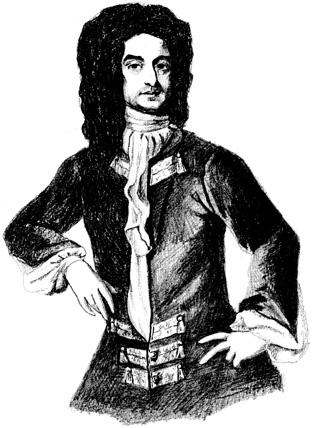
William Byrd II (1674-1744) of Westover came of an armigerous family of London goldsmiths who were connected by marriage to elites in counties near the English metropolis. These ties were reinforced by the marriage between Byrd’s parents, William Byrd I and Mary Horsmanden Filmer Byrd, which anchored the family firmly at the center of the Chesapeake elite. His secret diary, kept in shorthand for many years, is a major source for the cultural history of Virginia, and especially enlightening on the subject of gender, sex, marriage and domestic life. It records in elaborate detail the acts and prejudices of a Virginia patriarch throughout his mature life in both England and America.
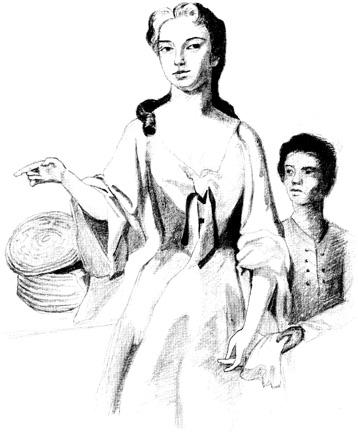
Lucy Parke Byrd, beautiful, sensual, imperious and high-spirited, was the daughter of Colonel Daniel Parke and the first wife of William Byrd II. Her domestic life is known in more intimate detail than that of any woman in early Virginia, mainly through the medium of her husband’s diary. That source describes a stormy union, but one that was also loving and supportive. It ended prematurely when Lucy Byrd died of smallpox in 1716. “How proud I was of her,” her grieving husband wrote, “and how severely am I punished for it. … All pronounced her an honor to Virginia.” This sketch follows an unfinished painting which was interrupted by her death.
to her husband’s rule. In consequence, Lucy Byrd and her husband quarreled frequently, as William Byrd confided in his secret shorthand diary:
[April 5, 1709] I was ill treated by my wife, at whom I was out of humor. …
[April 6] My wife and I disagreed about employing a gardener. … My wife and I continued very cool.
[April 7] I reproached my wife with ordering the old beef to be kept and the fresh beef used first, contrary to good management, on which she was pleased to be very angry … then my wife came and begged my pardon and we were friends again. …
[April 8] My wife and I had another foolish quarrel about my saying she listened on top of the stairs … she came soon after and begged my pardon.
[April 9] My wife and I had another scold about mending my shoes, but it was soon over by her submission.4
The most violent quarrels were about the house servants, whom Mrs. Byrd abused with a sadistic cruelty that shocked even her husband, who was no humanitarian. One domestic battle occurred when Lucy Byrd ordered a little slave girl named Jenny to be burned with a hot iron for a minor fault. On another occasion, William Byrd wrote:
I had a terrible quarrel with my wife concerning Jenny [whom] I took away from her when she was beating her with the tongs. She lifted up her hands to strike me but forbore to do it. She gave me abundance of bad words and endeavored to strangle herself, but I believe in jest only. However, after acting the mad woman for a long time she was passive again.5
These terrible scenes often ended as suddenly as they began, and within moments husband and wife became “good friends” again, strolling arm and arm in the garden, and talking so merrily together that in one such tête à tête with her husband Mrs. Byrd
“burst herself laughing—” splitting open the seams of her dress in high hilarity.6
Often a bitter quarrel ended in a bout of love-making. One furious battle began when Mrs. Byrd flogged a slave in the presence of a house guest—a major breach of etiquette in Virginia where slaves were supposed to be beaten after the guests had gone home. It ended in bed the next morning, when Byrd noted, “I lay abed till 9 o’clock this morning to bring my wife into temper again and rogered her by way of reconciliation.”7
The rhythm of love-making in the Byrd household was less legato than staccato. For long periods, husband and wife abstained from sex with one another—sometimes because of pregnancy or childbirth; more commonly because one or the other was ill with malaria, dysentery, enteritis or some endemic Chesapeake complaint. But when both husband and wife were in good health, they made love frequently and spontaneously—once on top of a billiard table after an afternoon game. Sex seems to have been deeply satisfying to them both. Byrd noted once in his diary that “I gave my wife a flourish, in which she had a good deal of pleasure.”8
There were also moments of quiet affection, which they cherished best of all. When Byrd fell ill with malaria, his wife gave him his quinine bark, and “looked after me with a great deal of tenderness.”9 After a painful episode of dysentery, William Byrd recorded that his wife “anointed my bum with hot linseed oil,” and made him feel much better.10 When Mrs. Byrd fell seriously ill (as frequently she did), and when her son died and she suffered paroxysms of grief, her husband was constantly at her side. He wrote that “I comforted her as well as I could.” This was a stormy but happy marriage. It ended suddenly in 1716, when Lucy Byrd died of smallpox in London. William Byrd was shattered by her loss.11
Every Virginia marriage had its own history, and no two were quite alike. But many of these chronicles were filled with strife—some much more so than the Byrds. These domestic conflicts were elaborately patterned. The trouble commonly arose from deep contradictions in the gender ways of Virginia. Perhaps the most common cause of trouble was money. Men were taught to believe that they were masters of their households. But women often possessed property of their own, and wished to make economic decisions independent of their husbands. An example was the disastrous marriage of Colonel John Custis of Arlington, one of the most powerful men in Virginia, and Frances Parke Custis, the daughter of Colonel Daniel Parke and the sister of Lucy Parke Byrd. The strife in this union seems to have arisen mainly from disputes over property. Mrs. Custis was a woman of wealth, which her husband had the right to manage as he wished. But he also had the duty to pass her property intact to her children. An elaborate marriage contract existed, but it became an invitation to struggle between husband and wife. So bitter was this strife that Col. Custis ordered that a record of his domestic misery should be carved upon his gravestone.12
For years, this unhappy couple refused to speak to one another, communicating only through their slaves. Long silences were punctuated by outbursts of rage so wild and violent as to border upon madness. After one such tempest, Col. Custis surprised his lady by inviting her to go driving with him. They rode in sullen silence through the Virginia countryside, until suddenly the colonel turned his carriage out of the road, and drove straight into Chesapeake Bay.
“Where are you going, Mr. Custis?” the lady asked, as the horses began to swim.
“To hell, Madam,” he replied.
“Drive on,” said she, “any place is better than Arlington.”13
Domestic conflicts over property were common in this culture. In Virginia, as in England, it was not unusual for husbands and wives to keep written cash accounts with one another. Colonel and Mrs. Custis bound themselves to do so by their marriage contract. So also did English gentlemen such as the Dorset Squire John Richards of Warmwell, who gave his wife an annual allowance, and often found himself in the humiliating position of having to borrow money back from her:
|
Borrowed of my Alice 15 Guineas |
16.2.6 |
|
I owe her last year’s allowance money |
10.0.0 |
|
23.2.6 |
|
|
Received of her 10 Guineas |
10.10.014 |
Altogether property appears to have been the leading source of marital discord in seventeenth-century Virginia—in conflicts that rose directly from contradictions in the gender ways of this culture.
A second source of marital strife was sex, on which there were cultural contradictions of another kind. Men were bound to fidelity by their marriage vows. But the unwritten customs of that culture created a different standard of behavior, as we shall see below. The diaries of the English gentleman John Richards and the Virginia patriarch William Byrd documented in melancholy detail the domestic conflicts that arose when both men engaged in sexual adventures. Richards, for example, had a liaison with a lady called M. in his diary. One day he wrote:
This evening A [his wife Alice] was angry as usual about M telling me that I loved her more than her, and that because of ill-treatment in this house she had often thought of killing herself.15
Richards’ diary became a running record of domestic strife between husband and wife. His wife Alice did not meekly accept her lot. She was “enraged to the last degree, and roared all the while,” forcing her husband to sleep in the dining room, and some nights even in the cellar. The journal which recorded these events was normally kept in English, but when things went wrong, Richards switched to French, and when they went very wrong he wrote in Italian.16
Another cause of domestic conflict rose from the politics of family life. Here again, the gender ways of this culture were contradictory. A wife was bound by her marriage vows to obey her husband. An apparently male essayist in the Virginia Gazette laid down rules of “matrimonial felicity” for the instruction of wives: “Never dispute with him … if any altercation or jars happen, don’t separate the bed, whereby the animosity will increase … read often the matrimonial service, and overlook not the important word OBEY.”17
But the unwritten customs of the culture encouraged women to demand more freedom and respect. In 1687, for example, a spirited lady named Sarah Harrison married Dr. James Blair, the future founder of William and Mary College. When the minister
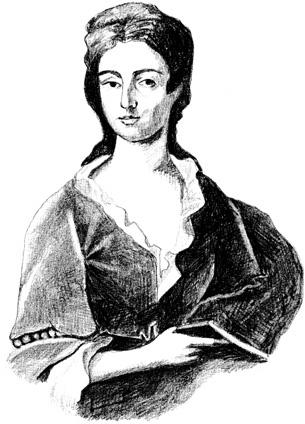
Sarah Harrison disrupted her own wedding ceremony in 1687. When asked if she would love, cherish and obey her husband, she responded firmly, “No obey,” and persisted in that answer until her husband agreed to marry on her own terms. Few women in Virginia were prepared to go quite so far, but many had a strong sense of their English liberties, and a determination to defend them. At the same time, the men of Virginia were raised to a tradition of high patriarchy. The domestic results were often explosive.
recited the marriage vows, she startled the congregation by responding, “No obey!” Three times the vows were repeated. Three times Sarah Harrison answered with increasing firmness “NO OBEY,” until Dr. Blair finally agreed to take his chances and the wedding went forward without any promise of obedience. Their married life together proved to be deeply unhappy. Some years later, William Byrd noted in his diary:
Went to the Commissary’s, where … I was very much surprised to find Mrs. Blair drunk, which is growing pretty common with her, and her relations disguise it under the name of consolation.18
Few women were as outspoken as Sarah Harrison. But many resisted by other means. Yet most were compelled to obey their husbands, often much against their will, in matters which they cared deeply about. Thus William Byrd compelled his wife to send her sick baby Otway to her mother-in-law, who lived at a plantation which was thought to be more healthy. The wife replied,
I am very sorry you have limited Poor, sweet Otway, so that he has but a short time to stay with me. Poor dear babe … But Sir, your Orders must be obeyed whatever reluctance I find thereby.19
Here was a fertile source of domestic strife.
A particular cause of trouble was the use of physical violence and verbal abuse by husbands against wives, and sometimes by wives against husbands as well. Here again the customs of the country were inconsistent. Men were expected to exercise authority over their wives, and were encouraged by custom to use moderate “chastisement” from time to time. But wife-beating was thought to be dishonorable and was punished in both England and American by practices variously called “rough music,” the “charivari,” and “riding skimmington.” A Berkshire gentleman explained:
A custom almost universally prevails in villages and rural districts, whenever a quarrel takes place between a man and his wife and the husband resorts to violence against his wife, for the laborers and the idle inhabitants of the parish and neighborhood to assemble together with flags, horns, bells, pieces of iron and all kinds of sonorous instruments with which they resort to the house where the unfortunate couple resides and create all the noice and disturbance in their power, much to the chagrin of the unhappy husband and greatly to the annoyance of the quiet and orderly inhabitants. … This recreation among the country people is called “rough music.”
The sound of this “rough music” carried for miles across the countryside. Sometimes it continued every night for several weeks.20
Precisely the same punishment was also used against wives who abused their husbands. In one such case, a Wiltshire mob punished both spouses by rough music, and then assaulted both the man and wife together. In this instance, the local gentry prevented the mob from ducking the woman, but by and large country gentlemen looked upon rough music with approval. At Montacute Hall, one of the great Wessex houses, Sir Edward Phelips ordered for the central decoration of the great hall a plaster relief of a “Skimmington ride.” This was not a device which arose spontaneously from rural communities; it was nourished by rural elites.21
Yet another tension in gender roles developed from ideas about love. Husbands and wives were expected to love one another—but not overmuch. Landon Carter complained of a Virginia lady who was “more fond of her husband perhaps than the politeness of the day allows for.”22 Even in happy marriages, the love that men felt for their wives was not a love between equals, and sometimes it seemed to be less a love for a person than for a valuable piece of property. One gentleman wrote when his wife died:
All grief will allow me to say of her is, that she was known to be a humble pious, virtuous, discreet woman, an ornament to her sex, and a crown to her husband. But woe is me the crown has fallen from my head.23
A further source of conflict arose from a confusion of roles for women in Virginia. They were expected to be feminine, refined, delicate, gracious, modest, virtuous. At the same time, all but the most privileged of women were also expected to do farm work and even field labor as well as housewifery. Women of every estate were required to be resourceful but self-effacing. Sir John Oglander celebrated his “most careful, thriving wife, who wore no splendor, never wore a silk gowne, but for her credit when she went abroad in company and never to please herself.”24
There were even theological disputes in Virginia on questions of gender. Some members of this culture shared a deeper sense of spiritual inequality between men and women than commonly existed in Massachusetts. At a rich planter’s table as late as 1773, the northern tutor Philip Fithian was startled to hear an argument on the question of whether women had souls. That ancient conundrum had long since been laid to rest among the Puritans. But it still remained a topic of debate in Virginia.25
All of these conflicts had a common denominator. In this society of English-speaking people, the rights which Christian Englishmen claimed for themselves were a standing reproach to the status of women in their society. A free-born English gentleman was in many ways the unfittest of all males to argue his wife into a condition of dependency. By an early date in the eighteenth century some of the ladies of Virginia were thinking of themselves as “She-Britons,” and demanding a share of the rights that their husbands enjoyed. As early as 1736, the Virginia Gazette published an angry poem called “The Lady’s Complaint,” which captured the deepest contradiction in the genderways of Virginia:
They plainly can their Thoughts disclose,
Whilst ours must burn within:
We have got Tongues, and Eyes, in vain,
And Truth from us is sin. …
Then Equal Laws let Custom find,
And neither Sex oppress;
More Freedom give to Womankind,
Or give to Mankind less.26