
 The Virginia Comity: Patterns of Migration, Settlement and Association
In the year 1754, a planter of high rank named Peter Fontaine gave his brothers a prescription for social happiness in Virginia. “The most happy state this life affords,” he wrote, “is a small estate which will … set him above the necessity of submitting to the humors and vices of others. … One thousand acres of land will keep troublesome neighbors at a distance.”1
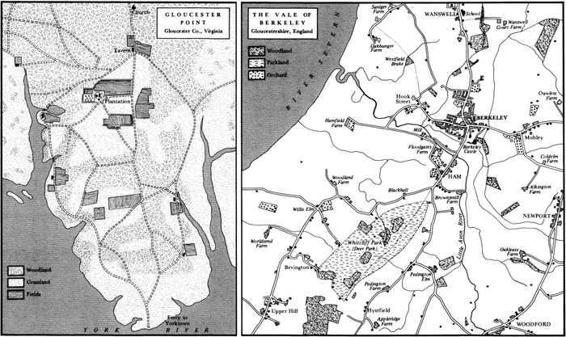
Few Virginia families were able to achieve this material goal, but many shared the same dream. In consequence, patterns of settlement in the Chesapeake colonies were very different from those in Massachusetts. Despite strong official efforts to encourage the growth of towns and cities, the people of Virginia preferred to scatter themselves across the countryside. Many visitors remarked upon the Virginians’ taste for “living solitary and unsociable … confused and dispersed.” But their houses were not scattered at random across the countryside. By the mid-seventeenth century, a distinct system of settlement had developed in Virginia—small market villages straggling along major streams, large plantations and little farms.2
This pattern was not invented in the New World. English travelers commonly recorded an impression that they had seen it all before. The little towns of Virginia reminded them of small market centers in the south and west of England. William Hugh Grove, for example, thought that the market town of Yorktown resembled Richmond Hill in Surrey.3 Tidewater plantations were often compared to English manorial communities. Grove observed that the great houses, with their surrounding servant quarters “shew like little villages.” A French traveler in Virginia thought that they had “the appearance of a small town.” Other tourists in the mother country had recorded similar impressions of larger manors throughout southwestern England.4 The small dispersed farms of Virginia also reminded observers of settlement patterns in southern England. Robert Beverley wrote, “‘the neighborhood is at much the same distance as in the country in England. … The goodness of the roads and the fairness of the weather bring people together.”5
In the absence of townships, local attachments were not as strong in Virginia as in New England, and rates of geographic migration were much higher. Persistence rates (by decade) for the
free whites were only about 40 to 50 percent in seventeenth-century Virginia, compared with 60 to 70 percent in most Massachusetts towns.6 Migration in Virginia tended to be more hierarchical than in New England. A study of geographic mobility in Massachusetts found remarkably little difference between rich and poor in rates of persistence. But in the Chesapeake colonies, that disparity was very great.7
Studies of migration in England have not been done by methods which permit exact comparison. But the best available evidence suggests that persistence rates in the Chesapeake colonies were similar to those in those parts of England from which the most Virginians came. Rates of migration in Northampton County, Virginia, for example, were almost exactly the same as in the parish of Cogenhoe, Northamptonshire.8
This system of migration and settlement had an impact upon patterns of association in Virginia. The primary units of belonging were the family and the rural “neighborhood,” a word often used in the seventeenth and eighteenth centuries to describe a group of ten or twenty households which were close enough to think of themselves as neighbors. The size of these rural neighborhoods was much the same in the Chesapeake and the west of England.9
As one generation succeeded another, neighborhoods tended to become kin-groups. Ties of blood and marriage created a web of increasing density. The members of these kin-neighborhoods worked together, played together, and went to church and court days together. They borrowed from one another, becoming also a network of credit and barter relationships. Gifts were frequently exchanged within these groups. The most important time for gift-giving was the new year. Cousins and neighbors exchanged presents such as sugar loafs, pomegranates, capons, spices, tobacco pipes, porcelain dishes. This tradition had been specially strong in the south of England—stronger than in the North or East Anglia. “Sussex is the freest place in England for the giving of New Year’s gifts,” one gentleman observed in 1622. The custom was also stronger in Virginia than in New England.10
Among the high elite, patterns of association were a little different. Virginia’s elite tended to mix with others of their own rank at a greater distance through the colony. But in other respects, the structure of these relationships was the same as within small neighborhoods of middling farmers. The gentry also increasingly became a cousinage, working and living together in unitary relationships of increasing intensity.11
Diaries on both sides of the Atlantic recorded the density of this associative pattern:
10 April 1649 [visiting with] Sir Thomas Wilbraham, my cozen Thomas, my cozen Roger Wilbraham of Derfold & my cozen Peter, my cozen John Bellot, Mr. Morgell & my cozen Ed. Nyonhall with divers others.
11 April at Baddesley, nothing remarkable
12 April at Baddesley. That day my cozen Peter Wilbraham and his wife, my cozen Rachel Lothian and my cozen Alice Wilbraham were here.
13 April at Stoke; in the afternoon my cozen Roger Wilbraham and old cozen Bellot came thither.12
These neighborhoods were intensely curious about strangers. When one West Countryman was traveling in England from
Somerset to Berkshire, he recorded many instances of this attitude. At Castle Cary in Somerset he wrote, “A crowd gathered and asked of what country I was,” though he was only a few miles from home. The same thing happened to him at Andover in Hampshire and Reading in Berkshire. A similar attitude also existed in Virginia.13
In southwestern England and tidewater Virginia, the rhythm of association was much the same. Through the week, people worked on their farms and plantations, mixing mostly with their own families and neighbors. But on church days and court days, the scale of association suddenly changed. Virginians of all ranks and conditions met and mingled at their parish churches and county courthouses, which were favorite places for buying and selling, racing and gambling, meeting and gossiping.
This tidewater pattern followed the prevailing customs in southwestern England. The seventeenth-century diary of an affluent Devon yeoman named William Honeywell, for example, detailed very much the same sort of life in the West Country of England, near the town of Exeter. Most days, Honeywell labored on his land. He had daily contacts with what he called his “principal friends” in his rural neighborhood, and he remembered them all in his will:
To my principal friend Mrs. Staplehill forty pounds, to my delighted sure friend Mr. Estchurch, thirty pounds, to my singular great friend Mr. Simon Clifford twenty pounds, to my constant friend Mr. Bollen twenty pounds, to my fast friend and cousin Mr. Bagwell of Exon twenty pounds, to my trusty friend Mr. Augustine Rackley five pounds, to my ancient and loving friend Mr. Simons five pounds.
Several times a year William Honeywell traveled to the shire town on court day:
August 6 [1602].—I did reap my rye. … August 10.—I rode to Exeter at the Assize and staid at Hole’s myself and horse, and spent there xvid. … August 11, 12, 13.—I remained at the Assizes. I bought a pair of shoes, and paid 2s. 6d. I bought a pair of boots, and a pair of shoes, and am to pay 9s. I spent there this week in horse and self 15s. …
William Honeywell’s diary also showed that Sundays were a time for recreation in rural Devon:
August 22—I went to Trusham Church. After evening prayers went to bowles.14
These patterns of association were closely interwoven with the structure of material life in southwestern England. The inhabitants of that region were not isolated subsistence farmers. A large part of its social life consisted of market relationships. Our Devon yeoman William Honeywell accumulated an estate of several hundred pounds sterling. His wealth did not sit idle in a strong chest. It was loaned in sums of ten or twenty pounds to neighbors of all ranks and conditions. Most lenders charged a fixed interest of a shilling on a pound (5.0%), the custom of the country. A few were allowed to borrow without interest. Most loans were shortterm transactions, settled at Christmas, Candlemas or Lady Day.
Altogether, a large part of this Devon yeoman’s wealth was liquid capital which was carefully invested in a local money market and brought handsome returns. In the year 1600, for example, Honeywell reckoned his total assets at £440, of which £220 were stock and household goods, and £211 were loaned to his neighbors. At the same time he also owed £80 to others.15
Here was a capital market without capitalists, a financial market without banks, and a money market without middlemen of any kind. It was a web of many small transactions among family, friends and neighbors. Most countrymen participated in proportion to their wealth without distinctions of rank or station. Agreements were not reduced to writing but made orally in the presence of witnesses. The memory of the community thus became the record of its transactions. An oral contract was thought to be binding:
Jan. 14 [1599]. I agreed with Hugh Clampitt and Arthur Home’s son-in-law to build the barn at Riddon … I must pay him 56 shillings 8 pence and if I bring the water to the place, then he is to abate five shillings. Hugh Clampitt hath given his word to see it finished … and this agreement was between us in the presence of George Murch, and I gave him fourpence in earnest.16
Some of the transactions became triangular exchanges, in which debts and credits passed current to a third party.
June 23, 1601. I lent to Dick Drake of Morchard, on the 23rd of June five pounds in old gold, 2 Royals and 5 angels, and one piece of twenty shillings. He engaged himself with a great many oaths not to exchange it, but he would deliver it to his Aunt and have silver for it: he promised on his soul’s health to bring it whole, in the presence of my sister Elisabeth.17
In the margin next to this entry, Honeywell later noted, “paid by Mrs. Thomas Clifford.”
When William Honeywell’s loans were not repaid, he went to law to recover them even from members of his own family. The result was a vast tangle of litigation in the country courts of southern England. Large numbers of little cases were tried without lawyers, and settled quickly by a member of the local gentry. The diaries of Chesapeake planters described precisely the same patterns as did the journals of southwestern England.18
This system of association was linked to a special idea of social bonding and belonging, in which reputation played a large part. Much depended on one’s “standing” in the eyes of neighbors, friends and family. Particularly important was that form of reputation which Virginians called honor.
Honor in Virginia was compounded of two ideas. One of them was what historian Bertram Wyatt-Brown calls “primal honor,” which meant physical courage and tenacity of will—in short, honor as valor. This was the meaning that Nathaniel Bacon had in mind when he cried out to his followers in 1676: “Come on, my hearts of gold! He that dies in the field lies in the bed of honor.”19 The other idea had to do with gentility, breeding, character and good conduct. This was honor as virtue. One English moralist in 1616 wrote, “ … honor in [its] true definition is a certain reverence, which one man yieldeth to another extraordinarily, for his virtuous merit, and worthy desert, so that it should not be wealth but virtue, which should make an honorable man.” An honorable person never lied, cheated, stole, or betrayed his family or friends. He was not disloyal, cowardly or meanspirited.20
These two ideals of honor-as-valor and honor-as-virtue were interwoven in a creed that had great force in the culture of Virginia. Honor was a hierarchical principle. A high-born gentleman had great honor. A yeoman had less honor, but was thought capable of behaving honorably. A servant had little honor, and a slave had none at all. But people of every rank were mindful of reputation, in a way that does not exist in our modern world.
When Virginians misbehaved, they were punished by rituals of public humiliation. The common punishments were meant to shame them, sometimes by the same devices that were used in Puritan New England. One miscreant in Virginia was ordered to stand “several Sundays in time of divine service … in a white sheet with a white wand in his hand.” This custom had long been kept in English parish churches, where people were required to appear “barehead, barefoot and barelegged,” with a white sheet wrapped around a body “from the shoulder to the feet” and a white wand in one’s hand.”21
Shame had an emotional power which it has lost today. In a seventeenth-century suit for slander, it was said of a woman that:
She lives forever in eternal shame
That lives to see the death of her good name.22
The image of mortality was appropriate, for loss of reputation was a form of social death in this culture. In the comity of both Virginia and New England, rituals of honor and reputation, shame and humiliation were highly important during the seventeenth century, but in very different ways.