
 Virginia Freedom Ways: The Anglican Idea of Hegemonic Liberty
“How is it,” Dr. Samuel Johnson asked, “that we hear the loudest yelps for liberty among the drivers of negroes?” That famous question captured a striking paradox in the history of Virginia. Like most other colonists in British America, the first gentlemen of Virginia possessed an exceptionally strong consciousness of their English liberties, even as they took away the liberty of others.1 Governor William Berkeley himself, notwithstanding his reputation for tyranny, wrote repeatedly of “prized liberty” as the birthright of an Englishman. The first William Fitzhugh often wrote of Magna Carta and the “fundamental laws of England,” with no sense of contradiction between his Royalist politics and libertarian principles. Fitzhugh argued that Virginians were both “natural subjects to the king” and inheritors of the “laws of England,” and when they ceased to be these things, “then we are no longer freemen but slaves.”2
Similar language was used by many English-speaking people in the seventeenth and eighteenth century. The fine-spun treatises on liberty which flowed so abundantly from English pens in this era were rationales for political folkways deeply embedded in the cultural condition of Englishmen.
These English political folkways did not comprise a single libertarian tradition. They embraced many different and even contradictory conceptions of freedom. The libertarian ideas that took root in Virginia were very far removed from those that went to Massachusetts. In place of New England’s distinctive idea of ordered liberty, the Virginians thought of liberty as a hegemonic condition of dominion over others and—equally important—dominion over oneself.
The Virginia idea of hegemonic liberty was far removed from the New England system of communal restraints which a town meeting voluntarily imposed upon itself. The English traveler Andrew Burnaby observed that “the public and political character of the Virginians corresponds with their private one: they are haughty and jealous of their liberties, impatient of restraint, and can scarcely bear the thought of being controlled by any superior power.”3
Virginia ideas of hegemonic liberty conceived of freedom mainly as the power to rule, and not to be overruled by others. Its opposite was “slavery,” a degradation into which true-born Britons descended when they lost their power to rule. The idea was given its classical expression by the poet James Thomson (1700-1748) in a stanza that everyone knows without reflecting on its meaning:
When Britain first, at Heaven’s command,
Arose from out of the Azure main,
This was the charter of the land,
And guardian angels sang this strain:
Rule, Britannia, rule the waves;
Britons never will be slaves.4
In Thomson’s poetry, which captured the world view of the Virginians in so many ways, we find the major components of hegemonic liberty: the concept of a “right to rule”; the notion that this right was guaranteed by the “charter of the land”; the belief that those who surrendered this right became “slaves”; and the idea that it had been given to “Britain first, at heaven’s command.”
It never occurred to most Virginia gentlemen that liberty belonged to everyone. It was thought to be the special birthright of free-born Englishmen—a property which set this “happy breed” apart from other mortals, and gave them a right to rule less fortunate people in the world. Even within their own society, hegemonic liberty was a hierarchical idea. One’s status in Virginia was defined by the liberties that one possessed. Men of high estate were thought to have more liberties than others of lesser rank. Servants possessed few liberties, and slaves none at all. This libertarian idea had nothing to do with equality. Many years later, John Randolph of Roanoke summarized his ancestral creed in a sentence: “I am an aristocrat,” he declared, “I love liberty; I hate equality.”5
In Virginia, this idea of hegemonic liberty was thought to be entirely consistent with the institution of race slavery. A planter demanded for himself the liberty to take away the liberties of others—a right of laisser asservir, freedom to enslave. The growth of race slavery in turn deepened the cultural significance of hegemonic liberty, for an Englishman’s rights became his rank, and set him apart from others less fortunate than himself. The world thus became a hierarchy in which people were ranked according to many degrees of unfreedom, and they received their rank by the operation of fortune, which played so large a part in the thinking of Virginians. At the same time, hegemony over others allowed them to enlarge the sphere of their own personal liberty, and to create the conditions within which their special sort of libertarian consciousness flourished.
To a modern mind, hegemonic liberty is an idea at war with itself. We think of it as a contradiction in terms. This is because we no longer understand human relationships in hierarchical terms, and can no longer accept the proposition that a person’s status in the world is determined and even justified by his fortune. But in Virginia during the seventeenth and eighteenth century,
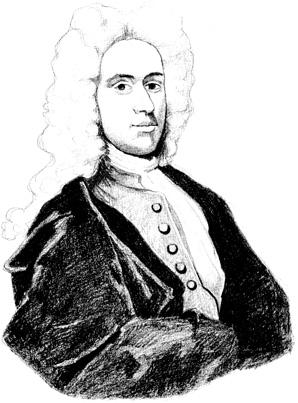
The noblest product of Virginia’s culture was the idea of a gentleman, here represented by Thomas Lee, who was so renowned for his character that his portrait hung in a place of honor at Badminton, home of the Dukes of Beaufort. When he suffered a fire a purse was contributed by the Queen herself.
The code of a Virginia gentleman made moral absolutes of truth, candor, fidelity, courage, manners, courtesy, and responsibility. Most of all, a gentleman treated others decently and was true to his own convictions. He was required to lead others of lower rank, and they were expected to follow his high example. The moral authority of a gentleman derived from his material independence. So important was this condition that in occupational lists of the eighteenth century, “independent” and “gentleman” were used as synonyms. Freedom was the necessary condition of a Virginia gentleman’s existence, but others in that society lived in various degrees of unfreedom and many had no freedom at all. Their bondage supported a gentleman’s freedom and independence, which thus became a hegemonic idea, very different from libertarian thinking in New England and Pennsylvania.
and throughout much of the American south until 1865, this idea of hegemonic liberty was entirely in harmony with its environing culture.
One acute English observer in the eighteenth century clearly perceived the special meaning of hegemonic liberty in what he called the “southern colonies.” Edmund Burke declared in Parliament:
a circumstance attending these colonies … makes the spirit of liberty still more high and haughty than in those to the northward. It is, that in Virginia and the Carolinas, they have a vast multitude of slaves. Where this is the case in any part of the world, those who are free are by far the most proud and jealous of their freedom.
Freedom is to them not only an enjoyment, but a kind of rank and privilege. Not seeing there that freedom, as in countries where it is a common blessing and as broad and general as the air, may be united with much abject toil, with great misery, with all the exterior of servitude, liberty looks amongst them like something that is more noble and liberal.
I do not mean, Sir, to commend the superior morality of this sentiment, which has at least as much pride as virtue in it; but I cannot alter the nature of man. The fact is so; and these people of the southern colonies are much more strongly, and with a higher and more stubborn spirit, attached to liberty than those to the northward. … In such a people, the haughtiness of domination combines with the spirit of freedom, fortifies it, and renders it invincible.6
Burke understood very well this system of hegemonic liberty in Virginia—perhaps because it was also shared by so many English gentlemen in the eighteenth century. He correctly perceived that liberty in Virginia was both a right and a rank, with a good deal of “pride” in it, and many contradictions. He also understood that this conception of hegemonic liberty contained larger possibilities which would expand in years to come.
One of these larger libertarian possibilities lay in its conception of self-government and minimal government. Hegemonic liberty was not an anarchical idea, opposed to all government. The preservation of liberty was thought to require the protection of the state. But the function of the state was largely limited to that minimal role. These ideas were introduced at the very beginning of
Virginia’s history. In the critical years from 1649 to 1652 the people of Virginia agreed to stand by Governor Berkeley and the Royalist cause only on condition that light taxes and loose restraints would be guaranteed to them. This wish was granted. Berkeley agreed to a general reduction of taxes, to the abolition of poll taxes altogether, to the principle of no taxation without representation, and to the idea of equitable assessments—“proportioning in some measure payments according to men’s abilities and estates.” Berkeley’s tax policy lay at the root of his popularity. The burgesses acknowledged a debt of gratitude for themselves and their descendants. “This is a benefit descending unto us and our posterity,” they declared, “which we acknowledge [is] contributed to us by our present governor.”7
Another important possibility within hegemonic liberty lay in its principle of the rule of law. In that regard, Governor Berkeley also made a change in the constitution of his colony. In the year 1643, he agreed to a statute which allowed appeals to be taken from the courts to the Assembly. This reform established the rule of law in a way which made the gentlemen-burgesses of Virginia the masters of their own world. Later the Assembly lost their appellate role, but the Council continued to function in Virginia as the court of last resort, and this body remained firmly in the hands of the planter elite of Virginia. It created for them a condition of cultural hegemony which continued for more than two centuries. At the same time, it also provided a firm base for the rule of law through two turbulent centuries of Virginia’s colonial history.8
Yet another expansive possibility in hegemonic liberty existed in its conception of freedom as a condition of social independence. This also was originally an hierarchical idea. The higher a person’s social status, the more independent he was thought to be. Great planters took special pride in their independence. Thus, Landon Carter characterized his estate which he called Sabine Hall as an “excellent little fortress … built on a rock of Independency.” Peyton Randolph used precisely the same formulation. In a quarrel with his British creditors, he wrote, “I shall never be affected with any reply that can be made, having an excellent little fortress to protect me, one built on a Rock not liable to be shaken with Fears, that of Independency.”9 Foreign travelers also commented upon this condition of “independence” among the great planters. A French visitor to Virginia in the seventeenth century observed that “there are no lords, but each is sovereign on his own plantation.”10
The largest possibility in this idea of hegemonic liberty lay in its conception of dominion over self. A gentleman of Virginia was trained to be, like Addison’s Cato, “severely bent against himself.” He was taught to believe that a truly free man must be the master of his acts and thoughts. At the same time, a gentleman was expected to be the servant of his duty. “Life is not so important as the duties of life,” said John Randolph, in one of the best of his epigrams.11
So exalted was this ideal of hegemony over self that every gentleman fell short. But the ideal itself was pursued for many generations. At its best, it created a true nobility of character in Virginia gentlemen such as George Washington, Robert E. Lee and George Marshall. The popular images of these men are not historical myths. The more one learns of them, the greater one’s respect one becomes. Their character was the product of a cultural idea.12
Hegemonic liberty was a dynamic tradition which developed through at least three historical stages. In the first it was linked to Royalist cause in the English Civil War. The Virginia gentleman Robert Beverley boasted that the colony “was famous, for holding out the longest for the Royal Family, of any of the English Dominions.”13 Virginia was the last English territory to relinquish its allegiance to Charles I, and the first to proclaim Charles II king in 1660 even before the Restoration in England.14 Speeches against the Stuarts were ferociously punished by the county courts.15 The Assembly repeatedly expressed its loyalty to the Crown, giving abundant thanks for “his Majesty’s most gracious favors towards us, and Royal Condescensions to anything requisite.”16
In the second stage, hegemonic liberty became associated with Whiggish politics, and with an ideology of individual independence which was widely shared throughout the English-speaking world. In Virginia, many families who had been staunch Royalists in the seventeenth century became strong Whigs in eighteenth century; by the early nineteenth century they would be Jeffersonian Republicans. Their principles throughout tended to be both elitist and libertarian—a clear expression of a cultural ethic which was capable of continuing expansion.
In Britain, this Whiggish idea of hegemonic liberty was taken up by English landed families who had tended to be Royalists in the seventeenth century, and became Whigs in the eighteenth. The classical examples were England’s great aristocratic families such as the Russells and Cavendishes. Both had been Royalist in the Civil Wars of the seventeenth century. William Cavendish, the third Earl of Devonshire, lost his fortune in the service of Charles I. His brother Charles Cavendish lost his life in the same cause, and became the beau ideal of a gallant cavalier. The poet Waller celebrated the loyalty of these royalist Cavendishes:
Two loyal brothers took their Sovereign’s part,
Employed their wealth, their courage and their art;
The elder did whole regiments afford,
The younger brought his courage and his sword.17
In the 1680s, another William Cavendish, the fourth Earl and first Duke of Devonshire, in the words of a family historian, removed “the politics of his race from a Cavalier to a Whig foundation.”18 The Cavendishes and Russells supported the Revolution of 1688, and became staunch Whigs for a century, until the French Revolution divided them. Late in the eighteenth century, the Cavendish connection stood with Burke, and the Russells went with Fox. But through the eighteenth century, many of the great landed families of England were as staunchly Whiggish as they had been Royalist a century before. Among them were the
Berkeley family, who were among the most extreme Royalists in the seventeenth century, and would become decided Whigs in the eighteenth.
In the nineteenth and twentieth centuries, the tradition of hegemonic liberty entered a third stage of development, in which it became less hierarchical and more egalitarian. Such are the conditions of modern life that this idea is no longer the exclusive property of a small elite, and the degradation of others is no longer necessary to their support. The progress of political democracy has admitted everyone to the ruling class. In America and Britain today, the idea of an independent elite, firmly in command of others, has disappeared. But the associated idea of an autonomous individual, securely in command of self, is alive and flourishing.