
 “The Quaker Galilee”: England’s North Midlands
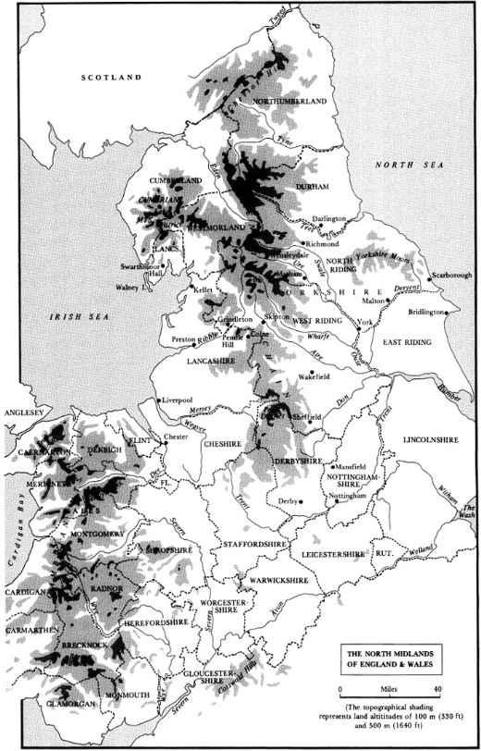
These emigrants came not from North Midlands in general, but mainly from the Pennine moors and uplands which ran in a northerly way from the Peak District of Derbyshire to the Fells of Yorkshire and Cumbria. This was the highest ground in England. It encompassed the six counties of Derbyshire, Nottinghamshire, Lancashire, east Cheshire, west Yorkshire and southern Westmorland. The Pennine Moors are Brontë country. Wuthering Heights and Jane Eyre were set in the West Riding of Yorkshire, where Charlotte, Anne and Emily Brontë had grown up in the village of Haworth. Their writings are uncertain guides to the culture of dissent in this region, but powerful evocations of its climate and terrain.
Later in the modern era, this area became the industrial heartland of Britain, a vast ganglion of gritty industrial cities such as Manchester, Bradford, Sheffield and Leeds, where large urban proletariats are now packed into close-built brick tenements that stretch mile after mile across the rolling countryside. In the seventeenth century this was a very different place—one of England’s most rural regions, thinly settled and desperately poor. The population consisted mostly of small farmers and shepherds who struggled to feed themselves and to produce a small surplus of wool for the market. Every year the wool was loaded on packhorses and sent to markets as far distant as Southampton. Even in good years there was barely enough to get by; in bad years famine lay heavy upon the land.
During the seventeenth century the north of England had the reputation of being a dangerous place. The English antiquary William Camden felt “a kind of dread” when he came to the borders of Lancashire—an apprehension shared by other travelers. There was a strong sense of insecurity in this sparsely settled land.
Isolated houses were attacked and robbed by roving nocturnal bands, and sometimes all the victims were brutally murdered to hide the crime.1 As late as the year 1680 a Yorkshire diarist recorded one such event, when a gentleman of that county, together with his mother and servants, was robbed and killed, and the house set ablaze to hide the crime: “The old gentlewoman was most burnt,” the diarist wrote, “her face, legs and feet quite consumed to ashes; the trunk of her body much burnt, her heart hanging as a coal out of the midst of it. … Some observe that all of their skulls were broken, as it were in the same place.”2
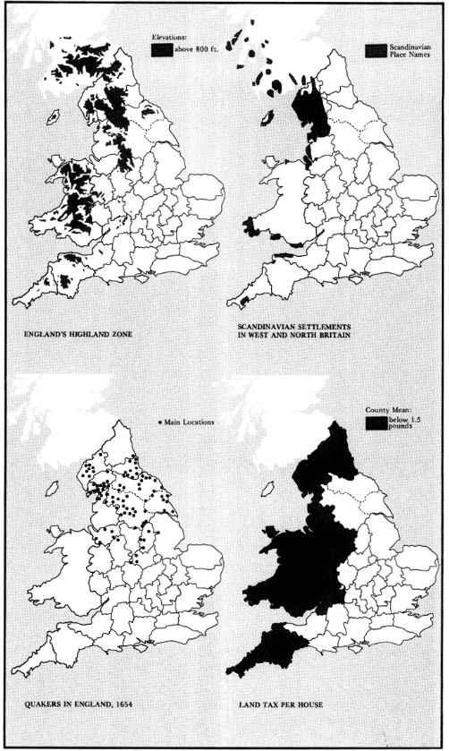
This region shared a common cultural condition, and also a common history. The North Midlands, more than any other part of England, had been colonized by Viking invaders. Historian Hugh Barbour writes, “ … in the central region of the North, the Pennine moorland, where Quakerism was strongest, the villages were mainly Norse in origin and name, and Norse had been spoken there in the Middle Ages. From the Norsemen came the custom of moots, or assemblies in the open at a standing-stone or hilltop grave, which may have influenced the Quakers’ love for such meeting places. The Norse custom was individual ownership of houses and fields: the Norman system of feudal manors imposed in the twelfth century was always resented.”3
The Norman conquest of the north had been particularly brutal, and had left a region bitterly divided against itself. Its governing families were culturally distinct from the governed, and long remembered their Norman-French origins. Many remained Roman Catholic more than a century after Henry VIII broke with the Pope. In the seventeenth century many of this elite became Royalist. But shepherds and farmers of the north thought of themselves as a race apart from their overlords. Their religion was evangelical and Protestant. They felt themselves to be aliens from the schools and churches and courts and political institutions of the region—all of which remained securely in the hands of the ruling few. This attitude entered into the theology of the Quakers, and profoundly shaped their social purposes. In some respects, the Quaker culture was that of its native region; in others it was a reaction against it.4
The farmers and herdsmen of this region, in the words of Hugh Barbour, “had a reputation for independence” and a custom of equality among themselves. The “family and farmhands all ate together,” at simple meals of “boiled porridge and oatcakes.” They dressed alike, in simple homespun suits and dresses of a distinctive color called “hodden gray.” Their houses were sparsely furnished, and their culture made a virtue of simplicity and plain speech. All of these folkways became a part of Quakerism.5
During the disturbances of the seventeenth century, radical sects in great variety multiplied rapidly throughout the North Midlands—Baptists of many types, Muggletonians, Familists, Fifth Monarchy Men, Ranters, Seekers and Quakers. These various movements were all part of a common impulse. In 1656, when England was ruled by Puritan major-generals, the officer responsible for the north wrote to John Thurloe, “Our Fifth Monarchy men have many of them turned Anabaptist … others have renounced that and other ordinances and are termed seekers, and … sober people [fear they] will soon profess to be Quakers.”6
This was the region where the Quakers first appeared. It long remained their strongest base. The founder, George Fox (1624-91), was a Leicestershire weaver’s son who developed his doctrine of the Inner Light by 1646 and made his early converts mostly in the North Midlands. By the year 1654, 85 percent of Quaker meetings were in the northern counties of England.7
The Quakers were most numerous in the poorest districts of this impoverished region. In Cheshire, for example, Quaker emigrants to Pennsylvania came not from the rich and fertile plains in the center and southwest of the county, but mostly from the high ridges and deep valleys on the eastern fringe of the county. This was rough country, with settlements that bore names such as Bosely Cloud and Wildboarclough. In the seventeenth century, much of this region was still densely wooded, the “last refuge in England of the wolf and the boar.” The climate was more severe
than in the lowlands—with bitter “close mists” that settled in the valleys, and the dreaded “wireglass” that glazed the ridges and killed many an unwary traveler. The sense of desolation was deepened by the forbidding appearance of small isolated farmhouses, constructed of a harsh gray-black millstone. On the steep slopes of eastern Cheshire, they may still be seen to this day.8
In Nottinghamshire, the Quakers came not from the rich alluvial lands of the Trent Valley, but from the craggy uplands. The men of the Monyash monthly meeting once wrote, “ … we are a poor, unworthy and despised people, scattered amongst the rocky mountains and dern valleys of the high peak country.”9 In Derbyshire, the pattern was also much the same. Here the Quakers lived mostly in the “coal measures” on the east side of the county, and also in the Peak District. Comparatively few came from South Derbyshire.10
In the West Riding of Yorkshire, Quakers tended to be poor dalesmen who lived in places such as Lotherdale, a secluded valley on the border between Yorkshire and Lancashire. In the seventeenth century this area was described as “perfectly inaccessible by road.” Remoteness was indeed one of its attractions. Some Quakers fled there to escape their persecutors.11
One of the great unanswered questions in Quaker historiography is to explain the regional origins of this sect. One scholar, Hugh Barbour, believes that the Scandinavian heritage of this region created an exceptionally fertile culture for Quaker evangelists. This ethnocultural interpretation has been adopted by some American scholars, while materialist explanations have found more favor among British historians. Both schools of thought are probably correct in some degree. The theology of Quakerism arose from an oppressed regional underclass which despised the foreign elite that exploited them. It also rejected the institutions of high culture that were visited upon them, and made virtues of simplicity and hard work in a hostile environment.12 The austere culture of this regional population became a fertile field for Quakerism. The values of both a region and a class were carried from England’s North Midlands to the Delaware Valley.