
 William Penn and the Delaware Valley: The Intent of the Founder
This “Delaware culture area,” as Frederick Tolles called it, developed not by some random process of social selection, but from the conscious will and purpose of its Quaker founders. The leading role was played by one founder in particular, William Penn—who served Pennsylvania, Delaware and also West Jersey as lawgiver, social planner, organizer, tireless promoter, and regulator of the immigration process. The cultural history of this region cannot be understood without knowing something about the mind and character of this extraordinary man.1
William Penn was bundle of paradoxes—an admiral’s son who became a pacifist, an undergraduate at Oxford’s Christ Church who became a pious Quaker, a member of Lincoln’s Inn who became an advocate of arbitration, a Fellow of the Royal Society who despised pedantry, a man of property who devoted himself to the welfare of the poor, a polished courtier who preferred the plain style, a friend of kings who became a radical Whig, and an English gentleman who became one of Christianity’s great spiritual leaders.
William Penn’s life began 14 October 1644, on London’s Tower Hill, in the shadow of the great castle where he would later be imprisoned for his faith. He was born into a violent world and very nearly made violence his career. The great events of his early life were wars and revolutions in which his family was intimately involved. His father was a naval officer who served both Cromwell and the King, and was rewarded by both sides with large estates in Ireland.
Penn grew up in Ireland, and believed (mistakenly) that he was of Welsh descent. But by birth and breeding he was very much an English gentleman. His Anglo-Norman family (originally De La Penne) was kin to many of the gentry who went to Virginia. By marriage he was related to Frances Culpeper Berkeley (the wife of Sir William Berkeley) who knew him well and called him “cousin.”2
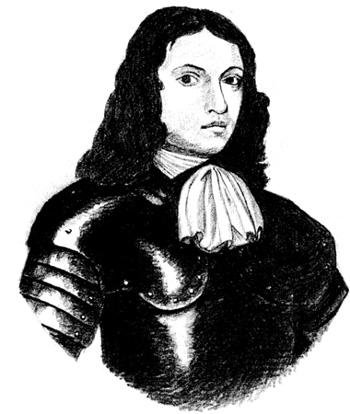
This portrait of William Penn as a young warrior was painted in 1666 (when he was 22 years old). It captures the improbable origins of the Quaker leader. He was raised in a military family, nearly became a professional soldier, and always cherished a warrior’s virtues, even when he turned against war itself. This militant Christian would always be a fighter for God’s truth, closer in spirit to St. George than to St. Francis. Penn appears in heavy armor such as he might have worn when he saw combat at Carrickfergus in the same year. The light falls upon his right arm and chest, bringing out a sense of strength. The neck cloth of fine lace adds a tone of refinement. A dark thick wig hides Penn’s unfashionable thin blond hair. The face has a delicate beauty, a candid expression, and a firm jaw. The lines of composition converge upon the eyes which are exceptionally full, deep and thoughtful—adding a hint of detachment from the world. This drawing is from an eighteenth-century copy of a lost original in the Historical Society of Pennsylvania.
As a youth, William Penn was trained to arms. He became so skillful a swordsman that once when attacked by a French duelist he expertly disarmed his enemy, gallantly spared his life and went upon his way, wondering if any “ceremony were worth the life of any man.” In 1666 Penn served in combat in the suppression of an English mutiny at Carrickfergus, and so distinguished himself that he was recommended for a military post.3
Penn was tempted to accept, but he was destined for a different life. Raised in a pious Protestant household to be a “Christian and a gentleman,” he had begun to have deep mystic visions as early as the age of twelve. His father sent him to Christ Church, Oxford, to temper his faith. The effect was the reverse. Penn was deeply shocked by what he called the “hellish darkness and debauchery” of Oxford. He refused to wear a black gown or to attend compulsory chapel, and was expelled for nonconformity.
Returning to Ireland, this restless young man heard the Quaker preacher Thomas Loe and was converted to that faith. His father tried to change his mind, first by “whipping, beating and turning out of doors,” then by sending him on a grand tour. Penn wavered in his faith. But after his return, the diarist Samuel Pepys (who knew him well and detested his piety) wrote cynically, “Mr. Penn … is a Quaker again, or some such melancholy thing.”
Penn quickly became a leader among Friends. He preached throughout Britain, published more than one hundred works, and was often imprisoned by the alarmed authorities. In 1668 he was locked in the Tower of London for writing a Quaker book. Penn used his time in jail to write another book called No Cross, No Crown, which many take to be his greatest work.4 Soon after his release, Penn was arrested again in 1670 for preaching outside a locked meetinghouse in London. In the trial that followed, Penn conducted his defense so brilliantly that the jurors refused to convict him even when threatened with prison themselves. The case became a landmark in the history of trial by jury.5
In 1671 Penn was arrested once more. This time he was tried secretly in the Tower and sent to Newgate, where he refused the privileges of his rank and lived in a common cell. There he finished The Great Case of Liberty of Conscience, one of the noblest defenses of religious liberty ever written.6
While suffering for his faith, Penni was treated with deference by his persecutors, and affection by many of his jailors. He maintained warm personal relations with Charles II and the future James II. From his cell he courted and won the hand of Gulielma Springett, a high-born lady who was celebrated for Quaker piety and for her blonde beauty (Penn’s rivals included London’s leading Restoration rakes). Her many connections gave Penn much influence in English society and helped him secure the charter of Pennsylvania. After her death, Penn married Hannah Callowhill, a rich Bristol heiress who brought him an income of £3000 a year—enough to keep his colony afloat.
In 1671 Penn traveled in Europe, and met with German Pietists who also suffered heavily from persecution. In company with them he began to think seriously about founding a colony in America—an idea which had been stirring in his mind since 1661. He became a trustee of West Jersey, and drew up the fundamental laws of that colony. But as the sufferings of Quakers and Pietists continued in western Europe, Penn felt the need of a larger sanctuary for oppressed Christians throughout the world. He petitioned his royal friend Charles II for a colony. In 1681, Charles overruled his advisors, and granted the request. The King himself named the colony, adding with his own hand the prefix “Penn” to the proposed “Sylvania.”7
Pennsylvania and its neighboring provinces were intended to be in Penn’s words a “colony of heaven” for the “children of Light.” He did not think of his province as a retreat from the world, but as a model for general emulation. Like the Puritans of Massachusetts and the cavaliers of Virginia, Penn intended his American settlement to be an example for all Christians.
The cornerstone of this “holy experiment” was liberty of conscience—not for everyone, and never for its own sake. William Penn believed that religious liberty was an instrument of Christian salvation. It did not occur to him that liberty was to be desired as an end in itself. He excluded atheists and nonbelievers from his colony, and confined officeholding to believing Christians. Even so, Pennsylvania came closer to his goal of a non-coer-cive
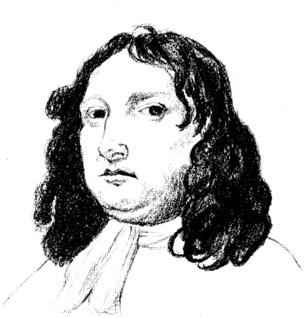
William Penn in maturity looks out upon us from this unfinished crayon sketch by Francis Place, which shows Penn as proprietor of Pennsylvania, aged 52 (ca. 1696). The face has grown very full, with fleshy cheeks and double chin. Even so, a lady called him “the handsomest best-looking, lively gentleman she had ever seen.” (Hull, 301). There is a feeling of simplicity and goodness in this gentle, kindly Quaker face. But one sees also a hint of rank and authority; and the set of the mouth and the arch of the brow are those of a man accustomed to command.
society than any state in Christendom during the seventeenth century.
Another part of Penn’s holy experiment was the renunciation of war. The Quaker colonies had no military establishment; Penn wrote to a Friend in 1685 that in the Delaware Valley there was “not one soldier, nor arm borne, or militia man seen, since I was first at Pennsylvania.”8
Penn also intended the Quaker colonies to be a political experiment for his radical Whig principles. He was no democrat, but believed deeply in the “ancient English constitution” of mixed or balanced government. Most of all he believed in the rule of law. “For the matters of liberty and privilege,” he wrote, “I propose … to leave myself and successors no power of doing mischief, that the will of one man may not hinder the good of an whole country.”9
In economic terms, Penn was not interested in founding an agrarian utopia. From the start, he intended his colonies to be a hive of commerce and industry, with a “due balance between trade and husbandry.” He recruited artisans and what he called “laborious handicrafts” more actively than other colonizers, and also with greater success.10
In social terms, Penn envisioned a society where people of different beliefs could dwell together in peace. His dream was not unity but harmony—and not equality but “love and brotherly kindness.” Penn never imagined that all people were of the same condition. He expected “obedience to superiors, love to equals, and help and countenance to inferiors.” There was to be no freedom for the wicked; Penn’s laws against sin were more rigorous in some respects than those of Puritans or Anglicans.
Some of Penn’s ideas for his colony have an aura of modernity about them. But he was not a modern man. He despised the material and secular impulses that were gaining strength around him, and dreamed of a world where Christians could dwell together in love. His vision for America looked backward to the primitive Church, and also to what he called England’s ancient constitution. These were not progressive ideas.11
The result of William Penn’s holy experiment was not precisely as he intended, but he gave decisive shape to the culture of the Delaware Valley. To this day its customs still bear the imprint of his mind and personality. “An institution,” Emerson remarked, “is the lengthened shadow of one man; as … Quakerism [is] of Fox.” He might have said, “as Pennsylvania is of Penn.”12