
 Delaware Child-naming Ways: Quaker Onomastics
Another clue to the character of this culture appeared in the ways that it named its children. Among Friends, there were no godparents and christening ceremonies as in Anglican Virginia, and no baptisms as in Puritan Massachusetts. Quakers condemned these “needless” practices as corruptions of Christianity. They put their own babies through another sort of onomastic ritual which was called the “nomination.” The infant’s name was carefully selected by the parents, certified by friends, witnessed by the neighbors, and solemnly entered in the register of the meeting. By the late seventeenth century, this event gradually became a typical Quaker anti-ceremony of the most elaborately studied simplicity. In 1694, William Penn described the custom of “nomination” as follows:
The parents name their own children, which is usually some days after they are born, in the presence of the midwife if she can be there, and those that were at the birth, who afterward sign a certificate, for that purpose prepared, of the birth and name of the child or children, which is recorded in a proper book in the Monthly meeting to which the Parents belong, avoiding the accustomed ceremonies and festivals.1
Delaware Quakers also differed from other English-speaking people in the descent of names from one generation to the next. Unlike New England Puritans, Quakers named their first-born children after grandparents. Unlike Virginia Anglicans, they were careful to honor maternal and paternal lines in an even-handed way. An example was the family of Thomas and Rachel Wharton, who came to Pennsylvania from Westmorland and Wales. They named their first-born children after grandparents on both sides of the family, and later arrivals after themselves in the following order:
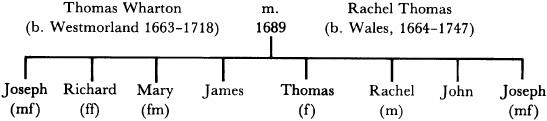
The eldest son was named after the mother’s father, and the eldest daughter after the father’s mother.
A son born of that union, John Wharton, married Mary Dubbins, daughter of James Dubbins. Their children were named as follows:
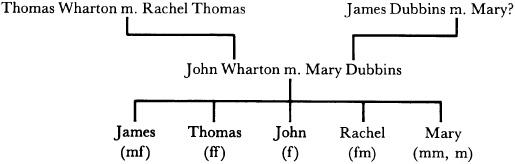
Here again, the grandparents were commemorated before the parents themselves. Further, the mother’s father and father’s mother were the first to be honored.2
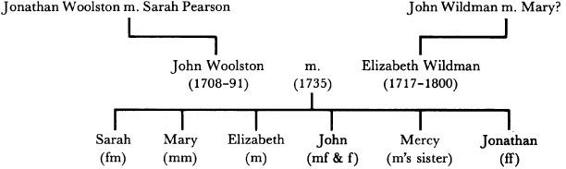
Yet another example was the family of John and Elizabeth Woolston, who married at Middletown, Bucks County, Pennsylvania, in 1735. The eldest children were three daughters, who were named after the father’s mother, the mother’s mother and the mother herself in that order. The first-born son received a forename common to his father and his maternal grandfather; the second son was named for his father’s father. Once again, the descent of names was carefully balanced between maternal and paternal sides of the family.3
A fourth example was the family of Nathan and Hannah Sharples (var. Sharpless), also of Bucks County, Pennsylvania.4

This bilateral descent of names was not universal among Quaker families. But it was very common in the Delaware Valley—more so than in Massachusetts or Virginia. An onomastic equality between husband and wife was more evident in the naming customs of Quaker families than in other Anglo-American cultures. This concern for equality was carried to the point of double-reversing the naming order for children of different genders, so that the first-born female commemorated the father’s line, and the eldest male followed the maternal line. This custom appeared in all but one of the examples listed above. In both the Wharton and Woolston families, boys were named first for the mother’s father; girls were named first for the father’s mother.
Quaker onomastics were also distinctive in the choice of names. Favored forenames often came from the Bible, but the proportion of biblical names was not nearly as strong as among the Puritans. In England only about 50 percent of male Quakers received biblical names, compared with 90 percent in Calvinist families. The leading favorites were John, Joseph and Samuel. Traditional English and Teutonic names continued to be popular among Friends. The extravagant biblicism of the Puritans was tempered by the plain style among the Quakers.5
Biblical namesakes were more common for females than for males. Mary, Elizabeth and Sarah accounted for a large part of all Quaker names, as they did among other English-speaking people. Also popular among Friends were the names Anne-Anna-Hannah, and Esther-Hester, which commemorated two of the strongest feminine characters in the Bible—an outspoken female prophet, and a consort of the Persian King Xerxes. Esther would seem at first sight to have been an unlikely Quaker namesake—reveling as that Jewish lady did in an epic slaughter of the Gentiles. But she also appears in the Bible as a woman of strong and independent character who was devoted to helping the people of God.
These naming choices were not invented in the New World. They were virtually identical among Quakers in England’s North Midlands and America’s Delaware Valley. Through the eighteenth century, males received the same combination of biblical and teutonic names—with John, Thomas, William, Joseph and George the leading favorites among Friends on both sides of the water. Quaker females were mostly named Mary and Sarah in England and America, with Hannah, Anne, Elizabeth, Hester, Esther and Deborah strong secondary favorites. Plain English names such as Jane, and traditional Christian favorites such as Catherine and Margaret preserved their popularity among Quakers, more so than among Puritans. Also exceptionally popular among Quakers in England and America was the name of Phebe, which rarely appeared in Puritan and Anglican families.6
Many Quaker families also made occasional use of grace names for their daughters, with particular favorites being Patience, Grace, Mercy and Chastity. A few families gave them to male children as well. All the names chosen by Richard and Abigail Lippincott for their eight children could be combined into a prayer:
Remember
John
Restore
Freedom
Increase
Jacob
Preserve
Israel
The Lippincotts were a Calvinist family who converted to the Society of Friends.7
Altogether, Quaker names were much the same on both sides of the Atlantic. In its choice of forenames this onomastic system was similar to the Puritans in some respects; but in the descent of names its three-generational rhythm was closer to Anglicans; and its even-handed bilateral descent of names was sui generis. Altogether, the Quaker culture of the Delaware Valley was unique in its customs of child naming.