
 The Delaware Comity: Patterns of Migration, Settlement and Association
On the day after William Penn arrived in Pennsylvania, he called his colonists together, and solemnly pledged to protect their full “spiritual and temporal rights.” In return, he asked only two things. The first was that they should try to stay sober. The second was that they should keep up a “loving neighborhood” with one another.1
This notion of “loving neighborhood” was an ideal of high importance in the Delaware Valley. It became the cultural cement of a special type of comity which combined Quaker ideas and North Midland traditions. This Delaware comity differed from those of New England and the Chesapeake in many ways—in patterns of settlement, migration, association and social bonding.
The ideal settlement in the Delaware Valley was one where every family lived separately upon its farmstead, but was not entirely isolated from others. Houses were to be built in small clusters which became the nuclei of rural neighborhoods—a pattern still to be seen throughout the Pennsylvania countryside.
This form of settlement had long existed in the north of England—a pattern equally distinct from the town life of East Anglia and the manorial villages of Wessex. Nucleated towns were comparatively rare in the North Midlands. So also were landed estates with a great house surrounded by a cluster of close-built cottages. The economy of the northern counties required smaller units and more open settlements.2
In America, this North Midland pattern was modified and reinforced by Quaker ideals. William Penn intended that homesteads should be grouped in “townships” of five or ten “for near neighborhood.” The houses were to be close-built on lots of ten acres, and surrounded by individual farmlands of 450 acres each. The purpose was to combine material autonomy with spiritual community. “Before the doors of the houses,” Penn explained, “lies the highway, and cross it every man’s 450 acres … so that conveniency of neighborhood is made agreeable with that of the land.”3 Near the center of each township, he ordered common meadows and pasturelands.
Penn’s idealized townships were different in scale from New England towns, which tended to be at least six miles on a side and 20,000 acres in area—sometimes much larger. The townships of Pennsylvania were originally intended to cover only about 5,000 acres, and to include only about fifty people. They were not self-governing. The vision of the founder was a quiet open countryside dotted with small clusters of independent farms. By 1685, more than fifty of these little townships had actually been planted in Pennsylvania.
The proprietor’s official policy received a mixed reception from his fellow Quakers. Most liked the idea of private property, fee simple tenure, moderate land grants of approximately the same size, and restriction of ownership to actual residents. But they did not favor nucleated farming towns, communal pastures or common meadows. Against the wishes of their Proprietor, the people of Pennsylvania proceeded to create their own pattern of land distribution: small farms scattered in clusters across the countryside without the common lands that Penn had wished to
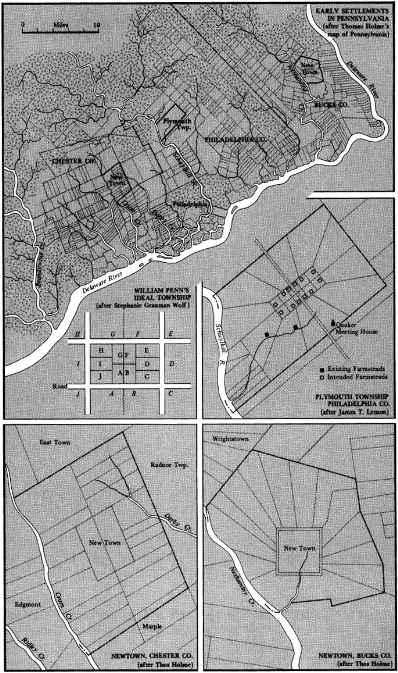
see. In the process, historian James T. Lemon observes that “the Quakers firmly established the pattern for all who followed in the eighteenth century, indeed well into the twentieth.4
Within a generation Penn’s colonists had moved beyond the Delaware Valley into the interior of Pennsylvania where rolling hills and valleys followed one another like waves of the sea. Across this corrugated countryside, the steep and barren hillsides remained uninhabited. Many stand empty even to this day. Each fertile valley became a unit of settlement with a distinct cultural character. A case in point is Big Valley, a beautiful crescent of fertility near the present geographical center of Pennsylvania. Today Big Valley is Pennsylvania Dutch territory. The names on the mailboxes are Zook and Peachey and Hostetler. An eighteenth-century Swiss-German dialect is still spoken from one end of the valley to the other. North of Big Valley across Stone Mountain lies Nittany Valley, which has a very different culture. In the eighteenth century its settlers were Presbyterians and Anglicans who came mainly from the borderlands of North Britain. Today, the young people of Nittany Valley still unconsciously pronounce some of their vowels in the old north British way. Very few Quakers settled in either of these places but patterns of settlement in Big Valley and Nittany Valley were similar to those that English Friends had planted on the banks of the Delaware. This Pennsylvania pattern became typical of an entire American region.
A similar tendency also appeared in patterns of internal migration. A distinctive “migration regime” was introduced to the Delaware Valley by English Quakers. Rates of geographic mobility were higher in this region than in Massachusetts or even Virginia. Most of this incessant movement consisted of local, short-distance migration.5
Here again, the Delaware Valley resembled England’s North Midlands. Studies of migration in England do not easily admit of controlled comparison with America. But comparable evidence exists for the parish of Clayworth (Nottinghamshire) in the midland region which contributed so heavily to the peopling of Pennsylvania.
It is interesting to observe that rates of persistence in Clayworth were almost exactly the same as in Pennsylvania’s Chester and Lancaster counties.6
These patterns of migration and settlement also supported a distinctive system of association. The comity in Pennsylvania was not as close or interactive as in New England, or as intense as the court days and county meetings of the Chesapeake colonies. Quaker meetings cautioned their members against “needless” socializing. The Morley women’s meeting urged that “friends keep clear in needless visits to the World, or to one another, in their childbed or other times, in giving or receiving [visits] where there is no need.”7The Cheshire quarterly meeting agreed:
A question being put to this meeting whether frequenting christenings, gossipings, housebringings and such like festivals justifiable or allowable, the Answer is no, and the judgment of the meeting is that no such thing ought to be practised that if any friend be found in the practice thereof that care be taken speedily to deal with them.8
The diaries of individual Quakers showed similar attitudes. John Kelsall entered into his journal, circa 1700, “I could not endure to see people take too much liberty in talk, laughter and such like things.”9 In the same spirit, American Quaker Anne Cooper Whitall wrote:
Converse as much as may be with God, with his holy Angels, with thy own conscience: and complain not for want of company. … Decline you may crowds and company, for frequent discourse, even of news or indifferent things, which happens upon such occasions, is sometimes destructive to virtue.10
Many Quakers were uncomfortable about “keeping company,” even with other Friends.
Still, Penn’s idea of “good neighborhood” was held in high esteem. “Useful” gatherings were encouraged. “Raisings” of meetinghouses and barns and homes were common among both English Quakers and German Pietists from an early date in the eighteenth century. These raisings were a classic form of “needful” association.11
Rhoda Barber also remembered from her youth in early eighteenth-century Pennsylvania the affection that existed among the Quaker families of her neighborhood:
The place not being as closely settled as now people seemed more affectionate to each other. I well remember when a death anywhere in the neighborhood seemed to cast a gloom over all even if it was the lowest class, and some of every family must attend the funeral. The neighbors for many miles around all were known to each other. A person from a distance was easily recognized and excited curiosity to know who they were and from whence they came.12
The Quaker comity, as historian Sydney James has taught us, was conceived as a system of association for “a people among peoples”—that is, “an organized segment of the population which kept morality and good order in its own ranks, expected no special favor from the government, and thought other elements should do likewise.” This pluralistic ideal came to be generally accepted throughout the Quaker colonies. It was not the product of ethnic expediency, but a highly principled idea, supported by strong moral imperatives.13
Local comities multiplied rapidly in Pennsylvania. The countryside, in consequence, took on an exceptionally open character. But the internal structure of each comity was tightly closed and strictly regulated. Reputation became all important in this system. For Quakers, a good reputation was a matter of “honor.” Loss of honor created intense feelings of shame.
Quaker ideas of honorable behavior were far removed from what historian Bertram Wyatt-Brown calls “primal honor.” They had nothing to do with the celebration of valor, or virility, or the exaltation of rank. Honor in that sense was the opposite of Quaker values.14 But in another way Quakers were as deeply mindful of “honor” and “reputation” as others of their age. Thomas Mifflin was set to writing in his copybook about “the sense of honor, by which we regard the approbation of men, and are uneasy under censure.”15 Isaac Norris explained his hesitation in a business transaction by writing, “I can’t tell if it would be accounted honorable if we should be concerned in shipping upon your order.”16
A Quaker’s honor was far removed from the code of chivalry that existed among Virginia gentlemen. It was also not the same as the contractual code that was kept by New England’s specially elected saints. Instead it was a reputation for Christian love, peace, “good neighborhood,” godliness, and doing good to others. As such, it became profoundly important to their comity. Joseph Oxley instructed his children:
There is much beauty in beholding brethren and sisters living in love, endeavoring to help one another, as occasion may require … in so doing, my children, your peace will flow in upon you abundantly, and your reputation and honour will be renowned among men. The Lord will delight himself in you.17
In this culture, as in every other of the same era, “reputation and honor” were urgently important. When a Quaker lost honor, he was compelled to stand before his brethren and to “take shame upon himself,” or be expelled from their association. The social operation of honor, reputation and shame was similar in some respects among Quakers, Puritans and Anglicans in the seventeenth and early eighteenth century. But the substance of these social ideas differed very much from one group to another.18
In all of these many ways, the interplay of North Midland experiences, Quaker ideals and the values of a generation combined to create a very special comity in the Delaware colonies. The topography of Pennsylvania imposed its physical frame; North Midland experiences defined different orbits of association and levels of internal migration; Quaker beliefs contributed a pluralistic ideal of “a people among peoples,” and also an austere conception of comity in which a special conception of honor, reputation and shame played a major role. Many of these characteristics persisted in midland America for many generations. Some survive even today.