
Bombshell is a delightful pre–Code screwball comedy. It is at once a zippy, aggressively paced comedy with one of early film’s most glamorous comediennes, while also being a sharp-edged and angry satire about Hollywood power dynamics and women’s sexuality. It is also an M.C. Escher-like knot of in-jokes and life-imitating-art-imitating life self-referential whorls. It is a bubbly, bitter comedy emerging from the intersection of two great comediennes, whose earthy sexuality was both their ticket to stardom and their downfall; two women whose careers were tragically destroyed before they reached the age of 30 but who managed in that short window of time to permanently etch their names and memories into pop culture posterity. You’ll be hard-pressed to identify 90 minutes of celluloid that accomplishes more than this.
The story begins with Clara Bow—we can summarize her key biographical details swiftly: the hardscrabble beginnings, the breakthrough moment when her natural charisma was discovered, the struggle to hold together a stable sense of self with such a poor support structure. Her mother institutionalized for mental illness, her father an overbearing stage dad leeching off her success.
And then comes British romance novelist Elinor Glynn and her book It which coined a euphemism for sex appeal—the 1927 movie version cast Clara Bow in the lead and permanently identified her as “the It Girl.” But here’s the thing about “It”: like being cool, the key is the unselfconscious nature of it. Try too hard to have “It” and you won’t. Having “It” does not mean being beautiful or handsome—there are plenty of beautiful people who seem to belong to another species altogether. That’s an unattainable beauty. The “It Girl” is real, tangible, available. To quote Playboy’s tagline from a subsequent generation: The Girl Next Door.
This had consequences. Becoming the “It Girl” made Bow’s sex life part of her public image, made it public property. With it came the slut-shaming rumors: that she slept with men, women, and dogs, she did it in public, she did it with multiple partners, she did it with the entire football team. Some of the people who spread these salacious lies went to jail for it—her secretary was convicted of blackmail, the editor of a tabloid paper was jailed for printing lies. But the problem was not all of it was lies—she did replace her partners the way some women changed their shoes, she was friendly with an entire football team—and those fragments of truth within the lies kept them alive.
The scandals destroyed her career. By the age of 28 she was forced into retirement and never made a film again.
Playwrights Caroline Francke and Mack Crane were fascinated by this American tragedy, and the irony of a woman whose sex appeal was specifically cultivated by Hollywood as a marketing hook, and then she was punished for it. A lot of people made a lot of money off of the very traits in Bow they criticized in her. The writers turned this into a thinly-veiled play, which they called Bombshell.
The play was never produced, but it was picked up by director Victor Fleming to be adapted into a film. Fleming had a special interest in the material—he had been through the revolving door of Bow’s affections and recognized the “Lola Burns” of the play. But he rejected the dramatic emphasis of the play in favor of a comic treatment—you could sell the anger much better, he figured, by packaging it within satire.
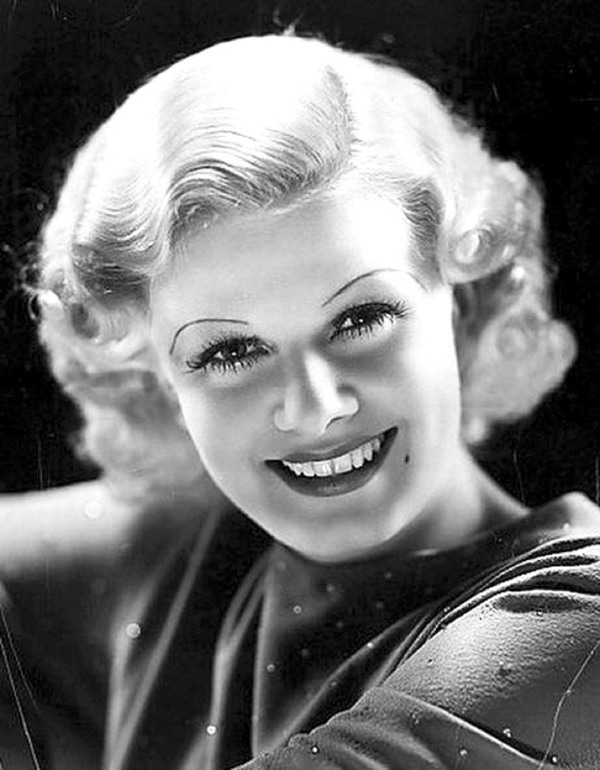
Jean Harlow’s real-life experiences became the background for screwball antics in Bombshell (1933).
Enter Jean Harlow. She too had some personal insight into the subject matter—her first speaking role was in Clara Bow’s The Saturday Night Kid. Moreover, she lived the life herself: she had the same hardscrabble roots, the same parasitic family leeching off her hard work, the same scandal-laden sex life.
Harlow had started off as a bit-player in slapstick comedies—appearing briefly with the likes of Laurel and Hardy or Charlie Chaplin, a bit part in an early Lubitsch film, and struggling to get taken seriously. Variety rudely summed up her prospects: “It doesn’t matter what degree of talent she’s got—nobody ever starved possessing what she’s got.”
Starting up a relationship with MGM executive Paul Bern was a good career move for a while, and led to an MGM contract and better-appointed films. But when Bern was found shot in her home, the questions started flying: had she killed him? Did he kill himself? Had some other ex-lover killed him and then MGM fussed with the crime scene to make it look like a suicide?
Together, Fleming and Harlow turned Bombshell into a sharp-witted and breezy comedy, that went beyond the contours of satirizing the rise and fall of Clara Bow. Early in the film, Lola is told she has to report to the set for retakes on Red Dust, an actual film that Harlow had just finished shooting. Her love/hate interest, smarmy PR guy “Space” Hanlon, was played by Lee Tracy in a spoof of actual MGM publicity chief Howard Strickling.
Behind the scenes, poor Jean Harlow couldn’t help but slip into mimicking her on-screen character. During post-production, she married her cinematographer Hal Rosson—a marriage that lasted only a year. During production, MGM script clerk Morris Abrams rolled his eyes at the way Harlow’s lazy, indolent family fatted themselves off her money while she worked a grueling schedule—just like the scenes she played in the film. “They were parasites,” he clucked.
Both Bow and Harlow had a sex appeal that relied in part of their earthy, unrefined ordinariness. Just as It turned Bow into the It Girl, Bombshell branded Jean Harlow with a lasting nickname—The Blonde Bombshell. And, like Bow, Harlow’s career burned out not long after—Harlow succumbed to kidney failure and died at age 26.
It’s unclear what would have happened to Harlow’s career had she lived. She was a top box office draw in the early 1930s, but the onset of the Production Code posed a problem for her. The kind of movies in which she had excelled were now forbidden, the public persona she developed was on the outs. Before the moralists came along to claim this independent and talented young woman was a threat simply for being who she was, her sexuality had made a lot of men very rich. She made blockbuster after blockbuster, she was a top marquee name for years—and she was such a role model for young women that sales of hair dye spiked as millions of fans tried to mimic her signature look.
Harlow glows in Bombshell—true to the screwball template, she anchors a comic ensemble wherein she holds her own against a large number of male (and some female) costars. For a film made two years before It Happened One Night, Bombshell surprisingly fits in almost all of the requisite screwball ingredients. For example, Harlow’s character is trying to get together with a smarmy European count that everyone else can see is wrong for her.1 There are various and sundry slapstick ex-pats in supporting roles—such as Three Stooges founder Ted Healy as Harlow’s belligerent brother, or former Harry Langdon-copycat Billy Dooley as an obsessive stalker fan. Most of all, this is an aggressively paced barrage of fast-talking and lies, fast thinking and schemes, as a boy and a girl attack each other over the course of 90 minutes as a form of combat-laden courtship … except…
That’s not quite accurate.
There is something missing, an element of true screwball that is isn’t fully developed here. Most of the best screwballs involve a crazy lady unleashing havoc on the men around her, and the consequence of her chaos is happiness. Here, for all that Harlow does to anchor and dominate the film, she is the recipient of the chaos whipped up by unethical PR man Space Hanlon (played by Lee Tracy). He either directly instigates every chaotic surge or he pours fuel on a fire set by someone else to ensure it blazes out of control. And all this abuse is to deny Harlow her happiness. The film ends where it began, with her and Lee Tracy back at square one, in a perpetual hamster wheel of comic cruelty.
The world of screwball comedy will eventually perfect this tricky formula, and deliver a comedy film about a “romantic” couple incapable of being together and incapable of being with anyone else either because of their irredeemable cruelty and selfish oblivion—and it will be one of the greatest comedies of all time. But we’re not there yet.