
Let’s start with a rarely seen 1940 screwball comedy, Roy Del Ruth’s He Married His Wife. While I won’t pretend that this is anything but a minor but somewhat enjoyable trifle, there’s something rather weird about it that deserves discussion. A number of social scholars—admittedly some of them film historians, but quite a few of them not film people at all—have written about this movie in a specific context: how Hollywood treats romantic love.
The “he” of the title is horse racing mogul Joel McCrea. His preoccupation with—and incompetence at—the horse trade crowds out any other consideration. Ex-wife Nancy Kelly grew weary of perpetual also-ran status in her husband’s life, and divorced him. Ironically, divorce provides her with the opportunity to force her way higher on his list of priorities: as he is now committed to a punishing monthly alimony, he can’t help but think of her constantly. McCrea conspires with his lawyer Roland Young to end the alimony by getting Nancy married to someone, anyone—say, their mutual friend Lyle Talbot. The plan goes awry when she snubs poor Lyle for a flashy, oily gigolo Cesar Romero. McCrea starts to realize he cares about something much more than horses or alimony … (there’s no real surprise where any of this is heading—just check out the title of the movie if you have any questions).
What makes this interesting to social commentators is that the idea of making a romantic comedy about a divorced couple getting back together didn’t just happen the once, or even twice—it’s an idea you’ll find in: The Awful Truth, (1937), The Philadelphia Story (1940), My Favorite Wife (1940), His Girl Friday (1940), Mr. and Mrs. Smith (1941), That Uncertain Feeling (1942), and Palm Beach Story (1942). Add He Married His Wife to that list and you have eight such comedies within five years, four of them appearing in 1940 alone.
Stanley Cavell’s acclaimed and influential 1984 book Pursuits of Happiness: The Hollywood Comedy of Remarriage (derived from a series of scholarly articles he published earlier) posits the suggestion that these films represent an effort by Hollywood to redefine marriage as something driven primarily by romantic love, rather than economic or religious reasons. These films depict couples who have forged deep bonds, that even when tested by separation do not sever.
There’s certainly something striking about finding so many of these things all at the same cultural moment—but that very fact gives me pause. The sudden flurry of their appearance suggests that they are actually copying each other. Furthermore, the fact they are all screwball comedies deserves some consideration. Maybe there’s something about the nature of how screwball works that led to these, at this specific moment.
The first thing to remember is that screwball comedies are formula-driven film vehicles designed to sell a particular kind of entertainment. Just as silent slapstick would cook up whatever narrative structures allowed the likes of Buster Keaton or Harold Lloyd to then go about and do their acrobatic stunts, screwball plots are there to provide the backdrop for the likes of Cary Grant and Claudette Colbert to fight with each other in silly ways. The tricky balance to be struck is to make sure that the combat is actually good-natured enough to serve as flirtation, because if it veers too far into mean-spirited antagonism then a final-reel reconciliation becomes too difficult to accept. Conversely, if the combat is too good-natured and flirtatious, then how come the couple doesn’t just get together right away?
One way of getting a full 90 minutes of entertainment out of comic antagonism is to let it be as flirtatious as possible, and generate as much chemistry as possible between the leading players, but concoct some additional narrative complication that keeps the couple apart. The most venerable, the most commonly seen complication of this sort is to have one or both of the couple already engaged to someone else—and on top of that, to have that pre-existing commitment be between social peers, while the romantic attraction that the film is keeping in abeyance is one that crosses social classes.
The prototypical example is It Happened One Night: Claudette Colbert is a spoiled rich girl who’s engaged to a smarmy European count. Their relationship, although icky and phony, is between upper crust socialites and European royalty. Colbert may be falling in love with the rogue-ish journalist Clark Gable, but he’s not in her league, and that right there provides enough of a barrier that their increasing attraction and intimacy cannnot easily overcome. The entire infrastructure of society has an investment in keeping them apart. There’s an added bonus to this narrative structure, too: watching their love overcome that class barrier is cathartic, it’s democratic, it’s utopian. Films that follow this pattern don’t see the lower-class lover of the runaway heiress as a Cinderella man—instead it’s the reverse. The poor man saves the rich girl (or poor girl saves the rich man).
Across the catalog of screwballs we see this pattern repeated, with earthy values redeeming the airless rich: It Happened One Night, My Man Godfrey, A Girl, a Guy, and a Gob, Next Time I Marry, Design for Living, Fifth Avenue Girl, Holiday, Bachelor Mother, Midnight, Slightly Dangerous, Easy Living, Ninotchka, Theodora Goes Wild…. But it couldn’t last forever, and the demand for screwball comedy exceeded the audience’s patience with variations on the runaway heiress theme. Other recipes were needed—but they needed to be new recipes that delivered the same fundamental flavor: an excuse for an attractive couple to fight for nine or 10 reels before getting together romantically.
The so-called Comedy of Remarriage offered just such a viable twist: the divorced couple could be introduced with the given that they were romantically compatible, but that circumstances drove them apart. We already know they were once in love, and we know that something substantial broke them apart—so their banter can be excessively flirtatious without easily resolving whatever has already separated them. Plus, as an added bonus, it becomes possible to easily expand the cast—films like He Married His Wife, Palm Beach Story and Philadelphia Story don’t just have love triangles, they have love quadrangles. (I liken this to the habit of superhero films of upping the ante by adding villains.)
The Comedy of Remarriage doesn’t need to invoke any class differential between the parties (some do, some don’t), because the divorce itself is doing the heavy lifting of keeping the lovers apart even as they grow together.
There’s something else, too—by their nature, these films begin with the main characters already established as sexually-active adults. They break apart, and experiment with other partners. For films made under the Puritanical restrictions of the Production Code, this was as close as you could get to making movies about adultery. The Comedies of Remarriage have a palpable sexuality to them rarely found in their other screwball peers.
But this brings us back to Stanley Cavell and the concept that these films represented a significant step in establishing the idea of “romance.” The structure of these films stack the deck against the main characters as a couple: something has already challenged the integrity of their marriage, and they have viable alternative partners. Isn’t adultery supposed to be the thing that dooms a union? How could anyone get back together after such a thing? But no matter how the deck is stacked, our screwball couples are drawn together because of something that defies objective, rational explanation.
In other words, love. Screwball comedies define love as the irrational, ineffable force that brings people together against all odds—and which resists even the most energetic threats. Previous generations had defined marriage in terms of social standing, economic necessity, and religious expectations. The screwball couples tossed all that out the window in favor of crazy, stupid love.
Virtually the entire genre of screwball comedies is predicated on a woman facing two possible life partners, one of whom is an ideal mate in objective terms, the other a total wild card. The so-called “ideal” mate turns out to be dry and uninspiring, while the rogue is a locus of passion. As it happened, Ralph Bellamy became the genre’s “go-to” actor to play this sort of role.
Ralph Bellamy had such a massive and sprawling career that you could be a huge Bellamy fan and not actually have seen some of the movies I’m going to talk about—even though Bellamy was a major force in the development of the screwball comedy, and was so singularly associated with it he became a punchline in and of himself.
It starts with Hands Across the Table in 1935—which is inexplicably underrated given its significance in the evolution of screwball. Ernst Lubitsch had taken over as chief of Paramount, and one of the first things he did was note that Carole Lombard was being grossly misused in romantic dramas that emphasized her glamour and beauty but ignored her singular comic gifts. This won’t stand, he said, and promptly orchestrated the production of the giddy farce Hands Across the Table, directed by Mitchell Leisen (another underrated comedy force).
The premise of Hands Across the Table is that Carole Lombard is looking to marry a rich guy so she can find some economic stability in her life, and while she’s trying to engineer this jump in social status, she is living platonically with Fred MacMurray, who is also looking to marry for money for much the same reason. Of course, the thrust of all this is to show how marrying for love is better than marrying for money, and she and Fred MacMurray are truly soul mates who belong together.
That it even makes sense to have a movie that argues people ought to marry for love instead of money speaks to the fact that social attitudes about romance and marriage have really changed over a short period of time. It’s almost as odd as running across a story that bothers to argue why child slavery is wrong. You almost feel like saying, “Duh!”
That being said, the movie doesn’t make the distinction easy. Fred MacMurray may be obviously the right guy for Carole, but her potential sugar daddy Ralph Bellamy is not obviously the wrong guy. He’s a profoundly decent, forgiving, loving, upright gentleman. Rejecting him is hard, and that’s what gives the romantic triangle its bite.
Bellamy proved himself excellent at playing such roles, and was quickly typecast as the earnest good guy who the female lead would reject in favor of the dangerous bad boy. As time went on, Bellamy’s performance of such roles drifted more and more into comic interpretations of what was originally designed as a straight-man role.
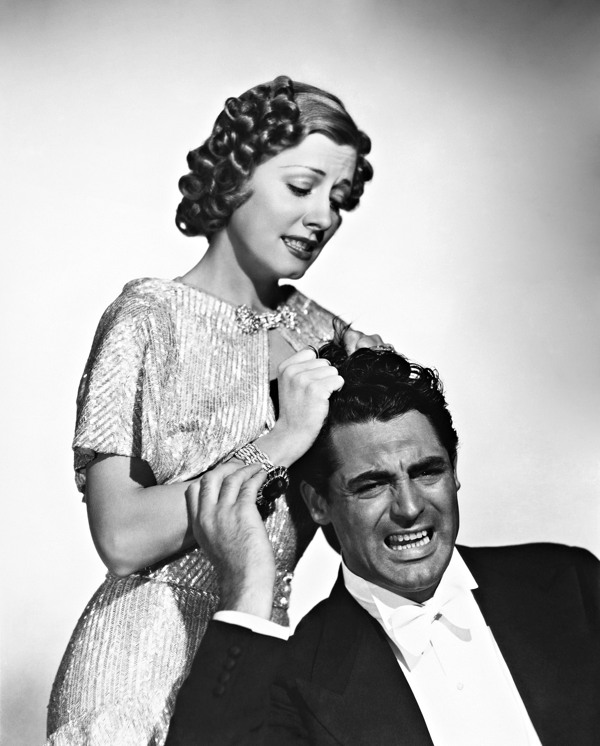
Irene Dunne and Cary Grant get in each other’s hair in The Awful Truth (1937).
Consider Leo McCarey’s The Awful Truth from 1937. Cary Grant and Irene Dunne start the thing off by getting divorced, foolishly, and then spending the rest of the film proving that if they aren’t good for each other, they’re way worse for everyone else. So Irene Dunne has as her new beau that bastion of wrong-right-manliness, Ralph Bellamy—all rich and decent and irksome in every respect.
It was in Stanley Gardner’s 1942 Lady in a Jam that Bellamy finally became the punchline he was already barreling towards. Because this movie is less well known than the others described above, let me spend a little time setting the stage:
Irene Dunne plays a spoiled rich girl whose irresponsible behavior has bankrupted her, but she is too self-absorbed to even realize the reality of her situation. Patric Knowles plays a psychiatrist who has developed a thing for her and wants to help her, but she can’t stand him. Already this is a bit of a deviation from the usual pattern, because Knowles is the “right” guy for her, but he also represents stability and reasonability, where these movies usually push their heroines into unstable and high-risk romantic relationships as their celebration of the power of love. So already the structure of this film means that Knowles’ rival for her affections will be a deviation from type…. But look, it’s Ralph Bellamy! Or more precisely, it’s some bizarro-world counterfeit of Ralph Bellamy, whose over-earnestness has gone over the edge into outright weirdness. He is a ridiculous parody of the uber-decent rural rube, with the added conceit that he’s obsessed with composing the perfect “lament” with which to woo her (his first lament wasn’t quite sad enough, he thinks).
Ralph Bellamy and the other Right Wrong Men of his ilk always looked good on paper—financially secure, decent, from solid loving families, earnest, respectful, from the right social class. All the boxes were ticked. By contrast, Cary Grant specialized in playing the rogues—misbehaved men who utterly failed to tick any of the boxes, but who were nevertheless clearly the Wrong Right Man.
For all these wacky couples, disregarding social norms and looking for the spark of true love at all costs, it’s just a good thing they didn’t have any children to get caught up in the shenanigans. Except, of course, when they did…
Ralph Bellamy may have earned an Academy Award nomination in The Awful Truth for playing the “Right Wrong Man”—but if you really want to celebrate the best supporting performance in that film, you need to be looking at Asta the Dog. Or to be pedantic—Skippy the Dog. Like all good movie stars, he was born with one name and became a screen icon under another. Norma Jeane Mortenson became Marilyn Monroe, and Skippy the Dog became Asta. According to online legend, Cary Grant got mixed up and calls the dog “Skippy” during The Awful Truth—but I’m not so sure. The scene in question finds Grant and his ex-wife Irene Dunne battling in court for custody of their dog Mr. Smith, and the judge asks each of them to call to the dog. Whichever one the dog picks, wins. Grant proceeds to unleash a barrage of variations on “Mr. Smith,” including “Smithy” and “Schmitty,” all while Dunne is calling out her own variations. I can see how this could sound like “Skippy” but I don’t think any mistake was made (perhaps I’m wrong and I just missed it).
The important thing about this scene isn’t the dog’s name, but his role as the child substitute in their family. This is in fact the role Asta was typecast in. And let’s be clear on this—Asta was an icon of screwball comedy with an absolutely impressive resume. In addition to The Awful Truth he’s in Topper Takes a Trip with Roland Young and Constance Bennett, Bringing Up Baby with Cary Grant and Katharine Hepburn, The Thin Man and After the Thin Man with William Powell and Myrna Loy, and The Big Broadcast of 1936 with George Burns and Gracie Allen, Bing Crosby, and others. And that’s just a sampling of his career.
Is career a funny word to use when talking about a dog? We’re talking about an individual who was professionally trained specifically to work in films (he was taught to respond to hand signals so he could be cued in his scenes without disrupting the dialog). He had his own fan base: He was one of several animals profiled by the 1936 book Dog Stars of Hollywood, not to mention his own puffball promo piece in The American Magazine in 1938, “A Dog’s Life in Hollywood.” He even has a fan site on the web today. And he was paid—handsomely, even. $200 a week in the 1930s (plus another $60 for his trainer) was an order of magnitude above what other dog actors got at the time—which shows what an asset he was in and of himself, because why else pay Asta $200 a week when there are plenty of identical looking dogs available at a fraction of the cost?
Indeed there were plenty of identical looking dogs to choose from—Asta’s over-enthusiastic fans went so gaga for wire fox terriers that the breed spiraled into a tragic overbreeding situation. Despite this, however, Asta-alikes only started appearing on screen when the real one retired in 1939, at the age of eight. And you wanna know something? The first time I saw Another Thin Man, I just knew that wasn’t the same dog. He was billed as “Asta,” and sure looked like him, but there was just something off, something missing. This, coming from someone who’s never had a dog, and who routinely misidentifies actors (in my commentary track to Syd Chaplin’s A Submarine Pirate, I openly questioned whether Harold Lloyd even appears in the movie, and said this nonsense during Lloyd’s scene). If even a schmo like me can tell the real Asta from his copycats (copydogs?), then you know you’re talking about an exceptional dog.
Hollywood has had many animal stars, and apparently there were enough canine actors in the 1930s to justify an entire book. But out of this pack, there was just one Asta.
Asta had the distinction of appearing in two films from the curious sub-genre of remarriage comedies, which put him in the same league as other “remarriage” mainstays like Cary Grant, Katharine Hepburn, and Spencer Tracy. As noted above, Comedies of Remarriage are films about married couples who break up, experiment with other romantic partners, and then get back together. Stanley Cavell argues that these films promoted a new conception of marriage as something built on mutual love, rather than religious or economic standards. The thing is, while this is true, it also happens to be true of screwball comedies as a whole. What “remarriage” added to the mix was sexuality—in films like The Awful Truth, we have a married, sexually active and experienced couple, who try out alternative partnering arrangements, and then reunite. In other words, a thinly veiled metaphor for adultery, designed to pass the censors.
Remember, though, these are comedies. Frothy, light-hearted things—and they evolved out of silent slapstick, to boot, so they aren’t intended to bear much in the way of heavy emotional weight. So, these films needed something to take the sting out of their adulterous themes. If Irene Dunne and Cary Grant are going to sleep around and then decide that, having sampled the alternatives, they really were happier together, that’s a potentially explosive and emotionally fraught premise. There’s real dramatic risk at the heart of that. So, the couple has a tether to a normal domestic life—a reminder of what’s at stake, a totem of the happy home they need to resurrect. Not a child—a child could be traumatized by these shenanigans. Audiences would object to watching Irene Dunne go swanning around in her fancy ball gowns, neglecting her kid. But a dog is enough like a child, without being too much like a child. Asta, as Mr. Smith, is the child stand-in—they even have a custody battle over him—but there’s no fear that the romantic adventures of the divorcees will damage him.
In fact, Asta plays this same faux-baby role in most of his screwball comedies. He’s the domestic anchor that roots the stars in something recognizable as a family, freeing them to act even more ridiculous and immature during the middle reels.
Which brings me back to Another Thin Man, the film where I spotted the low-calorie Asta substitute. This was the third film in the “Thin Man” franchise, and by this point the filmmakers figured having William Powell and Myrna Loy drink their way through an absurdly over-complicated murder mystery wasn’t enough, so they added a baby to the mix—Nick Charles, Jr. Of course the real Asta had to retire here—putting a real baby into the film by definition forced Asta out. You can’t have Asta playing alongside a child because it’s like casting Claudette Colbert and Irene Dunne in the same film—they end up playing two versions of the same character and unbalancing the film.
So in 1939, Asta stepped down. His owners and trainers, Henry East and Gale Henry, took him into retirement to enjoy his sunset years, ceding the stage to his knock-offs. Henry and Gale (or do I mean East and Henry? I get confused) kept on training dog actors—they were responsible for most of Hollywood’s canine stars—but they never had another hit like Asta. He was a unique combination of talent, charisma, and cultural zeitgeist that all came together in just the right way.