
Once upon a time there was a Hollywood director at the top of his game. He made movies that were widely popular, influential, critically esteemed, and profitable. He was a visual stylist and a practitioner of high Hollywood glamour. He coaxed great performances from top stars. He was on the short list for producers looking to staff their prestige pictures. Say the name “Mitchell Leisen” today though and be prepared for blank stares.
So what happened? How did someone who flew so high fall into such obscurity? Ironically, the answer is his own success.
Don’t fret if you can’t rattle off a list of Mitchell Leisen films off the top of your head, let me give you a cheat sheet: Death Takes a Holiday, Murder at the Vanities, Hands Across the Table, The Big Broadcast of 1937, Swing High Swing Low, Easy Living, The Big Broadcast of 1938, Midnight, Remember the Night, Artists and Models Abroad (the sequel to the Jack Benny everything-but-the-kitchen-sink blow-out several chapters ago)… This is nowhere near a comprehensive list, but I think it hits most of the highlights.
He was responsible for taking glamour queen Carole Lombard and reinventing her as a comedy star. He directed Jack Benny, Burns & Allen, Zasu Pitts, W.C. Fields, Jean Arthur, Fred MacMurray, Claudette Colbert, Ginger Rogers, Paulette Goddard, Thelma Ritter … the list goes on. And that’s just to discuss the films he directed. Mitchell Leisen spent decades as a premiere art director and costume designer. In short, we are talking here about an accomplished artist with an outstanding career. But let’s take a closer look at some of those highlights and see what happens upon closer scrutiny.
For example, Hands Across the Table. This is one of my go-to screwball classics when trying to explain the genre to newcomers. It’s not my favorite, nor is it the funniest, but it is by far the most representative. It Happened One Night gets all the attention for being the breakout hit that defined the genre, but the cycle of comedies that spun out of its success went pinging off in all kinds of other directions such that it doesn’t seem quite like the things it inspired—whereas Hands Across the Table manages to pack in practically every ingredient and approach of the genre as a whole. Which sounds a bit like I’m calling it generic, but not at all. I’m saying it’s more of a point of inspiration than the Capra film, and if anything about it feels overly familiar today it’s because what it did so quickly became standard.
But how much of the credit goes to Leisen? Precious little, because all the attention typically goes to Carole Lombard. This was a mid-career swerve for her, and she demonstrated such peerless comic confidence it was an absolute revelation. To the extent film historians look behind the scenes to understand how Lombard made the switch to comedy, they usually settle on Paramount studio chief Ernst Lubitsch, who apparently was pushing Carole towards comedy and insisted the script be rewritten specifically to write to her strengths.
Now consider Easy Living, which is in my opinion a contender for funniest screwball comedy, but is usually thought of a pseudo-Preston Sturges film. Sturges had written the screenplay, which had become something of a cause célèbre around Hollywood before the film was made. Producer Arthur Hornblow knew he had a blockbuster script on his hands, and turned to ace director Leisen to nurture it to the screen. But because Sturges had written something that was self-evidently a hit before a single frame had been filmed, when he started insisting he be allowed to direct his own material, it was hard to refuse him. That’s certainly the story Sturges told—that he stood on the sidelines throughout the production of Easy Living, fuming at how this journeyman hack was butchering it. Any deviation from his script was like a knife, and he was dying a death of a thousand cuts.
Then we come to Midnight. From a script by Billy Wilder and Charles Brackett, Midnight stars Claudette Colbert as a down-and-out chorus girl who arrives in Paris one night having lost the last of her money at a Monte Carlo casino. Unable to find a job, she sneaks into a fancy society gala by cooking up a phony identity as a baroness. Weirdly, every time her deception seems due to be discovered, she is spared from humiliation thanks to a variety of supporters who help maintain her disguise, for reasons of their own. It’s a Cinderella story in which the princess isn’t going to be forced back to her life of poverty—it’s a question of whether she will choose that life all on her own.
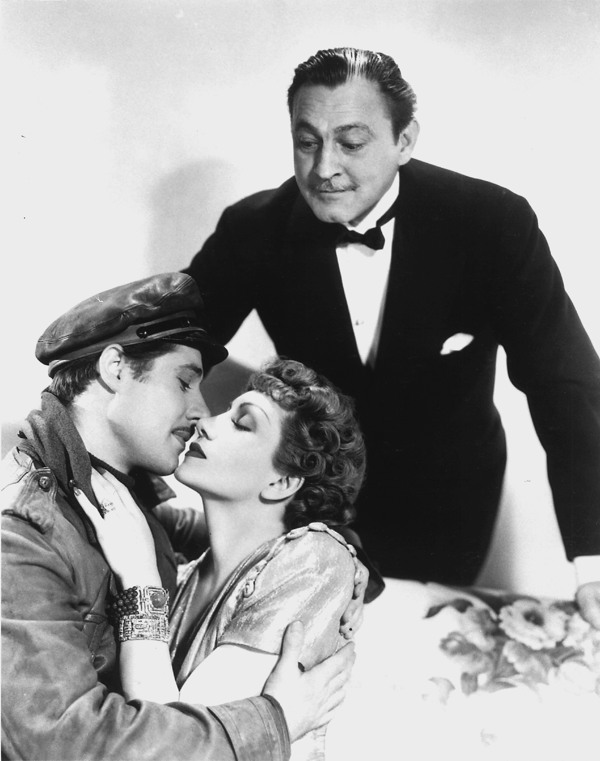
John Barrymore watches over Don Ameche and Claudette Colbert in a publicity still from Mitchell Leisen’s Midnight (1939).
Like Sturges’ backstage agony at Easy Living, Billy Wilder raged at what he saw as Leisen’s incompetent mishandling of the material. Just as Sturges was motivated by the experience to become a director, Wilder too determined to avoid a repeat of the experience and willed himself into the role of director.
That was the beginning of the end for Leisen. Not professionally, mind you—he remained an active and respected director through the 1950s. But in terms of posterity, Leisen’s memory would now be sullied by the likes of Sturges and Wilder. As their stars rose, they continued to tell of their displeasure at Leisen’s directing of their early scripts—and as they became legends, their petty grumblings were preserved and widely distributed.
But did they have a point? How would Midnight or Easy Living have turned out without Leisen? Well, probably not as good. You see, both films are Cinderella stories (although Midnight is more self-conscious about that fact) that drop their heroines into a world of opulence and luxury, contrasting that high life with their humble origins and the rough Depression-era economy outside. In other words, both have a distinctly visual component and a fundamentally human one. These are not characteristics you think of when you think of Preston Sturges or Billy Wilder. Their genius lay in other areas.
Leisen had risen into the world of directing from a background in art design and costuming. Sturges criticized him for worrying about the placement of lamps on the set over the timing of slapstick pratfalls, but this isn’t a proper criticism. Easy Living gets much of its power from the absurd over-the-top luxury of her new penthouse lifestyle. Getting the lamps right is part of the comedy, as much as the slapstick pratfalls.
It should also be noted that Leisen was also a rare openly gay man in 1930s Hollywood, who knew first-hand what it meant to yearn for acceptance and peace as an outsider (Leisen was nominally married to singer Sondra Gahle, but they lived apart and his relationship with Billy Daniels was not hidden. Daniels had a bit part in Midnight and began to appear in and collaborate on Leisen’s films from there on). Leisen brought a humanity and a graceful openness to his characters, which might have been at odds with Billy Wilder’s harsh cynicism, but that was ultimately to the better of the material.
In both Sturges’ and Wilder’s self-directed works, the characters tend to come off as programmatic pieces on a comic chessboard, manipulated for specific effect. Leisen brought a warmth to the proceedings, and did so within a context of visual stylization and eye candy that made his films at once earthy and ethereal.