
The first film in the “Mishaps of Musty Suffer” series, Cruel and Unusual, appeared in theaters on March 1, 1916. For the next two years, Musty Suffer’s mishaps unspooled over a raucous cycle of unruly two-reel shorts, full of surreal imagery and violent slapstick. Largely forgotten today, but available to the curious in an outstanding set of DVDs, the Musty Suffer films are remarkable both for what they are and also for what they are not. They are artifacts of what happens when talented and inventive people go significantly out of their way to take the road not traveled. And to understand just why these singular oddities deserve special attention beyond their immediate joys, we need to focus on the significance of that date—these would make sense if they’d been a few years before, or a few years after. But 1916? That’s just nuts.
Last chapter focused on the extraordinarily long shadow cast by Charlie Chaplin, and just one manifestation of the immense influence he had on other comedians and filmmakers. The story of Musty Suffer is the mirror image of that—instead of an influential artist whose genius is acknowledged, this is the tale of a forgotten weirdo who never meaningfully influenced anyone else.
But this is in itself a puzzle of sorts.
We start with Harry Watson, Jr., the titular “Musty Suffer” himself, a turn-of-the-century vaudeville comedian from a theatrical family. Like many vaudevillians of his day he was drawn to the allure of the new world of movies, and joined with early cinema pioneer George Kleine to make some feature comedies in early 1915.
We haven’t gotten very far into our story before hitting another anomalous date—recall from a couple of chapters ago that it isn’t hard to find a source that claims that the very first feature comedy in American movie history was the Charlie Chaplin film Tillie’s Punctured Romance released in December 1914. Even if you accept my claim that A Florida Enchantment deserves to be considered the first feature-length American screen comedy, finding Harry Watson making feature comedies in February 1915 marks him as a precocious talent, significantly ahead of the curve.
After a few fitful starts, Watson and Kleine made two key tweaks to their approach: (1) Watson started playing a disheveled tramp, and (2) they stopped making features and switched to one-reel shorts. These two tweaks were not simultaneous. In March 1916 Watson started releasing two-reel shorts under the name “Musty Suffer,” but it was a half year earlier when he committed to the tramp character.
So what we have here is a weird, anomalous backwards regression. Other comedians started in shorts and tried to graduate up to features; other comedians started off playing Chaplin-alike tramps and then developed their own distinctive screen characters. But Harry Watson, Jr., is doing this in reverse, and in his own context seemingly unconcerned with the tide of pop culture around him.
I used the word “surreal” to describe the comic style at work here. That’s another date anomaly: Surrealism emerged as an artistic movement after the Musty Suffer series started. And I also used the word “cartoon,” another anachronism. The cartoons of 1916 had not yet taken on the rambunctious slapstick they would once Warner Brother’s Termite Terrace started cranking out Looney Tunes. The one cultural touchstone that seems to inhabit the same world as Musty Suffer are the Dreams of a Rarebit Fiend newspaper cartoons by Winsor McKay.
Chaplin had risen to fame and gotten his first movie gig from having played a belligerent drunk on stage; he went through a couple of iterations of his homeless drunk characterization before hitting on a combination of costuming, makeup, and mannerisms that resonated around the world. But his fame meant that the iconography he had created to signal “homeless drunk” simply came to signal “Charlie Chaplin,” and to today’s audiences does not fully carry the same signifying power. Let’s face it, it’s hard to think of a “tramp” without thinking of Charlie Chaplin.
Harry Watson’s homeless drunk seems to owe nothing whatsoever to Chaplin’s. Chaplin used a combination of misfitting clothing, bowler hat, and chocolate bar mustache—all of which were easily replicated by imitators. Watson enhances his already craggly features with exaggerated makeup and a suit of rags, and ends up with a look that was all his own. Where Chaplin was a sympathetic figure, an intelligent and deeply affecting soul trapped by circumstance at the bottom rung of society’s ladder, Musty Suffer is almost a cipher—a slapstick cog in a surreal machine. He is there to be the brunt of violent physical humor, a human cartoon.
But to be drawing these distinctions at all is to be reminded of the incongruity of that date: March 1916 is the month that Charlie Chaplin’s contract at Essanay came to an end.
In case you skimmed or skipped the last chapter, here’s a quick refresher: Chaplin started appearing in movies at Keystone Studios in early 1914, and within months had catapulted to being a beloved movie star burning brighter than the rest of the Keystone stable. Chaplin jumped ship for better terms (more money, more control) at Essanay in early 1915. That relationship was somewhat rocky—Chaplin fulfilled his end of the bargain by making extraordinarily popular and profitable films for the company, but he was an increasingly temperamental employee. In March 1916, Essanay released the last of Chaplin’s official productions for them, a two-reel short called Police. But after he moved on to his next home, and started making films at Mutual Films, Essanay continued to turn out Chaplin films by recutting and reconfiguring footage he’d left behind.
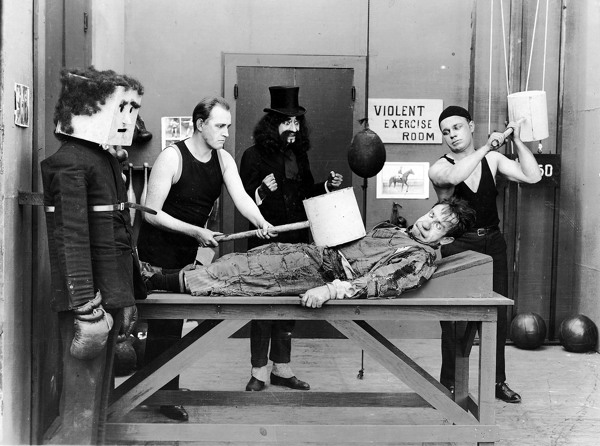
The misadventures of Musty Suffer get off to a ridiculous start in 1916’s Cruel and Unusual (courtesy Undercrank Productions/Library of Congress).
Chaplin had walked out while he still contractually owed Essanay another four films. The studio felt they were legally entitled to get as close to those four films as they could, by any means necessary. Chaplin sued, claiming the claptrap they were boggling together in his absence and sending out with his name on it would hurt his reputation—but he lost that suit and was ordered to pay Essanay damages. The ruling emboldened Essanay to keep making phony-Chaplin films, and helped embolden the burgeoning industry of Chaplin mimics (who didn’t have the same legal justification, but went for it anyway). From mid 1916 through 1917, Chaplin was in an ongoing competition against other comedians who tried to cash in on his name and image by making faux-Chaplin films.
In other words, during the exact period that Charlie Chaplin was in an existential struggle with mimics, the Musty Suffer films unfolded as a film series about the slapstick misfortunes of a tramp, with essentially zero connotations in common with Chaplin’s work.
If you were to tell me that the films of Musty Suffer were not actually of this Earth but were artifacts that fell into the world from a fracture in the space-time continuum from some other parallel dimension, I’d go, “Yeah, that explains it.”