
13
No employer rescinds an offer because you make a counteroffer. It's only if you come off like an unappreciative entitled jerk that things can go south. But don't worry—I got you! Here's a step-by-step guide to make sure the negotiation goes smoothly.
Step 1: Celebrate with the Employer as Soon as You Get the Offer
Most job offers are delivered over the phone, but I don't care if they deliver it by email, text, TikTok, or singing telegram—however the employer reaches out to you, you will immediately tell them how excited you are to receive the offer. It should sound something like this:
“I am excited to get this offer. Your company is my first choice! I can't wait to start working with you. Let me just look over the letter and I'll get back to you quickly.”
This is you burying the hook. You just about accepted, which in their minds shifts you to “on the team.” Hello endowment effect! Your value just became higher, as they now perceive you as theirs.
Step 2: Make a Smooth Counteroffer
Making a counteroffer is so much easier if you plan what to say ahead of time. If you only remember one thing about negotiating, remember this: you never have to give an ultimatum to get results. Here are three great negotiating tactics to choose from.
The Name-Your-Price Approach
You know what employers want in any negotiation? Certainty! That's why the time-tested best practice for making a counteroffer is to simply name a specific price at which the deal is done. This is the “vanilla” of negotiating techniques. Every employer has had it before, and using it will ruffle no feathers.
Here is the short version of the name-your-price approach in action:
“If you can do (x), we have a deal.”
However, remember, the goal is to give the employer psychological certainty. They are afraid of losing you so you want to reiterate they have full control over making you say yes. I would name my price like this:
“This job is my first choice! I can already see myself working there. I want to say yes, but the offer came below what I needed. If you can do (x), we have a deal right now.”
Important note: You want (x) to be at least 10% higher than what would actually make you happy. It's common for employers to counter below your new ask.
Negotiating Tip: Use Monthly Rather Than Annual Dollars in Your Counter
If you are uncomfortable asking for thousands of dollars more than they offered, try framing the counter in terms of a monthly amount versus annual. This has the added advantage of making it easier for you to explain your ask. “I need more salary to cover my monthly expenses.”
If you can do $400 more per month, we have a deal.
Did that feel better? Congratulations—you just asked for $4,800 more per year. That's almost $20,000 during the four years you're likely to hold the job. Not bad for one conversation.
The One-Small-Problem Approach
If you just can't bring yourself to make a direct ask, I offer you the one- small-problem approach. This approach avoids what makes most people uncomfortable about negotiating: fearing their ask will be viewed as an ultimatum.
With this approach you serve up a problem that's yours and give the employer a chance to jump in and help you solve it. The technique is simple. After spending a day with the offer in-hand, reach back out to the employer and say the following:
“This company is definitely my first choice, and I'm determined to make it work. I have one small problem I need to solve before I can accept … (fill-in-the-blank reason).”
You can of course put many different endings on this statement:
“I have one small problem I need to solve before I can accept. Childcare is proving more expensive than I expected as I go back to work.”
“I have one small problem I need to solve before I can accept. My student loan interest rates jump in December if I don't pay them down faster.”
“I have one small problem I need to solve before I can accept. I've got a vacation prepaid for December and realize I won't have enough accrued time off from when I start to take it.”
“I have one small problem I need to solve before I can accept. My spouse is worried about how much time I'll spend driving and the cost of commuting.”
Whether it's more salary, more vacation time, a signing bonus, or a flexible work schedule, all options are on the table with this tactic. They already love you. Let them help you.
The Multiple-Offers Approach
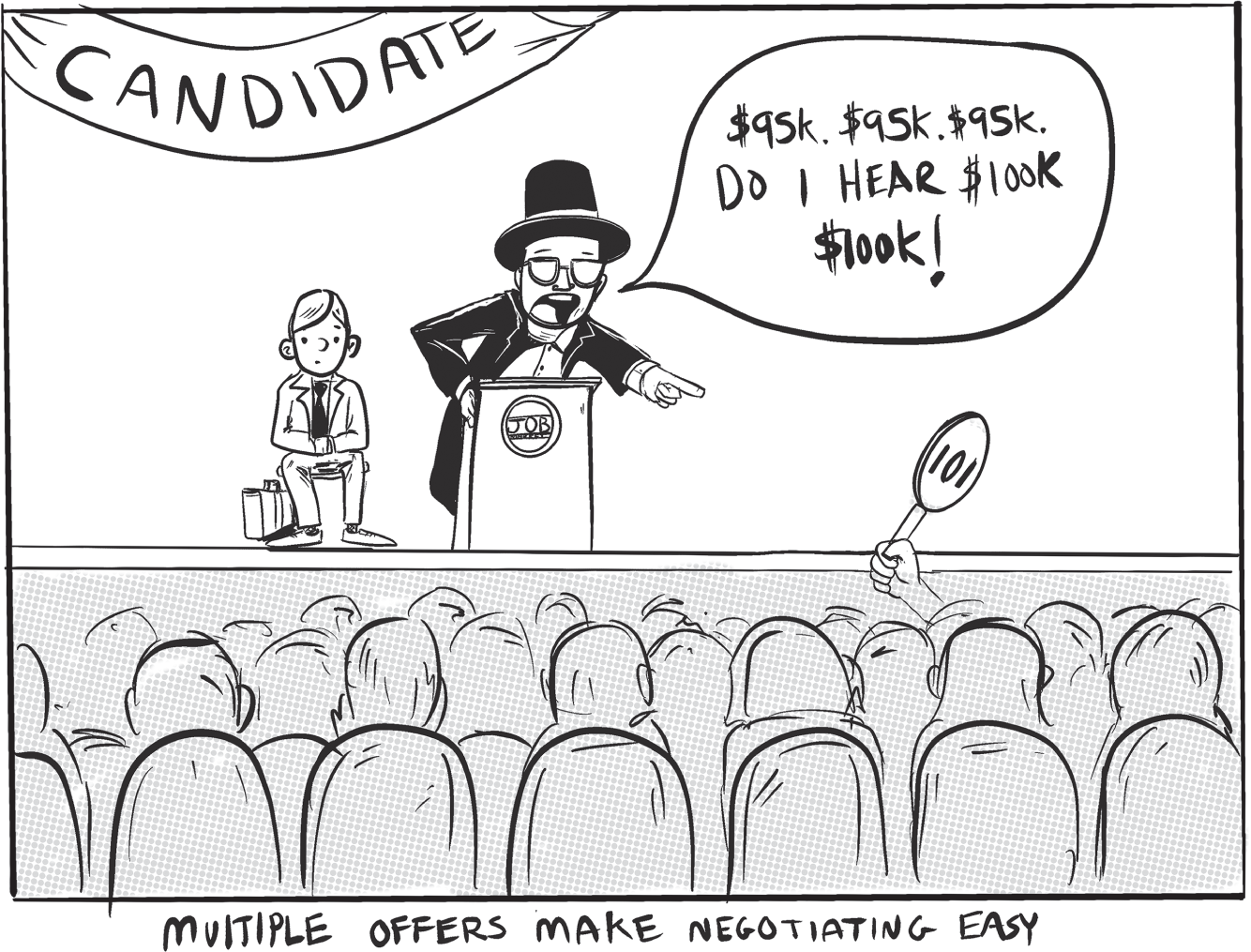
“As an in-house recruiter, I can say that the thing that drives our team leaders crazy is hearing that a candidate is choosing between two offers. No one wants to lose their first choice, especially when their first choice is obviously in such high demand. They always ask me what I think we should do to close, and my answer is always the same. Money talks and bulls**t walks. Offer the candidate more money before they ask for it, and do it fast. You want to bump your offer to demonstrate your enthusiasm. It's much more effective than trying to counter after they've first had a higher offer from the competition. Nothing else speeds up a negotiation and favors the candidate like getting a second offer.”
—Recruiter who is not gonna lose this candidate
Ready to bring a gun to this knife fight? There is one tactic that trumps them all. A technique so profound that it eliminates the need for any training I might give you and leaves the employer countering himself. The four most powerful words in a job seeker's repertoire are, “I have another offer.”
It's really that simple. Getting more than one offer changes everything. Now you're entering the world of auctions where crazy things can happen. (Scientists call it “auction fever” when two or more competing parties overbid their predetermined limits in a frenzied desire to win.1)
If you really dislike negotiating, then push yourself to get as many interviews going as possible. With two offers in hand, your endowment effect is mitigated. The employer's endowment effect is maximized. Now you get to relax and enjoy the journey. With three offers in hand you've entered what behavioral economists refer to as the “mojo zone” where your swagger becomes a palpable force that can physically impact the world. Okay, I just made that up, but that is how it feels to have three or more offers.
Once you get the offers, no need to do anything fancy. Just keep telling each side what the last offer is and let them decide when they want to drop out.
Step 3: Say Nothing Until They Do
“Everybody thinks the secret to negotiation is to say the right thing at the right time. The real secret to negotiation is to say nothing at the right time.”
—Employer who wouldn't tell me anything else
Okay, you've made your counteroffer!
A common response from employers is to go quiet. It could be in your face-to-face conversation, over the phone, during a video chat, or a slow response to your email. In all cases my instructions to you remain the same. Whatever you do, after you've made an ask, zip it!
Don't. Say. Another. Word.
The silence that occurs after you pitch your counter may seem filled with portent and meaning, but I promise you it's not because they are recoiling from the audacity of your proposal. The silence is happening for only one reason—the employer is thinking about their response. Thinking about whether they can meet your ask. Thinking about whether to counter your counter. Thinking about what else they might say to entice you to accept their original offer.
If you try to “restart the conversation” or “end the awkwardness,” you will end up negotiating against yourself. Even something innocuous like “I really want to be here” interrupts the employer's train of thought, which, until you spoke, was only focused on one thing—how to make you happy.
Fundamentally, if you start talking, they can't say yes. And just like that, you've spoiled your ask before you could hear an answer. Silence is golden. Use it to your advantage.
Step 4: Accept the Offer Correctly
After waiting out the silence, you get your reward when the employer informs you “we have a deal.” Congratulations! However, remember that you still haven't signed an official offer letter or contract. Here are some tips to make sure the offer comes through as agreed.
Ask for It in Writing
Compensation is frequently negotiated verbally before a final offer is delivered. Now that you have the verbal agreement it's imperative to get it in writing. Your first order of business is to clarify when you can expect the written offer so that you can officially say yes. This is normally a formality, but don't let it linger. You don't want to be in a situation in which you and your new employer have a different recall of what was agreed to. Especially if you saved signing the paperwork until your agreed upon start date.
“I am so excited to take this job! Can I get the offer in writing today so I can officially say yes?”
Employer: “We will have you sign the formal offer letter the day you start along with all your other paperwork.”
You: “No problem! Could I please have a copy of that offer letter now to review? Happy to formally sign it the first day I come in!”
Don't Sell Past the Close
“Nothing takes away the bad taste of difficult negotiations like a new employee excited to get to work.”
—Employer who is ready to move on
As soon as you accept the offer, the only thing you'll talk about from this moment forward is the future.
“I can't wait to start on the 30th. It would be great if I could get a jump on coming up to speed. Do you have any recommendations for me?”
Don't rehash any of the negotiation points. Don't reiterate any contributions you think you can make. Don't talk about other offers you'll be turning down. This moment is about giving the employer certainty that you're excited, and you're definitely coming.
Pro Tip: Shift Immediately to “We”
With the shake of a hand or sending of an email, you've just become “the new person.” Being the new person makes you an outsider. You want to lose that status and fully integrate as quickly as possible. A great hack for building camaraderie even before you start is to immediately use the words we, us, and our, instead of me, I, and my.
Inclusive language shows that you view yourself as “on the team” and that you measure team success as your success.
“I can't wait to start. We are going to make this product fly off the shelves!”
“What are our goals for the quarter?”
“You can count on us to get the production pipeline humming.”
In most cases, it takes people months to use inclusive language after starting a new job. Try it to see how it transforms your onboarding experience.
Summary
· Negotiating is expected and will make them want you more.
· You don't ever have to give an ultimatum to get something out of a negotiation.
· Having multiple offers is like having superpowers.
· Always get the offer in writing.
Note
1. 1. Marc T. P. Adam, Gillian Ku, and Ewa Lux, “Auction Fever: The Unrecognized Effects of Incidental Arousal,” Journal of Experimental Social Psychology 80 (2019): 52–58.