
IT COULD HAVE GONE WORSE
We’ve made it to the final invention. The final story. A story that fought hard to claim its place in the annals of written language. We’ll have to sail a ways from China, and dock our boat in Mexico.
The Mesoamerican scripts are the most recent invention, if—out of caution or personal opinion—we’re excluding Easter Island’s Rongorongo. For the Mayan script to claim its title as a true invention, it took hundreds of years and a painstaking process of decipherment. Less than two generations ago, its glyphs were seen as a limited mnemonic system, with no structure to its phonetic notation.* An uncodified mess, in other words.
It’s no secret that the attitude around glyphs was a little prejudiced. We’re an ocean away from Europe, in an environment long viewed as barely civilized. It was par for the course, this Old World snobbism, looking down on the New World with the pitying, paternalistic gaze of one who’s seen it all, invented it all. As one of my colleagues is always saying, with the same mistrust toward anyone who dares conceive of a new idea: “Eh, nothing’s ever invented.” And yet . . . In the Middle Preclassic period (900–500 BCE), amid a profusion of Olmec imagery, a revolution was under way. And I know revolution is the kind of word that people are always tossing around to grab attention, but in this case it’s actually true. A true revolution was in the works.
But one step at a time. Let’s start from the beginning. Diego de Landa was a fiendish, merciless, and highly determined man—a Franciscan bishop sent toward the middle of the sixteenth century to forcefully convert the peoples of the Yucatán.* So thoroughly did he ingratiate himself with the local population, they had little fear in showing him their most prized possession: the Mayan codices. In the eyes of the diabolic Diego de Landa, these writings could be nothing more than lies, superstition, manifestations of the devil. He had nearly all of them burned. However, like any true fiend, he set about studying that which he was destroying, producing an almost ethnographic work on their script. He interrogated the descendants of the Maya and quizzed them on the phonetic properties of what they were reading. Before long, he convinced himself that the script was alphabetical, albeit with a few inconsistences and redundancies. Something about his method wasn’t squaring, but he’d laid the foundations.
It would take hundreds of years, and a man more fiendish than any James Bond villain (though with a sharp mind, here pictured [fig. 19] with a cat), before we’d determine that the Mayan script is not based on an alphabetical system as de Landa thought, nor is it some structureless, iconographic mnemonic device. Mayan is a syllabary, a logo-syllabary to be precise. Yuri Knorozov—Russian, soldier, linguist—had the good sense to build on de Landa’s work, which wasn’t all that bad, refining his phonetic approach and eventually recognizing a substantial number of syllables.
This shift in approach was the true first step toward decipherment. But the air surrounding these glyphs was still toxic. Are you sure they really constitute a script? I mean, just look at them, carved into the walls of monuments and important buildings—you can tell something’s majorly off: Don’t they seem, deep down, like mere iconographic narratives? With a certain coherence, yes, but nonetheless still just drawings, decorations. Such was the suspicion that slithered among the “glyphologists” of the day (or “glyphers,” as Linda Schele called them, herself a towering figure in Mayan’s decipherment). And the most suspicious of all was J. Eric S. Thompson, a pioneer among the experts, who’d already created a cataloguing system for the glyphs, assigning each a T number (T for Thompson, as it was later defined—did I mention that philologists are often self-oriented?).

19. The linguist Yuri Knorozov, with cat
And, of course, it was his ego that began to weigh down the decipherment process. Thompson was convinced that Mayan, at its core, was a logographic system, lacking phonetic notation, and that Knorozov’s method was therefore invalid. Thompson was also convinced that the Maya were a virtuous people, devoted to moderation and temperance. And he was wrong about that, too.
No—in civilization, as in writing systems, there’s no such thing as purity. Knorozov understood this. No script is composed solely of logograms. Even our paltry alphabet (paltry in its number of characters, that is) uses logograms, such as numbers and other signs like %, $, &, @. The myopic Sir Eric! Our Russian cat-lover, on the other hand, was clever enough to make use of the Mayan languages that were already known and still spoken in modern times, and to rely on the easily recognizable iconicity of certain logograms, such as those for turkey and dog, which are linked to a syllabic spelling of the Mayan words for “turkey” and “dog.” And Knorozov discovered many others—not all correctly, but his method worked.
This is a virtuous story, one that led, albeit with a few obstacles, to a successful conclusion. And it also serves as a cautionary tale. We should never put our blind faith in what we read in books, and we should never trust scholars as if they’re gurus. It’s essential that we trust our own critical instinct. If we’d listened to the ipse dixits of the holier-than-thous, the solipsistic experts; if we’d taken it for granted that America had, in the end, invented nothing at all; if, in short, we’d paid too much mind to Thompson, we’d never have managed to decipher Mayan. And let’s not forget that this success story is owed not to the glory of some lone hero but to a decades-long effort by a team of scholars, fusing their various talents, constantly testing and calibrating their findings. Success, I repeat, is invariably founded upon collaboration. It could have gone worse.
FALSE START, LONG LIFE
Even though the Mayan script dominated the entire pre-Hispanic era—before the arrival of the conquistadors in Central America (1519 CE)—it nevertheless is not the most ancient Mesoamerican script that we know of. Thousands of years earlier, around 500 BCE, and perhaps even a century or two before then, another writing system left its mark. We have only a telescopic view of it, since it counts among the most enigmatic scripts in the world (and by “enigmatic,” of course, I mean undeciphered), but already present in this script are the seeds of what’s to come, the pre-Mayan ingredients, though almost all illegible. Let’s spin our telescope around to get a closer look.
In the Oaxaca Valley, at Monte Albán (c. 600–500 BCE), we find the Zapotec script—incomplete, a rough draft, though already reminiscent of the two obsessions that would come to define the Mayan culture: calendars and blood. In the New World’s first known instance of writing, on a stone known as a danzante (Monument 2 at San José Mogote, Oaxaca [fig. 20]), we find the image of a slain and bloody captive with two glyphs between his legs—his name, perhaps. He’s in a bad way, the poor fellow, and he’s surrounded by three hundred other bloodied captives. As for the writing? Still a mystery.
As if the Zapotec script wasn’t enough, it has a cousin, a few miles to the east, to compound our headache. A script known as “Isthmian.” Not a very imaginative name, but it gets the idea across, since the script comes from the Isthmus of Tehuantepec, the shortest distance between the Gulf of Mexico and the Pacific Ocean. A serpent of land, lapped by the sea. The Isthmian script is also known, inaccurately, as the Epi-Olmec script, since some contend that it’s derived from the preceding Olmec culture, which serves as a foundation and was flourishing as early as 1500 BCE. But the term is misleading: it’d be like calling the Etruscans “epi-Romans.” Best to give it a neutral, geographic name and call it “Isthmian.”
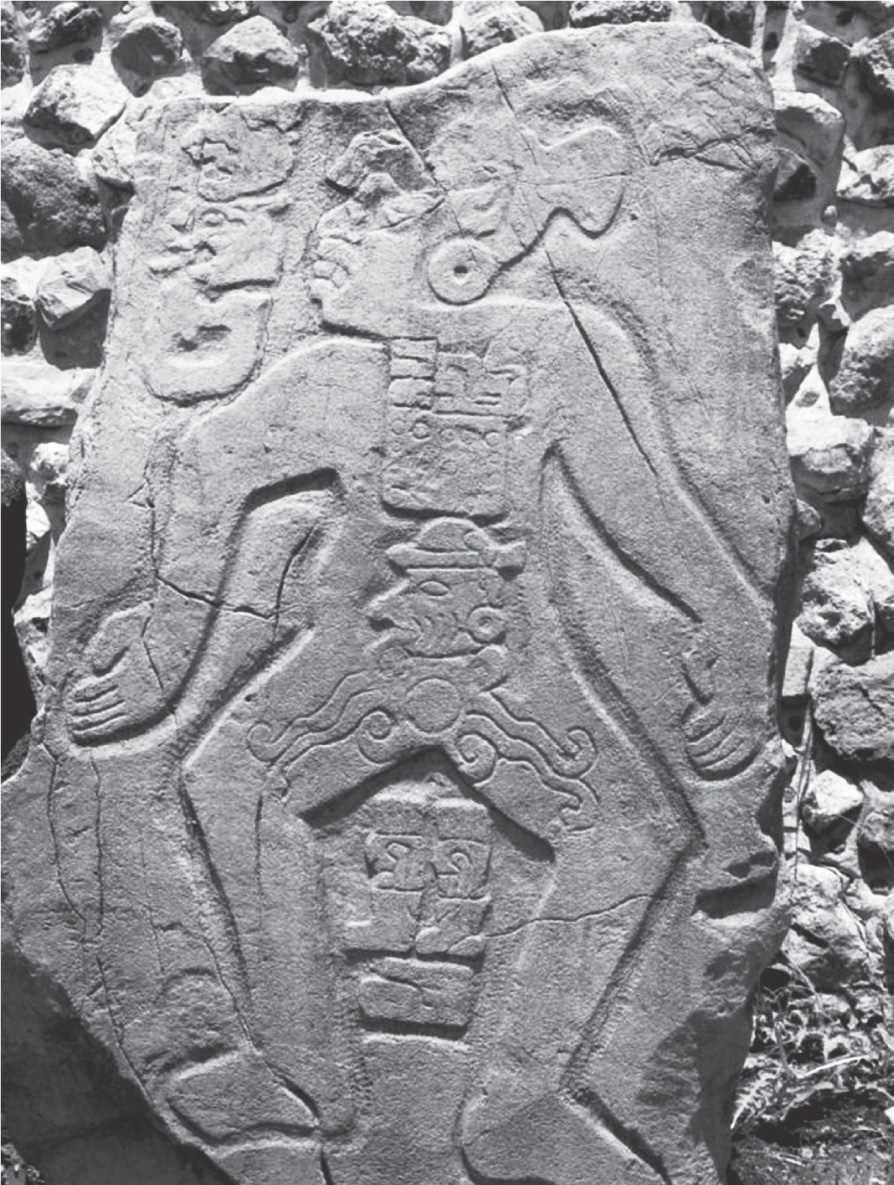
20. Stela of a danzante at Monte Albán, Mexico
The preceding Olmec phase, however—at sites like La Venta and San Lorenzo—gave rise to several traditions that would last into the succeeding Mayan civilization. There are two things we should point out about the Olmecs, since both are traditions that will endure for centuries and that will be ardently adopted by the Maya. The first is their boundless bloodlust. They weren’t violent, at least not according to the historical record, but drawing blood was extremely important for the Olmecs. Chopping off penises and tongues in public was a powerful symbolic ceremony, for preserving the social and cosmic order. The practice was grounded in myth, a belief in palingenesis. The gods had gifted life to men, sacrificing body parts and blood, and therefore blood needed to be returned to the gods. Blood meant life. So bring on the mutilation, torture, and gore.
The second fact is more pedestrian, literally. The Olmecs were the first to invent a game using a ball. An incredibly long tradition, still played today in the region—a game that is now called ulama, and is not all that different from squash, though don’t assume that it was merely recreational. The game had ritual and symbolic aspects, sometimes including human sacrifice. Historically, these sacrifices came later, toward the end of the Mayan period, but the moral is the same: blood must be spilled, even when playing ball, in this case via fervent decapitations. We know as much from the Popol Vuh, a text that recounts the mythical origins of the K’iche’ Maya of Guatemala, and which leads us to believe that they may have used the decapitated heads as balls. We don’t know for sure, but it’d be grand if it were true.
The Isthmian script seems to emerge from this Olmec atmosphere of ball games, decapitations, and blood. But enough splatter, already. In Isthmian, as in the Zapotec script, we witness the appearance of the calendar. In the few Isthmian texts to have survived (only ten or so), we find elements related to calculations and to the order of time—subjects of widespread interest in the classic period. Like the Tuxtla Statuette, for example (fig. 21). Take a careful look. Covering its front, back, and sides are various texts that appear to be (but aren’t) Mayan glyphs—what they are, instead, are numbers in a “long count.” They’re dates.* We find them on Stela C at Tres Zapotes as well, engraved with the date 32 BCE, and on the splendid La Mojarra Stela, from the second century CE (fig. 22).
One need only glance at these inscriptions to understand a fundamental aspect of the early Mesoamerican period: it was by no means a beginning, but already an advanced phase of writing. Sound a little like China? The first traces of Isthmian already constitute a complex script, able to codify extensive texts. Which would point us to antecedents. It’s a kind of false start. The true beginning, the earliest trace, thanks to the whims of archaeology, is invisible. Isthmian is the New World’s first script, but don’t kid yourself that we can actually read it: it remains an undeciphered system. No matter what the rumors are. Years ago, a decipherment of the inscriptions at La Mojarra was published to media fanfare urbi et orbi—only to be dismantled in the blink of an eye, by experts far more rigorous than your fly-by-night decipherer. When it comes to method, as we’ll see, there’s very little wiggle room.
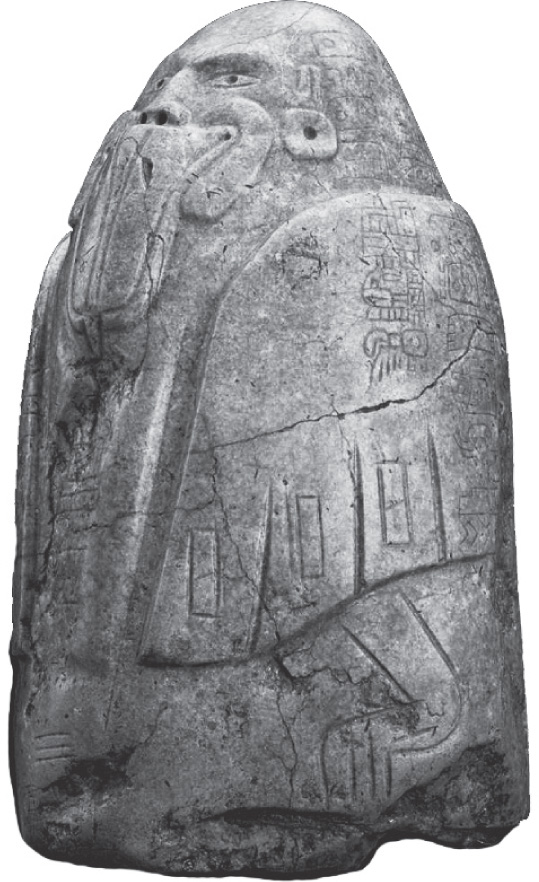
21. The Tuxtla Statuette, Veracruz, Mexico
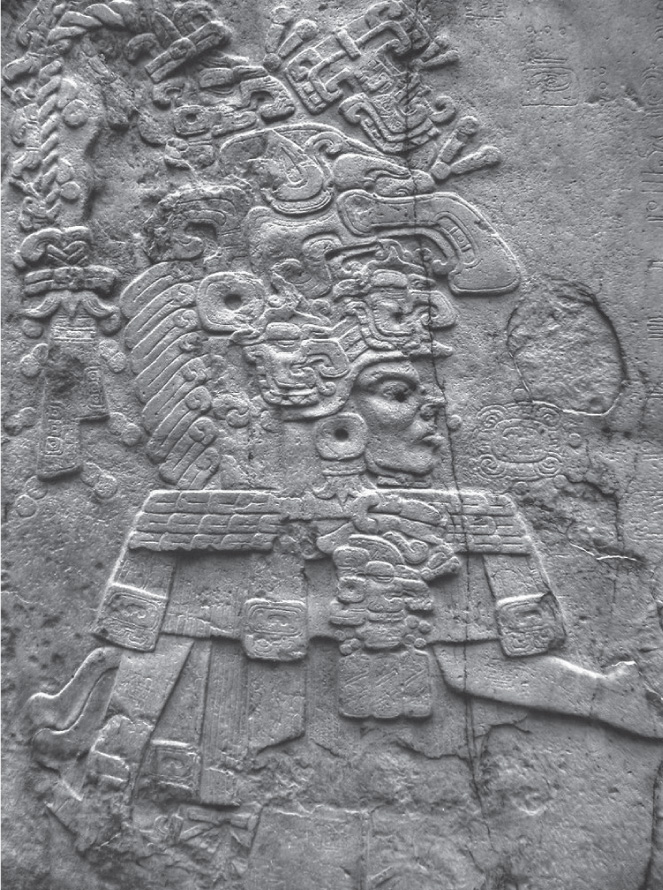
22. La Mojarra Stela, Veracruz, Mexico
EMOJIS
The signs in the Isthmian and Mayan scripts resemble one another, and so, too, do their internal structures. The earliest Mayan inscriptions date to around the birth of Christ; the most recent are from sixteen centuries later. A highly durable writing system, and one filled with a good deal of creativity and imagination, as we’ll see.
Its structure is logo-syllabic, with hundreds of signs in its inventory (a base of nearly 250, with at least 500 logograms). The signs can carry the value of both a logogram and a syllabogram: the same glyph can be used for both functions. Which means that, to all effects, each text is charged with double meaning. To give you an idea of just how well developed its structure was, let’s look at an example using one of its most delightful glyphs—the glyph for cacao. Chocolate was sacred, the drink of the gods, a mixture of cacao and spices.
But what matters to us is the sign (fig. 23) and how it functions. As a whole it indicates the word kakau, and the individual elements, its constituent parts, are what allow us to read it. This reading is syllabic. The syllable ka is repeated and combined with the syllable u(a), in which the a is a redundant vowel, though Mayan notates it all the same, picking up the a from the preceding syllable. The cherry, or cherries, on top, are the two dots just above the figure. These alert us to the phonetic reduplication, letting us know that we need to read ka twice. The Maya weren’t fiddling around—even the tiniest of dots counted.
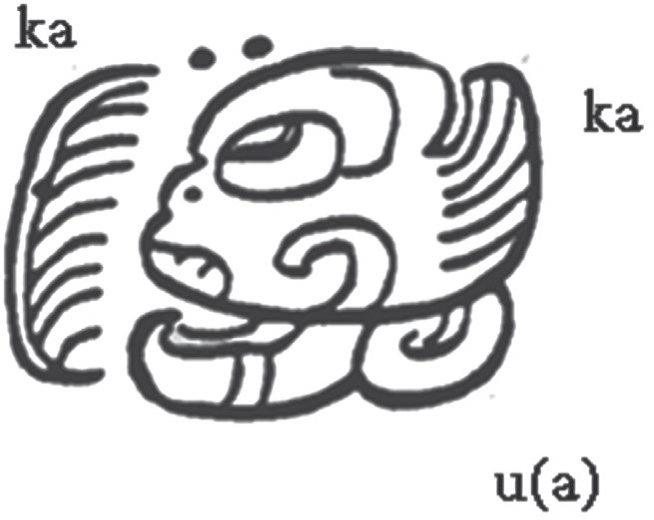
23. Mayan sign for “chocolate”
24. Another Mayan sign for “chocolate”
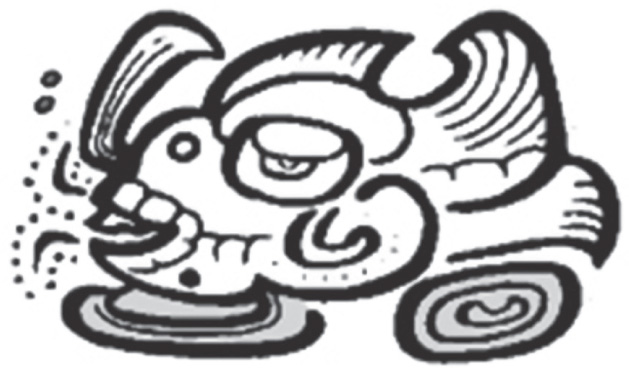
Evident, as well, is the complete artistic freedom they showed in their graphic interpretations of the signs: if I were to tell you that the glyph for cacao could also be represented using this variant (fig. 24), you might be skeptical. The base sign/icon is a fish, which gives us the syllable ka. That these two signs could indicate the same word seems almost incredible. And yet—did you notice the two dots, over on the left? There they are, unmistakable.
And this is just one example, not even among the most complex. The paleographic variants are astonishing: syllables flip around, creating impossible-to-recognize configurations, the logograms confound, sign after sign looks like a face. Glance below at the variants for the word witz, meaning “mountain” (fig. 25). The first sign is known as the “head variant,” depicting a face, the second is the logogram, the third the logogram with a phonetic complement, the fourth a syllabic rendering.
It’s enough to drive you mad—yet this incomprehensible pattern did nothing to stop the decipherers from unlocking Mayan’s secrets. If the human mind can conceive of such imaginative work, the human mind can decipher it, too. I may complain about Cretan Hieroglyphic, but with Mayan there’s nothing to do but turn and run. First off, it lacks something that might have aided in the early phases of decipherment, something we’d expect to find, given the path followed by other invented scripts. And that something is . . . wait for it . . . the rebus. We find almost no trace of it in Mayan. Which is very strange. The only explanation would be that Mayan is in fact a secondary invention, derived from the undeciphered Isthmian script. But that’s not something we know for sure. The dates of Mayan’s beginnings are always shifting. It may well be that the rebus is hiding in some earlier phase that we can’t see; should we discover more inscriptions, it could help clear things up.

25. The signs for “mountain,” witz in Mayan
There’s one other factor separating Mayan from all other early scripts, which you may have noticed even just glancing at the examples. Animate and inanimate things are all represented as if they were living: faces, unidentifiable beings with eyes and mouths, animal heads, signs indicating the part for the whole (pars pro toto, in technical jargon, such as legs, arms, feet, hands). And all of those head variants, like the signs for the numbers between one and nineteen, are represented by faces. Isn’t this a little odd? If you ask me, it all bears the stamp of Olmec iconography—though whether Olmec or not, this headstrong fixation on depicting living things and their parts is without parallel. Mayan glyphs live and breathe and speak.
I know what’s swirling around in your head right now. I can read your mind like Lady Hao. Emojis. But they aren’t the same. Mayan signs carry a specific phonetic value. They’re syllables or logograms. The little yellow faces we send to our friends are completely ideographic, though they’re little faces nonetheless, that much we can agree upon. We still need to figure out how Mayan became so emoji-fied, on the graphic level. And there might be an explanation.
LIVING SOULS
All Mesoamerican scripts are obsessed with iconicity, and not only do they feature it prominently, they safeguard it for the future. Why? There’s always some existential cause at the bottom of things. The signifier (that is, the sign) is bound, inextricably, to the essence of the signified. Vitality seeps from every pore of an object once it’s inscribed. The sign is a living thing. Whoever writes animates the inanimate, gives it life, spirit, as if the material and the spiritual were one and the same. For Italians, and to a large extent for Americans, immersed in the Christian tradition as we are—though we may not recognize it or even wish it so—the spiritual and the material are two separate things, with the material existing on a lower plane (see, for instance, a phenomenon such as iconoclasm, which aims to destroy the material). Any union between the two always feels a little strange.
For the Maya, though, it’s not just the body and soul that are alive, things are alive, too. Just look at the jade objects from the Olmec period, which are infused with breath. Carved into their chests, in line with the lungs and heart, is a T-shaped symbol, one of the most ancient signs—meaning wind. And from this T they breathe. Look at their belt plaques, too, with pendants shaped like the heads and names of ancestors, which alternate to form a kind of talking dance. Which is all to say that, in Mesoamerica, what’s written speaks. And it’s no coincidence that their head-shaped inscriptions are turned toward the direction in which they’re read, as if they’re truly engaged in dialogue with the reader.
And displaying these heads, for the Maya, required a certain amount of monumentality. Stone stelae, altars, panels, public declarations of royal deeds, lineages, and superhuman ancestors. Brilliantly colored panels advertising the king’s authority. All infused with life. And all proof of the incredible power of decipherment. Up until half a century ago, Mayan glyphs were still seen as flat drawings, the script still not considered to be phonetic. Then, in a matter of a few years, that view was turned on its head. Mayan glyphs are so phonetic that they’re heavily, redundantly full of sound, and they have been since the first Isthmian inscriptions. Mayan glyphs speak and, unlike Chinese and cuneiform signs, are also infused with spirit. In an adjective, they’re alive.