
THE LINE
Take a look at the objects around you. Look at how they’re positioned, their lines and outlines: How do they intersect? What shapes do they make? The window jambs form rectangles. Tabletops form Ls where they meet the legs. There’s the T between double doors, the D of an armchair’s oval backrest. The vertical lines of utility poles, the upside-down Vs of mountains, the circles of the sun, asterisks of the stars, skein of tangled twine, curling and coiling computer wires.
There’s an alphabet in things, and it’s no coincidence. If you pay attention, if you really look, you’ll see that all around you is an architecture of letters, emerging from the shapes of things. It seems almost obvious: our sense of vision is much more alert to lines, to contrasts, than to the flat or formless surfaces that contain them. What’s happening at the edges, the borders, the interstices—that’s what strikes our eyes. What’s between is of much less interest. The scientists who discovered this, Hubel and Wiesel, did so almost by accident, and it won them a Nobel Prize.
We are fundamentally visual creatures—animals that, like few others, rely on our vision to orient ourselves in the world. Among our senses, sight is dominant. Yet we’ve only recently discovered how vision and the visual cortex function. In the 1950s, the neurophysiologist David Hubel began recording the activity of visual cells, using cats as his guinea pigs. The experiments dragged on for years (as you can imagine, given what we know about herding cats).
Hubel’s approach was to record the cats’ brain activity while black and white blobs were projected on a screen. How did they perceive them? Trial after trial, the blobs produced no effect. Their amorphous shapes triggered no neuronal activity. No spike on the cat encephalogram. Until, one day, while running a glass slide with a blob painted on it through the projector, they noticed that the edge of the slide made a line on the screen. And finally, something sparked in their feline brains: a line, no matter how faint, caught the retina’s attention. The line’s irresistible allure.
The edges and contours of our surrounding environment are the first step to absorbing and understanding the world around us. Our brain feeds us images in pixels, the tesserae of a mosaic that we must reconstruct. It does not project, like a movie screen, all that’s happening before our eyes. And the most elementary pixels, the world’s first tesserae, are contours. Not what lies between them.
And if edges are indeed what capture our neurons’ attention, it makes perfect sense that, hiding in the lines and configurations of the things around us, we find an alphabet much like the one we know. In fact, the frequencies are constant. If we look at the signs in every writing system throughout history, with no regard for when or where they were created or used, we find that the frequency of their shapes remains the same. Line-segment combinations like the ones that form an L or a T have the same distribution frequency (high) across writing systems (even those from very distant historical periods). X and F are less frequent. What’s surprising is that the same distribution regularity we find across writing systems also applies to shapes in the natural world.
It’s as if writing, in its evolution, sought to copy nature’s contours, to make itself easier to perceive and simpler to read. Just like the line that captured the attention of Hubel’s cats. The neurons in our brain, whether by intuition or by a natural predisposition, selected shapes that resembled things we’d already seen before and were therefore recognizable. Which is to say that our process for perceiving objects was recycled, almost boorishly, for another purpose: to recognize written signs. And I say boorishly because the invention of writing stole space for itself in our brain—even if, physiologically, nothing changed. The stolen space was already there (the occipital-temporal area), though it was tasked with another function: the visual perception of objects. Neuron recycling at its best. Through a process of subtracting, toying with shapes, and above all simplifying, human beings not only created something that wasn’t there before, but, over time, and almost naturally, rendered it easy to recognize. Not always so easy to perceive, as we’ll see, much less to decipher. But there you have it: nature’s alphabet, woven into writing’s DNA.
Nulla dies sine linea, as Pliny the Elder said. No day without a line. Now lift your head, and start looking for the letters all around you.
THINGS
This discourse on the line is valid for “linear” scripts (obviously)—those that are stylistically advanced and that don’t resemble other immediately recognizable things, like a hand, or a foot, or a tree. Such signs carry clear reference points, which complicates things a bit, since we recognize depictions only because we’ve previously seen the thing being depicted—though levels of familiarity can vary widely, and are often subjective. Writing is born of a desire to name the things we see, to fix them in place. Not verbs or actions, but lists of things.
We could here delve into a long and heady discussion on the concept of “things,” but best to leave that to the philosophers. One Greek fable recounts the story of Thales, who, lost in thought as he studied the sky, walked himself right into a well. A young girl passing by teased him: “You want to know the things of the universe, but what about the things right in front of your eyes?” Ancient Greek uses ta for everything, a single syllable with a barrelful of meanings. But the contrast here is with concrete things, such as holes in the middle of the street.
Let us start, then, from concreteness. The bond between writing and “things” has always been a strong one. Both are, by definition, firm and lasting entities. Let’s try an experiment: grab a pen and paper and draw one thing. I’ll give you thirty seconds. What did you draw? An object, in all likelihood. A house? A bike? A Hershey’s kiss? We’d arrive at the same result, though perhaps with less predictability, if I asked you to think of one thing. You wouldn’t think of happiness or relativity or destiny—you’d think of something concrete.
All writing is founded on this concreteness. And it’s no different today. Think about what we do when we want to indicate actions, which are abstract concepts and therefore more difficult to represent. Take, for example, the recycling bin on your computer screen, which in one concise image suggests the act of “throwing away,” “deleting.” Or the magnifying lens: “to search.” And (nearly all) emojis: an airplane does not mean “to airplane” but “to fly,” a heart is not “to heart” but “to love,” a thumbs-up says, “I like this.” The action is expressed by the instrument used to evoke it or that renders it possible.
Things persist in time. They’re not fleeting like movements or gestures or actions. When we communicate them, especially when we draw or write them, we express a profound intuition: we embrace the cognitive persistence of objects, which brings them into greater focus, makes them more immediate. More solid. This is where they are and this is where they’ll stay. Actions have a dynamic element that’s harder to carry over to the page: actions are made of movement, gestures dissolve in air.
Writing is just the opposite: material, fixed in place, immobile. It’s static, like things.
Even actions, once written down, grind to a halt. They’re reified—they become “things.” With the result that writing’s strength, its permanence, is also its greatest limit: writing, like things, stays put.
ICONS
The lists of things with which writing first comes into being are composed of familiar icons. A bowl, an ear of wheat, a horse, a mountain, a fish.
These early icons are creative, drawn with variety but also with precision. Their relationship with reality is based upon resemblance and analogy, and therefore comes in degrees: the part for the whole (the head of an ox for the whole animal, the delta of the pubis for a woman); a bare-bones outline to represent something more complex (waves for water, a star for the heavens). But there’s one unifying factor: the drawings must be recognizable. This is true for all icons. Whether painted or drawn, an icon’s form and meaning must be in clear dialogue with each other, leaving no chance for arbitrary interpretation: one simply “reads” them on the spot. Familiarity can come in a million flavors—as long as the icon-image bears the imprint of an object with a precise name, that’s all that matters.
We’ve been grilling ourselves about this for centuries, testing the link between the names we give to things and their reality. Is it that we simply call up a name and slap it to whatever object, entity, thing? Or do names naturally capture the essence of what they represent, without artifice?
It’s a sticky subject, names and their relation to the objects they represent. What if our names are all naked, substance-free? Plato: names mislead, and it’s not always resemblance that determines them, but habit. Shakespeare, there’s no relation at all: a rose by any other name would smell as sweet—Romeo and Juliet’s love would be just as true even if his last name were Johnson. Convention, habit, tradition. And then, a century ago, came the coup de grâce, from the father of modern linguistics himself, Saussure: no natural resemblance exists between names and things; signifier and signified are detached, only weakly, whimsically, arbitrarily related. And that’s how the rose, and everything else, got its name. End of story.
These days, in truth, we’re not so militant in our belief. Yes, the connection between words and nature is fickle, but sometimes it can feel remarkably on target. Iconicity, when it occurs, can truly make us see, and even feel. Sign language, for example, is visual iconicity by definition. When I speak, on the other hand, I can repeat a word to indicate the plural (at least if I’m speaking Indonesian: orang-orang means “two people”), or else, for emphasis, I can stretch out my vowels: whaaaaaat!, reeeeally? And that’s not simply being colloquial, noooo, that’s linguistic iconicity.
Or else I can make use of onomatopoeia, words that imitate or reproduce sounds, like animal calls—meow, woof, moo. Or even words related to sound, like squawk, or murmur, or boom. Every language has its special relationship to onomatopoeia. Italian is fairly limited. Japanese, meanwhile, is much more inventive: for example, a rolling object is a korokoro when it’s light, but a gorogoro when it’s heavy. You can almost hear them rolling with their two different weights, the repeated syllables signaling their continuous movement, regardless of how swiftly they’re barreling forward. Now try testing your imagination: without checking the footnotes (no peeking!), what do you think a tekuteku might be?* Or a pyonpyon?* Both are words that suggest a clear and vivid image. Their sounds are “iconic”—and I don’t mean “memorably famous,” but iconic in the linguistic sense, icon-based, as I’ll use the term throughout this book. (And by the way, I know you peeked!)
English is even more fertile ground. In the comic books I read as a little girl, Batman and Robin were always dispatching one villain or another, and in such striking, realistic ways I could almost feel their pain: CRASH! BANG! ARRRGH!—the fight balloons imitating the sounds of their flying fists. By dint of all these onomatopoeic blows, one of Batman’s supervillains was even named Onomatopoeia. Iconicity leaves an incredibly strong impression, with enough impact to become a physical character. This strength, however, is limited to the page. Imagine a film where the bad guy fires his gun and “BANG” pops out—he’d look like a fool (or, at least, like Jim Carrey in The Mask).
In the early stages of every invented script, the signs’ iconicity played a powerful role (fig. 1). Or more than a powerful role—graphic iconicity served as the first true springboard for the invention of writing. In China, Mesopotamia, Egypt, Mesoamerica, and elsewhere, too, icons made themselves heard, pronouncing their names in a range of languages: Old Chinese, Sumerian, Pre-Pharaonic Egyptian, and Proto-Mayan.

1. Examples of iconic signs from the first scripts (Egyptian hieroglyphs, archaic cuneiform, Nahuatl, Cretan hieroglyphs, Mayan, and Anatolian hieroglyphs)
But this is where our problems begin: How do we define the relationship between icons and symbols, which—unlike true icons—lack a clear, transparent, and recognizable meaning? And how do we account for abstractions?
SYMBOLS
Symbols are as old as mankind, and I don’t mean Homo sapiens. As far back as the Paleolithic cave paintings from forty thousand years ago, alongside the naturalistic and “legible” depictions of animal icons, we find a series of abstract signs. And strangely enough they’re the same signs that we find at other sites around the world from this same period, from the Lascaux and Chauvet caves in France to the island of Sulawesi in Indonesia to the Blombos Cave in South Africa, which dates back even further.
Surrounding the paintings of horses, bison, and faceless men are thirty-two geometric forms, simple but beautiful—circles, asterisks, zigzags and triangles, parallel lines, spirals, hands stenciled on the wall (fig. 2). The exact same forms, in different corners of the world. These aren’t mere scribblings, but deeply moving and powerful signatures that mark one of the most important moments in the history of our species, like the invention of tools or the discovery of fire. They signal the desire, deeply ingrained in all of us, to say something, to bestow meaning, in whatever form, even with simple, erratic markings. Their power lies in their message: these traces will remain, long beyond the moment I steal from time to make them.
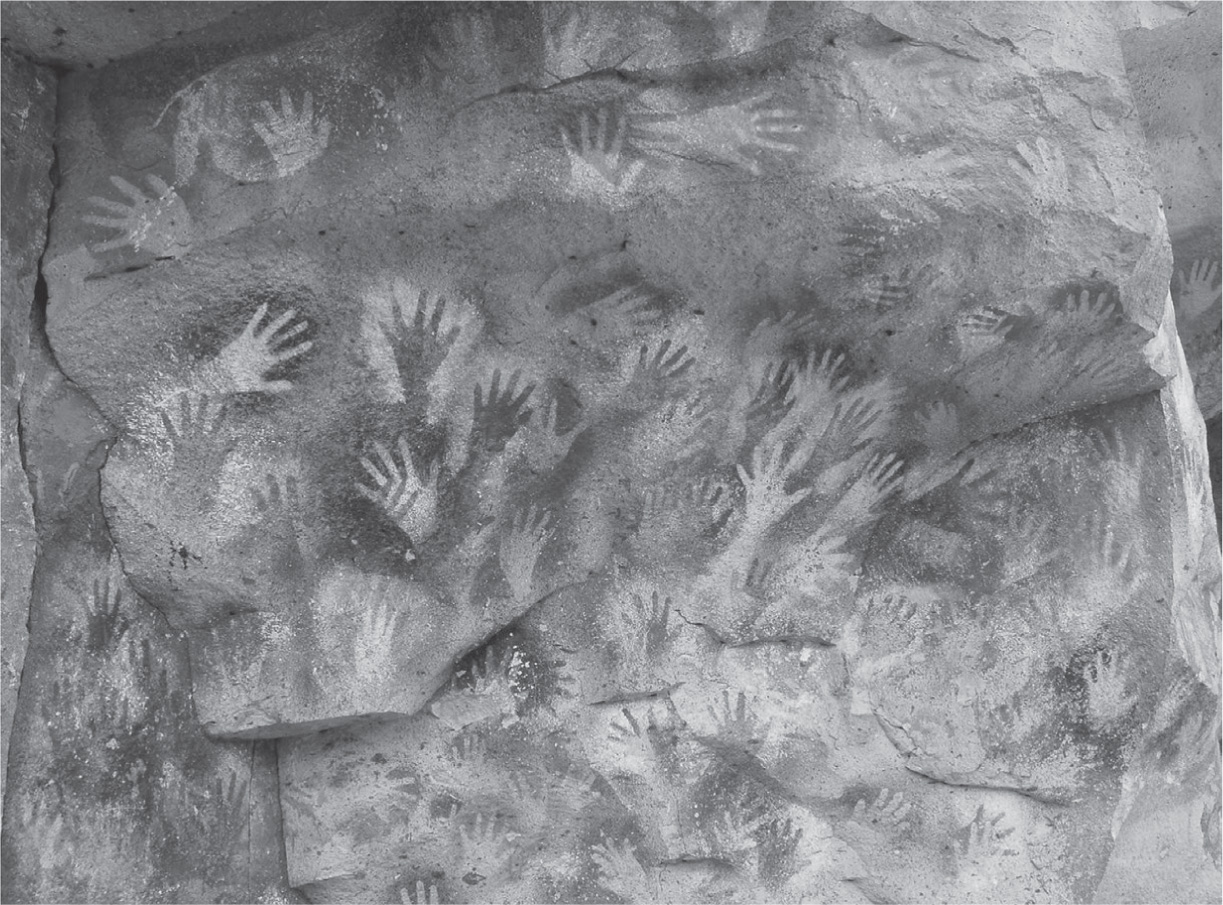
2. Handprints in the Cueva de las Manos, Santa Cruz, Argentina
Whoever made these marks knew their meaning, too, since they were linking language and spoken expression to graphic creativity. They therefore constitute the first form of communicating abstract thought—even if for us, today, they remain unsolvable enigmas. Of course, they’re not writing per se, but they do mark the first creative lunge in what was (I’d daresay) an all-but-inevitable direction.
We’re a species that’s dominated by symbols, and we’re not always so sure of how to decipher them. Nor can we always reconstruct their origin and evolution. Where do they come from, why did we create them? What was the spark that gave rise to abstraction?
When we depict something precise, with a specific name, using an icon-image, we create a sign. These signs are often called “pictograms.” The term is inaccurate and misleading, since a drawing, the moment it becomes the name for the thing represented, ceases to be a drawing. It becomes a sign. It’s already a script in embryo.
I draw a cat’s face. I call it “cat” and not “gatto” or “chat.” I usher it into the linguistic realm of English. The cat becomes a logogram for my language. A sign referring to the English word cat and nothing else. The name acquires substance, the feline substance of an American cat.
I draw a foot. I call it “foot”—a logogram. I draw a foot, but this time to indicate the verb “to walk.” I’ve abstracted the foot’s materiality, and I’ve set it in motion. I’ve created something else—an ideogram—by toying with the geography of meaning. I’ve expanded its possibility, though I’ve also rendered the sign’s meaning more obscure. I’ve made a marvelous, irresistible mess.
How did we get to this point? To the man and woman figures on restroom doors, to traffic signs, the buttons on a washing machine, music notes, all the things we interpret daily just to get by in the world? From the geometry of an object’s lines to our imaginative manipulation of meanings, we play with the nature and life of symbols each and every day. And most of the time, as we’ll see, we even enjoy ourselves.
Let’s turn back now to our two overarching stories. The first story I’ll tell is pervaded by the scent of the sea—along with the aroma of three ingredients that affect us in powerful ways, engaging our intellect, our logical skills, and our intuition. All three challenge us to understand one another more deeply and truly. They help us to better see the world, to recognize and reorganize the data we absorb from our environment, and to piece it all together.
They are mystery, competition, experiment.