
The word “contradiction” in Marxist terminology is a very specific one, and refers to the tensions which (it is argued) inherently exist within the capitalist system of production and will inevitably cause its demise.120 It may therefore seem deliberately ironic to employ the same expression to describe the position in which the Soviet Union, the world’s first Communist state, now finds itself. Nevertheless, as will be described below, in a number of absolutely critical areas there seems to be opening up an ever-widening gap between the aims of the Soviet state and the methods employed to reach them. It proclaims the need for enhanced agricultural and industrial output, yet hobbles that possibility by collectivization and by heavy-handed planning. It asserts the overriding importance of world peace, yet its own massive arms buildup and its link with “revolutionary” states (together with its revolutionary heritage) serve to increase international tensions. It claims to require absolute security along its extensive borders, yet its hitherto unyielding policy toward its neighbors’ own security concerns worsens Moscow’s relations—with western and eastern Europe, with Middle East peoples, with China and Japan—and in turn makes the Russians feel “encircled” and less secure. Its philosophy asserts the ongoing dialectical process of change in world affairs, driven by technology and new means of production, and inevitably causing all sorts of political and social transformations; and yet its own autocratic and bureaucratic habits, the privileges which cushion the party elites, the restrictions upon the free interchange of knowledge, and the lack of a personal-incentive system make it horribly ill-equipped to handle the explosive but subtle high-tech future which is already emerging in Japan and California. Above all, while its party leaders frequently insist that the USSR will never again accept a position of military inferiority, and even more frequently urge the nation to increase production, it has clearly found it difficult to reconcile those two aims; and, in particular, to check a Russian tradition of devoting too high a share of national resources to the armed forces—with deleterious consequences for its ability to compete with other societies commercially. Perhaps there are other ways of labeling all these problems, but it does not seem inappropriate to term them “contradictions.”
Given the emphasis in Marxian philosophy upon the material basis of existence, it may seem doubly ironic that the chief difficulties facing the USSR today are located in its economic substructure; and yet the evidence gleaned by western experts—not to mention the increasingly open acknowledgments by the Soviet leadership itself—leave no doubt that that is so. It would be interesting to know how Khrushchev, who in the 1950s confidently forecast that the USSR would overtake the United States economically and “bury” capitalism, would have felt about Mr. Gorbachev’s 1986 admissions to the 27th Communist Party Congress:
Difficulties began to build up in the economy in the 1970s, with the rates of economic growth declining visibly. As a result, the targets for economic development set in the Communist Party program, and even the lower targets of the 9th and 10th 5-year plans were not attained. Neither did we manage to carry out the social program charted for this period. A lag ensued in the material base of science and education, health protection, culture and everyday services.
Though efforts have been made of late, we have not succeeded in fully remedying the situation. There are serious lags in engineering, the oil and coal industries, the electrical engineering industry, in ferrous metals and chemicals in capital construction. Neither have the targets been met for the main indicators of efficiency and the improvement of the people’s standard of living.
Acceleration of the country’s socio-economic development is the key to all our problems; immediate and long-term, economic and social, political and ideological, internal and external.121
To which it might be remarked that the final statement could have been made by any government in the world, and that the mere recognition of economic problems is no guarantee that they will be solved.
The most critical area of weakness in the economy during the entire history of the Soviet Union has been agriculture, which is the more amazing when it is recalled that a century ago Russia was one of the two largest grain exporters in the world. Yet since the early 1970s it has needed to import tens of millions of tons of wheat and corn each year. If world food-production trends continue, Russia (and certain other socialist economies of eastern Europe) will share with parts of Africa and the Near East the dubious distinction of being the only countries which have changed from being net food exporters to importers on a large-scale and sustained way over recent years.122 In Russia’s case, this embarrassing stagnation in agricultural output has not been for want of attention or effort; since Stalin’s death, every Soviet leader has pressed for increases in food production, in order to meet consumer demand and to fulfill the promised rises in the Russian standard of living. It would be wrong to assume that such rises have not occurred—clearly, the average Russian is much better off now than in 1953, when his situation was desperate. But what is much more depressing is that after some decades of drawing closer to the West, his standard of living is falling behind again—despite all the resources which the state commits toward agriculture, which swallows up nearly 30 percent of total investment (cf. 5 percent in the United States) and employs over 20 percent of the labor force (cf. 3 percent in the United States). Merely in order to maintain standards of living, the USSR is compelled to invest approximately $78 billion in agriculture each year, and to subsidize food prices by a further $50 billion—despite which it seems “to be moving further and further away from being the exporter it once was”123and instead needs to pour out further billions of hard currency to import grain and meats to make up its own shortfalls in agricultural output.
There are, it is true, certain natural reasons for the precariousness of Soviet agriculture, and for the fact that its productivity is about one-seventh that of American farming. Although the USSR is often regarded as geographically rather similar to the United States—both being continent-wide, northern-hemisphere states—it actually lies much farther to the north: the Ukraine is on the same latitude as southern Canada. Not only does this make it difficult to grow corn, but even the Soviet wheat-growing regions endure far colder winters—and are subject to more frequent droughts—than states like Kansas and Oklahoma. The four years 1979–1982 were particularly bad in that respect, and so embarrassed the government that it stopped giving details of agricultural output (although its average import of 35 million tons of grain each year provided a clue!). Even the “good” year of 1983 did not make the USSR self-sufficient—and it was followed in turn by yet another disastrous year of cold and drought.124 Moreover, any attempt to increase production by extending the wheat acreage into the “virgin lands” is always constricted by frosts in the north and the arid conditions in the south.
Nevertheless, no outside observers are convinced that it is climate alone which has depressed Soviet agricultural output.125 By far the biggest problems are simply caused by the “socialization” of agriculture. To keep the Russian populace happy, food prices are held artificially low through subsidies, so that “meat costing the state $4 a pound to produce sells for 80 cents a pound”126—which, for example, makes it cheaper for peasants to buy and feed bread and potatoes to their livestock than to use unprocessed grain. The vast amounts of state investment in agriculture are thrown at large-scale projects (dams, drainage) rather than at individual barns or up-to-date small tractors that an ordinary peasant might want. Decisions as to planting, investment, and so on are taken not by those who work the fields but by managers and bureaucrats. The denial of responsibility and initiative to the individual peasants is probably the single greatest reason for disappointing yields, chronic inefficiencies, and enormous wastage—although the wastage is clearly affected also by the inadequate storage facilities and lack of year-round roads, which causes “approximately 20 percent of the grain, fruit and vegetable harvest, and as much as 50 percent of the potato crop [to perish] because of poor storage, transportation and distribution.”127 What could be done if the system were altered in its fundamentals—that is, a massive change away from collectivization towards individual peasant-run farming—is indicated by the fact that the existing private plots produce around 25 percent of Russia’s total crop output, yet occupy a mere 4 percent of the country’s arable land.128
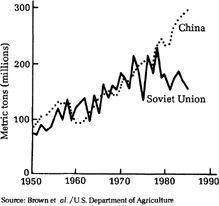
Yet whatever the noises about “reform” from the highest levels, the indications are that the Soviet Union is not contemplating following Mr. Deng’s large-scale agricultural changes to anything like the extent of China’s “liberalization” (see above), even when it is clear that Russian output is falling far behind that of its adventurous neighbor.129
Although the Kremlin is unlikely to explain openly why it prefers the present system of collectivized agriculture despite its manifest inefficiencies, two reasons for this inflexibility stand out. The first is that a massive extension of private plots, the creation of many more private markets, and increases in the prices paid for agricultural produce would imply significant rises in the peasantry’s share of national income—to the detriment of the resentful urban population and, perhaps, of industrial investment. It would mean, in other words, the final triumph of Bukharin’s policies (which favored agricultural incentives) and the demise of Stalin’s prejudices.130 Secondly, it would mean a decline in the powers of the bureaucrats and managers who run Soviet agriculture, and thus have implications for all of the other spheres of decision-making. While it is surely true that “individual farmers making day-to-day decisions in response to market signals, changing weather, and the conditions of their crops have a combined intelligence far exceeding that of a centralized bureaucracy, however well designed and competently staffed,”131 what might that imply for the future of the “centralized bureaucracy”? If it is correct that there is a consistent, embarrassing relationship between “socialism and national food deficits,”132 then that can hardly have escaped the Politburo’s attention. But from its own perspective, it may seem better—safer, certainly—to maintain “socialist” (i.e., collectivized) farming even if that implies rising food imports, rather than to admit the failure of the Communist system and to remove the existing controls upon so large a segment of society.
Chart 3. Grain Production in the Soviet Union and China, 1950–1984
By the same token, it is also difficult for the USSR to amend its industrial sector. To some observers, that may hardly seem necessary, given the remarkable achievements of the Soviet economy since 1945 and the fact that it outproduces the United States in, for example, machine tools, steel, cement, fertilizers, oil, and so on.133 Yet there are many signs that Soviet industry, too, is stagnating and that the period of relatively easy expansion—caused by fixing ambitious output targets, and then devoting masses of finance and manpower to meeting those figures—is coming to a close. Part of this is due to increasing labor and energy shortages, which are discussed separately below. Equally important, however, are the repeated signs that manufacturing suffers from an excess of bureaucratic planning, from being too concentrated upon heavy industry, and from being unable to respond either to consumer choice or to the need to alter products to meet new demands or markets. Producing masses of cement is not necessarily a good thing, if the excessive investment in it has taken resources from a more needy sector; if the actual cement-production process has been very wasteful of energy; if the final product has to be transported long distances across the country, thus placing further strains upon the overworked railway system; and if the cement itself has to be distributed among the thousands of building projects which Soviet planners authorized but have never been able to complete.134 The same remarks might be made about the enormous Soviet steel industry, much of the output of which seems to be wasted—causing some scholars to marvel at the “paradox of industrial plenty in the midst of consumer poverty.”135 There are, to be sure, efficient sectors in Soviet industry (usually related to defense, which can command large resources and must compete with the West), but the overall system suffers from concentrating upon production without much concern for market prices and consumer demand. Since Soviet factories cannot go out of business, as in the West, they also lack the ultimate stimulus to produce efficiently. However many tinkerings there are to assist industrial growth at a faster rate, it is difficult to believe that they will produce a sustained breakthrough if the existing system of a “planned economy” remains.
Yet if today’s levels of Soviet industrial efficiency are scarcely tolerable (or, judging from the harsher tone of the government, increasingly intolerable), the system is likely to be even more damaged by three further pressures bearing down upon it. The first of these concerns energy supplies. It has become increasingly obvious that the great expansion in Soviet industrial output since the 1940s heavily depended upon plentiful supplies of coal, oil and natural gas, almost without regard to cost. In consequence, the “energy waste” and “steel waste” in both the USSR and its chief satellites is extraordinary, compared with western Europe, as shown in Table 46.
In Russia’s case, this misuse of “inputs” may have seemed tolerable when its energy supplies were so plentiful and (relatively) easily accessible; but the awful fact is that this is no longer the case. It may have been that the CIA’s famous 1977 forecast that Soviet oil production would soon peak, and then rapidly decline, was premature; nonetheless, Russian oil output did drop a little in 1984 and 1985, for the first time since the Second World War.137 More alarming still is the fact that the remaining (and very considerable) stocks of oil—and of natural gas—are to be found at much deeper levels or in regions, like western Siberia, badly affected by permafrost. Over the past decade, as Gorbachev reported in 1985, the cost of extracting an additional ton of Soviet oil had risen by 70 percent and this problem was, if anything, intensifying.138 Hence, to a large degree, the very extensive commitment by Russia to building up its nuclear-power output as swiftly as possible, thus doubling its share of electricity production (from 10 percent to 20 percent) by 1990. It is too soon to know how far the disaster at the Chernobyl plant will hurt those plans—the four reactors at Chernobyl produced one-seventh of the total Russian nuclear-generated electricity, so that their shutdown implied an increased use of other fuel stocks—but what is obvious is that it will both increase costs (because of additional safety measures) and reduce the pace of the planned development of the industry.139 Finally, there is the awkward fact that the energy sector already absorbs so much capital—about 30 percent of all industrial investment—and that amount is bound to rise sharply. It seems difficult to believe the recent report that “a simple continuation of recent investment trends in oil, coal and electric power, combined with the targeted investment increase for natural gas, will absorb virtually the entire available increase in capital resources for Soviet industry over the period 1981–5,”140 simply because the implications elsewhere are too severe. Nevertheless, the overall pattern is clear: merely to keep the economy growing at a modest pace, the energy sector will require an increased share of the GNP.141
Table 46. Kilos of Coal Equivalent and Steel Used to Produce $1,000 of GDP in 1979-1980136

Equally problematic, from the viewpoint of the Russian leadership, is the challenge posed in the high-technology areas of robotics, supercomputers, lasers, optics, telecommunications, and so on, where the USSR is in danger of increasingly falling behind the West. In the narrower, strictly military sense, there is the threat that “smart” battlefield weapons and advanced detection systems could neutralize Russia’s quantitative advantages in military hardware: thus, supercomputers might be able to decrypt Russian codes, to locate submarines under the ocean’s surface, to handle a fast-moving battle scene, and—last but not least—to protect American nuclear bases (as implied in President Reagan’s “Star Wars” program); while sophisticated radar, laser, and guidance-control technology might allow western aircraft and artillery/rocket forces to locate and destroy enemy planes and tanks with impunity—as Israel regularly does to Syrian (Sovietequipped) weapon-systems. Merely to keep up with these advanced technologies requires ever-larger allocations of scientific and engineering resources to Russia’s defense-related sector.142
In the civilian field, the problem is even greater. Given the limitations which are being reached in such classic “inputs” as labor and capital investment, high technology is rightly perceived as being vital for increasing Russian output. To give but one example, the large-scale use of computers could greatly reduce wastage in the discovery, production, and distribution of energy supplies. But the adoption of this new technology not only implies heavy investments (taken from where?), it also challenges the intensely secretive, bureaucratic, and centralized Soviet system. Computers, word processors, telecommunications, being knowledge-intensive industries, can best be exploited by a society which possesses a technology-trained population that is encouraged to experiment freely and to exchange new ideas and hypotheses in the widest possible way. This works well in California and Japan, but threatens to loosen the Russian state’s monopoly of information. If, even today, senior scientists and scholars in the Soviet Union are forbidden to use copying machines personally (the copying departments are staffed by the KGB), then it is hard to see how the country could move toward the widespread use of word processors, interactive computers, electronic mail, etc. without a substantial loosening of police controls and censorship.143 As in agriculture, therefore, the regime’s commitment to “modernization” and its willingness to allocate additional resources of money and manpower are vitiated by an economic substructure and a political ideology which are basic obstacles to change.
By comparison, then, the increasing reliance of the Soviet Union upon imported technologies and machinery—whether legally traded goods, or stolen from the West—is a less fundamental if still serious problem. The extent of the industrial and scientific espionage (whether for military or commercial purposes) can obviously not be quantified, but seems to be yet another indication of Russia’s worry that it is falling behind.144 The more regular trade—importing western technology (and also eastern-European manufactures) in exchange for Russian raw materials—is a traditional way in which the country seeks to “close the gap”; it was done in the 1890–1914 period, and again in the 1920s. In that sense, all that has changed is the more modern nature of the product: oil-drilling machinery, rolled steel, pipe, computers, machine tools, equipment for the chemical/plastics industry, etc. What must be much more worrying to Soviet planners is the accumulating evidence that the imported technology takes longer to set up, and is used much less efficiently than in the West.145 The second problem is the availability of hard currency for the purchase of such technology. Traditionally, this could be circumvented by importing manufactured goods from fellow Comecon countries (thus involving no loss of hard currency), but the latter’s products have increasingly failed to keep up with those from the West, even if they still have to be accepted to prevent a collapse of their eastern-European economies.146 And while Russia has normally paid for a large proportion of western imports through the barter or direct sale of surplus oil, its prospects (and those of eastern Europe) may be shrinking because of the uncertainties in oil prices, its own growing energy needs, and the general change in the terms of trade for raw materials as manufacturing processes become more sophisticated.147 At the same time as Russian earnings from oil and other raw materials (except, presumably, gas) shrink, the payments for a variety of imports remain high—all of which presumably reduces the sums available for investment.
The third major cause for concern about Russia’s future economic growth lies in demographics. The position here is so gloomy that one scholar began his recent survey “Population and Labor Force” with the following blunt statement:
On any basis, short-term or long-term, the prospects for the development of Soviet population and manpower resources until the end of the century are quite dismal. From the reduction in the country’s birthrate to the incredible increase in the death rates beyond all reasonable past projections; from the decrease in the supply of new entrants to the labor force, compounded by its unequal regional distribution, to the relative ageing of the population, not much hope lies before the Soviet government in these trends.148
While all of these elements are serious—and interacting—the most shocking trend has been the steady deterioration in both life expectancy and infant mortality rates since the 1970s and perhaps earlier. Because of a slow erosion in hospital and general health care, poor standards of sanitation and public hygiene, and the fantastic levels of alcoholism, death rates in the Soviet Union have increased, especially among the working males: “Today, the average Soviet man can expect to live for only about 60 years, six years less than in the mid-1960s.”149 Equally shocking has been the rise in infant mortality—the only industrialized country where this has occurred—to a point where infant deaths are, comparatively, over three times the U.S. rate, despite the enormous numbers of Soviet doctors. Yet if the Russian population is dying off faster than before, its birthrates are slowing down sharply. Because (presumably) of urbanization, higher female participation in the work force, poor housing conditions, and other disincentives, the crude overall birthrate has been steadily dropping, more particularly among the Russian population of the country. The consequences of all these trends is that the male Russian population of the country is scarcely increasing at all.
The implications of all this have been disturbing Russia’s leaders for some time, and are obviously behind the exhortations to increase family size, the stricter campaign against alcoholism, and the efforts to persuade older workers to remain in the factories. The first is that the country clearly requires a larger proportion of resources to be devoted to health care and social security, especially as the percentage of older population increases: in this the USSR is no different from other industrialized countries (except in its increased death rates), but this again raises the issue of spending priorities. Secondly, there are the implications for both Soviet industry and the armed services, given the drastic fall-off in the rate of growth of the labor force: according to projections, between 1980 and 1990 the labor force will enjoy a net increase of “only 5,990,000 persons, whereas during the preceding ten years the estimated increase in the labor force was 24,217,000.”150 To leave the military’s problems until later, this trend reminds us again that a large part of the growth in Russian industrial output in the 1950s to the 1970s was due to an enhanced labor force, rather than increases in efficiency; from now on economic expansion can no longer rely upon a fast-increasing work force in manufacturing. To a considerable extent, of course, this difficulty could be overcome if more able-bodied males were released from agriculture; but the problem there is that an excessive number of youths in the Slavic areas have already left the communes for the city, whereas the surplus which does exist in the non-Slavic republics is more poorly educated, often has little knowledge of the Russian language, and would require an immense investment in training for industry. This brings us to the final trend which makes Moscow planners uneasy: that since the fertility rates in central Asian republics like Uzbekistan are three times larger than among the Slavic and Baltic peoples, a major shift in the long-term population balances is under way. In consequence, the Russian population’s share is expected to decline from 52 percent in 1980 to only 48 percent by 2000.151 For the first time in the history of the USSR, Russians will not be in the majority.
This catalog of difficulties may seem too gloomy to certain commentators. Military-related production in the USSR is often impressive and is constantly driven to improve itself because of the dynamic of the arms-race itself.152 As one historian (admittedly writing in 1981)153 points out, the picture cannot be seen as altogether negative, especially if one looks at Soviet economic achievements over the past half-century; and it has been a habit among western observers to exaggerate Russia’s strengths in one period and its weaknesses in the next. Nevertheless, however much the USSR has improved itself since Lenin’s time, the awkward facts are that it has not caught up with the West and, indeed, that the gap in real standards of living seems to have been widening since the later years of the Brezhnev regime; that it is being overtaken, by all measures of per capita output and industrial efficiency, by Japan and certain other Asian countries; and that its slowdown in rate of growth, its aging population, and its difficulties with climate, energy stocks, and agriculture cast a dark shadow over the claims and exhortations of the Soviet leadership.
It is in this context, then, that Gorbachev’s belief that “acceleration of the country’s socioeconomic development is the key to all our problems” becomes the more understandable. And yet, quite apart from natural difficulties (permafrost, etc.), two main politicalobstacles stand in the way of producing a “leap forward” on the Chinese model. The first is the entrenched position of the party officials, bureaucrats, and other members of the elite, who enjoy a large array of privileges (depending upon rank) which cushion them from the hardships of everyday life in the Soviet Union, and who monopolize power and influence. To decentralize the planning and pricing system, to free the peasants from communal controls, to allow managers of factories a greater freedom of action, to offer incentives for individual enterprise rather than party loyalty, to close outdated plants, to refuse to accept shoddy products, and to allow a far freer circulation of information would be seen by those in power as dire threats to their own position. Exhortations, more flexible planning, enhanced investments in this or that sector, and disciplinary drives against alcoholism or corrupt management are one thing; but all proposed changes, Soviet party officials have stressed, have to take place “within the framework of scientific socialism” and without “any shifts toward a market economy or private enterprise.”154 In the opinion of one recent visitor, “the Soviet Union needs its inefficiencies to remain Soviet”;155 if that is so, all Mr. Gorbachev’s urgings about the need for a “profound transformation” of the system are unlikely to make much impact upon the long-term growth rates.
The second political obstacle lies in the very significant share of GNP devoted by the USSR to defense. How best to calculate the totals and how that measures with western defense spending has exercised many analysts; the CIA’s 1975 announcement that the ruble prices of Soviet weaponry were twice as high as previously estimated—and that Russia was probably spending 11–13 percent of GNP upon defense rather than 6–8 percent—led to all sorts of misinterpretations of what that meant.156 But the exact figures (which may not even be available to Soviet planners) are less significant than the fact that although the growth in armaments spending slowed down after 1976, the Kremlin appears to have allocated around twice as much of the country’s product to this area as has the USA, even under Reagan’s arms buildup; and this in turn means that the Soviet armed forces have siphoned off vast Stocks of trained manpower, scientists, machinery, and capital investment which could have been devoted to the civilian economy. This does not mean, according to certain economic forecasts, that a large reduction in defense expenditures would quickly lead to a great surge in Russia’s growth rates, simply because of the fact that it would take a long time before, say, a T-72 tank-assembly factory could be retooled to do something else.157 On the other hand, if the arms race with NATO over the rest of this century drove up the share of Russian defense spending from 14 to 17 percent or more of GNP by the year 2000, a larger and larger amount of equipment such as machine-building and metalworking tools would be consumed by the military, crowding out the share of investment capital going to the rest of industry. Yet, while economists believe that “this will represent a tremendous problem for Soviet decision-makers,”158 all the indications are that defense expenditures will rise faster than GNP growth—and have the consequent effect upon prosperity and consumption.
Like every other one of the large Powers, therefore, the USSR has to make a choice in its allocations of national resources between (1) the requirements of the military—in this case, with their built-in ability to articulate Russia’s security needs; and (2) the increasing desire of the Russian populace for consumer goods and better living and working conditions, not to mention improved social services to check the high death and sickness rates; and (3) the needs of both agriculture and industry for fresh capital investment, in order to modernize the economy, increase output, keep abreast of the advances of others, and in the longer term satisfy both the defense and the social requirements of the country.159 As elsewhere, this involves difficult choices by the decision-makers concerned; yet one has the sense that however large and pressing are the needs both of the Russian consumer and of “modernizing” the economy, the traditional obsession by Moscow with military security means that the fundamental choice has already been made. Unless the Gorbachev regime really manages to transform things, guns will always come before butter and, if need be, before economic growth as well. This, as much as any other characteristic, makes Russia basically different from Japan and western Europe, and even from China and the United States.
Historically, then, the Kremlin today follows the tradition of the Romanov czars, and of Stalin himself, in its desire to have armed forces equal to (and, if preferable, larger than) those of any other Power. There is no doubt that at the present time, the military strength of the USSR is extremely imposing. To try to offer a realistic figure for annual totals of current Soviet defense expenditures would probably be a deception: on the one hand, Moscow’s official figures are absurdly low, concealing large amounts of defense-related spending under other headings (“science,” the space programs, internal security, civil defense, and construction); on the other hand, western estimates of the real total are complicated by the artificial dollar-ruble exchange rate, limited understanding of Soviet budgetary procedures, the difficulties in, say, the CIA’s effort to put a “dollar cost” on a Russian-made weapon or manpower costs, and institutional/ideological biases. The result is an array of “guestimates,” which one can choose according to one’s fancy.160 What is not in question, however, is the massive modernization which has occurred in all branches of the Soviet armed forces, both nuclear and conventional, on land and sea and in the air. Whether one considers the rapid growth of Russian land- and sea-based strategic missile systems, the thousands of aircraft and tens of thousands of main battle tanks, the extraordinary developments in the surface navy and in the submarine fleet, the specialist activities (airborne and amphibious warfare units, chemical warfare, intelligence and “disinformation” activities), the end result is impressive. It may or may not have cost as much in real terms as the Pentagon’s own allocations; but it undoubtedly gives the USSR a range of military capabilities which only the rival American superpower possesses. This is not a twentieth-century military Potemkin village, ready to collapse at the first serious testing.161
On the other hand, the Soviet war machine also has its own weaknesses and problems, and certainly ought not to be presented as an omnipotent force, able to execute with consummate efficiency all of the possible military operations which the Kremlin might require of it. Since the dilemmas which face the strategy-makers of the other large Powers of the globe are also being pointed out in this chapter, it is only proper to draw attention to the great variety of difficulties confronting Russia’s military-political leadership—without, however, jumping to the opposite conclusion that the Soviet Union is therefore unlikely to “survive” for very long.162
Some of the difficulties facing Russian military decision-makers over the middle to longer term derive directly from the economic and demographic problems of the Soviet state which have been outlined above. The first is in technology. Since Peter the Great’s time—to repeat a point made in the previous chapters of this book—Russia has always enjoyed its greatest military advantage vis-à-vis the West when the pace of weapons technology has slowed down enough to allow a standardization of equipment and thus of fighting units and tactics—whether that be the eighteenth-century infantry column or the mid-twentieth-century armored division. Whenever an upward spiral in weapons technology has placed an emphasis upon quality rather than quantity, however, the Russian advantage has diminished. And while it is clearly true that Russia has substantially closed the technological gap with the West which existed in czarist times, and that its military enjoys unrivaled access to the scientific and productive resources of a state-run economy, there nonetheless is evidence of significant lag times163 in a large number of technological processes. One of the two clearest signs of this is the unease with which the Soviet Union has watched its weaponry being repeatedly outclassed by American hardware in the surrogate battles which have taken place in the Middle East and elsewhere over the past few decades. Admittedly, the quality of North Korean, Egyptian, Syrian, and Libyan pilots and tank crews was never of the highest, but even if it had been, there are grounds to doubt if they could have prevailed against American weapons with far superior avionics, radar equipment, miniaturized guidance systems, and so on. It has probably been in response to this that western experts on the Soviet military report a constant effort to upgrade quality164 and to produce—a few years later—“mirror images” of U.S. weapon systems. But this in turn draws Soviet planners into the same vortex which threatens western defense programs: more sophisticated equipment leads to much longer building times, larger maintenance schedules, heavier (usually) and vastly more expensive (always) hardware, and a decline in production numbers. This is not a comforting trend for a Power which has traditionally relied upon large numbers of weapons to carry out its various and disparate strategical tasks.
The second sign of Soviet unease about technological obsolescence relates to the so-called Strategic Defense Initiative (SDI) of the Reagan administration. It seems difficult at this stage to believe that it would really make the United States completely invulnerable to nuclear attack (for example, it can do nothing against low-flying “cruise” missiles), but the protection it may give to American missile sites and airbases and the added strain upon the Soviet defense budget of producing many more rockets and warheads to swamp the SDI system with sheer numbers can hardly be welcome to the Kremlin. More worrying still, perhaps, are the implications for high-tech conventional warfare. One commentator has pointed out:
A defense that can protect against 99 percent of the Soviet nuclear arsenal may be judged as not good enough, given the destructive potential of the weapons that could survive.… [But if] the United States could achieve a technological superiority that would assure destruction of much of the Soviet Union’s conventionally armed aircraft, tanks, and ships, the Soviet numerical advantage would be less threatening. Technology judged less than ideal for SDI may be perfectly applicable for nonnuclear combat.165
This, in turn, compels a much larger Russian investment into the advanced technologies of lasers, optics, supercomputers, guidance systems, and navigation: in other words, as one Russian spokesman has put it, there will be “a whole new arms race at a much higher technological level.”166Judging from the 1984 warnings of Marshal Ogarkov, then chief of military staff, about the awful consequences of Russia’s failing to match western technology, the Red Army seems less than confident that it could win that sort of race.
At the other end of the spectrum, there lies a potential demographic threat to Russia’s traditional advantage in quantity, that is, in manpower. As noted above, this is the result of two trends: the overall decline in total USSR birthrate, and the rising share of births in the non-Russian regions. If this is leading to difficulties in the allocation of manpower between agriculture and industry, then it is even more of a long-term problem for military recruitment. In round terms, there ought not to be a problem in taking 1.3 to 1.5 million recruits each year from the 2.1 million males available; but an increasing proportion comes from the Asiatic youth of Turkestan, many of whom are not well versed in the Russian language, have a far lower level of mechanical (let alone electronic) competence, and are sometimes strongly influenced by Islam. All of the studies of the ethnic composition of the Soviet armed forces reveal that the officer corps and NCOs are overwhelmingly Slavic—as are the rocket forces, the air force, the navy, and the technical forces.167 So, too, unsurprisingly, are the Category I (first-class) divisions of the Red Army. By contrast, the Category II and (especially) Category III divisions and most of service and transport units are manned by non-Slavs, which raises an interesting question about the effectiveness of these “follow-on” divisions in a conventional war against NATO, if the Category I divisions required substantial reinforcement. Labeling this bias “racialistic” and (Great Russian) “nationalistic,” as many western commentators do, is less significant in strictly military terms than the fact that a considerable portion of available Soviet manpower is regarded as unreliable and inefficient by the general staff—which is probably a true judgment, given the reports of Muslim fundamentalism throughout southern Russia and the bewilderment of those troops at, say, having to invade Afghanistan.
In other words, like the Austro-Hungarian Empire eighty years ago or, for that matter, the Czarist Empire eighty years ago—the Russian leadership faces a “nationality problem”168 undimmed by the ideology of Marxism. To be sure, the control apparatus now is altogether more formidable than that existing prior to 1914, and one ought perhaps to take with a pinch of salt claims that, for example, the Ukraine is a “hotbed” of disaffection.169 Nevertheless, long memories about how Ukrainians welcomed the German invaders in 1941, reports of discontent in the Baltic provinces, the forcible (and successful) Georgian protests at the 1978 attempt to make Russian the equal-first language in that republic; above all, perhaps, the straddling across the Sino-Soviet border of millions of Kazakhs and Uighers, and the existence of 48 million Muslims north of the unstable borders with Turkey, Iran, and Afghanistan: these facts seem to prey upon the minds of the Russian leadership and to add to their insecurities. More specifically, they provoke an increasing concern about where to place the shrinking numbers of the more “reliable” Slavic youth. Should they be directed into the armed forces, to the Category I divisions and other prestige services, even if fewer and fewer of them are available for industry and agriculture, both of which desperately need infusions of trained and loyal recruits? Or should the non-Slavic population form a growing proportion of the Red Army, despite the risks to military efficiency, in order to release Russians and fellow Slavs for civilian purposes?170 Since the Soviet tradition is one of “safety first,” probably the former tendency will prevail; but far from solving the dilemma, that merely reflects a choice between evils.
If the economic components of what Soviet strategists term “the correlation of forces”171 is a cause for concern among the Politburo, those same leaders can hardly draw much encouragement from the more strictly military aspects of the fast-changing global balance of power. However imposing and alarming the Soviet military machine appears to outside observers, it is nonetheless worth measuring those forces against the array of strategical tasks which the Soviet military may be called upon to carry out.
In undertaking such an exercise, it is useful to separate a consideration of conventional warfare from that which may involve nuclear weapons. For obvious reasons, the item in the military balances which has attracted most attention and the most concern is the armory of strategic nuclear weapons in the hands of the Great Powers, and especially of the United States and the USSR, both of which possess the capacity to devastate the globe. For the record, it may be worth reproducing the 1986 “count” of their strategic nuclear warheads by the International Institute of Strategic Studies (see Table 47).
Table 47. Estimated Strategic Nuclear Warheads172
|
U.S. |
USSR |
|
|
ICBM-borne warheads |
2,118 |
6,420 |
|
SLBM-borne warheads |
5,536 |
2,787 + |
|
Aircraft-borne warheads |
2,520 |
680 |
|
Totals |
10,174 |
9,987 + |
Precisely how one reacts to such figures depends upon one’s interests. To those concerned with numbers alone, or with the possible misrepresentation of numbers, there will be a keen checking of the subtotals and a reminder of the fact that additional large stocks of tactical nuclear weapons are also held by each superpower.173 To a very considerable number of nonofficial commentators, and to many of the public at large, the sheer extent and destructive capacity of the nuclear weaponry held in these two arsenals is an indication of political incapacity or mental sickness, which threatens all daily life on this planet and should be abolished or greatly reduced as soon as possible.174 On the other hand, there is that whole cluster of commentators—in think tanks and universities, as well as in defense departments—who have accepted the possibility that nuclear weapons might indeed be used, as part of a national strategy; and who therefore devote their intellectual energies to an intensive study of the respective weapon systems, of escalation strategies and war-gaming, of the pros and cons of arms control and verification agreements, of “throw-weights,” “footprints,” and “equivalent megatonnages,” targeting policies, and “second-strike” scenarios.175
How to deal with “the nuclear problem”176 within a five-century survey such as this obviously presents a major difficulty. Is it not the case that the existence of nuclear weapons—or, rather, the possibility of their mass deployment—has made redundant any consideration of war, of strategy, of economics, from a traditional viewpoint? In the event of an all-out exchange of strategic nuclear weapons, would not estimates of their impact on the “shifting power balances” in world affairs be irrelevant to everyone in the northern hemisphere (and perhaps to everyone in the southern hemisphere as well)? Did not the traditional pattern—of Great Power rivalries turning from time to time into open warfare—finally come to an end in 1945?
There is, obviously, no way of answering such questions with certainty. Yet there are indications that today’s Great Powers may be returning to more traditional assumptions about the use of force despite—in many ways, because of—the existence of nuclear weapons. In the first place, there appears to be now—and probably has been for some years—an essential balance in nuclear armaments between the two superpowers. For all the debate about “windows of opportunity” and the possibilities of one side or the other having a “first-strike capability,” it is clear that neither Washington nor Moscow possesses any guarantee that it could obliterate its rival without the likelihood of also suffering devastation; and the coming of a “Star Wars” technology will not significantly alter that fact. In particular, the possession by each side of a great number of submarine-launched ballistic missiles, located in underwater craft which are difficult to detect,177 makes it inconceivable for either side to assume that it could knock out its enemy’s nuclear-weapons capacity all at once. This fact, more than—or at least as much as—fears of a “nuclear winter” will stay the hand of decision-makers, unless they are dragged down by some accidentally induced escalation. It therefore follows that each side is locked into a nuclear stalemate from which it cannot retreat—it being practically impossible either to disinvent nuclear technology or for one (or both) superpowers to give up possession of the weapons—and from which it cannot gain real advantage—since each power’s new system is countered or imitated by the other, and since it is too risky actually to use the weapons themselves.
In other words, the vast nuclear armories of each superpower will continue to exist, but (barring an accidental “triggering”) they are in all likelihood unusable, because they contradict the ancient assumption that in war, as in most other things, there ought to be a balance between means and ends. In a nuclear war, by contrast, the risk is run of inflicting and incurring such damage to mankind that no political, ideological, or economic purpose would be served by it. Although masses of brainpower are devoted to evolving a “nuclear-war-fighting strategy,” it is difficult to contest Jervis’s observation that “a rational strategy for the employment of nuclear weapons is a contradiction in terms.”178 Once the first missile is unleashed, there would be an end to the “mutual hostage” position into which each side has been locked ever since the United States lost its nuclear monopoly. The results then might be so cataclysmic that no rational political leadership is likely to take the first step across the threshold. Unless there is an inadvertent nuclear war—which is, because of human error or technical malfunction, always possible179—each side is likely to be deterred from “going nuclear.” If a clash does occur, both the political and the military leaderships will endeavor to “contain” it at the level of conventional fighting.
This does not address what may be a far more serious problem for the two rival superpowers over the next twenty years and beyond: that of nuclear proliferation into countries in the more volatile parts of the world—the Near East, the Indian subcontinent, South Africa, possibly Latin America.180 Since the states concerned are not part of the Great Power system, the awful possibility of their resorting to nuclear weapons in some regional clash is not considered here: on the whole it seems fair to conclude that the United States and the USSR have a shared interest in halting nuclear proliferation, since it makes global politics more complicated than ever before. If anything, the trend toward proliferation may cause the superpowers to appreciate what they have in common.
In a quite different league—from Moscow’s viewpoint, certainly—are the fast-expanding nuclear armories of China, Britain, and France. Until a few years ago, it was commonly assumed that all three of those nations were merely marginal factors in the nuclear balance, and that their nuclear strategy was not at all “credible,” since they could only inflict (in all three cases) limited damage upon the USSR in exchange for their own atomic obliteration. But the indications are that that assumption may soon require modification. The most alarming tendency—again, from Moscow’s viewpoint—is the increasing nuclear capacity of the People’s Republic of China, about which it has been concerned for the past twenty-five years.181 If the PRC can develop not only a more sophisticated land-based ICBM system but also—as seems its intention—a long-range, submarine-based ballistic-missile system, and if Sino-Soviet disputes are not settled to mutual satisfaction, then the USSR faces the possibility of a future armed clash along the borders which might escalate into a nuclear interchange with its Chinese neighbor. As things are at present, the devastation of the PRC would be immense; but Moscow cannot exclude the possibility that at least a certain number (and, the 1990s, a larger number) of Chinese nuclear missiles would hit the Soviet Union.
More worrying technically, although perhaps less alarming politically, is the buildup of the British and French nuclear delivery and warhead capacities. Until recently, the “deterrent” effect of both of these Powers’ strategic weapon systems appeared dubious. In the rather implausible event of their being involved in a nuclear interchange with the USSR, and with the United States neutral (which is, after all, the justification for the British and French systems), it was difficult to see them risking national suicide when they could only inflict partial damage upon Russia from their own modest delivery systems. In the next few years, however, the devastation which each of those midsized Powers could do to the USSR will be multiplied many times, because of the vast enhancement of their submarine-launched ballistic-missile systems. For example, Britain’s acquisition of submarines carrying the Trident II missile system—derided by The Economist as “the Rolls Royce of nuclear missiles”182 because of its high cost and excessive striking power—will give that country a nearly invulnerable deterrent force which could destroy more than 350 Soviet targets, instead of the present sixteen-plus targets. In rather the same way, France’s new submarine L’Inflexible, with the longer-range, multiwar-head M-4 missile, is probably capable of attacking ninety-six Soviet targets—“more than all of France’s five earlier nuclear submarines combined”183—and when the other boats have been reequipped with the same M-4 missile, France’s strategic warheads will have increased fivefold, allowing it also to be theoretically capable of hitting hundreds of Russian targets from thousands of miles away.
What this means in real terms it is, of course, impossible to forecast. In Britain itself many prominent figures have found the idea that their country would independently use its nuclear weapons against Russia to be, literally, “incredible”;184 and such critics are unlikely to be swayed by the counterargument that the country’s own suicide would at least be attended by inflicting much heavier damage upon the USSR than was possible hitherto. In France, too, public opinion—and some strategic commentators—find its declared deterrent policy to be scarcely credible.185 On the other hand, it seems fair to assume that Russian military planners, who take nuclear-war-fighting possibilities very seriously indeed, must find these recent developments disturbing. Not only will they face four countries—instead of the United States alone—with the potential to inflict heavy (perhaps extraordinarily heavy) damage upon the Soviet heartland, but they must consider what the subsequent world military balances would look like if Russia was involved in a nuclear interchange with one of these Powers (say, China) while the others were neutral observers of such mutually inflicted devastation. Hence the Soviets’ repeated insistence that in any overall Strategic Arms Limitation Treaty with the United States the Anglo-French systems have to be taken into account, and that the USSR must have a certain margin of nuclear force to take care of China. All this, it seems reasonable to suggest, makes nuclear weapons an ever more dubious instrument of rationalmilitary policy from the Kremlin’s viewpoint.
If, however, this leaves conventional weapons as the chief measure of Soviet military power—and the chief tool for securing the political aims of the Soviet state—it is difficult to believe that Russian planners can feel much more assured at the present state of the international military balance. This may seem a bold statement to make in view of the very extensive publicity which has been given to the far larger totals of Soviet aircraft, tanks, artillery, and infantry divisions in assessments of the U.S.-USSR “military balance”—not to mention the frequent assertion that NATO forces, unable to hold their own in a large-scale conventional war in Europe, would be compelled to “go nuclear” within a matter of days. Yet an increasing number of the most recent academic studies of the “balance” are now suggesting that that is precisely what exists—namely, a situation in which “there still appears to be insufficient overall strength on either side to guarantee victory.”186 To reach this conclusion involves both very detailed comparative analyses (e.g., of the composition of the U.S. as opposed to Russian tank divisions) and considerations of certain larger and intangible factors (e.g., the role of China, the reliability of the Warsaw Pact), and only a summary of these arguments can be provided here. If, however, this evidence is even roughly correct, it also cannot be very comforting to Soviet planners.
The first and most obvious point to be made is that any analysis of the conventional balance of forces needs to measure the rival alliances as a whole, especially in their European context. As soon as that is done, it becomes evident that the non-American parts of NATO are much more significant than the non-Russian parts of the Warsaw Pact. Indeed, as the 1985 British Defence White Paper made pains to point out, “European countries were providing the major part of the ready [NATO] forces stationed in Europe: 90 percent of the manpower, 85 percent of the tanks, 95 percent of the artillery and 80 percent of the combat aircraft; and over 70 percent of the major warships in Atlantic and European waters.… The full mobilized strength of European forces was nearly 7 million men as against 3.5 million for the United States.”187 It is, of course, also true that the United States has deployed 250,000 men in situ in Germany, that the army divisions and air squadrons which it plans to pour across the Atlantic in the event of a European war would be critical reinforcements, and that NATO as a whole depends upon the American nuclear deterrent and upon American sea power. But the point is that the North Atlantic Alliance is much more evenly balanced between, as it were, the twin pillars of the “arch,” than is the Warsaw Pact, which is top-heavy and skewed toward Moscow. It is also worth noting that America’s NATO allies spend six times more on defense than Russia’s Warsaw Pact allies; indeed, Britain, France, and West Germany each spend more than the non-Russian Warsaw Pact countries together.188
If, then, the strength of the two alliances is measured as a whole, and without the curious omissions and provisos which have characterized some of the more alarmist western assessments,* a picture emerges of strategical parity in most respects; and even where the Warsaw Pact has the edge in numbers, that does not look decisive. For example, each alliance appears to have roughly similar “total ground forces in Europe”; they also have similar “total ground forces” and “total ground force reserves.”189 In the roundestsense of all, the Warsaw Pact’s 13.9 million men (6.4 million “main forces” and 7.5 million reserves) is not vastly greater than NATO’s 11.9 million men (5 million “main forces” and 6.8 million reserves), the more especially since a large proportion of the Warsaw Pact total consists of Category III units and reserve forces of the Red Army. Even on the critically important Central Front, where NATO forces are most seriously outnumbered by the masses of Russian armored and motor-rifle divisions, the Warsaw Pact’s advantage is not a very comforting one—especially when it is recalled how difficult it would be to conduct fast, offensive, “maneuver warfare” in the crowded terrain of northern Germany and when it is realized how many of Russia’s 52,000 “main battle tanks” are the obsolescent T-54s—which would simply clog up the roads. Provided NATO has sufficient reserves of ammunition, fuel, replacement weaponry, etc., it certainly seems to be in a much better position to blunt a Soviet conventional offensive than it was in the 1950s.190
In addition, there is the incalculable element of the integrity and cohesion of the respective military alliances. That NATO has many weaknesses is undeniable: from the frequent transatlantic disputes over “burden sharing” to the tricky issue of intergovernmental consultation in the event of pressure to launch nuclear missiles. Neutralist and anti-NATO sentiment, detectable in left-of-center parties from West Germany and Britain to Spain and Greece, is also a cause of periodic concern.191 And if there were to be, at some future time, a “Finlandization” of any of the states lying along the Warsaw Pact’s western boundary (especially, of course, West Germany itself), then that would be a massive strategical gain to the USSR as well as providing economic relief. Yet even if such a scenario is possible in theory, that can hardly compare with the worries which Moscow must presently entertain about the reliability of its “empire” in eastern Europe. The broad-based popularity of the Solidarity movement in Poland, the evident East German wishes to improve relations with Bonn, the “creeping capitalism” of the Hungarians, the economic woes which are affecting not merely Poland and Rumania but all of eastern Europe, pose extraordinarily difficult problems for the Soviet leadership. They are not issues which can be readily solved by the use of the Red Army; nor, however, does it appear that fresh doses of “scientific socialism” would provide an answer satisfactory to the eastern Europeans. Despite the Kremlin’s recent rhetoric about the modernization and reexamination of Marxist economic and social policies, it is difficult to see Russia relinquishing its many controls over eastern Europe. Yet these varied signs of political discontent and economic distress must call ever more into question the reliability of thenon-Russian armies in the Warsaw Pact.192 The Polish armed forces, for example, can hardly be reckoned as an addition to the pact’s strength; if anything, the reverse is true, since they—and the critically important Polish road and rail lines—would need close Red Army supervision in wartime.193 Similarly, it is difficult to imagine the Czech and Hungarian armies enthusiastically rushing forward to assault NATO positions upon Moscow’s orders. Even the attitudes of East German forces, probably the most effective and modernized of Russia’s allies, may be affected by the order to attack westward. It is true that the great bulk (four-fifths) of the Warsaw Pact’s forces are Russians, and that Soviet divisions would be the real spearhead in any conventional war with the West; but it will be a considerable task for Red Army commanders both to conduct such a war and to keep an eye upon the million or more eastern European soldiers, most of them not very efficient and some of them not very reliable.194 The possibility (however remote) that NATO may even seek to respond to a Warsaw Pact offensive by mounting its own counteroffensive, into, say, Czechoslovakia,195 can only increase an unease which is probably as much political as it is military.
Since the early 1960s, moreover, Russian planners have had to juggle with an even more horrifying problem: the possibility that they might be involved in a large-scale conflict with NATO and with China. If this occurred at the same time, then the prospects of switching reinforcements from one front or to another would be severely limited, if not impossible; but even if the war was being fought only on one front, the Kremlin might well fear to redeploy divisions from a region which, while technically neutral, had large armed forces of a potential foe arrayed along the border. As it is, the USSR is compelled to keep about fifty divisions and 13,000 tanks ready for the eventuality of a Sino-Soviet clash; and although the Russian forces are more modern and mobile than the Chinese, it is hard to envisage how they could ensure a total victory—not to mention a prolonged occupation—against an army four times as large.196 All this necessarily assumes that the war would remain a conventional one (which, given some Russian hints about how they would crush China, may be a totally flawed assumption); but if there is a Russo-Chinese nuclear exchange, Soviet planners would then have to wonder whether their country might be left in a position of inferiority vis-à-vis the still neutral, yet very critical, West. In the same way, a Soviet Union badly hurt by either nuclear or large-scale conventional fighting against NATO must worry about how to handle Chinese pressures if it had been reduced to a “broken-backed” status.197
Although China is (apart from NATO) the most serious concern for Soviet planners simply because of its size, it is not difficult to imagine Soviet worries about the entire Asian “flank.” In the largest geopolitical sense, it looks as if the age-old tendency of Muscovite/Russian policy, steady territorial expansion across Asia, has come to a halt. The re-emergence of China, the independence (and growing strength) of India, the economic recovery of Japan—not to mention the assertive-ness of many smaller Asian states—has surely put to rest the nineteenth-century fear of a Russia gradually taking control of the entire continent. (The very idea nowadays would make the Soviet general staff blanch with alarm!) To be sure, this would still not prevent Moscow from making marginal gains, as in Afghanistan; but the duration of that conflict and the hostility it has provoked elsewhere in the region merely confirm that any further extensions of Russian territory would be at an incalculable military and political cost. By contrast with the self-confident Russian announcements of its “Asian mission” a century ago, the rulers in the Kremlin now have to worry about Muslim fundamentalism seeping across its southern borders from the Middle East, about the Chinese threat, and about complications in Afghanistan, Korea, and Vietnam. Whatever the number of divisions positioned in Asia, it can probably never seem enough to give “security” along such a vast periphery, especially since the Trans-Siberian Railway is still terribly vulnerable to disruption by an enemy rocket strike, which in turn would have dire implications for the Soviet forces in the Far East.198
Given the traditional concern of the Russian regime for the safety of the homeland, it is scarcely surprising that Soviet capacities both at sea and in the overseas world are, relatively speaking, much less significant. This is not to deny the very impressive expansion of the Red Navy over the past quarter-century, and the great variety of new and more powerful submarines, surface vessels, and even experimental aircraft carriers which are being laid down. Nor is it to deny the large expansion of the Soviet merchant marine and fishing fleets, and their significant strategical roles.199But there is as yet nothing in the USSR’s naval armory which has the striking power of the U.S. Navy’s fifteen carrier task forces. Moreover, once the comparison is between the fleets of the twoalliances rather than the two superpowers, the sizable contributions of the non-American NATO navies makes an immense difference.
Table 48. NATO and Warsaw Pact Naval Strengths200

“Even if China is excluded, the Western Allies have twice as many major surface combatants and three times as much naval air power as the Warsaw Pact, and practically as many submarines,” as shown in Table 48. If one adds to this the fact that many more of the Warsaw Pact’s large surface warships and submarines are over twenty years old, that its capacity to detect enemy submarines is more limited, and that 75 percent of the Red Navy’s personnel are conscripts (in contrast to the West’s long-service professionals), it is difficult to see how the USSR would be in a position to bid for “command of the sea” in the near future.201
Finally, if indeed the real purpose of the newer and larger surface warships of the Soviet navy is to form an “ocean bastion” in, say, the Barents Sea to protect its nuclear-missile submarines from Allied attack—that is, if the Russian fleet is being chiefly designed to guard the country’sstrategic deterrent as it moves offshore202—then this clearly gives it little surplus force (apart from its older submarines) to interdict NATO’s maritime lines of communication. By extension, therefore, there would be little prospect of the USSR’s being able to render help to its scattered overseas bases and troop deployments in the event of a major conflict with the West. As it is, despite all of the publicity given to Russia’s penetration of the Third World, it has very few forces stationed overseas (i.e., outside eastern Europe and Afghanistan), and its only major overseas bases are in Vietnam, Ethiopia, South Yemen, and Cuba, all of which require large amounts of direct financial aid, which seems to be being increasingly resented in Russia itself. It may be that the USSR, having recognized the vulnerability of its Trans-Siberian Railway in the event of a war in which China is involved, is systematically attempting to create a sea line of communication (SLOC), via the Indian Ocean, to its Far East territories. As things are at the moment, however, that route must still appear a very precarious one. Not only are the USSR’s spheres of influence not comparable with the far larger array of American (plus British and French) bases, troops, and overseas fleets stationed across the globe, but the few Russian positions which do exist, being exposed, are very vulnerable to western pressures in wartime. If China, Japan, and certain smaller pro-western countries are brought into the equation, the picture looks even more unbalanced. To be sure, the forcible exclusion of the Soviet Union from the Third World would not be a great blow economically—since its trade, investments and loans in those lands are minuscule compared with those of the West203—but that is simply another reflection of its being less than a global Power.
Although all of this may seem to be overstating the odds which are stacked against the Soviet Union, it is worth noting that its own planners clearly do think about “worst-case” analyses; and also that its arms-control negotiators always resist any idea of having a mere equality of forces with the United States, arguing instead that Russia needs a “margin” to ensure its security against China and to take account of its eight-thousand-mile border. To any reasonable outside observer, the USSR already has more than enough forces to guarantee its security, and Moscow’s insistence upon building ever-newer weapon systems simply induces insecurity in everyone else. To the decision-makers in the Kremlin, heirs to a militaristic and often paranoid tradition of statecraft, Russia appears surrounded by crumbling frontiers—in eastern Europe, along the “northern tier” of the Middle East, and in its lengthy shared border with China; yet having pushed out so many Russian divisions and air squadrons to stabilize those frontiers has not produced the hoped-for invulnerability. Pulling back from eastern Europe or making border concessions to China is also feared, however, not only because of the local consequences but because it may be seen as an indication of Moscow’s loss of willpower. And at the same time as the Kremlin wrestles with these traditional problems of ensuring territorial security for the country’s extensive landward border, it must also try to keep up with the United States in rocketry, satellite-based weapons, space exploration, and so on. Thus, the USSR—or, better, the Marxist system of the USSR—is being tested both quantitatively and qualitatively in the world power stakes; and it does not like the odds.
But those odds (or “correlation of forces”) would obviously be better if the economy were healthier, which brings us back to Russia’s long-term problem. Economics matters to the Soviet military, not merely because they are Marxist, and not only because it pays for their weapons and wages, but also because they understand its importance for the outcome of a lengthy, Great Power, coalition war. It might be true, the Soviet Military Encyclopedia conceded in 1979, that a global coalition war would be short, especially if nuclear weapons were used. “However, taking into account the great military and economic potentials of possible coalitions of belligerent states, it is not excluded that it might be protracted also.”204 But if such a war is “protracted,” the emphasis will again be upon economic staying power, as it was in the great coalition wars of the past. With that assumption in mind, it cannot be comforting to the Soviet leadership to reflect that the USSR possesses only 12 or 13 percent of the world’s GNP (or about 17 percent, if one dares to include the Warsaw Pact satellites as plus factors); and that it is not only far behind both the United States and western Europe in the size of its GNP, but it is also being overtaken by Japan and may—if long-term growth rates continue as they are—even find itself being approached by China in the next thirty years. If that seems an extraordinary claim, it is worth recalling the cold observation by The Economist that in 1913 “Imperial Russia had a real product per man-hour 3 Vi times greater than Japan’s [but it] has spent its nigh 70 socialist years slipping relatively backwards, to maybe a quarter of Japan’s rate now.”205 However one assesses the military strength of the USSR at the moment, therefore, the prospect of its being only the fourth or fifth among the great productive centers of the world by the early twenty-first century cannot but worry the Soviet leadership, simply because of the implications for long-term Russian power.
This does not mean that the USSR is close to collapse, any more than it should be viewed as a country of almost supernatural strength. It does mean that it is facing awkward choices. As one Russian expert has expressed it, “The policy of guns, butter, and growth—the political cornerstone of the Brezhnev era—is no longer possible … even under the more optimistic scenarios … the Soviet Union will face an economic crunch far more severe than anything it encountered in the 1960s and 1970s.”206 It is to be expected that the efforts and exhortations to improve the Russian economy will intensify. But since it is highly unlikely that even an energetic regime in Moscow would either abandon “scientific socialism” in order to boost the economy or drastically cut the burdens of defense expenditures and thereby affect the military core of the Soviet state, the prospects of an escape from the contradictions which the USSR faces are not good. Without its massive military power, it counts for little in the world; with its massive military power, it makes others feel insecure and hurts its own economic prospects. It is a grim dilemma.207
This can hardly be an unalloyed pleasure for the West, however, since there is nothing in the character or tradition of the Russian state to suggest that it could ever accept imperial decline gracefully. Indeed, historically, none of the overextended, multinational empires which have been dealt with in this survey—the Ottoman, the Spanish, the Napoleonic, the British—ever retreated to their own ethnic base until they had been defeated in a Great Power war, or (as with Britain after 1945) were so weakened by war that an imperial withdrawal was politically unavoidable. Those who rejoice at the present-day difficulties of the Soviet Union and who look forward to the collapse of that empire might wish to recall that such transformations normally occur at very great cost, and not always in a predictable fashion.