
3
Warrior heroines recur through history in a wide variety of cultures. This chapter draws on a selection of them in order to reveal themes and characteristics, uncover patterns, unpack their reasons for fighting and consider how they were variously placed in society. It argues that modern warrior heroines look backwards and emerge out of the past. Legendary global examples such as the Amazons, Boadicea, the Tru’ng sisters, Hua Mulan and Joan of Arc are the precursors to ongoing modern frames of reference. Through their violent actions, warrior hero-ines challenged the concept of women as essentially peaceful. Unsurprisingly, they are often pointed to as evidence of the limits of that idea, as their presence poses a challenge to women possessing a ‘preservative love’ innate to their biological, maternal experience.1 But how much did these women have agency over their actions? While warrior heroines are most often advocated as examples of women’s power and autonomy, their position in society was always gendered. To what extent were these heroines able to challenge women’s patriarchal position as effectively men’s property, to be protected and fought over? Indeed, warrior heroines often emerged through ‘default.’ In particular, the absence of a male warrior enabled their status as an ‘honorary man.’ In modern times, there are examples of self-made and radical warrior heroines increasingly breaking out of default confinement. Yet however alluring, warrior heroines generally remain ‘other’ as limited exceptions who enter combat as a last and temporary measure.
Gendered warriors
When it comes to war, women have been historically cast as mothers. They were life-givers and ‘beautiful souls’ who produced the sons who grew up to fight and, if necessary, be sacrificed to the cause. Ideologically, as Jean Bethke Elshtain has shown, there is a pervasive narrative of women as moral, peaceful and life-giving that accompanies warfare through the centuries.2 In patriarchal systems, men are the life-takers who fight for their country and explicitly for women and children. As Louise Edwards summarises, ‘Men are encouraged to go to war to protect the feminine domestic space.’3 Men protect their families, and in doing so reassert the patriarchal order. Women are considered men’s property to the extent that they are positioned as victims of war. A stark reminder of this is sanctioned rape that has occurred during warfare, rendering women victims of both patriarchy and war.4
Warrior heroines directly challenge women’s traditional place and status in society. It is unsurprising, then, that they are responsible for recurring transcultural allure. The effect, as Edwards points out, is that ‘stories about women’s involvement in wartime action attract instant popular attention all around the world. The vision of a woman killing another human being confronts long-held views about women as life-givers rather than harbingers of death.’5 The modern permission for women to serve in the military can be heralded as a mark of women’s equality. Indeed, during World War II, aviator heroine Amelia Earhart thought that gender was ‘irrelevant in the cockpit’ and that women should serve as fighter pilots. She said that ‘a pilot is a pilot.’6 She also said that ‘So far as sex is concerned, women are no more valuable than men’ and provocatively argued that if women were drafted wars would cease.7
Such participation emphasised women’s contribution as ‘honorary men,’ leaving behind their femininity, and challenging the highest obstacle of gendered masculine armed combat.8 Most women joining war efforts, however, have participated in a maternal capacity. When enlisting women, global modern state armies have placed them as nurses and auxiliaries occupied in gendered feminine work. Given that military operations maximise options in order to win, the persistence and reproduction of gendered ideology across cultures during warfare is evidence of strong patriarchal underpinnings. Where women are pragmatically called upon as a ‘reserve army of labour,’ they are quickly returned to their gendered duties in peacetime. As Louise Edwards warns, in patriarchal systems ‘there is a danger that women’s military work is contained within the rubric of “crisis femininity” – where women are welcomed temporarily out of the confines of regular feminine expectations to meet the needs of a particular national or community crisis.’9 Chapter 5 reveals that even in modern times, disguised cross-dressing remained an effective way for women to fight covertly.
Amazons and warrior Queens
Evoking persistent and powerful mythology, warrior heroines are often loosely referred to as ‘Amazons.’ Out of the ancient and through into the modern, the discourse of an ancient tribe of fighting women has reformed and reappeared. Amazons were a legendary ancient Syrian tribe of women whose husbands were killed in war, leaving the women to defend themselves and their homeland.10 Antonia Fraser develops the idea of Amazonians as living in a pre-classical matriarchy, a theme covered in Chapter 2. The women’s transformation into warriors included maiming their body in order to make it more masculine and fight-ready: they cut off a breast so that they could use a bow and arrow. In their wake, warrior heroines through myth and history became ‘Amazonian,’ such as ‘the encounter of the Amazonian Queen Thalestris with Alexander the Great during his campaign in Central Asia.’ As Salvatore Liccardo notes ‘numerous authors have both adapted this myth to their political and cultural climate and used it as a part of their ethnic discourse.’11 In his work on the representation of Amazons between the 4th and 11th centuries he suggests that the men in control of writing Amazonian stories constructed narratives that diminished women’s importance. Yet the popularity of Amazon mythology has extended into and gained momentum in modern times, with the ‘positivist, social, political and psychoanalytical interpretations of this myth, which continues to exercise a certain influence on modern popular culture to this day.’12 An Amazon has come to broadly mean a strong woman standing up and fighting for herself. Modern feminist versions of Amazons as heroines advance independent woman power.
Consistently tapping into Amazonian legends through history have been a group of heroines known as warrior Queens. These are women who through the lack of a male available to rule came to power through heredity status. Importantly, with their rule came control of the military and the necessity of being a warrior. Antonia Fraser uses the term ‘singular exception,’ to capture a default status that keeps warrior heroines rare and unusual, with no more women necessarily following in their footsteps. Links between warrior Queens are abundant, as are re-castings through time of the same heroine. For example, in British history the warrior heroine Boadicea has continually emerged out of the past, especially appearing during times of high patriotism. The 1902 statue on London’s embankment ‘Boadicea and her Daughters,’ featuring a Roman-style chariot with violent cutting scythes coming out of the wheels, captures the high British imperialism version of the warrior Queen: Boadicea stands tall with spear in hand, in rallying-fashion. In contrast, her two daughters sit diminished, bare-breasted and vulnerable, under the protection of their mother. Importantly, ancient and modern versions are united in the assertion of heroic British womanhood.13
The story of Boadicea is located shortly after Britain became a Roman Province. Boadicea’s husband Prasutagus, King of the Iceni, died leaving half of his kingdom to the Roman Emperor Nero and the other half to his two daughters Camorra and Tasca. But his attempt to appease the Romans was not enough. Boadicea and Prasutagus had no sons, and while under previous law and custom their daughters might inherit royal status, it was not possible under Roman Law. As the Roman historian Tacitus wrote ‘Kingdom and household alike were plundered like prizes of war.’ Boadicea was flogged and her daughters raped.14 This act of rape was what Susan Brownmiller has called ‘the vehicle of his victorious conquest over her being,’ in this case the Romans asserting power over the Iceni.15 Furthermore ‘The chieftains of the Iceni were deprived of their family estates as if the whole country had been handed over to the Romans. The king’s own relatives were treated as slaves.’16 Boadicea was a woman scorned, she and her daughters abused, and Tacitus writes in his account that this moved her to fight back. The content of a first call to arms speech (from Tacitus) advances the old ways of life and the strong Celts, now weakened under the control of the Romans: ‘Have we not been robbed entirely of most of our possessions, and those the greatest, while for those that remain we pay taxes?’ Tacitus recorded that Boadicea rode her chariot around the Britons before battle, encouraging them by reminding them what they were fighting for: the right to a decent life and liberty, and to be free of tyranny and enslavement by the arrogant invaders.17 According to Dio, Boadicea released a sacred hare from her dress.18
Emerging as a ferocious warrior Queen, according to legend, Boadicea and her army first attacked Camulodunum (Colchester), a town of Roman ex-military, where the Trinovantes had been driven from their lands.19 According to Dio, the assembled army of 120,000 descended on only 200 men sent in haste from London. Dudley and Webster have commented ‘that overconfidence often besets colonial powers.’20 The Britons set the town on fire so fiercely ‘that whole buildings became baked into a kind of clay’; they killed women and children and hacked at everything, even tombstones.21 The violent slaughter by Boadicea’s army only intensified in Verulamium (St Albans) and then London, where the events of AD 60 are indelibly scorched on the soil as a red layer of burnt debris.22
Importantly, the highly limited sources neither implicate Boadicea personally in the bloodshed, nor defend her from the atrocities of the warfare. She is most often reimagined as an iconic figure spurring on the warriors, rather than herself engaging in combat. Her words at the time of the attack on St Albans sum up her status as a warrior heroine: ‘We British are used to women commanders in war’ the Queen cries before adding, that she was ‘descended from mighty men.’ She reiterates the Britons’ treatment under the Romans by declaring ‘I am fighting as an ordinary person for my lost freedom, my bruised body and my outraged daughters.’ As a final and potent appeal to masculine shame she demands to ‘consider how many of you are fighting and why. Then you will win this battle or perish. That is what I, a woman, plan to do! Let the men live in slavery if they will.’23 Overall, in existing accounts, the violent battles play second place in favour of a patriotic heroine riding above the crowds in her chariot.24
As well as shaming her own, in a recurring theme for warrior heroines in history, the Romans were embarrassed and ashamed to be defeated by a woman. At the St Albans battle, Governor Suetonius Paulinus said scornfully ‘In their ranks there are more women fighting than men.’25 Rousing words and high spirit were not enough to stop the Celts’ defeat by Romans clad in sophisticated uniforms that included helmets, light body armour and broad leather belts with metal-tipped leather thongs.26 It is believed that in defeat Boadicea perhaps poisoned herself and her daughters. A 17th-century story held that she was buried at Stonehenge.27
Also steeped in legend, in AD 40, Vietnam’s well-born Tru’ng sisters Tru’ng Trắc and Tru’ng Nhị took to arms against the harsh Chinese governor and formed their own kingdom. They were spurred into action to avenge the death of Tru’ng Trắc’s husband after his rebellion.28 The warrior heroines’ actions shamed men on both sides into fighting. After their short-lived rebellion against stronger forces, they also lived on as ‘spiritual mothers’ of the nation.29 Like Boadicea, some stories have them retaining their power and dignity, ending their own lives rather than being beheaded by the Han forces. Their eventual defeat was also subsequently blamed on their weakness as women.
Warrior syndromes
Antonia Fraser has usefully identified characteristics, or syndromes, that apply to enduring narratives for many warrior heroines in history. These are useful for Boadicea and the heroines discussed in this chapter. First, as heroes were strong, voracious and virile, so too were their female counterparts. Yet, second, chastity could be simultaneously important, allowing heroines to tap into the super-womanly characteristics of Chapter 2. Chastity enabled warrior heroines to evoke a feminine pure and good status that had the effect of dampening down the threat posed by their involvement in masculine fighting pursuits. Third, Fraser’s ‘tomboy syndrome’ is used to emphasise that warrior heroines were different from the start. In particular, they were represented as masculine in childhood activities and in their physiology: they hunted, and reference might be made to their strong muscles and deep voices. Fourth, Fraser’s ‘appendage syndrome’ applied to when it was assumed that there must be a strong, responsible man behind warrior heroines’ actions. This saw them connected to the nearest strong masculine figure, deflecting society’s discomfort at violent women. Fifth, as this chapter shows, the presence of warrior heroines has continually shamed men into action. Fraser’s ‘shame syndrome’ suggests that surrounding masculine figures appear inadequate in the presence of warrior heroines because if men were playing their part, the women wouldn’t need to be fighting. Fraser’s sixth syndrome is the ‘Only-a-Weak-Woman.’30 Warrior heroines have been astute in employing that syndrome that recognises the power of switching from positions of great masculine strength and virility to playing on gendered feminine weakness and vulnerability. Elizabeth I’s expression of having ‘the body of a feeble woman, but the heart and stomach of a king.’31 is a famous example here. Susan Fry has argued for Elizabeth as ‘a discursive agent, as a woman engaged in a continual, fluid struggle for the images she became.’32 It is a strategy that, as this chapter shows, recurred for women across time and cultures.
Catherine the Great can be analysed as having multiple syndromes of a warrior Queen at work. Shapeshifter Catherine was born Sophia Anhalt-Zerbst, daughter of Prince Christian August of Anhalt-Zerbst, an officer in the Prussian army and the governor of Stettin. Her Prussian privileged ‘tomboy syndrome’ childhood included riding horses and learning to shoot.33 Moving to Russia in 1744 at the age of 14 to marry Peter, she was reinvented through a threefold resolution that saw her change her country, her religion from Lutheran to Russian Orthodox, and her name. Sophia was the name of Peter’s rebellious sister whom he had banished to a convent, and Elizabeth, the regent looking for a husband for her nephew Peter, did not like the name.34 Instead, Catherine Alexandrina emerged. Historians concur that Catherine’s marriage left her unhappy and that her main task was to produce an heir.35 In 1762, after only six months in power, Peter III was dead under vague circumstances during a coup and Catherine came to power.36 Was she a pawn used by generals who wanted to get rid of Peter? Included in the rebels were her lover Grigory Orlov and his brother and Catherine has been salaciously written about under the terms of Fraser’s ‘vocacity syndrome.’
On the cusp of modernity, Catherine gained her ‘Great’ title in no small part because of her warrior feats. She was a warrior and imperialist who ruthlessly expanded into Turkey, Crimea, Poland and the Alaskan coast. Catherine did not go into battle directly, but she delegated power to military leaders who worked under her. Much new territory was gained during her reign. When Augustus III, King of Poland, died in 1763, one of Catherine’s lovers, Stanislaw Poniatowski, was put on the Polish throne.37 In 1772 Poland was partitioned amongst Russia, Austria and Prussia. Under Catherine the Russians eventually reached the east Mediterranean, defeating the Turkish fleet. In 1774 the Turks sued for peace as the Russians were threatening Istanbul, resulting in Russia gaining the Black Sea coast territory and the Sea of Azov area.38
Was Catherine solely a uniformly aggressive, astute and predatory warrior leader, or did she also have a feminine side that affected her reign? In contrast to her foreign policy, in domestic affairs her policies were liberal. For example, in agriculture, she improved animal breeding techniques, introduced crop rotation and silkworm cultivation. She extended manufacturing and mining and broke up monopolies. In medicine and health Catherine was the first to receive a smallpox inoculation. She had ideas of social reform through ending serfdom. Perhaps most indicative, she advanced girls’ education.39
Anti-colonial warrior heroines
In the 19th-century modern imperial warrior Queens, such as Queen Victoria in Britain, served as titular heads of the military, but stayed away from the battlefield. There were also warrior Queens in colonised territories who mobilised to fight anti-colonial wars. For example, in the Walof kingdom of Walo in northern Senegal, Ndate Yalla Mbodj was the last linguer (queen mother) of Walo as the French moved in to control the region in the mid-19th century. Mbodj became a heroine for resisting European colonisation.40 In 1855 she placed a tax on cattle passing through her territory. Mbodj told the Governor of St Louis ‘this country belongs to us and we must govern it.’ When the French refused to pay her tax she denied them access to the area and threatened war if they did not leave.
When war broke out on 20 February 1855 the invading French army of 15,000 came across a ‘beautiful and proud warrior, who inherited a rich tradition of bravery and gallantry.’ Mbodj rallied her people. She developed a women’s army ‘as one of the most formidable forces to reckon with in her reign.’ She called upon the Moors for support, but after six months the French won.41 Exiled to Kayor in the north, she returned in 1860, but with no power and died shortly afterwards. Her son Sidia carried on her resistance and was also in turn exiled.42 Mbodj’s army has been considered similar to the women’s army of Benin (formerly Dahomey), where in the late 19th century King Gezo developed a fierce and ruthless women’s armed combat force. Referred to as ‘Amazons’ the celibate corp were symbolically married to the king.43
In India, Lakshmi Bai, Rani of Jhansi, grew up in the court of Baji Rao II, a local chief minister. Evoking Antonia Fraser’s ‘tomboy syndrome’ according to Jennifer Orkin Lewis, as well as the ability to read and write, Lakshmi Bai could ride horses, fence, was trained in martial arts and could ‘possibly shoot guns,’ all ‘skills that would become essential in her later years.’44 Redolent of the importance of maternal archetypes for heroines, Lakshmi Bai took her name after marriage ‘in honor of the Goddess Lakshmi, the Hindu deity of wealth and prosperity.’45
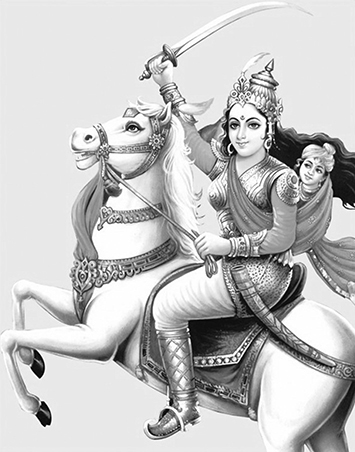
FIGURE 3.1 Lakshmi Bai, the Rani of Jhansi.
Credit: Alamy stock photo Image ID 2B02GAY: https://www.alamy.com/lakshmi-bai-the-rani-of-jhansi-c19-november-1835-17-june-1858-marathi-was-the-queen-of-the-maratha-ruled-princely-state-of-jhansi-situated-in-the-north-central-part-of-india-she-was-one-of-the-leading-figures-of-the-indian-rebellion-of-1857-and-a-symbol-of-resistance-to-the-rule-of-the-british-east-india-company-in-the-subcontinent-image344264115.html
In 1842 Lakshmi Bai married Maharaja Gangadhar Rao of Jhansi, a pro-British but independent princely state in Northern India. On his deathbed, the maharaja, with no direct heir as a son had died in infancy, adopted a five-year-old relative as his heir. Bringing to mind the Romans’ denial of Boadicea and her daughters’ legitimacy to rule, James Dalhousie, British Governor General of India, rejected the adoption and invoked the ‘Doctrine of Lapse’ that allowed for the British takeover of Jhansi.46 Lakshmi Bai’s appeals were rejected and as other warrior heroines before her had done once they were widowed, she fought back. She was able to raise an army of 14,000 rebels, including women, who fortified the city in readiness for the British attack.47 During the ensuing fight the story goes that ‘In darkness, she escaped the besieged fort, her son strapped to her back, and rode a hundred miles to Kalpi, where she continued the fight.’48 According to legend, when rebellion broke out in Meerut three years later Lakshmi Bai was killed in battle, armed with a sword in each hand.49
E F Drexler views Aceh to be significant as ‘the verandah of Mecca’ and a place of longstanding symbolic importance ‘as the site of fierce anti-colonial resistance.’ Aceh also has a longstanding tradition of widow warrior heroines. There was the intelligent and formidable Laksamana Malahayati (1550–1615), a woman who became an admiral in the Aceh Sultanate’s navy. In command during battles against the Portuguese and Dutch, myth has it that her troops came from Aceh’s widows. In 1599 the Dutch came to the Sultanate of Aceh. In the ensuing conflict Malahayati led her Inong Balee Army, killing Dutch expedition commander Cornelis de Houtman. Malahayati played a prominent political and diplomatic role in forming treaties with the Dutch. She also led trade negotiations with Englishman James Lancaster, an emissary of Elizabeth I. Malahayati was killed while attacking the Portuguese fleet at Teuluk Krueng Raya.
A new generation of Acehnese widow warriors emerged centuries later during the anti-colonial resistance to the Dutch (1873–1942). The most prominent two were Acehnese widows Cut Nyak Dhien (1848–1908) and Cut Meutia (1870–1910) who were ‘Indonesian heroines for continuing the legacy of their deceased husbands’ armed resistance to the Dutch colonizers.’ Cut Nyak Dhien was arrested by the Dutch in November 1905 and exiled to Sumedang, West Java, where she died two years later.50 From 1899 Cut Meutia became involved with her second husband Cut Muhammad (Teuku Cik Tunong) in fighting against the Dutch in Aceh. From 1901 Teuku Cik Tunong enjoyed some success, but in 1905 he was caught and executed the next year. Cut Meutia remarried the new commander, Pang Nanggroea and upon his death in battle in 1910 she became the new commander of the struggling force. Tracked down by the Dutch, she was fatally shot in battle. In 1964 she was made a National Hero of Indonesia.
During a third wave of Acehnese resistance that started at the end of the 20th Century (1976–2005), the Widows Battalion (Inong Balce) of the Free Aceh Movement arose. Importantly, they were an ‘invocation of the iconicity of the heroines of the anti-colonial resistance by Acehnese against the Dutch.’51 As E F Drexler puts it ‘The category of “widow” is used to re-enliven historical myths that support and extend the moral legitimacy of the armed struggle in the present.’ According to Drexler, the women were not all widows, but at least considered themselves to be ‘victim-warriors’ and shared the ideology of a sense of injustice and victimisation and, akin to the ancient Amazons, the need to take up arms in the absence of men.52
An article in the New York Times magazine by Andrew Marshall featured sepia tone images by photographer Philip Blenkinsop that evoked portraits of past heroines familiar from archives, textbooks, stamps and currency. Acehnese newsweekly Kontras articles published in 2001 also positioned the female combatants as the reincarnation of Acehnese heroines of the anti-colonial struggle. To do so they re-told historic legends and gave examples of contemporary warriors sharing names of past heroines. One 2001 Kontras article highlighted the female troops who are ‘prepared to die,’ led by a GAM (Free Aceh Movement) fighter named Cut Meutia (named after the first one), described as a young and beautiful widow. For Acehnese and Indonesian readers, the name ‘Cut Meutia’ evoked the historic, nationalist heroine of the same name whose life was chronicled in Indonesian school texts. According to the article, Meutia’s husband, who was not a member of GAM, was killed by the Indonesian Armed Forces (TNI) in 1997 when she was pregnant with her second child. She then chose to join the armed struggle after seeing the TNI abuse many innocent people. In general, their place ever-precarious, Amazonian warrior heroines have to navigate patriarchal society. For example, as interpreted from a 2002 Kontras article, the Widows Battalion risked being treated as ‘merely creatures of sexual attraction and desire or spies suspected by either side and disavowed by both.’53 And for all they were warrior heroines, their ultimate place was to fulfil their ‘biological destiny’ as wives and mothers.54
While the Acehnese example displays continuity from the past into the modern world, iconography always appears in context and can change over time. For example, in 2016, when Cut Meutia (1870–1910) was featured on the new Indonesian 1000-rupiah banknotes, her uncovered hair became controversial. While a 1970s postage stamp and popular public painting did not have her hair covered, some called for representations of the heroine in the 21st century to do so.55
Hua Mulan
Hua Mulan is another example of a heroine whose exploits are told as happening many centuries ago, whose evolution ‘sets the template from which all others are judged.’56 Since the Northern Wei dynasty (386–534) stories of Hua Mulan and her military adventures have ‘entranced and intrigued generations of Chinese.’57 Her changing story features the ‘ideological power of the Chinese woman warrior in the marketing of war and the selling of militarised violence to generations of Chinese people.’58 Capturing the important interconnection between fact and fiction present for heroines in history, Louise Edwards argues that Hua Mulan was fictional, but is considered as ‘real.’59 The original Mulan text is an anonymous poem that appeared in 568. According to ‘The Ballad of Mulan,’ to save her unwell father, and with a brother too young to assist, Mulan disguised to serve in the imperial troops. After passing as a soldier for over 12 years of service the khan offered her work as a cabinet minister, but she turned him down and asked for a camel to ride on and return to her family. Once home, she dressed as a woman, surprising those who had known her in the military.60 The original ballad emphasised family duty and homesickness.
As is the case for many traditional heroines, rather than be ‘heralded as feminist forerunners, carving new territory in a male-dominated world’ Chinese women warriors ‘have featured as fantastic and bizarre exceptions’ responsible for bolstering ‘Confucian patriarchal social order.’61 Edwards argues that ‘The lionised women warriors of dynastic China were without exception wives and daughters whose remarkable courage and martial skill were harnessed in the defence of their husbands or fathers.’62 In this context, it is unsurprising that Hua Mulan’s story was about the ‘filial piety’ of serving parents and seniors. With time, Mulan’s story became about her dedication to the state, as well as emphasising her chastity. And by the start of the 20th century ‘Hua Mulan, dutiful daughter in centuries of Confucian teachings, was mobilised by China’s new feminist movement as a model for woman’s independence and strength.’63
Self-made warriors: Mighty Joan
According to Marina Warner, Joan of Arc’s significance extends to she herself becoming an archetype. Warner writes that ‘Joan was a familiar face, but it had hardly ever been seen in the real world before. That was the miracle.’64 Presenting as an Amazon, the medieval heroine is of enormous and enduring importance in modern history.65 Joan has remained famous, reinvented and refreshed since her lifetime. Only gaining strength in the modern era, she was canonised in 1920 and is a national heroine of France. Where in modern times it is still difficult for women to lead armies, incredibly, Joan of Arc emerged from the peasantry. She was born around 1412 in Domremy, Lorraine, which at the time was part of the Holy Roman Empire. Constructed tomboy stories emphasise her good health and athleticism. Although illiterate, she was well-versed in the popular legends of saints, including the maternal heroism discussed in Chapter 2. Indeed, early on she made a vow of chastity and led a pious life praying in church.66
To understand her exceptional presence, Joan appeared during the last phase of the 100 Years War. The English controlled most of the north-west of France and much of the south and the Duke of Burgundy (the English king’s powerful cousin) was allied with the English and supported English Henry V’s claim to the throne of France. The unwell Charles VI died in 1422 and Charles VII had himself crowned king, yet a treaty recognised Henry as the rightful heir. Even Charles’s mother Isabella was on England’s side and declared her son illegitimate. The English seemed invincible and France’s position hopeless. The hope amongst French despair came from a prophesy that asserted that an evil woman would betray France to her enemy (such as Charles’s mother), but that the country would be saved by a pure maid from Lorraine. The stage was uncannily set for Joan, with her mission to save France from the English.67
The two parts of her mission were first, to see the Dauphin crowned at Reims as Charles VII, King of France and, second, recover the besieged city of Orleans from the English.68 Remarkably, the voices that guided Joan from the age of 13 assured her that although she was a girl, and one who couldn’t even ride a horse, if she trusted in God she would be able to do all that was necessary. The voices instructed Joan to go Captain Robert de Baudricourt, the king’s representative in the district and the governor of Vaucouleurs. He would provide her with an escort to reach Charles. But when her mother’s cousin took her there in May 1428 Baudricourt was unimpressed and sent her home with the message that her father should punish her for stepping out of line. A young peasant girl offering salvation was outrageous by the standards of the time. Once again, context was vital. The British were on the advance. Domremy was attacked and ransacked and Vaucouleurs was the last outpost loyal to the French crown. When Joan returned to de Baudricourt after these defeats in January 1429 she won some supporters, who were aware of the prophesy, as well as of their desperation. Getting supporters was vital as it led to the beginnings of Joan’s military career. The journey to the Dauphin was over 300 miles and took 11 days. An eyewitness later testified that ‘she went up to the king with great humility and simplicity like a poor shepherd girl’ and said ‘Most illustrious Sire Dauphin, I have come and God has sent me to bring help to the kingdom and to you.’69 It is phenomenal that he believed her.
Lasting from 1429–31, Joan of Arc’s warrior career was short but intense. Incredibly, with no military training, she was able to convince soldiers, citizens and the king’s commanders to do as she said. Kicking off a year of victories, the first major battle was the Siege of Orleans. She had a confidence and energy that inspired the soldiers. At this time she was given white armour, and images of her subsequently repeat that costume, along with her astride a warhorse carrying the cross of Lorraine, later adopted by Charles de Gaulle during World War II. Unlike warrior Queens, who were usually positioned away from fighting, Joan rode a horse in the front line. At one point she was wounded in the neck by an arrow, but soon returned to continue the fight.70
The English soldiers were said to be demoralised, and terrified of her supposed supernatural powers.71 And, of course, it was also shameful that a young woman could beat them in battle. Importantly, Joan’s success suggested that the French had God on their side. After a series of rapid victories in small towns Joan and her army moved on to Rheims where, as prophesised, Charles VI was crowned. With the English on their way with reinforcements, in line with her strategic thinking that always favoured action over procrastination, Joan advanced the army. Those cynical of her military prowess argue that luck led to her initial victories, while others believe that she was divinely inspired.72 Kelly De Vries has touted Joan’s military talent. She argues that Joan used well-positioned artillery against the English archers and that she rallied the soldiers and got them working in unison.73
Joan was once more wounded in battle while moving on Paris. Then in March 1430 while leading a small force of volunteers to relieve a town she was captured. The iconic warrior heroine’s battle days were over and the fight would shift to defending her actions, as discussed in Chapter 6, and along with her warrior heroine status, her invention as a martyr and saint.
Out of the old, into the new: two modern examples
Anti-colonial warrior heroine Malalai of Maiwand in Afghanistan is an example of an anti-colonial heroine whose story is linked to others across time, space and cultures. Significantly, Malalai became known as ‘The Afghan Jeanne D’Arc.’ She was celebrated for rallying the locals against the British at the 1880 Battle of Maiwand, part of the second Anglo-Afghan War where Afghans fought to stop the British from gaining control of their land.74 Malalai is famous in Afghanistan, appearing in school textbooks and with hospitals named after her.75 Recently named after her is Malala Yousafzai, discussed in Chapter 4, and Afghan activist and politician Malalai Joya.
Malalai was born in 1861 in the village of Khig, southwest of Maiwand in southern Afghanistan. In the late 1880s British forces were attempting to colonise the area and had made it to nearby Kandahar. Malalai’s father, a shepherd, and her fiancé joined commander Ayub Khan’s army in an attack on the British forces. Malalai was present at the battlefield to nurse the wounded and pass water and weapons. Legend has it that it was supposed to be her wedding day. To raise morale, when a flagbearer was killed, Malalai took the Afghan flag and sang out an Afghan women’s folk song about the noble sacrifice of husbands in battle.76 The Afghan fighters were encouraged and fought back against the odds, defeating the British in what was to be their greatest defeat of the Second Afghan War. Malalai herself was killed in battle; her body returned to her village for burial as a heroine.77
Another heroine who wore the mantle of heroine predecessors was Xie Bingying.78 Referred to by her father as ‘a second Mulan’ she became ‘China’s most well published woman warrior.’ Her book A Woman Soldier’s Own Story has been republished over 25 times in Chinese and into four different English versions, the first in 1940. Her War Diary has 19 editions.79 During the 1920s and 1930s, caught up in a climate of feminism and patriotism, women served in the Chinese military.80 Xie Bingying served on the frontlines between 1926–8 in the Northern Mission when Nationalists and Communists joined forces against warlords, in Shanghai in 1932 to resist the Japanese, and during the 1937 Japanese invasion of China.81 In common with other warrior heroines, Bingying was described as both a tomboy and an Amazon. For example, in 1934 her translator Lin Yutang described her as ‘barely over twenty, with a small face and bright eyes, light, joyous, enthusiastic, and with still something of a tomboy in her.’ She also commented on her ‘husky, staccato voice,’ the result from rough exposure to the elements, yet also played up the feminine, pondering if the ‘Amazons’ had carried mirrors and powder puffs as Bingying did.82
Modern radical warriors
While modern warrior heroines displayed continuity with the past and were variously employed by states to prosecute war, there were also militant warrior heroines who fought civil wars. As discussed in detail in Chapter 7, radical militant suffragettes led by Emmeline Pankhurst and the Women’s Social and Political Union (WSPU) were radicals. Ideologically, violent female activism challenged women’s submissive and life-giving place in society. Drawing comparison with the trope of Joan of Arc, Sikata Banerjee has argued that modern nationalist movements most often place men as the fighters and the women involved in assisting them as chaste.83 So how are women in modern history who have taken on the most globally despised killing missions, those of terrorism, represented? An heroic rhetoric combining motherhood and martyrdom has lurked awkwardly around these women. In her study of modern women terrorists Mia Bloom argues that overall, ‘most existing notions of women in the midst of conflict portray them as victims of war rather than as perpetrators.’84 For example, symbolically blurring the dichotomy between life-givers and life-takers, in April 2006, Kanapathipillai Manjula Devi posed as the pregnant wife of a soldier to gain access to a military hospital in Sri Lanka to kill and maim. As Bloom put it ‘The advent of women suicide bombers has thus transformed the revolutionary womb into an exploding one.’85 Writing in 2007 Mia Bloom asserts that there were female suicide bombers in Sri Lanka, Turkey, Chechnya, Israel and Iraq – ‘Out of the approximately seventeen groups that have started using the tactical innovation of suicide bombing, women have been operatives in more than half of them.’ Between 1985 and 2006, there have been in excess of 220 women suicide bombers, representing about 15 per cent of the total. Moreover, the upsurge in the number of female bombers has come from both secular and religious organisations, even though religious groups initially resisted using women.86
Mia Bloom argues that ‘In reality women have participated in insurgency, revolution and war for a long time.’ She argues for women taking an important place in the Russian Narodnaya Volya in the 19th century, the Irish Republican Army, the Baader-Meinhof organisation in Germany, the Italian Red Brigades, and the Popular Front for the Liberation of Palestine. She writes that participation was historically in ‘supporting roles,’ and following their role as mothers, that ‘Most often, the primary contribution expected of women has been to sustain an insurgency by giving birth to many fighters and raising them in a revolutionary environment.’87 Dagmar Hellmann-Rajanayagam reveals women’s part in liberation movements for example in Latin America, in the Spanish Civil War, the Communist Movement, the Italian Red Brigades in Italy and the Red Army Faction in Germany, and Laila Khaled, the PFLP (People’s Front for the Liberation of Palestine) member, who became famous in the 1970s.88 Banerjee adds the Nepali Maoist movement, the Tigers of Tamil and the Sandinistas of Nicaragua.89
Radical movements could be symbolically egalitarian. Gaining his evidence from criminal trials, Robert McNeal has argued that at the end of the 19th century, Russian women were much more involved in revolutionary activities than German women at that time. He argues that ‘Russian women literally fought tsarist autocracy shoulder to shoulder with men’ and points to three men and two women (Sofia Perovskaia and Gesia Gelfman), as well as a major conspirator Vera Figner, being condemned for the slaying of Alexander II as evidence of women’s radical participation.90 Gesia’s life was spared as she was pregnant (but she soon died in jail) and Vera because she was a woman. McNeal estimates that 20 per cent of the Russian radical movement before 1905 was women.91 Among the less known heroines whose names rarely appear in Soviet or western histories were members of a 1907 St Petersburg cell of assassins that included Anna Rasputina, Evstoliia Rogoznikova, Z Konnoplianikova, Elena Lebedeva, and Lidiia Struve and four or five men. Their violent careers included the attack on General Min, commander of the Semenovsky Regiment, which crushed the Moscow insurrection of 1905, an attempt on Grand Duke Nicholas Nicholaevich and Minister of Justice Shcheglovitov, and another on the St Petersburg police commandant. Lidiia Struve, a noblewoman and a Petersburg Female Institute graduate, attempted to shoot it out when she fell into a trap in 1908, aged 23. She wounded one detective with her Browning revolver, but was captured and hanged along with her comrades Rasputina and Lebedeva. The other two women in the group were also executed on separate occasions.92
McNeal argues that in global context Russian radical women stand out. He cautiously suggests that ‘the equality of female radicals is especially strong within the specifically Russian Narodnik tradition – the pre-Marxist revolutionaries and the Socialist Revolutionaries – and noticeably less present within the more European Social Democratic movement in the early twentieth century.’93 Drawing upon the Russian-born Rosa Luxemburg, Anglica Balabanova, and Emma Goldman, McNeal argues that ‘that the Russian female radical was an exportable surplus commodity.’94
With shades of Boadicea and Amazons, the actions of women terrorists are often explained by placing them as avenging the deplorable abuse of themselves and their families. For example, in 1991 Rajiv Gandhi was assassinated by Sri Lankan Thenmuli Rajaratnam, a suicide bomber for the Liberation Tigers of Tamil Eelam (LTTE). She detonated a suicide belt hidden beneath her clothes as Gandhi greeted supporters during a campaign for the Congress Party. According to LTTE rhetoric, Rajaratnam’s four brothers were killed by Indian security forces and she was gang-raped.95 In another example, 41 Chechen terrorists, 18 of them women, held approximately 800 Russians hostage in a Moscow theatre for three days in October 2002. The Russian press named the women ‘Black Widows’ after it was suggested that most had lost their husbands and sons in violence and acted out of vengeance.96 The term also vilified their Muslim headdress and associated them with a poisonous female spider that can kill its mate.97
Cragin and Daly argue that groups most associated with suicide terrorism do not use women. One of the few women recruited for suicide terrorism by Hamas was Reem Salih al-Rayasha in 2004. She was married to a Hamas operative and apparently had an affair with a married man.98 The implication is that her transgressions made her dispensable. Wafa Idris was the first woman suicide bomber in the Palestinian territories during the al-Aqsa Intifada, which occurred between September 2000 and July 2003. Idris lived in the Amari Refugee Camp near Ramallah and had worked as a volunteer nurse in ambulances for the Red Crescent. In 2002 she approached the secularist-nationalist al-Aqsa Martyrs’ Brigades, a militant off-shoot of former President Yasser Arafat’s Fatah. She detonated a 10kg rucksack filled with explosives on Jaffa Road in Jerusalem. Explaining her actions was her diminished status in Palestinian society after her divorce from her husband – the implication being that she turned to terrorism after her respectable life was ruined. Another story was that she was radicalised after being shot three times by Israeli forces while riding in an ambulance. Cragin and Daly cast her as ‘a somewhat naïve female heroine.’99
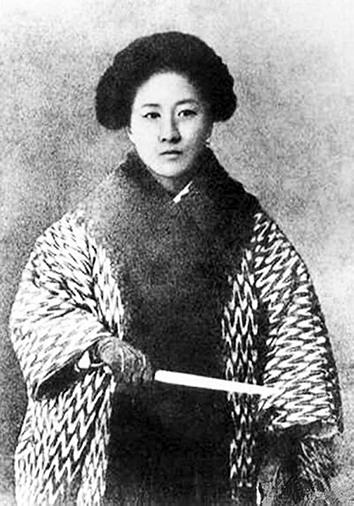
FIGURE 3.2 Qiu Jin.
Credit: Alamy stock photo Image ID KJB5YT: https://www.alamy.com/stock-image-qiu-jin-166203292.html
In early 20th century China, Qiu Jin was a radical revolutionary ‘a knife-wielding, gun-toting feminist warrior who explicitly identified the male-dominated gender hierarchy as unjust and sought to overthrow it.’100 A member of Sun Yat-sen’s Revolutionary Alliance. Qiu Jin married at 21 and had two children. When she moved to Beijing in 1903 for her husband’s work she started an anti-foot binding society. Unhappily married, she sold her jewellery, left her children and husband and, supported by her mother and brother, went to Tokyo to join anti-Qing rebels.101 Qiu Jin was injured while making bombs intended for Qing government officials, as part of ending the monarchy and forming a republic.102 Also a poet, her most famous poem ‘Regrets: Lines Written En Route to Japan’ summarised her beliefs and intentions, including the lines ‘Our woman’s world has sunk so deep; who can help us?’ and ‘Unbinding my feet, I clean out a thousand years of poison.’103 Returning to China in 1906, she taught at the Datong School in Shaoxing. She became principal and as Louise Edwards puts it, ‘from this base built her women’s army.’ Students unbound their feet, were taught foreign languages, geography, history, military strategy and physical education of military drills and weaponry skills. Like numerous other heroines in history Qiu Jin would ride around on a horse, ‘dressed in men’s clothes and Western leather shoes,’ rallying her supporters.104 Sharon Crozier-De Rosa and Vera Mackie provide evidence of Qiu Jin’s story being linked to ‘a pantheon which includes the legendary Hua Mulan, the Soong sisters, and several Communist women.’105
National movements were often gendered in a way that removed women from the action. For example, following Yeats’s play Cathleen ni Houlihan, Ireland itself was personified as ‘a beautiful maiden, an inspiration for rather than an actor in political conflict.’106 The Irish Republican movement has included women warriors, with The Sinn Fein, founded in 1905, open to women from its outset.107 Inghinidhe na hÉireann – daughters of Erin – formed in October 1900 with Maud Gonne as President.108 The Cumann na mBan (CB) (or Women’s Council) that was strong between 1916 and 1923 involved members wearing militaristic uniforms and its logo was a woman carrying a gun. Women trained in drilling, shooting and signalling.109 Of the estimated 90 women who took part in the Easter Uprising in 1916, 60 were CB members. Despite their training, however, the women did not take part in active combat. Rather they were involved in women’s gendered jobs of nursing and cooking and dispatch carrying. In the subsequent war of independence, they continued with these tasks, working as nurses, couriers, cooks and gun runners.110
Described as ‘active soldiers in the anti-imperial uprising of 1916 in Ireland,’ Constance Markievicz (Gore-Booth) and Margaret Skinnider were the most prominent republican warrior heroines.111 Skinnider was called to Ireland from Glasgow by Markievicz and played an important part in the Easter Uprising, where she was shot and wounded. She wrote an eyewitness account of the uprising, Doing My Bit for Ireland, and in 1917 toured the United States.112 Skinnider returned to civilian life and worked as a teacher in Dublin. She was a feminist who advocated for the rights of women teachers and workers more generally.113
The feminist, republican, socialist and artist Markievicz was from Ireland’s Protestant upper class. She met her Polish husband Casimir Dunin Markievicz while at art school in Paris.114 Upon election to the Dail Eireann in 1918 Constance Gore-Booth said that ‘Ancient Ireland bred warrior women’ who were ‘in the danger of being civilised by men out of existence … Women are left to rely on sex charm, or intrigue and backstairs influence.’ On the contrary, Constance argued that it was necessary to bring out the ‘masculine side of women’s souls.’115
Constance was the eldest of five children, with two brothers and two sisters. She can be portrayed as a tomboy, telling a sister that she loved ‘galloping through the woods and hunting and shooting!’116 As part of her radicalisation, Constance met Maud Gonne, who had started The Daughters of Ireland.117 Constance recruited her own foot soldiers: In 1909 she set up Fianna Eireann, a children’s scout movement named after a famous band of warriors; the scouts went on to play a support role in the Easter Rising.118
Out of the past and into the modern, as part of the Irish Women’s Franchise League (IWFL) fundraising, tableaux vivants (where people dressed up and posed to create scenes), were enacted featuring great women in history, including Sappho and Saint Brigid. As Anne Haverty writes ‘Constance was able to indulge her heroic self-image as Joan of Arc. There were actually two Joans of Arc, Kathleen Houston as Joan at the stake, and Con as Joan in full armour.’ It was remembered that ‘She posed as Joan appearing to a suffragist prisoner in her cell. Her alert, gallant bearing was well set off by silver armour, helmet and uplifted sword.’119
In 1916 Markievicz’s sister Eva’s verse-play The Death of Fionavar came out. This also demonstrated continuity with the past and connections between fact, fiction and mythology. Illustrated by Constance, ‘The play describes how Maeve, the Warrior Queen, was chastened by the death of her compassionate daughter, Fionavar, and sought the life of a contemplative.’ In September the New York Times gave it half a page of positive coverage.120
Also anti-British, the prominent ideologies of in India’s Bengali revolutionary movement, namely chastity and pure motherhood, were in stark contrast to the characteristics of women warriors.121 For example, Sikata Banerjee argues that celebrating ‘the martial goddess as the nation,’ ‘The Anushilan Samtiti – from which the main networks of terrorist societies developed, centred on a chaste male figure devoted to sacrificing blood to the Mother India, usually configured as the ferocious Kali or Durga.’ At the same time, however, the nation was represented as ‘grieving mother.’122
Preetilata Wadedar (1911–32) became involved in Surya Sen revolutionary nationalism as a student. On 24 September 1932, disguised in male clothing, she was part of an armed raid on the Paharatali European Club. After the attack she took a cyanide capsule, her suicide note positioning her as a warrior woman,
I think I owe an explanation to my countrymen. Unfortunately there are still many among our countrymen who may be shocked to learn how a woman brought up in the best tradition of Indian womanhood had taken up such a horrible deed as to massacre human lives. I wonder why there should be any distinction between male and female in a fight for her cause … As regards armed rebellion. It is not a novel method. It has been successfully adopted in many countries and the females have joined it in their hundreds … As regards fitness is it not sheer injustice to the females that they will always be thought less fit and weaker than the males in a fight for freedom? Time has come when this false notion must go.123
She continued,
Women today have taken the firm resolution that they will not remain in the background. For the freedom of their motherland they are willing to stand side by side with their brothers in every action however hard or fearful it may be. To offer a proof of this, I have taken upon myself the leadership of this expedition to be launched today. I earnestly hope that our sisters would no longer nurse the view that they are weak. Armed women of India will demolish a thousand hurdles, disregard a thousand dangers and join the rebellion.124
These Indian revolutionary warrior heroines ‘disturbed the dynamic expressed by the gendered binary of martial men versus chaste woman that underlay muscular nationalism.’125 According to Banerjee, ‘the armed female warrior represented an undermining of British manhood,’ a theme common with warrior heroines and the ‘shame syndrome.’ In continuity with earlier heroines in this chapter, they were often explained as resorting to violence in response to their own violent treatment. Another example was Indian national heroine Sunita Choudhury. She was radicalised into the revolutionary movement and trained in weaponry. On 14 December 1931 Choudhury and Santi Goshe (aged 14 and 15, respectively) walked into the office of Charles Stevens, a British district magistrate of Comilla, Bengal, and assassinated him. Sympathetic Indian sources justified their actions as a response to ‘misbehaviors of the British district magistrates who had abused their positions of power to rape Indian women.’ The two women were freed on amnesty after seven years. When another revolutionary Ela Sen walked into the office of a magistrate and shot him, her actions were placed as part of ‘making an example’ of a magistrate in order to end the ‘degradation’ of Bengali girls. The interpretation was that ‘to them it appeared that brutality must be paid back in its own coin.’126 Bina Das (1911–86) shot and wounded another magistrate, went to jail and was later released on amnesty.
Indian Naxalism and Irish Republicanism
The Marxist-Leninist Naxalite Movement emerged out of Naxalbari, a small village in the eastern state of West Bengal, India, in the late 1960s. From a beginning primarily concerned with land reform, it grew to include urban class struggle and unemployment.127 Its most notable heroines were revolutionaries Krishna Bandyopadhayay, Ajitha Narayanan and Joya Mitra. Bandyopadhayay commented on the sexism present in the 1970s for women revolutionaries whose most recognised roles were offering shelter, making the tea, carrying letters and documents and nursing.128 Meanwhile, in Ireland, women were present in the militant Irish Republican Army (IRA). By 1972 there were 236 women political prisoners in Northern Ireland. By 1976, however, they were no longer considered ‘political’ prisoners, but terrorists and criminals.129 From Belfast, Mairead Farrell was recruited into the Provisional IRA at the age of 14. Arrested in 1976 she was sentenced to 14 years in prison for explosives and firearms offences and for belonging to an illegal organisation. In Armagh Prison she led a dirt strike of 32 women and was later killed in a shootout in Gibraltar in 1988. Dirt strikes were a result of prisoners fearing assault in toilets and so staying unwashed in their cells with overflowing toilet bowls and excrement on walls.130 Amidst the late 20th-century Troubles, Irish Republicans fostered stories of past heroines. For example, Constance Markievicz appeared on Northern Ireland public murals. Sharon Crozier-De Rosa and Vera Mackie note the ‘obvious choice’ of Markievicz, considering her memory both political and violent.131
Conclusion
A warrior archetype that builds upon past legends is a global feature for modern heroines in history. Resting on women’s essential difference from men, women engaging in violence is cast as exceptional. In reality, in past and modern times, women have been present as ‘female warriors’ in many ways, pragmatically called upon as a ‘reserve army of labour’ if needs be. Beyond the iconic warrior Queens, however, occupying an intensely awkward position are the women claimed as heroines of liberation movements. As this chapter has shown, their position is strongly justified within patriarchal boundaries. Within a strongly gendered framework, they are cast as avenging violence against women and girls, and their sons and husbands. Given their longstanding participation in insurgency, Dagmar Hellmann-Rajanayagam comments that it is ‘astonishing’ in modern times that these women ‘should have attracted attention as something out of the ordinary, something not fit for women.’132 This is because of the strong and enduring ideology that women fighters are exceptions to the rule, their call to arms a last resort and a strictly exceptional position.
Notes
1 Sara Ruddick, Maternal Thinking: Toward a Politics of Peace (Boston: Beacon, 1989).
2 Jean Bethke Elshtain, Women and War (New York: Basic Books, 1987).
3 Louise Edwards, Women Warriors and Wartime Spies of China (Cambridge: Cambridge University Press, 2016), 7.
4 Susan Brownmiller, Against Our Will: Men, Women and Rape (London: Secker and Warburg, 1975).
5 Edwards, Women Warriors and Wartime Spies of China, 1.
6 Kathleen C Winters, Amelia Earhart: The Turbulent Life of an American Icon (New York: Palgrave Macmillan, 2010), 2.
7 Doris L Rich, Amelia Earhart: A Biography (New York: Laurel, 1989), 159.
8 See Lucy Noakes, Women in the British Army: War and the Gentle Sex, 1907–1978 (London and New York: Routledge, 2006).
9 Edwards, Women Warriors and Wartime Spies of China, 89–90.
10 Julie Wheelwright, Amazons and Military Maids: Women Who Dressed as Men in Pursuit of Life, Liberty and Happiness (London, Boston, Sydney, Wellington: Pandora, 1989), 7.
11 Salvatore Liccardo, ‘Different Gentes, Same Amazons: The Myth of Women Warriors at the Service of Ethnic Discourse,’ The Medieval History Journal, Vol. 22, No. 2 (2018), 222–50, 222–3, 242.
12 Liccardo, ‘Different Gentes, Same Amazons,’ 222–3.
13 Antonia Fraser, The Warrior Queens: The Legends and the Lives of Women Who Have Led Their Nations in War (London: Penguin, 1990), 3–4.
14 Fraser, The Warrior Queens, 61–2.
15 Fraser, The Warrior Queens, 62.
16 Andrea Hopkins, ‘Boudicca’, in Sara Hunt (ed), Heroines: Remarkable and Inspiring Women (Glasgow: Saraband, 1995), 18–9, 18.
17 Fraser, The Warrior Queens, 71.
18 Fraser, The Warrior Queens, 59, 96, 71.
19 Fraser, The Warrior Queens, 72.
20 In Fraser, The Warrior Queens, 73.
21 Fraser, The Warrior Queens, 74–5.
22 Fraser, The Warrior Queens, 77.
23 Fraser, The Warrior Queens, 96.
24 Fraser, The Warrior Queens, 88.
25 Fraser, The Warrior Queens, 96.
26 Fraser, The Warrior Queens, 98.
27 Fraser, The Warrior Queens, 100. Judy Chicago, The Dinner Party: A Symbol of Our Heritage (New York: Anchor/Doubleday, 1979) plate has image of Stonehenge, 67.
28 Sarah Womack, ‘The Remakings of a Legend: Women and Patriotism in the Hagiography of the Tru’ng Sisters,’ Crossroads: An Interdisiplinary Journal of Southeast Asian Studies, Vol. 9, No. 2 (1995), 31–50, 33.
29 Sarah Womack, ‘The Remakings of a Legend,’ 40.
30 Fraser, The Warrior Queens, 11–13.
31 Susan Frye, Elizabeth I: The Competition for Representation (Oxford and New York: Oxford University Press, 1993), 3.
32 Frye, Elizabeth I, 6.
33 Fraser, The Warrior Queens, 253.
34 Katharine Anthony, Catherine the Great (London: Cape, 1926), 88.
35 See Isabel De Madariaga, Catherine the Great: A Short History (New Haven: Yale University Press, 2002), 1.
36 Fraser, The Warrior Queens, 253.
37 De Madariaga, Catherine the Great, 43.
38 https://www.livescience.com/42006-catherine-the-great.html (Date last accessed 21 August 2019).
39 De Madariaga, Catherine the Great, 75–9.
40 Sylviane Anna Diouf, Kings and Queens of West Africa (New York: Franklin Watts, 2000), 49.
41 Diouf, Kings and Queens of West Africa, 46.
42 Diouf, Kings and Queens of West Africa, 47–9.
43 See Stanley Alpern, Amazons of Black Sparta: The Women Warriors of Dahomey (London: C Hurst and Co, 2011).
44 Jennifer Orkin Lewis, All Hail the Queen: Twenty Women Who Ruled (San Francisco: Chronicle Books, 2019), 106.
45 Orkin Lewis, All Hail the Queen, 108.
46 Orkin Lewis, All Hail the Queen, 106.
47 Orkin Lewis, All Hail the Queen, 110.
48 Orkin Lewis, All Hail the Queen, 111.
49 Orkin Lewis, All Hail the Queen, 110.
50 Jaqueline Aquino Siapno, Gender, Islam, Nationalism and the State in Aceh: The Paradox of Power, Co-Optation and Resistance (London and New York: Routledge, 2002), 24–6.
51 Elizabeth F Drexler, ‘Victim-Warriors and Iconic Heroines: Photographs of female combatants in Aceh, Indonesia’ Critical Asian Studies, Vol. 50, No. 3 (2018), 395–421, 397.
52 Drexler, ‘Victim-Warriors and Iconic Heroines,’ 395–6, 404.
53 Drexler, ‘Victim-Warriors and Iconic Heroines,’ 413.
54 Drexler, ‘Victim-Warriors and Iconic Heroines,’ 407.
55 Drexler, ‘Victim-Warriors and Iconic Heroines,’ 414.
56 Edwards. Women Warriors and Wartime Spies of China, 4–5
57 Edwards, Women Warriors and Wartime Spies of China, 17.
58 Edwards. Women Warriors and Wartime Spies of China, 4–5
59 Edwards, Women Warriors and Wartime Spies of China, 3.
60 Edwards, Women Warriors and Wartime Spies of China, 20
61 Edwards. Women Warriors and Wartime Spies of China, 9–10
62 Edwards, Women Warriors and Wartime Spies of China, 10.
63 Edwards, Women Warriors and Wartime Spies of China, 10, 11, 12.
64 Marina Warner, Joan of Arc: The Image of Female Heroism (London: Weidenfeld and Nicolson, 1981), 236.
65 Warner, Joan of Arc, 9.
66 Andrea Hopkins, ‘Joan of Arc’, in Hunt, Heroines 33–7.
67 Hopkins, ‘Joan of Arc’, 33.
68 Hopkins, ‘Joan of Arc’, 34.
69 Hopkins, ‘Joan of Arc’, 34.
70 Hopkins, ‘Joan of Arc’, 35.
71 Hopkins, ‘Joan of Arc’, 35.
72 Hopkins, ‘Joan of Arc’, 35–6.
73 https://archive.schillerinstitute.com/educ/joan_ib.html. (Date last accessed 21 August 2019).
74 https://enacademic.com/dic.nsf/enwiki/11682071 (Date last accessed 26 May 2020).
75 https://www.garenewing.co.uk/angloafghanwar/biography/malalai.php (Date last accessed 26 May 2020).
76 https://www.garenewing.co.uk/angloafghanwar/biography/malalai.php (Date last accessed 26 May 2020).
77 https://www.garenewing.co.uk/angloafghanwar/biography/malalai.php (Date last accessed 26 May 2020).
78 Edwards, Women Warriors and Wartime Spies of China, 71.
79 Edwards, Women Warriors and Wartime Spies of China, 68.
80 Edwards, Women Warriors and Wartime Spies of China, 90.
81 Edwards, Women Warriors and Wartime Spies of China, 66.
82 Edwards, Women Warriors and Wartime Spies of China, 70.
83 Sikata Banerjee, Muscular Nationalism: Gender, Violence, and Empire in India and Ireland, 1914–2004 (New York: NYU Press, 2012), 2.
84 Mia Bloom, ‘Female Suicide Bombers: A Global Trend,’ Daedalus, Vol. 136, No. 1 (2007), 94–102, 95.
85 Bloom, ‘Female Suicide Bombers,’ 95.
86 Bloom, ‘Female Suicide Bombers,’ 95.
87 Bloom, ‘Female Suicide Bombers,’ 94.
88 Dagmar Hellmann-Rajanayagam, ‘Female Warriors, Martyrs and Suicide Attackers,’ International Review of Modern Sociology, Vol. 34, No. 1 (Spring 2008), pp. 1–25, 2.
89 Banerjee, Muscular Nationalism, 163.
90 Robert H McNeal, ‘Women in the Russian Radical Movement,’ Journal of Social History Vol. 5, No. 2 (1971–2),143–63, 143.
91 McNeal, ‘Women in the Russian Radical Movement,’ 144.
92 McNeal, ‘Women in the Russian Radical Movement,’ 157–8.
93 McNeal, ‘Women in the Russian Radical Movement,’ 145.
94 McNeal, ‘Women in the Russian Radical Movement,’ 144.
95 Kim Cragin and Sara A Daly, ‘Women as Suicide Bombers.’ In Women as Terrorists:Mothers, Recruiters, and Martyrs (ABC-CLIO, LLC, 2009), 55–6.
96 Cragin and Daly, ‘Women as Suicide Bombers,’ 55 and Caron E Gentry and Laura Sjoberg Beyond Mothers, Monsters, Whores: Thinking about Women’s Violence in Global Politics (London: Zed Books, 2015), 99–100.
97 Gentry and Sjoberg, Beyond Mothers, Monsters, Whores, 101.
98 Cragin and Daly, ‘Women as Suicide Bombers,’ 69.
99 Cragin and Daly, ‘Women as Suicide Bombers,’ 56.
100 Edwards, Women Warriors and Wartime Spies of China, 40.
101 Edwards, Women Warriors and Wartime Spies of China, 44.
102 Edwards, Women Warriors and Wartime Spies of China, 43.
103 Edwards, Women Warriors and Wartime Spies of China, 45–6.
104 Edwards, Women Warriors and Wartime Spies of China, 47.
105 Sharon Crozier-De Rosa and Vera Mackie, Remembering Women’s Activism (London and New York: Routledge, 2019), 110.
106 Banerjee, Muscular Nationalism, 76.
107 Banerjee, Muscular Nationalism, 77.
108 Banerjee, Muscular Nationalism, 78.
109 Banerjee, Muscular Nationalism, 82.
110 Banerjee, Muscular Nationalism, 81–3. See also Liz Gillis and Mary McAuliffe (eds) Richmond Barracks, 1916 ‘We Were there’: 77 women of the Easter Rising (Dublin: Dublin City Public Libraries, 2016).
111 Banerjee, Muscular Nationalism, 17.
112 Margaret Skinnider, Doing My Bit for Ireland (Edinburgh: Luath Press, 1916/2016).
113 See Mary McAuliffe, Margaret Skinnider (Dublin: University College Dublin Press, 2020).
114 See Lauren Arrington, Revolutionary Lives: Constance and Casimir Markievicz (New Jersey: Princeton University Press, 2016).
115 Banerjee, Muscular Nationalism, 89.
116 Ann Carroll, Countess Markievicz: An Adventurous Life, 2016 (Dublin: Poolbeg Press Ltd., 2016), 1–2.
117 Carroll, Countess Markievicz, 13.
118 Carroll, Countess Markievicz, 16–7.
119 Anne Haverty, Constance Markievicz: Irish Revolutionary (Dublin: Lilliput Press, 1988/2016), 139.
120 Haverty, Countess Markievicz, 193.
121 Banerjee, Muscular Nationalism, 17.
122 Banerjee, Muscular Nationalism, 99.
123 Banerjee, Muscular Nationalism, 101.
124 Banerjee, Muscular Nationalism, 102.
125 Banerjee, Muscular Nationalism, 105.
126 Banerjee, Muscular Nationalism, 100.
127 Banerjee, Muscular Nationalism, 183.
128 Banerjee, Muscular Nationalism, 115.
129 Banerjee, Muscular Nationalism, 126.
130 See Begona Aretxaga, ‘Dirty Protest: Symbolic overdetermination and Gender in Northern Ireland Ethnic Violence,’ Ethos, Vol. 23, No. 2 (1995), 123–48, 122, 128.
131 Crozier-De Rosa and Mackie, Remembering Women’s Activism, 102.
132 Hellmann-Rajanayagam, ‘Female Warriors, Martyrs and Suicide Attackers,’ 2.