
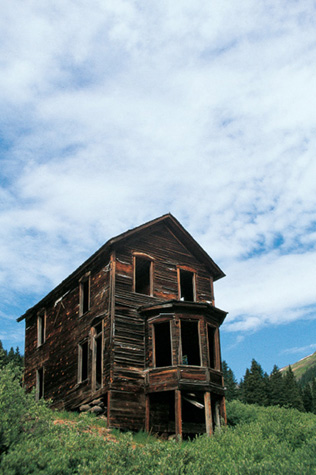
The Duncan House in Animas Forks is one of southwestern Colorado’s most photographed buildings.
THE SAN JUAN MOUNTAINS ARE SOME OF THE MOST SPLENDID IN COLORADO. Although they lack the proliferation of “Fourteeners” that the Rockies can claim (of fifty-three 14,000-foot peaks in Colorado, only thirteen are found in the San Juans), these mountains have a drama, a spectacle, that is unique in the state.
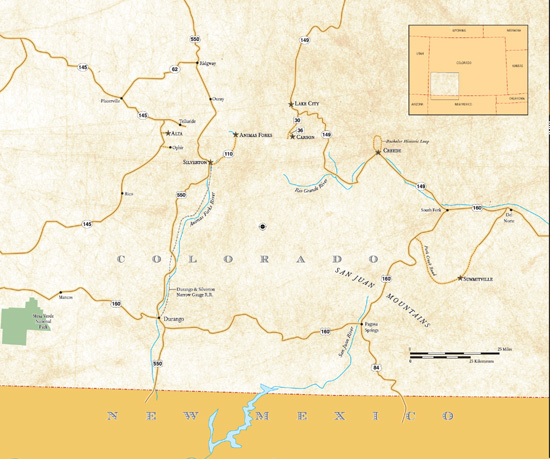
Perched near the San Juan’s pinnacles and nestled in its valleys are some of Colorado’s most beautiful mining camps. The ghost towns in this chapter range from deserted Carson, Summitville, Animas forks, and Alta to busy but charming tourist towns lake City, Creede, and Silverton. In addition, the area features an excellent mill tour, the best mining tour I’ve ever taken, and the world-famous Durango & Silverton Narrow Gauge Railroad.
The person whose history connects almost every site in this chapter is Otto Mears. He came to the united States a Russian orphan in 1850 at age ten, and a year later he was in the California Gold Rush. A small man with towering energy, Mears later served in the Civil War, fought indians under Kit Carson, and learned to speak the language of the ute indians fluently. in Colorado, he became known as the “Pathfinder of the San Juans” for his ability to create a road where others could not.
Lake City rivals Georgetown as one of Colorado’s most charming communities. Although smaller than Georgetown and not quite as splendid, it is also not nearly as crowded or tourist-oriented. Its downtown has some delightful buildings, while residential areas feature attractive homes and churches.
The region’s most infamous incident occurred in late 1873 or early 1874, before Lake City existed. Alferd Packer was hired by Utah prospectors to guide them through the San Juan Mountains. Many gave up as winter approached, but five men continued with Packer. Two months later, when he arrived, alone, at Los Pinos Indian Agency, Packer claimed he had become separated from his companions and had nearly starved.
A search party found the men near Lake San Cristobal. All were dead, four from ax blows, the fifth from a bullet. All had been, literally, butchered. Remembering that the “nearly starved” Packer had seemed suspiciously well fed, the would-be rescuers reached a logical but grisly conclusion. By the time the search party returned, Packer had vanished.
Meanwhile, other prospectors were also combing the San Juans. The area’s mineral deposits were spotted in 1874 by surveyor Enos Hotchkiss while scouting a wagon route through the San Juans. He and his party abandoned the road project and spent the winter staking claims.
By the spring of 1875, a camp of four hundred citizens was firmly established where Hotchkiss’ party had settled. Hotchkiss returned to road-building long enough to create a toll road from Saguache with partner Otto Mears.
Improved roads meant cheaper transportation of ore, and the camp, called Lake City for Lake San Cristobal, boomed. Also in 1875, the town wrested the seat of recently created Hinsdale County from San Juan City, which has since disappeared.
The arrival of the Denver & Rio Grande Railroad in the late 1880s added to Lake City’s status. The town could boast of its five general stores, five saloons, three restaurants, three breweries, two drugstores, two bakeries, two blacksmith shops, two meat markets, a newspaper, and a public library.
Back to unfinished business. In 1883, nine years after he had been suspected of murder and cannibalism, Alferd Packer was apprehended in Wyoming and brought to Lake City for trial. When Packer had left his camp near Lake San Cristobal, there was no Lake City; less than a decade later, he was being tried in its two-story courthouse. He was found guilty of murder and sentenced to death, but the sentence was later reduced to a prison term. After serving several years, Packer was paroled.
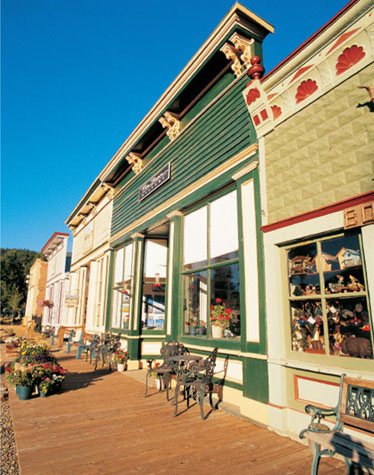
Lake City’s Silver Street has several excellent examples of wooden commercial buildings. Each features an attractive cornice atop its false front.
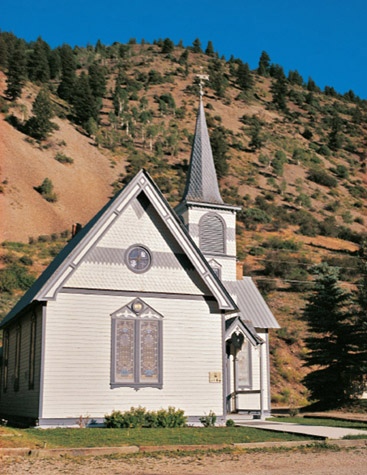
First Baptist Church’s graceful off-center steeple and pretty stained-glass windows make it one of Lake City’s most attractive places of worship.
The Silver Crash of 1893 damaged Lake City, but enough gold was also being mined that the town held on into the twentieth century.
WALKING AND DRIVING AROUND LAKE CITY
At the south end of Lake City’s business district, at Silver and Second streets, is the Hinsdale County Museum. It is housed in the Finley Block, a single-story stone building constructed by stonemason Henry Finley, who fashioned the attractive storefront himself.
The museum has many unusual items and displays. For example, one exhibit features Susan B. Anthony’s visit to Lake City in 1877; another shows a dollhouse made by Alferd Packer while he was in prison. One exhibit showcases the Hough Firefighters, which were sponsored by John Simpson Hough, a prosperous entrepreneur. His backing of the fire department was a public-spirited thing to do—and practical, because the firefighters protected his investments as well as those of others.
Downtown Lake City features several other historic buildings. At the corner of Silver and Third stands the 1877 Stone Bank Block, which served as a bank until 1914. It was then converted to other uses, including a forty-year stint as a hotel. Around the corner is Armory Hall, originally the opera house, built in 1883. The restricted, posh Hinsdale Club for men used the building’s second floor.
The Hough Block, on the east side of Silver in the next block north, was built by John Hough between 1880 and 1882. For Lake City old-timers, however, the block is remembered for Mike and Stella Pavich, who purchased the building in 1932 and ran Mike’s Place Cafe until 1945, when they turned it into a grocery.
The 1877 Hinsdale County Courthouse is one block east of the highway between Third and Fourth streets. The first-floor corridor displays documents on the Alferd Packer trial. The second-floor courtroom, except for a microphone and computer, transports you to 1877.
Too many historic residences stand in Lake City to enumerate them all, but here are several of my favorites. At the northeast corner of Fifth and Gunnison (Colorado Highway 149) is the 1877 John Hough House. Across the street is the small 1876 St. James Episcopal Chapel, originally a carpentry shop. South of the chapel is the lovely 1877 Turner House at 513 Gunnison. (Turner and a partner operated the carpentry shop that later became the chapel.)
The most grandiose residence in town, the 1892 Youmans House, stands on the northeast corner of Sixth and Gunnison. A plaque in front of the home wryly states that the home was “intended to be noticed.”
Henry Kohler’s brick home stands on the northeast corner of Fifth and Silver. Kohler, a pharmacist, returned to his native Germany to get his bride and built this home for her as a wedding present.
In addition to the St. James Episcopal Chapel, three other attractive churches remain in Lake City. The Presbyterian church, built in 1876, is located on Fifth near Gunnison. The narthex and steeple were added in 1882, with side doors flanking a decorative center window. It was aesthetic, perhaps, but not practical— caskets could not get through the side doors. The window was eventually replaced with a main door that gave pallbearers a straight shot into the church.
The 1891 First Baptist Church stands on Bluff Street at Fourth. The steeple is forty-five feet high, and the church can accommodate almost two hundred worshipers.
The third church, one few visitors see, is the St. Rose of Lima Catholic Church. To reach it, cross Henson Creek Bridge on the south side of town. In deference to the residents of the Henson Creek RV Park, leave your car on Gunnison and walk rather than drive through their park. The church was built in 1878 and restored between 1982 and 1992. Beyond it stands a handsome mansard-roofed brick home.
South of town 2.8 miles on Highway 149 is the Alferd Packer Massacre Site. Five metal crosses mark where Israel Swan, George Swan, Frank Miller, James Humphreys, and Wilson Bell were murdered.
The Lake City Cemetery is located a mile north of downtown along the highway. Another cemetery is a half-mile away. From the Lake City Cemetery, head north and then immediately turn left onto Balsam Drive, following the road to an attractive wrought-iron fence.
WHEN YOU GO
Lake City is 54 miles southwest of Gunnison and 52 miles northwest of Creede on Colorado Highway 149.
The Hinsdale–IOOF Cemetery has hundreds of graves. Two markers recall mining’s dangers. Harry Pierce died in an explosion at the Ulay Mine in 1878. Judson Hillis died in 1890 “as a result of an accident in the Ulay Mill on Henson Creek.”
A grave on a hill in the northwest corner affected me enormously. It is for Roger David Coursey, age forty-four, who “gave his life in the line of duty November 18, 1994.” I was so touched by the stone and its inscriptions that I returned to the sheriff’s office (located in a building dedicated to Coursey) to learn more.
Roger Coursey died ten days into his first elective term as Hinsdale County’s sheriff after two men attempted to rob a bank in Creede. He and another officer stopped the men’s car near the turnoff to the Packer massacre site. Sheriff Coursey was shot dead, leaving a wife and four children. A simple white cross along the highway near the Packer site marks where he died.
The Hardtack Mine Tour
The Hardtack Mine Tour, advertised in Lake City as “a real mine,” is a worthwhile introduction to mining if you haven’t already taken other such tours. It’s a reasonable value for an approximately forty-minute tour that features lots of rusted mining equipment set up with mannequin miners. My guide’s information was accurate and interesting.
The only problem is that there never was a hardtack Mine. What you enter was originally a proposed transportation tunnel intended to move ore more quickly from the nearby hidden Treasure Mine. After almost seven years of digging, beginning in 1899, it was abandoned, so it never was any part of a working mine.
Despite its good intentions, the Hardtack Mine Tour does not compare to two better Colorado tours mentioned in this book, the Mollie Kathleen Mine Tour (page 66) or the Old Hundred Mine Tour (page 105).
The Hardtack Mine is 2.7 miles west of Lake City on Henson Creek Road (County Road 20), the route over Engineer Pass.