
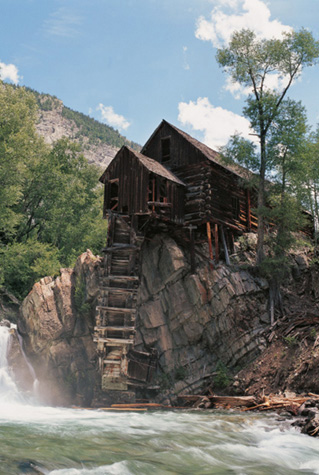
The hydroelectric power generator building for the Sheep Mountain Tunnel Mill (now a pile of rubble) is one of Colorado’s most famous ghost town structures.
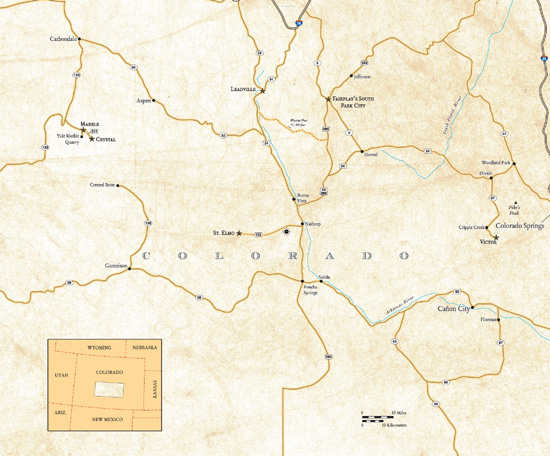
ALTHOUGH THE GOLD RUSH OF 1859 WAS KNOWN FOR THE MOTTO “PIKES PEAK OR BUST,” the early discoveries were actually sixty miles northwest of that mountain. More than thirty years later, prospectors made a serious attempt to ascertain what lay practically in Pikes Peak’s shadow. The reminders of the resulting bonanza are showcased at Victor, one of Colorado’s best urban ghosts. Nearby is its sister bonanza town, Cripple Creek, now a lively casino town but once nearly a ghost itself.
Farther west of Victor stands charming St. Elmo, perhaps my favorite Colorado ghost town. And northwest of St. Elmo is unusual Marble, not a mining town at all but rather a place whose quarried marble gave America some of its most famous monuments. Finally, at Crystal, next to Marble, stands Colorado’s most photographed structure: the hydroelectric generating plant for the mill of the Sheep Mountain Tunnel Mine.
Victor and its more glamorous sister, Cripple Creek, practically saved Colorado. When the state was reeling from the Silver Crash of 1893, Cripple Creek and Victor were alive and thriving because gold, not silver, surrounded the towns.
Victor and Cripple Creek share much in common with Central City and Black Hawk (see chapter 1, pages 22-27). Both sets of towns were rivals and shared much of their history. All four were ghosts in the 1950s, and three of the four were rejuvenated by limited-stakes gambling beginning in 1991. Only Victor was unaffected, and for that ghost town enthusiasts can rejoice. Cripple Creek hasn’t been altered as much as Black Hawk, but it nevertheless has huge, modern casinos. Because Victor was overlooked in the gambling rush, it has a somnolent, decaying beauty that the other three lack. It is, for me, one of the West’s best ghost towns.
Cripple Creek’s colorful name supposedly came from a mishap involving a cowboy on horseback chasing a cow into a creek, resulting in a broken leg to the horse and the cow and a broken arm to the cowboy. On hearing the account, a wag was supposed to have remarked, “That is a Cripple Creek.”
Victor’s name had more prosaic beginnings. It was either named for the nearby Victor Mine or for homesteader Victor Adams.
Prospectors began to explore the Cripple Creek–Victor area in 1874, but little was found. This wasn’t a place where gold should appear. The geology seemed wrong, and the deposits were hard to extract. The place confounded prospectors, confused miners, and bankrupted speculators. In 1884, a local scam brought investors to salted claims. As a result, the hills around Mount Pisgah had a tainted reputation.
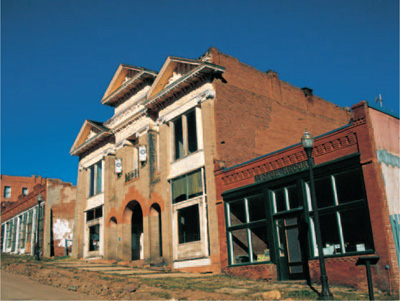
The Victor Daily Record newspaper was printed in the single-story brick building on the right. Next door is the triple-corniced Masonic Hall. Both buildings stand on Victor’s fourth Street.
The area became better known for its ranching an included property owned by Horace Bennett and Julius Myers. When prospectors once again tried the Mount Pisgah District in 1891, Bennett and Myers platted a town near the claims, named the two main streets after themselves, and named the town itself after explorer John C. Frémont.
A rival community, Hayden Placer, grew near Fremont, but ultimately the two joined, choosing the name everyone was using already: Cripple Creek. A bonanza was forecast.
Bob Womack, the original owner of Bennett and Myers’ ranch, is credited with finding the first promising ore, though he reportedly sold out his claims for a few hundred dollars before the true jackpots were discovered. Another sometime Cripple Creek prospector, Colorado Springs carpenter Winfield Scott Stratton, persisted in his search for the major lode. He found it southeast of Cripple Creek on Battle Mountain, near where Victor now stands, where he made the Independence claim on July 4, 1891. He became a multimillionaire from the gold strike even as “Silver King” Horace Tabor was losing everything in Leadville.
Cripple Creek and Victor boomed as silver towns floundered. Fortunately for laid-off silver miners, they could be gold miners as well, and they were Cripple Creek–bound.
By 1894, Cripple Creek was approaching city status with electricity, telegraph service, telephones, and a population of six thousand. The mines had produced five million dollars in gold as improved technology assisted in processing ore. Another boost came that year with the arrival of the Florence & Cripple Creek Railroad, followed a year later by the Midland Terminal Railroad. Not only could ore be more efficiently processed, it could be more cheaply shipped.
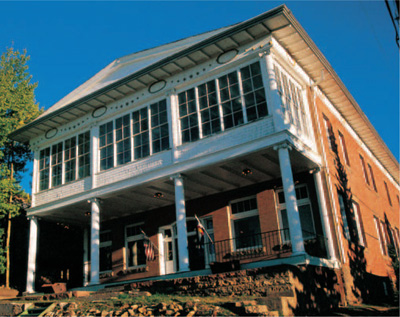
Victor’s Gold Coin Club still has residents. In its heyday it could boast of a library, a bowling alley, and a swimming pool.
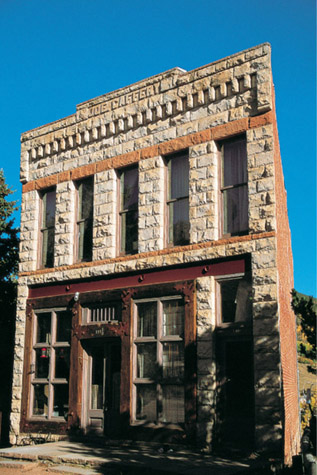
The Caffery Building has an attractive cut-stone front, built on a slight diagonal, with bricks making up the other three walls.
Victor and Cripple Creek became natural rivals. Cripple Creek was home to investors and mine owners, while Victor was a miners’ town. Victor, therefore, enjoyed any chance for one-upmanship. For instance, in 1897, Victor entered a float in a Salt Lake City festival with the queen of Victor aboard. She generously invited the Cripple Creek queen to ride as well. The Victor Daily Record wryly noted, “We might say that Cripple Creek took a ride on Victor’s band wagon, but Cripple has often done that commercially and the habit is growing.”
Victor even surpassed its rival in size for a short time but only because of a fire in Cripple Creek in 1896. When Cripple Creek rebuilt, however, it was again larger and even grander. When a fire decimated Victor in 1899, it also rebuilt, but its best times were already over.
In 1900, the mining district hit its peak in gold production at eighteen million dollars, when Cripple Creek was Colorado’s fourth-largest city. The Cripple Creek and Victor bonanza became the second-largest gold district in U.S. history, with about twenty-one million ounces of gold extricated, worth over ten billion in today’s dollars. And it is not finished, at least at this writing. An open pit operation that began in 1995 on Battle Mountain is chewing into many legendary mines, which will add to the gold-production total. Unfortunately, it is also chewing into some old mining camps.
Even though Victor was always outshone by its more genteel neighbor, the town was something special in its prime. The Portland Mine was “Queen of the District,” producing half of Battle Mountain’s gold. One of its muckers was a kid named William Dempsey, later famous as a heavyweight boxer under his brother’s name, Jack.
Ore was found all around Victor and even within the city itself. The workings were so rich that supposedly worthless tailings were used to pave Victor’s streets. When Harry Woods and his brother Frank were excavating a foundation for the Victor Hotel, they discovered a rich ore body. The hotel plan was shelved, and the Gold Coin Mine opened, eventually yielding six million dollars in gold. After the Gold Coin’s buildings were destroyed in the 1899 fire, the Woods brothers rebuilt the shaft house with ornate touches like stained glass windows. Their showy gesture demonstrated their confidence in the district. That confidence was ill-founded, however; within a few years, they were bankrupt.
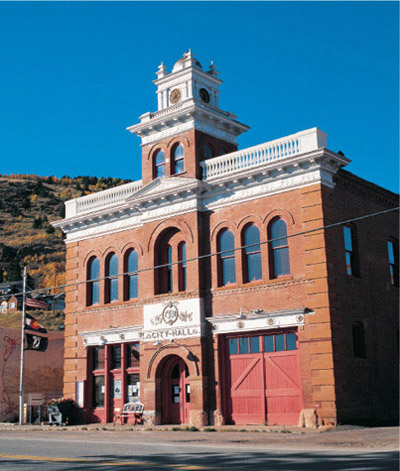
Victor’s city hall features pressed-tin ornamentation and a handsome two-tiered tower
Deteriorating ore bodies and labor troubles initiated Victor’s decline. As a miners’ town, it became the center for labor unrest when the Western Federation of Miners attempted to standardize wages and shorten the working day. Strikes and violence slowed production of nearly pinched-out mines. When miners left practically en masse to join World War I, Battle Mountain mines never recovered. The only other “mining” effort Victor saw was during the Depression, when the low-grade ore that had been used to pave the streets was scraped up and milled.
WALKING AND DRIVING AROUND VICTOR
Although Cripple Creek has succumbed to the glitter of casino gambling, Victor remains authentic—a bit dowdy, even dilapidated, but completely delightful.
Attractions for the ghost town enthusiast abound, including the Lowell Thomas Museum, on the southeast corner of Third and Victor Avenue, the main road through Victor. There you will find interesting memorabilia and items about Lowell Thomas, a Victor High School graduate whose radio voice became familiar to millions of Americans. That same intersection features the Fortune Club on the southwest corner, with an elaborate painted advertisement on its wall. South of Third from the Fortune Club is the Isis Theater, a turn-of-the-twentieth-century building that went from live theater to silent movies to talkies. Its sloping floor still has several rows of theater seats.
Farther down Victor Avenue at Fourth stands the completely renovated Victor Hotel, originally a bank. It has a huge vault in the lobby and a wonderful elevator.
South of the Victor Hotel are several outstanding buildings, including the Masonic Hall, with its three elaborate Colonial Revival cornices; the office of the Victor Daily Record; and the still-active First Baptist Church.
Drive the back streets south of the main business district to see countless boomtown-era homes that range from the abandoned to the neglected to the carefully restored.
North of Victor Avenue on Fourth, as you head toward the foothills of Battle Mountain, you’ll see Pikes Peak Power Company Substation No. 1 on your left, and, at Fourth and Diamond, the once-elegant Gold Coin Club. Built for the workers of the Gold Coin Mine, the club featured a library, bowling alley, and swimming pool. The mine itself, the one that was discovered while the Woods were building the foundation for a hotel, is across the street.
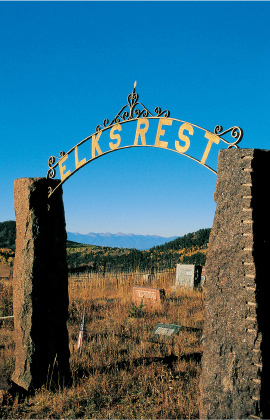
The stone and wrought-iron Elks Rest entrance leads to that fraternal organization’s section of Victor’s Sunnyside Cemetery.
Continue east on Diamond and then north one block to see the Midland Terminal Railway Depot, vacant at this writing.
As you head west toward Cripple Creek, you will see another fine building on Victor Avenue: the 1900 Victor City Hall with its ornate tower. West of city hall .1 of a mile is South Seventh Street, the turnoff south to the cemetery, which is .8 of a mile away from town.
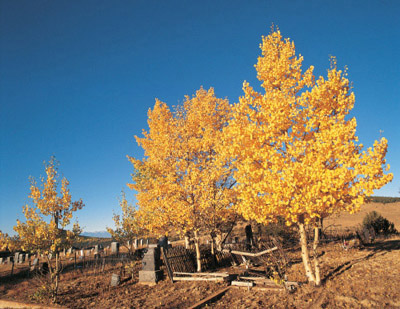
The Victor Sunnyside Cemetery has several fraternal sections: Moose, Odd Fellows, Masons, Eagles, and Elks. It also features a large number of wooden markers surrounded by wrought-iron fences.
Note: The Mollie Kathleen Mine Tour, one of the best mine tours in Colorado, is north of Cripple Creek on Colorado Highway 67. On your tour, you actually descend a thousand feet in a double cage, just as the miners did. On no other mine tour in the country can you do that.
Aspens signal the fall season at Sunnyside Cemetery, located southwest of Victor.
WHEN YOU GO
To reach Cripple Creek from Colorado Springs, take Colorado Highway 24 west for 25 miles to Divide. Go south 18 miles on Colorado Highway 67. Victor is 6 miles southeast of Cripple Creek on Highway 67. Incidentally, there once was another way to get from Cripple Creek to Victor: Battle Mountain is so extensively tunneled that one could actually walk between the two cities completely underground.