
15
Book I
“I POSTULATE the following:
1.Equal weights at equal distances are in equilibrium, and equal weights at unequal distances are not in equilibrium but incline towards the weight which is at the greater distance.
2.If, when weights at certain distances are in equilibrium, something be added to one of the weights, they are not in equilibrium but incline towards that weight to which the addition was made.
3.Similarly, if anything be taken away from one of the weights, they are not in equilibrium but incline towards the weight from which nothing was taken.
4.When equal and similar plane figures coincide if applied to one another, their centres of gravity similarly coincide.
5.In figures which are unequal but similar the centres of gravity will be similarly situated. By points similarly situated in relation to similar figures I mean points such that, if straight lines be drawn from them to the equal angles, they make equal angles with the corresponding sides.
6.If magnitudes at certain distances be in equilibrium, (other) magnitudes equal to them will also be in equilibrium at the same distances.
7.In any figure whose perimeter is concave in (one and) the same direction the centre of gravity must be within the figure.”
Proposition 1
Weights which balance at equal distances are equal.
For, if they are unequal, take away from the greater the difference between the two. The remainders will then not balance [Post. 3]; which is absurd.
Therefore the weights cannot be unequal.
Proposition 2
Unequal weights at equal distances will not balance but will incline towards the greater weight.
For take away from the greater the difference between the two. The equal remainders will therefore balance [Post. 1]. Hence, if we add the difference again, the weights will not balance but incline towards the greater [Post. 2].
Proposition 3
Unequal weights will balance at unequal distances, the greater weight being at the lesser distance.
Let A, B be two unequal weights (of which A is the greater) balancing about C at distances AC, BC respectively.
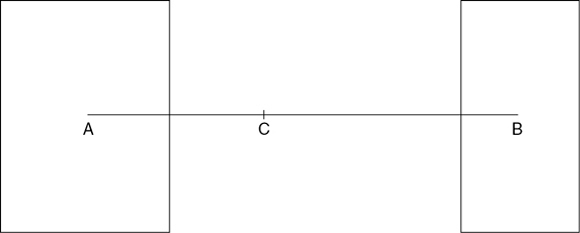
Then shall AC be less than BC. For, if not, take away from A the weight (A — B). The remainders will then incline towards B [Post. 3]. But this is impossible, for (1) if AC = CB, the equal remainders will balance, or (2) if AC > CB; they will incline towards A at the greater distance [Post.1].
Hence AC < CB.
Conversely, if the weights balance, and AC < CB, then A > B.
Proposition 4
If two equal weights have not the same centre of gravity, the centre of gravity of both taken together is at the middle point of the line joining their centres of gravity.
[Proved from Prop. 3 by reductio ad absurdum. Archimedes assumes that the centre of gravity of both together is on the straight line joining the centres of gravity of each, saying that this had been proved before. The allusion is no doubt to the lost treatise On Levers.]
Proposition 5
If three equal magnitudes have their centres of gravity on a straight line at equal distances, the centre of gravity of the system will coincide with that of the middle magnitude.
[This follows immediately from Prop. 4.]
COR. 1. The same is true of any odd number of magnitudes if those which are at equal distances from the middle one are equal, while the distances between their centres of gravity are equal.
COR. 2. If there be an even number of magnitudes with their centres of gravity situated at equal distances on one straight line, and if the two middle ones be equal, while those which are equidistant from them (on each side) are equal respectively, the centre of gravity of the system is the middle point of the line joining the centres of gravity of the two middle ones.
Propositions 6, 7
Two magnitudes, whether commensurable [Prop. 6] or incommensurable [Prop. 7], balance at distances reciprocally proportional to the magnitudes.
I. Suppose the magnitudes A, B to be commensurable, and the points A, B to be their centres of gravity. Let DE be a straight line so divided at C that
A:B = DC:CE.
We have then to prove that, if A be placed at E and B at D, C is the centre of gravity of the two taken together.
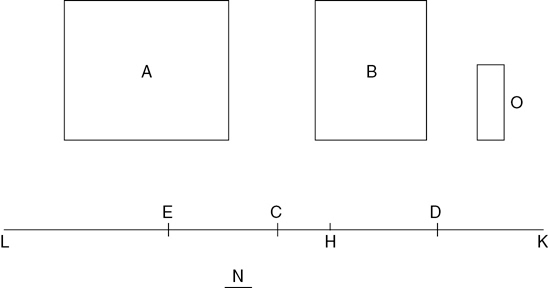
Since A, B are commensurable, so are DC, CE. Let N be a common measure of DC, CE. Make DH, DK each equal to CE, and EL (on CE produced) equal to CD. Then EH = CD, since DH = CE. Therefore LH is bisected at E, as HK is bisected at D.
Thus LH, HK must each contain N an even number of times.
Take a magnitude O such that O is contained as many times in A as N is contained in LH, whence
A: O = LH: N
But B:A = CE:DC = HK:LH.
Hence, ex aequali, B:O = HK:N, or O is contained in B as many times as N is contained in HK.
Thus O is a common measure of A, B.
Divide LH, HK into parts each equal to N, and A, B into parts each equal to O. The parts of A will therefore be equal in number to those of LH, and the parts of B equal in number to those of HK. Place one of the parts of A at the middle point of each of the parts N of LH, and one of the parts of Bat the middle point of each of the parts N of HK.
Then the centre of gravity of the parts of A placed at equal distances on LH will be at E, the middle point of LH [Prop. 5, Cor. 2], and the centre of gravity of the parts of B placed at equal distances along HK will be at D, the middle point of HK.
Thus we may suppose A itself applied at E, and B itself applied at D.
But the system formed by the parts O of A and B together is a system of equal magnitudes even in number and placed at equal distances along LK. And, since LE = CD, and EC = DK, LC = CK, so that C is the middle point of LK. Therefore C is the centre of gravity of the system ranged along LK.
Therefore A acting at E and B acting at D balance about the point C.
II. Suppose the magnitudes to be incommensurable, and let them be (A + a) and B respectively. Let DE be a line divided at C so that
(A+a): B = DG: CE.
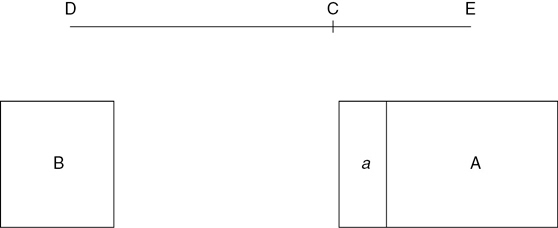
Then, if (A + a) placed at E and B placed at D do not balance about G, (A + a) is either too great to balance B, or not great enough.
Suppose, if possible, that (A + a) is too great to balance B. Take from (A + a) a magnitude a smaller than the deduction which would make the remainder balance B, but such that the remainder A and the magnitude B are commensurable.
Then, since A, B are commensurable, and
A: B < DC: CE,
A and B will not balance [Prop. 6], but D will be depressed.
But this is impossible, since the deduction a was an insufficient deduction from (A + a) to produce equilibrium, so that E was still depressed.
Therefore (A + a) is not too great to balance B; and similarly it may be proved that B is not too great to balance (A + a).
Hence (A + a), B taken together have their centre of gravity at C.
Translated by T. L. Heath
Reading and Discussion Question
1.Here Archimedes is using very abstract terms—such as planes, lines, and centers—to describe a physical system with which everyone is familiar. What can we gather about how he thinks about the relationship between mathematics and the physical world?