
25
120. The celestial sphere is a body like a ball revolving in its own place; it contains within its interior objects whose movements are different from those of the sphere itself, and we are in the centre of it. It is called falak on account of its circular movement like that of the whirl of a spindle,and its name, athir (ether), is current among philosophers.
121. There are eight such spheres enclosed the one within the other, like the skins of an onion; the smallest sphere is that which is nearest to us, within which the moon is always travelling alone, rising and setting, within its limits. To each sphere there is a certain amount of space between the outer and inner boundaries so that the planet to which it belongs has two distances, the one further, the other nearer. The second sphere above that of the moon belongs to Mercury, the third to Venus, the fourth to the Sun, the fifth to Mars, the sixth to Jupiter, the seventh to Saturn. These seven spheres belong to the planets, but above them all is the sphere known as that of the fixed (or desert) stars. The accompanying diagram represents them.
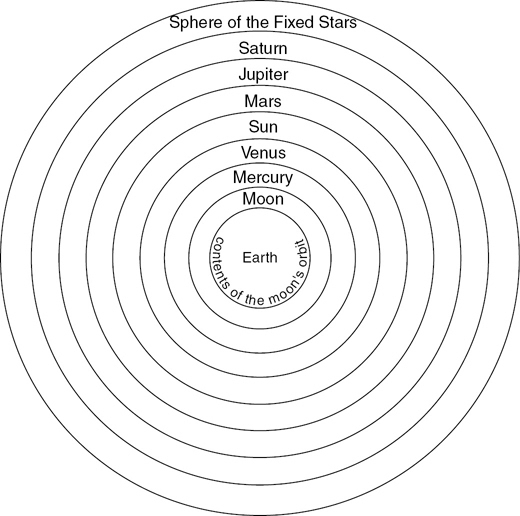
122. A number of people consider that beyond the eighth sphere there is a ninth entirely quiescent; it is this which the Hindus call in their language brahmanda, i.e., the egg of Baraham, because the prime mover must not be moved, and it is on this account that they describe it as motionless. But it is possible that it is not a body like the other spheres, otherwise its existence could be demonstrated, and that to apply this name to it is an error. Many of our ancestors considered that beyond the eight spheres there is an infinite empty space, others, a boundless quiescent substance, while according to Aristotle there is neither substance nor void beyond the revolving bodies ... .
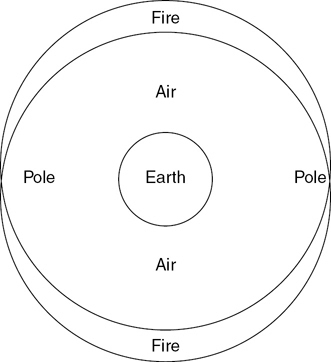
124. In the centre of the sphere of the moon is the earth, and this centre is in reality the lowest part (and this is a real centre, because all heavy things gravitate towards it). The earth is, as a whole, globular, and in detail is rough-surfaced on account of the mountains projecting from it and the depressions on its surface, but when considered as a whole it does not depart from the spherical form, for the highest mountains are very small in comparison with the whole globe. Do you not see that a ball of a yard or two in diameter, covered with millet seeds and pitted with depressions of similar size, would still satisfy the definition of a sphere? If the surface of the earth were not so uneven, water coming from all sides would not be retained by it, and would certainly submerge it, so that it would no longer be visible. For water while it shares with earth in having a certain weight, and in falling as low as possible in air, is nevertheless lighter than earth, which therefore settles in water sinking in the form of sediment to the bottom. Moreover water, although it does not penetrate earth itself, sinks into the interstices thereof, and there becomes mixed with air, and as a result of the intimate contact becomes suspended in the air. When the air escapes to the outside, the water regains its natural state in the same way as rain falls from the clouds. On account of the various irregularities projecting from the surface, water tends to collect in the deepest places giving rise to streams.
The earth and the waters together form the one globe, surrounded on all sides by the air; as much of the latter as is in contact with the sphere of the moon becomes heated in consequence of the movement and the friction of the parts in contact. Thus is produced the fire which surrounds the air, less in amount in the proximity of the poles owing to the slackening of the movement there.
125. The fixed stars are those which stud the whole heaven, whose distance from each other is fixed to all eternity, so that they neither approach each other nor separate from each other ... . The planets, on the other hand, seven in number, each moving in its own sphere, continually alter their distance from each other and from the fixed stars, sometimes being near and sometimes opposite, in virtue of the difference in the rapidity and character of their movements.
126. Everyone sees that the sun, the moon, and stars are engaged in a first or westward movement; they rise gradually, attain the summit of their course, and then descend little by little till they disappear, thereafter returning to the place where they rose. It is owing to the heavenly bodies that this movement is perceived; it is well-known to animals as they disperse in search of food, more so indeed than to man, for there are animals whose movements correspond with it like the chameleon, which facing the sun turns with it, as do the leaves of many plants, notably: vetch, mash, and liquorice ... .
127. The second or eastward movement of all planets is towards the quarter where they arose; but the movement of the fixed stars is very small, and on account of the fact that the distance between them remains the same, they are called fixed, whereas the motion of the planets is much greater, more obvious, and also of varied nature.
It is most obvious in the case of the moon on account of its rapid movement, for, from the time when the moon appears in the west, it moves further away from the sun and any star which is between it and the sun, and approaches any star which is on the other side of the sun from it. When it occults one of these, it does so with its eastern border and clears it with the western. This second movement is common to all the planets; it is an inverted replica of the first, but is not an exact counterpart, for it deviates from it slightly. It is called second because it is different in amount for each planet, while the first is uniform and prevails over all the second movements, although in the opposite direction. It is like the movement of a ship whose passengers may walk in the direction of the current, while they are all being carried up stream by the ship; the uniform movement prevails over the contrary one by reason of greater efficiency.
The second movement is not obvious like the first, but requires some consideration and reasoning based on observation. It is called eastward, on account of its direction towards the rising of the sun.
128. Only about half of the vault of heaven is visible to the observer; it is like a dome placed over the earth, its margin forming a circle round about him. Whatever is above this circle, known as the horizon, is visible to him.
There are two kinds of horizon, the one sensible or visible, the other true or astronomical. The sensible horizon is that already referred to, which we always see when on the surface of the earth, and which divides the celestial sphere into two parts, an upper smaller one, and a lower invisible to us.
The true horizon is parallel to the other, but on a plane passing through the centre of the earth and cutting the celestial sphere into two equal parts. That which is between the two horizons is small in amount so as not to be obvious when the sphere is large [the celestial sphere] but large when the sphere is small [the earth] ... .
152. Saturn, Jupiter and Mars are superior planets, while Venus and Mercury are inferior, as is the moon; but the moon is not to be reckoned with the other planets. The expressions superior and inferior refer to the position relative to the sun ... . All the conditions of the planets are certainly referable to the sun, especially the luminosity of the moon and the retrograde movement of the planets.
The difference between the inferior and superior planets is that the distance of the former from the sun is restricted and never exceeds a certain maximum elongation either in the East or in the West. When they precede the sun (are east of it) they leave it so far behind that they become visible after sunset in the evenings. Their visibility increases with the distance from the sun until the greatest eastern elongation is reached. Thereafter their movement becomes slower, and they again begin to approach the sun, when their slow movement comes to a complete stop. This is the stop before retrograding, After this stop, they turn back and their retrograde movement becomes more rapid until, at inferior conjunction, they become invisible in the rays of the sun, their evening occultation. After which, emerging on the other side of the sun, they move more slowly on their retrograde course, and begin to rise before the sun, so as to be visible when they have escaped from its rays; this is called their matutine apparition; then the retrograde movement becomes still slower till the planets reach the second stationary period, before entering on their direct course. Then they soon reach their greatest distance from the sun, their western elongation, and proceed on their direct path till they again approach it, and, at superior conjunction, become invisible in its rays, their matutine occultation. Thereafter, passing through the rays, they again become visible in the west in the evening, thus returning to the sequence of the events described.
But the distance of the superior planets from the sun is not thus restricted; the sun moves quicker and outstrips them so that they escape from its rays and become visible in the east in the morning. Every day their distance from the sun is increased as they proceed on their direct course, until at sunrise they arrive at a point in the heavens, which, if the sun were there, would indicate a time between the early and late afternoon prayers. They then attain the stationary point before retrograding, after which, their distance from the sun increasing every day, they reach the middle point of that course, they are in opposition to the sun, and have thus attained the greatest distance possible within their spheres. They then begin to rise in the east at sunset like the full moon at the fourteenth night of the month. Thereafter, the distance between them and the sun begins to decrease till a point is reached at sunset, which, if the sun were there, would indicate the forenoon. That time corresponds to the stationary period before beginning the direct course; thereafter the sun gradually approaches them till they come within its rays, and they become invisible in the west, a condition described as their occidentality.
The difference, therefore, between the inferior and the superior planets is this, that the former are never further from the sun than the sixth of a circle, and in the middle of their retrograde course are occultated, their apparition and occultation occur both in the east and the west; while the latter attain the greatest possible distance from the sun within their spheres, are not concealed at the middle of their retrograde course but are there in opposition to the sun. Their apparition is only in the east, and their occultation is restricted to the west.
153. A planet is said to be combust, when it comes into conjunction with the sun, the expression being due to the comparison of the sun with fire, and the nonappearance of the planet when it enters the sun’s rays, suggesting its combustion or destruction. This phenomenon is common to all the planets, and occurs when they are at the summit or apogee, of the epicycle. The superior planets differ from the inferior ones in that the latter show the same phenomenon at its lowest point or perigee, whereas the former do not, but are then in opposition to the sun.
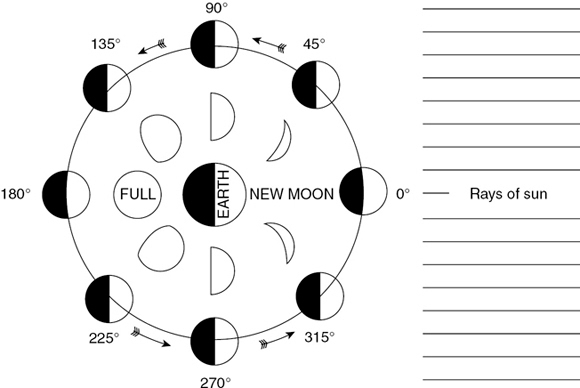
154. The moon exhibits the same appearance, but this is described as its conjunction. After its first appearance in the west as a slender crescent in the evening at the beginning of the month, the illuminated surface grows with the increasing distance from the sun, till on the seventh evening, halfway between east and west it looks like a half-circle. When the moon has travelled 180° from the sun by the fourteenth evening, it rises at sunset and the whole surface is illuminated. Thereafter as the distance decreases, the bright surface diminishes, so that by the twenty-second evening the dark part is again equal to the bright part; after which the dark part gains on the bright till the crescent shape like that of the new moon is attained, visible in the east in the morning. In all phases the luminosity of the moon comes from that surface which is towards the sun, consequently when it enters the rays of the sun, it is concealed, till after two days it again appears new in the west. During these two days it is in conjunction with the sun, close union, as Ptolemy describes it in the Majisti [Almagest], and so it has come about to speak of this as companionship, rather than as combustion. The opposite position of the moon, full moon, when it confronts the sun, is known as istiqbal.
155. The moon is a non-luminous globular body and its brightness is due to the rays of the sun which fall upon it as they do upon the earth, mountains, walls or the like, the other sides of which are not illuminated. When the moon is in conjunction with the sun, it is between us and the sun, because it is lower and the rays fall on that surface which is towards the sun, while we see only the surface facing us, and are unable to distinguish the dark mass of the moon from the blue of the sky on account of the dazzling light of the sun, until the moon moves a little further away from it. Then a small part of the illuminated surface comes into view if the evening twilight is not too bright, and we have the new moon.
Owing to the spherical form of the moon, the margin of the sun’s rays which fall upon it is necessarily circular, and so much of the illuminated half as comes into view is also bounded by part of a circle so as a result of the intersection of these two circles on the spherical surface, the interval between them is at first crescentic like the slice of a melon. As the distance from the sun increases, the illuminated surface grows until it equals the dark part, and this is called the first quarter, because the sun and moon are distant from each other by quarter of a circle. This equality of the bright and dark parts occurs also at the second quarter. At full moon, when it is separated from the sun by half a circle, the whole of the surface illuminated by the sun is visible to us, as may be seen from the diagram.
156. Opinions of intelligent people differ as to why this waxing and waning of the moon is not shared by the other planets, and as to whether the planets are self-luminous like the sun, or merely illuminated by the rays of the sun falling on them.
Many assert that light is exclusively the property of the sun, that all the stars are destitute of it, and that since the movements of the planets are obviously dependent on those of the sun, it may be assumed by analogy that their light is in the same position. But others believe that all the planets are luminous by nature with the exception of the moon, and that its special peculiarities are its paleness and absence of brilliancy. This opinion is more in accord with the truth (as long as there is no evidence to the contrary) and that their concealment under the rays of the sun is just like their non-visibility in diffused daylight, which by its intensity so affects our vision, that we are unable to perceive them. But any one who looks out from the bottom of a deep pit by day may see a planet which happens to pass over the zenith, because his vision is relieved from the intensity of light by the surrounding darkness and strengthened by it, for black concentrates and strengthens vision, while white dissipates and weakens it.
Whether the higher planets are self-luminous or not, they are always to be seen in the same condition. For if the moon were above the sun, it would cease to present the phenomena of waning, and would always appear as full moon. The situation, however, with regard to Venus and Mercury is this, that if they are not luminous, there would be a difference in the amount of their light when at their greatest distance from the sun, and when approaching their disappearance in its rays at conjunction, for indeed they are lower than the sun, and no such difference is observable.
It is therefore preferable to regard the planets as self-luminous, while the special characteristics of the moon and the variety of the phases of its light are due to three things: its captivity (by the sun, conjunction), its pale colour and absence of brilliance, and its position below the sun.
157. The fixed stars in the heavens are so multitudinous that it is impossible to enumerate them, yet those diligent investigators who have endeavoured to recognize them and to determine their positions in longitude in the signs, and their latitude north and south of the ecliptic, observed that they differ in size and have consequently established a scale of magnitudes, to the two first degrees of which astrologers give the name of glory. Of the first magnitude there are fifteen stars, of the second, forty-five, of the third, two hundred and eight, of the fourth, four hundred and seventy-four, and of the fifth, fifty-eight.
Among the stars of the sixth magnitude there are nine stars which Ptolemy described as ‘dark’, apart from three others not counted with them, which together are called the tresses, (Coma Berenices), the lock-wearer.
Stars which are smaller than the sixth magnitude cannot be separately distinguished by our vision, or if they are can only with difficulty be kept under observation ...
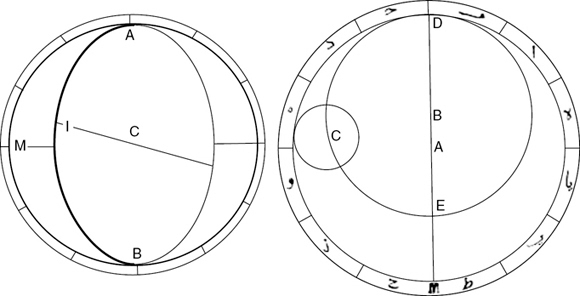
178. An epicycle, is a small orbit which does not surround the earth, but is entirely outside it. The planet moves on its circumference with the motion peculiar to it.
179. The centre of the epicycle travels continuously in the direction of succession of the signs on the circumference of an orbit called the deferent, which is in the plane of the inclined orbit, but like the eccentric, has a different centre from the centre of the world.
180. If the centre of the epicycle traversed equal arcs of the deferent in equal times, then the mean rate of the progress of the planet would be on the deferent, and the angles opposite these arcs would also be equal; the angles of the arcs, however, traversed by the centre of the epicycle in equal times are not equal, but are so at a point as far from the centre of the deferent as that is from the centre of the world. This point is the centre of equal progress, the equant, and is the same for Venus and the three superior planets. All three points are in the same straight line. It is necessary to regard this point as the centre of an orbit like the deferent, and to calculate the progress of the planet on its circumference from the position pf the centre of the epicycle, which may be done by lines drawn to this point (without drawing the orbit).
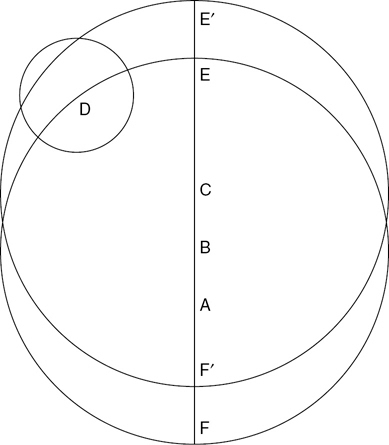
A – Centre of world
B – Centre of deferent
C – Centre of equant
D – Centre of epicycle
E F – Apogee and Perigee of deferent
E’F’ – Apogee and Perigee of equant
Translated by R. Ramsay Wright
Reading and Discussion Questions
1.How does Al-Bı¯ru¯nı¯, account for the phases of the moon? Does he believe that the planets emit their own light or reflect it? What reasons does he give in support of his position?
2.The epicycles that he is referring to date back to Ptolemy’s Almagest. What problem are they meant to solve? What developments and additions beyond Aristotelian astronomy are evident in this reading and what remains the same?