
30
III. I. Here begins the third part, on the acquisition and measure of quality and velocity.
Chapter 1. How the acquisition of a quality is to be imagined.

Succession in the acquisition of a quality can take place in two ways, according to extension and according to intension, as was stated above in the fourth chapter of the second part. And so extensive acquisition of linear quality is to be imagined by the motion of a point flowing over that subject line, so that the part [of the line] traversed has the quality (sit qualificata) and the part not yet traversed has not the quality. Example: if point C were moved over line AB, whatever part was traversed by that point would be white and whatever was not yet traversed would not yet be white. Moreover, the extensive acquisition of a surface quality would have to be imagined by the motion of a line dividing the part of the surface altered from the other part which has not yet been altered. In the same manner, the extensive acquisition of corporeal [quality] is to be imagined by the motion of a surface dividing the part altered from the part not yet altered.
Furthermore, the intensive acquisition of a punctual quality is to be imagined by the motion of a point continually ascending above the subject point, while the intensive acquisition of a linear quality is to be imagined by the motion of a line perpendicularly ascending above the subject line; and by its flux or ascent it describes the surface by which the acquired quality is designated. For example: Let AB be the subject line (see Fig. 6.5 A). Hence I say that the intension of point A is imagined by the motion or perpendicular ascent of point C. And the intension of line AB or the acquisition of intension is imagined by the ascent of line CD. The intensive acquisition of a surface quality in the same way is to be imagined by the ascent of a surface, and by its imagined motion it describes the body by which the quality is designated. And similarly the intensive acquisition of a corporeal quality is imagined by the motion of a surface quality, because by its imagined flux a surface describes a body. And it is not necessary to give a fourth dimension, as was said in the fourth chapter of the first part.
And what we have just now said about the acquisition of quality ought to be said and imagined in the same way about the loss [of quality] ... for such loss is imagined by movements opposite to the aforementioned motions [of acquisition]. What has been just now said about the acquisition or loss of quality is to be imagined as applying in the same way to the acquisition or loss of velocity both in intension and in extension ... .
III. 7. On the measure of difform qualities and velocities. Every uniformly difform quality [in a subject] is just as great as would be a quality in the same or equal subject uniform at the degree [of intensity] of the middle point of the same subject; and I understand this [to be so] if the quality is linear. If it is a surface quality, [it would be equal to a quality uniform] at the degree of the mean line; if corporeal, [to one uniform] at the degree of the mean surface, all of them being understood in the same way.
In the first place this is demonstrated for a linear [quality]. Let there be quality imaginable by a triangle ABC, which is uniformly difform, and is terminated at zero degree in point B (see Fig. 6.5B); and let D be the middle point of the subject line. The degree of this midpoint, or its intension, is imagined by the line DE. Hence the quality which is uniform at degree DE throughout the whole subject is imaginable by a quadrangle AFGB, as is clear from the tenth chapter of Part I. And it is evident by the twenty-sixth [proposition] of the first [book] of Euclid, that the two small triangles EFC and EGB are equal. Therefore, the larger triangle BAC, which designates the quality uniformly difform, and the quadrangle AFGD, which would designate the quality uniform at the degree of the middle point, are equal. Hence the qualities imaginable by a triangle of this kind and a quadrangle are equal; and this was proposed.
In the same way it can be argued with respect to a uniformly difform quality terminated in both extremes at some degree. This quality would be imaginable by a quadrangle ABCD (see Fig. 6.5 C); for let there be drawn a line DE parallel to the subject base [line] and let triangle CED he formed. Then there is protracted through the degree of the middle point line FG, equal and parallel to the subject base [line]. Also another line GD is drawn. Then, as before, it will be proved that triangle CED is equal to quandrangle EFGD. Therefore, with quadrangle AEDB common to both, the two total [areas] are equal, namely, the quadrangle ACDB, which designates the uniformly difform quality, and the quadrangle AFGB, which designates the quality uniform at the degree of the middle point of the subject AB. Therefore, by the tenth chapter of the first part, the qualities representable by these quadrangles are equal.
It can be argued in the same way with respect to surface and even corporeal [quality]. We ought to speak of velocity completely in the same way as linear quality, except that in the place of the middle point [of the subject] the middle instant of time is taken as the measure of this [uniformly difform] velocity ... .
III. 8. On the measure and intension to infinity of certain difformities. A finite surface can be made as long and as high as you wish without an [over-all] increase in the area by varying the extension. For such a surface has both longitude and latitude, and so it is possible for one dimension of the surface to be increased at will without increasing the over-all area, so long as the second dimension is decreased proportionally. And it is thus for bodies as well.
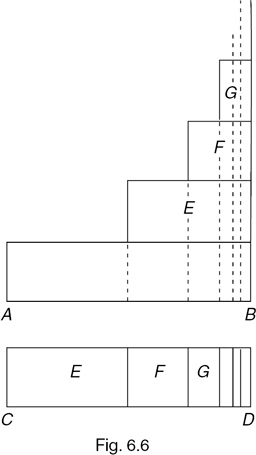
Let there be taken, for example (see Fig. 6.6), a rectangular surface whose [altitude] is one foot and whose base line is AB, and let there be another surface similar and equal to it whose base is CD. This [latter figure] is pictured as being divided into parts continually proportional to infinity, according to a double proportion, on its base CD, divided in the same way. Let E be the first part, F the second, G the third, and so on for the others. Take the first of these parts, namely E, which is one-half of the whole [subject], and place it on top of the first surface toward the end B. Then on top of both of them put the second part F. Then again on top of all of them put the third part G, and similarly with the other parts to infinity. When this has been done, the base line AB is imagined as being divided into proportional parts continually according to a double proportion and working toward B. Then it is immediately clear that above the first proportional part of line AB stands a surface with altitude of one foot, upon the second part a surface altitude of two feet, upon the third a surface with altitude of three feet, [upon the fourth part a surface with altitude of four feet], and so forth to infinity. And yet the whole surface as originally conceived with only an altitude of two feet is in no way augmented overall [by this proportional division]. Consequently, the total surface which stands over line AB is precisely four times the area of the surface of the part of it which stands over the first proportional part of the same line AB. Hence, that quality or velocity which will be proportional in intension as this figure is in altitude would be precisely quadruple to the part of it which would be in the first part of the time or subject according to a dimension of this kind ... .
Similarly, if any moving body were moved with some velocity in the first proportional part of a period of time so divided [into proportional parts] and were moved with a double velocity in the second [proportional part], with a triple velocity in the third [proportional part], and with a quadruple velocity in the fourth [proportional part], and continually increasing velocity in this way to infinity, the “total velocity” would be precisely quadruple to the velocity of the first part, so that a body in the whole hour would traverse four times as much distance as it traversed in the first half of that hour. And if in the first half or proportional part it traversed one foot, in the whole remaining part it would traverse three feet, and in the whole time it would traverse four feet.
Translated by Marshall Clagett
Reading and Discussion Questions
1.What does Oresme take himself to prove about the relationship between an object moving at a constant velocity as compared to an object that is constantly accelerating over the same period of time? How does he use geometry to establish this conclusion?
2.Might what Oresme says here about rates of change apply to changes in qualities other than velocity, such as the ripening of a fruit or the growth of a flower?