
40
Chapter Six: Description of a New World, and on the Qualities of the Matter of Which It Is Composed
For a short time, then, allow your thought to wander beyond this world to view another, wholly new one, which I shall cause to unfold before it in imaginary spaces. The philosophers tell us that these spaces are infinite, and they should very well be believed, since it is they themselves who have made the spaces so. Yet, in order that this infinity not impede us and not embarrass us, let us not try to go all the way to the end; let us enter in only so far that we can lose from view all the creatures that God made five or six thousand years ago and, after having stopped there in some fixed place, let us suppose that God creates from anew so much matter all about us that, in whatever direction our imagination can extend itself, it no longer perceives any place that is empty.
Although the sea is not infinite, those who are on some vessel in the middle of it can extend their view seemingly to infinity, and nevertheless there is still water beyond what they see. Thus, even though our imagination seems to be able to extend itself to infinity, and this new matter is not assumed to be infinite, we can nonetheless well suppose that it fills spaces much greater than all those we shall have imagined. Indeed, in order that there be nothing in all this that you could find to blame, let us not permit our imagination to extend itself as far as it could, but let us purposely restrict it to a determinate space that is no greater, say, than the distance between the earth and the principal stars of the firmament, and let us suppose that the matter that God shall have created extends quite far beyond in all directions, out to an indefinite distance. For there is more reason, and we have much better the power, to prescribe limits to the action of our thought than to the works of God.
Now, since we are taking the liberty of imagining this matter to our fancy, let us attribute to it, if you will, a nature in which there is absolutely nothing that anyone cannot know as perfectly as possible. To that end, let us expressly assume that it does not have the form of earth, nor of fire, nor of air, nor any more particular form (such as wood, or a stone, or of a metal); nor does it have the qualities of being hot or cold, dry or moist, light or heavy, or of having some taste, or smell, or sound or color, or light, or suchlike, in the nature of which one could say that there is something that is not clearly known by everyone.
Let us not also think, on the other hand, that our matter is that prime matter of the philosophers that has been so well stripped of all its forms and qualities that nothing more remains that can be clearly understood. Let us rather conceive of it as a real, perfectly solid body, which uniformly fills the entire length, breadth, and depth of the great space at the center of which we have halted our thought. Thus, each of its parts always occupies a part of that space and is so proportioned to its size that it could not fill a larger one nor squeeze itself into a smaller one, nor (while it remains there) suffer another to find a place there.
Let us add further that this matter can be divided into any parts and according to any shapes that we can imagine, and that each of its parts is capable of receiving in itself any motions that we can also conceive. Let us suppose in addition that God truly divides it into many such parts, some larger and some smaller, some of one shape and some of another, as it pleases us to imagine them. It is not that He thereby separates them from one another, so that there is some void in between them; rather, let us think that the entire distinction that He makes there consists in the diversity of the motions He gives to them. From the first instant that they are created, He makes some begin to move in one direction and others in another, some faster and others slower (or indeed, if you wish, not at all); thereafter, He makes them continue their motion according to the ordinary laws of nature. For God has so wondrously established these laws that, even if we suppose that He creates nothing more than what I have said, and even if He does not impose any order or proportion on it but makes of it the most confused and most disordered chaos that the poets could describe, the laws are sufficient to make the parts of that chaos untangle themselves and arrange themselves in such right order that they will have the form of a most perfect world, in which one will be able to see not only light, but also all the other things, both general and particular, that appear in this true world.
But, before I explain this at greater length, stop again for a bit to consider that chaos, and note that it contains nothing that is not so perfectly known to you that you could not even pretend not to know it. For, as regards the qualities that I have posited there, I have, if you have noticed, supposed them to be only such as you can imagine them. And, as regards the matter from which I have composed the chaos, there is nothing simpler nor easier to know among inanimate creatures. The idea of that matter is so included in all those that our imagination can form that you must necessarily conceive of it or you can never imagine anything.
Nonetheless, because the philosophers are so subtle that they can find difficulties in things that appear extremely clear to other men, and because the memory of their prime matter (which they know to be rather difficult to conceive of) could divert them from knowledge of the matter of which I speak, I should say to them at this point that, unless I am mistaken, the whole problem they face with their matter derives only from their wanting to distinguish it from its own proper quantity and from its outward extension, i.e. from the property it has of occupying space. In this, however, I am willing that they think themselves correct, for I have no intention of stopping to contradict them. But they should also not find it strange if I suppose that the quantity of the matter I have described does not differ from its substance any more than number differs from the things numbered. Nor should they find it strange if I conceive of its extension, or the property it has of occupying space, not as an accident, but as its true form and its essence. For they cannot deny that it is quite easy to conceive of it in that way. And my plan is not to set out (as they do) the things that are in fact in the true world, but only to make up as I please from [this matter] a [world] in which there is nothing that the densest minds are not capable of conceiving, and which nevertheless could be created exactly the way I have made it up.
Were I to posit in this new world the least thing that is obscure, it could happen that, within that obscurity, there might be some hidden contradiction I had not perceived, and thus that, without thinking, I might suppose something impossible. Instead, being able to imagine distinctly everything I am positing there, it is certain that, even if there be no such thing in the old world, God can nevertheless create it in a new one; for it is certain that He can create everything we can imagine.
Chapter Seven: On the Laws of Nature of This New World
But I do not want to defer any longer from telling you by what means nature alone could untangle the confusion of the chaos of which I have been speaking, and what the laws of nature are that God has imposed on her.
Know, then, first that by “nature” I do not here mean some deity or other sort of imaginary power. Rather, I use that word to signify matter itself, insofar as I consider it taken together with all the qualities that I have attributed to it, and under the condition that God continues to preserve it in the same way that He created it. For from that alone (i.e. that He continues thus to preserve it) it follows of necessity that there may be many changes in its parts that cannot, it seems to me, be properly attributed to the action of God (because that action does not change) and hence are to be attributed to nature. The rules according to which these changes take place I call the “laws of nature.”
To understand this better, recall that, among the qualities of matter, we have supposed that its parts have had diverse motions since the beginning when they were created, and furthermore that they all touch one another on all sides, without there being any void in between. Whence it follows of necessity that from then on, in beginning to move, they also began to change and diversify their motions by colliding with one another. Thus, if God preserves them thereafter in the same way that He created them, He does not preserve them in the same state. That is to say, with God always acting in the same way and consequently always producing the same effect in substance, there occur, as by accident, many diversities in that effect. And it is easy to believe that God, who, as everyone must know, is immutable, always acts in the same way. Without, however, involving myself any further in these metaphysical considerations, I will set out here two or three of the principal rules according to which one must think God to cause the nature of this new world to act and which will suffice, I believe, for you to know all the others.
The first is that each individual part of matter always continues to remain in the same state unless collision with others constrains it to change that state. That is to say, if the part has some size, it will never become smaller unless others divide it; if it is round or square, it will never change that shape without others forcing it to do so; if it is stopped in some place, it will never depart from that place unless others chase it away; and if it has once begun to move, it will always continue with an equal force until others stop or retard it.
There is no one who does not believe that this same rule is observed in the old world with respect to size, shape, rest, and a thousand other like things. But from it the philosophers have exempted motion, which is, however, the thing I most expressly desire to include in it. Do not think thereby that I intend to contradict them. The motion of which they speak is so very different from that which I conceive that it can easily happen that what is true of the one is not true of the other.
They themselves avow that the nature of their motion is very little known. To render it in some way intelligible, they have still not been able to explain it more clearly than in these terms: motus est actus entis in potentia, prout in potentia est, which terms are for me so obscure that I am constrained to leave them here in their language, because I cannot interpret them. (And, in fact, the words, “motion is the act of a being in potency, insofar as it is in potency,” are no clearer for being in [English].) On the contrary, the nature of the motion of which I mean to speak here is so easy to know that mathematicians themselves, who among all men studied most to conceive very distinctly the things they were considering, judged it simpler and more intelligible than their surfaces and their lines. So it appears from the fact that they explained the line by the motion of a point, and the surface by that of a line.
The philosophers also suppose several motions that they think can be accomplished without any body’s changing place, such as those they call motus ad formam, motus ad calorem, motus ad quantitatem (“motion to form,” “motion to heat,” “motion to quantity”), and myriad others. As for me, I conceive of none except that which is easier to conceive of than the lines of mathematicians: the motion by which bodies pass from one place to another and successively occupy all the spaces in between.
Beyond that, the philosophers attribute to the least of these motions a being much more solid and real than they do to rest, which they say is nothing but the privation of motion. As for me, I conceive of rest as being a quality also, which should be attributed to matter while it remains in one place, just as motion is a quality attributed to it while it is changing place.
Finally, the motion of which they speak is of such a strange nature that, whereas all other things have as a goal their perfection and strive only to preserve themselves, it has no other end and no other goal than rest. Contrary to all the laws of nature, it strives on its own to destroy itself. By contrast, the motion I suppose follows the same laws of nature as do generally all the dispositions and all the qualities found in matter, as well those which the scholars call modos et entia rationis cum fundamento in re (modes and beings of thought with foundation in the thing) as qualitates reales (their real qualities), in which I frankly confess I can find no more reality than in the others.
I suppose as a second rule that, when one of these bodies pushes another, it cannot give the other any motion except by losing as much of its own at the same time; nor can it take away from the other body’s motion unless its own is increased by as much. This rule, joined to the preceding, agrees quite well with all experiences in which we see one body begin or cease to move because it is pushed or stopped by some other. For, having supposed the preceding rule, we are free from the difficulty in which the scholars find themselves when they want to explain why a stone continues to move for some time after being out of the hand of him who threw it. For one should ask instead, why does it not continue to move always? Yet the reason is easy to give. For who is there who can deny that the air in which it is moving offers it some resistance? One hears it whistle when it divides the air; and, if one moves in the air a fan or some other very light and very extended body, one will even be able to feel by the weight of one’s hand that the air is impeding its motion, far from continuing it, as some have wanted to say. If, however, one fails to explain the effect of the air’s resistance according to our second rule, and if one thinks that the more a body can resist the more it is capable of stopping the motion of others (as one can perhaps be persuaded at first), one will in turn have a great deal of trouble explaining why the motion of this stone is weakened more in colliding with a soft body of middling resistance than it is when it collides with a harder one that resists it more. Or also why, as soon as it has made a little effort against the latter, it spontaneously turns on its heels rather than stopping or interrupting the motion it has. Whereas, supposing this rule, there is no difficulty at all in this. For it teaches us that the motion of a body is not retarded by collision with another in proportion to how much the latter resists it, but only in proportion to how much the latter’s resistance is surmounted, and to the extent that, in obeying the law, it receives into itself the force of motion that the former surrenders.
Now, even though in most of the motions we see in the true world we cannot perceive that the bodies that begin or cease to move are pushed or stopped by some others, we do not thereby have reason to judge that these two rules are not being observed exactly. For it is certain that those bodies can often receive their agitation from the two elements of air and fire, which are always found among them without being perceptible (as has just been said), or even from the grosser air, which also cannot be perceived. And they can transfer the agitation, sometimes to that grosser air and sometimes to the whole mass of the earth; dispersed therein, it also cannot be perceived.
But, even if all that our senses have ever experienced in the true world seemed manifestly contrary to what is contained in these two rules, the reasoning that has taught them to me seems to me so strong that I would not cease to believe myself obliged to suppose them in the new world I am describing to you. For what more firm and solid foundation could one find to establish a truth (even if one wanted to choose it at will) than to take the very firmity and immutability that is in God?
Now it is the case that those two rules manifestly follow from this alone: that God is immutable and that, acting always in the same way, He always produces the same effect. For, supposing that He placed a certain quantity of motions in all matter in general at the first instant He created it, one must either avow that He always conserves as many of them there or not believe that He always acts in the same way. Supposing in addition that, from that first instant, the diverse parts of matter, in which these motions are found unequally dispersed began to retain them or to transfer them from one to another according as they had the force to do, one must of necessity think that He causes them always to continue the same thing. And that is what those two rules contain.
I will add as a third rule that, when a body is moving, even if its motion most often takes place along a curved line and (as has been said above) can never take place along any line that is not in some way circular, nevertheless each of its individual parts tends always to continue its motion along a straight line. And thus their action, i.e. the inclination they have to move, is different from their motion.
For example, if a wheel is made to turn on its axle, even though its parts go around (because, being linked to one another, they cannot do otherwise), nevertheless their inclination is to go straight ahead, as appears clearly if perchance one of them is detached from the others. For, as soon as it is free, its motion ceases to be circular and continues in a straight line.
By the same token, when one whirls a stone in a sling, not only does it go straight out as soon as it leaves the sling, but in addition, throughout the time it is in the sling, it presses against the middle of the sling and causes the cord to stretch. It clearly shows thereby that it always has an inclination to go in a straight line and that it goes around only under constraint.
This rule rests on the same foundation as the two others and depends only on God’s conserving everything by a continuous action and, consequently, on His conserving it not as it may have been some time earlier but precisely as it is at the same instant that He conserves it. Now it is the case that, of all motions, only the straight is entirely simple; its whole nature is understood in an instant. For, to conceive of it, it suffices to think that a body is in the act of moving in a certain direction, and that is the case in each instant that might be determined during the time that it is moving. By contrast, to conceive of circular motion, or of any other possible motion, one must consider at least two of its instants, or rather two of its parts, and the relation between them.
But, so that the philosophers (or rather the sophists) do not find occasion here to exercise their superfluous subtleties, note that I do not thereby say that rectilinear motion can take place in an instant; but only that all that is required to produce it is found in bodies in each instant that might be determined while they are moving, and not all that is required to produce circular motion.
For example, suppose a stone is moving in a sling along the circle marked AB and you consider it precisely as it is at the instant it arrives at point A: you will readily find that it is in the act of moving (for it does not stop there) and of moving in a certain direction (that is, toward C), for it is in that direction that its action is directed in that instant. But you can find nothing there that makes its motion circular. Thus, supposing that the stone then begins to leave tile sling and that God continues to preserve it as it is at that moment, it is certain that He will not preserve it with the inclination to go circularly along the line AB, but with the inclination to go straight ahead toward point C.
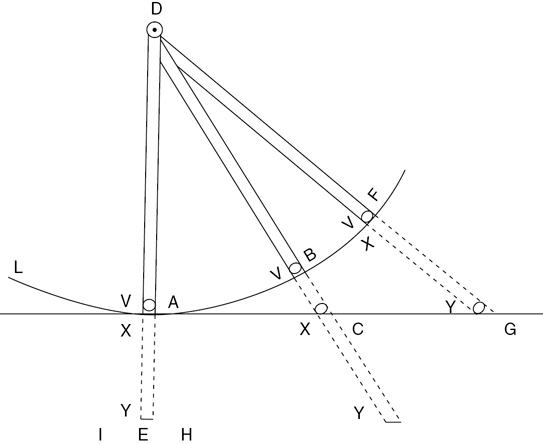
According to this rule, then, one must say that God alone is the author of all the motions in the world, insofar as they exist and insofar as they are straight, but that it is the diverse dispositions of matter that render the motions irregular and curved. So the theologians teach us that God is also the author of all our actions, insofar as they exist and insofar as they have some goodness, but that it is the diverse dispositions of our wills that can render those actions evil.
I could set out here many additional rules for determining in detail when and how and by how much the motion of each body can be diverted and increased or decreased by colliding with others, something that comprises summarily all the effects of nature. But I shall be content with showing you that, besides the three laws that I have explained, I wish to suppose no others but those that most certainly follow from the eternal truths on which the mathematicians are wont to support their most certain and most evident demonstrations; the truths, I say, according to which God Himself has taught us He disposed all things in number, weight, and measure. The knowledge of those laws is so natural to our souls that we cannot but judge them infallible when we conceive them distinctly, nor doubt that, if God had created many worlds, the laws would be as true in all of them as in this one. Thus, those who can examine sufficiently the consequences of these truths and of our rules will be able to know effects by their causes and (to explain myself in the language of the School) will be able to have demonstrations a priori of everything that can be produced in that new world.
And so there will be no exception that impedes this, we will add, if you wish, to our suppositions that God will never mark any miracle in the new world and that the intelligences, or the rational souls, which we might hereafter suppose to be there, will in no way disturb the ordinary course of nature.
Nonetheless, in consequence of this, I do not promise you to set out here exact demonstrations of all the things I will say. It will be enough for me to open to you the path by which you will be able to find them yourselves, whenever you take the trouble to look for them. Most minds lose interest when one makes things too easy for them. And to compose here a setting that pleases you, I must employ shadow as well as bright colors. Thus I will be content to pursue the description I have begun, as if having no other design than to tell you a fable.
Translated by Michael S. Mahoney
Reading and Discussion Questions
1.Descartes is imagining a world created by God that operates according to laws. What laws does he envision? Does he think that God needs to intervene in this world after the laws have been established?
2.How does his second law or rule solve the Aristotelian problem of the continuance of projectile motion?
3.What is Descartes’ stance on the value of information derived from the senses? How does that judgement compare with the confidence that he places in reason?