
52
Although the invention of plausible hypotheses, independent of any connection with experimental observations, can be of very little use in the promotion of natural knowledge; yet the discovery of simple and uniform principles, by which a great number of apparently heterogeneous phenomena are reduced to coherent and universal laws, must ever be allowed to be of considerable importance towards the improvement of the human intellect.
The object of the present dissertation is not so much to propose any opinions which are absolutely new, as to refer some theories, which have been already advanced, to their original inventors, to support them by additional evidence, and to apply them to a great number of diversified facts,which have hitherto been buried in obscurity. Nor is it absolutely necessary in this instance to produce a single new experiment; for of experiments there is already an ample store, which are so much the more unexceptionable, as they must have been conducted without the least partiality for the system by which they will be explained; yet some facts, hitherto unobserved, will be brought forwards, in order to show the perfect agreement of that system with the multifarious phenomena of nature ... .
Those who are attached, as they may be with the greatest justice, to every doctrine which is stamped with the Newtonian approbation, will probably be disposed to bestow on these considerations so much the more of their attention, as they appear to coincide more nearly with Newton’s own opinions. For this reason, after having briefly stated each particular position of my theory, I shall collect, from Newton’s various writings, such passages as seem to be the most favourable to its admission; and, although I shall quote some papers which may be thought to have been partly retracted at the publication of the optics, yet I shall borrow nothing from them that can be supposed to militate against his maturer judgment.
Hypothesis I
A luminiferous Ether pervades the Universe, rare and elastic in a high degree.
...
Hypothesis II
Undulations are excited in this Ether whenever a Body becomes luminous.
Scholium. I use the word undulation, in preference to vibration, because vibration is generally understood as implying a motion which is alternately backwards and forwards, by a combination of the momentum of the body with an accelerating force, and which is naturally more or less permanent; but an undulation is supposed to consist in a vibratory motion, transmitted successively through different parts of a medium, without any tendency in each particle to continue its motion, except in consequence of the transmission of succeeding undulations, from a distinct vibrating body; as, in the air, the vibrations of a chord produce the undulation’s constituting sound ... .
Hypothesis III
The Sensation of different Colours depends on the different frequency of Vibrations, excited by Light in the Retina.
... Scholium. Since, for the reason here assigned by Newton, it is probable that the motion of the retina is rather of a vibratory than of an undulatory nature, the frequency of the vibrations must be dependent on the constitution of this substance. Now, as it is almost impossible to conceive each sensitive point of the retina to contain an infinite number of particles, each capable of vibrating in perfect unison with every possible undulation, it becomes necessary to suppose the number limited, for instance, to the three principal colours, red, yellow, and blue, of which the undulations are related in magnitude nearly as the numbers 8, 7, and 6; and that each of the particles is capable of being put in motion less or more forcibly, by undulations differing less or more from a perfect unison; for instance, the undulations of green light being nearly in the ratio of 61, will affect equally the particles in unison with yellow and blue, and produce the same effect as a light composed of those two species: and each sensitive filament of the nerve may consist of three portions, one for each principal colour. Allowing this statement, it appears that any attempt to produce a musical effect from colours, must be unsuccessful, or at least that nothing more than a very simple melody could be imitated by them; for the period, which in fact constitutes the harmony of any concord, being a multiple of the periods of the single undulations, would in this case be wholly without the limits of sympathy of the retina, and would lose its effect; in the same manner as the harmony of a third or a fourth is destroyed, by depressing it to the lowest notes of the audible scale. In hearing, there seems to be no permanent vibration of any part of the organ.
Hypothesis IV
All material Bodies have an Attraction for the ethereal Medium, by means of which it is accumulated within their Substance, and for a small Distance around them, in a State of greater Density, but not of greater Elasticity.
It has been shown, that the three former hypotheses, which may be called essential, are literally parts of the more complicated Newtonian system. This fourth hypothesis differs perhaps in some degree from any that have been proposed by former authors, and is diametrically opposite to that of Newton; but, both being in themselves equally probable, the opposition is merely accidental; and it is only to be inquired which is the best capable of explaining the phenomena. Other suppositions might perhaps be substituted for this, and therefore I do not consider it as fundamental, yet it appears to be the simplest and best of any that have occurred to me.
Proposition I
All Impulses are propagated in a homogeneous elastic Medium with an equable Velocity.
Every experiment relative to sound coincides with the observation already quoted from Newton, that all undulations are propagated through the air with equal velocity ... .
Proposition II
An undulation conceived to originate from the Vibration of a single Particle, must expand through a homogeneous Medium in a spherical Form, but with different quantities of Motion in different Parts.
Proposition III
A Portion of a spherical Undulation, admitted through an Aperture into a quiescent Medium, will proceed to be further propagated rectilinearly in concentric Superficies, terminated laterally, by weak and irregular Portions, of newly diverging Undulations.
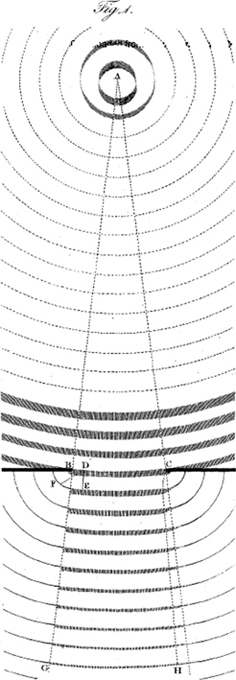
At the instant of admission, the circumference of each of the undulations may be supposed to generate a partial undulation, filling up the nascent angle between the radii and the surface, terminating the medium; but no sensible addition will be made to its strength by a divergence of motion from any other parts of the undulation, for want of a coincidence in time, as has already been explained with respect to the various force of a spherical undulation. If indeed the aperature bear but a small proportion to the breadth of an undulation, the newly generated undulation may nearly absorb the whole force of the portion admitted; and this is the case considered by Newton in the Principia. But no experiment can be made under these circumstances with light, on account of the minuteness of its undulations, and the interference of inflection; and yet some faint radiations do actually diverge beyond any probable limits of inflection, rendering the margin of the aperture distinctly visible in all directions; these are attributed by Newton to some un known cause, distinct from inflection; (Optics, Third Book, Obs. 5.) and they fully answer the description of this proposition.
...
Proposition V
When an Undulation is transmitted through a Surface terminating different Mediums, it proceeds in such a Direction, that the Sines of the Angles of Incidence and Refraction are in the constant Ratio of the velocity of Propagation in the two Mediums.
Corollary 1. The same demonstrations prove the equality of the angles of reflection and incidence.
Corollary 2. It appears from experiments on the refraction of condensed air that the ratio of the difference of the sines varies simply as the density. Hence it follows, by Schol. I Prop. I. that the excess of the density of the ethereal medium is in the duplicate ratio of the density of the air; each particle cooperating with its neighbours in attracting a greater portion of it.
...
Proposition VIII
From two Undulations, from different Origins, coincide either perfectly or very nearly in Direction, their joint effect is a Combination of the Motions belonging to each.
Since every particle of the medium is affected by each undulation, wherever the directions coincide, the undulations can proceed no otherwise than by uniting their motions, so that the joint motion may be the sum or difference of the separate motions, accordingly as similar or dissimilar parts of the undulations are coincident.
I have, on a former occasion insisted at large on the application of this principle to harmonics (Phil Trans. for 1800, p. 130), and it will appear to be of still more extensive utility in explaining the phenomena of colours. The undulations which are now to be compared are those of equal frequency. When the two series coincide exactly in point of time, it is obvious that the united velocity of the particular motions must be greatest, and, in effect at least, double the separate velocities; and also, that it must be smallest, and if the undulations are of equal strength, totally destroyed, when the time of the greatest direct motion belonging to one undulation coincides with that of the greatest retrograde motion of the other. In intermediate states, the joint undulation will be of intermediate strength; but by what laws this intermediate strength must vary, cannot be determined without further data. It is well known that a similar cause produces in sound, that effect which is called a beat; two series of undulations of nearly equal magnitude cooperating and destroying each other alternately, as they coincide more or less perfectly in the times of performing their respective motions.
...
Proposition IX
Radiant Light consists in Undulations of the luminiferous Ether.
This proposition is the general conclusion form all the preceding; and it is conceived that they conspire to prove it in as satisfactory a manner as can possibly be expected from the nature of the subject. It is clearly granted by Newton, that there are undulations yet he denies that they constitute light; but it is shown in the three first Corollaries of the last Proposition, that all cases of the increase or diminution of light are referable to an increase or diminution of such undulations, and that all the affections to which the undulations would be liable, are distinctly visible in the phenomena of light; it may therefore be very logically inferred, that the undulations are light.
A few detached remarks will serve to obviate some objections which may be raised against this theory.
...
1.Newton has advanced the singular refraction of the Iceland crystal, as an argument that the particles of light must be projected corpuscles; since he thinks it probable that the different sides of these particles must be differently attracted by the crystal, and since Huygens has confessed his inability to account in a satisfactory manner for all the phenomena. But, contrarily to what might have been expected from Newton’s usual accuracy and candour, he has laid down a new law for the refraction, without giving a reason for rejecting that of Huygens, which Mr. Hauy has found to be more accurate than Newton’s; and, without attempting to deduce from his own system any explanation of the more universal and striking effects of doubling spars, he has omitted to observe that Huygens’s most elegant and ingenious theory perfectly accords with these general, effects, in all particulars, and of course derives from them additional pretensions to truth: this he omits, in order to point out a difficulty, for which only a verbal solution can be found in his own theory, and which will probably long remain unexplained by any other.
2.Mr. Mitchell has made some experiments, which appear to show that the rays of light have an actual momentum, by means of which a motion is produced when they fall on a thin plate of copper delicately suspended. (Priestley’s Optics) But, taking for granted the exact perpendicularity of the plate, and the absence of any ascending current of air, yet since, in every such experiment, a greater quantity of heat must be communicated to the air at the surface on which the light falls than at the opposite surface, the excess of expansion must necessarily produce an excess of pressure on the first surface, and a very perceptible recession of the plate in the direction of the light. Mr. Bennet has repeated the experiment, with a much more sensible apparatus, and also in the absence of air; and very justly infers from its total failure, an argument in favour of the undulatory system of light. (Phil. Trans. for 1792, p. 87) For, granting the utmost imaginable subtlety of the corpuscles of light, their effects might naturally be expected to bear some proportion to the effects of the much less rapid motions of the electrical fluid, which are so very easily perceptible, even in their weakest states.
3.There are some phenomena of the light of solar phosphori, which at first sight might seem to favour the corpuscular system; for instance, its remaining many months as if in a latent state, and its subsequent re-emission by the action of heat. But, on further consideration, there is no difficulty in supposing the particles of the phosphori which have been made to vibrate by the action of light, to have this action abruptly suspended by the intervention of cold, whether as contracting the bulk of the substance or otherwise; and again, after the restraint is removed, to proceed in their motion, as a spring would do which had been held fast for a time in an intermediate stage of its vibration; nor is it impossible that heat itself may, in some circumstances, become in a similar manner latent. (Nicholson’s Journal, vol. ii, p. 399)
But the affections of heat may perhaps hereafter be rendered more intelligible to us; at present, it seems highly probable that light differs from heat only in the frequency of its undulations or vibrations; those undulations which are within certain limits, with respect to frequency, being capable of affecting the optic nerve, and constituting light; and those which are slower, and probably stronger, constituting heat only; that light and heat occur to us, each in two predicaments, the vibratory or permanent, and the undulatory or transient state; vibratory light being the minute motion of ignited bodies, or of solar phosphori, and undulatory or radiant light the motion of the ethereal medium excited by these vibrations; vibratory heat being a motion to which all material substances are liable, and which is more or less permanent; and undulatory heat that motion of the same ethereal medium, which has been shown by Mr. King (Morsels of Criticism, 1786, p. 99), and M. Pictet (Essais de Physique, 1790) to be as capable of reflection as light, and by Dr. Herschel to be capable of separate refraction (Phil. Trans. for 1800, p. 284).
How much more readily heat is communicated by the free access of colder substances, than either by radiation or by transmission through a quiescent medium, has been shown by the valuable experiments of Count Rumford. It is easy to conceive that some substances, permeable to light,may be unfit for the transmission of heat, in the same manner as particular substances may transmit some kinds of light, while they are opaque with respect to others.
On the whole it appears, that the few optical phenomena which admit of explanation by the corpuscular system, are equally consistent with this theory; that many others, which have long been known, but never understood, become by these means perfectly intelligible; and that several new facts are found to be thus only reducible to a perfect analogy with other facts, and to the simple principles of the undulatory system. It is presumed, that henceforth the second and third books of Newton’s Optics will be considered as more fully understood than the first has hitherto been; but, if it should appear to impartial judges, that additional evidence is wanting for the establishment of the theory, it will be easy to enter more minutely into the details of various experiments, and to show the insuperable difficulties attending the Newtonian doctrines, which, without necessity, it would be tedious and invidious to enumerate. The merits of their author in natural philosophy, are great beyond all contest or comparison; his optical discovery of the composition of white light, would alone have immortalised his name; and the very arguments which tend to overthrow his system, give the strongest proofs of the admirable accuracy of his experiments.
Sufficient and decisive as these arguments appear, it cannot be superfluous to seek for further confirmation; which may with considerable confidence be expected, from an experiment very ingeniously suggested by Professor Romson, on the refraction of the light returning to us from the opposite margins of Saturn’s ring; for, on the corpuscular theory, the ring must be considerably distorted. When viewed through an achromatic prism; a similar distortion ought also to be observed in the disc of Jupiter; but, if it be found that an equal deviation is produced in the whole light reflected from these planets, there can scarcely be any remaining hope to explain the affections of light, by a comparison with the motions of projectiles.
Reading and Discussion Questions
1.Young seems to be presenting a theory of light which is counter to Newton’s. Why, then, is he so careful to suggest how much of his theory aligns with that of his predecessor?
2.What is a luminiferous ether? Why would Young need to postulate such a thing?
3.What evidence does Young provide in favor of this theory that light is an undulation in the luminiferous ether?