
After Nicholas abdicated, a committee of Duma delegates created the Provisional Government, intended to serve until the election of an assembly, called the Constituent Assembly, which would draft a constitution for a new, republican Russian government. The Provisional Government tried to keep the bureaucracy functioning and the war effort afloat, while the uprising against the tsar spun into a revolutionary effort to destroy the old political order. Crowds looted police stations and drove tax collectors out of town, peasants seized landlords’ property, workers took over factories, and soldiers organized committees to speak for them in negotiations with officers. In the cities, democratic organizations sprang up, the most important of which were the soviets, elected assemblies of workers and soldiers. Political parties—the Bolsheviks, Kadets, Mensheviks, Socialist Revolutionaries, and many others—pledged to work for freedom and social justice.
The politicians that benefited most from the Revolution were the Bolsheviks, the left wing of the Social Democratic party. They called for an end to the war, the granting of the landlords’ land to the peasants, improvement in food supplies, and the transfer of power from the Provisional Government to the soviets. They also built a strong, well-led organization based in the working class and the army. When, in October 1917, the Bolshevik leadership ordered its troops to overthrow the Provisional Government, the latter could not rally an equally powerful corps of defenders. On October 25 (November 7 on the Western calendar), Vladimir Lenin, the head of the Bolsheviks, stood before a national meeting of representatives of the soviets and declared a new government, based in the soviets and led by the Council of People’s Commissars, which was composed mostly of Bolsheviks. The first stage of the Russian Revolution was over.
WOMEN’S ACTIVISM
Many revolutions, by weakening social norms and controls and broadcasting calls to equality and freedom, have opened up new opportunities for women; the Russian Revolution was one of the most liberating. In the cities, women marched in demonstrations and joined political parties and trade unions. In the countryside, peasant women participated in the confiscation of the nobility’s property. Women also developed their own independent activism. Shoppers continued to press their demands on merchants. Women workers held meetings to discuss their problems, particularly low wages and sexual harassment. Some workers, such as the laundresses of Petrograd, unionized. Most poor women stayed away from all these activities, because they were afraid to get involved and because they needed to concentrate on feeding themselves and their children, but more women than ever before were politically active, and their uprising empowered cadres of female leaders.
The first off the mark were the feminists of the League for Women’s Equal Rights, who began lobbying the Provisional Government in March. Now their years of work bore fruit, for women from all classes were joining them to demand that women’s rights be on the agenda of a democratizing Russia. On March 19, Poliksena Shishkina-Iavein, a founder of the league, and Vera Figner, a veteran revolutionary, led a demonstration of thirty-five thousand women to the Taurida Palace, headquarters of the Provisional Government and the Petrograd soviet. They called on the leaders of both bodies to write women’s equality into the laws of the new Russia. The men who came out to meet them declared their support for women’s rights. The feminists kept up their lobbying thereafter, and by midsummer they had achieved their major objective. The Provisional Government issued an electoral law that granted the right to vote and to run for office to all men and women twenty years of age and older. Tens of thousands of women voted in local elections in the following months, as well as in the elections to the Constituent Assembly that were held in the fall. The Provisional Government also opened the legal profession and the civil service to women, and abolished the rule that only men could serve on juries. The feminists had won, in a few months, reforms they had sought for more than a decade, and in so doing had put Russia at the forefront of European nations in the political rights it granted women.40
THE WOMEN’S MILITARY MOVEMENT
Feminists also promoted one of 1917’s most publicized developments in female activism—the “women’s military movement.”41 Russia was still at war with Germany, and many feared that the Germans would take advantage of the political instability to invade the Russian heartland and stamp out the fledgling democracy. Feminists saw an opportunity in this perilous situation. If women joined the army, they could demonstrate that they were willing to shoulder all the obligations of citizenship and therefore that they deserved political equality. They could also stiffen the spines of wavering male soldiers and raise morale behind the lines. Feminist leaders Maria Pokrovskaia and Anna Shabanova made these arguments in the spring of 1917, and by late May they had persuaded the Provisional Government to authorize the formation of all-female military units.
In the months that followed, women in at least fifteen cities from Petrograd to Odessa, Minsk to Ekaterinburg, as well as in Tashkent and Baku, set up organizations to recruit volunteers and raise the money to equip them. More than five thousand women answered their call. Most were Russians, though there were many Cossacks as well, probably because the Cossacks were a warrior people who prized valor among women as well as men. The volunteers were almost all young and single, and they came from all Russia’s social ranks. Many had already done military service as nurses; a few were female infantry veterans who became NCOs in the women’s units.
By late summer, sixteen companies—four infantry battalions, one naval unit, and eleven communications detachments—had been set up. The only one to see combat was the First Russian Women’s Battalion of Death, so named because its members had sworn never to surrender. Sent into battle in Belarus in July, the three hundred or so women acquitted themselves honorably. So did the soldiers of the First Petrograd Women’s Battalion, who were assigned to defend the ministers of the Provisional Government from arrest by the Bolsheviks in late October. The women stayed at their posts until a much larger contingent of Bolshevik troops arrived, then surrendered. Most of the male soldiers on duty with them had deserted ahead of time, which may speak to the valor of the women, or to their misreading of political reality.42
Women volunteered for the all-female units because they were patriots eager to defend Russia. Some were also seeking to prove their equality with men. They won the support of the soldiers they worked with, but were harassed, sometimes violently, by men from other units who were sick of war and angry that women had been sent to shame them into more killing and dying. Public opinion was mixed as well: some people were horrified, others inspired. Feminists hailed the young women as shining examples of women’s involvement in the Revolution. Others, harkening back to older ideals, praised the female soldiers as martyrs willing to shed their “saintly blood” for Russia.43
The women’s military movement ended in early fall, when army commanders canceled the experiment because they judged it a waste of time and resources. Bolshevik leaders agreed. In their view, which was widely shared, the women’s units were a public-relations stunt, designed to drum up support for an unjust war. When they took power, they ordered the remaining battalions to disband and thereby alienated the most famous female soldier of 1917, Maria Bochkareva.

MARIA BOCHKAREVA (1889–1920)
Bochkareva was a Siberian peasant who married young to escape from a father who beat her, then ran away from her husband when he did the same. She next got involved with a thieving, drunken, abusive butcher. When the war began in 1914, Bochkareva decided to give up being a wife and enlist in the army. A bemused recruiting officer turned her down, but suggested that she petition the tsar. Nicholas was touched by Bochkareva’s heartfelt expressions of patriotism, which had been written down for her by someone else, for she was illiterate. The tsar himself granted her request to join the infantry.
Bochkareva proved to be an able, courageous soldier. In combat in Belarus in February 1915, she repeatedly rushed, unbidden, onto the battlefield to rescue wounded comrades. Her heroism earned her the St. George’s Cross (Russia’s highest military award), promotion to junior NCO, and three serious wounds. It also made her reputation among the men of her unit. They accepted her because she was brave, because she could perform as well as they, and because she had made herself into one of the boys. Bochkareva smoked, spat, swore, and beat up men who insulted her.
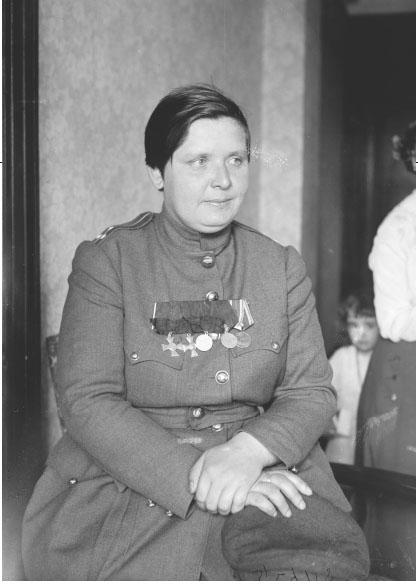
A photograph probably taken on Maria Bochkareva’s U.S. tour in 1918.
Prints and Photographs Division, Library of Congress.
MARIA BOCHKAREVA
In her memoir, Bochkareva recounted huddling in a trench at night, after her regiment’s first battle, listening to the cries of the wounded.
“In the dark it seemed to me that I saw their faces, the familiar faces of Ivan and Peter and Sergei and Mitia, the good fellows who had taken such tender care of me…. They called me. I could see their hands outstretched in my direction, their wide-open eyes straining in the night in the hope of rescue, the deathly pallor of their faces. Could I remain indifferent to their cries? Was it not my bounden duty as a soldier, a duty as important as that of fighting, to render aid to stricken comrades?
I climbed out of the trench and crawled under our wire entanglements. There was comparative calm, interrupted only by occasional rifle shots, when I would lie down and remain motionless, as though I were a corpse. There were wounded within a few feet of our line. I carried them one by one to the edge of our trench where they were picked up and carried to the rear. The saving of one man encouraged me to continue my efforts till I reached the far side of the field. Here I had several narrow escapes…. When dawn broke in the East, putting an end to my expeditions through No Man’s Land, I had saved about fifty lives.”
SOURCE: MARIA BOTCHKAREVA, YASHKA, MY LIFE AS A PEASANT, EXILE, AND SOLDIER, AS SET DOWN BY ISAAC DON LEVINE (LONDON: CONSTABLE, 1919), 90–91.
On a trip to Petrograd in May 1917, she became a convert to the idea of creating all-female units. Bochkareva was no feminist. She scorned women as weak creatures and referred to herself with masculine pronouns. She was, however, an enthusiastic and impressive advocate for the proposition that women could be soldiers. When the Provisional Government authorized the units in late May, Bochkareva was appointed commander of the Women’s Battalion of Death. She trained her volunteers with an iron hand, driving many of them away in the process, and then led the troops to the front in July. They performed well.
That bloody campaign was the high point of Bochkareva’s military career, but not of her fame. After the Bolsheviks disbanded her unit, she supported the anti-Bolshevik coalition known as the Whites. In 1918 she toured the United States and Britain to drum up support for the White armies. It was a highly publicized journey, during which Bochkareva met with President Woodrow Wilson and King George IV. She also told her life story to journalist Isaac Don Levine, who polished her recollections into prose and published them as Yashka, My Life as Peasant, Officer, and Exile. In 1919, her tour completed, Bochkareva returned to Russia and sought out the Whites. Before she could reach an army to enlist in, the Bolsheviks tracked her down. She was tried, found guilty of treason, and executed in May 1920.44
WOMEN IN THE SOCIALIST PARTIES
The socialist parties, the largest of which were the Socialist Revolutionaries and the two factions of Social Democrats—the Bolsheviks and Mensheviks—grew rapidly in 1917. Women, as in the past, were among the recruits. None of the parties kept good records in that tumultuous year, so it is impossible to determine how many such women there were. Probably they constituted 10 to 15 percent of party members. It is somewhat easier to reconstruct what women did. Among the Bolsheviks, they held a greater percentage of party offices than ever before or after, and the same may have been true of the Mensheviks and Socialist Revolutionaries.45 Most of these women worked in the lower ranks, on neighborhood or city committees, where they spread their party’s message through speeches, leaflets, and newspapers. Some, particularly Bolsheviks in Petrograd, reached out to women workers. A handful of women rose to the top leadership of their parties. Of these, the most prominent in 1917 were Maria Spiridonova and Alexandra Kollontai. Kollontai became a popular stump speaker and Spiridonova headed the Left Socialist Revolutionaries.
MARIA SPIRIDONOVA (1884–1941) AND ALEXANDRA KOLLONTAI (1872–1952)
Spiridonova was a fabled terrorist. Born into the lower-ranking nobility, she became a Socialist Revolutionary in her late teens. The Socialist Revolutionaries were socialists much influenced by Marxism but loyal as well to the populist mission of inspiring the peasants to revolt. They kept alive the populist tradition of assassinating brutal tsarist officials, and it was as an assassin that Spiridonova first became famous. In 1906 she gunned down a police commander in broad daylight. Spiridonova fit the profile of the female martyr-revolutionary: she was a pretty, young noblewoman who shot an evil man and then made no attempt to escape. Her case, including the fact that she had been severely beaten while under arrest, was widely publicized by her comrades and by the press. The publicity elicited an outpouring of sympathy for a frail girl who had killed a brute, and that sympathy in turn convinced the government to cut its public-relations losses by commuting her death sentence to life imprisonment in Siberia. As she headed east by train, crowds gathered at the stations through which she passed to greet her.
Freed in the spring of 1917, Spiridonova went to Petrograd to claim a place in the Socialist Revolutionary leadership. Prison had neither softened her radicalism nor weakened her self-confidence. After a few weeks in the capital, she decided that the Socialist Revolutionary leadership was too cautious and the Bolsheviks were right in calling for the overthrow of the Provisional Government. She did not become a Bolshevik, as did other socialists who agreed with their strategy. Rather she joined with like-minded Socialist Revolutionaries to set up a new organization, the Left Socialist Revolutionaries. They supported the Bolshevik seizure of power and worked in the new government for a few months afterward, but Spiridonova soon realized that the Bolshevik leaders had no intention of sharing power with her party. She was also repelled by the peace treaty Lenin signed with Germany in March 1918, because it ceded vast amounts of Russian territory to Germany. Spiridonova and her group broke with the Bolsheviks soon thereafter, and in the summer of 1918 she helped organize the assassination of the German ambassador. The police arrested her, then released her. She refused to stop speaking out against the new government and in 1919 was arrested again. Spiridonova spent most the rest of her life in prison. She was executed in 1941.46
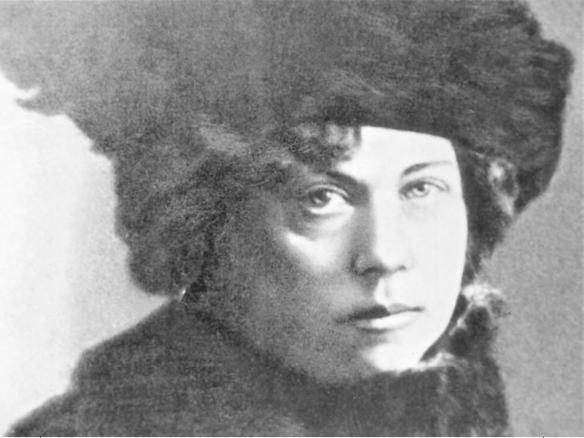
Alexandra Kollontai in 1912. Author’s collection.
ALEXANDRA KOLLONTAI
In May 1917, Kollontai issued this call to arms in an article published in Rabotnitsa, the newly revived Bolshevik magazine for women.
“All our strength, all our hope lie in organizing!
Now our cry should be: comrade women workers. Don’t stand alone! In isolation we are straw people that every boss can bend down. Organized, we are a great force that no one can crush.
We, women workers, in the first days of the Russian Revolution supported the Red Banner. We went to the streets first on Women’s Day. We are hurrying now into the front ranks of the fighters for the workers’ cause; we are joining trade unions, the Social Democratic Party, the Soviet of Workers’ and Soldiers’ Deputies!
By closing ranks, we will achieve the quickest end to the world war. We will fight against those who forgot the great call of the working people for unity, for the solidarity of workers of all countries.
Only in revolutionary struggle against the capitalists of all countries and only in unity with the female and male workers of the whole world will we establish a new, bright future—the socialist brotherhood of the workers.”
SOURCE: A. M. KOLLONTAI, “NASHI ZADACHI,” IN IZBRANNYE STATI I RECHI (MOSCOW: POLITIZDAT, 1972), 213. TRANSLATED BY BARBARA CLEMENTS.
The other famous female radical of 1917, Kollontai, played on the winning side. A very popular speaker, she was elected to the Petrograd soviet as well as to the Bolsheviks’ Central Committee. Kollontai was one of the Central Committee members who voted in early October for the party to overthrow the Provisional Government. After it did so, Lenin appointed her commissar of social welfare, and Kollontai set about enacting the reforms for women that she had long advocated. After a few months, she too fell out with Lenin, because she, like Spiridonova, believed the treaty with Germany was an unnecessary surrender to a capitalist power. In March 1918 Kollontai resigned her government position and went off to lick her political wounds.
Bochkareva, Kollontai, and Spiridonova were the most famous female activists of 1917. Like so many women in Russia’s past, they became prominent because they were strong-willed, self-confident, talented people who seized the opportunities their times gave them. Those same qualities led them to oppose the new rulers, with disastrous consequences for Bochkareva and Spiridonova. Kollontai came out of her self-imposed exile later in 1918 and claimed a leading part in reforms for women, without recanting any of her criticism. A few years after that, she locked horns with Lenin again.