
The new rulers were mostly men from the Soviet elite. “While women were waiting on line for food,” feminist Maria Arbatova observed tartly, “men carved up the country into pieces.” The successor governments did not continue the Soviet practice of setting quotas for female representation in their legislatures and bureaucracies, with the result that the numbers of women in those institutions fell. In 1993, 14 percent of the delegates to the Russian Duma, the national legislature, were women; by 2003 that proportion had dipped below 10 percent. There were more women in regional legislatures and city councils; 26 percent of the members of the Tver municipal Duma in 2005 were female. The public seemed to consider this continuance of male dominance in politics unexceptional. Women did not have the temperament to serve in elected office, many believed. They meant this as a compliment; politics, like business, corrupted everyone who participated in it. Women should devote their talents to the higher callings of education, health care, and childrearing.21
PUBLIC POLICY
In the 1990s, the governments of the successor states passed constitutions and other laws that affirmed women’s rights to civil, educational, employment, legal, and political equality with men. They continued Soviet benefits programs, but, on the advice of such foreign lenders as the World Bank, they shifted much of the responsibility for funding public services to local governments. Because those administrations were even more strapped for revenues than the national ones, the results were disastrous. Thousands of daycare centers closed; others raised their fees. Maternity and child-support benefits went unpaid. The sick had to bear more of the cost of treatment, even while conditions in the hospitals deteriorated. The implementation of all these changes was made still worse by poor planning and local foot-dragging, the same difficulties that had plagued many Soviet projects.
Abortion rights in the Western successor states were also imperiled. Nationalist conservatives and the Orthodox and Catholic Churches advocated restricting abortion, citing declining populations as a rationale. The Russian and Ukrainian governments made some unpublicized, minor changes in the regulations in 2003–2004, but widespread public support for the availability of the procedure dissuaded them from going further. Perhaps they were influenced as well by the fact that women were having fewer abortions. Between 1991 and 2001, there was a 50 percent drop in the abortion rate in Russia and Ukraine because public-health workers and volunteer organizations, supported by international agencies and foundations, expanded family-planning counseling and increased supplies of affordable contraceptives.
Women in Central Asia and the Caucasus had less access to contraceptives and underwent fewer abortions. They continued to prefer having large families. In 2007, the Uzbek government, worried about overpopulation, ordered physicians to promote surgical sterilizations; the birthrate dropped in consequence, even as complaints about women being forced to have the procedures increased.22
WOMEN IN POLITICS
The most important women in the governments of the FSU were those who kept social services functioning. In cities and towns, many of the civil servants who staffed the schools, hospitals, and social-service agencies were women; some of these people worked hard to preserve programs benefiting women and to create new ones, staffed by volunteers, that could help people deal with the economic crisis. In Uzbekistan, this collaboration resulted in a network of women’s committees extending from the national to the neighborhood level. Neighborhood committee members served as volunteer social workers, passing out poor relief, advising women on family matters, and teaching Islam. Many people across the FSU, especially poor women, believed that women did such jobs better than men, because they were more sympathetic to the plight of the disadvantaged. The general disgust with politicians did not extend, therefore, to those civil servants who helped women get through the hard times.23
The political parties that sprang up after 1991 were predominantly male organizations, with a couple of fleeting exceptions. The largest and most successful of these was the Women of Russia party (WOR), formed in 1993 by the Union of Women of Russia, an alliance of three women’s groups: the Soviet Women’s Committee, the Association of Women Entrepreneurs of Russia, and the Women of the Naval Fleet. WOR ran on a platform that criticized other parties for not paying attention to women’s plight, praised female legislators as more effective than male ones, and advocated increased spending on services beneficial to women. The campaign succeeded; WOR won twenty-one seats. The party’s delegates to the Duma concentrated on funding social services, such as family planning, and on writing laws that affirmed gender equality.24
WOR’s successes were short-lived. In elections in 1995, their delegation shrank to three representatives. Political inexperience, which plagued all the new parties, contributed to this decline, as did WOR’s own particular weaknesses. Its leaders quarreled with one another and with other female activists. Feminist groups denounced WOR for its association with the Soviet Women’s Committee and charged that its delegates were mere tokens who did as men told them. The fact that WOR became more assertively feminist during its two years in the Duma did not allay the suspicions. There was still greater diversity of political opinion among the masses of female voters, huge majorities of whom did not vote for WOR.25
Women participated in other parties much as they had done in the Soviet communist party—that is, they remained in the lower ranks, where they did clerical and organizational work. In the Caucasus and Central Asia, women ran female auxiliaries derived from the Soviet Women’s Committees. Male party leaders reported that they valued their female comrades as dependable, reliable functionaries who were more compliant and less ambitious than male politicians.26 Perhaps the ambitious ones learned to content themselves with whatever they could achieve.
A handful of women did rise to positions of regional and national leadership across the FSU. There were probably several thousand such women in the period under consideration here, of whom two, Kazimiera Prunskiene of Lithuania and Yulia Tymoshenko of Ukraine, reached the highest offices in their nations.
KAZIMIERA PRUNSKIENE (b. 1943), AND YULIA TYMOSHENKO (b. 1960)
Prunskiene and Tymoshenko were Ph.D. economists who, like Tatiana Zaslavskaia, entered politics during the Gorbachev years, but who, unlike Zaslavskaia, stayed in the game after 1991. Prunskiene was the sort of politician that Zaslavskaia scorned as “sly, dodgy.” Her admirers praised her pragmatism and flexibility. A specialist in agricultural development, Prunskiene was one of the founders of the independence movement Sajudis. In 1990 she became prime minister, then resigned a year later because of policy differences with parliamentary leaders. She set up a consulting firm and returned to academics, publishing studies of economic development in post-socialist Eastern Europe.
Soon Prunskiene’s ambitions drew her back into the political fray. First she tried to build a base among women. Following the example of WOR, she founded the Women’s Party of Lithuania in 1995 and criticized the continuing economic and political inequality of women as well as conservative Catholic influences. When the Women’s Party failed to win popular support, Prunskiene renamed it the New Democracy Party and arranged a merger with the larger Farmers’ Party. Now she became an advocate for the peasants, supporting the development of private enterprise in rural areas, declaring her allegiance to “conservative values (family, local communities, Christian morality),” and speaking fondly of her own childhood in the countryside. She served as a delegate to the national legislature, the Seimas, from 1996 onward, and managed to build up her own popularity, if not that of her party. In 2004 the Farmers and New Democracy Party won 6.6 percent of the popular vote in parliamentary elections, while Prunskiene, running for president that same year, lost by only 3 percent of the vote. Thereafter she became minister of agriculture. Her adaptation to democratic politics had succeeded.27
Yulia Tymoshenko exercised her political skills in Ukraine’s more turbulent political world. She had worked in the Komsomol during graduate school. When perestroika came, she built a successful chain of video-rental stores. In the 1990s, she moved to the more lucrative field of managing privatized energy companies and made a fortune. Politics then began to interest her again, and she decided to run for election to Ukraine’s national legislature, the Verkhovna Rada. Eloquent and beautiful, Tymoshenko received huge majorities from her constituents.
In the late 1990s, she began to criticize the corruption of the new elite, of which she herself was such a successful member. Appointed deputy prime minister for the fuel and energy sector by Prime Minister Victor Yushchenko in 1999, Tymoshenko set about closing tax loopholes that were benefiting many of her former colleagues. They retaliated by having President Leonid Kuchma fire her in January 2001, and then arrest her on corruption charges. Tymoshenko emerged from a month in jail more critical of the government than ever. She organized her own political party, the Yulia Tymoshenko Bloc, and began holding public protests. She was targeted for assassination in 2003, but survived a suspicious auto crash.
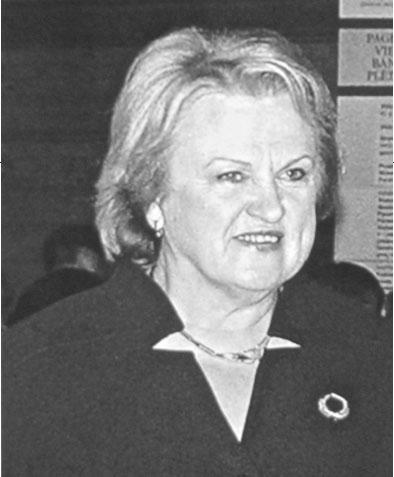
A photograph of Kazimiera Prunskiene in the 2000s. http://en.wikipedia.org/wiki/File:Kazimiera_Prunskiene.2008–05-23.jpg. Accessed June 27, 2011.
KAZIMIERA PRUNSKIENE
In 1990, after Lithuania had declared its independence, Prunskiene came to Washington, D.C. The visit put the U.S. political establishment, then supporting Mikhail Gorbachev, in a difficult position. According to Maureen Dowd of the New York Times, Prunskiene rose to the occasion.
“At a dinner tonight, with journalists at the house of Christopher Matthews, a columnist for The San Francisco Examiner, Mrs. Prunskiene was asked why Lithuania had not waited a year to declare its independence.
She smiled and said, ‘We felt we had to do it quickly, like a karate chop, if it was to work.’
Mrs. Prunskiene, a 47-year-old economist and former Communist Party official, had a small entourage, no security guards and she rode in a dark-blue sedan paid for by a private person in the Lithuanian-American community. As a translator, she used the head of a Lithuanian-American organization based in Washington.
Even so, she showed a natural aptitude for American politics. When the Prime Minister settled in her room at the Embassy Row hotel here on Wednesday night, her friends and advisers gathered around to counsel her on how to handle the American politicians she would be meeting.
They told her that each politician would think he was more important than the last.
‘And my job,’ she said, smiling knowingly, ‘is to confirm that.’”
SOURCE: MAUREEN DOWD, “EVOLUTION IN EUROPE: LITHUANIA PREMIER SEES BUSH, BUT THERE’S NO RED CARPET,” NEW YORK TIMES, MAY 4, 1990, HTTP://WWW.NYTIMES.COM. FROM THE NEW YORK TIMES, MAY 4 1990 THE NEW YORK TIMES. ALL RIGHTS RESERVED. USED BY PERMISSION AND PROTECTED BY THE COPYRIGHT LAWS OF THE UNITED STATES. THE PRINTING, COPYING, REDISTRIBUTION, OR RETRANSMISSION OF THIS CONTENT WITHOUT EXPRESS WRITTEN PERMISSION IS PROHIBITED.
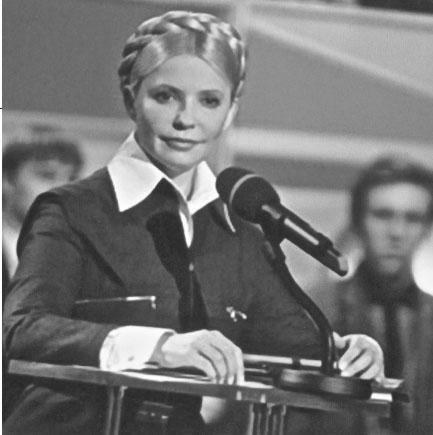
Yulia Tymoshenko speaking to the press on December 2, 2010. http://www.tymoshenko.ua/. Accessed December 2, 2010.
YULIA TYMOSHENKO
In July 2010, on her husband’s birthday, Tymoshenko wrote this about him on her blog:
“There are people (very few, unfortunately) who you can always rely on in the most difficult moments. You know that they’ll never betray you, they’ll never turn away, they’ll never judge. Such is my Oleksandr. And not because he’s my husband, but because he’s a real man—120%.
We were once in the same detention facility in Lukianivka. It was clear that they threw my husband behind bars only because he was my husband. Back then this was a ‘crime.’ One night he and I were both being taken for questioning and we saw each other for just a moment, for just one breath. But for me this was enough. This gave me such a boost of energy, faith and courage that I felt I could endure and survive everything. It seems the prison administrators also sensed this because the next day Sasha was transferred to a prison in the Zhytomyr oblast. He handed me a note directly into the cell on which he wrote: ‘Don’t give up.’…
Why am I writing all this? Just because. I’m grateful to my husband for simply being. I’m grateful that I have someone I can rely on. I’m grateful that in all these years he has never said a word about the fact that I haven’t dedicated myself entirely to my family….
I hope that you always have lots of people you can rely on. “
SOURCE: YULIA TYMOSHENKO, HTTP://BLOG.TYMOSHENKO.UA/EN/ARTICLE/ACNONAA4. THE TRANSLATION HAS BEEN SLIGHTLY EDITED HERE BY BARBARA CLEMENTS
Tymoshenko came to international attention during Ukraine’s Orange Revolution of December 2004, when hundreds of thousands of demonstrators gathered in downtown Kyiv to protest Kuchma’s clumsy attempts to falsify the results of a presidential election in favor of his candidate, Victor Yanukovich. Her long blond hair now braided and curled around her head in a hairdo once favored by Ukraine’s peasant women, Tymoshenko became the voice of the protestors, speaking often before them and to the international press. Kuchma soon backed down and a coalition of reform parties chose Tymoshenko as prime minister in January 2005.
When the coalition fell apart nine months later, Yushchenko fired Tymoshenko. She returned to building her reputation and her party. She vowed to end corruption, reform the economy, and assert Ukraine’s independence from Russia. She also promised to make life better for peasant women. Tymoshenko continued to cultivate foreign elites, publishing articles in such prestigious journals as Foreign Affairs and traveling often to Western Europe. By the fall of 2007 she was heading two political parties, the Yulia Tymoshenko Bloc and the All Union Fatherland Party. In elections that summer, her Bloc received one-third of the vote. In December, she once again became prime minister. In February 2010, she lost a bid for the presidency to a resurgent Yanukovich, and thereafter resigned from the premiership and became the leader of the coalition of opposition parties in the parliament. The vicious jockeying for power that had bedeviled Ukraine’s politics for more than a decade continued thereafter.28
Tymoshenko and Prunskiene were intelligent, ambitious, determined, adroit, and assertive. In their political skills, they resembled Catherine the Great. Like Catherine, they were elite women who reached for power to which the patriarchal rules of the game did not entitle them. Like Catherine, they built alliances with powerful men and tailored their advocacy to the public mood. They also created reassuringly feminine images, as Catherine had done. Prunskiene dressed the part of a matronly professional and embraced family values. Tymoshenko wore designer clothes that showed off her figure, publicized her church-going, and kept her bright hair in that peasant braid. The clothes and the smiles cloaked the reality that these women, like Catherine, were hard-nosed political infighters. Prunskiene and Tymoshenko may have been even more skilled at the dark arts of politics than Catherine, for Catherine was sustained at least in part by her courtiers’ deference to her royal rank. The other two made their way in the free-for-all of post-Soviet politics.
WOMEN IN THE MEDIA
There were many women among the journalists who worked to build an independent press in the successor states. It was a risky business, for the autocratic regimes in Belarus and Central Asia arrested their critics, while in Ukraine President Kuchma arranged automobile accidents or poisonings for his. In Russia, Yeltsin was fairly tolerant of the electronic and print media; Putin was not. He closed offending television networks, arrested critics on trumped-up charges, and approved assassinations. Estimates of the number of journalists murdered in Russia between 1991 and 2010 range from several dozen to more than three hundred. Despite the intimidation and the increasingly strict regulation of the media, a few outspoken women remained. Of these, two of the best known were Maria Arbatova and Anna Politkovskaia.
MARIA ARBATOVA (b. 1957) AND ANNA POLITKOVSKAIA (1958–2006)
Maria Arbatova was a sardonic, self-promoting playwright, poet, novelist, talk-show host, radio broadcaster, actor, and blogger who became famous in the 1990s as “Russia’s first feminist.” She was not the first, but she, unlike the academic feminists, had a national audience. Arbatova was a Muscovite who began publishing stories on women’s lives in the 1980s and embraced feminism during the Gorbachev years. In the 1990s she organized women’s groups, became an adviser to Yeltsin, and wrote still more on feminist themes. She became famous as host of the television show I Myself. Her co-host, also a woman, sang the praises of motherhood as woman’s highest calling; Arbatova championed feminism. In an effort to break down feminism’s negative connotations for her audience, Arbatova dressed well, talked lovingly about her twin sons, bemoaned the double shift, and asserted women’s rights to independence and equality. The show became a hit, particularly with working-class women, and Arbatova became a star.29
After I Myself went off the air, Arbatova remained Russia’s foremost celebrity feminist. Broadening her criticism in the Putin years to include human-rights issues, she larded her public pronouncements with humor. Her novel, How I Tried to Get into the Duma Honestly (2007), mocked political corruption. In 2007 she drew international attention when she proposed that since Russian men were drinking and smoking themselves to death, the government should import Indian men for Russian women to marry. She had married one herself. Arbatova hosted a radio program, The Right to Be Yourself, and maintained a lively website and a Facebook page.30
Anna Politkovskaia was a muckraking journalist of exceptional courage and determination. She came to prominence by publishing reports on atrocities committed by the Russian army during the war with separatists in the province of Chechnya. Soon she turned her attention to passionate exposés of corrupt politicians, judges, and businessmen. Politkovskaia was unsparing in her condemnation of Putin. “I dislike him for a matter-of-factness worse than felony,” she wrote in 2004, “for his cynicism, for his racism, for his lies…, for the massacre of the innocents that went on throughout his first term as president.”31 When Chechen terrorists seized a school in the city of Beslan in 2004, Politkovskaia flew south to help mediate the confrontation. En route, she became seriously ill, probably because she had been poisoned. Undeterred, she continued to write her scathing articles. On October 7, 2006, Putin’s birthday, gunmen lying in wait in the elevator of her apartment building in Moscow assassinated her.
The fact that she was publishing her criticism abroad and thereby publicizing the regime’s brutality to the world, even as it was trying to present itself as humane and democratic, may have sealed her fate. Officially, the government denied any involvement in her death, then launched an investigation that proceeded according to well-established precedents. Police found the gunmen, but not those who had hired them. In 2009, the three men tried for her murder were acquitted, the acquittal was overturned on appeal, and a new trial was ordered. The same year, five people who had worked with Politkovskaia to expose human-rights abuses in Chechnya were killed.32
FEMALE TERRORISTS
The atrocities in Chechnya also called forth a terrorist campaign against the Russians in which a handful of women participated.
The most lethal attacks were the occupation of the Dubrovka Theater in Moscow in the fall of 2002 and of a school in the southern city of Beslan in 2004. In both cases the terrorists included a few heavily armed women. In both cases hundreds of people died when police tried to free the hostages. The women called themselves shakhidki, a Russification of the Arabic word for martyr. Dressed in black headscarves or veiled from head to foot, shakhidki also conducted most of the group’s suicide bombings. In August 2004, two of them blew up two passenger jets in flight, killing ninety people. A few weeks later a single shakhidka destroyed herself and nine others in a Moscow subway station. In March 2010, two women, one of them identified as Dzhanet Abdurakhmanova, the seventeen-year-old widow of a Chechen militant leader, killed forty people and wounded more than ninety in a suicide attack on the Moscow subway.33
Veiled women assaulting defenseless civilians seemed to confirm the long-standing Russian belief that the male Chechen terrorists were savages and female terrorists their benighted dupes. Most Russians had not read Politkovskaia’s articles. They did not know that their army had committed war crimes against the Chechens, including the rape of children, which went unpunished. The shakhidki, inspired by the militant Islamism preached among Chechen guerillas and by the suicide bombers of the Palestinian Intifada, sought through terrorism to avenge their dead and draw attention to the crimes perpetrated against their people. Vengeance seemed the stronger of their motives, for the mass killing of civilians did nothing to inform Russians about the depredations of their own government.34