
· · · CALIFORNIA, NEVADA, ARIZONA · · ·
The hat must come off before the military general, the flag staff, and the church, and I preferred a country where I could keep mine on … where I should be absolute master.
—JOHN A. SUTTER1
On January 24, 1848, gold was discovered in California at Sutter’s Mill. The discovery determined the way California would be shaped. Had it not been for John A. Sutter, gold would still have been discovered. Sutter was just lucky—or, as it turned out, unlucky.
Like a moth to a flame, Sutter was attracted to fragile boundaries: geographic, social, and contractual. Born in northern Switzerland, he served in the Swiss military, married, and went into the dry goods business. By the time he was thirty, he had five children, was deeply in debt, and had lost control of his business to his mother-in-law, who had financed it. With the help of his wife, Sutter secretly sold off the store’s inventory and fled, arriving in Missouri in 1834. There he established a similar business, became an American citizen, fell deeply into debt, and fled the day before he’d been summoned to appear in court.
During the Missouri years and in the year that followed, Sutter’s business pursuits took him to Santa Fe, Oregon, Hawaii, and California. Taken together, these destinations tell us something of his instincts. At the time, none of these locations was within the United States (though it shared, and disputed, Oregon with England). All of them, however, became part of the United States within the next ten years. Sutter, of course, could not have known this. What he could have known was that they were jurisdictionally weak.
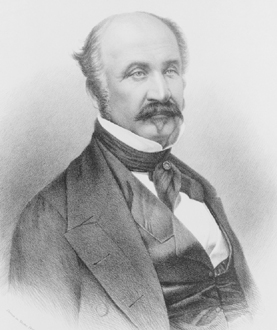
John A. Sutter (1803-1880) (photo credit 27.1)
Arriving in California in 1839, he sought permission from the Mexican government to establish an agricultural colony. “Governor [Juan Bautista] Alvarado … was very glad to hear that … I intended to settle in the interior on the banks of the river Sacramento, because the Indians … would not allow white men, and particularly of the Spanish origin, to come near them,” Sutter recorded in his diary. “I got … permission to select a territory wherever I would find it convenient.”
He selected territory at and around the juncture of the Sacramento and American Rivers, building his settlement’s initial structures slightly to the southeast, above the flood plain, and naming it New Helvetia (New Switzerland). Governor Alvarado may have been pleased about the location, but Mexico’s regional military commander, General Mariano Vallejo, was not. The area was too far in the interior for Vallejo’s forces to assert control. That fact suited Sutter, who sought a place where he need not remove his hat to anyone. It also suited him that the location was ripe for business, perched along a route used by pioneers heading to the Oregon Territory.
Adding to General Vallejo’s concern was the fact that Sutter’s initial colony was non-Hispanic, consisting of five American and German men, eight to ten Hawaiians (two of whom were, according to Sutter, wives), one bulldog, and three cannons. The bulldog and cannons provided a measure of security from hostile Indians, but Vallejo knew they could also provide protection from Mexican forces.
Sutter became well known even before gold was discovered at his mill. His importance rated inclusion in an 1844 report to the State Department. “Augustus Sutter, alcade of the new town of New Helvetia … is a Swiss, and now a citizen of Mexico, and obtained from the government a large tract of land,” the U.S. consul in Mexican California informed his superiors. “All parties by land from Oregon or from the United States to California touch at this establishment.”2
An alcade was the Mexican government’s chief executive and judicial officer for a municipality. Sutter did not possess this authority. He did, however, possess a personality ideally suited for commerce with travelers. A March 1849 item in the magazine Home Journal reveals a good deal of his gregarious character:
Captain Sutter … was one of the officers of the Swiss Guard in the Revolution of July during the reign of Charles X. After this Revolution, he emigrated to the United States.… Capt. Sutter is kind, hospitable, and generous.… Surrounded as he was, on his first settling in this country, by tribes of wild Indians, he has by kindness and just dealing, attached them to his interest.… They, for their food and a pay from four to six dollars per month, man his fort, work his farms and mills, and do all the labor generally required in the new settlement.
Actually, Sutter had been neither a captain nor a Swiss Guard. He had been a sublieutenant in the local reserves. He also appears to have misled the correspondent regarding labor-management relations. He may have paid his Indian workers $4 to $6 a month during the Gold Rush, when labor was scarce in every enterprise other than mining. Before that, however, American dollars were a rarity in what was still Mexican California. So too, for that matter, were pesos in tribal transactions, since payment was generally made in goods.
Still, as the correspondent reports, Sutter did have a character befitting a lord of the manor. To one Indian caught stealing, he imposed a sentence of twenty-fives lashes, which was duly carried out, despite the fact that Mexican law prohibited private citizens from exercising judicial functions.3 Mexican law enforcement, however, was 90 miles downriver in San Francisco.
In 1841 Sutter purchased the Russian-American Company’s coastal trading post known as Fort Ross (near present-day Jenner, California). He transported its movable goods and livestock to New Helvetia and held the distant Pacific Coast land as an investment. To finance the purchase, he borrowed from the Russian-American Company, using New Helvetia as collateral. He subsequently took out loans to finance his agricultural, ranching, fur-trapping, and distilling enterprises by putting up portions of his land as collateral, despite the fact that all his land was now mortgaged to the Russian-American Company. The common denominator in these and later transactions was the boundaries that contracts were written to stipulate. Sutter was not big on boundaries.
Loyalty, too, is a boundary, dividing certain actions one will and will not do. Sutter’s political loyalties were just as supple regarding that boundary. At the time, Mexico’s control of California was being challenged both by native-born californios (under the leadership of José Castro, General Vallejo, and Governor Alvarado) and by the United States. After Mexican President Antonio López de Santa Anna replaced Governor Alvarado with Manuel Micheltorena, the new governor sought to secure his authority by offering Sutter clear title to all his land in return for a vow of loyalty to Mexico. Sutter avowed it. When General Vallejo confronted Sutter regarding his action, Sutter avowed his loyalty to Vallejo.
After the Mexican War commenced in 1846, Sutter kept the Mexican military informed of events that came to his attention—until events tilted in favor of the U.S. forces. Sutter then sent a letter of support to General John C. Frémont. By adjusting his sails to the prevailing winds, Sutter spent the war years expanding his enterprises. For one such project, the construction of a lumber mill, he partnered with James Marshall, with Sutter providing the financing and Marshall overseeing construction. In Sutter’s diary entry for January 28, 1848, he wrote in his less than perfect English, “Marshall arrived in the evening. It was raining very heavy but he told me he came on important business. After we was alone in a private room, he showed me … specimens of gold. That is, he was not certain if it was gold or not, but he thought it might be.”
Four days later, Sutter traveled to the site to see for himself. This may seem blasé, but there had been discoveries of gold before in California and each had turned out to be insignificant. By the time he arrived, continual findings of gold suggested that this one could be big.
But there was a hitch. The mill was not on Sutter’s land. He and Marshall promptly leased the land and surrounding area from the Yalisumni Indians, making no mention of the gold. The Yalisumnis made no mention of not being the tribe to whom Mexico had accorded the land.
Over the next year, more than 80,000 people flooded into the region. Sutter’s debts had left him poorly positioned to profit from the gold or from providing supplies to the prospectors. To make matters worse, their arrival caused Sutter’s lax attitude toward boundaries to boomerang, as evidenced by an announcement he published in July 1849:
NOTICE TO SQUATTERS
All persons are hereby cautioned not to settle without my permission on any land of mine in this territory. Said land is bounded as follows:
What followed was a lengthy and precise stipulation of boundaries. But Sutter’s notice went unheeded due to jurisdictional weakness—the very element that had drawn him to this region. With the Mexican War just ended, Congress had not yet established a territorial government, and the military’s forces were depleted by soldiers deserting for the gold fields.
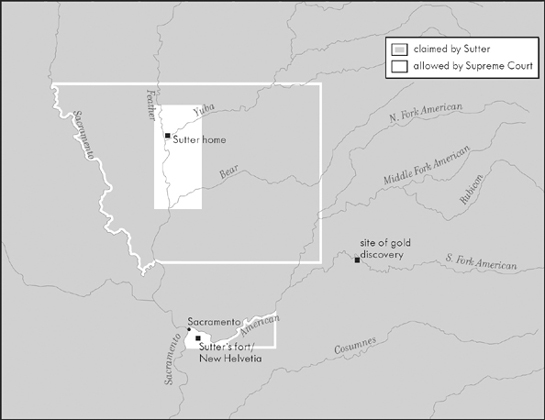
Sutter’s land claims
Unfortunate as the squatters were for Sutter, something worse was arriving in their wake: jurisdictional strength. California’s statehood convention in 1849 marked the imminent establishment of state and federal courts that would become the arena of his undoing.
The statehood convention also established California’s borders, and the debates regarding those borders were intense. Two big issues were at stake. Slavery was the more urgent of the two, and its advocates sought to create two states: a Northern and a Southern California—one free, the other slave. The second issue was water. California had very little of it in its south unless it located its border at the Rocky Mountains in order to include the Colorado and Gila Rivers. Such a border, however, would create a huge state. Opponents advocated a border just beyond the gold-filled Sierra Nevada Mountains, extending south to the Colorado River and along that river to the Gulf of California.
Among the delegates to the convention was Sutter, at whose mill all this had begun. Now out of his element, he spoke briefly only once during the proceedings, adding his support to the majority preference: a single state with the more modest eastern border.
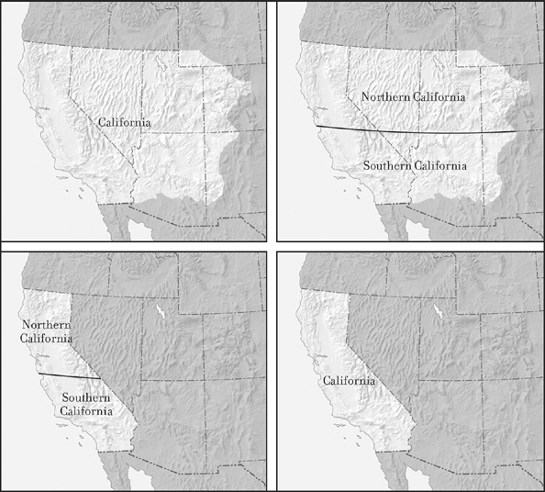
Defining California: four proposals
Meanwhile, the Russian-American Company commenced legal action to foreclose on New Helvetia owing to Sutter’s many missed payments. The crisis was averted by the arrival of Sutter’s eldest son, August (soon followed by the rest of the family, from whom Sutter had been apart for twenty years). To delay foreclosure, Sutter transferred title to all his property to August. August proceeded to have plans drawn up for a town in the squatter-populated area at the juncture of the rivers. He named it Sacramento. Sutter objected vehemently to the plan, both because it was in a floodplain and because he had been trying to sell lots for a town of Sutterville, located on higher ground three miles below the juncture.4 But demand was so high for real estate at the point of entry, August was able to pay off all his father’s debts. Sutter then invested in gold mines, using as collateral property that was now in his son’s name.5
Sutter’s tangled title claims soon became a gold mine for lawyers, representing or suing not only Sutter but also those who had bought land from him to which his title was dubious. The Chicago Tribune reported in July 1858:
Judge Hoffman, of the United States District Court, rejected the claim of Milton Little for 22,197 acres of land opposite Sacramento City. This claim is founded on an alleged grant from Mexico, and among the papers offered in evidence were two certificates signed by [John A.] Sutter and dated in 1845. Judge Hoffman declares himself satisfied that one of these was written in 1857 and ante-dated, and he expresses a suspicion of the good faith of the other. This is the second case in which Judge Hoffman has declared certificates of Sutter dated previous to the American conquest to have been written since and ante-dated.
Not only in the courts but in the streets, the forces of organization were increasingly challenging Sutter’s claims. The squatters now formed themselves into a political association:
Whereas, the evidence that the land in Sacramento County belongs to the United States is becoming clear and more positive everyday.…
Resolved, that we will hold our hold [sic] peaceably, if we can—forcibly, if we must—till a decision shall be had upon this question in the Supreme Court of the United States.
Resolved, that if the bail of an arrested squatter be refused, simply because the bondsman is not a landholder under Capt. Sutter, we shall consider all executions issued in consequence thereof as acts of illegal force and shall act accordingly.6
Sutter’s claims ultimately made their way to the U.S. Supreme Court, the decorum of which was also disrupted by his disregard for boundaries. Two attorneys claimed to be his representative. Once resolved, the legal arguments—involving “conveyances,” “petitions for surplus,” and “parol evidence”—decorously masked the fact that they had been the cause of bloodshed and death in Sacramento. In February 1859 the Supreme Court announced its ruling. It affirmed Sutter’s claim to his original land grant by Governor Alvarado but rejected his second (and twice as large) claim. That claim was based on Governor Micheltorena having sweepingly cleared any rival claims, in return for Sutter’s vow of loyalty to Mexican President Santa Anna.
The decision caused the collapse of Sutter’s shaky finances. His remaining hope was to find a means of keeping his home and the farmland on which it sat. Relief came in 1864, when California provided him with a pension of $250 per month.
Through it all, Sutter remained unchanged. In 1865 a discharged soldier whom he had hired to do odd jobs was caught stealing. Sutter, ever the lord of the manor, ordered the man flogged—as illegal under American law as it had been when he’d done the same under Mexican law. This time Sutter paid a price, similarly without regard to the boundaries of law. “The old adobe residence of General Sutter … together with its valuable contents, was destroyed by fire on Wednesday morning, the 21st,” San Francisco’s Evening Bulletin reported. “The fire was the work of an incendiary [arsonist], supposed to be a discharged soldier, who had been hanging about the premises the past few days.”
With everything in ashes, the Sutters left California, relocating in Lititz, Pennsylvania. Sutter spent his remaining years seeking to salvage something of the fortune that had slipped through his fingers. Shuttling between Lititz and Washington, DC, he had entreaties to Congress prepared on his behalf. “Now in his old age, and in a state of absolute penury,” one such plea stated, “he asks not for one cent for such aid as he rendered to his adopted and profoundly honored government in the extension of its domain to the borders of the Pacific Ocean, and … the untold treasures of California. He asks only that the government shall secure to him so much of its unsold public lands as it has caused to be unjustly taken from him, or its equivalent in money.”7
Every new Congress, over a period of fifteen years, considered another of his appeals. While in Washington continuing his efforts in 1880, Sutter died at the age of seventy-eight. Congress no longer had to decide what it thought about John A. Sutter.