
· · · FLORIDA, GEORGIA · · ·
Official persons … endeavored to deny, to insinuate in their vile newspapers, that Jenkins lost his ear nearer home, and not for nothing.… Sheer calumnies we now find. Jenkins’ account was doubtless abundantly emphatic; there is no ground to question the substantial truth of him and it.
—THOMAS CARLYLE1
In today’s society, people often refer to “fifteen minutes of fame,” pop artist Andy Warhol’s notion that mass media have become so prevalent that everyone will be in the spotlight at some point in their lives. Warhol actually said that in the future everyone will have fifteen minutes of fame, but in fact there is nothing new in this phenomenon. Mass media have created fleeting fame for as long as mass media have existed—which is to say, since the printing press or even the politically charged graffiti of ancient Rome.
Such was the case with one Robert Jenkins, the captain of a British merchant ship in the eighteenth century. At a key moment, the newspapers of the day put the spotlight on Jenkins—technically, on his ear, or more technically, on the absence of his ear—and in so doing provoked a war between England and Spain. Though the war had nothing to do with Florida and Georgia, it resulted in the boundary between those two states that exists to this day.
In April 1731 Jenkins was at the helm of the Rebecca, carrying a cargo of sugar from the British colony of Jamaica to London. While off the coast of Cuba, Jenkins’s ship was overtaken by the Spanish coast guard, which boarded and searched for contraband goods from Spanish ports. Finding none, Captain Juan de León Fandino brandished his cutlass and ordered Jenkins to reveal where he’d hidden the contraband. When Jenkins continued to insist he had none, Fandino sliced his sword across Jenkins’s ear. Still, Jenkins maintained he could not confess to what was not there. Fandino then had his men tie Jenkins to the yardarm using a neck halter. But even as the Spanish captain ordered the halter incrementally raised, thereby approaching the point of a lynching, Jenkins maintained there was nothing to tell. Frustrated and furious, Fandino took hold of Jenkins’s wounded ear and tore it off, handing it to Jenkins and saying (depending on which version one reads), “Carry that to your king, and tell him of it!” Clearly an act of war.
But not in 1731. George II, the last British monarch born outside Great Britain, was uncertain as to his clout and allowed leadership to be exerted by Robert Walpole, who is thus recognized as England’s first prime minister. Walpole’s success was due in large part to his policy that England’s economy was best maintained and strengthened by avoiding war. Consequently, he had negotiated the Treaty of Seville in 1729, which led to the episode involving Captain Jenkins two year later. Under the treaty, England agreed not to trade with Spain’s North American colonies and, to enable verification, allowed British ships to be inspected by Spain for cargo from those ports.
The treaty was highly controversial in England. While peace was good for the economy, such severe limitations on its overseas trade were not. Nor did it sit well with the nation’s pride. Many merchants and the sea captains and crews they financed did not abide by the treaty’s prohibitions.
These violations explain, in part, Captain Fandino’s frustration and violence. From Prime Minister Walpole’s perspective, Fandino’s rage reflected Spain’s reduced circumstances. Spain was increasingly desperate to preserve its monopolies in the New World—the totality of which it had originally possessed following the voyages of Christopher Columbus. But that had been over two hundred years earlier. Spain’s efforts to control the New World’s supply of sugar and gold created a lucrative black market. Pirates engaged in hijacking, initially on their own and later with secret financing in some instances by other nations. By the time Robert Jenkins was at sea, otherwise legitimate shipping companies engaged in periodic smuggling as well.
When Jenkins returned to England in June 1731, a full account of his misfortune appeared in the press, but fame did not ensue. Such occurrences were not particularly unusual. The article in London’s Universal Spectator also included:
The Bacchus, Captain Stephens, which is arrived at Bristol from Jamaica, was taken the 27th of April by a Spanish pirate sloop or guarde costa.… They treated her captain and crew very barbarously, putting their fingers between gunlock screws till they flattened them, and some had lighted matches between, in order to extort a confession where their money [Spanish doubloons from smuggling] lay, of which they had none on board.
Still, as these depredations continued, Walpole’s efforts to avoid war met with increasing opposition. The tipping point came in 1737 with the death of Queen Caroline, through whose friendship Walpole had maintained the approval—or mitigated the occasional disapproval—of George II and the Prince of Wales (the future George III).
The future king’s opposition to his father now emerged more boldly, and with it Walpole’s political opponents commenced a drumbeat for war. Parliament held hearings regarding instances of mistreatment of British seamen by Spain. And just as the U.S. Congress has demonstrated its flair for the dramatic through the stage-managed appearances of star witnesses, Parliament’s star for 1738 was Robert Jenkins. His presentation was electrifying: he related his breathtaking experience and climaxed his testimony by unfolding a square of cotton and producing his severed ear.
Or so later accounts state. The parliamentary records of his testimony do not record the ear being displayed. Nor is it mentioned in any of the newspaper accounts that immediately followed his testimony. Nevertheless, those news accounts, augmented by politicians expressing newfound outrage, generated a public uproar. Walpole had no choice but to accede to war.
In Georgia these distant events created considerable concern, since the colony was adjacent to the Spanish colony of Florida. Fearing an attack, James Oglethorpe, Georgia’s founder, raised troops and improved defenses along his colony’s coast and nearby islands. In July 1742 the Spanish attacked, with a vastly larger force than that of Oglethorpe, and quickly overtook one of the two forts on St. Simon’s Island.
Oglethorpe still occupied the island’s second fort, which was protected by a surrounding marsh with only two roads of access. The greater number of Spaniards was countered by the Georgians’ greater knowledge of the pathways and marshes, and by Oglethorpe’s skill in creating the impression that he had more forces than he actually did. The Spanish, believing Oglethorpe’s numbers far larger, cautiously approached and were confused by the pathways. These factors enabled the Georgians to engage them successfully in what became known as the Battle of Bloody Marsh. The victory resulted in a new boundary with Spain, establishing the St. Marys River as the eastern segment of the Florida-Georgia border.
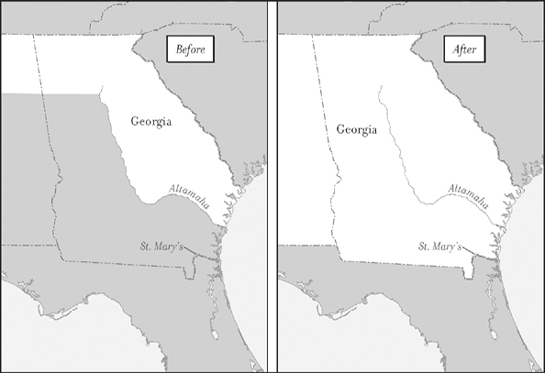
War of Jenkins’s Ear: Georgia before and after
The larger war, however, was not as successful. England suffered a massive defeat in its campaign against the Colombian port of Cartagena. The war ended soon after, as did the career of Robert Walpole. All in all, little had changed as a result of the war—except for the Georgia border.
As for Robert Jenkins, he returned to work and obscurity. For a time he administered affairs for the British East India Company on the small island of St. Helena, midway between Africa and South America, then resumed his career at sea.