
CHAPTER 16
IGROW OLD, I grow old / I shall wear the bottoms of my trousers rolled’, as T.S. Eliot wrote in ‘The Love Song of J. Alfred Prufrock’, his musings on the human condition. We all grow old. Nearly all life on Earth grows old and dies. I say nearly all. Organisms like bacteria and yeast, which mainly live as single cells on their own, just divide and keep dividing, although there is some evidence that once they have undergone 40 or so budding events, a yeast cell doesn’t divide any more, which means death1.
That is a bit like us. Our cells keep dividing and then eventually stop. Cells in your gut, for instance, are replaced every two to four days2. But eventually you die. You might die in an accident, although even then your cells keep dividing in your bloodstream until they run out of food. Most of us die of diseases, and as we saw in the previous chapter many of us die of diseases of ageing. Our bodies eventually pack in, and perhaps an infection that we would normally fight kills us, or our hearts or brains eventually run down in a process called senescence. If you don’t die an accidental death, or of some disease that strikes at any age like cancer, your body will age and die. We will look at death more closely in the next chapter. But what exactly is ageing?
We can start by looking at lifespan. The longest a human being has ever lived (that we know of) is Jeanne Calment of France (1875–1997), who lived to the age of 122 years, 164 days. Quite what her longevity was due to we don’t know. She herself said: ‘Always keep a smile. I attribute my long life to that. I believe I will die laughing. That’s part of my program.’ This is likely to be close to the absolute limit for humans. When we look at other creatures we see some striking results. Mice live an average of three years, cats for 12 years and dogs for up to 13 years. There is no accepted rhyme or reason to this. It was thought to be due to size – the bigger you are, the longer you live.
The creature on Earth thought to hold the record for having the longest lifespan is a type of creature called hydra, which is a small freshwater animal with tentacles; it can live for 1,400 years. In Ireland we can expect to live about 81.4 years on average (79.4 for males, 83.4 for females)3. We don’t actually do too badly in Ireland compared to other countries. Japan tops the league table at 83.7 years. Ireland is number 19, just ahead of the UK, whose citizens have an average lifespan of 81.2 years. Sierra Leone isn’t doing too well, with an average life span of 50.1 years, which is caused in part by diseases such as AIDS.

JEANNE CALMENT HAS THE LONGEST CONFIRMED HUMAN LIFESPAN, LIVING TO THE AGE OF 122 YEARS AND 164 DAYS.
What determines how long a creature (including possibly us) lives might come down to number of heartbeats4. On average, humans have 2.21 billion heartbeats in their lifetime. Cats have 1.18 billion. The number of heartbeats has been shown to directly correlate with the number of years each organism lives. If you put the water flea Daphnia in a warmer environment, its heart rate goes up by 412 per cent, and it dies 77 per cent sooner. The number of heartbeats, though, stays the same, at 15,400,000. There are caveats, however, and ageing experts see it as a very rough rule of thumb. Birds and bats have much higher numbers of heartbeats than would be expected for their lifespan. However, the number of heartbeats in each species does seem to be finite. This kind of thing led astronaut Neil Armstrong to quip: ‘I believe every human has a finite number of heartbeats. I don’t intend to waste any of mine.’ It also might mean that if you exercise and increase your number of heartbeats per minute, it might actually shorten your life – which gives me the perfect justification to avoid exercise.

THE SEA CREATURE HYDRA CAN LIVE FOR 1,400 YEARS.
When it comes to the level of individual cells in your body, they divide a finite number of times and then stop. This was first studied in detail by a scientist named Leonard Hayflick, and the finite number of cell divisions for a given cell type is termed the ‘Hayflick limit’5. This is the number of times each cell type can divide before it senesces. For foetal cells this is up to 60 times. Some cells never divide – they are known as end cells. The best example is neurons in your brain. This is why when you have a brain injury repair is defective because of the inherent reluctance of neurons to divide.
How does a cell know when it has reached its Hayflick limit? A striking discovery was made by Elizabeth Blackburn, Carol Greider and Jack Szostak, who noticed that at the end of our chromosomes there are repeats of nucleotides6. Remember, our chromosomes are made of DNA, which in turn is made of lots of nucleotides on a very long string, or in our case 23 pairs of strings, which make up our 23 chromosomes. Blackburn and colleagues noticed that there were lots of the same nucleotides at the ends of chromosomes – somewhat like lots of yellow coloured balls strung out at the end of a string of beads. These are called telomeres. They won the Nobel Prize for Physiology or Medicine in 2009 for this discovery.
Every time a cell divides, they are slightly shorter: the chromosome loses some beads. Finally they are so short that the cell senses this and stops dividing. It’s like a counting mechanism in cells. Cancer cells, however, have the key feature of being immortal. They will keep on dividing and dividing, and will form a tumour (the name of which comes from the Latin for ‘swollen’ – like a lump). This is because they keep adding beads back on. The enzyme that does this is called telomerase, and is an interesting target being explored as a way to stop cancer cells from growing.
Quite how the Hayflick limit or telomere length relates to your final number being up (as in death) isn’t known, but scientists feel there must be a connection. This is because eventually all the cells stop dividing and you die. It might be to do with stem cells. These cells are the ones that keep replenishing tissues as you age. They become, say, a gut cell, then undergo their number of divisions set by Hayflick and then die. When they stop getting replaced, that is a sign of ageing.
Attempts to further explain the mechanism of how we age have focused on two aspects. First, as with most things, variants in certain genes plays a role. We know this anecdotally, where longevity seems to run in families. There has been a problem pinpointing exactly what genes might be involved, however, as the second aspect, environmental factors, can play a confounding role. Your mother might bring you up in a certain way based on what she learnt from her own mother, and as a result both she and you live to a ripe old age.
But when it comes to the environment, one factor seems to play an especially important role, and that is what we eat. When you eat food, your body breaks it down and uses the products to help build more of you, and also to generate a molecule called ATP, which is the energy currency of all life. It is the battery that you use to fuel all the things in your body that need energy, be it muscle power, or blood flow or copying your DNA when a cell divides. There is a by-product from the production of ATP, though – a bit like the exhaust coming from a car engine when petrol is used.
That by-product is called ‘reactive oxygen species’, or ROS, and in the context of ageing it comes largely from mitochondria, the structures inside our cells that make ATP from food7. It’s a highly reactive chemical (in fact bleach has a lot of ROS in it), and our bodies have ways to keep it under control. We make in our own cells, or take in as part of our diet, chemicals called antioxidants, which mop it up. But ROS is able to ‘rust’ our DNA – similar to air causing iron to rust. This damages the DNA in the long run, and some scientists are of the view that it is the rusting of DNA, meaning its gradual disintegration, that lies at the heart of ageing, although there are disagreements concerning this mechanism of ageing.
Gene variants that seem to promote old age make proteins that are good at detoxifying ROS, adding weight to the idea that it is what you eat that eventually kills you. These proteins act as supercharged antioxidants. It might be possible to counteract the damaging effect of ROS by eating certain foodstuffs rich in antioxidants, such as blueberries and broccoli8. There’s not much we can do about food ultimately killing us, except not becoming obese and eating sparingly. In studies of people who have lived to be over 100, the main thing they shared was that they generally had small meals and they weren’t obese.
Other studies have shown that if you exercise in your 50s you can prolong your life by 2.5 years. Marriage also promotes longevity by as much as seven years, probably because overall it decreases stress9. Getting divorced shortens life by three years on average. It’s easy to see the health benefits of marriage. Your spouse provides support and often encourages you to develop good habits. However, there can be difficulties with cause and effect here. There is evidence that marriage enhances people’s inherent higher odds of living a longer healthy life, whereas people with negative traits such as emotional instability already have lower odds of living a healthy life and are more prone to divorce. For some people, escaping a doomed marriage may provide a new lease of life, meaning that it will be longer and happier.
Work in animals has supported the idea of food being linked to ageing, especially studies in a microscopic worm called the nematode10. These creatures live on rotting mushrooms but people who study ageing love them. They live for a few weeks and so it’s easy to see if they are living short or long lives. They are made of 1,096 cells in total (unlike our bodies, which have billions of cells), and these cells can all be followed. When I worked in Cambridge I met a scientist called John Sulston, and I asked him what he worked on. He told me he spent eight hours a day looking down a microscope counting and following the cells in a worm. I thought ‘WTF?’ He went on to win the Nobel Prize in 2002 for this ground-breaking work which provided huge insights into how cells live and die. It’s also easy to manipulate genes in nematodes and see what happens. When scientists mutated certain genes involved in nutrition in these little creatures, they extended their lives two-fold.
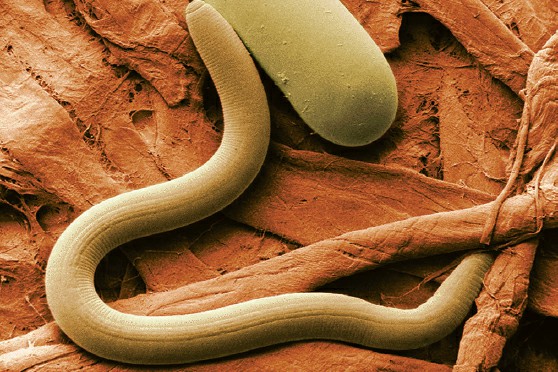
THE MICROSCOPIC WORM THE NEMATODE CAN BE MODIFIED TO LIVE TO FOUR TIMES ITS NORMAL LIFE SPAN. THE GENES THAT ARE MODIFIED ARE INVOLVED IN NUTRITION.
If that translated to humans, we would live to be over 200. The worms with the modified genes that prolonged their lives were most likely digesting their food more effectively – on a ‘lean burn’ mode in a sense, generating less ROS, and so less damage to DNA was occurring. We also have evidence in humans that DNA damage drives ageing. There is a disease called Werner’s syndrome, or progeria, where people age much faster. People with this condition have a mutation in a gene for an enzyme that can repair damaged DNA, and so in these people, that damage builds up and promotes ageing. The normal enzyme repairs the damage to the DNA being caused by ROS, the by-product of nutrition.
So can we live longer if we watch what we eat? Well, that indeed is what the evidence seems to tell us. Overeating is bad. Certain diets seem especially good, notably the so-called Mediterranean diet, which consists of lots of fruit and vegetables, olive oil and seafood. Some exercise is also good but not too much. If you exercise hard you will generate more ROS. Light exercise gets the body to make chemicals that are beneficial in all kinds of ways, including for repairing damaged tissue.
To get to the bottom of some of these things scientists often study populations where the people live much longer than the average. In the remote Italian town of Acciaroli11, which was thought to have inspired Ernest Hemmingway’s novel The Old Man and the Sea, around 300 people have lived to be 100 or more. These villagers are now being tormented by scientists trying to find out why, and may well have their lives shortened by all the attention. What is it about these people? They have very low rates of heart disease and Alzheimer’s disease, both of which are diseases of ageing. The villagers have a classic Mediterranean diet, with lots of fish, olive oil and herbs such as rosemary. A natural chemical called carnosic acid occurs in rosemary, and this has been shown to improve memory in older people, and limit the damaging effects of ROS. The villagers also exercise more than average, living in a hilly region where they hike and hill walk as part of their day-to-day lives. As we have heard from time immemorial, the secret therefore seems to be to eat healthily and to take exercise. As the proverb says: ‘You eat your own grave.’

THE ITALIAN TOWN OF ACCIAROLI HAS A REMARKABLE NUMBER OF CENTENARIANS. THEIR SECRET? LOTS OF EXERCISE AND EATING THE RIGHT DIET.
Another interesting theory of ageing concerns the inflammatory process. As we saw in the last chapter, inflammation is an important part of our body’s defences. If you have an infection, or if you sprain your ankle, inflammation is triggered, which means redness, soreness, swelling and the injured area becoming warm. The purpose of this is to repair the damage – most of these events are due to blood rushing in to bring in the immune system to defend us from the infection, but also to rebuild damaged tissue. This is a highly elaborate process that heals the body. However, it can go awry in a whole range of diseases, from arthritis (which is inflammation of the joints) to colitis (inflammation of the gut) to diseases that afflict the brain including multiple sclerosis and Alzheimer’s disease.
There is a major effort to understand this process in order to devise new therapies for these very troubling diseases. Several of these diseases are diseases of ageing, and it is thought that the ageing process plays a role in their development. This gives rise to the term ‘inflammaging’, meaning inflammation as we age. ROS will provoke inflammation too. It is therefore possible that anti-inflammatory agents will limit ageing, and in fact a drug called rapamycin has been shown to do just that. This anti-inflammatory (among other things) drug extended life in mice by 20 per cent, which would mean an average extension to 96 years for humans12.
It has also been shown that the hypothalamus in the brain is key to ageing because of an inflammatory factor there called NF-kappaB13. When this was blocked mice again lived 20 per cent longer. There is also a key driver of inflammation in macrophages in our blood called NLRP3 (see Chapter 15 for its role in disease), which is able to sense the build-up of damage as we age (say in the form of cholesterol in our blood vessels). Limiting NLRP3 in mice has been shown to slow down the ageing process14. Mice lacking it had fewer cataracts in their eyes, and less bone weakening. These results are remarkable, and bring us closer to new options for limiting the diseases of ageing.
There is a possibility that each country will find itself turning Japanese. By which I mean an ageing healthy population will be the norm. What has happened there has been remarkable. In 1950, 5 per cent of the Japanese population were over 65. This figure is now 50 per cent. There is a birth rate of 1.4 births per woman, which means the Japanese population is not replacing itself15. The Japanese are the first country where the sale of adult diapers has exceeded that of baby diapers. Playgrounds are being converted into exercise areas for the elderly. The reason for the longevity again appears to involve diet. The Japanese eat a lot of seafood and drink a lot fewer sugary drinks compared to Westerners. In Japan, obese people are a rarity, sumo wrestlers notwithstanding.
Given all this research the question is, Will we eventually discover the elixir of youth? We may be taking elixirs already, as drugs as common as low-dose aspirin (given to decrease the risk of heart attacks by thinning the blood) or metformin (which is used for type 2 diabetes) appear to prolong life somewhat16, again most likely because they have anti-inflammatory properties. Metformin is in fact a fascinating drug. It was first synthesised in Trinity College Dublin by Emil Werner and James Bell, who made a derivative of a herbal agent from goat’s rue, which had been used since antiquity for type 2 diabetes. This is a disease where your blood sugar stays high after a meal because of insulin insensitivity. In a study of 180,000 people in the UK there was a 15 per cent extension in lifespan for people on metformin. If we can find out exactly what it does, an even better form of metformin might emerge. We know again that it’s tied into nutrition, as it can keep blood sugar low, and we also know that it has anti-inflammatory properties.
Another unlikely elixir that might prolong life is young blood17. In a rather unusual yet striking series of experiments, investigators noticed that if an old mouse was transfused with a young mouse’s blood, the old mouse became healthier, his eyes cleared and his joints became more supple. The young blood had in fact rejuvenated the old mouse. This sounds a bit like Dracula feasting on the blood of the young. A factor called GDF11 is higher in young blood and declines as we age. When this factor was used in mice it had a similar effect. Quite how it works isn’t clear but maybe it is the long-sought-for elixir – or maybe not, as there have been false dawns in this regard in the past.

YOUNG BLOOD HAS BEEN SHOWN TO SLOW AGEING WHEN INJECTED INTO OLD MICE. DOES THIS EXPLAIN IMMORTALITY IN VAMPIRES?
Will all this research be worthwhile? It is still a fascinating philosophical question, why we age – and, as we’ll see in the next chapter, why and how we die. If we do find drugs to help us, it’s unlikely that they will let us live beyond a certain finite span, which is probably around 120 years, unless we come up with ways to keep replacing our organs by growing them from stem cells in a dish and replacing our worn-out parts as we age. Instead we’ll slow down the depredations of ageing, by limiting the disintegration that happens because of inflammaging. This should also include a lower incidence of dementia as we get older, since the ageing brain is more prone to diseases such as Alzheimer’s disease. If we can somehow protect our brains by, say, keeping our minds active (which might bring benefits by increasing connections between brain cells, which in turn might mean that although people lose connections as they age they will have spare capacity), we will stave off dementia.
But maybe ageing isn’t all bad. One thing that a series of studies has shown is that we peak at different things at different ages18. When you look back on your life, will you say that you loved being 24 or 47 or maybe 75? Scientists have been studying a wide range of both physical and mental traits to determine at what age we peak for each of them, and there have been some very interesting results. You are best able to learn a second language when you are seven or eight years of age. That seems to be when the mind is at its most receptive, probably because it’s when we listen to the advice of our parents most acutely; otherwise we might get hurt in an accident, for example.
Mind you, it’s also the age when we are highly susceptible to information, as the Jesuits spotted when they said ‘Give me the boy at seven, and I will give you the man.’ Try to learn a second language past 30 and it’s much more difficult. Your brain-processing power, on the other hand (e.g. your ability to decode information and retain long strings of numbers), peaks at 18. This is good for when you are in university – your brain is most ready for the complexities of your degree. Your ability to remember unfamiliar names peaks at 22. This is possibly because you are now out in the wild, and you don’t want to go offending the chief of another tribe by forgetting his name. Your status anxiety is therefore at its peak.
Men find women most attractive when the woman is 22. Women on the other hand tend to find men who are a year or two older than they are more attractive. (This could be nonsense as it was based on OKCupid’s data pool, which may be unreliable overall, as the people on that dating site may not be the same as the general population.) Your muscle strength will peak at age 25. You will run your best marathon at age 28. And your bone mass will peak at age 30, because that is when you can retain the most calcium in your bones. If you are a chess player, you will peak at age 31. That finding came from a study of 96 grand masters.
According to a study of 10,000 people (which is a large number and therefore probably gave correct results), one’s ability to understand someone else’s emotional state peaks in your 40s and 50s. And then it gets better as you get older for certain things – your ability in arithmetic peaks at age 50, your vocabulary in your late 60s (so wait until then before you write your magnum opus). You feel much more comfortable in your own body in your 70s and, finally, and we all know this, you are at your wisest when you are over 70. This was a test where people were asked to judge someone else’s point of view, consider possible outcomes in a given scenario and the ability to search for compromise. So it really is true that wisdom comes with age.
One striking result from several studies is that life satisfaction peaks at two ages: 23 and 69. This is the famous U-shaped curve, where you are happiest at 23 and then your happiness plummets, bottoming out at 50, and then climbing back up to peak again at 6919. This is independent of whether you have children or whether you are single or maybe even whether you support the Irish football team. It seems to be built into us for some unknown reason. Crucially, after 70 we rate our lives as being at least a seven out of ten. When we’re younger we rate it lower. So, if you’re feeling miserable with your life, wait. As a wise old man once said: ‘At age 20 we worry about what others think of us. At age 40 we don’t care what they think of us. And at age 60 we discover they haven’t been thinking of us at all.’ So it’s well worth hanging on in there and ageing gracefully (and hopefully healthily), as things will only get better.