
CHAPTER 2
AS YOU SIT THERE reading this sentence you are living in a body and with a mind very similar to an ancestor that lived some 200,000 years ago. Our species, Homo sapiens sapiens (or ‘wise wise human’ – so wise they named us twice), then lived on the plains of Africa with no smartphones, no obesity, no nuclear weapons, no spaceships or large hadron colliders and no knowledge of DNA. If we took someone from that time to today, we could, with education, make them exactly like you and be well capable of all the things you can do. We could turn them into airline pilots or doctors or politicians. All that’s happened since then is that we’ve used the cleverness that we evolved way back then in all kinds of interesting ways1.
To begin with, we used our special intelligence to anticipate drought, protect our children from dangers, work together to kill a large animal, try to deal with the death of a loved one, and figure out where we were in the pecking order with our fellow tribe members. The key scientific question is: How did we evolve from an ancestral ape akin to a chimpanzee, who couldn’t do lots of the things I’ve listed (or at least not as well as we can) into us?
Of course if you’re a scientologist you might believe that the alien Xenu brought humans to Earth 75 million years ago and put us in volcanoes to emerge later. But science tells us the ancestor of modern humans arose in Africa at least 200,000 years ago and came to Europe 45,000 years ago, and finally to Ireland around 10,000 years ago. How did a species that would have been classified as a third species of chimp (the other two being chimpanzees themselves and the bonobo – the most closely related apes to us) some time before 200,000 years ago, go beyond their ape identity and become us? From bonobo to Bono in 200,000 years.
As ever with this kind of question we must start with DNA. Remember, DNA is the recipe to make all living things. It provides the instructions to make proteins, the grunts of every cell in your body that do all the heavy lifting, from digesting food to making your brain work to defending you from infection. This recipe is written in a chemical code that is made up of building blocks called nucleotides. These are akin to very tiny beads on a string, each nucleotide being a different bead. Somewhat mercifully, there are only four nucleotides, which go by their letter: A, T, C and G. These are strung together to make up your chromosomes – the structures that contain DNA.

WITH JAMES WATSON OUTSIDE THE EAGLE PUB, WHERE HE AND FRANCES CRICK ANNOUNCED THEY HAD DISCOVERED THE SECRET OF LIFE IN 1953.
Incredibly, the total number of beads strung out along the chromosomes in you is 3 billion. That’s an awful lot of beads, and an awful lot of threading, and yet it’s real. But it’s even more wonderful, because DNA is actually made of two separate strings that wrap around each other, twisting into the iconic double helix. This arrangement makes it stable, a bit like a ladder, though twisted around its centre. When Watson and Crick first inferred that 3D shape, from a picture taken of DNA by Rosalind Franklin using something called X-ray crystallography, they couldn’t believe it. Watson said they ran to their local pub (The Eagle in Cambridge) that lunchtime and exclaimed ‘We’ve found the secret of life!’ Why did they exclaim that? Well, if we look at the two strings that wrap around one another we see something quite remarkable. We see that if there is an A bead on one string, it is always pairs with a T bead on the other. They click together a bit like Lego blocks. If there is a C bead on one string there is always a G bead on the other string. These are a bit like the rungs on the ladder that connect the two sides.

AN X-RAY DIFFRACTION IMAGE OF CRYSTALLISED DNA WHICH WAS TAKEN BY RAYMOND GOSLING, A PHD STUDENT WORKING UNDER THE SUPERVISION OF ROSALIND FRANKLIN AT KING’S COLLEGE LONDON. THIS IMAGE LED TO THE ELUCIDATION OF THE DOUBLE HELICAL STRUCTURE OF DNA, CREATING MODERN MOLECULAR BIOLOGY.

ROSALIND FRANKLIN, INSTRUMENTAL IN DISCOVERING THE MOLECULAR STRUCTURE OF DNA.
This suggested to Crick that the way we pass on information to make a new cell involves the two strings unravelling from each other and then a new string being made one bead at a time, each bead clicking into place by bonding with its corresponding bead on the single string. This process is termed DNA replication. Two strands link together into a double helix, then separate when a cell divides. Each separate strand then gets copied – A bringing in T and C bringing in G – to form a new double helix. In a moment they had found the secret of life – how information is passed on to the next generation. The rule of A clicking into T and G clicking into C applies in all forms of life on Earth, and initially arose in the first cell, from which all other cells are descended.

DNA REPLICATION: TWO STRANDS LINK TOGETHER INTO A DOUBLE HELIX, THEN SEPARATE WHEN A CELL DIVIDES. EACH SEPARATE STRAND THEN GETS COPIED – A BRINGING IN T AND C BRINGING IN G – TO FORM A NEW DOUBLE HELIX.
Now once you have the sequence of the beads on the string – the DNA sequence that tells us the order of the A, T, C and G – you have the recipe for life. The sequence instructs the cell to make proteins in a very complex process called translation. Runs of nucleotides make specific proteins – we call these runs genes. The proteins then make you the living creature that you are. The proteins might give you horns on your head or determine whether you’re hairy or make you tall or short.
We can therefore compare different species for how similar they are to each other in terms of their DNA sequence. An Irish molecular biologist called Des Higgins and colleagues came up with a computer program to do just that: to align DNA sequences and compare how similar they are2. His publication on this is the world’s most cited paper in computer science, which means it has been referred to by more scientists than any other publication in that field – no mean feat. It turns out that half of the beads on the string from a banana are in roughly the same sequence as half of the beads on the string from a human. We share half our recipe with bananas. Sadly some of my friends are probably slightly more banana than human. This makes overall sense as bananas have many of the same features we do: they have cells broadly made of the same things, and use similar enzymes to do lots of ‘housekeeping’, like taking out the trash or extracting energy from food.
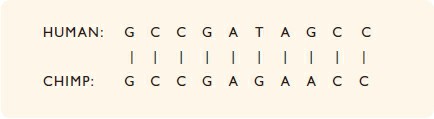
When we compare ourselves to chimpanzees and bonobos, we are around 95 per cent identical in our DNA recipe, confirming our close shared ancestry3. We had a common ancestor some 2 million years ago, a creature that looked a lot like a chimpanzee. It had offspring and one of those became our ancestor and another became the ancestor of chimps or bonobos4. Gradually over time, a 5 per cent difference in the DNA sequence became apparent. The trouble is we don’t know what is in that 5 per cent that makes us smartphone-using creatures and the chimp not. It might be a recipe for a special brain protein that makes our neurons work better. It might be a recipe to make our vocal cords better at speaking and for a wiring protein in the brain that allows us to process sounds better. We just don’t know.
An interesting experiment (which could actually be done today because of a gene-editing technique called CRISPR) would be to replace the 5 per cent of DNA in a chimp with the 5 per cent of our DNA and see what happens. Would we make a human? Probably not, as what is also important is the amount of ingredients specified by the recipe (which is also built into the DNA sequence), not just the name of the ingredients, and that is also different between chimps and humans. If you make two cakes from the same recipe but put in different amounts of flour, you will end up with two cakes but they will be slightly different, a bit like how we are broadly like chimps but with clear differences. But still, it might give interesting insights. That 5 per cent difference is certainly a part of what makes us human.
It’s easier to describe the actual differences between us and chimps. This is the work of anthropologists, who have studied other apes and compared their behaviour and abilities to ours. What is thought to have happened is that a trait called inventiveness arose in us humans, or at least we became much more inventive than chimps. We began to use tools in all kinds of interesting ways. We also used this inventiveness and capacity for observing and learning to make fire, which gave us a huge advantage, as we could use it to cook food. Cooking means partial digestion, which means more efficient extraction of energy from the food. It was also a way to preserve food (e.g. by smoking it), which would have been useful in times of food scarcity. A human who could do these things was more likely to survive and pass on that trait to his or her offspring, and that trait would then begin to dominate5.
We also learnt to make elaborate tools for cutting or killing animals or defending ourselves. At some point we began to walk upright, and again that gave us an advantage, as it freed our hands to do other things, such as hunt efficiently, and allowed us to observe our environment more effectively6. We also became very social. Again this provided advantages (as it does in other organisms), but in our case it meant we had to figure out where we stood in the pecking order. We became status obsessed, because to get this wrong could be lethal. If you think you’re the alpha male or female and you’re not, the true alpha might kill you or harm you or exclude you. Equally, you had to lord it over a lesser mortal to get more resources. And so status anxiety became a feature which afflicts us to this very day, and explains much of our behaviour, from the type of car we drive to where we live and to the clothes we wear.
All of this happened on the savannahs of Africa. We then begin to move around, most likely in search of food or other resources. We evolve a hungry heart and a curiosity which drives us to move on in search of adventure. This trait of curiosity is why we eventually become so successful and dominant as a species on Earth. It’s why we become scientists. And our inventiveness allows us to use what science discovers to make things that are useful to us, be it to provide power beyond muscle power to make machines to help us, or to find new medicines to treat diseases that ail us. The curiosity probably evolved to make sure we would move to a new place if resources became scarce, or perhaps to help us find a mate and pass on our DNA. Or it could be a consequence of our ability to anticipate what might happen next and to be curious about that, which would give a clear survival advantage.
Other animals display these traits too, but not to the same extent. Other animals will use tools elaborately, but nowhere near as elaborately as us. Chimpanzees, for example, will strip a twig of its leaves and use it as a tool to catch insects. They also use twigs to fish honey from beehives or to extract marrow from the bones of animals they have caught. Or they use bunches of leaves to soak up water for drinking. Gorillas use walking sticks to help them cross deep rivers. So we’re not alone in using tools – it’s just that we have taken their use to a much higher level, giving us a killer advantage over other species.
We’re so clever that we eventually learn to paint pictures on cave walls. This may have first been a way to pass information on to others (‘hunt these animals’) but it was also the beginning of art, which is a way to express ourselves and give us satisfaction. Our smartness might have had artistic ability as a by-product. We paint the animals we hunt. We must see them and then notice that we can put marks on a wall that resemble them and perhaps that makes us feel we can control them. Or perhaps it just made us smile, our smart brains enjoying the pleasure of it.
We certainly begin to wonder about death. We see our children die, or friends die in a fight, or our old relative dies and we don’t like it because we are so attached to them. Other animals grieve when a loved one dies. A male gorilla will wail beside the dead body of his mate. Dolphins will make keening noises after losing a baby dolphin. But we go one step further. We carefully look after our dead, probably for reasons of hygiene, but also because death disturbs us, and we try to control it somehow. Again, this might be a by-product of us being smart.
So the two traits that emerge that begin to define us – artistic activities and ritualistic burial of our dead – become evident. No other animal is as artistic as us, spending as much time as we do in creating or appreciating art. And no other animal goes to the trouble that we do to look after our dead loved ones, burying them with such ritual, marking where we bury them and visiting where their remains lie.
We take these traits with us as we move around the world. This begins around 90,000 years ago. We begin to get restless and we start to move out of Africa7. The evidence of this is very compelling, based on the dating of fossils from human bones. Maybe it happened because of overcrowding. Maybe it happened because of an accident – a tribe wandered over into the Middle East and couldn’t get back. Evidence suggests that only a small number of our ancestors made this journey, and that all Europeans, Asians and Americans are descended from this intrepid group. And when we leave Africa, two interesting things happen. We move into a part of the world where plants are easy to grow: the so-called Fertile Crescent in the Middle East. We notice this initially perhaps when we drop seeds from a plant and see that the same plant grows there. And so we discover agriculture.

OUT OF AFRICA. MODERN HUMANS AROSE IN AFRICA AND THEN MOVED AROUND THE WORLD. THEY WENT TO ASIA WHERE THEY MET AND INTERBRED WITH DENISOVANS, THEN MOVED ON TO AUSTRALIA AND ALSO THE USA. THEY MOVED INTO EUROPE, WHERE THEY MET AND INTERBRED WITH NEANDERTHALS.
Some scientists see this as a big mistake, as the invention of agriculture may have given rise to misery8. Misery in the form of a job that is hard physical work. Misery in the form having to get up early the next morning to work in the field for ‘The Man’. We suddenly (about 10,000 years ago) go from being hunter-gatherers to being farmers. This also means having to live in bigger communities. We build the first towns and villages. And we get sick from infectious diseases, as bacteria and viruses spread more readily between our tired bodies and perhaps jump into us from the animals we have domesticated. They live happily in these animals and don’t make them sick, but in us they wreak havoc.
Society also becomes more unequal. A more pronounced hierarchy is established – the haves (who might be slightly smarter such that they own the land or control the seeds) and the have-nots (who must work for them). An unequal society begins to emerge which we continue to endure to this very day. It may well be that when we start to cultivate crops and breed animals, instead of this being the Garden of Eden, we actually create a living hell for the masses. This is difficult to say for sure, as we don’t have enough information on what life was actually like for humans before agriculture. For most of human history, however, a tiny minority have had a great life controlling and abusing the mass of humanity. Socialism changed this to some extent, but we still live in a very unequal world.
Today’s equivalent is perhaps the masses working for Google or Facebook. The founders of these companies are ultra-rich, while all the workers earn a tiny multiple of their wealth. They won’t revolt as long as they have what the Romans called bread and circuses (takeaway food and Netflix?), but we can’t help but wonder that the reason for the opioid crisis in the USA, or why people binge drink at the weekend is because we should really be living free on the savannahs of Africa. Hard to know, because there are many reasons why people use drugs or alcohol, which include to ease anxiety, alleviate boredom or relieve stress. But perhaps if we were freer in our lives, living in an environment for which our evolution optimised us (as may have been the case before agriculture), we would need less chemical support.
The move out of Africa also leads to an encounter with a distant cousin: Neanderthals, in Europe some 40,000 years ago. They are another species of Homo, with whom we shared an ancestor about 600,000 years ago. Some of the descendants of that ancestor became us – the clever cousin who got 630 points in his Leaving Cert (or whatever the equivalent might have been all those years ago). The Neanderthals didn’t do quite so well in terms of brain power (although recent work is challenging this notion), but they nonetheless thrived. At one point, scientists think there were as many as a million of them living in Europe. And then they encounter us, and within about 5,000 years they die out9. We probably wipe them out because we outsmart them, pushing them to the margins of Europe where they can’t survive. Or maybe we gave them a nasty germ which they couldn’t fight. Or we might simply have swamped them rather than slaughtered them, as our population grew.
A debate has raged for some time over whether we had sex with them. This seemed unlikely – it would almost be like having sex with a chimpanzee. But then the DNA evidence told us that we did10. Some of the genes we carry actually came from Neanderthals. There may have been numerous sexual encounters over time. Recent evidence also suggests that there might have been sex even earlier, with small amounts of Homo sapiens DNA being found in Neanderthal DNA. Whatever happened, we are all descended from the offspring of our matings with Neanderthals – the classic knuckle-dragging cavemen of movies, with their thick foreheads, and with limited evidence that they were in any way artistic like us or that they buried their dead. Evidence for these things may well still be uncovered, however, so we can’t be certain. What we can be certain about is that humans and Neanderthals were very close neighbours indeed. We now know that around 1.8 per cent of our DNA came from Neanderthals. Some of my friends may have slightly more …
One of the genes (called BCN2) is a recipe for pale skin pigmentation. This means that Europeans owe their pale skin partly to Neanderthals (we were dark-skinned when we came out of Africa). The pale skin is likely to have given us an advantage in the northern hemisphere, where the sun is weaker. Our skin makes Vitamin D in response to sunlight, which is important for the health of our bones, among other things, and pale skin allows for maximum penetration of sunlight. So Neanderthal DNA might have helped us adapt to life outside Africa.
Not all of the Neanderthal DNA is beneficial, though. Some of it makes us more susceptible to certain diseases, such as type 2 diabetes and Crohn’s disease, an inflammatory disease of the digestive system. Our lifestyle may have been different from that of the Neanderthals (for example our diet), and this, combined with these Neanderthal genes, might put us at more of a risk of these diseases, although we don’t know.
Another interesting gene we got from Neanderthals makes us more likely to be addicted to nicotine. A gene associated with the inability to stop smoking from Neanderthals is a surprise. The scientists who found this are not of course suggesting that our evolutionary cousins were puffing away in their caves. This gene must have some other function, perhaps involving a craving for a foodstuff key to survival. Genes for keratin filaments – a fibrous protein that lends toughness to skin, hair and nails, also came from Neanderthals. This may have provided us with thicker insulation against the cold.
One gene that we have that they didn’t is called FOXP2. This is a very interesting gene, as scientists think it provides us with the ability to make elaborate vocal sounds, making us much more linguistically versatile. When this gene was put into a mouse, the mouse could make all kinds of guttural noises that it was unable to make without it. Effectively the scientists had made a mouse that roared, although its brain was no different, so it couldn’t understand what it was saying. This must have given rise to a very puzzled mouse, making noises it couldn’t understand. As Neanderthals lacked this gene, their vocal repertoire was likely to be more limited. No wonder we often depict them as the strong, silent type.
Finally, we also got from Neanderthals genes that boosted our immune systems. Neanderthals probably evolved these genes to survive the harsher conditions in Europe, where injury may have been more common (possibly because of violence between Neanderthals, although we don’t know) and therefore infection more likely. Neanderthals with stronger immune systems survived, and passed those genes on to us.

COLUMBUS ENCOUNTERS NATIVE AMERICANS, A FAMILY REUNITED AFTER 40,000 YEARS.
We have, then, a picture of a post-coital hairy guy smoking a cigarette, who is an excellent conversationalist and whose immune system can fight off any germs he may have picked up during sex. That, my friends, is our ancestor. No wonder he outbred his more crude Neanderthal cousins.
If we move outside Europe to Asia, we find evidence that there was interbreeding with another Homo species, called Denisovans. These were closely related to Neanderthals (and us). Evidence suggests that Denisovans interbred with Homo sapiens too, and passed on genes which can be seen in Melanesians (who live in Papua New Guinea) and indigenous Australians11. The latter deserve a special mention, as they reached Australia around 65,000 years ago, long before their brothers and sisters went into Europe. They are like the family member who goes travelling, leaving the family behind, and the descendants of the family finally leave home after another 5,000 years and go to Europe. Then, many thousands of years later, in 1770, the long-lost descendants of this family are finally reunited when Captain Cook lands in Australia. This family reunion, however, doesn’t go so well for the Aborigine cousins, who should have hidden behind the sofa when the relatives came knocking on the door. They are still paying the price of this reunion.
Our current view of these three branches of Homo are therefore that they are all descended from a species that lived between 300,000 and 400,000 years ago in Africa. One branch move into the Middle East and then split, with some of their descendants becoming Neanderthals who move into Europe and another branch becoming Denisovans who move into Asia. By 130,000 years ago, those who stayed in Africa eventually evolve into us – Homo sapiens. Some 75,000 years ago we ourselves move and go to Europe and Australasia, but we interbreed with our long-lost cousins the Neanderthals in Europe, and the Denisovans in Asia. The Asian branch around 20,000 years ago move on to the Americas and their descendants are the Native Americans.
Finally, in 1492, there is another reunion – this time of the European branch of the family with their cousins who had travelled through Asia to the Americas12. This is a family that had been separated for at least 40,000 years. Again, this doesn’t end well for the Native Americans. The Americas, though, are perhaps the big melting pot, where all of the branches of Homo sapiens, be they those carrying a bit of Neanderthal DNA or those carrying a bag of Denisovan DNA, can mix and mingle their DNA, bringing all kinds of advantages and challenges yet to be worked out. Here’s to a future of coffee-coloured coffee drinkers by the million.
Whatever way you look at it, Homo sapiens is one big clever family sharing this planet, so stop all the fighting and try and get along with your brothers and sisters. After all, it took an awful lot of evolution, travel and sex to get to you.