
THE RAILROADS AS WE KNOW THEM were not the only form of rail transportation that was considered in the latter half of the 19th century. Indeed, before the current system became standard, tracks, cars, and engines were combined in all kinds of ways that may seem eccentric today. Some of these ideas might have been successful had they received the proper attention, but others were patently ill-considered and bound to fail.
Perhaps the most spectacular failure was the “atmospheric railway”—a brainchild of British engineer Isambard Kingdom Brunel, the otherwise unimpeachable builder of the Great Western Railway, the SS Great Britain (the first propeller-driven iron ship), and the Royal Albert Bridge. His contention was that locomotives were uneconomical because they had to haul themselves as well as their trains (which made uphill travel even harder), and his solution was to remove the engine altogether, creating a train that was propelled by a series of stationary steam engines located along the track. At the time, locomotives were far from popular—people were afraid of suffocating in tunnels and of sparks setting fire to farmland—so alternatives were welcomed, and in 1844 an Act of Parliament sanctioned Brunel’s idea. It was to be tested on the South Devon Railway, a broad-gauge line that Brunel would build from Exeter to Plymouth.
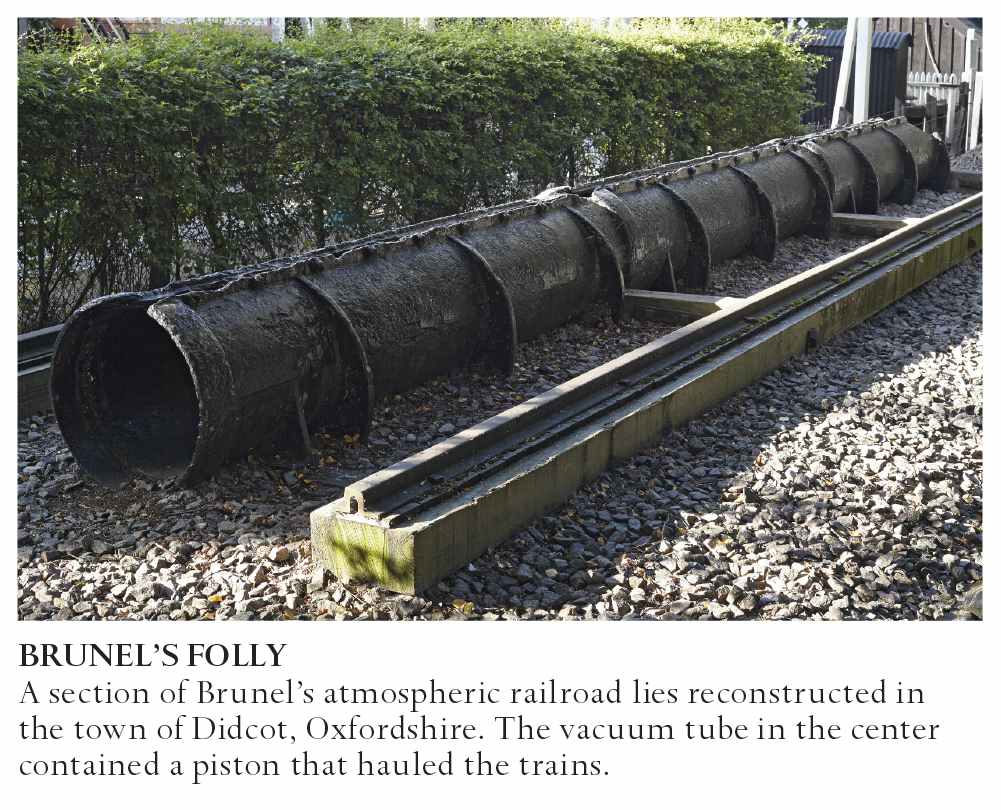
The atmospheric system worked by means of a tube that ran down the center of the track. This functioned like the cylinder of a steam engine (see Powering the Engine), having a piston inside it that was connected to the first car of the train (the “piston car”). The connecting arm of the piston traveled through a slit in the top of the tube, which was kept airtight with a long strip of leather and metal components that opened and closed as the piston passed through it. A steam engine at the side of the track created a vacuum inside the tube, which forced the piston forward, hauling the train along with it. The train then traveled some 3 miles (4.8km) until it reached a second engine, which created a new vacuum and propelled the train to the next engine, and so on. A total of 11 engine houses were completed for the line, which took it as far as Newton, about 26 miles (42km) short of the planned terminus at Plymouth—the final series of engine houses was never built.
The railroad opened in September 1847 on the 11-mile (18-km) stretch of line between Exeter and Teignmouth, and at first it seemed to work well. According to Brunel’s biographer:
the new method of traction was universally approved of. The motion of the train, relieved of the impulsive action of the locomotive, as singularly smooth and agreeable; and passengers were freed from the annoyance of coke dust and the sulfurous smell from the engine chimney.
It was also fast, with a top speed of 68mph (109kph) and an average of around half that, which were both remarkable speeds for trains of the period.
There were, however, difficulties from the outset. Setting off from a station proved to be a problem, as the train often needed a helping tow from horses or an extra engine attached to a tow rope. The system was also inflexible, as the pipework prevented the trains from being routed from one track to another. The biggest problem, however, was maintaining the vacuum itself. The leather flaps that sealed the pipe failed to be airtight, and there were rumors that they were gnawed by rats. Likewise the metallic parts of the seal were corroded by salt from sea-spray. Consequently, the atmospheric system was abandoned after a mere eight months, and the equipment replaced by conventional steam locomotives.
It was an expensive failure. The shareholders of the South Devon Railway were almost £400,000 (in modern terms, $55 million) poorer as a result, which was a huge sum at the time. Much of the money had been spent on the elaborate engine houses, which Brunel had constructed in an Italianate style, their large chimneys disguised as campaniles. Each house cost several times the price of a conventional locomotive, and they were so elegant that one, at Starcross, was later used as a chapel. Also, installing atmospheric traction had been nine times more expensive than the original estimate, and the static engines burned far more coal than expected, costing twice that of conventional traction.
Brunel’s failure was particularly painful since it happened in public, on a commercial railroad, but there were plenty of other disasters that happened in relative privacy. In 1824, for example, British inventor W.F. Snowden designed a train that eschewed the use of steam power altogether. It had a single line of wheels that ran in a U-shaped rail flanked by a pair of flat rails that kept the cars upright. To propel the train, “industrious laborers” in the lead car literally cranked a wheel that was connected to a gear that engaged with the toothed edge of one of the rails—thus providing human traction, and requiring superhuman stamina on the part of the laborers. Not surprisingly, the idea was never taken up, despite a pamphlet published in 1834 extolling its virtues. However, Snowden’s system did highlight a problem that is common to all railroads—that wheels slip in damp conditions and on inclines—a problem Snowden solved by keeping the gear locked in the track. A related idea was to have a rack and pinion (see Climbing Mountains) in the center of the railway to aid traction, and such devices are still used on mountain lines today.
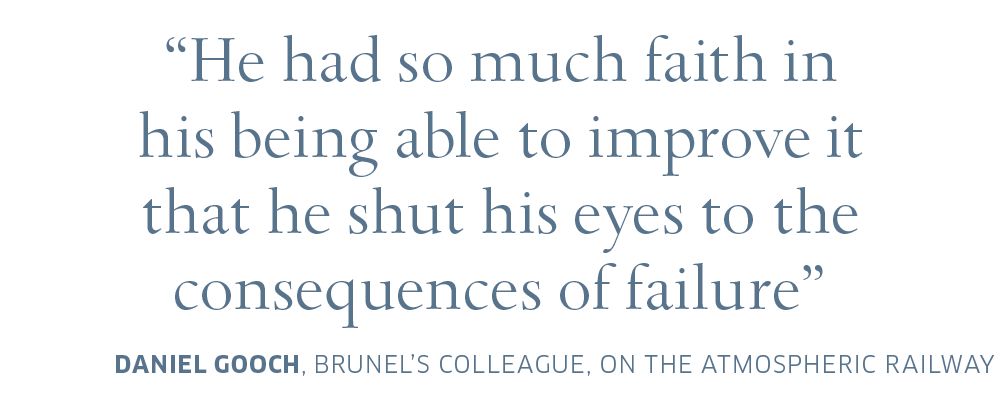
Rope or cable railroads were another attempt at solving the problem of how to haul trains. Again, as with atmospheric railroads, the idea was to have stationary engines placed along the track, but this time for hauling cables attached to the trains. On the Canterbury and Whitstable line in Britain, which opened in May 1830, trains were hauled by rope for 4 miles (6.5km) out of Canterbury and then by locomotive for the remaining two miles. Several other lines used cables to deal with inclines. Nearly two miles of the Düsseldorf–Elberfield line in Germany was cable-hauled, as was part of the Brussels–Liège line in Belgium, and the Denniston Incline on the South Island of New Zealand. The Liverpool and Manchester (see Liverpool and Manchester line) had cables for the first part of the line out of Liverpool station, as did the London and Birmingham for the incline between Euston station and Camden Town. One of London’s first railroads, the London and Blackwall, was cable-drawn for its entire 3½-mile (6-km) length. Cables were complicated to operate, however, and as locomotives became more powerful, most of these systems were phased out (although the German one remained in operation until 1927). A cable system was even proposed for the first deep subway line built on the London Underground—the City and South London line, completed in 1890—but given its length of nearly 5 miles (8km), planners decided to use the new technology of electric power instead.
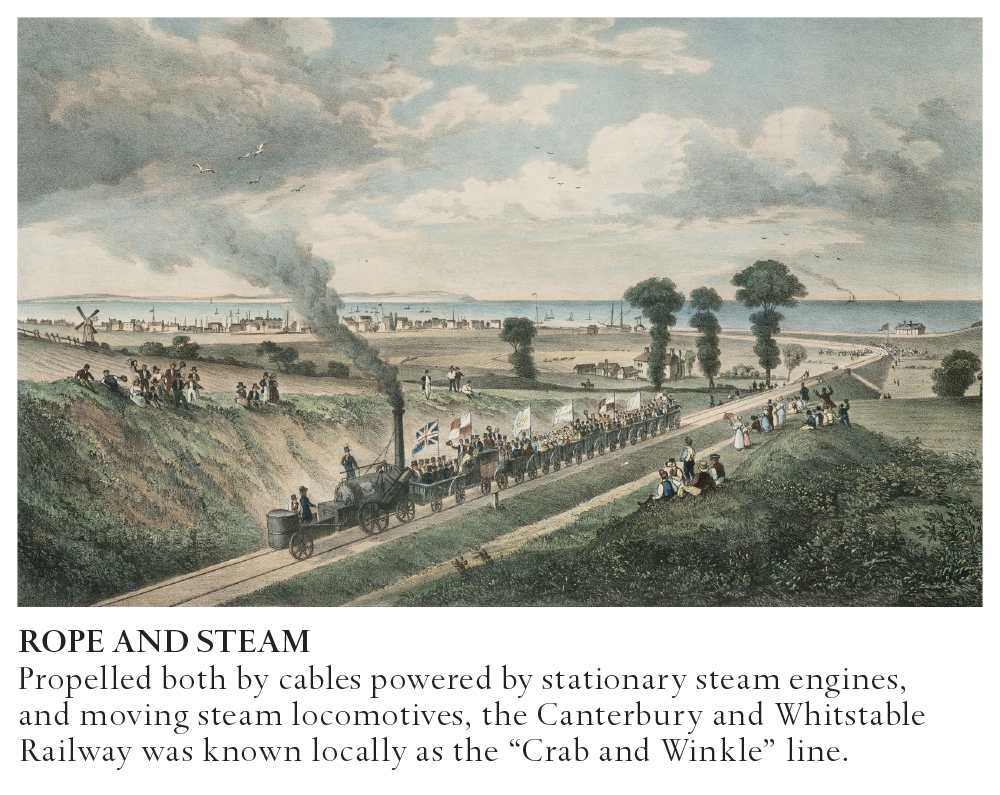
Monorails were another great hope of the railroad pioneers, and although a few were constructed—and indeed some still operate—they have never overcome the basic problems of being expensive to build, and being inflexible due to the structural requirements of their rails. The first patent for a vehicle designed to run on a single rail was granted in November 1821 to British civil engineer Henry Robinson Palmer, who described it as “a single line of rail, supported at such height from the ground as to allow the center of gravity of the carriages to be below the upper surface of the rail.” The vehicles straddled the rail, rather like pannier baskets on a mule, and were horse-drawn. The idea was to make it easier to transport goods across worksites, and the first monorail was built in the Deptford Dockyard, London, in 1824. The following year, another line, the horse-drawn Cheshunt Railway, was built at a brick factory in London. At its opening it carried passengers—an historic moment, as it predated the world’s first passenger railroad, the Stockton and Darlington (see Stockton and Darlington Railway), by three months. Monorails have since resurfaced from time to time, but never with much success. A steam-driven monorail was first demonstrated at the United States Centennial Exposition in Philadelphia in 1876, and although a couple of versions were built, neither lasted very long. The oldest monorail in the world is the Wuppertal Suspension Railway in Germany, which opened in 1901 and still operates today, carrying 25 million passengers a year. In the later 20th century, a number of monorails were built in urban areas in Asia, including Tokyo in Japan and Kuala Lumpur in Malaysia.
Fanciful ideas for new transportation systems continued into the 20th century. Perhaps the strangest of all was the balloon railroad constructed near Salzburg in Austria in the early 1900s. This consisted of a large balloon tethered to a slide running on a single rail up a mountainside. The hydrogen balloon hovered some 33ft (10m) above the car, which could carry up to ten passengers. Once loaded, the balloon was freed, pulling up the car beneath it. To descend, the car’s tanks were filled with water. Its inventor, Herr Balderauer, believed that his system would replace the costlier funiculars that were being built across the Alps (see Crossing the Alps), but perhaps unsurprisingly, it failed to attract investors.