
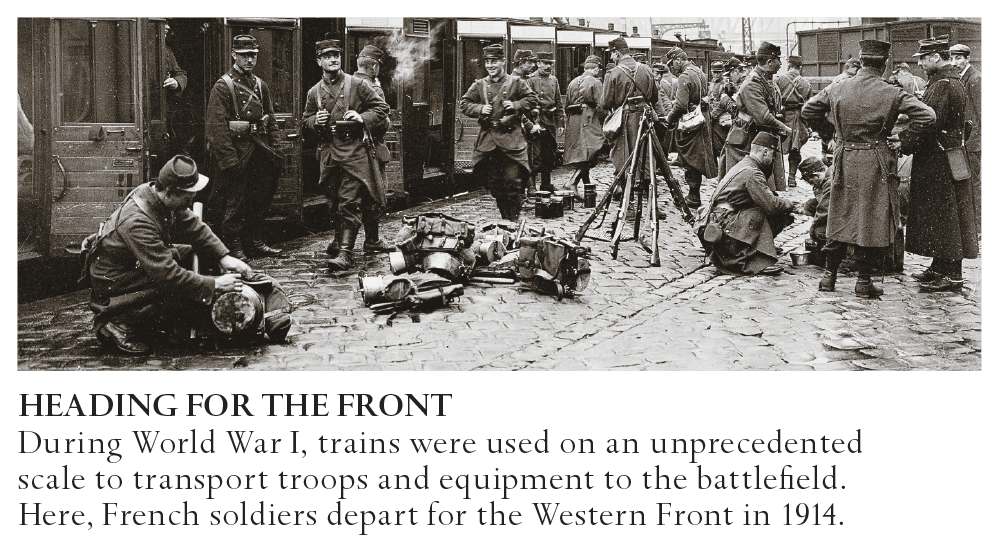
IT IS NO COINCIDENCE THAT A HIGH PROPORTION of the world’s most serious rail disasters occurred during wartime. Britain, France, and Italy all experienced their worst accidents in terms of fatalities during the two world wars—although interestingly, none involved enemy attack—and the highest death toll of any rail accident in Europe occurred in Romania during World War I. Each of these disasters was wholly or partly caused by the overuse of the railroads due to the imperatives of war, combined with a general decrease in safety. Wartime censorship meant that information on these incidents was withheld at the time, and even today the details are sketchy. Consequently, many wartime disasters have been largely forgotten.
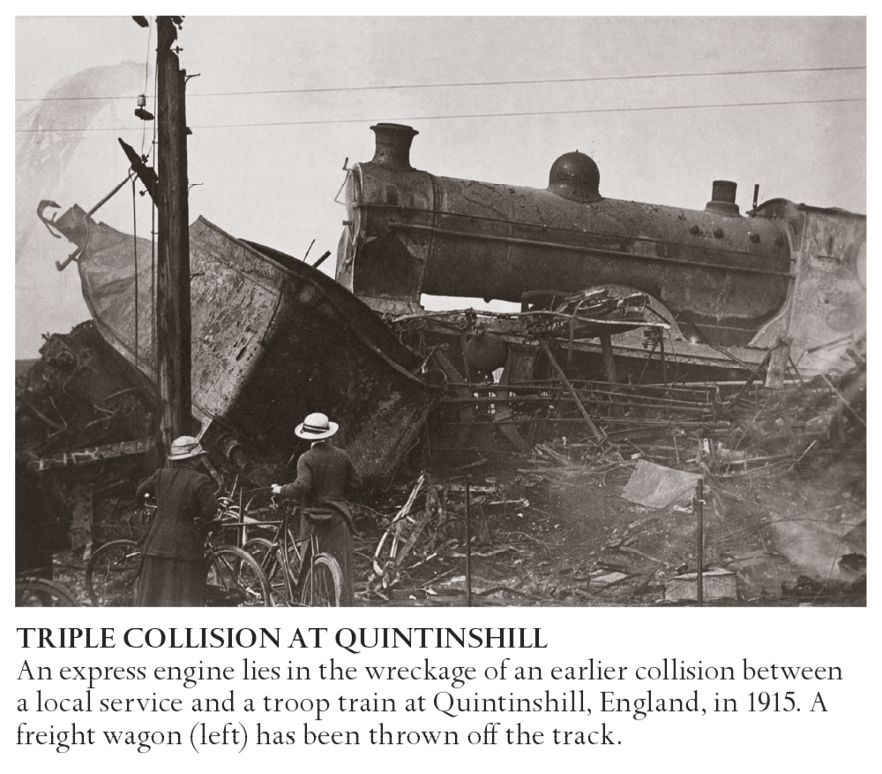
The first of this series of tragedies occurred during World War I at Quintinshill, near the English–Scottish border. In terms of loss of life, it remains by far the worst train accident in British history, and while the direct cause was a series of mistakes by rail traffic controllers, a contributory factor was the enormous pressure placed on the railroads due to the war. The Caledonian main line approaching Carlisle from the north—one of two main rail connections between England and Scotland—was one of the busiest stretches of railroad in the country during the conflict. A huge number of “Jellicoe specials”—freight trains carrying coal for Admiral Jellicoe’s Royal Navy—used the line when returning empty from Scotland to England, as well as local and express passenger services.
On the morning of May 22, 1915, the two overnight passenger sleeper expresses from London were late, as often happened in the war due to the intensity of traffic. The small interlocking towers at Quintinshill, 10 miles (16km) north of Carlisle, controlled a section of the main line as well as the sidings on either side of the track, which were used to temporarily accommodate slower freight trains or local services so that faster trains could pass. That morning, the sidings were full of empty Jellicoe specials waiting to return to the mines to collect more coal. Consequently, the towermen decided to direct a slow local train off the northbound main line and onto the southbound track, in order to allow the passenger sleeper express trains to pass through.
Disastrously, the rail traffic controllers then forgot that the southbound track was occupied, even though the parked train was within sight of the interlocking tower. It was just after 6am, and the signalmen were about to change shifts—George Meakin giving way to James Tinsley. However, against the rules, the two men had agreed to swap shifts a little later than scheduled to give Tinsley time to take the local train to the interlocking tower. Tinsley, therefore, was busy filling in the register—to cover the fact that he had not started work until after 6am—and chatting about the war when he gave the signal “line clear” to a southbound troop train. He had forgotten that the local train—on which he had just traveled—was sitting on the southbound main line.
The troop train was carrying 485 soldiers of the Royal Scots, who had just finished their training and were bound for the fighting at Gallipoli in Turkey. The engineer had no chance of stopping when the troop train came down a slight grade at more than 70mph (110kph). The train smashed into the local service head on, with such force that the troop train’s cars were telescoped into a length of just 210ft (64m)—a third of their original size. To compound the disaster, the old rolling stock that had been commandeered for the troop train was made of wood and acted like a tinderbox—a fire quickly broke out and was fueled by kerosene lanterns and coal from the engines. But worse was yet to come. The northbound express for which the local service had been waiting was unable to stop, and plowed into the wreckage from the two earlier trains, which had been strewn across the northbound main line. The death toll from the incident was 227—by far the worst British rail disaster, and nearly twice the total of the second-worst, at Harrow in 1952—but fatalities on the two passenger trains were light, although the figures may have been massaged by the wartime official sources. The two towermen were jailed for manslaughter, with relatively light sentences given the scale of the disaster—Tinsley received three years and Meakin half that.
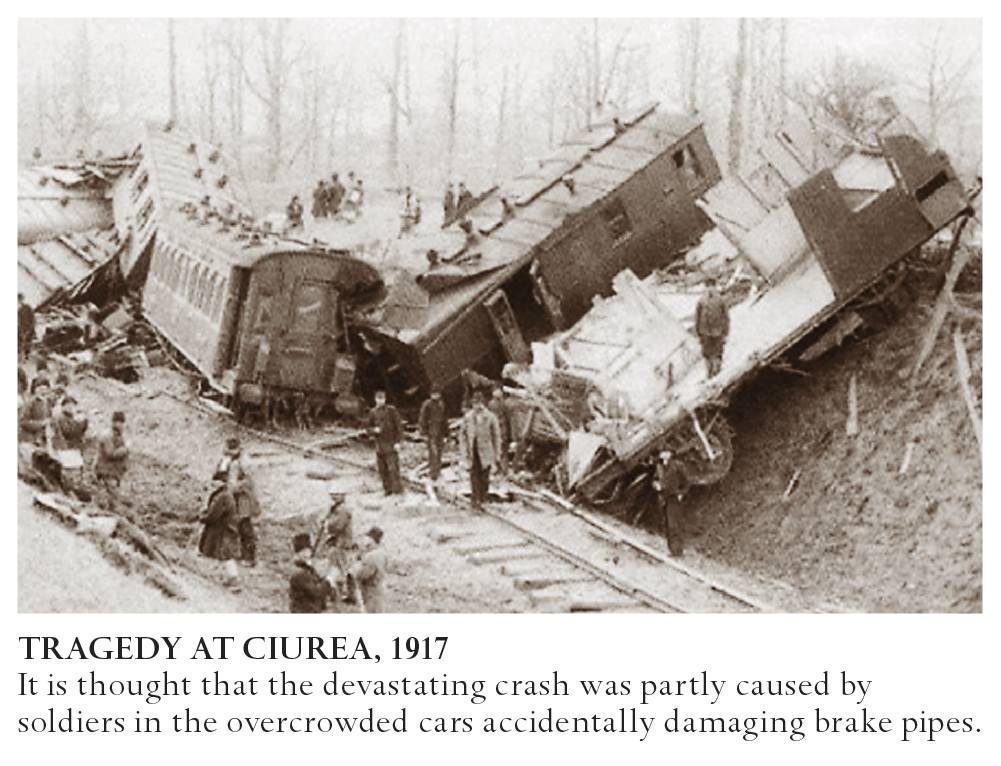
The Romanian accident, which happened on January 13, 1917, is shrouded in mystery because of its location and the tight censorship of the Romanian and Russian authorities. It bore several similarities with a later disaster at St-Michel-de-Maurienne in France (see St-Michel-de-Maurienne)—a heavily overloaded troop train ran out of control, leading to a fire that killed many of the victims. The accident occurred at Ciurea—in a remote eastern part of Romania near what is now the border with Belarus—and involved Russian troops and Romanian civilians fleeing a brutal German advance. Romania had entered the war late on the side of the Allies, and after early success was soon overrun by German forces. To escape the enemy, a huge train of 26 cars packed with wounded Russian soldiers, as well as refugees, left the small town of Bârnova bound for Ciurea. A survivor, Nicolae Dunanreanu, wrote of the scramble to get on the train:
… everywhere, people—and particularly soldiers—clambered on to the roofs, steps, and buffers, gripping each other in mad desperation. There was not even the smallest corner free, one could not even get both feet on a step, nor a buffer, and these desperate people seeking a relative or fleeing from the enemy who occupied more than half the country could not guess that a greater disaster awaited them.
The two stations were separated by an incline that averaged 1 in 40, but with sections as steep as 1 in 15. It became apparent shortly after starting the descent that the train’s brakes were not working properly—it later emerged that passengers had broken the connecting pipes between cars by stepping on them as they crowded onto the train. The two locomotives did not have sufficient braking power between them, and consequently the train hurtled ever faster down the slope. Despite the efforts of the train crew—who took the emergency measure of putting the locomotive in reverse, and tried to sand the track to increase adhesion—the cars were derailed as they entered Ciurea station, causing destruction on a vast scale. The final death toll is thought to have exceeded 1,000, although wartime secrecy—and the remoteness of the area in which the accident occurred—meant that no precise figure has ever been ascertained. There is no doubt, however, that it was by far the worst railroad accident ever to occur in Europe as a whole.
Later that year, an accident occurred in France that would prove to be the worst railroad disaster within Western Europe. It was caused by elementary mistakes made by railroad officials working under the strain of wartime loads and—crucially—under the orders of the military, who ignored the officials’ warnings. A very long train of 19 cars was being hauled over the Alps on the night of December 12, 1917, carrying more than 900 French troops on their way home for Christmas. The men had fought in Italy and were anxious to get home quickly for their leave. Having traveled through the Mont Cenis tunnel, a crucial link between the two countries, the train waited at Modane on the French side for more than an hour as other services were allowed onto the overburdened line. The train was also being delayed because of the lack of a second locomotive, which was vital not just to provide extra power up the grades, but to assist with braking on the descents. Only three cars had air brakes, while the rest had either crude, hand-operated brakes, or none at all.
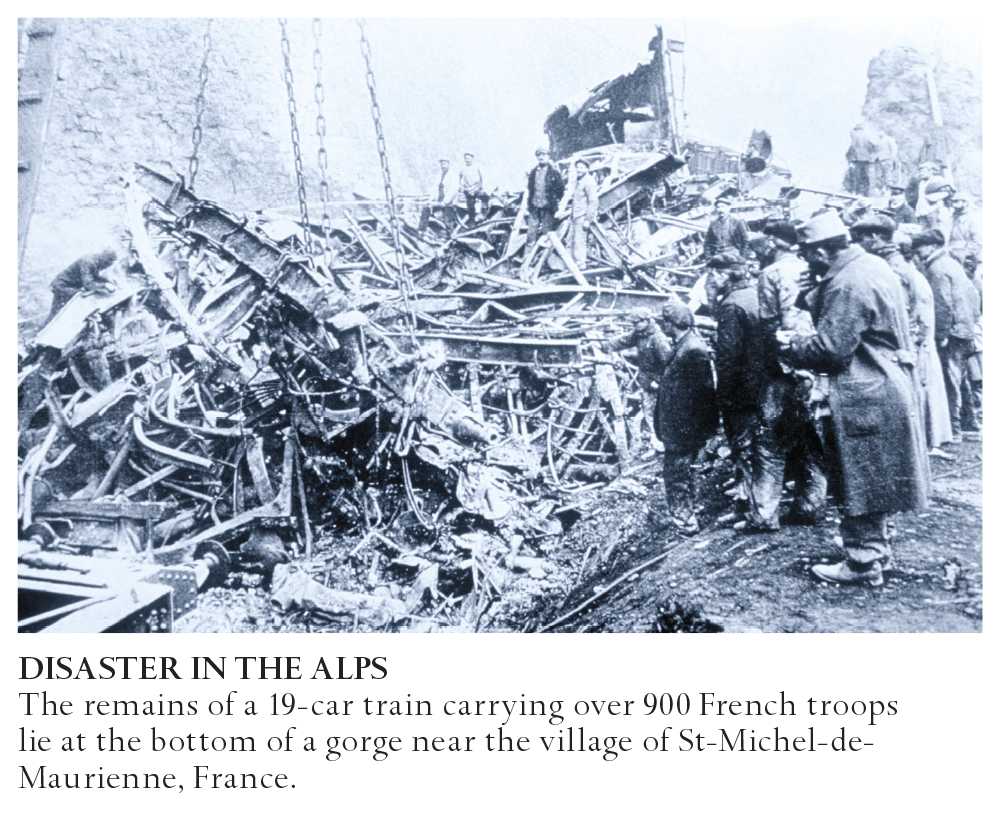
As the delay lengthened and the poilus (French infantry) became rowdy, the train’s engineer, Girard, came under pressure to proceed down the incline. He refused unless a second locomotive could be found, but the only one available had been allocated to an ammunition train. Girard was overruled by the local military traffic officer, Capitaine Fayolle, who told the engineer that he would be thrown into the fortresse (prison) if he refused. It was a classic case of military personnel failing to understand the limitations and safety requirements of the railroad. As a result, the inevitable happened. With such a huge load and inadequate braking power, the train began to speed out of control. When the brakes were applied, the friction was so great that they heated up and caught fire. This sowed panic among the passengers, some of whom jumped off the speeding train. Traveling at around three times the speed limit of 25mph (40kph), the train jumped the rails at a bend near the village of St-Michel-de-Maurienne. Several cars plunged into the gorge below, while others burst into flames. Relieved of its burden, the locomotive stayed on the tracks—and Girard, who was not initially aware of having lost his load, survived.
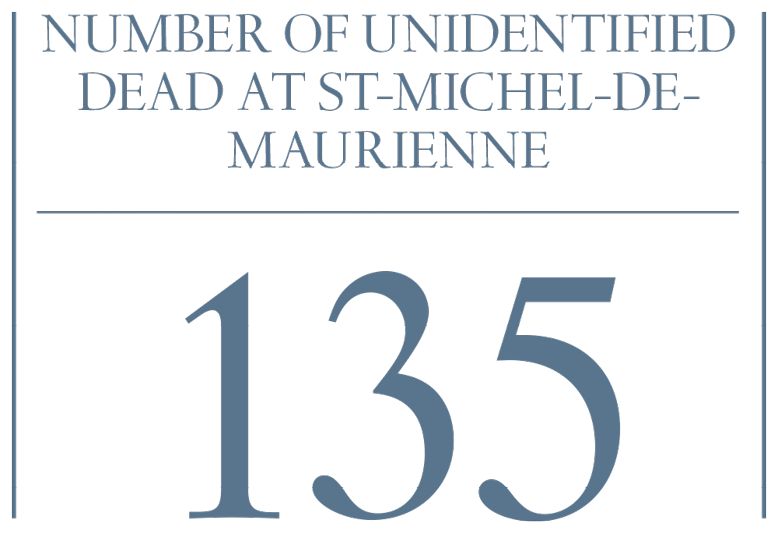
The death toll was initially announced as 424, but is now thought to have been 457. Other estimates put the number as high as 675, since many of the dead were incinerated in the ensuing fire—which took a day to burn out—and several survivors later succumbed to their injuries in the hospital. But it could have been even worse. Only the quick actions of a stationmaster prevented a train carrying Scottish troops toward Italy from crashing into the debris. Reflecting the sensitivity of such wartime incidents, it was not until 79 years after the accident, on December 12, 1996, that a memorial to the dead was opened at the site of the disaster.
Spain experienced its worst train disaster during World War II, despite the country’s neutrality. The accident occurred on January 3, 1944, near the village of Torre del Bierzo in the León province, when three trains collided inside a tunnel. Like the Romanian and French disasters, the cause was a runaway train speeding down an incline, resulting in a fire that claimed most of the lives. The overnight Galician mail express failed to make a scheduled stop at Albares due to a broken braking system. The stationmaster at Torre del Bierzo, the next station down the line, ordered railroad ties to be placed on the line to slow the train down, but his efforts were to no avail. The train ran toward a tunnel where it hit another train that was in the process of being moved out of its path. Unaware of the crash, a coal train with 27 loaded cars then approached the tunnel from the opposite direction and plowed into the wreckage. The ensuing fire burned for two days, preventing the injured from being rescued and making identification of most of the victims impossible.
Strict censorship under the regime of General Franco meant that the accident received very little publicity at the time, and the official RENFE (the Spanish rail company) file on the accident was lost. There were many illegal travelers on the train heading for a post-Christmas market, and although the official death toll was 78, research has shown that the real figure was closer to 500.
World War II was also the backdrop for Italy’s most serious accident, which brought a death toll far in excess of any other rail disaster in the country. Again, wartime conditions were the underlying cause. The accident happened at Balvano, a small town inland from Salerno on the Bay of Naples. The area was under occupation by Anglo-American forces that had battled their way up from Sicily, and food and other basics were in short supply. Many townspeople jumped on freight trains illegally to travel into the countryside to obtain supplies, either for themselves or to sell on the black market. One such steam-hauled train left Salerno on the wet and cold evening of March 2, 1944, heading for farms inland in the Apennine mountains. Hundreds of people jumped onto the flat cars at each successive stop, and sheltered under tarpaulins and whatever else they could find. The train stopped in a tunnel near Balvano, where it was forced to wait nearly 40 minutes for another service to come down the hill. This was to prove fatal for hundreds of the 650 or so illegal travelers. Wartime shortages meant that the only fuel available for the engine was poor-quality coal, which emitted a high level of carbon monoxide. The incline in the tunnel caused the fumes to spread downward; the death toll was enormous, and has been estimated at between 450 and 500. Those who survived had mostly been in the rear cars, which were not in the tunnel when the train stopped. The alert was sounded by a brakeman, who ran back to the nearest station shouting “they are all dead,” before collapsing from the effects of the fumes. A colonel in the US Army who helped in the aftermath of the disaster later wrote: “The faces of the victims were mostly peaceful. They showed no sign of suffering. Many were sitting upright or in positions they might assume while sleeping normally.” Death had come quietly and quickly.
Fortunately, the scale of these disasters is unlikely to be repeated in the modern era. Train technology—such as advances in braking efficiency—and the enforcement of regulations mean that train travel is far safer now. Generally, trains are not as overcrowded as in previous years, and fire is rarely a hazard given that steam locomotives are no longer used. Moreover, cars are no longer made of wood, and are designed and built to be strong enough to withstand the forces of crashes—so even when accidents do occur, the survival rate tends to be higher. Nevertheless, with high-speed trains traveling at nearly 200mph (320kph) every day in Europe, the possibility of a tragedy on a large scale remains—as evidenced by the July 2013 accident at Santiago de Compostela in Spain, in which 79 people lost their lives.