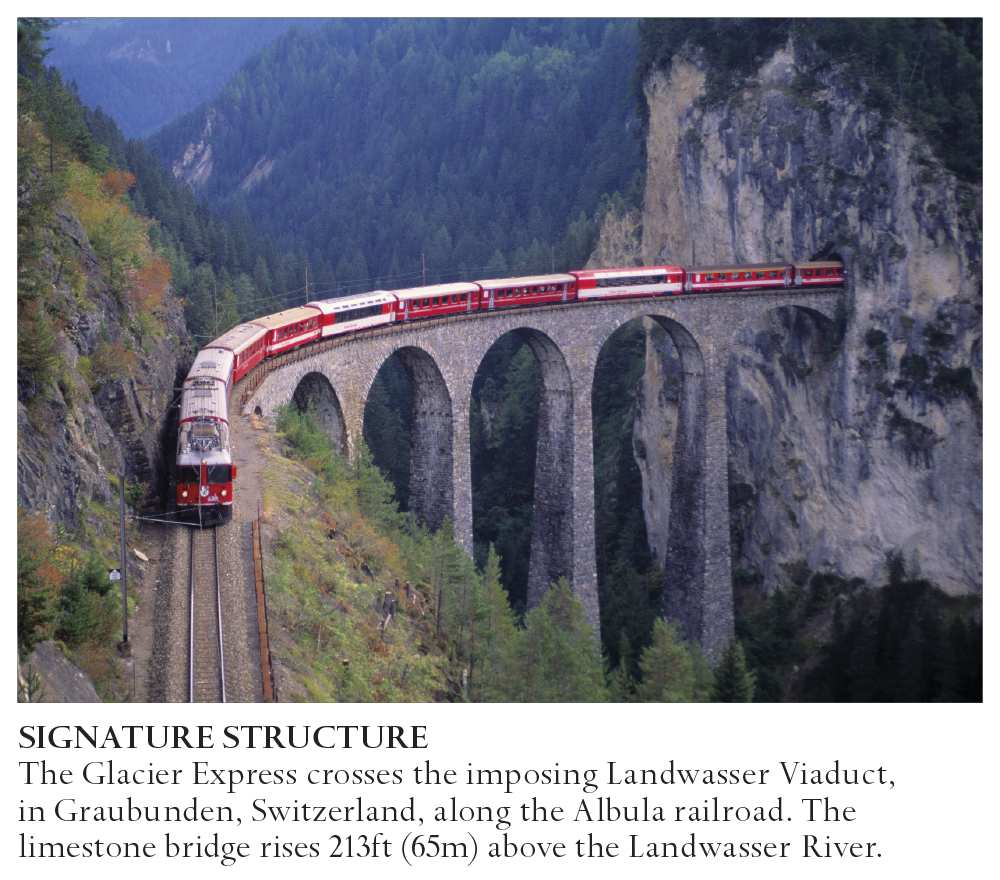
SWITZERLAND JOINED THE RAILROAD AGE relatively late, but, as in other countries such as Germany, the railroads quickly became a unifying force and a vital part of the nation’s prosperity. So much so that today Switzerland can lay claim to having one of the most efficient and well-used railroad networks in the world.
Surrounded by mountains and beset by cold temperatures and copious snowfall in the winter, Switzerland did not seem like fertile territory for the iron road. Moreover, it did not even become a unified nation until 1848, following a brief civil war between the Protestant and Catholic cantons (states). The new Switzerland adopted a federal state system, similar to that of the US, and the new government decided that the country needed a proper, planned railroad system. So, in 1850, two British engineers, Robert Stephenson and Henry Swinburne, were asked to oversee the development of a rail network. The pair suggested a basic, east-to-west line along the valleys between Geneva and Zürich, plus another line from Basel to Lucerne. Rather oddly though, the capital, Bern, was to be on a branch line. The cantons built these early lines, often with foreign investment and contractors. Stephenson and Swinburne’s influence also meant that the Swiss adopted the standard gauge (4ft 8½in/1,435mm) and instituted British-style left-hand running on double-track lines, both of which are still used today.
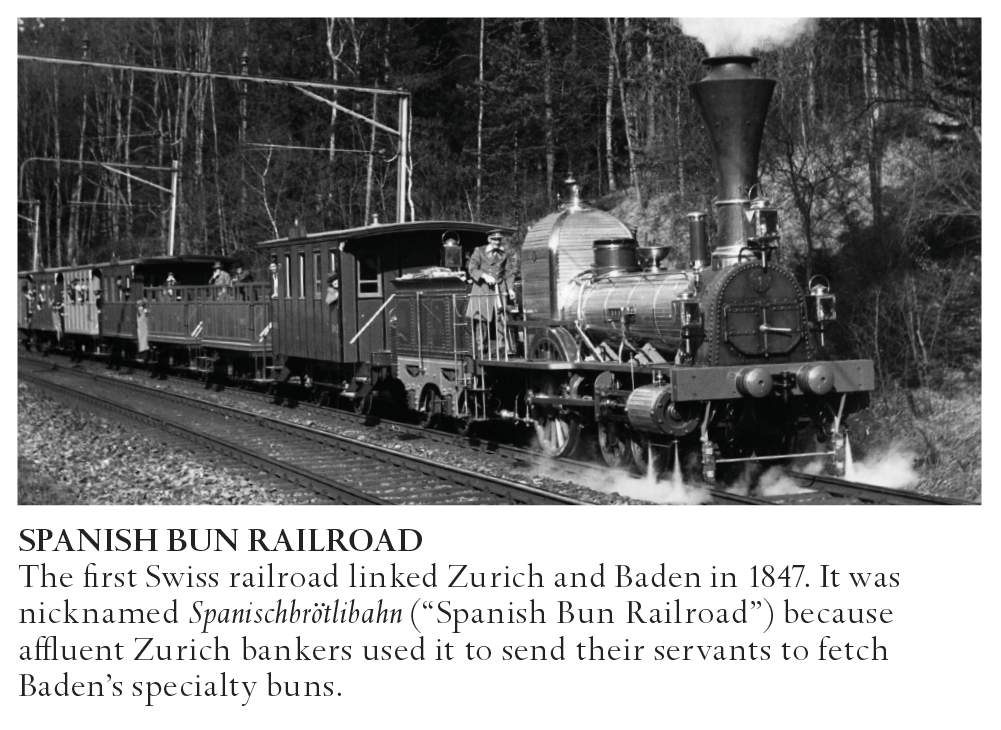
The iron road’s progress in Switzerland remained slow. Unlike most European countries, where the demands of traditional heavy industries such as mining or agriculture fueled railroad expansion, it was tourism that eventually became the catalyst for further development in Switzerland. From the mid-19th century, increasing numbers of visitors flocked to resorts in the scenic Alps and lakes. However, when pioneering travel agent Thomas Cook took his first tour party to Switzerland in 1863, there was still barely 400 miles (650km) of railroad in the whole country. It was clear that the country’s existing rail network could not cope with the demands of the tourist industry.
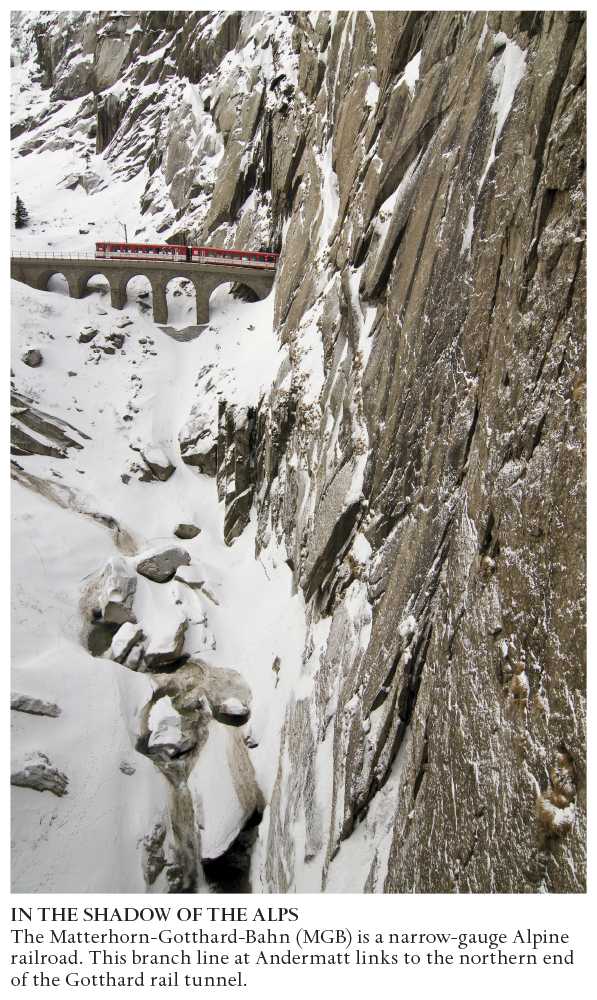
So, by the last third of the 19th century, the Swiss federal government was eager to see its railroads develop more rapidly. Furthermore, the country’s location in the center of Europe made an efficient railway network in Switzerland highly desirable for its neighbors, too. They were eager to traverse Swiss territory to create both passenger and freight links across Europe, and were happy to invest in Swiss railroads to make that possible. A treaty between Switzerland, Germany, and Italy in 1869 agreed to a strategic link under the Gotthard Pass in the Alps. Completed in 1882, the Gotthard Tunnel (see Gotthard Tunnel) linked not just the cantons of Uri and Ticino, but also provided a valuable north–south route between Germany and Italy; the Simplon Tunnel (see Simplon), opened in 1906, also linked Switzerland to Italy.
Meanwhile, the railroads continued to spread across the country, including Europe’s first rack railroad (see Climbing Mountains), which opened in 1871. Built to take tourists up the Rigi Mountain above Lake Lucerne, it used a rack-and-pinion system developed by Swiss engineer Niklaus Riggenbach. Three years later, the first 3ft 3⅜in- (1m-) gauge line opened from Lausanne to Bercher via Echallens, although this was actually built to serve an agricultural area rather than the tourist industry. By adopting a narrower gauge in less accessible or less populous areas, lines could be built much more economically, allowing railroads (and also light rail) to spread into the steepest and most remote corners of Switzerland.
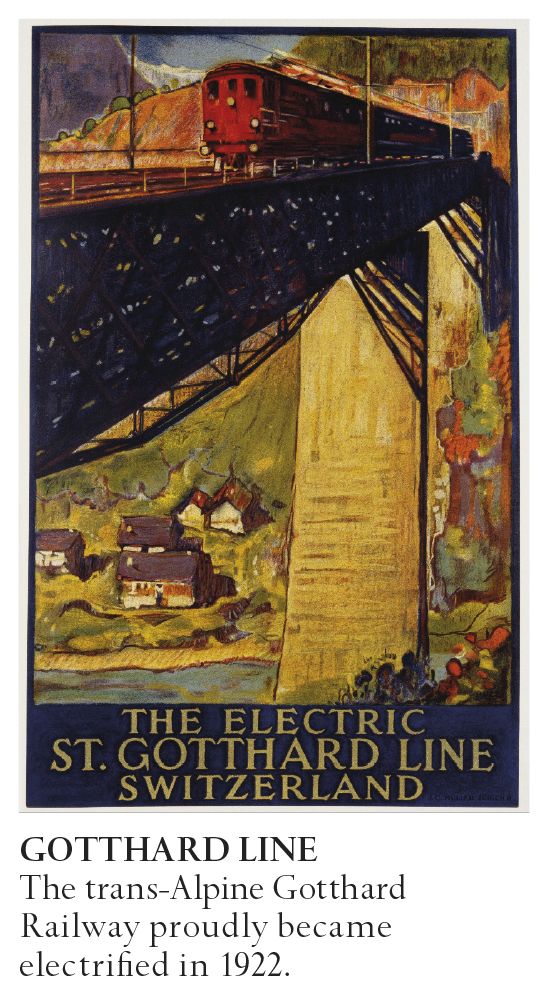
After the initial railroad boom of the late 19th century, some speculative railroads went bust and many Swiss people became disenchanted with their railroads being largely owned and operated for the benefit of foreign shareholders. Consequently, in 1898 a referendum on nationalizing the railroads led to the formation of the Swiss Federal Railways in 1902 (officially known as SBB-CFF-FFS). Over the next few years, the SBB-CFF-FFS acquired approximately 50 percent of the national trackage and embarked on a program to electrify the whole network. Given the country’s lack of coal, the Swiss were early adopters of electric traction: the first electrically powered railroad in Switzerland was a 3-ft 3⅜-in (1-m) gauge line between Montreux and Chillon in 1888. The Simplon Tunnel was also electrified from the start, and electric traction was used, too, for the Jungfraubahn, completed in 1912.
The two world wars accelerated the electrification process in Switzerland: during World War I coal shortages caused widespread travel disruption, while World War II affected Switzerland even more, despite its neutrality. The tourist trade on which many railroads depended dried up, and some lines closed in the aftermath of the wars. However, the postwar government soon realized the value of Switzerland’s transportation infrastructure and began to invest in the railroads, so much so that by 1960 the entire railroad network in Switzerland was electric, making it the first country in the world to achieve this milestone.
During the latter half of the 20th century, car and semitruck traffic in Switzerland grew inexorably, as it did elsewhere. With the building of modern highways through and under the Alps, much freight that was once rail-borne transferred to the road. By the 1980s, however, the Swiss public was increasingly concerned about the environmental damage caused by heavy semitrucks. This eventually led to two major national referendums on the railroads. The first, in 1987, led to the Bahn 2000 project, which aimed to bring the Swiss rail network into the 21st century. This initiative resulted in the improvement of many lines and the construction of sections of high-speed track that are an integrated part of the existing infrastructure rather than, as in many other countries, entirely separate. A second referendum in 1992 approved, by a massive majority, a project called “AlpTransit” that regulated the number and capacity of semitrucks allowed across the Alps. It prioritized improvements to the rail infrastructure over road-building, intending freight to be transferred onto the trans-Alpine railroads. To facilitate this plan two new railroad tunnels were proposed—the 21-mile (34-km) Lötschberg Base Tunnel, which opened in 2007, and the 38-mile (61-km) Gotthard Base Tunnel, which is due to be completed 2016.
The 1980s also saw the introduction of an impressive integrated national transportation schedule in Switzerland, coordinating rail, bus, and trolley services. It means that almost every station in Switzerland has at least an hourly rail service that links to a national timetable plan, giving regular connections with all other routes and modes of transportation. Oddly, although the transportation services are coordinated by the government, its national rail company, SBB-CFF-FFS, owns just under 2,000 miles (3,200km) of track, with the remaining 1,200 miles (750km) being operated by around 80 different private or seminationalized companies. Despite this, the Swiss railroad system is far more streamlined and has far less duplication than many other networks around the world, where competition between different companies resulted in unnecessary or inefficient lines being built.
Historically, the Swiss electorate, and generally their politicians, have been far more conscious of the implications of their public transportation than most other nations. For example, the standard gauge rail network is the core of a wider transportation system in Switzerland into which local trains (often 3-ft 3⅜-in gauge/1-m), trolleys, and buses link at all stations. Despite this integrated network, the Swiss still have one of the highest rates of automobile ownership per capita (about one for every two people), but they use them far less. In fact, Swiss people make more journeys via railroad than any other nation, apart from Japan. On average, the Swiss travel 1,060 miles (1,706km) per person annually by rail, while the Japanese travel 1,200 miles (1,900km). (The Swiss actually make more individual journeys than the Japanese, but these journeys are shorter.) Given that Japan is a far bigger country with a very dense population, Switzerland’s record is all the more remarkable. The key to that success is that the rail network is part of a genuinely integrated public transportation system designed to make nonmotorized travel easier and more efficient for its citizens. Reliability and punctuality have proved crucial, too, supported by consistent government investment in the railroads. Not only is the rail network extensive and well managed, but the cost of rail travel is also highly competitive. In addition to the usual range of discounted season and zonal tickets, it is possible to purchase a national, all-modes (rail, bus, trolley, boat) travel card that costs around $5,630 (£3,500) per year—a bargain by the standards of many other countries.
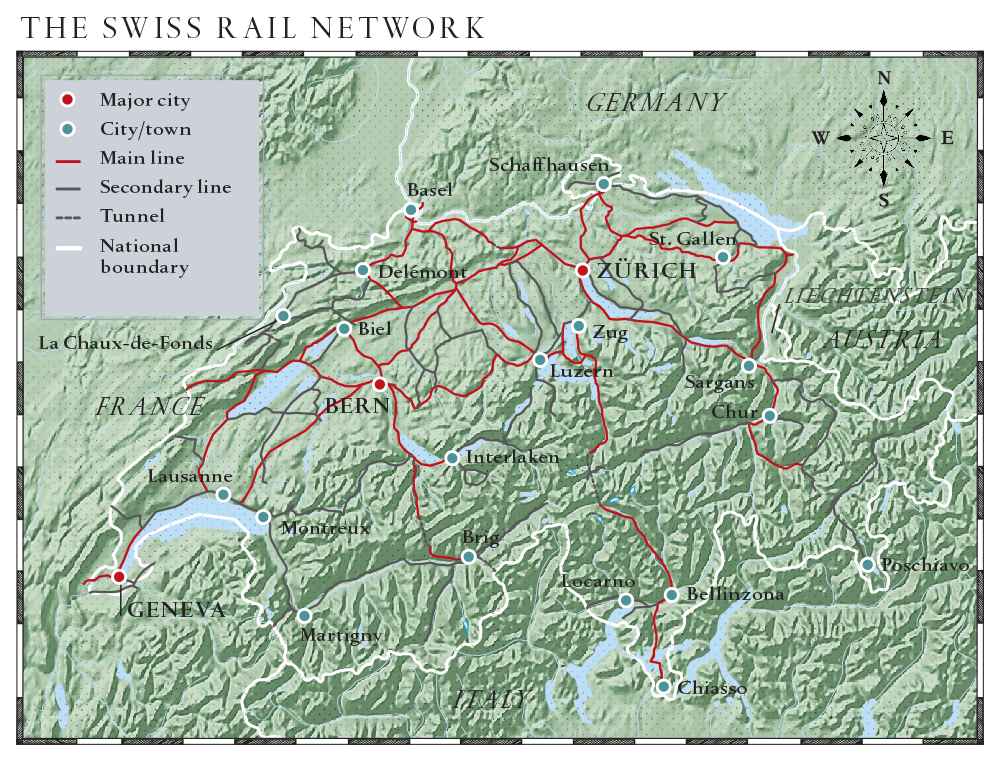
Today, a growing Swiss population is placing the rail network under increasing strain and the railroads require considerable investment to keep pace with demand. The Swiss, however, seem up to the task: in ZÜrich, for example, an expensive series of tunnels has been planned to allow trains to pass through the city more quickly and to link expanding suburbs. Railroads, it seems, have become ingrained in the culture and success of Switzerland, and the importance of the iron road shows no signs of waning.