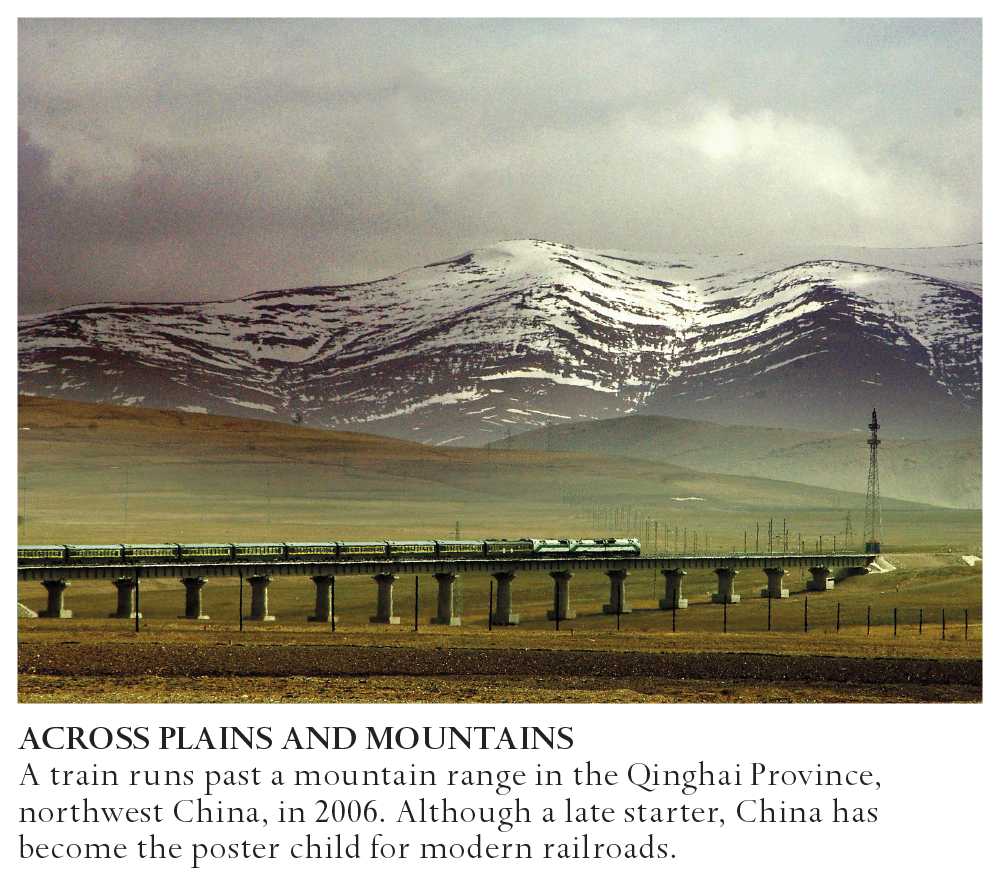
CHINA WAS PROBABLY THE ONLY COUNTRY in the world to have joined the railroad age and then, briefly, to have left it again. Despite this false start, China now boasts by far the most extensive system of high-speed dedicated lines anywhere on the globe, a network that China is bent on expanding to become the backbone of the nation’s transportation infrastructure. China is also home to the world’s highest railroad: the Qinghai–Tibet Railroad.
The first railroad line in China was built by Jardine, Matheson & Co., a European-owned trading company looking to improve access between Shanghai and the nearby port of Woosung. The line was just 10 miles (16km) long, but its construction in 1876 was mired in controversy: the deeply conservative Chinese officialdom was reluctant to allow the laying of railroads, fearing it would ruin the livelihood of the vast numbers of those who carried goods for a living. One Chinese official at the time, Yü Lien-yuan, worried that the resulting unemployment would foment unrest:
several tens of millions, who earn their living by holding the whip or grasping the tiller, will lose their jobs. If they don’t end up starving in the ditches, they will surely gather [as outlaws] in the forests.
Another official was concerned that coal would run out, arguing that “when one uses coal with such profligacy, coalfields would soon disappear.” In addition to these doom-laden visions, there was much antagonism toward foreigners and foreign-owned concerns at this time. Imperialist shows of might, such as the Opium Wars, lived in very recent memory, and foreign powers had been taking advantage of China’s weakness: several European governments, as well as the Japanese, had set up missions along the coast that were effectively a way of obtaining access to China’s riches without paying taxes on them. As such, Chinese officials took a dim view of the Shanghai–Woosung Railroad, and its European-sponsored construction never received official sanction. Just one year after the railroad opened, Shen Pao-Chen, the governor of the region through which the railroad ran, ordered the line to be ripped up and had the equipment shipped to Taiwan, where it was abandoned to the elements.
It was not until 1881 that a permanent railroad line would open in China. Originally intended to be mule-hauled, the line was a 6-mile (10-km) standard-gauge railroad running from a coal mine to a canal at Hsukochuang, about 100 miles (160km) east of the capital, Beijing. A British engineer, C. W. Kinder, was responsible for the construction, as well as for commissioning China’s first locomotive, the Rocket of China. These events, however, did not herald a railroad revolution. The government remained reluctant to endorse this groundbreaking method of transportation, despite its success across the world, and very few lines were built in the 1880s. It took the disastrous defeat in the Sino-French War of 1884–85 to make the Chinese realize that modernization was essential and that railroads could be a catalyst for development. Kinder’s line was extended by 20 miles (32km) in the direction of Beijing. However, in what can be seen as a measure of the role of superstition in Chinese government structures, a mysterious fire in the Imperial Palace was seen as a sign of celestial displeasure and the line was never completed.
By 1894, when the Sino-Japanese war broke out, little progress had been made and China had a mere 320 miles (500km) of railroad, compared with 175,000 miles (280,000km) in the US. However, defeat in the war finally stimulated a railroad boom in China. While Beijing became the center of the network, many other lines were built to serve mines in relatively remote areas. By the time of the Xinhai Revolution of 1911, which created the Republic of China, there were 6,000 miles (9,500km) of track, a significant increase, but still a relatively small statistic for the most populous country in the world. It was, at the time, half the size of the railroad network in India—a similarly impoverished, but smaller, nation.
Growth of the railroads slowed during the period of the Republic as a result of a series of civil wars and the occupation of China by Japan in the late 1930s. Many lines were destroyed in these various conflicts, and by the end of World War II this vast nation still had only 14,000 miles (22,500km) of workable railroad. After gaining control of the country for the communists in 1949, Mao Zedong invested heavily in the railroad network. Lines were repaired and new ones built, even in difficult mountainous territory. This progress continued after Mao’s death in 1976, and by the end of the 20th century China finally had a network covering most of the country. One major gap, however, remained—a line connecting Tibet with the rest of China.
Tibet is remote and separated from the rest of the country by the Kunlun Mountains in the north and the Nyenchen Tanglha range in the east. The main Tibetan plateau is a huge, high landmass stretching 1,500 miles (2,400km) from east to west, and 500 miles (800km) from north to south. It is home to the largest subarctic permafrost region in the world—which, to put it mildly, is not ideal railroad territory. All land routes to the vast plateau cross mountain passes that climb higher than any peak in the US. As author Abrahm Lustgarten describes in China’s Great Train, the roads
twist and wind through steep gorges loaded like cannons with unstable rock and snow at their peaks and flushing with torrents of interminable water in their troughs.
A China–Tibet rail link was seen as a way to cement China’s control over this long-disputed area, known by the Chinese as the Tibetan Autonomous Region. Historically part of China, Tibet had declared its independence following the collapse of the Qing dynasty in 1912, but had been reclaimed by the communist-controlled government in 1951 and occupied by soldiers from the People’s Liberation Army. Ever since the communist revolution, the government had harbored ambitions to build a railroad line to Lhasa, the capital of Tibet, to help establish control over the territory. However, technical difficulties and lack of money had stood in the way of the project. International experts argued that the railroad simply could not be built, having observed the difficulties of laying railroad tracks on permafrost during the construction of the Baikal Amur Mainline in eastern Russia (see Brezhnev’s Folly).
Tibet accounts for an eighth of China’s landmass and yet in 2000 it was still the only region in the country without a rail link connecting it to the more developed east. The Chinese government instituted a “Go West” campaign and the proposed line to Tibet became an important part of that strategy. At the time, Tibet was an undeveloped agrarian region with little connection to the outside world, but there was a possibility that mineral resources could be exploited with the help of the proposed railroad.
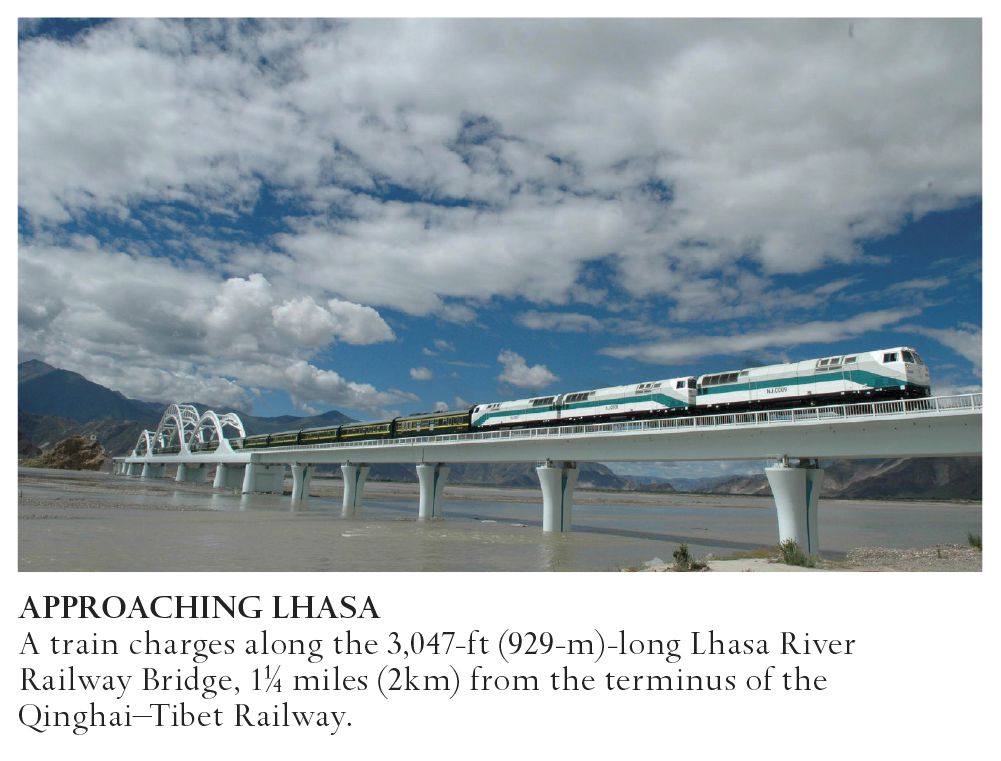
A precursor to the Tibetan Railroad was completed in 1984: an 500-mile (800-km) railroad heading west from Xining (the capital of Qinghai province and the traditional gateway to Tibet) to Golmud, also in Qinghai province. The plan to continue the line through to Lhasa, however, would not be agreed to until over a decade later. In 1999, President Jiang Zemin launched a campaign to develop western China, which was lagging behind the booming east, and the Tibet railroad became a key part of that strategy. However, there remained some dispute over the best route for the railroad. Golmud, which had been founded in the 1960s as a labor camp for mainly Tibetan prisoners, was now a small city and offered the shortest route to Lhasa. This route involved crossing hundreds of miles of permafrost, however, and there were concerns that the technology to ensure that this could be done was not available. The most obvious alternative route was one from Yunnan province in southern China, but this would be twice the distance of the Golmud route, and so twice as expensive. Eventually, it was decided that it was possible to overcome the permafrost problem, and work started on the 710-mile (1143-km) line between Golmud and Lhasa in 2001.
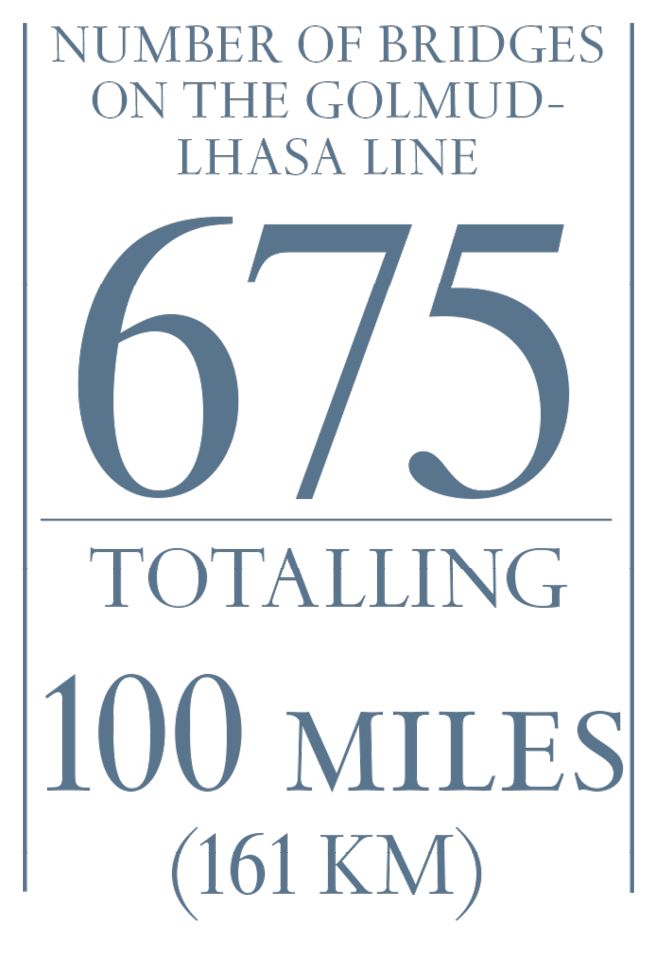
A railroad constructed in the 21st century benefitted from many previously unavailable techniques, but the difficulties of working at such high altitude in a remote region still surpassed that of most previous railroad projects, and the labor force required was enormous—over 100,000 workers migrated to Tibet to build the railroad at the start of the project. One major challenge was that some sections had to be built on ground that was not quite permafrost—the top layers of soil melted during the summer and so became unstable. To accommodate this, long sections of track were elevated on what were effectively bridges, held up by deep, pile-driven foundations. In addition, passive heat exchangers were installed to cool the track and the surrounding soil.
The human cost of the venture was high, with many workers succumbing to altitude sickness. According to Lustgarten, “Tibetans in nearby villages would see railway officials burying dead workers on the hillsides outside the [Fenghuoshan] tunnel”, but the official explanation for the deaths was food poisoning. No casualty statistics have been released by the authorities, who deny that there were any deaths from altitude sickness.
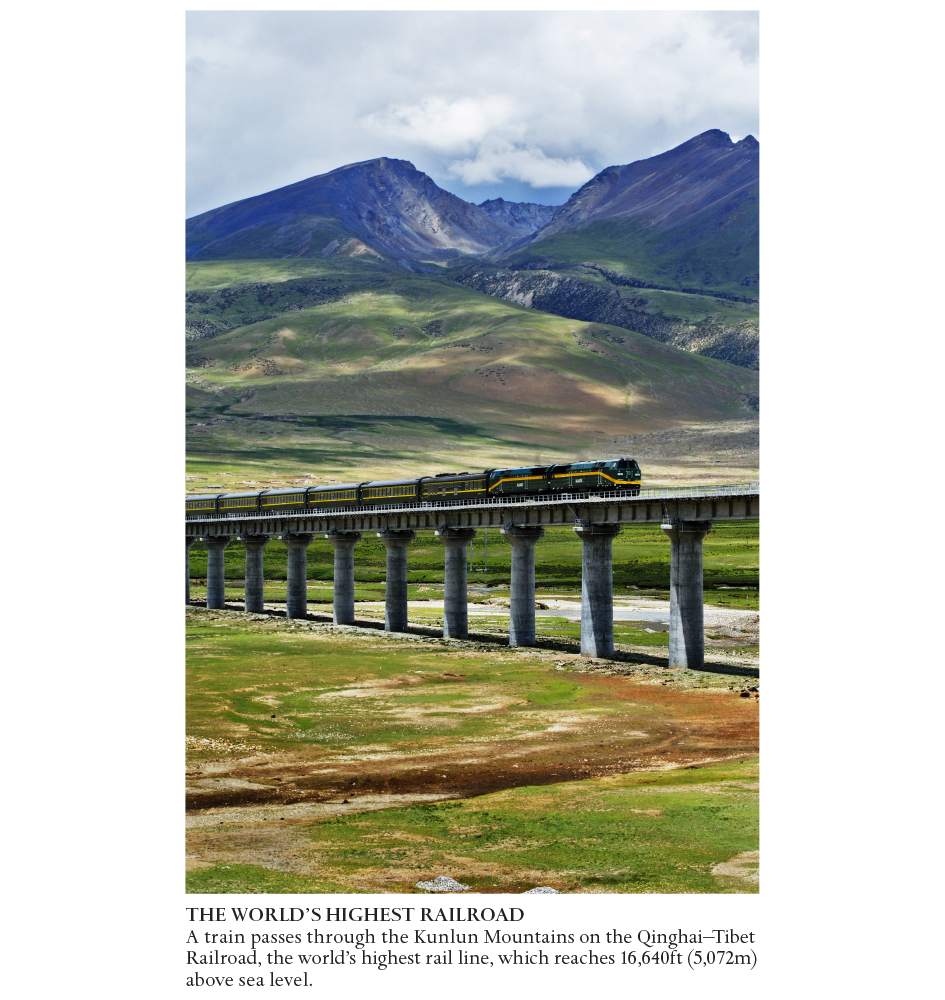
The work began at both ends of the line, and track-laying was completed within four years—installation of signaling and other equipment took another year. Just five years after work started in July 2006, the line opened with much fanfare. The overall cost was around $4 billion—although this may be an underestimation given the difficulties of precisely working out the costs of the program. On its completion, the Qinghai–Tibet Railroad beat numerous records in railroad construction. It is the highest railroad in the world: the Tanggula Pass, at 16,640ft (5,072m), surpasses its spectacular counterpart in the Andes, Peru (see Peru), built almost a century before, by around 820ft (250m). Tanggula station is also the world’s highest railroad station, and the ¾-mile (1.2-km)-long Fenghuoshan Tunnel is also the highest railroad tunnel in the world at 13,435ft (4,905m) above sea level.
The railroad has a capacity of up to eight passenger services per day in each direction. Since the air in Tibet is thin, the cars on Lhasa trains have special air conditioning systems to keep oxygen levels healthy, and each seat has its own emergency breathing apparatus. The windows are especially large to give travelers the best view, and are protected against the high levels of ultraviolet light on the Tibetan plateau. With all these dangers, passengers are required to obtain a Health Registration Card before traveling from Golmud to Lhasa, and each train has a doctor on board in case of emergencies.
China’s belated railroad expansion has continued with the construction of a huge network of high-speed lines. Up until 1993, China’s trains were still very slow, averaging just 30mph (48kph), prompting a number of “speed up” campaigns to counter competition from roads and aviation. The result was a series of services that could run at up to 100mph (161kph) by the end of the decade. The government, however, had even greater ambitions: the construction of a whole new set of lines in order to radically improve rail services and the nation’s infrastructure. A program was thus devised to build the world’s biggest network of high-speed lines, defined as more than 124mph (200kph). Some existing lines were upgraded, but for the most part entirely new lines were constructed—each one faster than the last. The “Mid-to-Long-Term Railway Network Plan” proposed the construction of a national, high-speed rail grid composed of four north-south corridors and four east-west corridors, which, together with upgraded existing lines, would total 7,500 miles (12,000km).
The first of these dedicated lines, the Qinhuangdao-Shenyang High-Speed Railway along the Liaoxi Corridor in the northeast, opened in 2003 with a line speed of 124mph (200kph), which was upgraded to 155mph (250kph) by 2007. Others soon followed, some opening in time for the 2008 Olympics. One of these was the Beijing–Tianjin Intercity Railway linking northern China’s two largest cities and designed for trains running at a speed of 217mph (350kph).
In October 2010, China opened its fifteenth high-speed rail, the Shanghai–Hangzhou line, and the following year the key Beijing–Shanghai line, which had a design speed of 236mph (380kph), became operational. This gave China over 5,000 miles (8,000km) of dedicated high-speed track, more than double that of any other country.
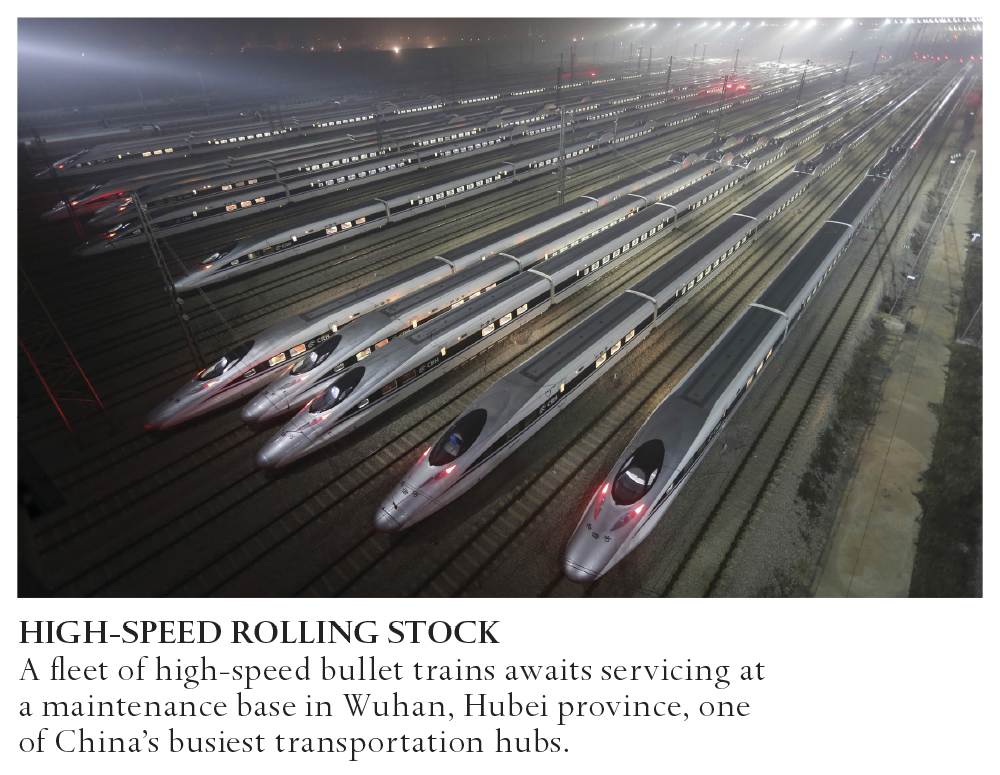
These impressive advances received a setback in July 2011 with a disastrous crash at Wenzhou in which two high-speed trains derailed. The crash cast a long shadow, and for a time construction slowed. The program threatened to be delayed, or even shelved, as passenger numbers dwindled in response to the accident, and the top speeds of trains were reduced. However, by 2012, the program had resumed and passenger numbers climbed again.
In 2013, China’s 1,580 high-speed train services transported 1.3 million passengers daily, and these impressive statistics are only going to grow. The government plans to have a 16,000-mile (25,750-km), high-speed network by 2020—at a cost of $300 billion—giving China a high-speed rail system extending many times the distance of any other country. This achievement, along with the expanding number of subway lines in towns across the country—and the record-breaking Tibet Railroad—establishes China as indisputably the 21st century’s principal railroad pioneer, so far.